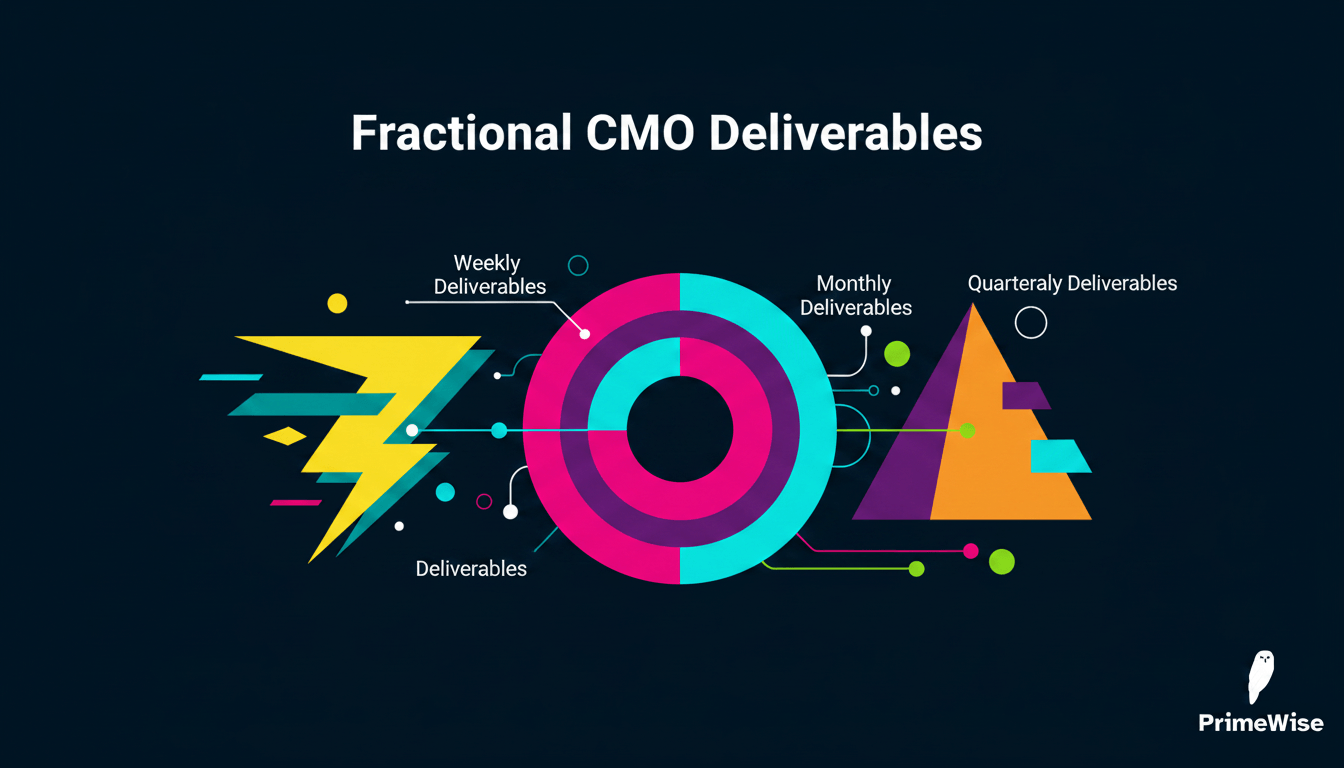
What does a fractional CMO do, exactly? The short answer: they work with a fractional CMO model to embed executive-level marketing leadership directly into your business, taking full accountability for strategy, team performance, and revenue growth without the full-time headcount cost. Unlike consultants who deliver slide decks and disappear, a fractional Chief Marketing Officer operates inside your leadership team, owns the commercial outcomes, and drives a structured cadence of execution across every workstream. This article breaks down the precise weekly, monthly, and quarterly deliverables you should expect, grounded in 15 years of live fractional CMO engagements across UK and global businesses.
Key Takeaways for CEOs and FoundersA fractional CMO is not a consultant. They integrate into your executive team, own Go-To-Market execution, manage internal staff and external agencies, and report directly to the board typically at 1 to 3 days per week. UK firms using a structured fractional model consistently report a 40% reduction in external agency waste within the first 90 days, based on PrimeWise engagement data.
What a Fractional CMO Actually Is
A fractional CMO is a part-time, executive-level marketing leader who integrates into your leadership team to design Go-To-Market strategy, hire and manage marketing talent, direct external agencies, and deliver board-level ROI reporting without the full-time salary burden. The role sits between a strategic consultant and an employed CMO: they hold real operational authority, manage real budgets, and are measured against real commercial outcomes.
In London’s current talent market, a full-time CMO commands a base salary of £150,000 to £250,000, before accounting for Employer National Insurance contributions, PAYE obligations, equity packages, and bonus structures. LinkedIn Talent Insights data indicates the average time-to-hire for a senior marketing leader in London currently runs between four and six months a runway-burning delay for any scaling business. The fractional model eliminates both the cost and the delay. Specialists such as PrimeWise have operationalised this model specifically for UK financial and investment firms, deploying vetted fractional CMOs on engagement models structured around your commercial stage and budget, with availability typically within 14 days.
The fCMO 3×3 Integration Matrix
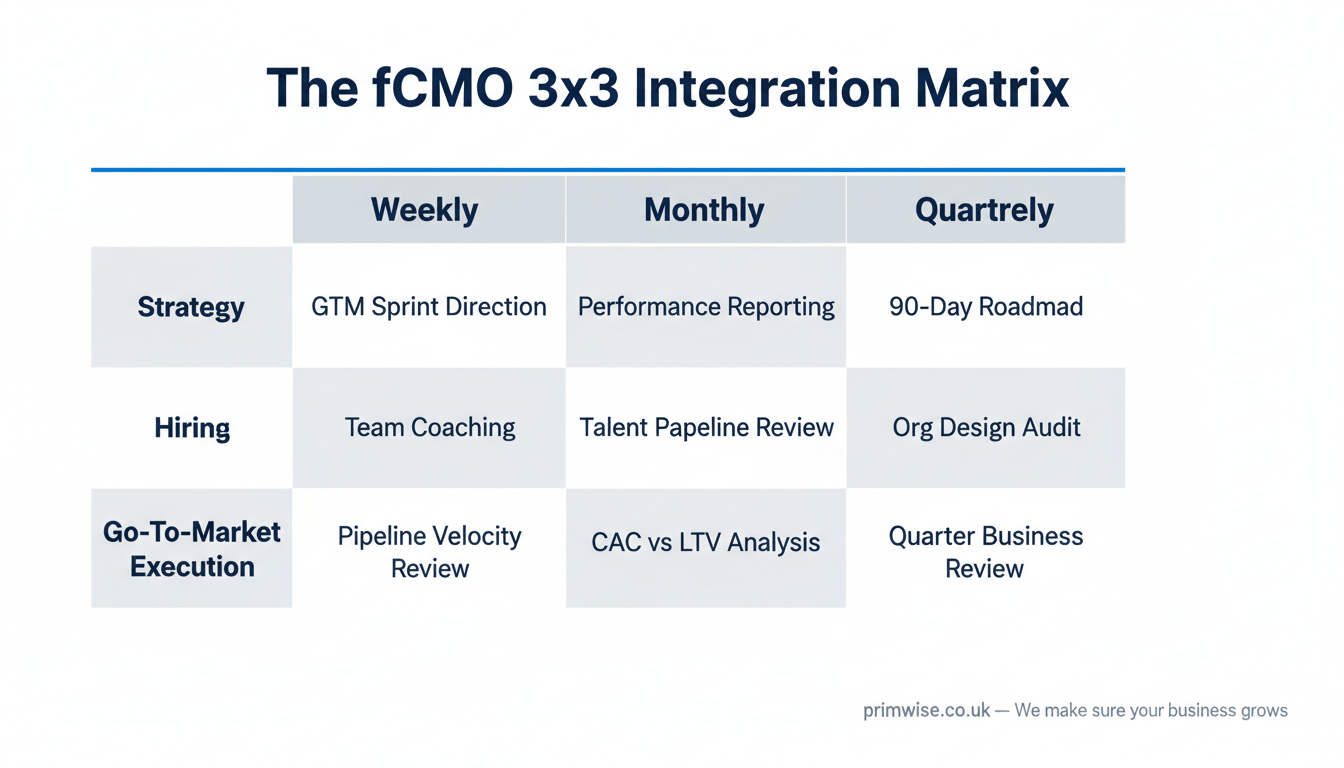
The single most common failure in fractional engagements is ambiguity, neither the business nor the executive is clear on what success looks like week to week. To solve this, PrimeWise fractional engagements operate on a proprietary framework called the fCMO 3×3 Integration Matrix. This framework maps three core workstreams, Strategy, Hiring, and Go-To-Market Execution, against three time horizons: Weekly, Monthly, and Quarterly. Every hour billed is accounted for within one of the nine matrix cells, creating complete commercial transparency.
| Workstream | Weekly | Monthly | Quarterly |
|---|---|---|---|
| Strategy | GTM blocker removal, sprint direction | Performance reporting, budget reconciliation | 90-day roadmap, OKR setting |
| Hiring | Staff 1-to-1s, coaching, task prioritisation | Talent pipeline review, candidate interviews | Capability gap audit, org design |
| GTM Execution | Pipeline velocity review, agency sprint planning | CAC vs LTV analysis, campaign post-mortems | Quarterly Business Review, capacity planning |
This matrix is not a theoretical model it is the live operating system used across active UK client engagements. Each cell represents a named deliverable with a defined output and a measurable commercial outcome. The matrix is shared with the CEO and board at onboarding, reviewed monthly, and updated quarterly to reflect shifting business priorities.
Strategic Advantages for UK Financial Firms
For financial services and investment firms operating under FCA oversight, the fractional model carries a regulatory dimension that generic marketing consultancy simply cannot match. A seasoned fractional CMO working in this sector must be operationally fluent in FCA financial promotion rules, specifically the conduct standards outlined in COBS 4 of the FCA Handbook, which govern how financial products and services may be communicated to retail and professional clients.
The introduction of the FCA Consumer Duty in July 2023, which came into full effect for closed products in July 2024 added a further layer of obligation. Under Consumer Duty, all marketing communications must now demonstrably serve the best interests of customers, with documented evidence of fair value, clear information, and accessible support. A fractional CMO operating in UK financial services builds a compliant content approval workflow into the monthly cadence: all campaign assets are reviewed against FCA guidance before deployment, and a compliance sign-off log is maintained for audit purposes. This is not decorative compliance, it is operational risk management embedded directly into the marketing function.
FCA Compliance NoteUnder COBS 4 and the Consumer Duty Act 2023, all financial promotions must be fair, clear, and not misleading. A qualified fractional CMO operating in UK financial services will build a documented compliance approval workflow into the monthly marketing cadence as standard practice.
Beyond regulatory compliance, the fractional model addresses the capital efficiency imperative that every UK board is currently navigating. By converting a fixed, high-cost salary headcount into a flexible, outcome-linked engagement, firms preserve runway while retaining the executive horsepower needed to compete. This is particularly acute in London, where the cost of a mis-hire at CMO level including recruitment fees, notice periods, and productivity loss can exceed £400,000 when fully accounted for.
Weekly Deliverables That Drive Execution
The weekly rhythm of a fractional CMO is deliberately engineered to maintain commercial momentum between executive touchpoints. On a 1.5 to 2 day per week engagement, every hour is structured against the Integration Matrix to ensure zero administrative waste and maximum impact on pipeline and team output.
Marketing Team Alignment and Coaching
Internal marketing staff whether a single marketing manager or a team of five require executive-level direction to stay focused on high-impact activities. Weekly one-to-one sessions with internal staff serve as the primary mechanism for performance coaching, task prioritisation, and connecting daily marketing activities to overarching sales targets. This is not a status update meeting. It is a structured 30-minute session with a prepared agenda, a shared task tracker, and a defined output typically a revised priority list aligned to that week’s pipeline targets.
Over time, this consistent mentorship systematically elevates the internal team’s capability and strategic thinking, reducing dependency on expensive external agencies and building genuine institutional marketing competence within the business. This is one of the most undervalued long-term outcomes of a fractional engagement the internal team that remains after the fractional CMO steps back is meaningfully stronger than the one they inherited.
Pipeline Velocity and Agency Sprint Planning
Revenue-generating activities demand weekly scrutiny. The fractional CMO leads a standing pipeline velocity review alongside the sales director or revenue lead, analysing Marketing Qualified Lead volume, lead quality scores, and conversion rates through each funnel stage. The output of this session is not a report it is a set of immediate corrective actions distributed to the relevant team members before the session closes.
External performance marketing agencies whether managing paid search, programmatic display, or paid social are held to account through structured weekly sprint planning. The fractional CMO interrogates search and social performance data, challenges underperforming ad sets, adjusts budget allocation in real time, and ensures that third-party vendors are executing against agreed KPIs rather than optimising for vanity metrics. Agencies that cannot demonstrate clear pipeline contribution are placed on notice within the first 30-day sprint cycle.
Monthly Deliverables and Commercial Reporting
The monthly cadence transforms the tactical outputs of weekly execution into structured commercial intelligence. For CEOs and board members, this is the layer of the engagement that converts marketing activity into financial language the only language that secures executive sponsorship and budget approval.
CAC, LTV and Budget Reconciliation
Customer Acquisition Cost measured against Customer Lifetime Value is the definitive health metric for any scaling business. The monthly reporting cycle includes a rigorous analysis of CAC by channel, LTV by customer segment, and the resulting payback period presented in a format that a non-marketing CFO or investor can immediately interrogate. For UK financial services firms, this reporting layer also includes a full FCA-compliant budget reconciliation, with every pound of marketing spend mapped to a measurable pipeline outcome and Return on Ad Spend validated mathematically rather than asserted qualitatively.
This financial governance framework eliminates the most common board-level frustration with marketing functions: the perception that spend is unmeasured and disconnected from commercial reality. When a fractional CMO presents a monthly report, every line item is defended with data.
Campaign Post-Mortems and Talent Pipeline Reviews
Continuous optimisation requires structured retrospection. Monthly campaign post-mortems analyse completed marketing initiatives against their original hypotheses, clearly identifying which tactics warrant scaling, which require refinement, and which should be eliminated. This discipline prevents the common failure mode of scaling underperforming campaigns simply because they have existing budget allocations.
The monthly cadence also includes a review of the internal talent acquisition pipeline. Identifying capability gaps early whether in content, demand generation, marketing operations, or analytics and maintaining an active pipeline of mid-level candidates ensures that the business can hire quickly when headcount approval is granted, rather than beginning a four-to-six month search from a standing start.
Quarterly Deliverables at Board Level
Quarterly deliverables are where the fractional CMO transitions from operational leader to board-level strategic advisor. These outputs are designed specifically for the CEO, CFO, and non-executive directors who require a forward-looking view of the commercial landscape not a retrospective account of marketing activity.
The 90-Day Strategic Roadmap
At the close of each quarter, the fractional CMO produces a 90-day strategic roadmap that codifies the overarching Go-To-Market direction for the period ahead. This document defines Objective Key Results at the marketing function level, maps required resources against projected pipeline outcomes, and outlines any strategic pivots required in response to market shifts, competitive dynamics, or regulatory changes. Critically, it is written in commercial not marketing language, ensuring that board members without a marketing background can evaluate it, challenge it, and approve it with confidence.
The Quarterly Business Review
The Quarterly Business Review (QBR) is the primary mechanism through which the fractional CMO secures ongoing executive sponsorship and future budget allocation. The QBR presentation consolidates the quarter’s performance data, benchmarks outcomes against the original 90-day roadmap commitments, and presents a forward investment case for the next quarter’s activity. For businesses preparing for fundraising or a strategic review, the QBR deck also serves as a ready-made marketing due diligence asset demonstrating to investors that the commercial function operates with institutional-grade rigour and measurable accountability.
Forward-Looking Capacity Planning
Sustainable growth requires that the marketing infrastructure scales ahead of demand, not reactively behind it. Quarterly capacity planning involves auditing the existing technology stack CRM configuration, marketing automation, attribution tooling, and data infrastructure and producing a forward resource allocation model that anticipates the headcount, tooling, and budget requirements of the next two growth stages. This prevents the common operational failure where a business scales its pipeline ambitions without scaling the infrastructure needed to execute against them.
PrimeWise Engagement ModelPrimeWise deploys experienced fractional CMOs to UK financial services firms on structured engagement models starting from two days per week. Current availability and engagement frameworks are outlined at primewise.co.uk.
Rebuilding a Financial Services GTM Engine in Six Months
Frameworks must be validated by outcomes. The following engagement demonstrates the fCMO 3×3 Integration Matrix applied to a real commercial challenge in a regulated UK environment.
A scaling UK financial services firm engaged PrimeWise to overhaul a stagnant marketing function that had accumulated significant agency overhead without producing measurable pipeline contribution. The fractional CMO entered the engagement on a 1.5 day per week schedule and immediately applied the Integration Matrix to audit historical performance data, renegotiate agency contracts, and identify the three highest-leverage channels for pipeline generation.
Within the first 90-day sprint, external agency waste was reduced by 40 percent achieved by eliminating redundant software subscriptions, consolidating overlapping agency retainers, and redirecting liberated budget into two high-performing paid channels. Over the following three months, the fractional CMO hired a mid-level demand generation manager and a marketing operations specialist, building an internal capability that reduced external agency dependency by a further 30 percent. By month six, the firm had a fully operational internal marketing function, a documented FCA-compliant content approval workflow, and a quarterly board reporting cadence that had not previously existed. The total engagement cost represented less than 20 percent of the equivalent full-time CMO salary cost for the same period.
Engagement TransparencyThe outcome data cited above reflects a specific PrimeWise client engagement. Individual results vary based on business stage, existing marketing infrastructure, and engagement duration. PrimeWise provides a structured onboarding diagnostic to establish realistic outcome benchmarks before any commercial engagement begins.
Fractional CMO vs Interim CMO vs Consultant
One of the most frequently misunderstood distinctions in executive hiring is the difference between a fractional CMO, an interim CMO, and a marketing consultant. Each has a legitimate use case, but conflating them leads to costly mis-hires and misaligned expectations.
- A fractional CMO works part-time across multiple clients simultaneously, typically one to three days per week per client, and operates as an ongoing embedded executive with full operational authority over the marketing function.
- An interim CMO is a full-time, temporary placement typically brought in to cover a permanent hire gap, manage a specific transition such as an acquisition or rebrand, or stabilise a function during a leadership crisis. Day rates are consequently higher, and the engagement is finite by design.
- A marketing consultant provides advisory services on a project or retainer basis without operational authority. They do not manage staff, own budgets, or attend board meetings as an executive. Their value is in specialised knowledge transfer, not sustained execution.
For scaling businesses that need sustained executive marketing leadership at a capital-efficient cost, the fractional model is the structurally correct choice in the majority of cases. The interim model is appropriate when full-time cover is genuinely required for a defined period. Consultancy is appropriate when a specific knowledge gap, rather than an execution gap, needs to be addressed. Knowing which model fits your commercial stage is the first decision, and the right fractional provider will be transparent about which engagement type serves your interests rather than their billing rate.
When to Hire a Fractional CMO
The decision to deploy a fractional CMO is a function of commercial stage, not company size. The fractional model delivers maximum value when a business has sufficient revenue to justify executive marketing leadership but insufficient scale to absorb a full-time CMO salary without sacrificing financial discipline. In practice, this typically corresponds to businesses generating between £2 million and £20 million in annual revenue, though the model is equally applicable to larger firms with specific division-level or market-entry challenges.
The clearest indicators that a fractional CMO engagement is commercially appropriate include: marketing spend exceeding £10,000 per month without a documented attribution framework, a sales team generating pipeline without a structured demand generation function, an internal marketing team operating without executive direction, or a board preparing for Series A, B, or institutional fundraising that requires a credible CMO-level narrative around commercial growth strategy.
If your firm is scaling without a board-level marketing leader, PrimeWise can deploy a vetted fractional CMO within 14 days. Explore current engagement models and availability at primewise.co.uk.