The cmo vs fractional cmo decision is one of the most capital-consequential choices a scaling financial services firm will make. Before you hire a fractional CMO or commit to a six-figure full-time executive, consider this: a London-based financial services firm appointing a permanent CMO in 2026 faces a total employer burden exceeding £285,000 annually before a single campaign launches. An equivalent fractional engagement, delivering the same board-level strategic output, costs between £60,000 and £96,000 per year. The model you choose should not be determined by preference or convention it should be determined by five precise commercial triggers that define where your business sits right now.
Executive InsightHigh-growth financial firms do not pay for executive time. They pay for elite commercial decisions. Evaluating leadership through a cost-per-decision lens rather than a cost-per-hour lens changes everything about how you structure your executive team.
Executive Summary
The fractional versus full-time marketing leadership debate is ultimately a capital allocation problem, not a hiring preference. The distinction hinges not on hours worked, but on the precise strategic decisions required to drive enterprise valuation at your current stage of growth.
- A comprehensive Total Employer Burden analysis reveals a full-time London CMO costs 50 to 70 percent more than their headline salary when Employer National Insurance, pension auto-enrolment, recruitment fees, and office overheads are applied.
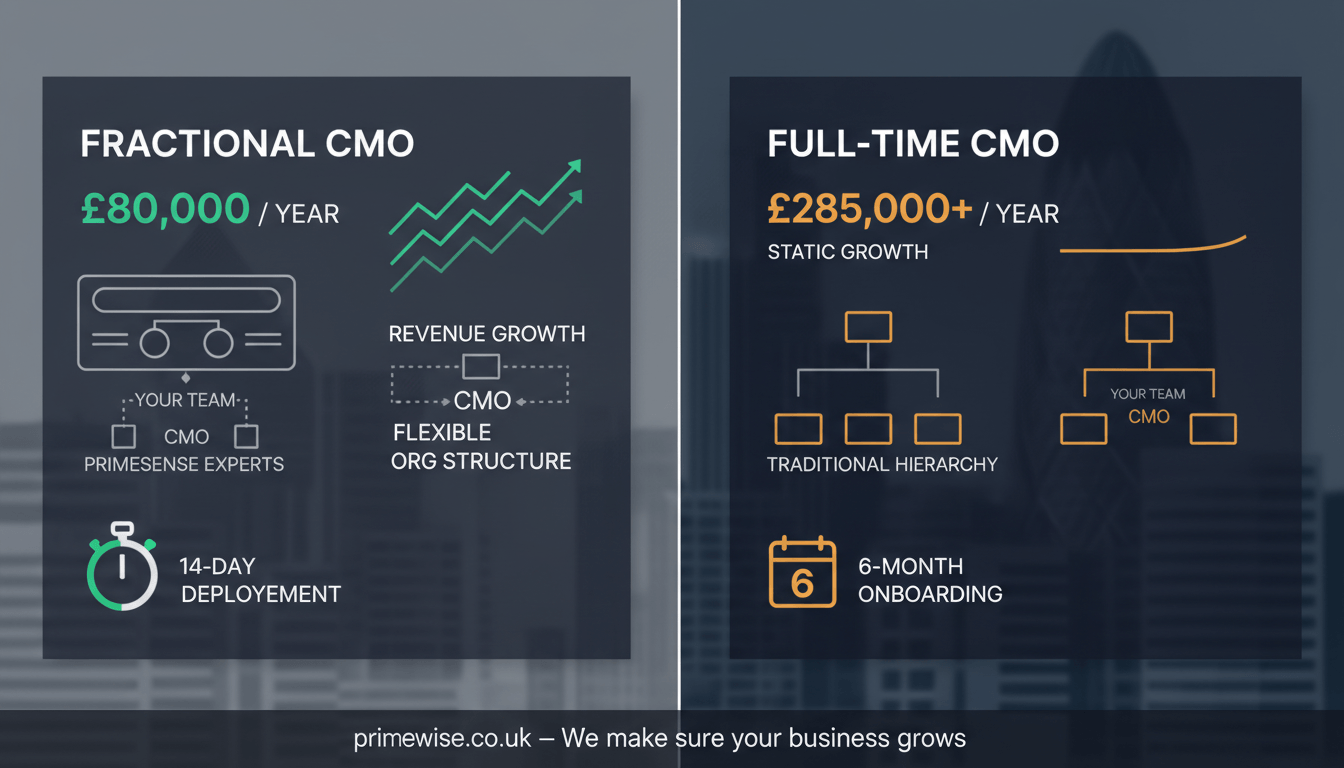
- Fractional operators can deliver a comprehensive go-to-market audit within 14 days, entirely bypassing the 3 to 6-month onboarding timeline of a permanent hire.
- The average tenure of a B2B CMO is just 18 to 24 months, meaning replacement and severance costs often exceeding 200 percent of base salary represent a hidden structural risk in every full-time appointment.
- UK firms operating under FCA oversight carry an additional compliance dimension that a fractional CMO with regulated-sector experience directly addresses from day one.
- A third model the build-and-transfer engagement allows fractional leaders to architect the marketing function, hire internal talent, and hand over a fully operational department, combining strategic speed with long-term internal ownership.
The Decision Matrix at a Glance
For a time-poor CEO or CFO, the following table provides an immediate diagnostic. Match your current operational reality to the appropriate column to identify the model most likely to deliver capital-efficient growth at your specific stage.
| Business Trigger | Fractional CMO | Full-Time CMO |
|---|---|---|
| Annual marketing budget | Under £500,000 | Over £500,000 |
| Internal marketing headcount | Under 10 people | 20+ people |
| Funding stage | Pre-Series B or M&A prep | Post-Series B, global expansion |
| Time to first strategic output needed | Within 30 to 60 days | 3 to 6 months acceptable |
| Total employer budget available | £60,000 to £96,000 | £270,000 to £310,000+ |
| Operational complexity | Single market, focused GTM | Multi-jurisdictional, complex org |
Defining the Fractional CMO
A fractional CMO is a senior marketing executive who provides board-level strategy, team leadership, and commercial oversight on a part-time or contract basis. They are not marketing consultants who produce strategy decks and disappear. They are operational executives who attend board meetings, direct internal teams, own revenue targets, and report directly to the CEO or CFO. The critical distinction is execution accountability a fractional CMO is measured against business outcomes, not deliverable hours.
Fractional CMO vs Marketing Consultant
The terms are frequently conflated, and the confusion is commercially dangerous. A marketing consultant diagnoses and advises. A fractional CMO diagnoses, decides, and leads. They sit within your organisational hierarchy, manage your internal team, own your go-to-market strategy, and present performance data at board level. For financial services firms seeking an outsourced marketing director or a part-time CMO with genuine P&L accountability, the fractional model is the correct classification. Related search terms in this space include CMO as a service, interim CMO, and PE-backed growth marketing leadership all of which describe variations of the fractional engagement model.
The Cost-Per-Decision Framework
Traditional employment models condition business leaders to evaluate executive compensation through the lens of a 40-hour working week. This is a structurally flawed mental model when applied to senior leadership. Businesses encountering a growth ceiling are not suffering from a lack of tactical throughput they are suffering from strategic misalignment. The executive value is in the decision, not the hours required to make it.
The Commercial Efficiency Ratio
The Cost-Per-Decision Framework operates on a straightforward principle: Strategic Impact Generated ÷ Total Annual Leadership Cost = Commercial Efficiency Ratio. A fractional CMO operating at £80,000 per year who engineers a go-to-market strategy generating £2.4 million in pipeline within 90 days produces a fundamentally different efficiency ratio than a full-time executive at £285,000 who requires six months to reach operational efficacy. The framework shifts the board conversation away from ‘what does this person cost?’ toward ‘what commercial outcome does this investment generate, and at what speed?’ This named framework has been applied across multiple PE-backed UK financial services engagements to justify fractional leadership appointments at board level.
Key Concept: Total Employer BurdenTotal Employer Burden is the complete annual cost of employing a full-time executive, encompassing base salary, Employer National Insurance at 13.8%, mandatory pension contributions at minimum 3%, annual bonus, equity, recruitment agency fees of 20 to 25% of first-year salary, and commercial office overheads. For a London-based CMO in financial services, this figure routinely sits between £270,000 and £310,000 annually.
UK Headcount Economics
According to salary benchmarking data aligned with CIM and LinkedIn Talent Insights UK, the median base salary for a CMO in UK financial services sits at approximately £165,000, rising to £210,000 in London. This headline figure is where most executive teams begin and end their cost analysis and that is a strategically expensive error. The true cost of a full-time marketing executive is buried in the compounding employer liabilities that UK employment law mandates.
The Hidden Employer Burden Breakdown
Applying the Total Employer Burden framework to a £185,000 London-based CMO base salary produces the following financial reality. Employer National Insurance contributions at 13.8 percent add approximately £23,000. Mandatory pension auto-enrolment at a minimum 3 percent employer contribution adds £5,550. Executive recruitment agency fees, typically ranging from 20 to 25 percent of first-year salary, represent a one-time cost of £37,000 to £46,000. Performance bonuses of 20 to 30 percent add a further £37,000 to £55,500. Premium London office space, equipment, and associated headcount overheads contribute an estimated £15,000 to £25,000 per year. In aggregate, the Total Employer Burden for a single London-based CMO hire sits firmly between £270,000 and £310,000 in the first year alone. A fractional engagement operating through a structured B2B consultancy framework is a clean, predictable operational expense with no hidden liabilities.
Navigating IR35 Compliance
A genuine fractional CMO engagement is structured as an independent, business-to-business service and sits firmly outside IR35 when correctly configured. This requires the engagement to be built around specific commercial deliverables rather than time-based presence, the operator to work across multiple clients simultaneously, and the relationship to avoid the hallmarks of disguised employment such as fixed hours, single-client dependency, or operational supervision. HMRC’s Check Employment Status for Tax (CEST) tool should be used to formally assess status before any engagement commences.
IR35 DisclaimerIR35 status must be assessed individually for every fractional engagement using HMRC's CEST tool. The information provided here is for commercial guidance only and does not constitute legal or tax advice. Independent legal counsel is strongly recommended before structuring any fractional executive arrangement.
FCA Compliance and Financial Promotions
This is the dimension that generic marketing content universally ignores, and for financial services firms, it is arguably the most commercially significant differentiator in the fractional versus full-time debate. Under the Financial Services and Markets Act 2000, Section 21, all financial promotions must be approved by an FCA-authorised person. Marketing leadership in regulated financial services firms therefore carries direct compliance obligations that extend well beyond campaign performance. A fractional CMO with a demonstrable track record in FCA-regulated sectors asset management, wealth management, investment platforms, or fintech arrives with an understanding of financial promotions compliance, risk disclaimer requirements, and the FCA’s consumer duty obligations that a generalist full-time hire from an unregulated sector simply does not possess. For firms where a mis-approved financial promotion can trigger regulatory censure, this sectoral expertise is not a preference. It is a structural requirement.
Integration Trade-Offs
Selecting the appropriate leadership model requires a pragmatic assessment of how quickly the business requires strategic impact relative to the necessity for deep cultural embedding. Both models present distinct operational characteristics that determine their suitability at different phases of enterprise scaling.
Fractional Deployment Speed
Fractional operators bring unparalleled speed to strategic impact. Unencumbered by internal politics and onboarding bureaucracy, an experienced fractional CMO can execute a comprehensive audit of technology stacks, team competencies, messaging architecture, and go-to-market positioning within 14 days. This political neutrality operating as an external executive rather than a culture-absorbed employee allows rapid identification of structural inefficiencies and swift corrective action. For firms approaching a Series A or B funding round, preparing for an M&A event, or attempting to break through a sustained revenue ceiling, this deployment speed is a material commercial advantage. Related terms that describe this capacity include go-to-market strategy consultant, demand generation leadership, and marketing due diligence all of which fall within the operational mandate of a well-structured fractional engagement.
Full-Time Onboarding Timelines
A full-time executive typically requires three to six months to reach optimal operational efficacy. This timeline is structurally necessary for deep cultural embedding, stakeholder relationship architecture, and the nuanced understanding of global operations that a multi-national organisation demands. For massive, post-Series B enterprises managing internal marketing departments of 20 or more people across multiple international jurisdictions, this methodical integration timeline is not a weakness it is an operational prerequisite. The full-time model becomes structurally justified when the complexity of internal team leadership, multi-market brand governance, and long-term cultural transformation exceeds what part-time oversight can responsibly manage.
The Build-and-Transfer Model
The binary fractional-versus-full-time framing omits what is increasingly the most strategically intelligent option for scaling UK firms: the build-and-transfer engagement. In this model, a fractional CMO is deployed to architect the entire marketing function from the ground up defining strategy, selecting and implementing technology infrastructure, establishing reporting frameworks aligned to EBITDA targets, and recruiting and onboarding a permanent internal marketing team. Once the infrastructure is operational and internal capability is validated, the fractional operator transitions out, leaving the business with a fully functional department led by permanent headcount. This model delivers the strategic speed and capital efficiency of the fractional engagement while building the long-term internal ownership that PE-backed firms and growth-stage enterprises require. It is the preferred deployment model for firms at the inflection point between pre-Series B operational agility and post-Series B structural maturity.
Board-Level Reporting and EBITDA Alignment
For Private Equity backers and Venture Capital boards, marketing performance is entirely irrelevant unless it demonstrably moves enterprise valuation. Marketing leadership must therefore operate in the language of the boardroom translating campaign metrics into financial outcomes that directly connect to EBITDA targets, revenue operations frameworks, and Series funding milestones.
Marketing Dashboards That Speak to Investors
A fractional CMO with PE-backed growth marketing experience excels at engineering board-level reporting infrastructure that strips vanity metrics entirely from investor presentations. Revenue operations data, cost-per-qualified-lead, pipeline velocity, and marketing-sourced ARR contribution replace impressions, reach, and engagement rates. During critical Series A or B transitions, or whilst preparing for an M&A event, the marketing leadership function must prove that spend is generating a predictable, measurable revenue return not a discretionary brand-building exercise. Fractional operators who have navigated multiple funding round cycles bring this reporting architecture as an embedded capability, not a learning curve.
A Practical Case Study
Consider a mid-market UK-based asset management firm anonymised for confidentiality that engaged a fractional CMO at the point of preparing for Series B. The firm had a disjointed go-to-market strategy, an underperforming internal marketing team of four, and no board-level marketing reporting aligned to investor KPIs. Within 90 days of fractional engagement, the firm had a restructured go-to-market strategy focused on institutional investor acquisition, a board reporting dashboard directly tied to AUM growth and pipeline contribution, and a 38 percent reduction in cost-per-qualified-lead. The total fractional investment over that period was approximately £22,000. An equivalent full-time executive hire would have cost the business over £70,000 in the same period before reaching full operational efficacy. The firm subsequently completed its Series B and transitioned to a full-time CMO hire once internal headcount and operational complexity justified the appointment. This is the fractional model functioning precisely as designed.
How Primewise Structures EngagementsPrimewise delivers fractional CMO engagements specifically for UK financial services and investment firms. Typical first-30-day deliverables include a go-to-market audit, board reporting framework, and team competency assessment. First-90-day outcomes target measurable pipeline growth and investor-ready marketing infrastructure. If your firm is approaching a funding round, navigating a revenue ceiling, or restructuring its commercial strategy, Primewise offers a structured 60-minute strategic diagnostic at no cost. Engage directly at primewise.co.uk.
Definitive Decision Triggers
The following criteria serve as a board-level diagnostic tool. Apply them objectively against your current commercial position to determine which leadership model your firm actually requires at this stage of its growth trajectory.
When to Deploy a Fractional CMO
Engage a fractional marketing leader when annual marketing budget sits below £500,000, internal marketing headcount is under 10 people, the business is pre-Series B or preparing for an M&A event, a board-level go-to-market strategy is required within 60 days, or cash flow constraints make a full-time Total Employer Burden of £270,000 to £310,000 commercially indefensible. This model delivers maximum strategic leverage while preserving operational capital for go-to-market execution, sales infrastructure, and product development.
When to Commit to a Full-Time CMO
A business must transition to a permanent CMO appointment when internal marketing headcount exceeds 20 people, the firm is expanding simultaneously into multiple international jurisdictions, post-Series B complexity demands a deeply embedded brand figurehead, or the operational scope of the marketing function requires full-time executive presence to manage stakeholder relationships across a genuinely global organisation. The decision is not cultural it is structural. When part-time oversight can no longer responsibly govern the scale of internal operations, the permanent appointment becomes commercially justified.