
Fractional CMO for scaleups is one of the most commercially significant hiring decisions a UK founder will make between £2M and £20M in revenue. At this stage, the gap between where your marketing function is and where it needs to be is not filled by another junior hire or another agency retainer. It is filled by executive-level strategic leadership that your cash runway cannot yet justify on a full-time basis. This article breaks down exactly what that leadership looks like, what it costs, how it deploys, and when it is the right commercial decision for your specific stage of growth.
KEY COMMERCIAL TAKEAWAYSScaleups in the £2M–£10M bracket typically waste up to 30% of their marketing budget through tactical misalignment (PrimeWise internal client data, 2024–2025, across 14 UK scaleup engagements). Fractional leadership reduces senior marketing overhead by up to 60% whilst maintaining board-level strategic output. The transition from founder-led hustle to predictable revenue systems requires executive oversight, not more junior execution.
What Is a Fractional CMO
A fractional CMO is a part-time, executive-level marketing leader who embeds within your business to build systemic revenue generation, restructure lean teams, and deliver board-level strategic oversight providing the full commercial impact of a full-time CMO without the premium overhead. Unlike a consultant who advises from the periphery, a fractional CMO takes direct accountability for commercial execution, holds external agencies to measurable outcomes, and integrates into your leadership team as a functional member of the board.
This is not an advisory model. It is an operational one. The fractional executive owns the go-to-market strategy, manages the marketing function day-to-day on their allocated days, and builds the revenue infrastructure your scaleup needs to scale predictably from customer acquisition cost optimisation and marketing attribution modelling through to Series B commercial due diligence readiness. The distinction matters because too many founders engage consultants expecting executive output, and the gap between the two is where budget gets wasted.
The Marketing Maturity Curve
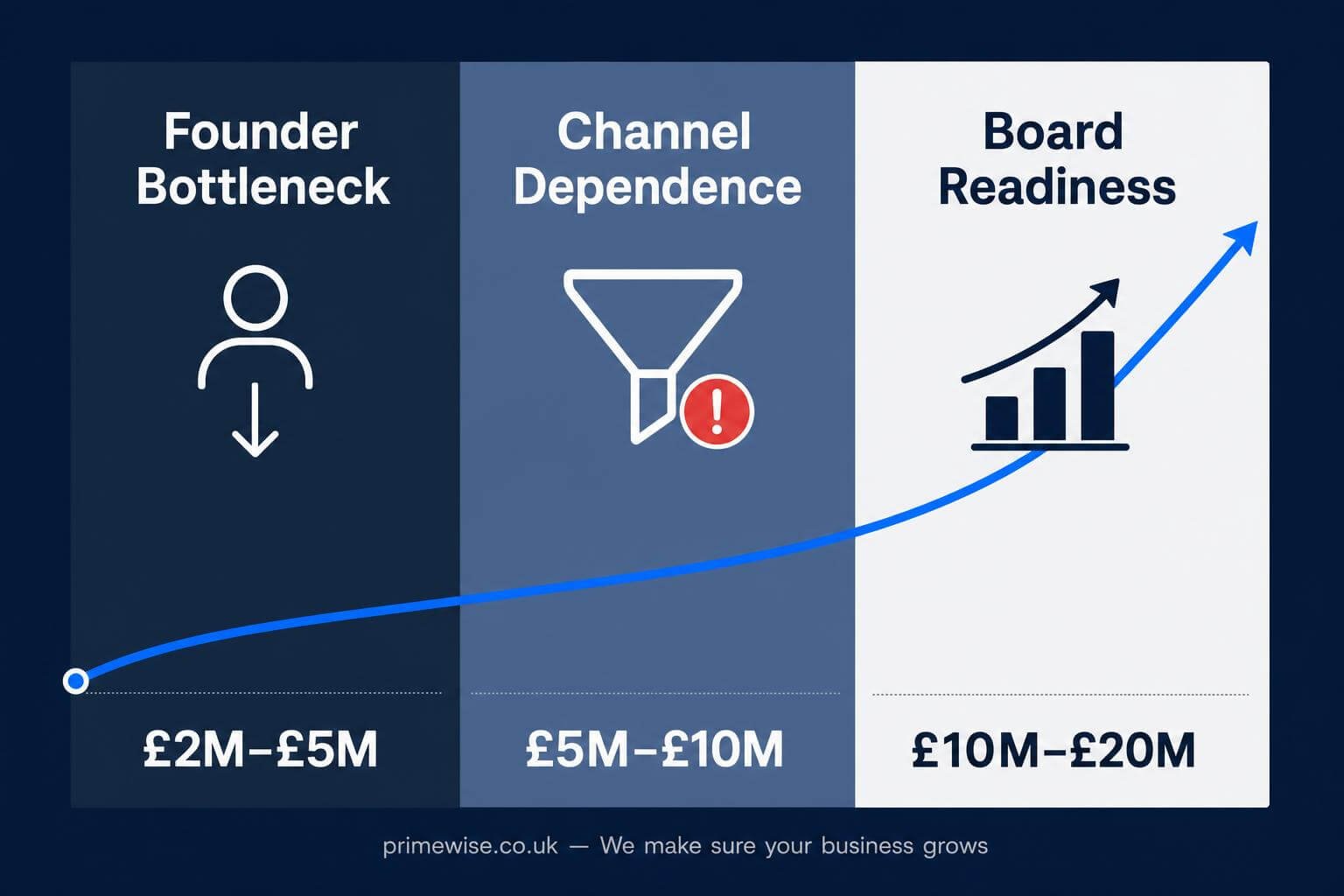
Scaling through the £2M to £20M growth band is not a single challenge it is three distinct phases, each demanding a fundamentally different marketing infrastructure. Understanding which phase you are in determines the exact leadership model you need. Misidentifying your stage is one of the most expensive mistakes a founder can make at this point in the journey.
Breaking the Founder Bottleneck
Between £2M and £5M, the most common growth constraint is not product quality, market size, or team capability. It is the founder. At this stage, the CEO is typically still approving copy, managing junior marketers directly, attending agency calls, and making tactical channel decisions that should sit two levels below them. This creates a severe strategic vacuum at the top and a confidence vacuum at the bottom, where junior marketers are executing without direction and external agencies are optimising for their own KPIs rather than your commercial objectives.
A fractional CMO steps into this vacuum immediately. Within the first thirty days, they assume full accountability for commercial execution defining the go-to-market strategy, setting channel priorities, and managing agency relationships against board-aligned outcomes. The founder is liberated to focus on product, investor relations, and business development. For most CEOs at this stage, this shift alone represents a step-change in personal output and business momentum.
Overcoming Channel Over-Dependence
As revenues approach the £5M to £10M range, early growth engines begin to plateau. The founder network that drove initial pipeline dries up. The single paid acquisition channel that delivered strong early CAC starts exhibiting diminishing returns. Scaleups at this stage frequently find themselves spending more to acquire the same number of customers, with rising customer acquisition costs masking deeper structural fragility in the commercial model.
Executive oversight at this point introduces diversified, predictable revenue systems. A fractional CMO builds out the B2B revenue operations infrastructure introducing account-based marketing strategy for high-value prospects, establishing multi-channel attribution modelling, and installing the OKR framework for marketing teams that connects every tactical output to a board-level commercial metric. The goal is not more activity. It is more reliable, capital-efficient growth from a broader and more resilient channel mix.
Building Board-Ready Systems
Beyond £10M, the commercial objective shifts decisively toward Series B or Series C readiness. UK VC and PE investors including funds operating under EIS and VCT structures are conducting increasingly rigorous commercial due diligence. They want to see predictable revenue systems, clean attribution data, a scalable go-to-market model, and a marketing function that operates independently of the founder. Sporadic growth tactics are a red flag at this valuation stage, not a charm.
According to Beauhurst’s 2024 UK funding intelligence data, the median Series B round in the UK sits between £15M and £25M, and the commercial narrative underpinning that raise is scrutinised at a level that most early-stage marketing functions are not equipped to support. A fractional CMO installs the board-level reporting infrastructure, the data architecture, and the strategic frameworks that make a scaleup genuinely investable not just growing, but provably scalable.
The Economics of Senior Marketing Leadership
For founders managing cash runway, the financial case for fractional engagement is not a compromise. It is a structurally superior commercial decision at this stage of the business. The numbers are unambiguous when you account for the true cost of full-time executive talent in the UK market.
The True Cost of a London CMO
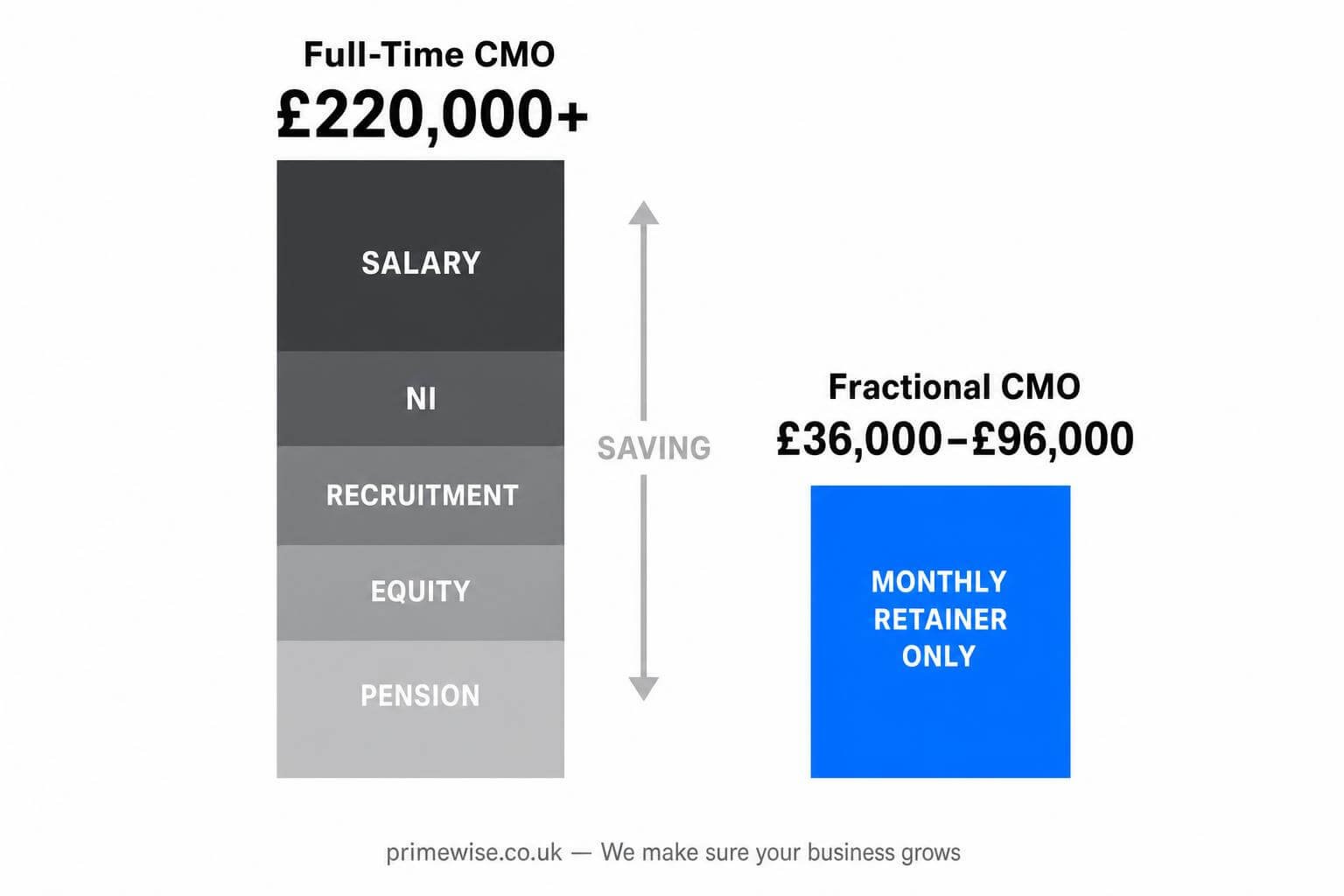
Hiring a full-time CMO in London involves considerably more than the headline base salary of £150,000 to £175,000. Employer National Insurance at the current 15% rate (effective April 2025, per HMRC employer cost guidelines) adds approximately £22,500 to £26,000 annually. Pension contributions, recruitment fees typically ranging from 20% to 25% of first-year salary, executive equity dilution, and severance exposure push the true annualised cost of a full-time CMO in London beyond £220,000 in year one. This figure is consistent with Chartered Institute of Marketing salary benchmarking data for senior marketing leadership roles in the South East.
A fractional CMO delivering two to three days per week typically costs between £3,000 and £8,000 per month for a UK-based engagement, depending on commercial complexity and sector specialism. That represents a direct annual saving of £150,000 to £180,000 compared to a full-time hire capital that a capital-efficient growth model directs into revenue-generating activities rather than static overhead. There is no recruitment fee, no equity dilution, no onboarding lag, and no severance risk.
INVESTOR SIGNALEmbedding a fractional executive rather than inflating headcount sends a clear capital efficiency signal to UK VC and PE boards. EIS and VCT-backed fund managers increasingly scrutinise operational cost structure during due diligence. A lean, fractional leadership model demonstrates financial discipline without sacrificing strategic output.
Satisfying UK Investors
The British Business Bank’s 2024 Small Business Finance Markets report highlights that capital efficiency remains the primary concern for UK growth-stage investors beyond initial product-market fit. Boards representing EIS and VCT funds are not rewarding headcount growth they are rewarding revenue per headcount growth. A fractional CMO embedded at board level signals exactly the kind of operational discipline that distinguishes investable scaleups from those that raise rounds on momentum and then stall on execution.
Role Clarity at Every Level
One of the most expensive and demoralising patterns in scaling businesses is the misalignment of leadership roles within the marketing function. CEOs hire Marketing Directors expecting strategy. They engage agencies expecting integration. They retain junior marketers expecting initiative. None of these expectations are met because the roles are structurally wrong for what the business actually needs at this stage.
Fractional CMO vs Marketing Director vs Agency
A Marketing Director excels at managing execution, coordinating junior team members, and maintaining operational consistency across campaigns. What they rarely possess is the board-level commercial acumen, investor relations experience, or cross-functional strategic authority to define the entire go-to-market strategy and hold every function of the business accountable to it. They are exceptional operators within a defined strategic frame but they cannot build the frame itself.
External agencies, whether specialising in paid media, SEO, content, or demand generation, focus narrowly on their specific deliverable. Without an internal executive to define the overarching strategy and integrate agency outputs into a coherent commercial model, agencies optimise for their own metrics rather than your business outcomes. The fractional CMO sits above both functions. They define the strategy, set agency accountability frameworks, manage the Marketing Director’s scope, and report directly to the CEO and board on commercial progress. This is the structural clarity that scaleups in this revenue band fundamentally lack.
| Function | Strategic Ownership | Board Reporting | Agency Management | Typical Cost |
|---|---|---|---|---|
| Full-Time CMO | Full | Yes | Yes | £220,000+ per year |
| Fractional CMO | Full | Yes | Yes | £36,000–£96,000 per year |
| Marketing Director | Partial | Limited | Partial | £70,000–£100,000 per year |
| Agency | Channel Only | No | N/A | Variable retainer |
The 90-Day Fractional CMO Roadmap
A structured deployment framework separates high-performing fractional engagements from ones that drift into indefinite advisory. The first ninety days of a fractional CMO engagement should be treated as a transformation sprint, with defined deliverables at each thirty-day gate. This is the model deployed across PrimeWise’s fractional leadership engagements with UK scaleups.
Days 1 to 30: Commercial Audit and Strategy Reset
The first thirty days are entirely diagnostic and directional. The fractional CMO conducts a deep commercial audit reviewing budget allocation, channel performance, agency contracts, team structure, CRM data quality, and attribution accuracy. The objective is to identify and immediately neutralise the tactical misalignment responsible for up to 30% budget wastage in scaleups at this stage (PrimeWise internal client data, 2024–2025).
By the end of day thirty, underperforming campaigns are paused, agency contracts are renegotiated or terminated where appropriate, and a singular data-driven go-to-market strategy aligned to the board’s revenue objective is documented and socialised. The CEO has a clear commercial roadmap for the first time, and the marketing function has strategic direction it has likely been missing for months.
Days 31 to 60: Team Restructuring and Tech Stack Rationalisation
The second thirty-day block focuses entirely on operational efficiency. Lean team structures are reorganised with absolute clarity around operational roles, reporting lines, and individual accountability. Junior marketers who have been executing without direction are given defined remits and measurable KPIs tied to commercial outcomes rather than output volume.
This period includes ruthless tech stack rationalisation. Redundant software tools are identified and eliminated. Core CRM platforms whether HubSpot, Salesforce, or sector-specific alternatives are configured to capture precise attribution data. For UK B2B scaleups, this often means properly integrating intent data tools and enabling the pipeline reporting that investors expect to see during Series A and Series B due diligence. The result is a leaner, more accountable marketing operation with significantly lower fixed overhead.
Days 61 to 90: Systematised Execution and ROI Infrastructure
The final thirty days cement the transition from hustle to system. Predictable revenue systems are fully operational. Board-level reporting dashboards are live. ROI tracking is granular enough to attribute every pound of marketing spend to a pipeline outcome. The OKR framework for the marketing team is embedded and understood by every member of the function.
At the ninety-day mark, the scaleup possesses a marketing function that operates independently of the founder, scales without proportional headcount growth, and generates the commercial data quality that sophisticated UK investors require. The business is no longer dependent on founder energy for revenue it has a system.
READINESS CHECKIf your executive team is constantly approving granular marketing decisions, customer acquisition costs are rising without explanation, and your board pack lacks actionable commercial insight from marketing the systemic marketing function required for scale is structurally absent. This is the exact gap fractional leadership is designed to close.
UK FinTech Scaleup Case Study
Theoretical frameworks only earn credibility when they are validated by real commercial outcomes. The following engagement was delivered through PrimeWise’s fractional leadership model. Details have been anonymised at the client’s request, with full references available to qualifying founders upon direct enquiry.
A UK FinTech scaleup operating at £3M ARR was heavily reliant on founder-led sales, with over 70% of new pipeline generated directly through the CEO’s personal network. The marketing function consisted of two junior marketers executing disconnected content and paid campaigns with no attribution model and no defined ICP. Customer acquisition costs had risen 40% in twelve months. The business was preparing for a Series B raise but had no commercial narrative that could withstand investor scrutiny.
PrimeWise deployed a fractional CMO engagement with a mandate focused on three outcomes: eliminating founder pipeline dependency, building an account-based marketing strategy targeting high-value B2B financial services buyers, and installing the board-level commercial reporting required to support the fundraise. Within the first thirty days, two underperforming agency retainers were terminated, saving £8,400 per month in misaligned spend. A refined ICP and tiered ABM target account list was established, prioritising 120 high-fit enterprise prospects across UK financial services and insurtech.
By month six, pipeline generated through the fractional CMO’s ABM programme exceeded founder-sourced pipeline for the first time. By month eighteen, the business had scaled to £12M ARR. The Series B round was oversubscribed, with lead investors explicitly citing the quality and predictability of the commercial model as a primary driver of their conviction. The pipeline velocity improvement from average 110-day sales cycle to 67 days was directly attributable to the trust-focused, relationship-driven go-to-market approach built for the UK B2B buyer context, which differs materially from the aggressive outbound playbooks common in US-market FinTech.
Is Your Scaleup Ready for Fractional Leadership
The decision to engage a fractional CMO is not purely financial. It is structural. The question is not whether you can afford it the question is whether your current marketing leadership architecture is capable of delivering the commercial outcomes your board expects over the next twelve to eighteen months. If the honest answer is no, the cost of inaction is significantly higher than the cost of fractional engagement.
The scaleups that extract the most value from fractional CMO engagements share three characteristics: the CEO is genuinely ready to relinquish day-to-day marketing decisions, the business has enough existing marketing activity to audit and optimise, and the board has a defined revenue objective within a specific timeframe. If all three conditions are present, a fractional engagement will typically deliver measurable commercial impact within sixty days.
Founders and CEOs assessing their readiness for fractional marketing leadership can request a complimentary commercial diagnostic at primewise.co.uk a structured 30-minute session that maps your current marketing function against the maturity requirements of your next revenue milestone.