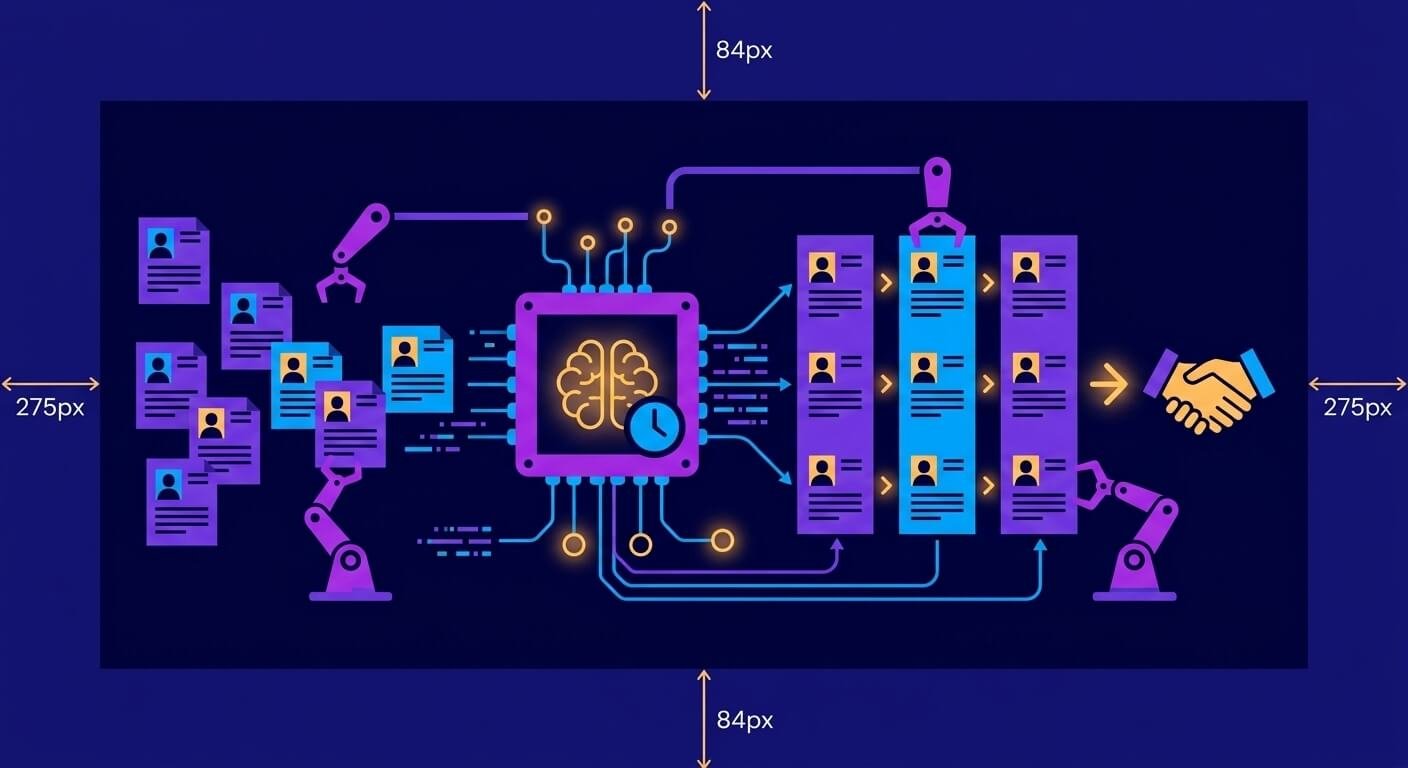

Fractional CMO leadership and fractional cmo sales alignment sit at the top of every UK revenue leader’s agenda in 2026 and for good reason. If your Monday morning board call involves the words “pipeline shortfall,” “wasted marketing budget,” or “sales ignoring MQLs,” you are not facing a motivation problem. You are facing a structural failure. For scaling UK tech, SaaS, and professional services firms under Private Equity or Venture Capital scrutiny, the chasm between sales and marketing is a critical revenue leak that compounds with every quarter it goes unresolved. HubSpot’s State of Marketing research confirms that misaligned revenue teams record win rates up to 38% lower than their aligned counterparts. This guide delivers the precise diagnostic blueprint and 90-day intervention framework that a Fractional CMO deploys to permanently fix the marketing-to-pipeline problem.
What Is Sales and Marketing Alignment in Revenue Operations
Sales and marketing alignment is the strategic and operational integration of two revenue-generating functions through a shared Ideal Customer Profile, unified pipeline metrics, enforced Service Level Agreements, and a connected technology stack. It is not a cultural initiative or a team-building exercise. It is a structural discipline, increasingly managed under the Revenue Operations (RevOps) umbrella, that determines whether marketing spend translates into qualified pipeline or evaporates as noise. A Fractional CMO acts as the unbiased executive integrator who designs, enforces, and continuously optimises this alignment without the overhead of a full-time C-suite hire.
Gartner research shows that B2B buyers complete approximately 57% of their purchase decision before they ever engage a sales representative. This means the quality of marketing’s contribution to the middle and bottom of the funnel is no longer a soft metric it is a hard commercial variable directly affecting revenue. When that contribution is misaligned, it does not simply underperform; it actively damages the sales cycle by flooding it with poorly qualified contacts and consuming sales capacity on prospects who will never convert.
BOARD-LEVEL REALITY CHECKUK Series A to C technology firms now rank pipeline conversion efficiency as a top-three portfolio concern, ahead of headcount growth. If your marketing function cannot demonstrate a direct, measurable contribution to Sales Qualified Opportunities, your CAC ratio will fail PE scrutiny at the next portfolio review.
The Four Structural Failure Modes in UK Firms
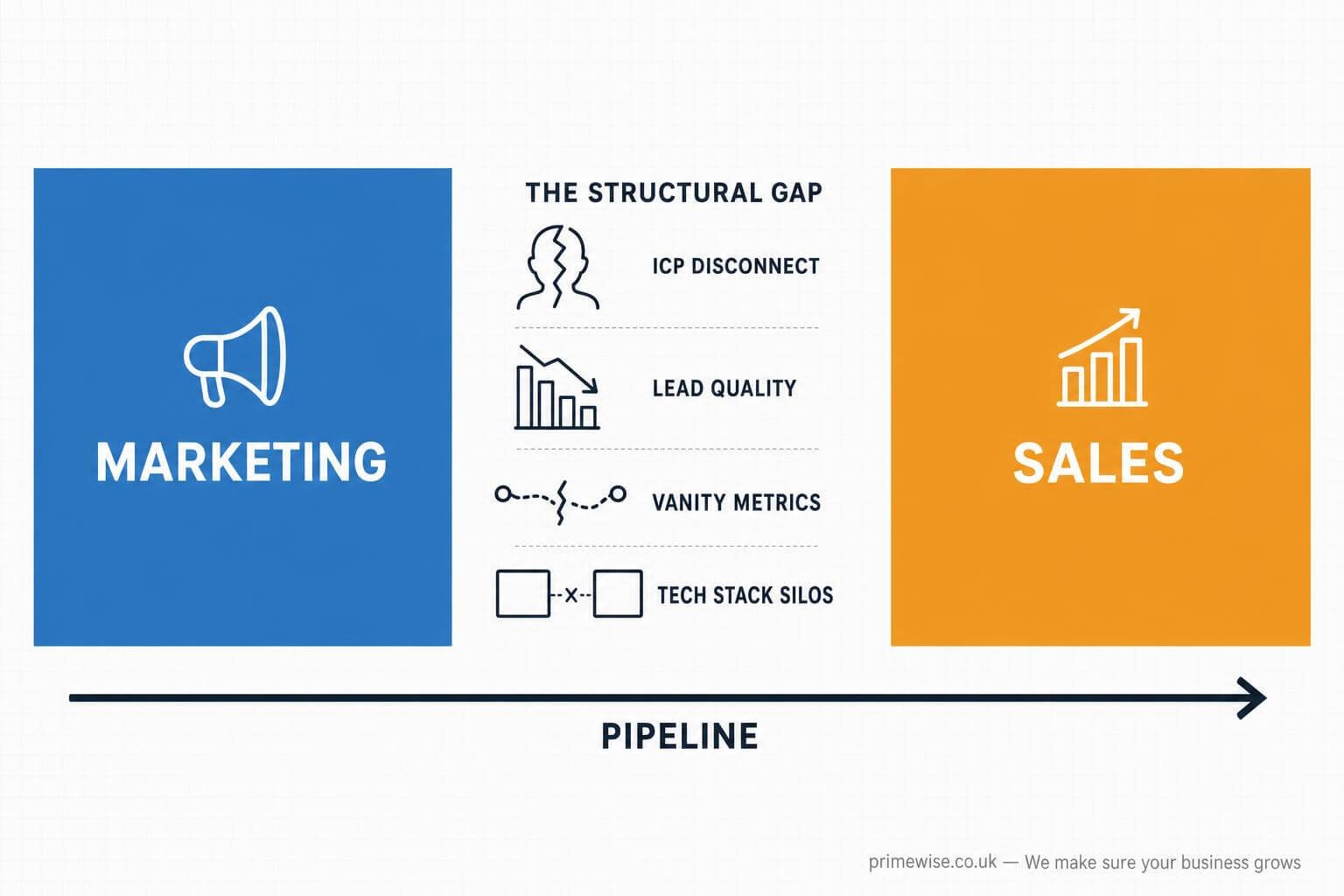
Systemic pipeline failure rarely results from a lack of effort. It results from four specific, diagnosable misalignments that fracture the buyer journey at its most commercially critical points. Understanding these failure modes is the first act of a Fractional CMO engagement and the foundation of any credible revenue recovery plan.
Disconnected Ideal Customer Profiles
The Ideal Customer Profile and the buyer persona are related but distinct tools that most scaling firms conflate, and that conflation is expensive. An ICP defines the firmographic and technographic characteristics of the account most likely to deliver high Customer Lifetime Value company size, sector, revenue band, tech stack, and regulatory context. A buyer persona describes the individual decision-maker within that account their role, priorities, objections, and content consumption habits. When marketing targets a broad Total Addressable Market using loosely defined personas while sales is hunting a highly specific enterprise decision-maker at a pre-qualified account type, every pound of Account-Based Marketing budget is partially misdirected from the first campaign brief.
A Fractional CMO’s opening intervention is to facilitate a mandatory ICP Consensus Workshop with both commercial leadership teams. The output is a single, locked document that defines the precise account profile, the buying committee structure, and the trigger events that indicate active commercial intent. Until this document exists and is ratified by both departments, all downstream activity content, paid media, outbound sequencing, event sponsorship operates on an untested assumption.
Lead Quality Disputes and the MQL Problem
The classic inter-departmental conflict: marketing hits its Marketing Qualified Lead volume target and reports green status to the board. Sales reports that the leads are unworkable. Both teams are measuring different things and calling them the same thing. This is not a personality conflict. It is a taxonomy failure. MQLs defined purely by behavioural scoring thresholds downloaded an eBook, attended a webinar, visited the pricing page twice systematically overstate commercial intent when there is no firmographic or technographic gate applied at the point of qualification.
A mature revenue operations framework distinguishes clearly between the MQL, the Sales Qualified Lead, and in product-led growth models, the Product Qualified Lead. Each stage requires an explicit, agreed definition, a minimum data threshold, and a mapped handoff protocol. A Fractional CMO implements this taxonomy and ties lead scoring model governance to both teams simultaneously, so neither department can unilaterally redefine what constitutes a qualified lead without cross-functional sign-off.
KEY DISTINCTIONAn MQL tells you someone is interested. An SQL tells you someone is ready to buy. Conflating the two is the single most common source of sales-marketing conflict in UK B2B firms. Your Fractional CMO's first structural fix is to make this distinction contractual, not conversational.
Attribution Friction and Vanity Metrics
When marketing and sales operate from separate reporting dashboards with no shared attribution logic, deal origination becomes political. Marketing claims the content-assisted touchpoint. Sales claims the relationship. Finance sees only the closed-won and has no reliable view of which activities drove it. Multi-touch attribution models can illuminate this, but they are only as trustworthy as the data flowing into them and in most scaling UK firms, that data is fragmented, inconsistently tagged, and partially lost in manual handoffs.
The practical consequence is that board-level reporting defaults to vanity metrics: total MQL volume, website sessions, email open rates, social impressions. None of these appear on the P&L. A Fractional CMO replaces this reporting layer with pipeline-anchored metrics: Cost Per Sales Qualified Opportunity, Pipeline Velocity, and Marketing-Sourced Revenue as a percentage of total closed-won. These metrics survive board scrutiny because they connect marketing activity directly to commercial outcomes.
Tech Stack Silos and Data Black Holes
Technical friction between a Customer Relationship Management platform and a Marketing Automation Platform is the operational manifestation of everything described above. In the UK market, the dominant stack pairing is Salesforce as the CRM of record and HubSpot as the marketing automation layer, sometimes accompanied by Cognism or Apollo for outbound data intelligence. When these platforms are not integrated at the API level with properly enforced field mapping and bi-directional sync rules, lead-routing failures occur silently. A prospect engages with three high-intent content pieces, scores above the MQL threshold in HubSpot, and the record never surfaces in Salesforce because a workflow trigger broke three months ago and nobody noticed.
For UK enterprises, this is not solely a revenue risk. Under UK GDPR, the lawful basis for processing and the consent record must be consistent across every platform that holds a data subject’s record. Disconnected stacks create compliance liability alongside commercial drag. A Fractional CMO with genuine technical depth mandates a full stack audit, enforces API integration standards, and centralises data governance removing the non-compliant spreadsheet handoffs that characterise early-stage scaling firms that have outgrown their original infrastructure.
How a Fractional CMO Fixes the Marketing-to-Pipeline Problem
The Fractional CMO’s value in this context is not creative direction or brand positioning. It is structural engineering. The following three interventions form the core of the alignment methodology deployed across PrimeWise client engagements with UK B2B technology firms.
Establishing Shared Language Across Revenue Functions
Shared language precedes shared metrics. Before a single dashboard is built or a single SLA is drafted, both commercial teams must operate from an identical vocabulary. This means a ratified ICP document, a jointly approved buyer journey map that covers every stage from first awareness to contract renewal, and a locked lead taxonomy that defines MQL, SQL, and PQL with explicit criteria rather than intuitive judgement. Account-Based Marketing strategy is then built directly on top of this shared language, ensuring that every target account list, every content asset, and every sales outreach sequence references the same firmographic and intent criteria.
Designing Shared Pipeline Metrics That Survive Board Scrutiny
The Pipeline Velocity formula is the most powerful shared metric a Fractional CMO can install: Pipeline Velocity equals the number of qualified opportunities multiplied by average deal value multiplied by win rate, divided by average sales cycle length. This single formula forces both departments to care about the same variables simultaneously. Marketing cannot improve Pipeline Velocity by generating more low-quality opportunities that depresses win rate and extends sales cycle length, making the number worse. Sales cannot improve it by cherry-picking easy deals that reduces average deal value. The formula is inherently cross-functional and inherently honest.
Alongside Pipeline Velocity, the shared KPI framework anchors Customer Acquisition Cost against Customer Lifetime Value. A CLV-to-CAC ratio below 3:1 signals a structurally inefficient go-to-market model regardless of how impressive the individual departmental metrics appear. This ratio is the language PE operating partners and VC portfolio managers speak. A Fractional CMO ensures marketing leadership speaks it fluently and that every campaign brief includes a target CAC assumption tied to projected CLV.
Implementing Cross-Functional Revenue Governance
Sustainable alignment degrades without structural governance. A Fractional CMO implements a Revenue Alignment Governance Matrix a defined set of recurring forums, decision rights, and escalation paths that prevent both departments from retreating into operational silos after the initial alignment sprint. This includes a weekly Revenue Operations cadence attended by marketing, sales, and if present, a dedicated RevOps function, where pipeline velocity, SLA compliance, and lead stage conversion rates are reviewed against targets.
The Service Level Agreement between marketing and sales is the governance framework’s most practical output. A well-structured SLA defines the exact criteria a lead must meet before marketing passes it to sales, the maximum response time within which sales must action the lead, the feedback protocol sales uses to return unqualified leads, and the escalation path when either side violates the agreement. Without a signed SLA, every lead quality dispute reverts to subjective argument. With one, it becomes an operational audit.
PRIMEWISE INSIGHTAcross PrimeWise engagements with UK B2B technology firms, the implementation of a formal sales-marketing SLA combined with a shared Pipeline Velocity dashboard has consistently reduced lead-to-opportunity leakage by an average of 40% within the first 60 days. The mechanism is simple: accountability is no longer optional.
Harmonising the Tech Stack for Single-Source Reporting
Revenue visibility at board level requires that Salesforce and HubSpot or whichever CRM and MAP pairing the firm uses operate as a single logical system rather than two separate databases that are periodically reconciled. A Fractional CMO with hands-on technical experience in enterprise stack architecture defines the integration requirements: which object types sync in which direction, which fields are master-recorded in which system, which workflows are triggered by which events, and how consent and processing records are maintained consistently across both platforms for UK GDPR compliance.
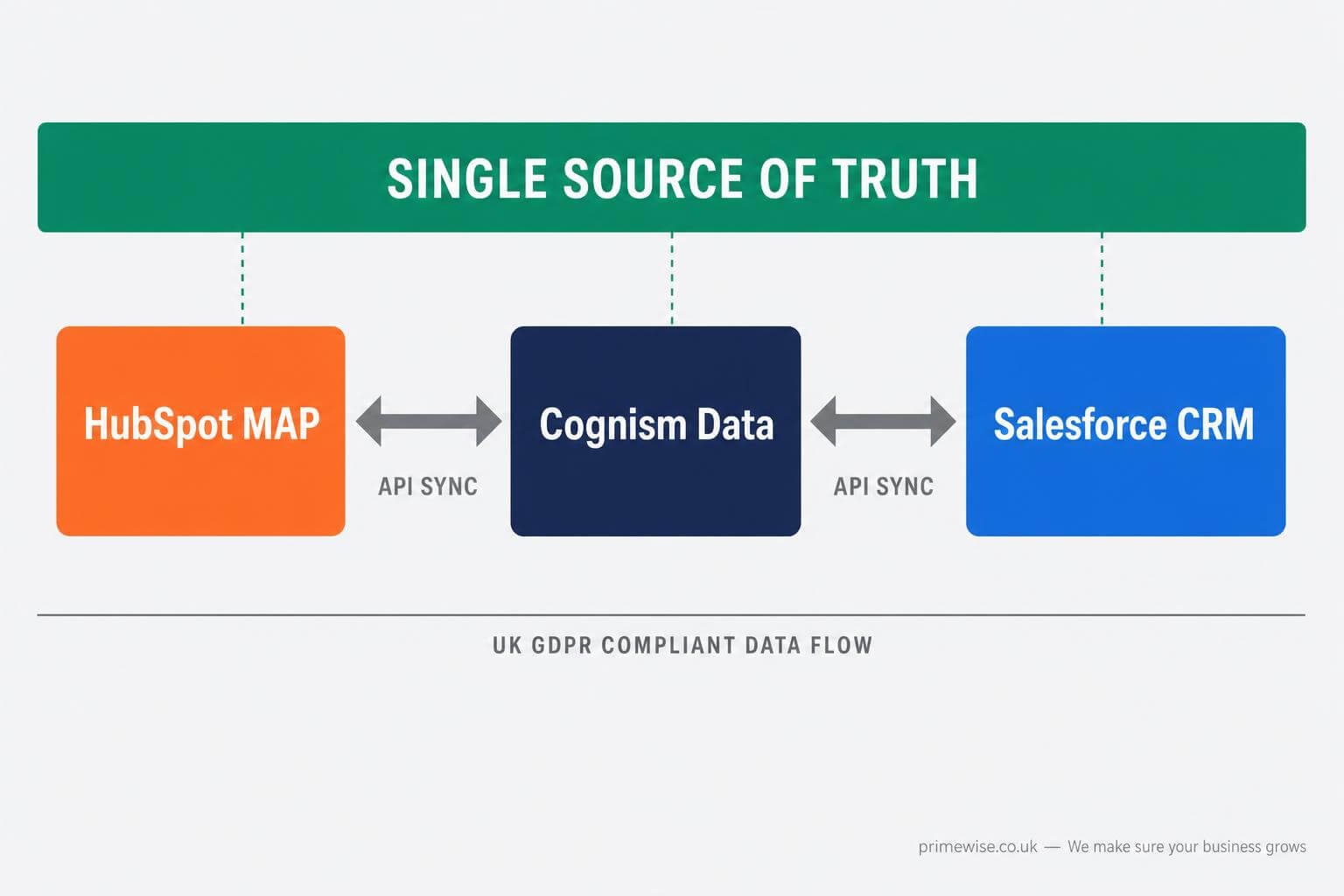
Cognism, as a UK-compliant B2B data intelligence platform, plays a specific role in this architecture for firms running outbound Account-Based Marketing programmes. Cognism’s Diamond Data verification layer ensures that contact records entering HubSpot or Salesforce meet a minimum data quality threshold before they enter the lead scoring model preventing the garbage-in-garbage-out problem that quietly corrupts MQL quality metrics over time. Integrating a data intelligence layer at the point of ingestion, rather than attempting data cleansing retrospectively, is a structural best practice that a Fractional CMO enforces from day one of the tech stack harmonisation workstream.
The outcome of full stack harmonisation is a single attribution report that both marketing and sales accept as the authoritative record of how each closed-won deal originated, what touchpoints contributed, and what the blended CAC was across channels. This report is not a marketing deliverable. It is a revenue operations deliverable and that distinction matters enormously for board-level trust.
The 90-Day Fractional CMO Turnaround Plan
Every fractional executive mentions a 90-day plan. The differentiator is specificity. The following three-phase framework is the structured methodology PrimeWise deploys when engaging a UK B2B firm to resolve sales and marketing misalignment. Each phase has defined inputs, named deliverables, and measurable exit criteria.
Phase One Diagnostic and Foundation
Days one to thirty focus entirely on building the factual baseline. This is the phase that separates a strategic Fractional CMO from a senior marketing contractor. The work is diagnostic, not executional. It begins with structured discovery interviews across sales leadership, marketing leadership, finance, and where available, a sample of recently won and lost accounts. The output of this discovery layer feeds directly into the deliverables.
- Delivery of a full ICP Consensus Workshop with documented output ratified by sales and marketing leadership
- Completion of a current-state tech stack audit covering data flow integrity, integration health, and UK GDPR compliance gaps
- Establishment of a Pipeline Velocity baseline measurement using the preceding twelve months of CRM data
- Drafting of the first version of the sales-marketing Service Level Agreement for review and sign-off
- Identification of the top three attribution gaps distorting current board reporting
Phase Two Implementation and Integration
Days thirty-one to sixty shift from diagnosis to deployment. The structural fixes identified in Phase One are built and activated. This is where the Revenue Alignment Governance Matrix is launched and where the tech stack integration work reaches a functional state. A Series B London-based SaaS firm engaged through PrimeWise reduced its sales cycle length by 22% within this phase, primarily because the new lead scoring model eliminated the lowest-intent tier of MQLs that had been consuming disproportionate sales capacity.
- Go-live of the revised lead scoring model within HubSpot or the firm’s existing MAP, incorporating firmographic and intent-based gates
- Deployment of the shared KPI dashboard combining Pipeline Velocity, Cost Per SQL, and CLV-to-CAC ratio in a single executive view
- API integration completion between CRM and MAP with validated bi-directional sync and UK GDPR consent field mapping
- Launch of the weekly Revenue Operations governance cadence with defined agenda, attendees, and decision rights
- Activation of the sales-marketing SLA with a documented breach and escalation protocol
Phase Three Optimisation and Board Readiness
Days sixty-one to ninety shift to optimisation and evidence generation. By this point, the structural fixes are live and producing data. The Fractional CMO’s role transitions to interpreting that data, recalibrating assumptions, and packaging the findings into board-ready reporting that satisfies PE and VC scrutiny. This phase is also when the CLV-to-CAC ratio recalibration occurs using real post-alignment data rather than pre-alignment estimates giving the firm a genuinely defensible efficiency narrative for its next portfolio review.
- Publication of the first unified attribution report accepted by both sales and marketing as the authoritative deal origination record
- CAC recalibration by channel using post-integration data, identifying the highest and lowest efficiency acquisition routes
- Delivery of a board-ready pipeline forecast using the Pipeline Velocity formula against the next two quarters of target revenue
- Documentation of the Revenue Alignment Governance Matrix as an institutional process, ensuring continuity beyond the Fractional CMO engagement
- Identification of the top three Account-Based Marketing campaign priorities informed by the newly validated ICP and intent data
IS YOUR PIPELINE STRUCTURALLY BROKENPrimeWise offers a Revenue Diagnostic for UK B2B technology and professional services firms. In a structured 60-minute session, we identify the specific misalignment failure modes costing your firm pipeline and present a prioritised remediation roadmap. No obligation. Pure signal.
Why UK B2B Buyers Demand This Level of Alignment
British B2B buyers operate with a distinctly consultative purchasing style. Aggressive top-of-funnel volume tactics imported from US go-to-market playbooks consistently underperform in the UK market, where trust, sector credibility, and peer referral carry disproportionate commercial weight. This cultural context makes ICP precision and Account-Based Marketing discipline even more commercially critical than in other markets because the cost of reaching the wrong person with the wrong message is not just a wasted impression. It is reputational noise in a market where relationships are long and memories are longer.
For UK FinTech and regulated financial services firms, the compliance dimension extends beyond UK GDPR into FCA conduct rules governing marketing communications and client categorisation. A Fractional CMO operating in these sectors must understand that the alignment framework applies not only to commercial efficiency but to regulatory risk management and that a misaligned tech stack creating uncontrolled data flows between systems is a potential FCA reporting liability, not just a RevOps inconvenience.
Measuring Long-Term Alignment Health
The 90-day plan establishes the structural foundation. Sustaining alignment over subsequent fiscal quarters requires a small set of lead indicators that signal when the system is beginning to drift before it reaches the point of visible pipeline impact. These indicators are reviewed in the weekly Revenue Operations cadence and reported monthly to the executive team.
- SLA compliance rate the percentage of leads actioned by sales within the agreed response window, tracked weekly
- MQL-to-SQL conversion rate a declining trend signals either lead quality degradation or sales process friction, both of which are diagnosable and fixable
- Pipeline Velocity delta month-on-month change in the velocity formula, which gives an early warning of cycle length extension or win rate erosion before it hits revenue
- Attribution coverage rate the percentage of closed-won deals with a complete multi-touch attribution record, which degrades when data governance lapses
- CLV-to-CAC ratio by acquisition channel identifying which channels are becoming less efficient over time before budget renewal decisions are made
A Fractional CMO engagement at PrimeWise does not end at day ninety. The governance framework and measurement infrastructure installed during the turnaround plan are designed to run independently, with the Fractional CMO transitioning to a lighter-touch advisory role that provides ongoing calibration without the cost of continuous full-time executive involvement. This is the capital efficiency argument in its most practical form: you get the structural outcome of a full-time CMO hire without the fixed overhead, and you retain the flexibility to scale the engagement up or down as the business cycle demands.