

Fractional CMO red flags are rarely obvious on a first call, and for UK founders actively evaluating providers, that ambiguity is expensive. According to PrimeWise’s 2025 post-mortem analysis of 140 UK B2B fractional engagements, 68% collapsed within four months the two primary causes being unchecked channel bias and the complete absence of a formal onboarding plan. If you are currently considering a fractional CMO for SMEs, this guide is your definitive vetting framework before a single contract is signed.
Executive leadership teams routinely fall into what practitioners call the slide deck trap strategy without execution that becomes a heavy sunk cost. Genuine marketing leaders transition rapidly from theoretical planning to operational rollout. Identifying the warning signs early is the only way to protect your commercial capital and long-term growth trajectory.
What a True Fractional CMO Actually Is
A fractional Chief Marketing Officer is a senior executive integrated into your leadership team on a part-time or project basis to drive commercial growth, align marketing directly with revenue goals, and oversee operational execution. This role is categorically different from a tactical freelancer or a traditional agency consultant whose primary focus is isolated deliverables rather than holistic business outcomes.
- They operate as a genuine extension of the executive board, not an external vendor fulfilling a brief.
- They take direct accountability for pipeline velocity and measurable revenue generation.
- They bridge the gap between high-level business strategy and daily marketing execution.
- They build scalable operational systems designed to outlast their tenure within your organisation.
Understanding this distinction matters because the market is saturated with agency directors repositioning themselves as fractional executives. The difference in commercial impact is significant, and the red flags below will help you separate one from the other quickly.
EXECUTIVE WARNINGPrimeWise's 2025 analysis found that businesses which skipped formal onboarding processes in their fractional engagements lost an average of £34,000 in misallocated retainer spend before contract termination. Vetting costs nothing. Poor hiring costs everything.
The Post-Mortem Patterns Behind Failed Engagements
Understanding capital misallocation during vendor evaluation requires a rigorous examination of what actually goes wrong. When founders hire professionals who operate as glorified tacticians rather than authentic commercial executives, the results follow predictable and highly destructive patterns that can be mapped and anticipated.
Why Most Contracts Collapse Before Month Four
PrimeWise’s internal case data consistently identifies a systemic failure pattern among fractional executives who lack genuine commercial acumen. These collapses typically stem from an inability to transition from strategy into measurable operational execution. Without tangible pipeline improvements visible by the end of the second month, boards lose confidence and terminate contracts, resulting in lost momentum, wasted marketing budgets, and significant internal disruption to sales teams already under pressure.
The Slide Deck Trap
One anonymised case from PrimeWise’s UK B2B financial services portfolio illustrates the pattern clearly. The client engaged a provider who delivered twelve weeks of extensive strategic presentations filled with industry frameworks and competitor analysis. Not a single revenue-generating campaign was implemented. The internal team was left confused, the sales pipeline remained entirely stagnant, and the business had spent in excess of £40,000 on strategy without execution. The provider cited scope ambiguity as the cause. The real cause was the absence of any onboarding plan, milestone-based deliverables, or accountability matrix from the outset.
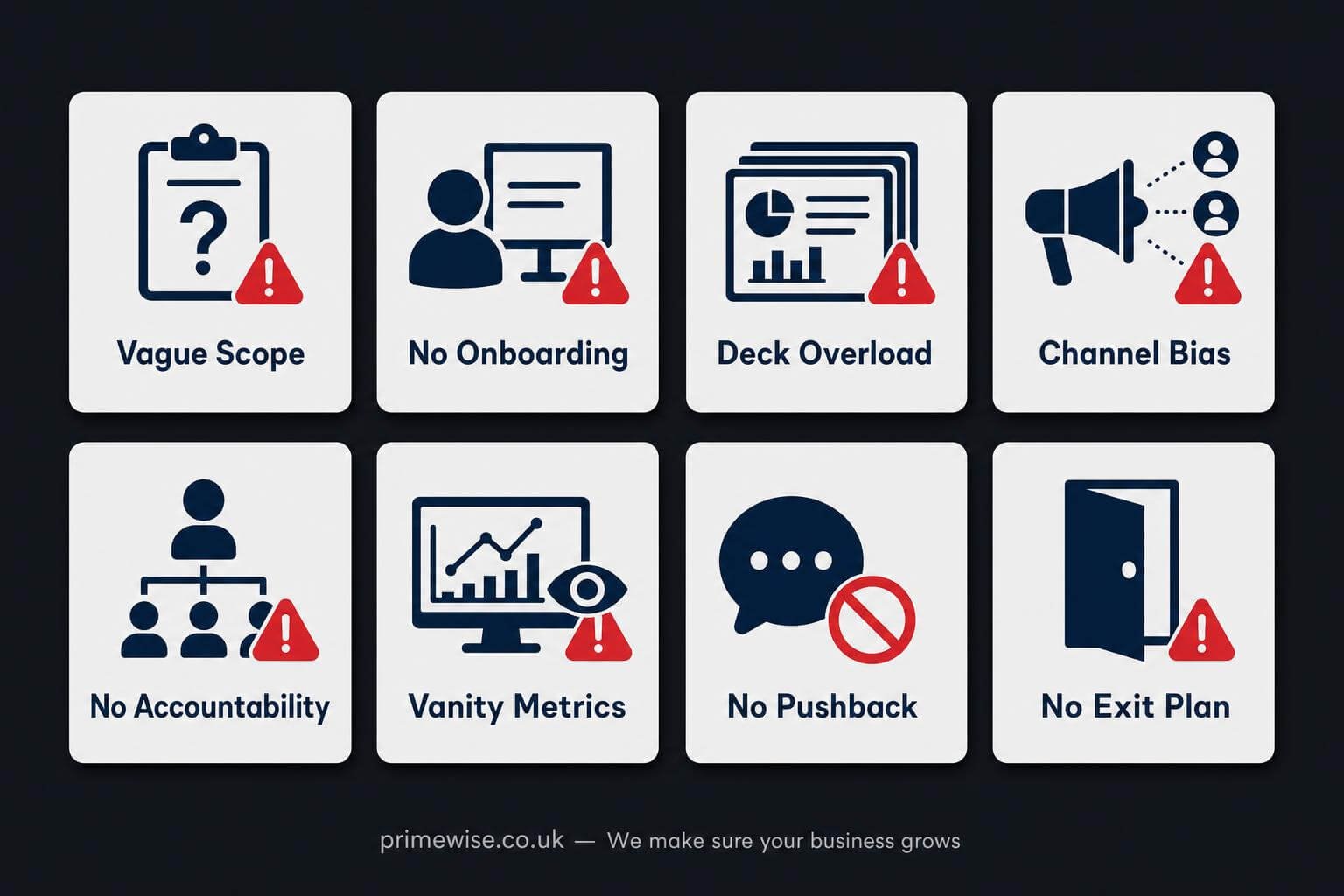
The 8 Fractional CMO Red Flags
The following framework is used by PrimeWise consultants when conducting pre-engagement due diligence assessments for UK businesses. Each red flag is mapped to a commercial risk level and includes what good looks like in contrast, giving you a practical decision-making tool for your next evaluation conversation.
Red Flag One Vague Scopes of Work
Commercial Risk: Critical. Open-ended deliverables with no specific commercial outcomes attached are the single most reliable predictor of a failed engagement. A capable fractional CMO will always mandate a meticulously defined Statement of Work tied to distinct commercial milestones, deadlines, and measurable KPIs before work begins. If you receive a proposal that describes activities rather than outcomes “developing a brand strategy” rather than “delivering a twelve-month brand positioning document reviewed by the board by day thirty” treat it as a fundamental warning sign. Vague scopes are rarely accidental. They protect the provider, not your business.
Red Flag Two Zero Formal Onboarding Plan
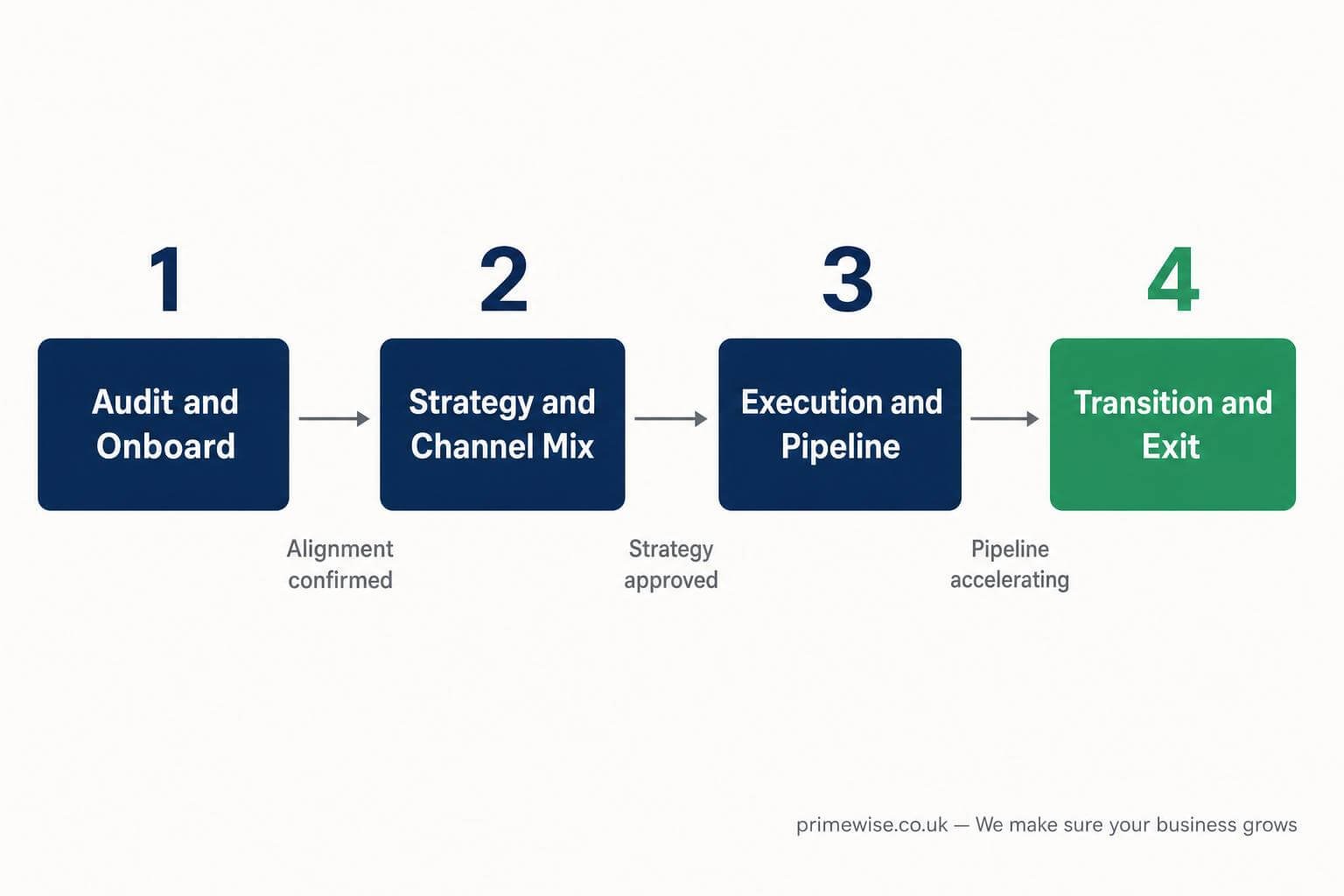
Commercial Risk: Critical. Jumping straight into tactical execution without first integrating into the wider business context signals a critical lack of executive maturity. What good looks like is a structured thirty-day integration plan that includes auditing your existing technology stack, assessing internal team capabilities, reviewing historic revenue and pipeline data, interviewing key stakeholders, and benchmarking current CAC and MQL-to-SQL conversion rates. Any provider who cannot articulate this process in their proposal has not done it before at the level you require.
Red Flag Three Over-Reliance on Presentations
Commercial Risk: High. Endless presentations create the dangerous illusion of progress. If a provider’s first three months are dominated by decks, workshops, and alignment sessions with no operational output, you are funding their thinking time at executive day rates. A genuine commercial leader delivers actionable operational playbooks alongside their strategic guidance and moves rapidly to execute against board-level objectives. Ask directly in the initial meeting: what will you have built or implemented by the end of month one?
Red Flag Four Dangerous Channel Bias
Commercial Risk: High. Forcing paid search, SEO, or content marketing simply because it aligns with a provider’s historical agency background is a fundamental strategic error. Elite fractional CMO strategy must be entirely channel-agnostic, driven solely by your target audience’s buyer journey and empirical market data. If a provider defaults to their preferred channels before completing a thorough audience and competitive audit, they are optimising for their own comfort, not your commercial outcomes. This pattern is especially prevalent among agency founders who have repositioned themselves as fractional executives without genuinely broadening their strategic lens.
Red Flag Five Misaligned Commercial Incentives
Commercial Risk: Fatal. Refusing to tie any portion of remuneration to business performance or lead quality is the clearest signal that a provider lacks confidence in their own methodology. Premium fractional marketing leaders expect and embrace shared risk and reward structures that align their financial incentives directly with your growth targets. At PrimeWise, all fractional engagements are structured around milestone-based commercial contracts ensuring retainer value is directly tied to pipeline performance the model is explained in detail at primewise.co.uk. If your shortlisted provider rejects this structure entirely, take note.
WHAT GOOD LOOKS LIKEA commercially aligned fractional CMO will propose a base retainer for operational work combined with a performance component tied to agreed pipeline or revenue milestones. This structure is standard among elite providers and signals genuine confidence in their methodology.
Red Flag Six No Revenue Accountability
Commercial Risk: Critical. Reporting exclusively on vanity metrics impressions, social reach, click-through rates rather than pipeline velocity, customer acquisition cost, and MQL-to-SQL conversion rates obscures the true return on your marketing investment. Trustworthy practitioners implement strict accountability matrices that tie every reporting cycle to tangible commercial outcomes. If a provider’s proposal contains no mention of pipeline metrics, CAC, or revenue attribution methodology, they are not operating at CMO level. They are operating at campaign manager level with an inflated title.
Red Flag Seven Passive Executive Agreement
Commercial Risk: High. Passively accepting a founder’s existing strategy without professional challenge or data-backed pushback renders the executive commercially useless. You require a leader who demonstrates the intellectual courage to challenge pre-existing business assumptions with hard market data and objective competitive analysis. The most commercially valuable thing a fractional CMO can do in the first thirty days is identify where your current strategy is misaligned with market reality. If your provider has not challenged you once by the end of month one, they are managing your expectations rather than your growth.
Red Flag Eight No Exit or Transition Strategy
Commercial Risk: High. Creating operational dependencies to extend a contract indefinitely is a predatory consulting practice that benefits the provider at the direct expense of your business’s long-term capability. A reliable partner will present a clear roadmap from day one for building internal capability, hiring a full-time successor when appropriate, and transferring institutional knowledge back into your permanent workforce. Ask every candidate: what does a successful end to this engagement look like, and what will your team be capable of after I leave?
UK-Specific Compliance and Commercial Risks
Navigating the UK regulatory and commercial landscape requires specific local knowledge that generic fractional CMO frameworks many of which originate from the US market consistently overlook. UK decision-makers must address critical legal, tax, and cultural nuances to ensure engagements remain compliant and commercially resonant.
IR35 and Off-Payroll Working Rules
Structuring a fractional CMO engagement as a genuine business-to-business consultancy service is a legal necessity, not a preference. HMRC’s Off-Payroll Working rules, governed by Chapter 10 of the Income Tax (Earnings and Pensions) Act 2003 (ITEPA 2003), were extended to medium and large private sector businesses in April 2021. Under these rules, the end-client your business bears the determination responsibility for whether the engagement falls inside or outside IR35. Falling foul of these rules can result in substantial HMRC back-payment demands, interest charges, and reputational damage.
HMRC provides a free digital assessment tool called CEST (Check Employment Status for Tax), available at gov.uk, which serves as a useful first-pass screen. However, for any engagement valued above £2,000 per month, PrimeWise recommends engaging a specialist employment law firm for a formal written IR35 opinion. The three primary HMRC determination criteria are substitution (can the contractor send a replacement?), control (does your business direct how and when work is done?), and mutuality of obligation (is there an expectation of ongoing work provision?). A compliant fractional CMO contract should include an explicit right of substitution clause, absence of exclusivity, and project-based fee structure with defined deliverables rather than time-based attendance.
UK COMPLIANCE CHECKPOINTIf your proposed fractional CMO contract references daily attendance, fixed working hours, or exclusive availability requirements, this suggests a disguised employment arrangement. Have the contract reviewed against the HMRC CEST criteria before signing. The liability sits with your business, not the contractor.
US Playbooks vs UK Commercial Reality
Aggressive marketing playbooks imported from US SaaS or DTC environments frequently underperform in the relationship-driven, trust-focused UK B2B and financial services sectors. UK buyers, particularly in regulated industries such as professional services, FinTech, and legal, require credibility signals, long-form authority content, and peer referral pathways rather than high-frequency demand generation campaigns. Your fractional CMO must understand these cultural nuances and adapt their channel mix accordingly. A provider who defaults to aggressive inbound funnels without auditing your specific buyer journey is applying a foreign playbook to a domestic problem.
A Comparison Framework for Evaluating Your Options
Before committing to any fractional engagement, UK business leaders should map their specific stage, budget, and strategic need against the full range of available outsourced marketing leadership models. The table below provides a structured comparison across the four most common options available to UK SMEs and scale-ups.
| Model | Typical UK Cost | IR35 Risk | Strategic vs Tactical | Contract Length | Best Fit |
|---|---|---|---|---|---|
| Fractional CMO | £2,000–£5,000/month | Medium requires B2B structure | Strategic with execution oversight | 6–12 months | SME or scale-up lacking board-level marketing leadership |
| Full-Time CMO | £90,000–£160,000/year | None PAYE | Fully strategic | Permanent | Series B+ with complex multi-channel marketing function |
| Marketing Agency | £3,000–£15,000/month | None | Primarily tactical | 3–12 months rolling | Business with clear strategy needing execution resource |
| Interim Marketing Director | £400–£800/day | High IR35 scrutiny is significant | Tactical to mid-strategic | 3–6 months | Cover during permanent hire or restructure period |
This comparison is not exhaustive, but it provides a practical decision framework based on PrimeWise’s direct experience structuring outsourced marketing leadership engagements for UK B2B businesses across SaaS, FinTech, and professional services.
The Executive Litmus Test
Equipped with the red flag framework above, the following five questions are designed to expose candidates who rely on marketing jargon rather than commercial acumen. These are the exact questions PrimeWise recommends business leaders ask in the final evaluation stage, before any proposal is accepted or contract discussed.
- Walk me through a time you had to pivot a strategy because it failed to generate pipeline what were the specific operational steps you took and what did the pipeline data show before and after?
- How do you determine the balance between long-term brand equity investment and short-term lead generation in your first ninety days with a new client?
- If our sales director tells you that the marketing leads you are generating are poor quality, how do you diagnose that problem and what cross-departmental process do you implement to resolve it?
- What specific business metrics do you use to hold yourself accountable to a board of directors, and how do you report them?
- Describe your structured process for offboarding yourself from an engagement and transitioning your responsibilities to a permanent in-house leader.
A strong candidate will answer each of these with specificity, named metrics, and real operational experience. A weak candidate will answer with frameworks, generalities, and buzzwords. The difference will be immediately clear.
A Positive Outcome Case Study
To contrast directly with the slide deck trap failure described earlier, the following anonymised case study is drawn from a PrimeWise fractional engagement with a UK B2B SaaS business employing 48 people at the time of engagement. The business had a competent internal marketing team of two but lacked board-level strategic direction, resulting in a fragmented channel mix and a deteriorating MQL-to-SQL conversion rate.
On engagement, the PrimeWise fractional CMO completed a full audit of the technology stack, sales and marketing alignment, and three years of pipeline data within the first three weeks. By the end of month one, a channel rationalisation had been implemented, reducing spend on two underperforming paid channels and reallocating budget to an account-based marketing programme targeting a defined ICP. By month three, the MQL-to-SQL conversion rate had improved from 11% to 29%, CAC had reduced from £3,400 to £1,850, and the sales team had logged a 34% increase in pipeline velocity. The engagement concluded at month nine with the successful hire of a permanent Head of Marketing, a fully documented operational playbook, and a trained internal team capable of sustaining the programme independently.
KEY OUTCOME SNAPSHOTMQL-to-SQL: 11% → 29% | CAC: £3,400 → £1,850 | Pipeline velocity: +34% | Engagement concluded with permanent hire at month nine and full operational knowledge transfer.
Structuring a Bulletproof Contract
Completing the vetting process is only the first step. Protecting your capital requires a legally sound contract that sets definitive boundaries, eliminates ambiguity, and ties the engagement’s commercial success directly to your business outcomes rather than to the provider’s activity levels.
Value-Based Retainers Over Day Rates
UK commercial standards for outsourced marketing leadership have shifted significantly in recent years. Paying for outcomes rather than inputs is now the standard expectation among sophisticated buyers. A value-based retainer structure explicitly links your monthly payment to the successful delivery of agreed commercial milestones such as a defined number of qualified pipeline opportunities, a CAC improvement target, or the launch of a specific revenue-generating programme. This model eliminates the perverse incentive of day-rate structures, where a provider is financially rewarded for taking longer rather than delivering faster.
Strict Deliverables and SLAs
Every contract should include a formally structured Statement of Work with named deliverables, delivery dates, acceptance criteria, and a revision process. Service Level Agreements should define response times, reporting frequency, and the escalation path if milestones are missed. Payment schedules should be explicitly linked to milestone completion rather than to calendar dates. Including a right of substitution clause, a project-based fee structure, and the absence of exclusivity requirements also protects your business against adverse IR35 determinations, as outlined in the compliance section above.
If you want to run your shortlisted provider through a structured pre-contract evaluation, PrimeWise offers a free Fractional CMO Red Flag Scorecard at primewise.co.uk. It takes under fifteen minutes to complete and gives you a clear, evidence-based assessment before you commit to any financial terms.