
A fractional CMO engagement sits at the intersection of commercial agility and HMRC scrutiny and for UK SMEs, getting the fractional CMO IR35 status wrong carries consequences far more severe than most founders anticipate. Backdated PAYE liabilities, compounded National Insurance Contributions, and sustained HMRC investigation can collectively expose a business to six-figure penalties. This guide gives UK CEOs, CFOs, and HR Directors the authoritative compliance framework needed before any contract is signed.
Quick AnswerA Fractional CMO operating through a Personal Service Company can legally sit outside IR35 but only if three critical working practice tests are satisfied in reality, not just on paper: no control over daily methodology, a genuine right of substitution, and no mutuality of obligation beyond the agreed project scope.
What IR35 Actually Means for a Fractional CMO
IR35 is the informal name for the off-payroll working rules now codified under Chapter 10 of the Income Tax (Earnings and Pensions) Act 2003 (ITEPA 2003). Its core function is to determine whether an individual providing services through an intermediary typically a Personal Service Company (PSC) would have been classified as an employee had they contracted directly with the client business. For fractional executive roles, this test is particularly high-stakes because the seniority and strategic authority of a Chief Marketing Officer superficially resembles an employment relationship, even when the commercial reality is genuinely independent.
The legislation does not care what the contract says in isolation. HMRC and employment tribunals consistently apply a principle of substance over form the true, day-to-day working relationship always supersedes the written agreement. For a Fractional CMO, this means that even a perfectly drafted contract can fail an IR35 status assessment if the operational reality reflects disguised employment. Understanding this distinction is the single most important principle for any UK business engaging senior marketing talent on a fractional basis.
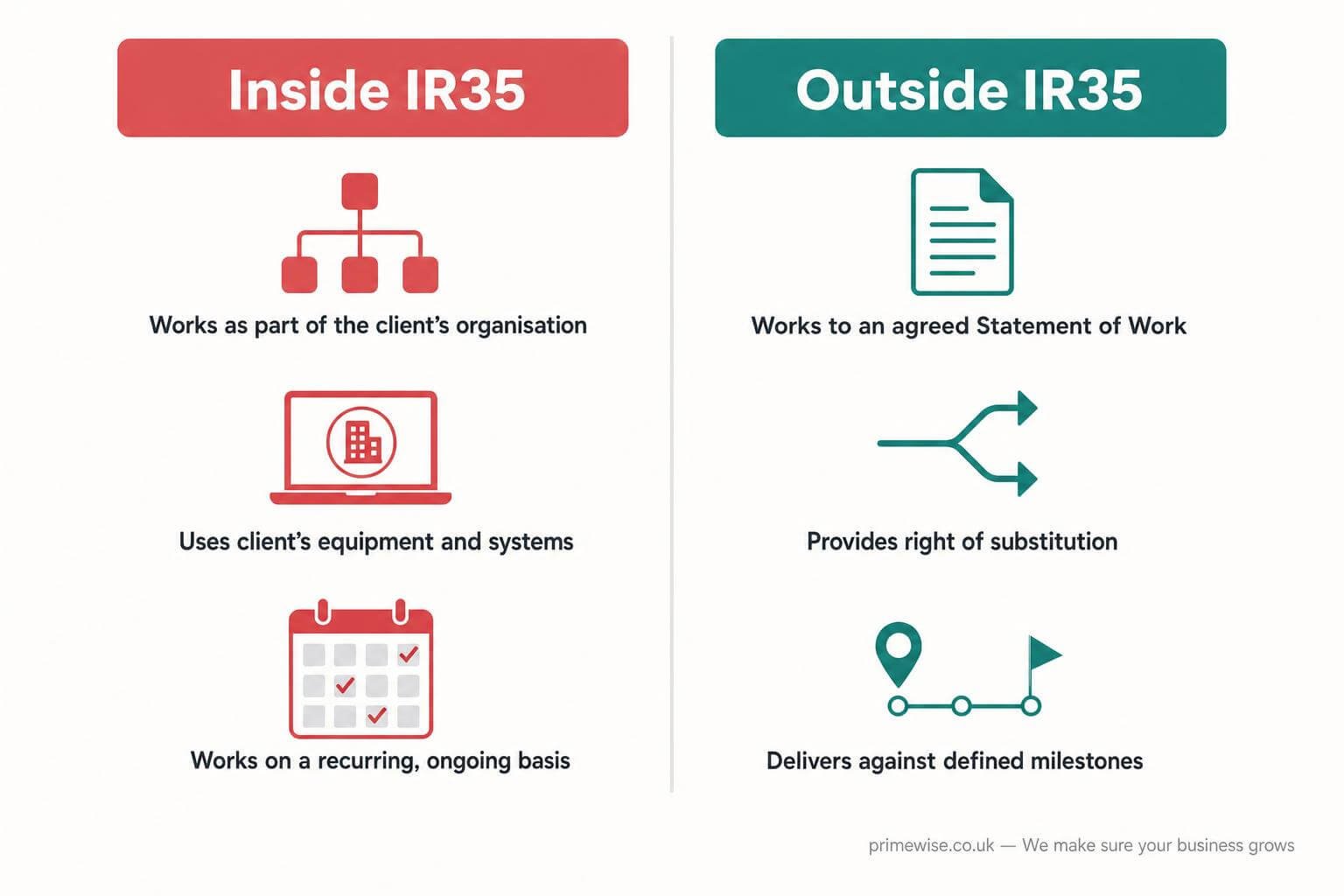
Inside IR35 Versus Outside IR35 for Senior Marketing Roles
The inside versus outside IR35 distinction determines who holds the tax liability, whether PAYE and NICs must be deducted at source, and whether the engaging business faces retrospective financial exposure. For senior executive engagements, HMRC applies heightened scrutiny because the depth of integration into a business attending board meetings, setting strategy, leading teams can easily mirror employment even where no formal employment contract exists.
The Inside IR35 Disguised Employment Scenario
An inside IR35 engagement occurs when a Fractional CMO is operationally indistinguishable from a permanent Marketing Director. Common indicators include the CMO attending all internal leadership meetings as a voting participant, being subject to company performance appraisals, receiving company-supplied equipment, being listed on the company organisational chart, or having line management responsibility over internal employees assessed through standard HR processes. In this scenario, the hiring business becomes the deemed employer and is liable for employer NICs, income tax deductions, and apprenticeship levy contributions as though the individual were on the payroll. HMRC’s off-payroll working compliance yield reached £1.6 billion in its 2023-24 annual report, demonstrating the agency’s sustained enforcement appetite.
The Outside IR35 Compliant Advisory Structure
A legally compliant outside IR35 structure positions the Fractional CMO as an independent commercial entity delivering a defined marketing service through their PSC. The CMO sets their own working methodology, is not subject to corporate supervision or appraisal, retains the right to provide a substitute if unavailable, and is engaged strictly to deliver specified project outcomes rather than to fulfil an ongoing employment function. The engagement should look and actually operate as a B2B commercial relationship, with the CMO’s PSC invoicing for milestones rather than receiving a salary equivalent.
The Three HMRC Tests Applied to Fractional CMO Engagements
Employment status for IR35 purposes is determined through three foundational tests drawn from decades of UK employment case law. These are not administrative checkboxes they are substantive assessments of actual working behaviour that HMRC inspectors, and employment tribunals, evaluate with considerable rigour. The landmark case of HMRC v Kickabout Productions Ltd [2022] and the Court of Appeal’s analysis in the Atholl House Productions case reinforced that each test must be assessed holistically, with no single factor being determinative.
Test One Control Over Daily Methodology
The control test distinguishes between a client setting commercial objectives and a client dictating how those objectives are achieved. A Chief Executive is entirely entitled to define the growth targets, the budget envelope, and the strategic priorities. What they cannot do without risking an inside IR35 finding is direct the Fractional CMO on which channels to use, which agency partners to appoint, how to structure their working week, or what meetings they must attend beyond agreed deliverable checkpoints. The CMO must retain full professional autonomy over the execution of their marketing mandate. Requiring daily status updates, assigning the CMO to a line manager within the business, or including them in standard HR induction processes are all indicators that shift the control test towards employment. HMRC’s Employment Status Manual at ESM3500 onwards sets out the agency’s detailed analysis of the control dimension, and it is essential reading for any HR Director structuring an executive contractor agreement.
Test Two The Genuine Right of Substitution
Substitution is often the test that most confuses businesses engaging fractional C-suite talent. The intuitive objection is that a CMO role is personal the business engaged this specific individual for their expertise and network. However, HMRC requires that the contract contain a genuine, unfettered right for the contractor’s PSC to provide a suitably qualified substitute if the primary individual is unavailable, and that the client business cannot unreasonably refuse that substitute. In practice, a compliant clause might specify that the PSC may substitute a senior marketing professional of equivalent seniority and relevant expertise, with the client’s approval not to be unreasonably withheld. The substitute does not need to have been invoked in practice the right must simply exist without restriction. Contracts that include substitution clauses but then contain language giving the client absolute discretion to reject any proposed substitute are routinely treated as sham clauses by HMRC inspectors.
Test Three Mutuality of Obligation
Mutuality of obligation (MOO) refers to the implicit expectation in a genuine employment relationship that the employer will provide continuous work and the employee will accept it. A compliant fractional engagement eliminates this expectation entirely. The client business has no legal obligation to offer work beyond the scope defined in the Statement of Work, and the Fractional CMO has no obligation to accept tasks, projects, or responsibilities outside that defined remit. Each renewal or extension of the engagement should be treated as a fresh commercial agreement, not a rolling continuation. HMRC’s ESM3500 guidance on MOO confirms that where no irreducible minimum of obligation exists on either side, the MOO test points firmly towards self-employment.
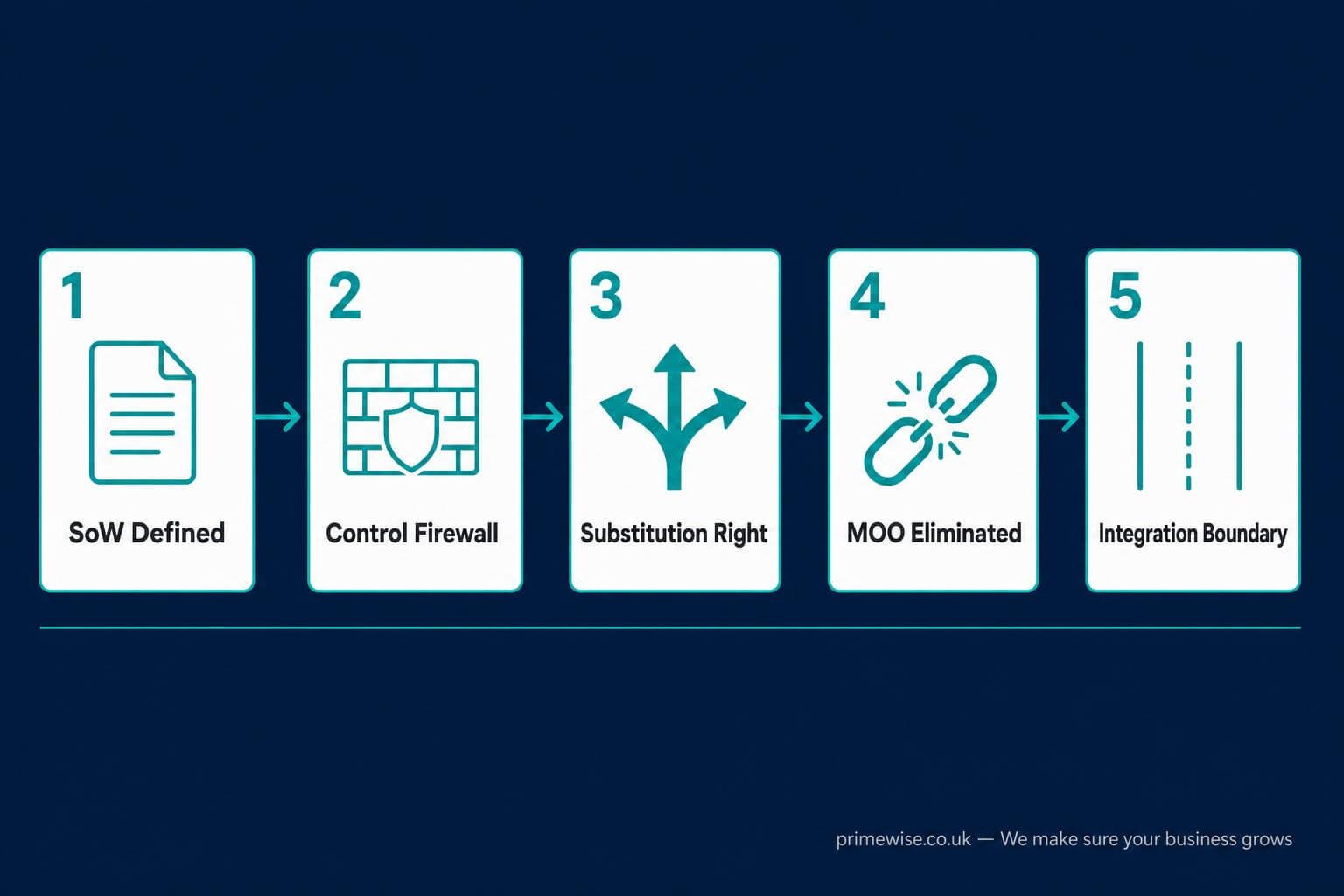
The Fractional Executive IR35 Safe Harbour Framework
Primewise has developed a practical five-point compliance framework specifically for UK businesses engaging fractional C-suite talent. Rather than relying on generic contractor guidance, this framework translates the HMRC employment status tests into actionable operational standards for executive engagements. Every fractional CMO engagement facilitated through Primewise is structured against these five criteria from day one, with pre-drafted, legally reviewed documentation available to clients as part of the engagement setup process.
- Deliverable-Based Statement of Work: The engagement is anchored to specific, measurable growth outcomes not to the provision of time or availability. Fixed-fee milestone payments replace salary equivalents entirely.
- Control Firewall: The contract explicitly prohibits the client from directing the CMO’s working methodology, hours, or toolset. Strategic objectives are set collaboratively; execution autonomy belongs to the CMO.
- Unrestricted Substitution Clause: The PSC retains the right to substitute a senior equivalent, with client approval limited to objective competency criteria. No personal service language is included.
- MOO Elimination: Each project phase is documented as a discrete commercial engagement. No language implies rolling continuation or an expectation of future work.
- Integration Boundary Protocol: The CMO does not receive company equipment, a corporate email address without external consultant identification, equity through standard employee schemes, or a place on the organisational chart. Board attendance is advisory and documented as such.
The Statement of Work The Foundation of Compliance
A robust Statement of Work (SoW) is the single most important document in an outside IR35 fractional engagement. Unlike a traditional employment contract, which defines a role and a reporting line, an IR35-compliant SoW defines outcomes, not inputs. It should specify the strategic deliverables expected within the engagement period for example, a go-to-market strategy for a new product vertical, a measurable uplift in qualified pipeline, or a defined content and SEO framework and tie payment to the achievement of those milestones rather than to hours worked or days attended.
Under Section 61NA of ITEPA 2003, where a Status Determination Statement is required, the SoW forms the primary evidential document against which the client’s IR35 assessment is evaluated. A well-structured SoW for a Fractional CMO should include: a clearly scoped project description with defined start and end dates; specific, measurable deliverables with associated milestone payment triggers; an explicit statement that the CMO is engaged as an independent contractor through their PSC; substitution rights language meeting the HMRC compliance standard; confirmation that the client cannot assign tasks outside the documented scope without a new SoW being executed; and a fee structure based on project value rather than time-and-materials billing that mirrors a salary.
Compliance WarningUsing a corporate email address without an explicit external consultant signature, supplying company-owned hardware, or integrating the Fractional CMO into your HR system as a worker are individually low-risk but cumulatively constitute the 'part and parcel' integration test that HMRC uses to argue disguised employment. Each of these factors alone has contributed to adverse tribunal findings.
The UK Small Company Exemption A Critical Nuance for Scale-Ups
The April 2021 off-payroll working reforms extended the Chapter 10 ITEPA 2003 rules to the private sector but critically, they included a small company exemption. Under Section 382 of the Companies Act 2006, a business qualifies as small if it meets at least two of the following three criteria: annual turnover below £10.2 million, a balance sheet total under £5.1 million, or fewer than 50 employees. Where a business qualifies as small, the legal responsibility for determining IR35 status and any associated tax liability shifts from the client business to the contractor’s PSC.
However, there is a critical nuance that the vast majority of online guidance omits: a company must satisfy those two-of-three criteria for two consecutive financial years before the exemption applies. A business that breached a single threshold in the prior year may incorrectly believe it retains the exemption when it has already lost it. Furthermore, the connected persons and group company aggregation rules under the Companies Act mean that a subsidiary which individually qualifies as small may lose its exemption entirely if its parent group exceeds the thresholds in aggregate. This is the most frequently misapplied aspect of the rules among UK scale-ups with holding company structures, and it is precisely the scenario that triggers retrospective HMRC assessments. Any business within two years of breaching these thresholds should seek a formal status determination review rather than assuming continued exemption.
Scale-Up Pitfalls That Destroy Outside IR35 Status
High-growth UK tech businesses and Series A scale-ups consistently fall foul of the part and parcel test of employment the principle that an individual who is genuinely embedded in the operational fabric of a business is more likely to be an employee than a contractor. The following practices individually raise IR35 risk and cumulatively create a near-insurmountable presumption of employment for HMRC inspectors.
- Awarding Enterprise Management Incentive (EMI) share options or including the CMO in an EIS or SEIS equity scheme structured for employees
- Providing company-owned equipment including laptops, mobile devices, or software licences without a documented commercial justification
- Assigning the CMO voting rights or a formal directorship on the main board rather than documenting board appearances as advisory
- Including the CMO in standard all-staff communications, company-wide performance reviews, or internal HR processes
- Using a corporate email address format identical to employees without external consultant identification in the signature block
- Offering discretionary annual bonuses tied to company performance rather than milestone-based SoW payments
IR35 Insurance and Professional Risk Mitigation
Even where an engagement is correctly structured and documented, HMRC retains the right to investigate. An IR35 investigation typically runs for 12 to 18 months based on tribunal disclosure patterns, consuming significant management time and legal resource. IR35 insurance offered in the UK primarily by specialist providers such as Qdos and Kingsbridge provides indemnity cover for backdated tax liabilities, legal representation costs, and NIC exposure arising from an adverse status determination. For fractional C-suite engagements, where the daily rates and associated deemed employment tax calculations are materially higher than standard contractor roles, IR35 insurance is a cost-effective risk transfer mechanism that boards should consider alongside contractual compliance measures.
The HMRC Check Employment Status for Tax (CEST) tool provides a useful starting baseline for status assessment, but businesses should be aware of a critical limitation: HMRC explicitly states that CEST results are not legally binding, and the tool has been widely criticised for failing to adequately model the mutuality of obligation test. Relying solely on a CEST determination as proof of outside IR35 status would not withstand tribunal scrutiny. Formal status opinions from a Chartered Tax Adviser accredited by the Chartered Institute of Taxation (CIOT), or from an employment law solicitor regulated by the Solicitors Regulation Authority, provide materially stronger evidential weight in any HMRC challenge.
Expert InsightHMRC's 2023-24 compliance enforcement report confirmed £1.6 billion in off-payroll working compliance yield across medium and large businesses. As scale-ups approach the small company exemption thresholds, they move into the highest-risk enforcement bracket with the least institutional preparation. Early professional advice on IR35 structuring consistently costs a fraction of the retrospective tax exposure it prevents.
Practical Financial Exposure for Noncompliant Engagements
The financial consequences of an adverse IR35 determination for a senior fractional role are not abstract. Consider a Fractional CMO engaged on a daily rate equivalent to £120,000 per annum through a PSC over a two-year period. An HMRC reclassification would generate backdated PAYE income tax at the higher rate, employer NICs at 13.8 percent on deemed earnings, employee NICs, interest on late payment, and potentially a penalty surcharge depending on whether HMRC concludes the error was careless or deliberate. In realistic executive-rate scenarios, aggregate liability routinely exceeds £100,000, with cases involving multiple senior contractors generating exposures in the mid six figures. The reputational dimension HMRC compliance notices are discoverable during due diligence processes can materially affect investment rounds and acquisition valuations for growth-stage UK businesses.
Businesses navigating this complexity can access pre-vetted, IR35-compliant Fractional CMO engagements through Primewise, where commercial terms, Statement of Work frameworks, and contractor vetting are structured to satisfy all three HMRC employment status tests from day one. Primewise clients receive a pre-drafted, legally reviewed Status Determination Statement template and a compliant SoW framework as standard components of every fractional engagement setup, eliminating the most common documentation failures that trigger adverse HMRC assessments.
Inside IR35 Versus Outside IR35 Executive Indicator Comparison
The following comparison table translates the three HMRC employment status tests into observable, real-world indicators specific to senior marketing leadership engagements. This reference framework is designed for HR Directors and General Counsel assessing an existing or proposed fractional arrangement against HMRC’s published Employment Status Manual criteria.
| Factor | Inside IR35 Employment Indicators | Outside IR35 Contractor Indicators |
|---|---|---|
| Control | Client directs working hours, tools, and methodology | CMO controls execution; client sets objectives only |
| Substitution | Personal service required; no substitution right | PSC can provide qualified substitute; client approval limited to competency |
| Mutuality of Obligation | Rolling engagement; expectation of continuous work | Discrete project scope; no obligation beyond SoW |
| Integration | On org chart, company email, HR appraisals | External consultant ID, no corporate systems integration |
| Equipment | Company-supplied hardware and software | CMO provides own professional tools |
| Financial Risk | Fixed remuneration regardless of outcome | Milestone payments; commercial risk borne by PSC |
| Equity and Benefits | EMI options, bonuses, pension contributions | No employment benefits; performance tied to SoW milestones |
Key IR35 Dates and Legislative Timeline
Understanding how the current rules arrived at their present form helps UK business leaders appreciate why compliance processes have become so rigorous and why HMRC’s enforcement posture has intensified sharply since 2021.
- 2000: Original IR35 legislation introduced via the Finance Act, applying to all sectors with the contractor’s PSC holding status determination responsibility
- April 2017: Off-payroll working rules extended to the public sector, shifting status determination responsibility to the client body for public sector engagements
- April 2021: Chapter 10 ITEPA 2003 reforms extended to the private sector for medium and large businesses, including the small company exemption framework
- September 2022: The Kwarteng mini-budget announced repeal of the 2017 and 2021 reforms a decision reversed within weeks, with the Chapter 10 rules reinstated in full
- 2023 onwards: HMRC enforcement activity intensifies; off-payroll working compliance yield included explicitly in HMRC annual performance reporting
Next Steps for UK Executives
The fractional CMO model delivers genuine strategic value for UK SMEs but only when the engagement is structured with the same rigour applied to any material commercial contract. The three HMRC tests are not bureaucratic obstacles; they are the architecture of a compliant, commercially durable relationship that protects both the business and the contractor. For businesses approaching the small company exemption thresholds, the priority action is an immediate review of whether the exemption still applies and whether existing fractional arrangements reflect genuine outside IR35 working practices in substance, not just in writing.
Primewise structures every fractional CMO engagement with IR35 compliance built into the commercial foundation including verified PSC arrangements, compliant SoW templates, Status Determination Statement frameworks, and substitution clause language reviewed against current HMRC Employment Status Manual standards. For UK CEOs and HR Directors seeking to engage senior marketing leadership without regulatory exposure, engaging through a platform that has systematised compliance from the outset is the most direct path to risk elimination.
This article constitutes general educational guidance only and does not represent formal legal or tax advice. UK businesses engaging fractional executive talent should seek a formal status opinion from a Chartered Tax Adviser accredited by the CIOT or from an employment law solicitor regulated by the SRA before finalising any off-payroll engagement. Last reviewed: June 2026.