
A fractional CMO for fintech is the most capital-efficient way for a scaling UK financial technology business to access executive-level marketing leadership without committing to a £150,000–£220,000 base salary, equity package, and 12-month onboarding cycle. For venture-backed founders operating under FCA authorisation, the commercial logic is immediate: part-time engagements typically run between £4,000 and £9,000 per month, deliver strategic direction from day one, and critically bring deep regulatory fluency that generalist agencies and junior marketers structurally cannot replicate. This article sets out exactly what a fractional fintech CMO does, what it costs, how it navigates the UK compliance landscape, and what a founder should expect across the first 90 days of an engagement.
WHO THIS ARTICLE IS FORThis guide is written for fintech founders, CEOs, and PE/VC investors at Series A and Series B stage who need senior marketing leadership now but are not yet at the scale, budget, or operational maturity to justify a permanent full-time hire. It covers FCA compliance integration, B2B2C distribution strategy, and the structured frameworks Primewise uses to unblock regulated growth.
What a Fractional Fintech CMO Actually Does
A fractional fintech CMO is a part-time or interim Chief Marketing Officer who specialises exclusively in regulated financial services environments. Unlike a generalist marketing director hired through a traditional agency, a fractional CMO for fintech brings operational familiarity with the Financial Conduct Authority’s conduct rules, the Section 21 financial promotions regime under the Financial Services and Markets Act 2000, and the FCA’s Consumer Duty outcomes framework introduced under PS22/9. They design scalable, compliance-led growth strategies, oversee customer acquisition architecture across both direct and B2B2C distribution channels, and act as the institutional bridge between commercial revenue targets and internal legal and compliance functions. The engagement is typically structured on a two to four day per week basis, with clear deliverables tied to OKRs rather than time spent.
The practical distinction from a retained agency is critical. An agency executes campaigns within a brief it has been given. A fractional CMO writes the brief, owns the strategy, challenges the product roadmap, and sits in the room when the board discusses capital allocation. That strategic proximity to the decision-making layer is precisely what scaling fintechs require when navigating a growth inflection point whether that is preparing for a Series B raise, launching a new payment product, or entering an adjacent market such as embedded lending or insurtech.
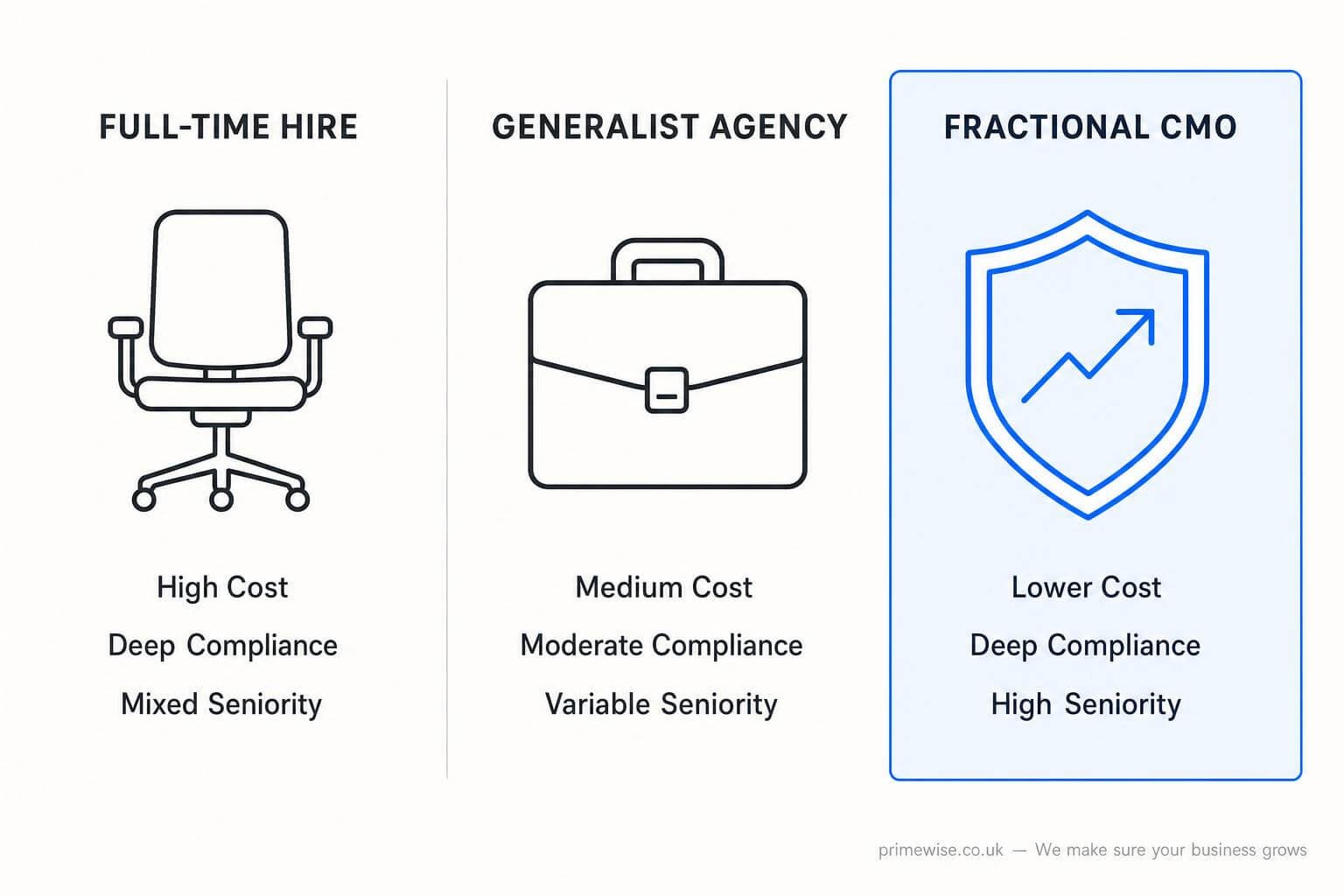
Fractional CMO vs Full-Time CMO vs Generalist Agency for UK Fintechs
The resource allocation decision is rarely straightforward. Each option carries a distinct cost profile, capability ceiling, and risk exposure for a regulated financial services business. Understanding the structural differences before committing budget is essential for founders who are accountable to investors for every pound of runway consumed.
A full-time Chief Marketing Officer at a UK fintech commands an average base salary of £155,000–£220,000 according to LinkedIn Salary Insights and Beauhurst’s 2024 UK tech talent benchmarks, before accounting for employer National Insurance contributions, pension obligations, equity vesting schedules, and a recruitment fee that typically represents 15–20% of first-year salary. The total cost of a full-time CMO in year one routinely exceeds £280,000. For a Series A fintech that has raised £5–£12 million, deploying that level of fixed overhead into a single marketing hire before the go-to-market model is commercially validated is an aggressive capital risk. It burns runway before the strategy has been stress-tested.
Generalist B2B agencies present a different but equally serious problem. Their retainer structures typically £8,000–£25,000 per month for a senior team appear cost-effective until the business encounters its first FCA compliance review of a campaign asset. According to the FCA’s Financial Promotions Annual Report, the regulator issued over 10,000 interventions against non-compliant financial promotions in 2023 alone, with a disproportionate number targeting smaller authorised firms and their marketing partners who lacked sector-specific regulatory training. An agency that does not understand COBS 4.2 fair, clear and not misleading standards, or the new Section 21 gateway rules that came into force in February 2024 requiring FCA-authorised firms to formally approve promotions for unauthorised entities, is not just a strategic liability it is a compliance liability that can result in enforcement action, public censure, or FCA-imposed restrictions on financial promotions.
| Resource Type | Indicative Monthly Cost | FCA Regulatory Expertise | Strategic Seniority | Runway Impact |
|---|---|---|---|---|
| Full-Time CMO | £13,000–£18,000+ all-in | Variable sector-specific only if explicitly hired | Embedded, long-term | High fixed burn |
| Generalist Agency | £8,000–£25,000 retainer | Typically absent or superficial | Tactical execution focus | Medium burn, high compliance risk |
| Fractional CMO | £4,000–£9,000 engagement | Deep, operationally embedded | Immediate executive direction | Optimised variable cost |
Fractional leadership resolves both problems simultaneously. It delivers the institutional-grade strategic intelligence of a senior CMO at a cost structure that preserves runway, while providing the regulatory depth that generic agencies categorically lack. For a Series A or Series B fintech operating in payments, lending, wealthtech, or insurtech, this is not a compromise model; it is the architecturally correct model for the growth stage.
PRIMEWISE ENGAGEMENT MODELPrimewise works with Series A and Series B UK fintechs as an embedded fractional marketing partner. If your current growth architecture is creating compliance friction or burning runway on campaigns that stall in legal review, a confidential 30-minute diagnostic call is the fastest way to identify exactly where the bottlenecks are. Explore the engagement model at primewise.co.uk.
The Compliance-First Growth Matrix
The single most persistent operational failure inside scaling fintechs is the structural antagonism between the marketing function and the legal and compliance team. Marketing presents a campaign; legal raises objections; the campaign is delayed, diluted, or abandoned. This cycle does not reflect a failure of legal it reflects a failure of the marketing strategy to be designed with compliance as an input rather than as a final checkpoint. The Compliance-First Growth Matrix is the proprietary operational framework that Primewise deploys to permanently resolve this bottleneck.
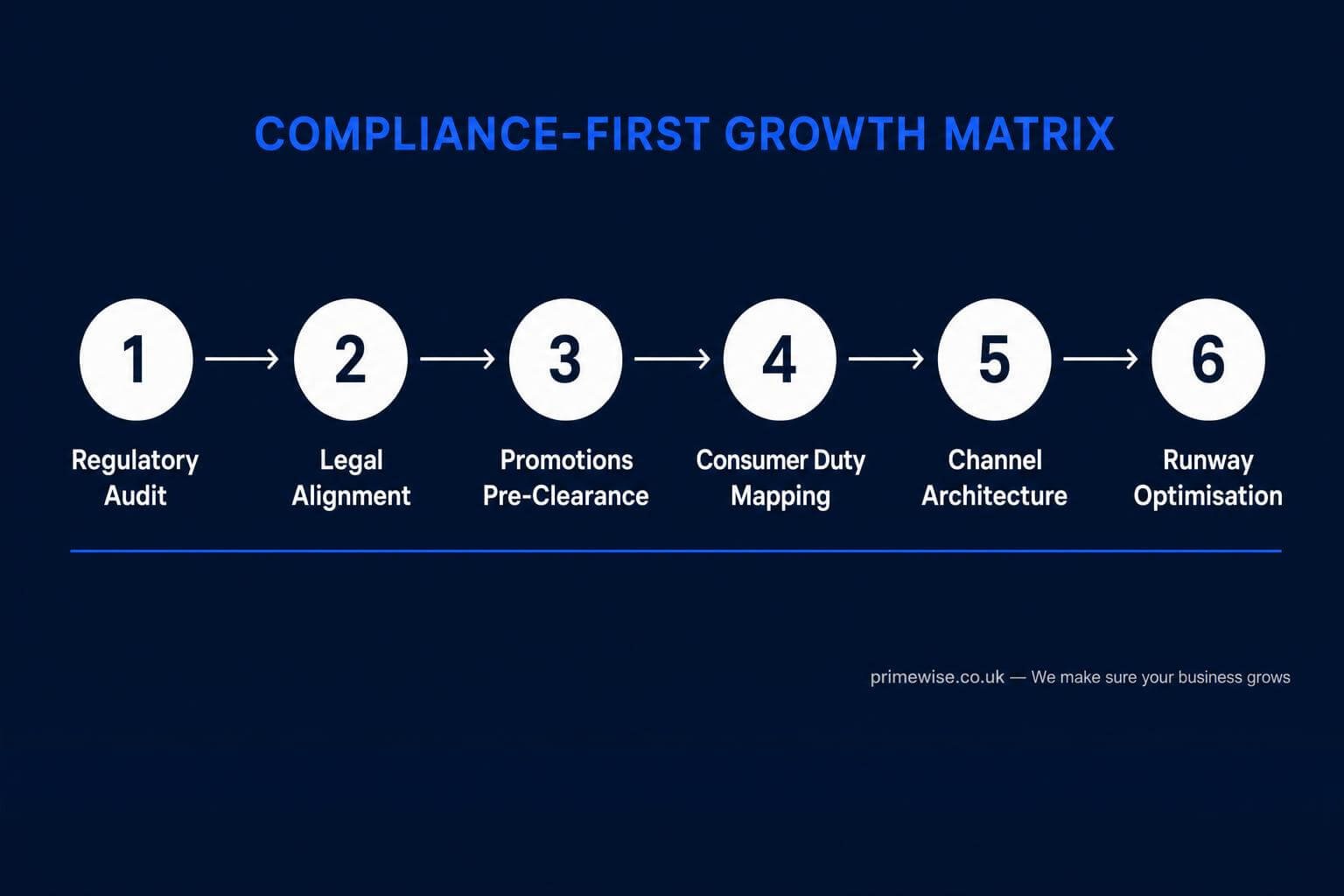
The matrix restructures the relationship between growth strategy and regulatory governance across six named stages. Each stage produces a documented output that is simultaneously a commercial asset and a compliance artefact, meaning that legal review accelerates rather than impedes campaign deployment. Below is the complete framework.
Stage One Regulatory Asset Audit
Every live marketing asset landing pages, paid search copy, email sequences, partner co-marketing materials, investor-facing communications, and social content is assessed against COBS 4.2 standards and the Consumer Duty’s cross-cutting rules on communications. The audit produces a risk-graded asset register that identifies non-compliant language, unsubstantiated performance claims, and missing regulatory disclosures. This stage alone routinely uncovers three to seven material compliance exposures in a typical fintech’s existing marketing estate that no internal team has formally documented.
Stage Two Legal-Marketing Alignment Protocol
A structured working agreement is established between the marketing function and the compliance and legal team. This includes a shared taxonomy of approved language, a tiered review process that distinguishes low-risk brand communications from high-risk financial promotions requiring Section 21 approval, and a named compliance liaison within the legal team who is embedded into the campaign planning calendar at ideation stage rather than final-review stage. This protocol typically reduces legal review turnaround time by 40–60% within the first 60 days of implementation because the volume of substantive objections falls dramatically when compliance is consulted early.
Stage Three Financial Promotion Pre-Clearance Framework
Under the Financial Services and Markets Act 2000 and the amended gateway rules effective February 2024, all financial promotions must either be communicated by an FCA-authorised firm or approved by one. The pre-clearance framework establishes a documented internal workflow for categorising each campaign asset by promotion type, determining the applicable approval pathway, and maintaining an auditable record of approvals. This is not a bureaucratic exercise it is a commercial accelerant, because campaigns that have been pre-cleared against a documented framework move from ideation to live deployment significantly faster than those navigating ad-hoc legal reviews.
Stage Four Consumer Duty Outcome Mapping
The FCA’s Consumer Duty, which came into full effect for closed book products in July 2024 following the initial implementation deadline of July 2023, requires firms to demonstrate that their communications actively support good consumer outcomes. The FCA’s first Consumer Duty findings report, published in early 2024, identified widespread gaps in outcome monitoring, particularly among smaller authorised firms that lacked structured processes for evidencing that communications were enabling customers to make effective and timely decisions. The outcome mapping stage translates these regulatory obligations into specific messaging standards and content audit checkpoints that the marketing team can operationalise without requiring legal review at every touchpoint.
Stage Five Compliant Acquisition Channel Architecture
With the regulatory foundation secured, the acquisition channel strategy is designed from first principles. Each channel paid search, organic content, partner distribution, account-based marketing for B2B, and embedded finance co-marketing is assessed for its compliance risk profile, cost-per-acquisition efficiency, and alignment with the product’s distribution model. For B2B2C fintechs operating through partner or platform intermediaries, this stage explicitly maps the communication responsibilities across each layer of the distribution chain, ensuring that neither the platform nor its partners inadvertently issue non-compliant financial promotions to end consumers.
Stage Six Performance and Runway Optimisation Loop
The final stage establishes a continuous measurement and optimisation cycle. Marketing spend is mapped against FCA-approved acquisition channels, customer lifetime value metrics, and runway consumption rate. The loop produces a monthly marketing efficiency report that the CEO and CFO can present directly to the board or investor group, demonstrating that the marketing function is operating as a capital-efficient growth driver rather than an uncontrolled cost centre. This reporting cadence also satisfies the Consumer Duty requirement for ongoing outcome monitoring, creating a single artefact that serves both commercial and regulatory governance purposes simultaneously.
Sector-Specific Expertise Across the UK Fintech Ecosystem
A fractional CMO for fintech must carry genuine operational depth across the distinct sub-sectors of the UK financial technology landscape, because the growth challenges, distribution models, and regulatory pressure points in payments are structurally different from those in wealthtech, lending, or insurtech. London’s fintech ecosystem anchored around Level39 in Canary Wharf and the Silicon Roundabout cluster in Shoreditch is the most densely competitive regulated technology market in Europe, and differentiation demands sector-specific strategic precision rather than generic digital marketing playbooks.
Payments and Embedded Finance
Marketing payment infrastructure and embedded finance products requires a sophisticated B2B2C value proposition architecture. The end consumer does not interact with the payment rail they interact with the merchant or platform that has embedded it. This means the primary acquisition motion is a B2B sales and partner marketing strategy targeting payment facilitators, platform operators, and software vendors, while the secondary motion involves supporting those partners in communicating the product’s benefits compliantly to their own end-user base. A fractional CMO experienced in payments understands how to build merchant acquisition strategies that communicate technical resilience, API integration quality, and commercial pricing structures to a technical and commercial buyer simultaneously. Open Banking maturity in the UK where the Open Banking Implementation Entity reports over ten million active users as of 2024 creates an additional layer of complexity and competitive opportunity that generalist marketers are simply not equipped to navigate strategically.
Wealthtech and Institutional Trust
Wealth management platform marketing operates in an environment where a single non-compliant claim can destroy institutional credibility irreversibly. The FCA’s COBS 4 rules on financial promotions are at their most exacting in the investment and wealth management space, where past performance disclaimers, fair and balanced presentation of risk, and the absolute prohibition on guaranteed return claims require meticulous copy governance. A fractional CMO in wealthtech builds messaging hierarchies anchored in verifiable third-party data, assets under management milestones, regulatory authorisation status, and genuine thought leadership on investment philosophy. The goal is to grow assets under management through institutional authority rather than direct response, advertising a fundamentally different growth motion that demands a marketer who understands fiduciary positioning.
Lending and Consumer Credit
Consumer credit marketing carries some of the highest regulatory exposure of any fintech sub-sector. Representative APR requirements, affordability messaging, and the Consumer Duty’s specific obligations around vulnerable customer communications create a compliance surface that is unusually broad. A fractional CMO in the lending space must simultaneously manage the commercial imperative to grow loan origination volume and the regulatory imperative to ensure that marketing does not incentivise over-borrowing or obscure the true cost of credit. The Financial Conduct Authority’s sustained scrutiny of consumer credit promotions, including specific guidance on the use of promotional incentives and introductory rate advertising, makes this a domain where senior regulatory marketing experience is not optional.
Insurtech and RegTech
Insurtech disruptors and RegTech platform vendors face a dual positioning challenge: they must communicate the innovative nature of their technology to attract venture capital attention and enterprise clients, while demonstrating the institutional reliability and regulatory alignment that risk-averse financial services buyers require before committing procurement budget. A fractional CMO in these sectors builds a content and thought leadership strategy that navigates this tension positioning the business as technically sophisticated and commercially proven without making claims that the FCA’s insurance product governance rules or financial promotions regime would treat as misleading.
The 90-Day Fractional CMO Roadmap for Fintech Scale-Ups
The following phased roadmap details the specific deliverables, KPIs, and operational milestones that Primewise establishes at the outset of every fractional CMO engagement with a UK fintech. It is designed to move a business from compliance-blocked stagnation to scalable, FCA-approved customer acquisition within a single quarter.
Days 1 to 30 Regulatory Audit and Foundational Strategy
The first thirty days are entirely focused on risk elimination and strategic alignment. By Day 30, one hundred percent of live financial promotions across all active channels will have been audited against COBS 4.2 fair, clear, and not misleading standards. A compliance risk matrix will be documented, identifying every material exposure within the existing marketing estate. The Section 21 financial promotion approval workflow will be formalised, with a named approval contact within the FCA-authorised firm structure. The overarching marketing strategy will be aligned with both the commercial revenue targets set by the CEO and the risk appetite defined by the Head of Compliance. A competitive positioning analysis will be completed across the fintech’s primary UK market segment. The output of this phase is a single foundational document: the Compliant Growth Strategy Brief, which serves as the agreed strategic mandate for the remainder of the engagement.
Days 31 to 60 Go-to-Market Architecture
With risk managed and strategy agreed, the second month focuses on building the acquisition infrastructure. The customer acquisition funnel is rebuilt to integrate compliance approval as a seamless operational step rather than a late-stage blocker. By Day 60, the Legal-Marketing Alignment Protocol from the Compliance-First Growth Matrix will be fully operational, with a documented tiered review process reducing average campaign approval time. The go-to-market strategy for the primary acquisition channel, whether that is paid search, content-led organic, account-based marketing, or partner co-distribution, will be fully specified and approved. Junior marketing staff will have been trained on the compliance taxonomy and pre-clearance workflow, eliminating the structural dependency on the CMO as the sole compliance filter. Key messaging frameworks tailored to the specific distribution model B2B, B2B2C, or direct will be finalised and approved by legal.
Days 61 to 90 Scaling Acquisition and Extending Runway
The final foundational phase activates commercial growth. By Day 90, the first fully compliant paid acquisition campaigns will be live across approved channels, with tracking frameworks measuring cost-per-acquisition, conversion rate by channel, and lead quality by segment. B2B pipeline development for partnership and enterprise channels will be progressing against a documented account-based marketing target list. The monthly marketing efficiency report format will be established and presented to the board or investor group. The budget optimisation review will identify any legacy spend that is not generating qualified acquisition and redirect it to higher-intent channels. The business will exit the 90-day engagement phase with a documented, repeatable, FCA-compliant growth system that the internal team can operate and scale independently, or that the fractional CMO continues to develop under a retained ongoing engagement.
DOWNLOAD RESOURCEPrimewise provides a Fintech Financial Promotions Compliance Checklist a structured pre-clearance tool covering COBS 4.2 standards, Section 21 gateway obligations, and Consumer Duty communication requirements. Request access at primewise.co.uk to receive the checklist directly to your inbox.
Building the Fintech Trust Funnel
The most durable competitive advantage available to a UK fintech is not its technology stack, it is the institutional trust its marketing communications generate over time. In an environment where the FCA’s Consumer Duty has redefined the standard of care that authorised firms owe to their customers, and where the regulator actively monitors the quality of firm communications as part of its supervisory framework, trust-led messaging is simultaneously the most defensible brand strategy and the most compliant one.
The Fintech Trust Funnel is a messaging architecture that positions the business’s regulatory credentials, transparency, and customer outcome focus as primary conversion drivers rather than afterthought disclaimers. At the top of the funnel, content marketing and thought leadership establish the firm as an authoritative, knowledgeable voice within its specific sector, whether that is open banking payments, embedded lending, or digital wealth management. This content is structured to satisfy the FCA’s requirement that communications be fair, clear and not misleading, while simultaneously building the organic search presence and AI citation footprint that drives inbound lead generation at scale. At the mid-funnel, case studies, data-backed performance evidence, and regulatory milestone communications FCA authorisation anniversaries, Consumer Duty compliance statements, and FSCS protection confirmations convert initial interest into qualified engagement. At the bottom of the funnel, the trust architecture enables conversion without resorting to high-pressure tactics or sensationalist performance claims that would attract FCA scrutiny. The result is a customer acquisition system that is inherently compliant, institutionally credible, and commercially scalable.
When Should a Fintech Hire a Fractional CMO
The optimal entry point for a fractional CMO engagement is typically at or immediately following a Series A raise, when the business has validated its core product-market fit, secured initial regulatory authorisation or an appointed representative arrangement, and is ready to build a repeatable, scalable go-to-market system. At this stage, the business needs genuine strategic marketing leadership, not a junior head of marketing executing campaigns without institutional context, and not an agency producing content without regulatory fluency. The fractional model delivers exactly the seniority the moment requires, at a cost structure the Series A runway can comfortably absorb.
The fractional CMO model also applies at other critical inflection points: when a scaling fintech is preparing for a Series B raise and needs to demonstrate marketing-led revenue growth to prospective investors; when the business is launching a new product line such as expanding from payments into embedded lending that requires a distinct go-to-market strategy; when a compliance review has identified material gaps in the marketing function’s regulatory knowledge; or when the incumbent marketing lead has departed and the business needs senior coverage while a permanent search is conducted. In each scenario, the fractional engagement provides executive continuity and strategic momentum without the delay and cost of a permanent hire.