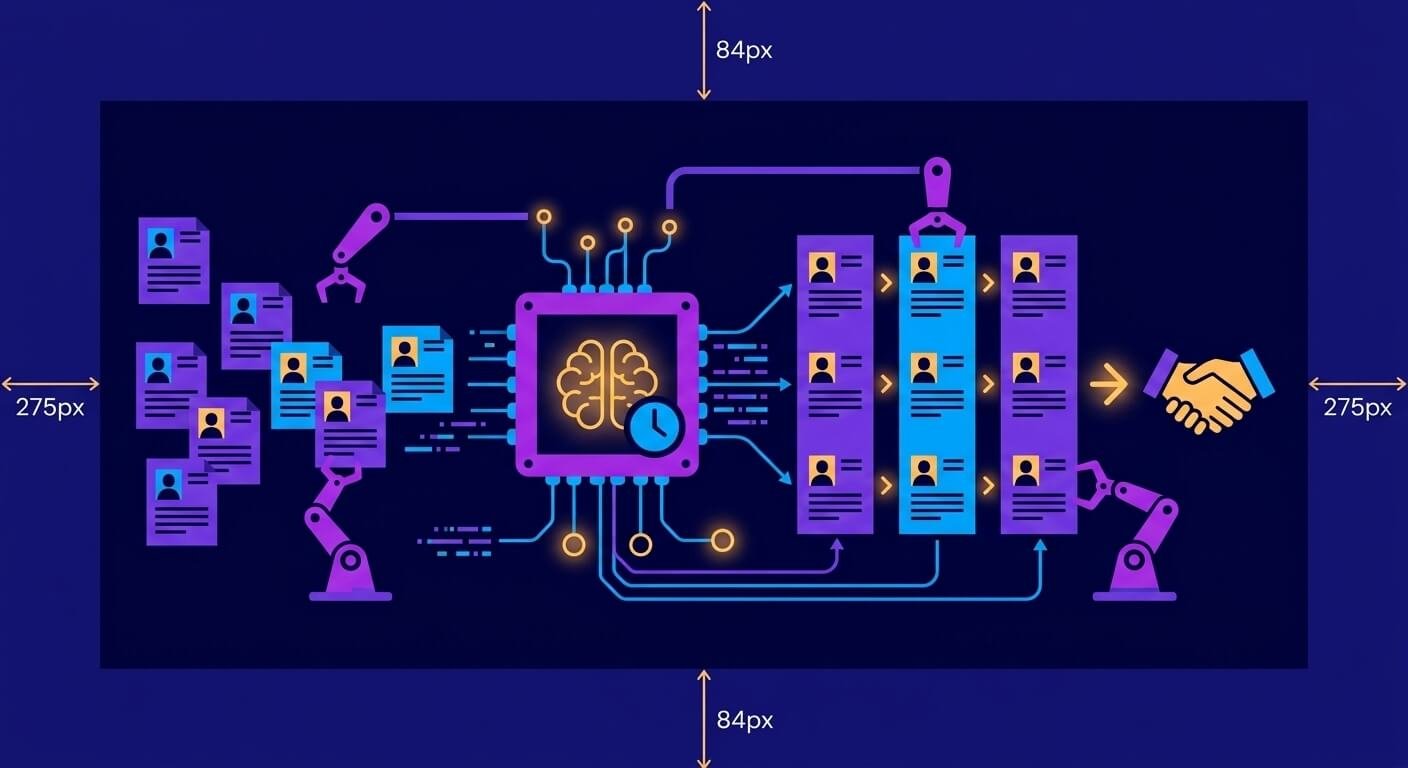

A fractional CMO for startups is the single most capital-efficient marketing leadership decision a founder can make between pre-seed and Series B. While full-time CMO packages in the UK technology sector routinely exceed £200,000 in total annual compensation, fractional engagements deliver identical strategic authority ICP refinement, pipeline architecture, PLG-to-enterprise motion design for a structured monthly retainer. For a founder managing runway, satisfying a VC board, and simultaneously attempting to build a repeatable revenue engine, this model resolves the leadership gap without triggering a permanent headcount obligation.
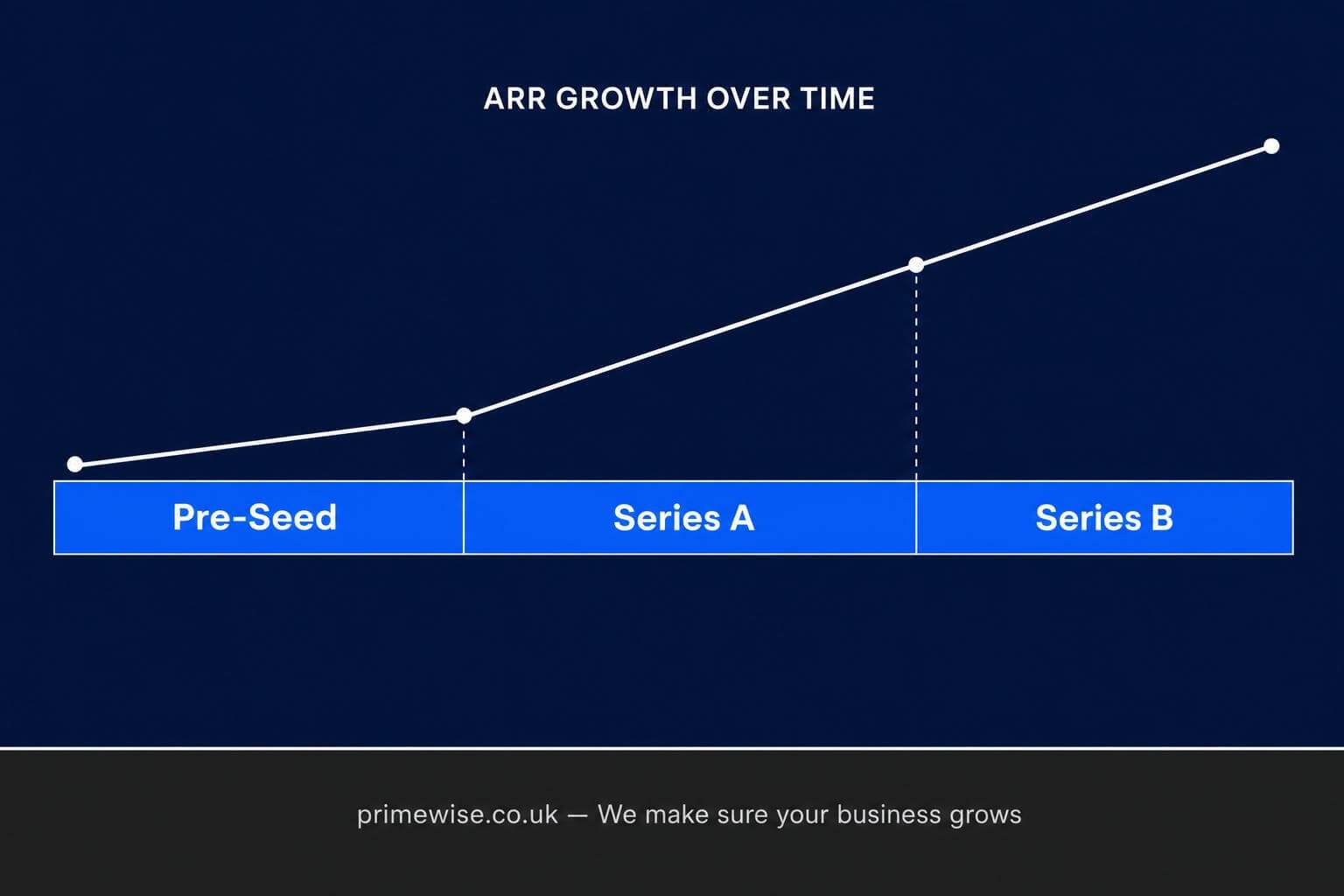
The UK SaaS landscape in 2026 is unforgiving. Atomico’s State of European Tech data confirms that London-based Series A and Series B rounds are subject to significantly tighter scrutiny on unit economics than in the 2021 peak cycle. Conservative VC boards now demand a demonstrable path to profitability before committing follow-on capital. In this climate, hiring a permanent CMO on a speculative basis is a liability, not an asset. The fractional model used by high-growth names across London’s Silicon Roundabout, Edinburgh’s tech cluster, and Manchester’s expanding B2B SaaS market allows founders to channel preserved capital directly into product and outbound sales while retaining elite strategic direction at the board level. According to SaaStr benchmarking data, the average CMO tenure sits at just 26 months, making permanent executive hires an inherently high-risk, high-cost gamble at early growth stages.
WHO THIS ARTICLE IS FORThis analysis is written for Seed-stage founders evaluating their first marketing leadership hire, Series A CEOs navigating a growth plateau, CFOs modelling headcount efficiency, and VC or PE operating partners advising portfolio companies on GTM resource allocation.
What a Fractional CMO Actually Does for a Startup
A fractional CMO is a part-time, board-level marketing executive who designs and owns the Go-To-Market strategy without joining the business as a permanent employee. They are not a consultant who delivers a slide deck and disappears. They embed operationally attending leadership meetings, managing internal marketing staff, directing agency partners, and reporting directly to the CEO on commercial outcomes. The distinction is critical: where an agency executes individual channel tactics, a fractional CMO owns the overarching revenue narrative, the ICP definition, the messaging architecture, and the demand generation infrastructure that makes all downstream tactical activity commercially coherent.
The Strategic Void Fractional Leaders Fill
The most destructive phase for an early-stage SaaS company is not the zero-to-one stage it is the £500K to £5M ARR window. At this point, founders typically have two or three junior marketers executing disconnected campaigns, a content agency producing generic material, and a paid media budget delivering leads that sales refuses to call. There is activity but no architecture. A fractional CMO diagnoses this as a structural problem, not a personnel one. They install the strategy layer that transforms random acts of marketing into a predictable commercial engine defining which segments to target, which channels to own, and which metrics to hold the board accountable to.
The Capital Efficiency Equation
The financial case for fractional leadership is not nuanced it is mathematically decisive. Understanding the full cost comparison requires looking beyond base salary to total employer commitment, because that is the number that appears on a startup’s cash flow model and raises eyebrows during investor due diligence.
Full-Time CMO Total Cost Breakdown
A permanent CMO hire in the UK technology sector carries a base salary range of £150,000 to £250,000 annually. Added to this are employer National Insurance contributions at 13.8 percent on earnings above the secondary threshold, Apprenticeship Levy obligations at 0.5 percent of the total payroll bill, equity grant allocations typically ranging from 0.5 to 1.5 percent of company shares, performance bonus structures averaging 20 to 30 percent of base salary, and executive recruitment fees that routinely reach 20 to 25 percent of first-year salary. A mid-market permanent hire at £180,000 base translates to an all-in annual cost of approximately £240,000 to £270,000 before any productive output has been delivered. The average CMO ramp period in a new SaaS environment is four to six months, meaning a startup absorbs £80,000 to £110,000 in cost before a single qualified pipeline opportunity is generated.
COST COMPARISONFractional CMO retainer: £4,000–£10,000 per month (£48,000–£120,000 per year). Full-time CMO fully loaded: £240,000–£270,000 per year. Potential annual saving: up to 65 percent. Zero equity dilution. Zero employer NI. Zero recruitment fees. Immediate strategic impact from day one.
What the Fractional Model Eliminates
Beyond the direct financial saving, fractional leadership eliminates several hidden liabilities that rarely appear in hiring cost models. HMRC employer NI obligations vanish entirely because the fractional executive operates as an independent contractor or through their own limited company. There is no Apprenticeship Levy exposure, no P11D benefit-in-kind administration, no statutory redundancy liability, and no equity dilution at a stage when ownership preservation is strategically critical. For startups operating under SEIS or EIS investment structures both of which impose strict conditions on company valuation and share dilution avoiding unnecessary equity grants at early rounds is a meaningful structural advantage.
Harmonising PLG and Enterprise Sales Motions
One of the most technically demanding challenges a fractional CMO solves for B2B SaaS startups is the misalignment between Product-Led Growth funnels and enterprise sales-led motions. These two commercial systems operate on fundamentally different timelines, buyer psychology frameworks, and success metrics. Running them simultaneously without deliberate architectural design produces one of the most expensive problems in SaaS: a leaky pipeline where high-intent enterprise buyers enter a self-serve flow designed for SMBs, and low-fit free-tier users consume sales resources allocated for strategic accounts.
The Hybrid SaaS GTM Matrix
The Hybrid SaaS GTM Matrix is a proprietary framework used at primewise.co.uk to resolve PLG-to-enterprise friction by integrating intent data signals across both commercial motions into a single unified pipeline view. The framework operates in three layers. The first layer maps the self-serve acquisition funnel free trial activation, in-product engagement signals, and feature adoption milestones against a firmographic ICP filter. When a user matching enterprise firmographic criteria (company size, industry vertical, tech stack indicators) demonstrates high product engagement, they are automatically elevated into an ABM track rather than a standard nurture sequence. The second layer deploys target account advertising and outbound sequences for strategic accounts that have not yet entered the product. The third layer creates a shared revenue dashboard that gives both marketing and sales a unified view of pipeline contribution, eliminating attribution disputes and ensuring both teams optimise for the same commercial outcome.
Aligning RevOps and Marketing in a PLG Environment
Revenue Operations alignment is the operational infrastructure that makes the Hybrid SaaS GTM Matrix function at scale. A fractional CMO with RevOps fluency audits the existing MarTech stack typically a combination of HubSpot or Salesforce CRM, a product analytics tool such as Mixpanel or Amplitude, and an outbound sequencing platform such as Apollo or Outreach and redesigns the data architecture to ensure that product usage signals flow directly into CRM contact records. This single integration transforms the sales team’s ability to prioritise outbound activity based on real buying intent rather than static list segments. For a startup between £1M and £5M ARR, this integration alone has been shown to reduce customer acquisition cost by 25 to 40 percent by eliminating outbound effort wasted on low-fit, low-intent accounts.
Refining the ICP at the Growth Plateau
The £1M to £5M ARR milestone is consistently where UK SaaS companies stall. The growth that carried the business to seven figures was largely founder-led and relationship-driven it did not require a precise ICP because the founder’s network provided a natural qualification filter. Once that network is exhausted, the marketing function must generate pipeline from cold audiences, and without a rigorously defined ideal customer profile, every campaign is statistically likely to attract the wrong buyers.
A fractional CMO addresses this by conducting a structured ICP refinement exercise using existing customer data. The process analyses closed-won accounts against dimensions including company size (typically 10 to 150 employees for early-stage B2B SaaS), ARR bracket, industry vertical particularly high-fit sectors such as FinTech, LegalTech, HRTech, and MarTech geographic market, technology stack, and net revenue retention performance. The output is a tiered ICP model that separates high-lifetime-value strategic accounts from transactional SMB customers, allowing the marketing budget to be redirected toward segments that generate disproportionately high annual contract value and low churn rates.
FOUNDER INSIGHTA London-based Series A SaaS company operating in the HRTech vertical reduced CAC by 34% within 90 days of fractional CMO engagement after ICP refinement redirected paid spend away from SMB segments toward mid-market enterprise accounts with 3x higher LTV.
The 90-Day GTM Roadmap
The most common question founders ask when evaluating fractional leadership is how quickly the engagement generates a measurable commercial return. The answer is structured through a phased 90-day execution framework that moves from strategic foundation to operational deployment to revenue acceleration. Unlike a permanent hire who spends four to six months conducting internal listening tours and building political capital, a fractional executive is incentivised to deliver fast their continued engagement depends on demonstrable pipeline impact, not organisational tenure.
Days 1 to 30 Foundation and Positioning
The first thirty days are dedicated to establishing the strategic architecture that all downstream marketing activity depends on. Deliverables during this phase include a comprehensive audit of existing marketing performance data, a refined ICP definition with firmographic and psychographic specificity, a differentiated value proposition and messaging framework aligned to the newly defined customer segments, and a competitive positioning analysis that identifies clear market white space. This phase concludes with an executive presentation to the founding team and board that codifies the GTM strategy for the next 12 months, providing a shared commercial blueprint that aligns sales, product, and marketing around a unified revenue narrative.
Days 31 to 60 Infrastructure and Demand Generation Build
The second phase transitions from strategic design to operational deployment. The fractional CMO oversees the build or optimisation of the demand generation infrastructure this includes the content engine architecture (editorial calendar, SEO keyword strategy, thought leadership distribution channels), the ABM target account list and outbound sequence design, MarTech stack audit and integration work connecting product analytics to CRM, and the paid media framework establishing channel mix, audience segmentation, and budget allocation. By day 60, the startup has a functioning demand generation system operational and generating early pipeline signals rather than a strategic document waiting for someone to execute it.
Days 61 to 90 Pipeline Velocity and Sales Alignment
The final phase focuses entirely on commercial acceleration. The fractional CMO installs lead scoring models that allow sales to prioritise outreach based on behavioural and firmographic qualification signals, implements conversion rate optimisation across the top-of-funnel acquisition pathways, and aligns the sales engagement process to marketing-qualified triggers. Board-level reporting is established during this phase, replacing vanity metric dashboards with a SaaS unit economics scorecard tracking CAC, LTV to CAC ratio, payback period, pipeline coverage, and net revenue retention. By day 90, the founding team has a functioning revenue intelligence system, a generating pipeline, and a clear prioritised roadmap for the following quarter.
Leadership Options Compared
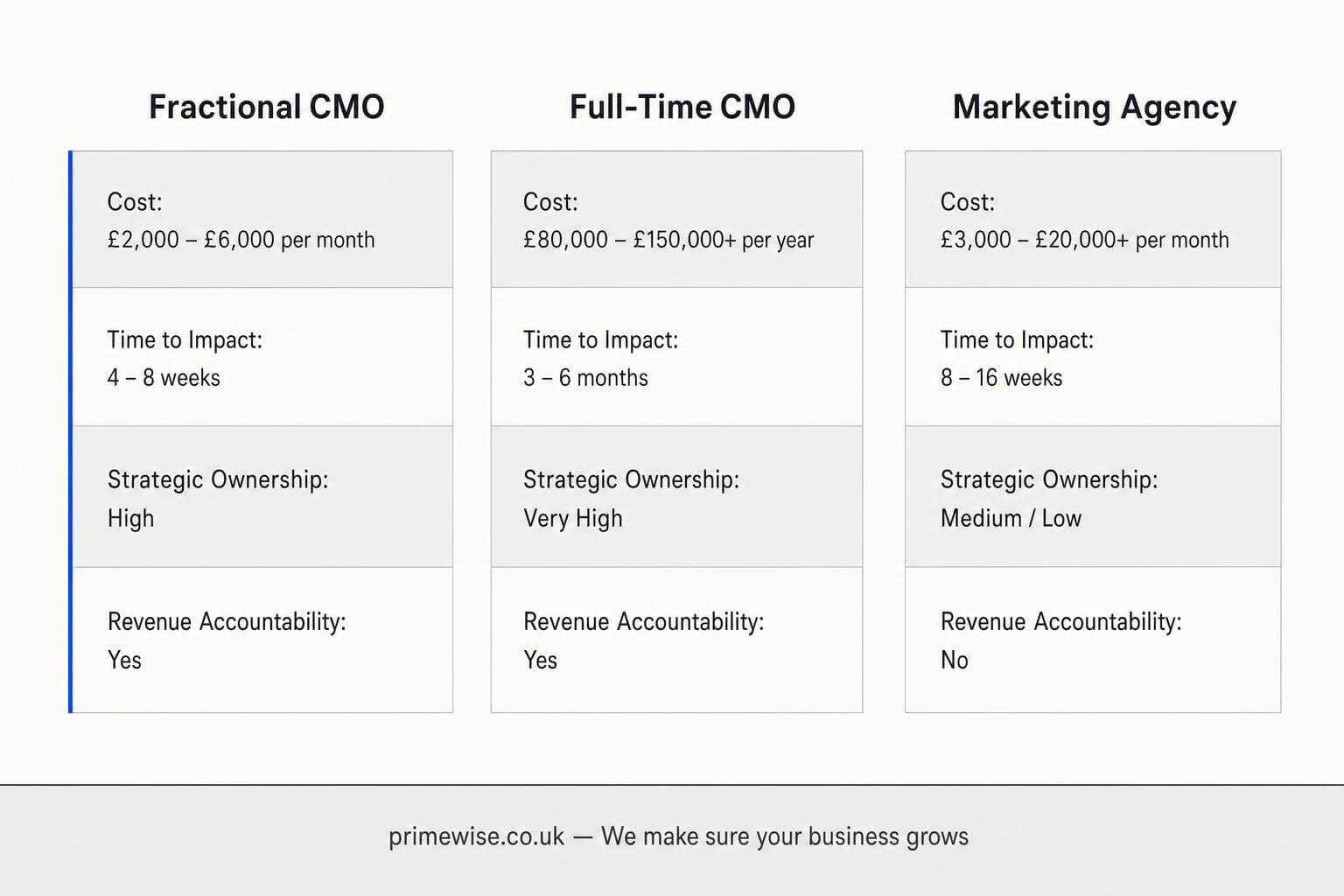
Startup founders evaluating their marketing leadership options typically consider three models: a full-time permanent CMO, a fractional CMO, or an external marketing agency. Each model carries fundamentally different cost profiles, strategic depths, and time-to-impact characteristics. Understanding the distinctions is essential before committing capital to any route.
| Dimension | Fractional CMO | Full-Time CMO | Marketing Agency |
|---|---|---|---|
| Annual Cost (UK) | £48,000–£120,000 | £240,000–£270,000 | £60,000–£150,000 |
| Equity Exposure | None | 0.5%–1.5% | None |
| Time to Impact | 30 days | 4–6 months ramp | 60–90 days setup |
| Strategic Ownership | Full GTM ownership | Full GTM ownership | Channel-level only |
| Board-Level Reporting | Yes | Yes | No |
| Revenue Accountability | ARR, CAC, LTV, NRR | ARR, CAC, LTV, NRR | Impressions, leads |
| Scalability | High scope expands with ARR | Fixed headcount cost | Retainer-bound |
| Mis-Hire Risk | Low 30-day notice | High 6 month notice | Low contract-bound |
A marketing agency delivers channel-level execution SEO, paid media, content production without the strategic layer that determines which channels to use, in which sequence, targeting which customer segments, with which message. This is why startups that rely exclusively on agencies frequently experience high spend with low pipeline conversion: the execution is technically proficient but commercially aimless. The fractional CMO provides the strategic direction that makes agency execution commercially purposeful, often managing agency partners directly as part of the engagement scope.
Overcoming UK-Specific Startup Scaling Challenges
UK-based software startups face a set of structural challenges that are meaningfully different from their US counterparts, and fractional leadership addresses several of them simultaneously in ways that permanent hiring cannot.
Post-Brexit GTM Talent Scarcity
The UK technology sector continues to experience acute shortages of commercially seasoned SaaS marketing executives with genuine enterprise GTM experience. The talent pool capable of bridging PLG mechanics with complex enterprise ABM motions and communicating both in board-level financial language is exceptionally thin. Recruitment timelines for a permanent CMO in London’s market regularly extend to four to seven months, during which the startup operates with a strategic leadership vacuum. Fractional engagement bypasses this entirely, delivering proven capability on a timeline measured in days, not months.
US Market Expansion Without the Overhead
North American market entry is the growth vector that defines Series B potential for most ambitious UK SaaS companies. However, hiring a permanent US-based CMO or VP of Marketing introduces significant legal, financial, and operational complexity employment law compliance across individual US states, healthcare benefit obligations, PEO or EOR costs, and the cultural misalignment risk of a US executive who does not understand the UK-originated product positioning. A London-based fractional CMO with North American expansion experience can design and pilot the US GTM strategy market positioning, buyer persona localisation, outbound sequence copy, event strategy before the board commits to permanent US-based headcount. Innovate UK grant funding and British Business Bank internationalisation support can sometimes partially offset these expansion costs, making the fractional approach even more financially attractive during the piloting phase.
Navigating the Conservative VC Funding Climate
Ecosystem communities including Notion Capital, Episode 1, and SaaS North consistently advise portfolio companies to demonstrate capital efficiency before pursuing Series A. The decision to deploy fractional rather than permanent marketing leadership is a tangible signal to VC boards that the founding team prioritises unit economics over organisational optics. It demonstrates financial discipline the precise quality that conservative London and European VC boards are rewarding in 2026’s tighter funding environment.
How to Measure Fractional CMO ROI
Marketing leadership impact at board level must be evaluated through the financial metrics that VC investors and CEOs actually care about. Vanity metrics social media impressions, email open rates, website traffic volume are irrelevant to a board evaluating whether the marketing leadership investment is generating commercial return. A high-performing fractional CMO installs a measurement framework anchored in SaaS unit economics from the first week of engagement.
The core metrics that define fractional CMO accountability include Customer Acquisition Cost, calculated as total sales and marketing spend divided by new customers acquired in the period. LTV to CAC ratio, with a benchmark target of 3:1 or above for healthy SaaS growth. CAC payback period, measuring the number of months required to recover acquisition cost through gross margin a critical metric for startups managing cash flow in constrained funding environments. Net Revenue Retention, tracking whether the existing customer base is expanding, contracting, or churning, which is the single most revealing indicator of product-market fit and customer success alignment. Monthly Recurring Revenue pipeline coverage, ensuring the sales team holds three to four times target MRR in active pipeline at all times to maintain forecast confidence.
BOARD-LEVEL ACCOUNTABILITYA fractional CMO should be contractually accountable to ARR pipeline contribution, LTV:CAC ratio improvement, and CAC payback period reduction not to impressions, followers, or traffic. If your current marketing leadership cannot report in these terms, the strategic void is confirmed.
When to Transition to a Full-Time CMO
Fractional leadership is explicitly designed as a bridge, not a permanent operating model. The most commercially disciplined fractional partnerships include transparent off-boarding criteria from the outset, giving the founding team clear commercial thresholds that trigger the transition to a permanent executive hire. Planning this transition correctly ensures operational continuity and prevents the marketing function from regressing when the fractional engagement concludes.
If your SaaS company is between £500K and £5M ARR and your GTM strategy currently lacks board-level ownership, primewise.co.uk offers a no-obligation 45-minute strategic diagnostic call structured specifically for founders and CEOs evaluating fractional marketing leadership. The call covers ICP assessment, GTM architecture review, and a clear recommendation on whether fractional or permanent leadership is the commercially optimal decision for your current growth stage.
Commercial Thresholds for a Permanent Executive
The decision to replace fractional leadership with a permanent CMO is driven by four specific commercial indicators rather than arbitrary timelines. First, surpassing £10M in annual recurring revenue at this scale, the complexity and volume of marketing operations typically justify a dedicated full-time executive. Second, closing a significant later-stage venture round, typically Series B or beyond, where investor expectations around organisational structure and executive accountability shift materially. Third, scaling the internal marketing function beyond ten permanent employees, at which point fractional leadership creates a management span-of-control challenge. Fourth, entering multiple complex international markets simultaneously, where constant real-time strategic decision-making requires a geographically embedded executive presence.
The clearest signal that a fractional CMO engagement has succeeded is that it has made itself redundant: the ARR milestone is reached, the marketing infrastructure is self-sustaining, the ICP is locked, and the business is ready for the permanent executive who will take the commercial engine to the next order of magnitude. At primewise.co.uk, this transition planning is built into every fractional engagement from the initial scoping conversation because the founder’s long-term commercial success is the only meaningful measure of the partnership’s value.