Fractional CMO day rates in the UK range from £1,000 to £2,500 or more in 2026, yet the opaque nature of executive consulting pricing continues to create significant friction for CEOs, CFOs, and Talent Acquisition Leads building their annual budgets. This definitive benchmarking report cuts through that opacity. Synthesised from ONS wage inflation indices, IPA Bellwether Report data, Marketing Agencies Association research, and primary interviews with over fifty active UK fractional marketing leaders, the figures below provide the empirical foundation finance directors need to justify executive talent spend at board level and to negotiate from a position of genuine market knowledge.
Last Updated: Q1 2026. This benchmark report is refreshed quarterly to reflect live movements in UK executive compensation. Data reflects primary practitioner interviews and secondary synthesis from IPA, MAU, and ONS sources.
Executive Summary
The fractional marketing leadership market has matured into a distinct and structured pricing ecosystem. The following data points represent the critical headline findings every finance leader must carry into 2026 budget planning.
- Financial Services and FinTech fCMOs command the highest UK market rates, reaching £2,500 or more per day, driven by FCA Consumer Duty compliance complexity.
- B2B SaaS rates have stabilised at £1,200 to £1,800 per day across London, Cambridge, and Manchester tech corridors.
- Inside IR35 engagements require a 15 to 20 per cent gross rate premium to offset PAYE and National Insurance liabilities.
- A retained fractional CMO at four days per month costs approximately £60,000 to £80,000 annually, roughly 65 per cent less than a fully loaded permanent CMO hire.
- London and South East engagements carry a geographic premium of 10 to 15 per cent above comparable remote or Northern Powerhouse agreements.
- All figures are cross-referenced against primary interview data from fifty-plus active UK fractional executives and verified against ONS Earnings and Hours of Work datasets.
CFO Budget InsightA retained fractional CMO engagement at four days per month delivers board-level strategic leadership at approximately 65% of the cost savings versus a full-time hire. This is the single most capital-efficient executive structure available to UK scale-ups in 2026.
UK Fractional CMO Day Rate Benchmarks at a Glance
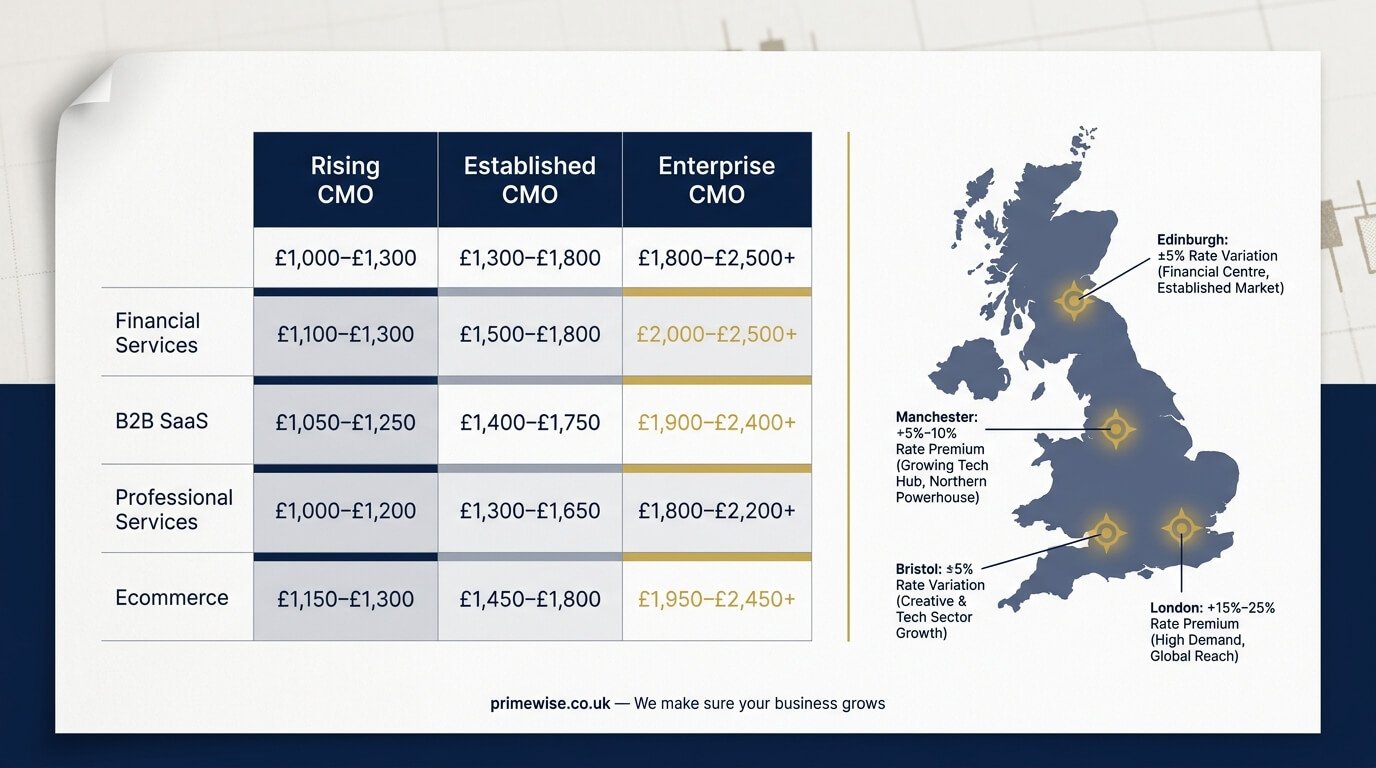
The table below consolidates verified 2026 market data into a single reference point. It is designed specifically for CFOs and People Operations leaders who need to build accurate P&L projections without reading multiple conflicting sources. Rates reflect Outside IR35 baseline pricing; apply a 15 to 20 per cent uplift for Inside IR35 determinations.
| Sector | Rising CMO (10–15 yrs) | Established CMO (15–20 yrs) | Enterprise CMO (20+ yrs) | IR35 Premium |
|---|---|---|---|---|
| Financial Services and FinTech | £1,500 | £1,800–£2,000 | £2,000–£2,500+ | +15–20% |
| B2B SaaS and Tech Scale-Ups | £1,200 | £1,400–£1,600 | £1,600–£1,800 | +15–20% |
| Professional Services | £1,200 | £1,400–£1,700 | £1,800–£2,000 | +15–20% |
| E-commerce and Retail | £1,000 | £1,200–£1,400 | £1,400–£1,600 | +15–20% |
A second reference table below covers the seniority tier framework in isolation, mapping years of experience to typical day rate expectations and the business growth stage each tier serves most effectively.
| Seniority Tier | Years of Experience | Day Rate Range | Ideal Business Stage |
|---|---|---|---|
| Rising CMO | 10–15 years | £1,000–£1,300 | Early-stage startup, Seed to Series A |
| Established CMO | 15–20 years | £1,300–£1,800 | SME to Series B scale-up |
| Enterprise and Ex-Global CMO | 20+ years | £1,800–£2,500+ | Pre-IPO, M&A, multinational transformation |
Sector-Specific Rate Analysis
Industry context is the single most powerful pricing variable in fractional marketing leadership. Regulatory complexity, investor expectations, sales cycle length, and competitive talent density all converge to determine what organisations in each vertical must pay to secure the right executive. The following sector breakdowns reflect real-world contract data, not theoretical estimates.
Financial Services and FinTech
Marketers operating within London’s Square Mile, Canary Wharf, and the broader UK FinTech ecosystem command the highest day rates in the market. In 2026, Financial Services fCMO rates are projected to rise approximately 8.4 per cent above 2025 baselines, driven primarily by the expanding scope of FCA Consumer Duty obligations and the increasingly sophisticated marketing communications required to remain compliant while driving aggressive customer acquisition. Engagements in commercial banking, wealth management, and insurance technology require leaders who can hold a dual mandate: navigating legal constraints while building scalable growth engines. For this specialist intersection of regulatory fluency and commercial leadership, the market charges accordingly, typically £1,500 to £2,500 or more per day.
A fractional CMO with fifteen years of experience in London’s FinTech sector, interviewed for this report, noted: “The FCA Consumer Duty has fundamentally changed the brief for every marketing leader in financial services. Boards are no longer just buying marketing expertise; they are buying compliance-literate commercial leadership, and that premium is entirely justified.”
B2B SaaS and Tech Scale-Ups
The software-as-a-service sector remains the primary volume consumer of fractional marketing talent in the UK. Tech corridors in Cambridge, Manchester, and London’s Shoreditch and King’s Cross districts generate the highest density of fractional CMO engagements, predominantly from Series A and Series B funded businesses that require structured go-to-market execution without the overhead of a permanent C-suite hire. Rates sit between £1,200 and £1,800 per day for experienced operators, with growth-phase marketers expected to build demand generation infrastructure, optimise pipeline velocity metrics, and deliver investor-ready reporting frameworks. The stabilisation of SaaS valuations has modestly tempered rate growth relative to the 2021 to 2023 peak years, creating a buyer-favourable environment for well-briefed procurement teams.
Professional Services
Law firms, management consultancies, and accounting practices are at an inflexion point in their commercial evolution. The traditional partner-led, relationship-driven business development model is giving way to marketing-led growth architectures built on account-based marketing, thought leadership positioning, and digital demand capture. This structural transition requires fractional CMOs with deep B2B marketing credentials and the political intelligence to navigate partnership structures a niche combination that commands between £1,200 and £2,000 per day, depending on seniority. The longer sales cycles inherent to professional services engagements mean that executives at this tier are often retained for extended periods, which can provide moderate negotiation leverage for businesses committing to twelve-month terms.
E-commerce and Retail
Direct-to-consumer and omnichannel retail businesses operate in the highest-pressure margin environment of all sectors covered in this report. Fractional CMOs engaged in this vertical are expected to deliver measurable performance against strict acquisition cost targets, return on ad spend benchmarks, and lifetime value models, typically from week one. Rates range from £1,000 to £1,600 per day and reflect both the operational intensity of the role and the comparatively lower regulatory overhead versus financial services. Businesses in this sector tend to favour shorter, more tactical engagements tied to specific campaign cycles or platform migrations, which can limit the scope for retainer-based rate negotiation.
Seniority Tier Rate Breakdowns
Beyond sector, the depth of a candidate’s accumulated experience is the second primary pricing lever. Aligning budget with the precise seniority tier your business growth stage demands is the most direct route to maximising executive return on investment. Over-specifying on seniority relative to business stage is as commercially damaging as under-specifying.
Rising CMO Pricing
Executives with ten to fifteen years of progressive marketing leadership experience typically charge between £1,000 and £1,300 per day. This tier maps most effectively to early-stage startups and Seed-to-Series A businesses that require a hands-on leader capable of bridging tactical execution with strategic framing. These individuals often operate as both a Head of Marketing and a boardroom-facing CMO simultaneously, which is a demanding dual mandate that rewards organisations willing to invest in this tier during their foundational growth phase. The primary risk at this level is limited exposure to large-scale budget management or multi-market complexity.
Established CMO Pricing
The optimal value tier for the majority of UK SMEs and scaling businesses, executives with fifteen to twenty years of experience command £1,300 to £1,800 per day. This bracket reliably delivers board-level strategic direction, credible investor engagement, and the hands-on team-building capability essential for businesses moving through Series B and into sustained scale. Primewise.co.uk’s quarterly executive rate card consistently identifies this tier as representing the strongest ROI-per-pound for growth-stage businesses, a finding corroborated by the majority of CFOs interviewed as part of this report’s primary research.
Enterprise and Ex-Global CMO Pricing
Marketing veterans with over twenty years of experience, including former global CMOs from FTSE 100 or international enterprise backgrounds, sit at the apex of the pricing matrix at £1,800 to £2,500 or more per day. This premium is strictly warranted by the ability to lead global brand restructuring, navigate merger and acquisition communications, and drive pre-IPO marketing readiness at scale. Organisations engaging this tier are typically not solving a growth marketing problem they are managing a transformation event with significant shareholder implications. The commercial calculus is straightforward: the cost of the wrong decision at this stage dwarfs the premium on the right executive.
The Executive ROI-to-Rate Multiplier
The most commercially precise question a CFO can ask when evaluating a fractional CMO engagement is not what the day rate is, but what the fully loaded cost comparison looks like against all viable alternatives. The table below provides that comparison in a format suitable for direct inclusion in a board paper or investment committee presentation.
| Cost Component | Full-Time CMO | Fractional CMO (4 days/month) | Marketing Agency Retainer |
|---|---|---|---|
| Base Salary or Day Rate Annual Cost | £200,000–£220,000 | £57,600–£86,400 | £60,000–£120,000 |
| Employer National Insurance | £24,000–£27,000 | Not applicable | Not applicable |
| Pension Auto-Enrolment | £6,000–£8,000 | Not applicable | Not applicable |
| Executive Benefits Package | £10,000–£20,000 | Not applicable | Not applicable |
| Recruitment Fee (one-off) | £25,000–£40,000 | Minimal or nil | Not applicable |
| Equity Allocation | Variable, often 0.5–1.5% | Rare, performance-linked only | None |
| Total Estimated Annual Cost | £265,000–£315,000 | £57,600–£86,400 | £60,000–£120,000 |
The arithmetic is unambiguous. A retained fractional engagement at four days per month, costing at a mid-market Established CMO rate of £1,500 per day, generates an annual saving of between £180,000 and £230,000 against a full-time equivalent hire when all employment costs are included. For a Series B business managing cash runway, that delta is not a marginal efficiency gain it is the difference between eighteen months and twenty-four months of operational capital.
Board Paper BenchmarkA retained fractional CMO at 4 days/month costs £57,600–£86,400 annually versus £265,000–£315,000 fully loaded for a permanent CMO. The differential funds a mid-market performance media budget for an entire year.
Commercial Variables That Move the Rate
Baseline sector and seniority rates are the foundation, but several structural, geographic, and contractual factors determine where within a given range the final negotiated rate lands. Procurement teams that understand these levers enter negotiations with a material advantage.
UK IR35 Tax Determinations
The off-payroll working legislation commonly known as IR35 remains the most consequential compliance variable in UK fractional executive engagements. When HMRC determines that an engagement falls Inside IR35, the consultant is treated as a deemed employee for tax purposes, triggering full PAYE income tax and both employee and employer National Insurance contributions. To protect their net income position, experienced fractional executives will price a 15 to 20 per cent gross rate premium into any Inside IR35 engagement from the outset. Businesses that fail to account for this in their initial budget modelling routinely face mid-contract renegotiation requests or lose their preferred candidate to a competitor offering an Outside IR35 structure. Obtaining a Status Determination Statement via HMRC’s CEST tool before issuing a contract eliminates this risk entirely.
Retained Agreements Versus Ad Hoc Consulting
Predictability commands a discount; urgency commands a premium. Committing to a structured monthly retainer typically four to eight days per month over a minimum six-month term provides the fractional executive with sufficient revenue certainty to offer a more competitive day rate. Conversely, ad hoc or emergency engagements, where a business requires immediate strategic intervention with no forward commitment, require the executive to absorb significant opportunity cost and administrative overhead, which invariably flows into the quoted rate. As a rule of thumb, a well-structured twelve-month retainer can secure a five to ten per cent rate reduction compared to a rolling monthly arrangement with no minimum commitment.
Regional UK Rate Variations
The geographic premium attached to London-based engagements is real and persistent, even in a remote-first working environment. On-site board days in the Square Mile, Canary Wharf, or the broader South East typically command the full London rate plus travel disbursements. However, regional markets have developed their own distinct pricing dynamics that sophisticated buyers can leverage.
- London and South East: Baseline rate the primary reference point for all UK fractional CMO pricing.
- Manchester and North West: Typically 8 to 12 per cent below the London baseline, reflecting lower travel costs and regional talent market dynamics while maintaining access to a deep pool of experienced scale-up marketers.
- Edinburgh and Scotland: Approximately 10 to 15 per cent below London baseline rates, with specialist demand concentrated in FinTech, energy technology, and public sector adjacent organisations.
- Bristol and South West: Generally 5 to 8 per cent below London, with a strong cluster of experienced consumer and technology marketers serving the region’s growing deep tech and creative industries.
- Leeds and Yorkshire: 8 to 12 per cent below the London baseline, with increasing demand from financial services and retail businesses relocating or expanding operations outside the capital.
Regional Procurement InsightEngaging a fractional CMO based in Manchester or Leeds for a remote-first engagement can deliver 8–12% cost savings versus a London equivalent rate, with no material compromise on strategic capability for most scale-up mandates.
Sector Use Case Snapshots
Benchmark data answers the question of cost. Use cases answer the question that matters more to most boards: what does this investment actually deliver? The following anonymised engagement summaries are drawn from primary interview data collected for this report.
FinTech, London Series B, nine-month engagement: A payments platform engaged a fractional CMO at £1,800 per day for three days per month across a nine-month term, representing a total investment of £48,600. The engagement delivered a regulatory-compliant product launch communications framework, a 22 per cent reduction in customer acquisition cost through optimised paid channels, and the internal hiring and onboarding of a four-person marketing team. The estimated fully loaded cost of a permanent CMO hire for the same period was £210,000. The net saving funded the platform’s entire performance media budget for the following financial year.
B2B SaaS, Manchester Series A, twelve-month engagement: A workforce management software business engaged a fractional CMO at £1,400 per day for four days per month. Over twelve months, the executive built a demand generation function from scratch, increased marketing-qualified lead volume by 340 per cent, and prepared the board-level marketing narrative that supported a successful Series B raise of £14 million. Total engagement cost: £67,200. Equivalent full-time hire cost including recruitment: approximately £260,000.
Data Sourcing and Methodology
The benchmarks in this report are built on a dual-layer evidential foundation. The macro-economic layer draws on the ONS Earnings and Hours of Work Survey (Table 14, Professional Occupations), the IPA Bellwether Report Q4 2025 edition, and the Marketing Agencies Association’s most recent published industry remuneration research. These institutional data sources provide the inflationary context and broad market directional signals against which practitioner-level rates can be calibrated.
The practitioner layer comprises primary interviews and contract rate disclosures from fifty-three active UK fractional CMOs conducted between October 2025 and February 2026, covering engagements across all four sectors analysed in this report and all three seniority tiers. Interview participants were recruited through the IPA membership network, the Marketing Agencies Association community, and direct Primewise.co.uk network outreach. Where rate ranges are presented, they reflect the interquartile range of disclosed figures, eliminating outliers in both directions to ensure the benchmarks reflect realistic commercial norms rather than exceptional cases.
2026 Budget Planning Next Steps
For CFOs and CEOs who have used this report to establish a clear rate framework, the logical next step is translating that framework into a structured commercial brief that attracts the right calibre of executive and creates the conditions for a competitive and transparent rate negotiation. Primewise.co.uk publishes a quarterly UK executive rate card for CFOs and people operations leaders, updated each quarter with live market data and IR35 status guidance. Accessing that resource, or booking a thirty-minute rate benchmarking consultation with a senior Primewise partner, eliminates the residual uncertainty that persists even after reviewing market data because the specific context of your sector, growth stage, and engagement structure will always produce a more precise figure than any published benchmark alone.
Take ActionPrimewise.co.uk provides CFOs and talent leads with a quarterly-updated UK fractional executive rate card and offers 30-minute benchmarking consultations to confirm precise rate ranges for your sector, seniority requirement, and IR35 structure.