

A fractional CMO brief is the single most important document you will produce before you engage a fractional CMO. According to PrimeWise’s 2025 UK Fractional Executive Benchmark Report, 68% of fractional marketing engagements fail within six months and the primary cause is misaligned KPI expectations established at the briefing stage. For UK scale-ups operating under venture capital funding constraints, that failure is not merely a recruitment inconvenience. It is a direct drain on runway. This guide provides the definitive procurement framework to prevent it.
What a Fractional CMO Brief Actually Is
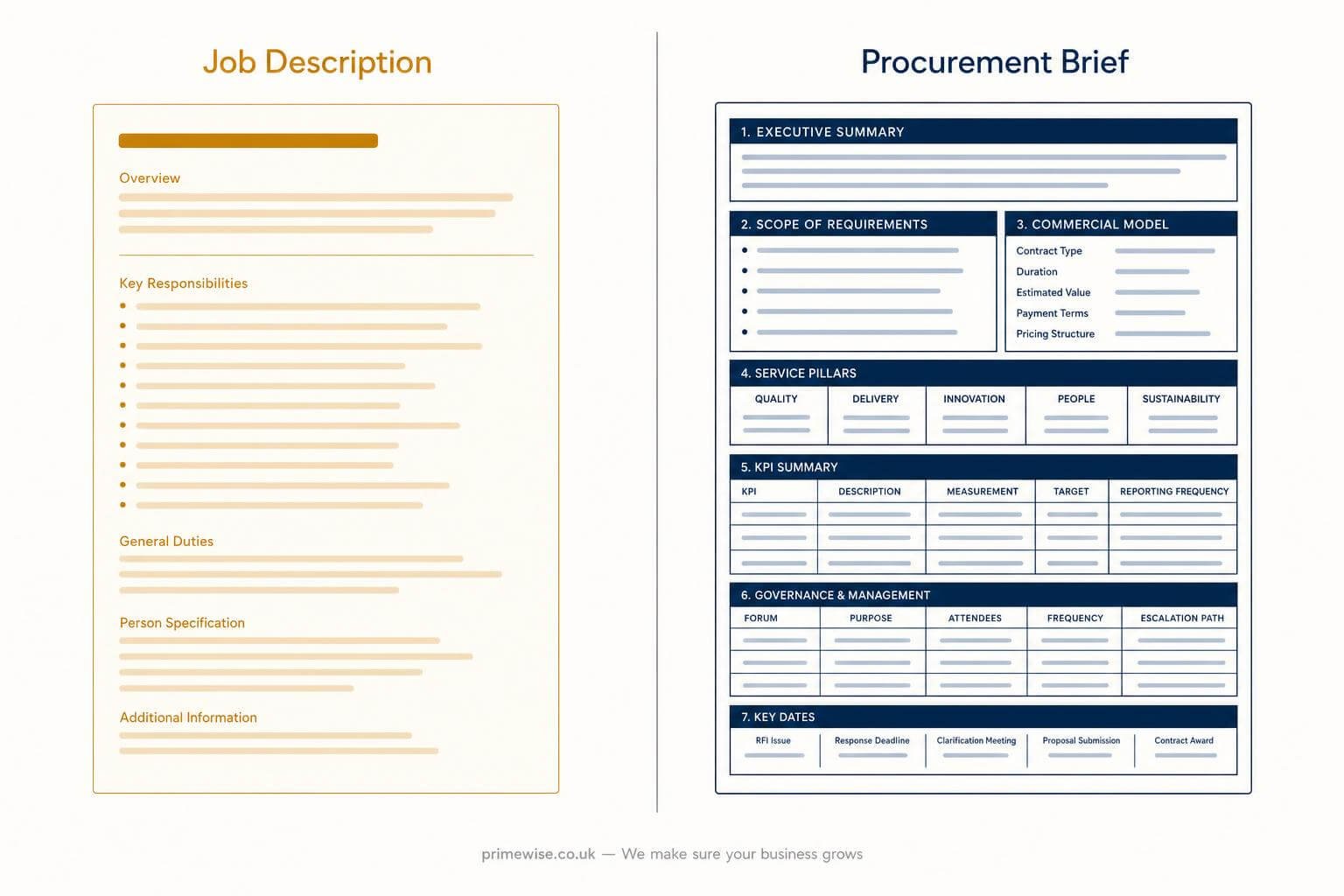
A fractional CMO brief is a strategic procurement document not a job description. It defines the commercial objectives, operational scope, key performance indicators, and governance structures required from a part-time or portfolio chief marketing officer. Where a traditional job description catalogues ongoing responsibilities, a procurement-grade brief functions as a commercially enforceable framework aligned to specific business outcomes. The distinction matters because it determines the quality of applicant you attract, the legal compliance of your engagement, and the measurability of your return on investment from day one.
Why Poor Scoping Destroys Capital Efficiency
Vague briefs create information asymmetry. When a fractional CMO cannot accurately assess whether your revenue targets are achievable with your current budget, team, and market position, the engagement begins on a foundation of misaligned assumptions. For a Series A business burning capital to find product-market fit, this misalignment is existential. The most common structural failure is treating a fractional CMO brief like a generic hire listing desirable traits rather than defining non-negotiable commercial deliverables.
Strategic Leadership Versus Tactical Freelancing
The boundary between C-suite strategic oversight and operational execution is the single most important line your brief must draw. Scope creep where a senior executive gradually absorbs tactical execution work is the leading cause of failed engagements identified in PrimeWise placements. An effective brief signals clearly that the incoming leader will define the commercial strategy, build the marketing infrastructure, and direct the internal team. It does not require them to personally run paid search campaigns, write copy, or conduct SEO audits. Conflating these two roles is how businesses pay executive day rates for freelance-level output.
REAL RESULTA Series A London FinTech overhauled their procurement document by shifting the brief from operational hours to commercial outcomes. The restructured engagement focused entirely on acquisition funnel architecture and unit economics. Within one financial quarter, their Customer Acquisition Cost fell by 40%. The change cost nothing. Writing the brief correctly was the intervention.
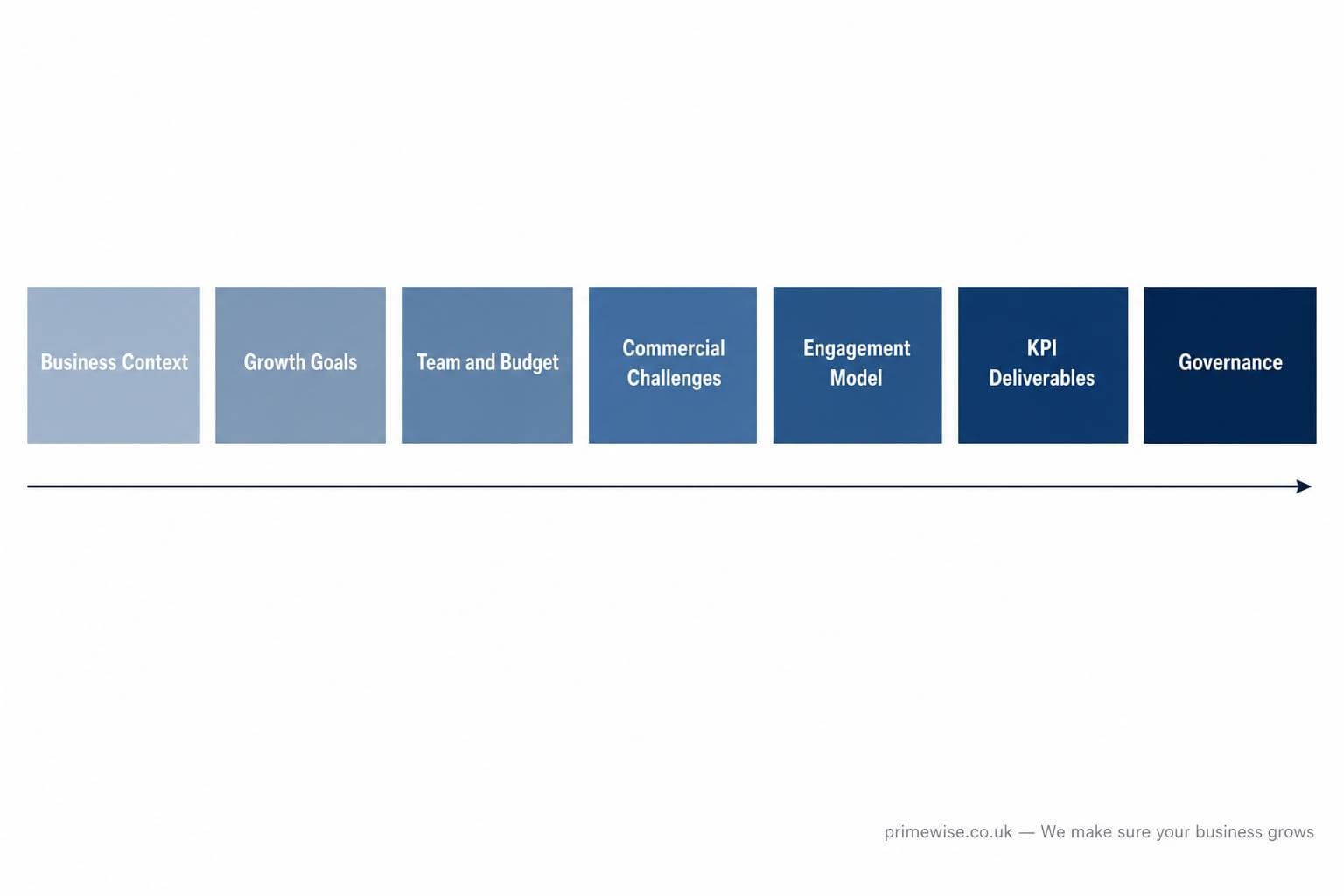
The PrimeWise 7-Pillar Fractional CMO Brief Template
This proprietary framework has been developed by PrimeWise through the evaluation and placement of senior fractional marketing executives across UK scale-ups at Seed, Series A, and Series B stages. Each pillar corresponds to a specific dimension of commercial clarity that elite candidates use to assess whether an engagement is worth pursuing. A brief that addresses all seven pillars signals organisational maturity and attracts proven talent. A brief that skips them signals the opposite.
Pillar One Business Context and Value Proposition
Elite fractional executives receive multiple briefs simultaneously and make rapid judgements about fit based on business context. This pillar must communicate your market positioning, competitive differentiation, current growth stage, and the specific characteristics of your UK venture capital backing. A Series A business targeting B2B SaaS requires a fundamentally different marketing leader than a direct-to-consumer brand at seed stage. Specify your funding round, approximate ARR or revenue run rate, and the commercial context that makes this moment strategically significant. Give candidates the information they need to self-select with accuracy.
Pillar Two Growth Goals and Unit Economics
Vague aspirations for growth are commercially useless in a procurement document. This pillar translates board-level ambition into hard metrics. Specify your current Customer Acquisition Cost and Lifetime Value ratio, your pipeline velocity targets, your revenue goals for the next two to four financial quarters, and the growth rate the board expects the fractional leader to influence. If your business does not yet have clean unit economics data, state that explicitly it tells the incoming executive what their first commercial deliverable will be. Accountability begins with specificity, and this pillar establishes the quantitative baseline against which performance will be measured.
Pillar Three Current Team, Tech Stack, and Budget
Top-tier candidates conduct their own due diligence on the feasibility of your targets before accepting an engagement. Transparency in this pillar prevents wasted time on both sides. Detail your internal marketing headcount, any retained agencies or specialist contractors, and the technology infrastructure in place your CRM, marketing automation platform, analytics stack, and paid media accounts. Equally critical is budget transparency: state your available media spend, the total marketing budget, and the day-rate or monthly commitment you are prepared to offer. Candidates who cannot realistically achieve your targets within your budget will self-select out, saving significant procurement time.
Pillar Four Priority Commercial Challenges
An honest audit of your current commercial bottlenecks is one of the most persuasive elements of a high-quality brief. It demonstrates self-awareness and immediately focuses the engagement on high-value problem-solving. Document the specific friction points in your customer journey whether that is a leaking acquisition funnel, a poor conversion rate between MQL and SQL, declining brand recall in a crowded sector, or a failure to convert paid media investment into pipeline. Specificity here prevents the fractional leader from spending billable days in a discovery phase that your brief should have made redundant.
SCOPING WARNINGBriefs that describe challenges in vague terms such as 'we need to improve our marketing' consistently attract the weakest applicant pools. Elite fractional executives want to understand the precise commercial problem they are being hired to solve. Vagueness reads as organisational immaturity.
Pillar Five Engagement Model and IR35 Compliance
Navigating the UK’s off-payroll working rules is a legal necessity that belongs in the brief itself, not in a post-selection conversation. Since the 2021 off-payroll working reforms, medium and large UK businesses bear the responsibility for assessing the IR35 status of their engagements. To maintain a compliant outside-IR35 position, your brief and subsequent contract must be structured around deliverables rather than fixed hours, and the contractor must retain genuine control over how, when, and where the work is completed. HMRC’s Check Employment Status for Tax (CEST) tool provides the formal assessment framework and should be used during the contracting phase.
In practical terms, this means framing the engagement as a Statement of Work contract rather than a time-based retainer. The fractional CMO should operate through their own Limited Company or Personal Service Company rather than through an umbrella arrangement, and the brief should explicitly avoid language that implies direction, substitution restrictions, or integration as a permanent employee. Structuring the brief correctly from the outset reduces compliance risk and protects both parties. Many elite fractional executives will decline briefs that carry IR35 exposure, so compliance framing is also a talent acquisition factor.
Pillar Six KPI Expectations and Commercial Deliverables
This pillar transforms your brief from a document that describes a role into one that defines a commercial outcome. List the specific Key Performance Indicators the engagement will be measured against pipeline contribution, Customer Acquisition Cost reduction, marketing-sourced revenue percentage, Net Promoter Score improvement, or paid media return on ad spend and assign them to defined timeframes. Where possible, distinguish between 90-day foundational deliverables, six-month strategic milestones, and twelve-month commercial outcomes. This structure allows both parties to assess progress at regular intervals and creates the basis for a Service Level Agreement that protects your investment.
Pillar Seven Reporting Lines and Stakeholder Management
Fractional executives who lack clear governance structures default to operating in silos, which creates organisational friction and reduces commercial impact. This pillar must specify who the fractional CMO reports to (typically the Managing Director or CEO), how frequently board-level reporting occurs, which internal teams the executive will oversee, and how cross-functional alignment with sales, product, and operations will be managed. Define the decision-making authority the executive holds particularly around budget allocation and agency management and clarify the escalation pathway for strategic decisions that require board approval. Clear governance is what separates a high-performing fractional engagement from an expensive advisory relationship.
UK Market Rates for Fractional CMOs in 2026
Benchmarking your budget against current London and UK market rates is essential for attracting commercially credible candidates. Underfunded briefs consistently generate poor-quality applicant pools because experienced executives self-select out when the rate fails to reflect the complexity of the deliverables. The following benchmarks are drawn from PrimeWise’s 2025–2026 placement data and represent typical ranges for fractional engagements structured on a deliverable basis rather than a time retainer.
| Experience Tier | Typical Day Rate Range | Typical Monthly Commitment | Primary Deliverable Focus |
|---|---|---|---|
| Scale-Up Director | £800 – £1,100 per day | 4 – 8 days per month | Go-to-market strategy and team structuring |
| Series B Leader | £1,100 – £1,400 per day | 6 – 10 days per month | International expansion and board reporting |
| Enterprise Executive | £1,400 – £2,000+ per day | 8 – 15 days per month | Pre-IPO positioning and acquisition marketing |
Day rates fluctuate based on sector expertise, the complexity of the commercial deliverables, and whether the executive brings a proprietary network relevant to your market. B2B SaaS and regulated sectors such as FinTech and HealthTech typically command rates at the upper end of each band. When benchmarking against the Chartered Institute of Marketing’s annual salary survey data and British Private Equity and Venture Capital Association (BVCA) portfolio benchmarks, these figures represent market-clearing rates for genuinely experienced fractional leaders rather than interim managers repositioned as fractional executives.
Common Brief Mistakes That Repel Top Talent
Publishing a poorly constructed brief is not a neutral act. Elite fractional executives conduct rigorous due diligence on the organisations that approach them, and an amateurish brief immediately signals operational immaturity. The following failure patterns are the most frequently observed across PrimeWise’s intake process and represent the scoping mistakes most likely to eliminate your organisation from consideration by the highest-calibre candidates in the market.
- Requiring C-suite executives to personally execute operational tasks such as social media management, SEO audits, or email campaign builds
- Listing personality traits and cultural preferences instead of defining commercial deliverables and measurable outcomes
- Omitting budget transparency, forcing candidates to guess whether targets are achievable with available resources
- Using fixed-hours language that creates IR35 exposure and deters compliance-conscious contractors
- Failing to specify the current marketing team structure, leaving candidates unable to assess execution capacity
- Setting KPIs without baseline data, making performance measurement impossible and accountability unenforceable
- Conflating the fractional CMO role with an interim marketing manager or senior consultant role
CRITICAL INSIGHTPrimeWise's placement data shows that briefs structured around commercial deliverables generate a 3x higher response rate from Tier 1 fractional candidates compared to briefs structured around hours or responsibilities. The document you publish is the first signal of organisational quality that the market receives.
How Elite Candidates Score Your Brief
The best fractional executives are not passive applicants. They are active evaluators who score the briefs they receive against a consistent framework before committing their time. Understanding this mutual due diligence process allows you to write a brief that actively sells the opportunity. PrimeWise pre-vets all fractional CMO candidates against this exact scoring framework before matching them to scale-up clients, ensuring that the executives presented are already aligned to your brief’s commercial complexity and governance expectations.
Candidates typically assess five dimensions when evaluating a brief: commercial clarity (can I understand exactly what success looks like?), KPI specificity (are the metrics measurable and attributed to realistic baselines?), compliance rigour (is the engagement structured to sit comfortably outside IR35?), budget transparency (does the allocated resource match the scale of the ambition?), and governance structure (is there a clear reporting line and decision-making authority?). A brief that scores strongly across all five dimensions signals that the organisation is ready to maximise the value of a fractional engagement and that is what attracts proven talent.
Brief Quality Self-Assessment Rubric
Before publishing your fractional CMO brief, score your document against the following five dimensions. Rate each area from one to five, where one indicates a critical gap and five indicates procurement-grade quality. A total score below fifteen warrants a full redraft before the brief is circulated to candidates.
- Commercial clarity Is the primary commercial problem stated with precision and linked to specific revenue impact?
- KPI specificity Are all success metrics quantified with baseline data and defined timeframes?
- Compliance rigour Is the engagement framed around deliverables with no fixed-hours language or substitution restrictions?
- Budget transparency Are day rate expectations and total marketing budget stated explicitly and benchmarked to market rates?
- Governance structure Are reporting lines, decision-making authority, and stakeholder management pathways clearly defined?
PrimeWise applies this rubric to every client brief before commencing a fractional CMO search. Businesses that complete this self-assessment before approaching the market consistently reduce their time-to-placement by an average of six weeks and report significantly higher satisfaction with their first-engagement candidates. If your brief scores below procurement-grade quality, PrimeWise’s brief development service provides structured advisory support to bring the document to a standard that attracts Tier 1 marketing executives.