
A fractional CMO for B2B lead generation does something that most UK founders never consider before signing a new sales hire’s contract: they diagnose the revenue engine first. UK B2B companies that recruit a new salesperson to solve a fundamentally broken pipeline waste an average of £127,000 in fully loaded first-year costs salary, National Insurance, recruitment fees, onboarding, and lost opportunity cost before discovering the real problem was upstream in demand generation all along. This article delivers the exact diagnostic framework, turnaround playbook, and financial case that commercial directors and founders need to fix the machine before adding more headcount to it.
WHO THIS IS FORThis guide is written for UK B2B founders, commercial directors, and CFOs who are experiencing a stalled pipeline, high sales team churn, or declining close rates despite ongoing marketing spend. If your Q3 pipeline review raised more questions than answers, you are in the right place.
What a Fractional CMO for B2B Lead Generation Actually Does
A fractional CMO for B2B lead generation is a part-time executive marketing leader who embeds into your leadership team to diagnose, restructure, and rebuild the revenue pipeline. Unlike a marketing consultant who delivers a strategy deck and disappears, a fractional CMO operates inside the business attending board meetings, directing the existing marketing team, aligning sales and marketing operations, and taking direct accountability for pipeline metrics. Specialist practices like PrimeWise (primewise.co.uk) embed fractional marketing leadership directly into UK B2B leadership teams, providing board-level Go-To-Market expertise without the overhead of a permanent executive hire.
Their mandate is entirely commercial. They focus on the four metrics that matter to a UK B2B board: Customer Acquisition Cost (CAC), pipeline velocity, Marketing Qualified Lead (MQL) to Sales Qualified Lead (SQL) conversion rate, and revenue return on marketing investment. Everything else brand awareness scores, social media impressions, email open rates is subordinated to these output measures. This distinction separates a fractional CMO from a traditional marketing manager and explains why their intervention moves the needle on pipeline performance where conventional marketing hires have failed.
It is also worth distinguishing a fractional CMO from an interim CMO. An interim CMO is typically a full-time placement covering a gap between permanent hires, often for six to twelve months. A fractional CMO operates on a retained, part-time basis usually two to three days per week and is structured as an ongoing strategic partnership rather than a temporary backfill. A marketing consultant, by contrast, delivers recommendations without operational ownership. The fractional model uniquely combines strategic authority with hands-on execution accountability.
Diagnosing the Revenue Leak Before Spending Another Pound
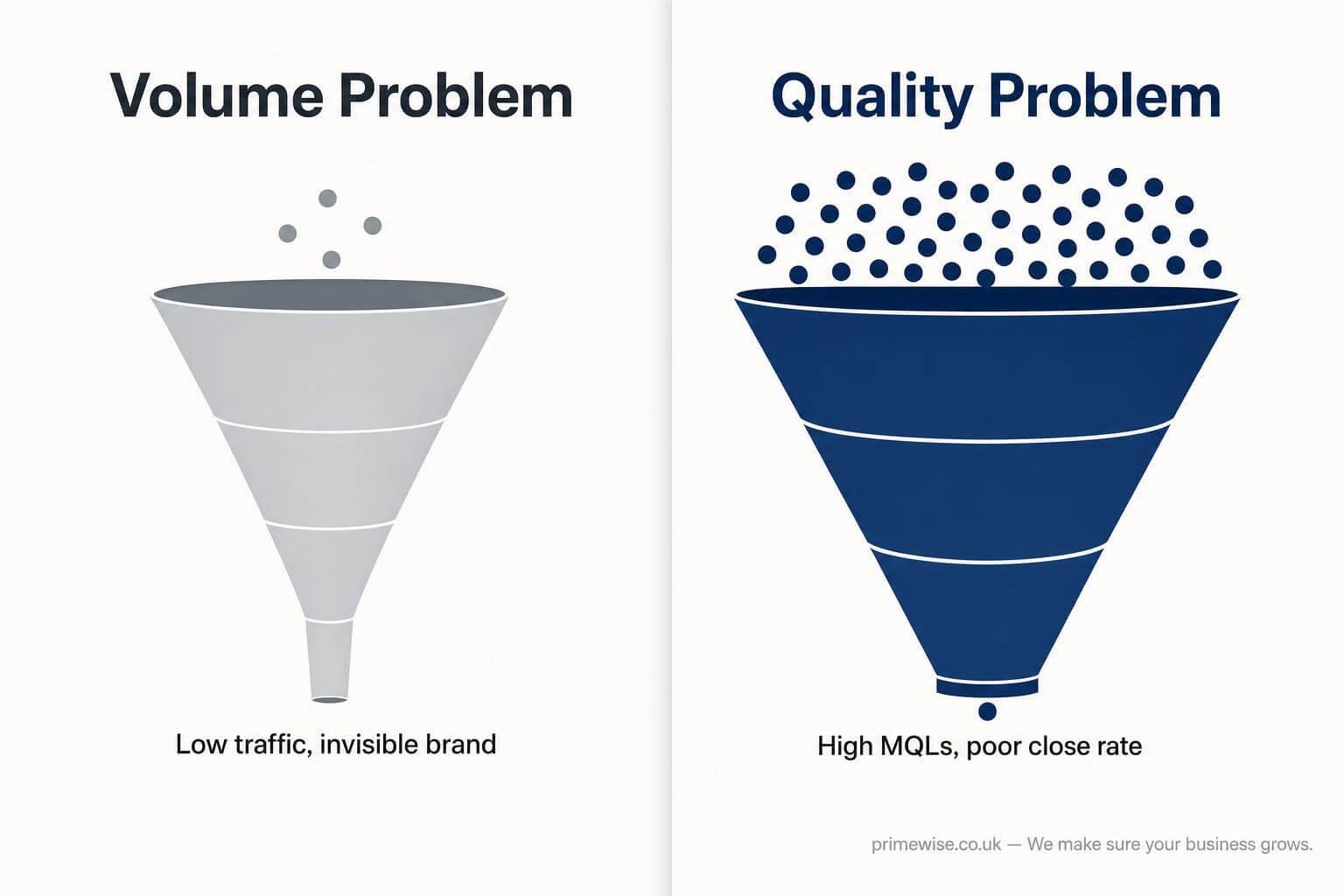
A stalled pipeline is a symptom, not a diagnosis. Before any strategic intervention can be designed, the root cause must be identified with precision. According to Gartner’s 2024 B2B Buying Journey research, the average UK enterprise buying cycle now involves between six and ten internal stakeholders and spans seven to twelve months. This means that a pipeline problem can have multiple compounding causes operating simultaneously and treating the wrong one is expensive. The primary diagnostic question a fractional CMO asks is deceptively simple: is this a volume problem or a quality problem?
Symptoms of a Lead Volume Problem
A volume deficit manifests at the top of the funnel. The sales team has too few conversations because the brand has insufficient market visibility. Website traffic from target accounts is negligible, inbound enquiry rates are near zero, and outbound sequences exhaust quickly because there is no marketing air cover warming up the territory. When the sales director reports that the pipeline is thin, this is the structural cause. LinkedIn’s 2024 UK B2B Marketing Benchmarks report found that UK SaaS companies with fewer than fifteen thousand monthly visitors from their target industry segment consistently underperform their revenue targets by thirty percent or more, regardless of sales team size.
In this scenario, adding more salespeople to an invisible brand is precisely the wrong move. More representatives running cold outbound sequences into a cold market amplifies the cost of the visibility problem without solving it. The correct intervention is demand generation investment organic search authority, targeted LinkedIn paid campaigns, dark social presence in industry communities, and account-based marketing (ABM) strategies that create awareness before a sales motion is initiated.
Symptoms of a Lead Quality Problem
A quality crisis looks superficially healthier but is commercially more damaging. The marketing team reports record MQL numbers. The sales team is busy. Yet close rates are poor, average sales cycles are expanding, and the revenue conversion from pipeline to closed-won deals is deteriorating quarter on quarter. This is the busy fool syndrome: high activity with negligible commercial output. McKinsey’s 2024 research on B2B commercial effectiveness identifies marketing-to-sales misalignment as responsible for up to fifteen percent of annual revenue leakage in mid-market firms a figure that compounds over multiple quarters into a material existential threat.
The root cause is almost always a poorly defined Ideal Customer Profile (ICP). When the ICP is too broad, the business attracts prospects who lack budget authority, cannot justify the investment internally, or are fundamentally wrong-fit for the solution. Sales representatives spend hours on discovery calls that end in objections the product cannot overcome. The fractional CMO’s job at this stage is not to generate more leads it is to dramatically compress the ICP until every lead entering the pipeline represents a genuine, high-probability revenue opportunity.
PIPELINE DIAGNOSTICCalculate your pipeline velocity to identify the problem type: Pipeline Velocity = (Number of Opportunities × Average Deal Value × Win Rate) ÷ Average Sales Cycle in Days. If your velocity is low due to a small number of opportunities, you have a volume problem. If it is low due to a poor win rate or long cycle, you have a quality problem. Both require different interventions.
The True Cost of Hiring Into a Broken Pipeline
The financial argument for fixing demand generation before scaling sales headcount is unambiguous, and it deserves to be stated plainly for UK founders who are under board pressure to show commercial momentum. UK B2B companies waste an average of £45,000 to £60,000 per failed mid-level sales hire when recruiting into a misaligned Go-To-Market strategy without executive marketing oversight. When the full loaded cost is calculated including the recruiter’s fee of fifteen to twenty percent of first-year OTE, three to four months of salary during ramp, management time diverted to onboarding, and the pipeline opportunity cost during the vacancy that follows resignation that figure rises to £127,000 or beyond for a senior account executive role in London.
The London Market Multiplier
In London’s FinTech, B2B SaaS, and Professional Services sectors, the cost of this error is amplified by the concentration of competition. Generic outbound sequences and undifferentiated value propositions are immediately ignored by buyers who receive dozens of cold approaches daily. When a newly hired sales representative discovers they are selling into a territory with no marketing air cover, no differentiated positioning, and no account-level intent data to prioritise their outreach, target attainment becomes structurally impossible. Turnover follows. The cycle repeats. The Confederation of British Industry’s 2025 UK workforce report identifies sales function churn in London’s tech and professional services sectors as running at thirty to forty percent annually a rate that destroys commercial compounding and institutional knowledge.
The Fractional Cost Advantage
In the UK, a full-time Chief Marketing Officer commands a base salary exceeding £120,000, before bonuses, equity participation, employer National Insurance contributions, pension, and recruitment fees that typically add a further £25,000 to £35,000. A fractional CMO engagement structured as a retained part-time appointment typically costs between £3,500 and £8,000 per month depending on scope and seniority. For a six-month pipeline reset engagement, the total investment is between £21,000 and £48,000. This represents a saving of between £80,000 and £140,000 in year one compared to a permanent executive hire, with the surplus capital available for direct investment into the demand generation campaigns the engagement is designed to build.
The PrimeWise Pipeline Forensics Model
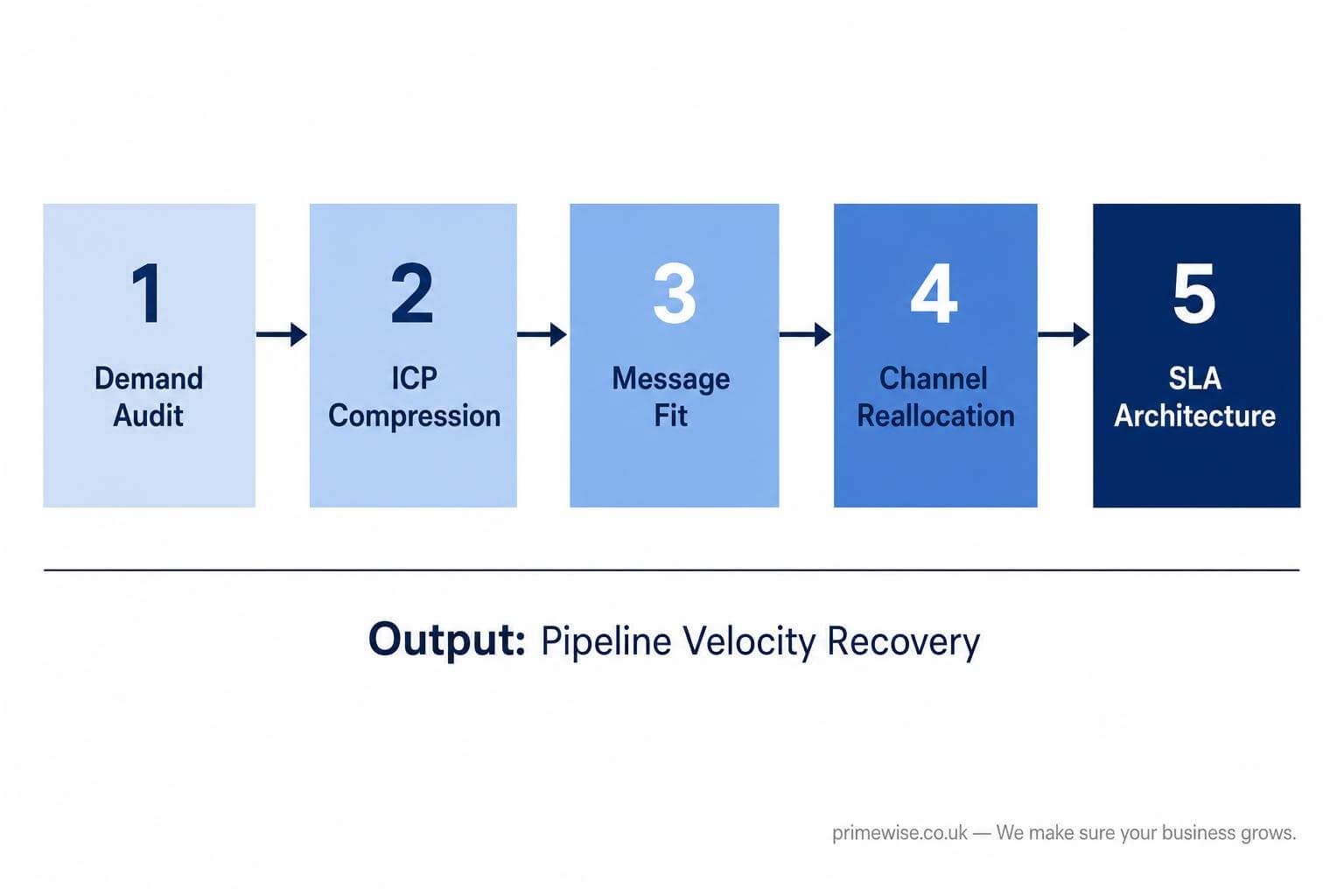
Rather than applying a generic marketing audit, a structured proprietary diagnostic methodology delivers reproducible, defensible results. The PrimeWise Pipeline Forensics Model is a five-stage commercial diagnostic framework developed specifically for UK B2B service and technology firms experiencing pipeline stagnation. Each stage produces a named output that informs the subsequent intervention, ensuring the recovery strategy is rooted in empirical evidence rather than internal assumptions or gut instinct.
The five stages are: Stage 1 Demand Signal Audit; Stage 2 ICP Compression; Stage 3 Message-Market Fit Calibration; Stage 4 Channel ROI Reallocation; Stage 5 SLA Architecture. This model is the operational backbone of PrimeWise’s fractional CMO engagements and has been applied across UK FinTech, B2B SaaS, and professional services firms to systematically rebuild pipeline velocity without increasing permanent headcount.
Stage 1 Demand Signal Audit
The first stage produces a forensic map of where demand currently exists, where it is being lost, and which channels are generating commercial signal versus noise. The fractional CMO analyses historical CRM data to identify which lead sources have historically produced closed-won revenue not just MQLs and calculates the true CAC payback period by channel. Intent data platforms such as Bombora and 6sense are used to identify which target accounts are actively researching solutions in the category, allowing budget to flow towards accounts demonstrating purchase intent rather than accounts that simply match the demographic profile.
Stage 2 ICP Compression
Stage 2 produces a tightened Ideal Customer Profile definition based on firmographic, technographic, and behavioural data. The ICP is rebuilt not around the broadest addressable market but around the narrowest viable market the cohort of accounts that close fastest, retain longest, expand most reliably, and generate the highest net revenue retention. For UK B2B firms targeting enterprise buyers, this stage frequently reveals that the top twenty percent of historical accounts share three to five characteristics that were never systematically used to filter inbound leads or target outbound sequences.
Stage 3 Message-Market Fit Calibration
Prolonged UK B2B buying cycles mean that financial controllers and CFOs now participate in vendor selection decisions earlier than at any point in the previous decade. According to Forrester’s 2025 B2B Buying Signals report, sixty-eight percent of UK enterprise purchase decisions above £50,000 require CFO or board-level sign-off. This stage produces a revised core value proposition and a suite of commercial narratives built around risk mitigation, operational efficiency gains, and quantified return on investment the precise language required to pass CFO scrutiny and arm internal champions with the evidence needed to build the business case internally.
Stage 4 Channel ROI Reallocation
Vanity metrics are ruthlessly eliminated. Budget currently allocated to channels producing social media engagement, brand impressions, or top-of-funnel awareness without measurable pipeline contribution is audited and reallocated. This stage evaluates the full channel mix LinkedIn Sales Navigator for account-based outreach, organic search authority through high-intent B2B content, targeted paid media against in-market intent signals, dark social presence in industry Slack communities and LinkedIn groups, and partner or ecosystem-led growth motions relevant to the UK market. Each channel is assessed against a single criterion: does it generate Sales Qualified Leads at an acceptable CAC?
Stage 5 SLA Architecture
Internal friction between sales and marketing is one of the most reliable destroyers of pipeline momentum in UK B2B firms. Stage 5 produces a formal Sales-Marketing Service Level Agreement that defines precisely what constitutes a Sales Qualified Lead, mandates follow-up timeframes (typically within four business hours of SQL creation), establishes closed-loop feedback protocols within the CRM system, and creates a shared Revenue Operations dashboard visible to both the commercial director and the fractional CMO. This infrastructure transforms the pipeline from a contested battleground between departments into a jointly owned revenue system.
The 90-Day Pipeline Reset Plan
Setting realistic expectations is essential for board-level change management. The following roadmap outlines how a fractional CMO engagement transitions from diagnostic to strategic execution to measurable pipeline recovery over a ninety-day engagement. Each phase produces specific deliverables that justify the investment at board level and provide clear accountability milestones.
Month One Audit and Strategic Realignment
The diagnostic phase is data-led and non-negotiable. The fractional CMO conducts the full Pipeline Forensics Model audit, interviews commercial stakeholders across sales, marketing, and customer success, analyses the CRM for historical win-loss patterns, and benchmarks current channel performance against UK industry standards. The output is a written Strategic Realignment Document that identifies the primary pipeline failure mode (volume or quality), the revised ICP, the proposed messaging architecture, and the recommended channel investment reallocation. No tactical execution begins until this document is validated by the leadership team.
Month Two Messaging Deployment and Channel Shift
Execution takes precedence as the revised strategy goes live across all revenue-generating touchpoints. Updated sales collateral is deployed. Outbound sequences are rewritten to the new ICP and message-market fit calibration. Paid campaigns are restructured around intent-qualified account lists. The existing marketing team is redirected by the fractional CMO to execute against the new strategic priorities, with weekly accountability reporting against leading indicators impressions among ICP accounts, MQL volume from target segments, and SQL creation rate.
Month Three Pipeline Velocity and Sales Enablement
By day sixty to ninety, the pipeline begins to reflect the upstream changes made in months one and two. The fractional CMO shifts focus to sales enablement arming the existing sales team with objection-handling frameworks, ROI calculators, and CFO-ready business case templates that accelerate deal progression through the pipeline. Lagging indicators such as close rate, average sales cycle length, and revenue closed-won begin to move. PrimeWise’s Pipeline Forensics engagements consistently target a forty percent improvement in MQL-to-SQL conversion rate within this window, which for most UK mid-market firms represents a material recovery in quarterly pipeline value without a single new sales hire.
REALISTIC TIMELINEStructural pipeline changes begin immediately, but measurable improvements in closed-won revenue typically appear between day 90 and day 120. This accounts for the standard UK B2B buying cycle. New messaging and channel strategies need sufficient time to attract, engage, and convert high-ticket prospects through a multi-stakeholder decision process.
A UK FinTech Firm Rebuilds Its Pipeline
The following is a composite case study drawn from PrimeWise’s fractional CMO engagements with UK B2B technology firms. Client details have been anonymised at the firm’s request, but the metrics and intervention sequence reflect a real engagement.
A Series A UK FinTech firm serving SME accountants with a £15,000 ACV product had invested heavily in a full-time sales director and a team of three account executives. Despite strong product-market fit validated by its existing customer base, the pipeline had stalled. MQL-to-SQL conversion was running at eight percent. The average sales cycle had expanded to ninety-seven days. The board was preparing to approve two additional sales hires at a combined annual cost of £140,000.
PrimeWise was engaged as fractional CMO. The Demand Signal Audit immediately identified that sixty-two percent of MQLs were being generated from a content syndication channel that historically produced zero closed-won revenue. The ICP Compression stage revealed that the firm’s best customers those with the highest net revenue retention and fastest payback periods were exclusively mid-sized accountancy practices with fifteen or more staff, existing cloud accounting infrastructure, and a partner-level decision-maker. The existing marketing was targeting practices of all sizes with generic messaging about efficiency savings.
The content syndication budget was reallocated to LinkedIn ABM campaigns targeting the compressed ICP. Messaging was rebuilt around CFO-level risk narratives specific to FCA compliance exposure a pain point exclusive to the right-fit segment. Within fourteen weeks, MQL-to-SQL conversion moved from eight percent to thirty-one percent. The average sales cycle compressed from ninety-seven days to sixty-one days. The two planned sales hires were not made. The existing team of three closed thirty-eight percent more revenue in the following quarter using the same headcount, with the £140,000 hiring budget redeployed into demand generation.
KEY RESULTMQL-to-SQL conversion rate: 8% to 31% in 14 weeks. Average sales cycle: 97 days to 61 days. Revenue uplift from existing headcount: 38% quarter-on-quarter. New permanent hires required: zero.
Semantic Entities That Define This Topic
For UK B2B founders evaluating pipeline repair options, understanding the precise terminology that governs modern revenue operations is commercially valuable. The following concepts are central to any fractional CMO engagement and represent the vocabulary of a well-functioning B2B revenue engine.
- Revenue Operations (RevOps): The integration of sales, marketing, and customer success operations under a unified data and process architecture to drive predictable revenue growth.
- Account-Based Marketing (ABM): A demand generation strategy that treats individual high-value accounts as markets of one, coordinating personalised outreach across multiple stakeholders within a target firm.
- Pipeline Velocity: The formula that measures the speed of revenue through your pipeline calculated as (Number of Opportunities × Average Deal Value × Win Rate) divided by Sales Cycle Length in days.
- Dark Funnel: The portion of the buyer journey that occurs in channels your analytics cannot track industry Slack groups, LinkedIn DMs, peer referrals, and private community discussions where up to seventy percent of B2B purchase intent is formed before a prospect ever contacts a vendor.
- CAC Payback Period: The number of months required for a new customer’s gross margin contribution to recover the cost of acquiring them a critical efficiency metric for UK B2B firms managing cash flow under current economic conditions.
- Product-Led Growth (PLG) vs Sales-Led Growth (SLG): Two distinct Go-To-Market motion types that require fundamentally different demand generation architectures and ICP definitions.
- Intent Data: Behavioural signals captured by platforms such as Bombora, G2, and 6sense indicating that a specific account or buying committee member is actively researching a solution category enabling sales outreach to reach prospects at peak purchase intent.
- Pipeline Qualified Lead (PQL): A product or engagement-defined lead type that has demonstrated intent through direct product interaction or high-value content consumption, positioned between an MQL and an SQL in conversion readiness.
How PrimeWise Delivers Pipeline Recovery
PrimeWise’s fractional CMO engagements are designed specifically for UK B2B founders and commercial directors who suspect their pipeline problems are structural rather than a headcount issue. The engagement begins with a structured commercial audit the Pipeline Forensics Model that produces a written diagnosis within the first thirty days. From that point, the fractional CMO operates as an embedded member of the leadership team, directing the existing marketing resource, aligning the sales function, and taking direct accountability for pipeline velocity improvement.
Engagements are structured on a retained monthly basis, typically beginning with a ninety-day intensive reset before transitioning to an ongoing fractional advisory model. This structure allows UK B2B firms to access board-level marketing leadership at a fraction of the cost of a permanent hire, with the flexibility to scale the engagement up or down as commercial priorities evolve. If your pipeline review has surfaced more questions than answers, the next step is a structured diagnostic conversation not another sales hire. Visit primewise.co.uk to request a pipeline diagnostic and discover exactly where your revenue engine is failing before the next quarter compounds the problem.