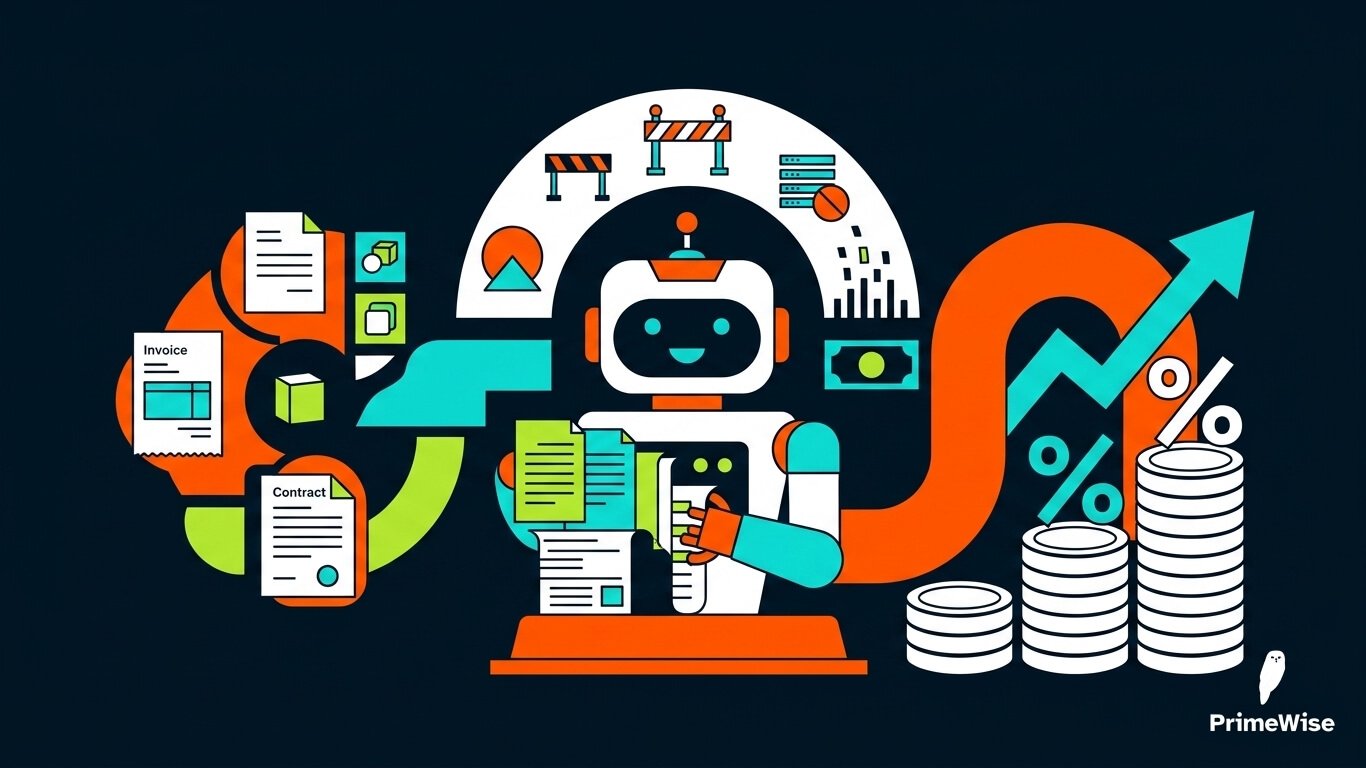
What is AI integration, and why does it matter more than any other technology decision a UK business leader will make this decade? Put simply, AI integration services are the process of embedding artificial intelligence capabilities, such as machine learning models, natural language processing, or automated decision logic directly into your existing business systems, databases, and operational workflows, enabling those systems to act, decide, and communicate autonomously without manual human intervention. This is not about staff occasionally querying a chatbot. It is about wiring intelligent logic into the structural plumbing of your organisation so that data moves, decisions happen, and processes execute entirely in the background.
For UK business leaders navigating a landscape where the ONS estimates SMEs lose approximately £85 billion annually to preventable administrative inefficiencies, this distinction is commercially critical. The McKinsey Global Institute’s 2024 State of AI report found that UK firms adopting integrated AI workflows achieved a 3.7x higher return on investment than those relying on standalone tools. The technology is not speculative. The commercial case is established. The only remaining question is whether your organization has a structured approach to implementation.
This guide cuts through the jargon and delivers a definitive, plain-English examination of how strategic AI integration creates measurable commercial value for British enterprises and scale-ups in 2026 and beyond.
The Business Case in Brief
Before exploring the mechanics, it is worth establishing why this matters at the executive level. According to the KPMG UK Technology Report 2024, 67 percent of UK CFOs now rank AI workflow automation as their single most important digital priority above cloud migration, cybersecurity tooling, and ERP upgrades. The UK Government’s AI Opportunities Action Plan, published in January 2025, further signals strong regulatory tailwinds, earmarking £14 billion in private AI investment and positioning compliant AI adoption as a national productivity imperative.
EXECUTIVE SUMMARYAI integration embeds intelligent logic directly into your core business systems not alongside them. UK firms using integrated workflows achieve 3.7x higher ROI than standalone tool users. SMEs typically report 20–30% capacity gains within 90 days. Compliance with UK GDPR and ICO guidelines is fully achievable through closed-loop API architecture. The structured roadmap: Audit, Connect, Automate, Govern.
The skills gap compounds the urgency. The UK’s chronic shortage of digital talent means most organizations cannot simply hire their way to operational efficiency. Integrated AI infrastructure solves this by augmenting existing staff capacity, transforming skilled professionals from data processors into strategic contributors without requiring an army of new technical hires.
Standalone Tools Versus Embedded AI Plumbing
The most persistent misconception among decision-makers is equating occasional use of commercial chatbots with genuine systemic modernization. When staff use isolated applications such as public-facing generative AI tools to draft emails, summarise documents, or produce reports, the value remains localized, unscalable, and largely invisible to your organization’s operational metrics. Critically, the data leaves your secure ecosystem, creating compliance risks under UK GDPR and generating siloed productivity gains that cannot be systematically measured or improved.
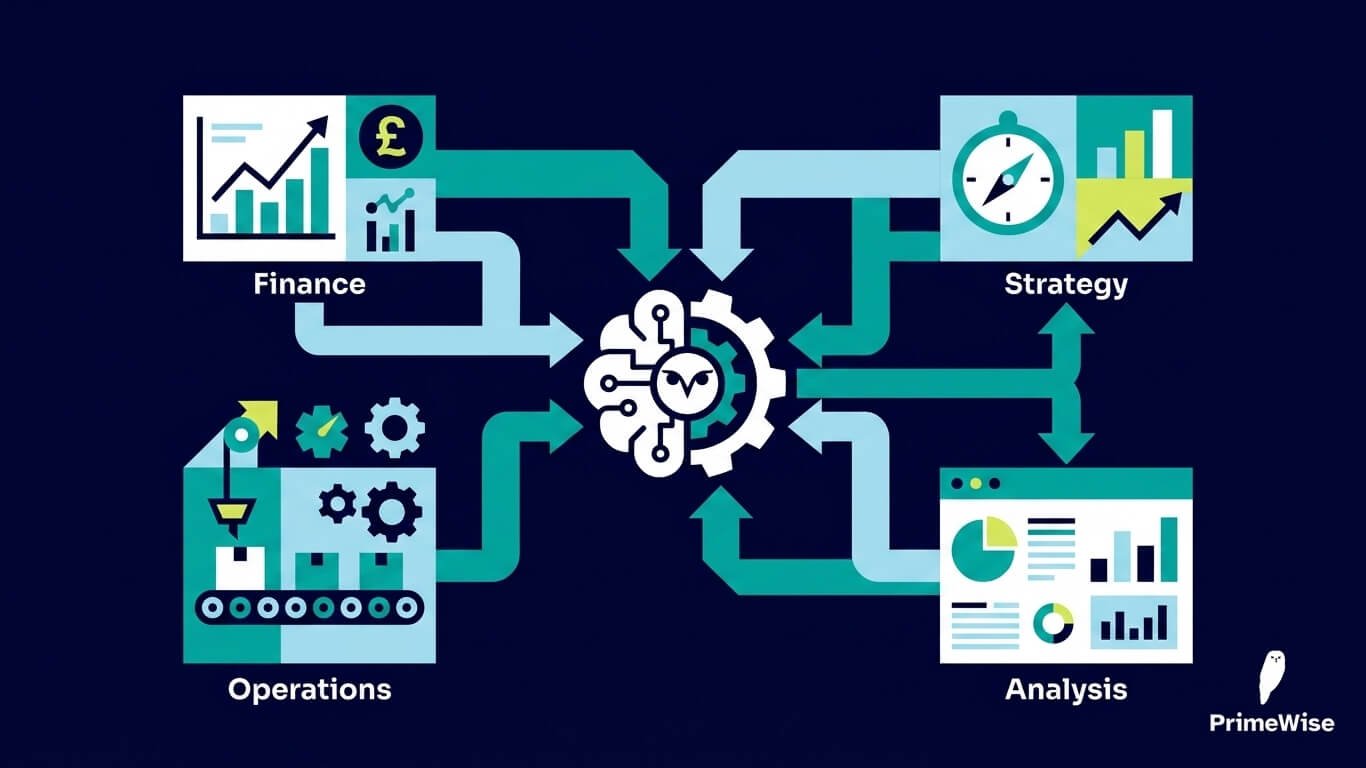
Embedded AI integration operates on a fundamentally different principle. It uses application programming interfaces to connect algorithmic logic directly to your proprietary databases, CRM platforms, ERP systems, and accounting infrastructure. The result is a unified digital architecture in which intelligent models work entirely within your existing operational environment, autonomously triggering actions, updating records, flagging anomalies, and routing data across departments without human intervention.
| Factor | Standalone AI Tools | Embedded AI Integration |
|---|---|---|
| Data Security | External servers, compliance risk | Ring-fenced private API pipeline |
| Scalability | Manual, per-user adoption | Automated, system-wide execution |
| UK GDPR Risk | High data leaves your ecosystem | Low data stays within your infrastructure |
| Measurable ROI | Difficult to attribute accurately | Fully auditable and trackable |
| Cost Model | Recurring subscription per seat | Bespoke build with compounding returns |
The table above illustrates a decision that every UK business leader must eventually confront. The short-term convenience of standalone tools carries long-term structural costs in compliance exposure, data fragmentation, and missed operational leverage. Embedded integration, by contrast, creates a compounding commercial asset.
The Commercial Reality of Tangible Outcomes
The core justification for any digital transformation investment must remain rooted in measurable commercial outcomes. Adopting new infrastructure solely for the sake of modernization is a poor allocation of capital. The strategic focus must address three specific levers: reducing operational overhead, recovering lost capacity, and creating a scalable business model that absorbs increased demand without a proportional rise in headcount.
Reclaiming Hours Through Net Capacity Gains
Return on investment metrics for AI integration must centre on net capacity gain rather than vanity technology metrics. By mapping automated data routing across administrative bottlenecks, organizations consistently uncover hundreds of wasted staff hours per week. When repetitive processing invoice reconciliation, compliance checks, data entry, and report formatting are delegated to automated workflows, human resources are immediately reallocated to strategic, revenue-generating activities. For UK SMEs and scale-ups, this fundamental reallocation allows the business to process significantly higher volumes of client work without inflating payroll budgets. Research consistently shows organizations implementing structured integration programmes document 20 to 30 percent administrative capacity gains within the first 90 days of deployment.
Eliminating Human Error in High-Stakes Processing
For financial services, legal, and professional services firms, the cost of a single processing error frequently exceeds the cost of the underlying transaction by an order of magnitude. Human operators suffer from attention fatigue when executing repetitive data transfers, making quality failures statistically inevitable over time. Integrated automation provides absolute consistency. By standardizing data handling through defined logic flows, firms dramatically enhance risk mitigation and ensure that high-stakes processing occurs with near-zero error rates, a standard no human workforce can sustainably maintain at scale.
The UK Context: Legacy Systems, Software Staples, and Compliance
Operating within the British business landscape presents specific infrastructural and regulatory challenges that any credible AI integration strategy must address directly. From the historic business hubs in the City of London to industrial manufacturers across the Midlands, many organizations continue to rely on legacy IT infrastructure that predates modern API standards. Genuine technological modernization requires bridging these historic frameworks with current algorithmic capabilities securely, efficiently, and without disrupting live commercial operations.
Integrating AI into Xero, Sage, and Core CRM Platforms
British SMEs rely heavily on established software ecosystems. Xero dominates UK SME accounting, while Sage remains the preferred ERP solution for mid-market manufacturers and distributors. Salesforce, HubSpot, and Microsoft Dynamics anchor the CRM layer for most scale-ups. Intelligent automation excels precisely in these environments because each platform exposes well-documented API endpoints that serve as connection points for automated logic. By wiring AI directly into these systems, businesses can automate invoice reconciliation, trigger dynamic inventory alerts, execute CRM record updates, and generate compliant client reports without any manual intervention. The integration does not replace the software your teams already understand it simply makes those platforms dramatically more productive.
Integration middleware platforms such as Make (formerly Integromat), Zapier, and Microsoft Power Automate serve as the practical connective tissue in many deployments. These tools enable non-technical teams to visualize and manage the logic flows governing data movement between systems. For more sophisticated requirements, particularly those involving proprietary data querying, Retrieval-Augmented Generation (RAG) architecture has emerged as the leading method, enabling AI models to interrogate internal business data without that data ever leaving the secure enterprise environment. Enterprise-grade deployments in the UK typically leverage Microsoft Azure OpenAI Service, AWS Bedrock, or Google Vertex AI as the underlying infrastructure, each offering UK data residency options critical for GDPR compliance.
Navigating UK GDPR, ICO Guidelines, and Data Governance
Regulatory compliance is non-negotiable when implementing automated decision-making processes that touch client data. The Information Commissioner’s Office enforces strict guidelines regarding data residency, automated processing under Article 22 of UK GDPR, and individual privacy rights. Standalone public AI tools inherently risk exposing proprietary client data to external model training pipelines. A closed-loop API architecture, by contrast, ensures data remains entirely ring-fenced within your proprietary ecosystem, satisfying UK GDPR data residency requirements and ICO automated decision-making safeguards simultaneously. For FCA-regulated firms, this architectural distinction is not merely best practice it is a compliance prerequisite.
COMPLIANCE INSIGHTUnder UK GDPR Article 22, individuals have the right not to be subject to solely automated decisions that produce significant effects. Any AI integration touching client outcomes must include documented human-in-the-loop oversight protocols. Your ICO compliance posture must be assessed before any automated decision-making workflow goes live.
The AI Workflow Plumbing Protocol
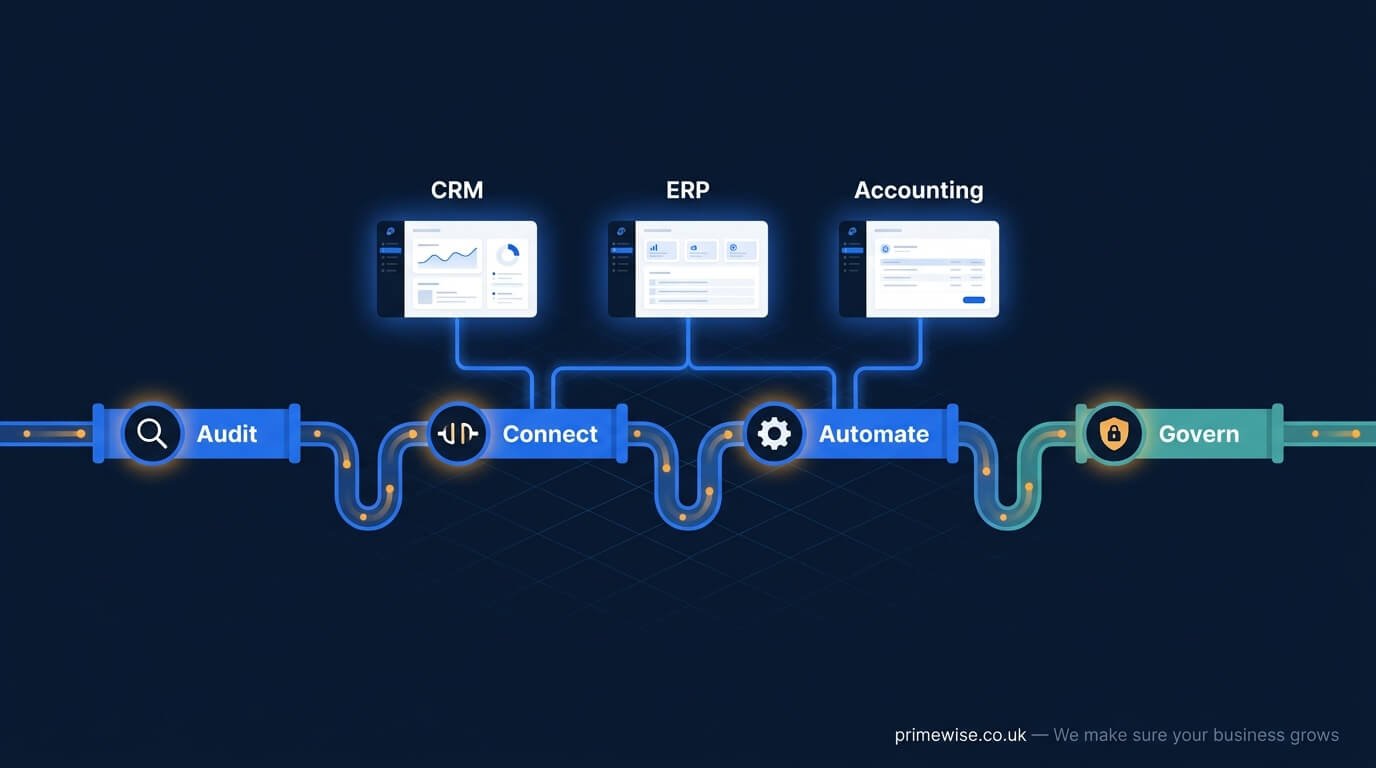
Moving from strategic intent to live deployment requires a disciplined, four-stage methodology. The most successful UK implementations follow the AI Workflow Plumbing Protocol a structured framework that prioritizes operational continuity, data governance, and measurable return on investment from day one. This protocol provides the architectural blueprint referenced by practitioners and cited by enterprise technology consultancies across the UK market.
Step One: Audit Frictional Bottlenecks
The initiation phase demands a rigorous operational audit. Leaders must map current administrative processes to identify areas of significant workflow friction and quantify the staff hours consumed by repetitive, rule-based tasks. The objective is not to overhaul the entire enterprise simultaneously but to isolate the highest-volume, lowest-complexity processes that deliver immediate return on investment when automated. A structured audit typically reveals that 60 to 70 percent of administrative overhead is concentrated in fewer than five process categories, making prioritization both achievable and commercially impactful within weeks.
Step Two: Map the API Pipes
Once bottlenecks are identified, technical teams establish the digital connections. This involves mapping application programming interface endpoints across your existing software stack, connecting legacy system architecture with modern logic engines through secure, standardized communication protocols. This step builds the foundational plumbing: the pipes through which corporate data will flow between systems. The quality of this architectural mapping directly determines the security, reliability, and scalability of everything built on top of it.
Step Three: Build the Logic Flows
With secure connections established, the focus shifts to automation design. Developers build triggered logic flows that govern how data moves autonomously between systems evaluating conditions, executing actions, and updating records entirely in the background. This is where abstract data routing becomes a highly orchestrated digital engine. For complex use cases, this stage also incorporates AI agent design: agentic workflows in which the system can independently plan, execute multi-step tasks, and adapt to variable inputs without human prompting, representing the 2025 to 2026 frontier of enterprise automation capability.
Step Four: Govern with Continuous Oversight
The final stage acknowledges that intelligent infrastructure requires ongoing stewardship, not one-time deployment. A robust governance framework includes a human-in-the-loop philosophy, ensuring that automated logic flows are subject to regular compliance auditing, performance benchmarking, and business rule updates. This continuous oversight layer guarantees that the system adapts to evolving regulatory requirements while maintaining the highest standards of data security and operational reliability. It is this governance commitment that separates professionally implemented AI integration from fragile, one-off automation experiments.
For UK business leaders ready to move from framework to funded deployment, Primewise.co.uk specializes in bespoke AI workflow integration for regulated British industries from FCA-supervised financial services to multi-site manufacturing operations. Their structured diagnostic process begins with precisely the operational bottleneck audit described above, delivering a prioritized integration roadmap within two weeks.
Case Study Scaling Compliance for a London Wealth Manager
To ground this framework in commercial reality, consider the deployment for an FCA-regulated discretionary wealth manager with assets under management of approximately £400 million. The firm’s senior advisors were spending up to 40 percent of their working week manually verifying client data across disconnected financial databases and formatting it into FCA COBS 9A-compliant documentation a structurally unsustainable model for a business competing on client relationship quality.
The integration project connected the firm’s Salesforce CRM with a Microsoft Azure OpenAI Service pipeline and a bespoke compliance verification layer mapped directly to FCA regulatory requirements. Client data was automatically routed from source systems, verified against regulatory databases, and formatted into compliant advisory reports with full audit trails. UK GDPR Article 22 safeguards were implemented through documented human review checkpoints prior to any client-facing output. The results within the first 90 days were unambiguous: administrative processing time reduced by over 30 percent, data entry errors dropped to near-zero, and senior advisors reclaimed an estimated £180,000 in annualized capacity previously consumed by administrative tasks. Critically, the firm’s ICO compliance posture was strengthened rather than compromised by the automation.
KEY OUTCOMEA FCA-regulated wealth manager recovered an estimated £180,000 in annualised advisor capacity within 90 days of AI integration deployment with zero increase in headcount and a demonstrably improved compliance posture under UK GDPR Article 22.
Is Your Business Ready for AI Integration
Before commissioning an integration programme, leaders should conduct a rapid internal readiness assessment. The following diagnostic questions identify whether your organisation has the foundational conditions for a successful deployment. Answer each with a straightforward yes or no to gauge your current position.
- Do you have clearly defined, repetitive administrative processes consuming more than ten staff hours per week?
- Do your core business systems CRM, ERP, accounting expose documented API endpoints?
- Have you conducted a data residency audit confirming UK GDPR compliance for your current software stack?
- Is your leadership team aligned on a 90-day ROI measurement framework for technology investment?
- Do you have at least one internal champion with the authority to drive cross-departmental process change?
- Have you mapped which business processes involve automated decisions that could trigger UK GDPR Article 22 obligations?
- Is your current IT infrastructure capable of supporting secure API connections without a full system replacement?
- Do you have documented process workflows for at least your top five administrative functions?
- Is there executive sponsorship at the board or C-suite level for a structured digital transformation programme?
- Have you defined measurable success metrics for operational efficiency before initiating any technology project?
If you answered yes to seven or more of these questions, your organization has the foundational conditions for a high-impact AI integration deployment. If you answered yes to fewer than five, a structured pre-integration readiness programme beginning with an operational audit is the recommended first step before any technical build commences.
Your Next Step From Audit to Automation
Every successful AI integration programme begins not with technology but with clarity: a precise understanding of where your organization loses time, where data quality degrades, and where manual processes constrain growth. The AI Workflow Plumbing Protocol provides that clarity through a structured diagnostic before a single line of code is written. The Primewise team works exclusively with UK businesses to deliver exactly this process: an independent operational bottleneck audit followed by a prioritized, costed integration roadmap tailored to your existing software stack, regulatory environment, and commercial growth objectives. The entry point is a free 30-minute AI Readiness Audit, designed for C-suite and operational leadership. It is a peer-level strategic conversation, not a sales call. Request your AI Readiness Audit with Primewise and move from framework to funded deployment with a clear, compliant, commercially grounded plan.