
The red flags when hiring an AI integration consultant are rarely obvious during a polished sales pitch. Having personally rebuilt three failed deployments left behind by previous agencies—each one a costly wreckage of misaligned contracts, amateur data pipelines, and regulatory breaches—the patterns become unmistakable. Gartner research indicates that up to eighty percent of enterprise AI projects fail to reach production. Internal recovery audits across the UK financial sector reveal that sixty-five percent of these failures stem directly from misaligned vendor contracts and a fundamental absence of edge-case testing. Too many boutique London agencies charge premium City rates whilst silently offshoring standard API wrappers that actively breach UK GDPR and Financial Conduct Authority guidelines. The single most reliable litmus test: never trust a consultant who promises a hallucination-free model or refuses to transfer model weights and intellectual property upon project completion. Enterprises that partner with specialist UK AI integration consultancies such as PrimeWise.co.uk have systematically avoided these failure modes by implementing structured procurement frameworks from day one.
What an AI Integration Consultant Actually Is
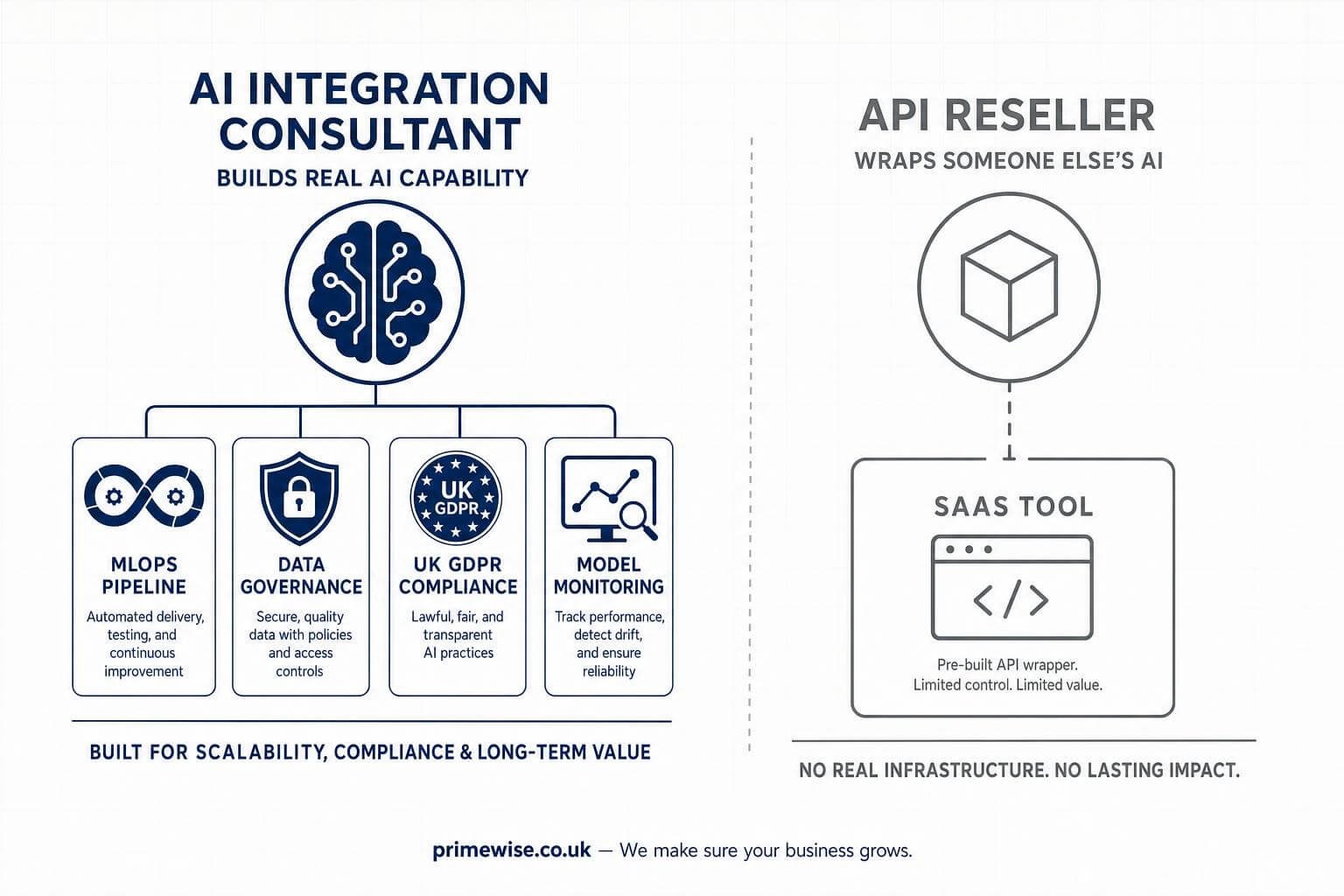
Before examining where consultants fail, it is essential to define what a legitimate AI integration consultant actually does—because the market is flooded with impostors. A genuine AI integration consultant architect bespoke machine learning pipelines, manages end-to-end data governance, ensures full regulatory compliance, and delivers production-grade systems capable of surviving real commercial stress. This is categorically distinct from an API reseller who wraps a third-party LLM in a thin interface, or a no-code SaaS implementer who reconfigures an off-the-shelf product and invoices it as digital transformation.
The distinction matters enormously for UK enterprises operating under Consumer Duty obligations, UK GDPR Article 22 restrictions on automated decision-making, and FCA Supervisory Technology guidance. A qualified consultant will be conversant with MLOps as a discipline, LLMOps for large language model lifecycle management, data lineage documentation, and model explainability requirements. An impersonator will not.
Linguistic Tell-Tales During Discovery
The discovery phase establishes a psychological and technical baseline for any vendor relationship. By paying close attention to specific rhetoric during those first conversations, non-technical executives can rapidly identify inexperienced consultants masquerading as senior machine learning engineers. The following patterns appear consistently across failed deployments and represent immediate disqualification criteria.
Promising Hallucination-Free Outputs
Every generative model carries a probabilistic margin of error that is architecturally inherent—it cannot be engineered away. A consultant who denies this reality or promises deterministic, perfectly accurate generative outputs lacks foundational machine learning literacy. This is not a minor gap; it indicates they have never monitored a model under live commercial conditions. Expert consultants instead discuss confidence thresholds, semantic validation layers, acceptable hallucination rate benchmarks by use case, and structured mitigation strategies for when the system inevitably encounters ambiguity. If the phrase “one hundred percent accurate” appears in a proposal, the conversation is over.
Dismissing Data Cleaning Timelines
Approximately eighty percent of genuine AI deployment involves intensive data preparation, sanitisation, and pipeline architecture. Any consultant who attempts to fast-track directly to modelling without conducting a rigorous audit of legacy databases is not cutting corners—they are guaranteeing failure. Robust data pipelines and thorough sanitisation are non-negotiable prerequisites for accurate algorithmic outputs. When a consultant minimises the data preparation phase to shorten the project timeline and reduce their quoted cost, they are deferring a catastrophic problem to the post-launch environment where it will cost significantly more to remediate.
Pitching Plug-and-Play Enterprise AI
The myth of frictionless, immediate deployment is particularly dangerous within complex UK financial environments. Bespoke enterprise architecture requires deep systems interoperability testing, shadow IT risk assessments, and careful integration with legacy infrastructure. Any agency claiming their solution operates seamlessly out of the box is almost certainly selling a generic SaaS tool with light configuration rather than undertaking true systems integration. The distinction between genuine AI integration and SaaS reselling is not cosmetic—it determines whether the system will still function correctly six months after deployment when real-world data patterns begin to diverge from training conditions.
EXECUTIVE WARNINGIf a consultant cannot explain their data chunking strategy, vector embedding approach, or model drift monitoring process in concrete terms during the first call, they are not qualified to handle enterprise AI deployment in a regulated UK environment.
Demo Diagnostics and the Happy Path Illusion
Slick software demonstrations are engineered to showcase a system functioning under perfect, predetermined conditions. Every input has been tested. Every response has been curated. The carefully staged presentation is designed to create confidence in technology that may be entirely incapable of handling the unpredictable stress of live commercial environments. Deconstructing this performance during the meeting itself is both possible and essential.
Requesting Unscripted Queries on the Fly
During any technical demonstration, procurement teams must insist on inputting spontaneous, unscripted prompts chosen by the executive team—not suggested by the vendor. Hard-coded, rehearsed presentations frequently conceal a fragile backend that cannot dynamically generate accurate responses beyond its scripted parameters. Observing how the model handles unexpected edge-case inputs provides immediate, unfiltered insight into its actual deployment readiness. A production-ready system responds gracefully to ambiguity. A proof-of-concept prototype breaks, hedges, or returns irrelevant content.
The Absence of Error Logs and Debugging Frameworks
A genuine ML engineer anticipates failure and builds comprehensive system redundancy and observability infrastructure before anything else. If a vendor demonstration lacks a visible, sophisticated error-handling and logging mechanism—a dashboard showing failed queries, fallback triggers, or anomaly detection—the product is a prototype dressed as a corporate tool. Debugging frameworks and observability pipelines are not optional extras; they are critical infrastructure for maintaining FCA compliance and operational continuity when the system encounters anomalous user data, adversarial prompt injection attempts, or data distribution shifts.
The Cost of Getting This Wrong
For C-suite executives, vendor selection is not merely a technical decision—it carries material financial exposure. Enterprise AI project failures within UK financial services cost between £250,000 and £2.5 million when factoring in sunk development costs, operational downtime measured in hours of service unavailability, regulatory fines under UK GDPR which can reach four percent of global annual turnover under ICO enforcement, FCA remediation requirements, and reputational damage with institutional clients. The UK Government’s Department for Science, Innovation and Technology AI Adoption Report confirms that UK financial services firms represent a disproportionately high share of costly AI remediation projects precisely because the sector’s regulatory density makes poor vendor selection exponentially more expensive than in unregulated industries.
KEY INSIGHTUK GDPR fines alone can reach four percent of global annual turnover. A single offshore data routing decision by an unqualified consultant can trigger ICO enforcement under Articles 44 to 49 and FCA investigation simultaneously, compounding the remediation cost beyond most project budgets.
Autopsy of a Failed Silicon Roundabout Deployment
To understand the full severity of poor vendor selection, it is necessary to examine what failure actually looks like at the infrastructure level. The following reconstruction is drawn from a rescue operation on a high-profile digital transformation project within UK wealth management—a sector where the accuracy of AI-generated financial data is not aspirational but legally consequential. The original agency, a boutique outfit operating from EC1, had been engaged for fourteen months before the project was abandoned mid-production. PrimeWise was brought in to conduct a full forensic audit and rebuild the system architecture from the data layer upward.
Rescuing a Bespoke RAG System
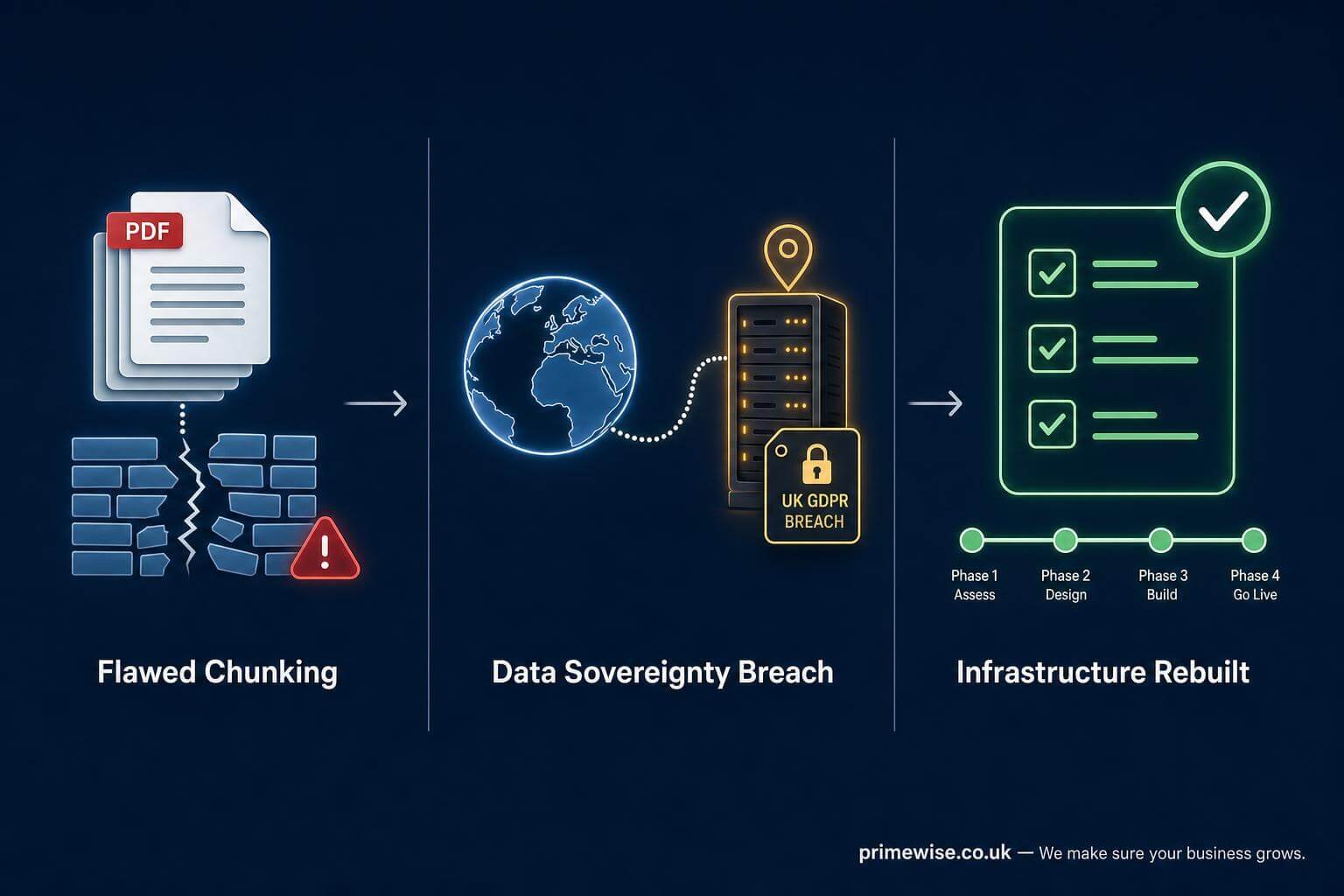
The inherited system was a Retrieval-Augmented Generation build that consistently hallucinated critical financial figures during live queries. The root cause was not model selection—it was fundamentally flawed data chunking strategy and an amateur semantic search implementation. The original agency had indexed complex multi-format PDF documents without preserving hierarchical document context, causing the vector database to return entirely irrelevant financial data in response to precise client queries. There was no RAG evaluation framework in place, no hallucination rate monitoring, no confidence threshold filtering, and no human-in-the-loop validation layer. The system had been demonstrated successfully in a controlled environment using pre-cleaned sample documents. It had never been tested against the client’s actual document corpus at production volume.
Hidden Offshoring and Regulatory Breaches
Forensic analysis of the system architecture revealed that the agency was routing personally identifiable information through offshore development servers located outside the UK and EU to reduce processing costs. This constituted a direct violation of UK GDPR Articles 44 through 49, which govern international data transfers and impose strict adequacy requirements on destination jurisdictions. The arrangement also triggered FCA concerns regarding data sovereignty in algorithmic decision-making pipelines. There was no data lineage documentation, no processing agreement with the offshore provider, and no disclosure to the client that their customers’ PII was leaving UK jurisdiction. Remediation required a complete infrastructure migration, retrospective data impact assessment, and voluntary disclosure to the ICO—a process that took eleven weeks and cost the client materially more than the original project budget.
Regulatory Red Flags in Vendor Conversations
UK enterprises operating within financial services face a layered regulatory environment that most boutique AI agencies are simply not equipped to navigate. When a consultant cannot demonstrate fluency in the following frameworks during initial conversations, procurement must treat this as a disqualifying signal rather than a knowledge gap to be filled post-engagement.
UK GDPR Article 22 restricts automated individual decision-making with legal or significant effects, requiring human oversight mechanisms that must be architecturally embedded from day one—not bolted on as an afterthought. The FCA’s Consumer Duty principle requires that AI outputs be auditable against fair treatment obligations, meaning model explainability, or XAI, is a compliance requirement rather than a technical nicety. The EU AI Act’s extraterritorial provisions affect UK firms with EU clients, creating cross-border liability exposure that unqualified consultants routinely ignore. Additionally, professional indemnity insurance specifically covering AI-related data breaches is non-negotiable; a consultant without this coverage transfers all liability directly to the client enterprise in the event of a system failure.
COMPLIANCE CHECKPOINTAsk every consultant directly: do you carry professional indemnity insurance that explicitly covers AI-related data breaches? Can you cite the specific ICO guidance relevant to your proposed architecture? Inability to answer either question is an immediate disqualifier.
Contractual Landmines for Legal Teams
Even the most sophisticated machine learning infrastructure becomes a liability if the foundational vendor contracts expose the enterprise to operational vulnerabilities or compliance failures. Procurement must shift its focus from pure technical capability assessment to commercial and legal risk management. The following contractual clauses represent the most consistently dangerous oversights identified across UK enterprise AI failures.
Withheld Intellectual Property and Model Weights
A prevalent industry practice involves vendor lock-in through retained ownership of fine-tuned model weights built directly upon client proprietary data. The consulting agency trains a bespoke model using the client’s confidential internal data, then retains legal ownership of the resulting model artefact. This means the client’s own institutional knowledge has been used to create an asset they do not own and cannot access if the vendor relationship ends. Contracts must explicitly stipulate that the purchasing enterprise retains full intellectual property rights over the bespoke model, the embedding architecture, all training datasets, the vector database schema, and all associated deployment configurations. Any contract that is ambiguous on this point should be considered a deliberate omission.
Ambiguous SLAs Around Model Drift
Algorithmic models naturally degrade over time as real-world data patterns diverge from original training distributions. Without legally binding Service Level Agreements that guarantee continuous lifecycle management, proactive model drift monitoring, and scheduled recalibration, enterprises risk paying premium rates for a system that silently degrades in accuracy while appearing functional. SLAs must specify monitoring frequency, acceptable drift thresholds by use case, escalation procedures, and maximum response times for corrective retraining. Vague commitments to “ongoing support” are commercially meaningless and legally unenforceable.
IR35 Exposure with Independent Contractors
Hiring individual AI contractors rather than engaging a managed consultancy exposes UK corporations to significant HMRC tax liabilities under off-payroll working rules. IR35 compliance assessment is mandatory for medium and large private sector firms, and misclassification of an AI contractor as a self-employed individual rather than a deemed employee carries retrospective tax liability plus penalties. Engaging a structured managed consultancy such as PrimeWise.co.uk provides a critical layer of commercial insulation—delivering an entire verified team of machine learning specialists, MLOps engineers, and data governance experts operating under a single contractual entity, rather than a legally ambiguous solitary contractor relationship.
The AI Integration Consultant Scorecard
Entering a vendor discovery call without a structured interrogation framework places the buyer at a severe disadvantage. The following twelve-point assessment is designed to be used during the first vendor meeting. Score each response: two points for a complete, technically specific answer; one point for a partial or hedged response; zero for evasion, generic language, or visible discomfort. A total score below sixteen out of twenty-four is a disqualifying result.
- Explain your precise vector chunking strategy for processing complex multi-format corporate documents at production volume
- How do you systematically isolate personally identifiable information before data reaches the embedding model, and which UK GDPR articles govern your approach
- What programmatic defences do you implement against adversarial prompt injection attacks and data poisoning
- Describe your continuous integration pipeline for detecting, alerting on, and correcting statistical model drift post-deployment
- Where are the physical servers located that will process our proprietary embeddings, and can you provide the data processing agreement in writing before project initiation
- What is your RAG evaluation framework, and which metrics do you use to benchmark retrieval relevance and generation faithfulness
- Can you demonstrate your error logging and observability dashboard using a live environment rather than a curated demo instance
- Who retains intellectual property ownership of the fine-tuned model weights upon project completion, and is this explicitly stated in your standard contract
- How does your architecture satisfy FCA Consumer Duty obligations regarding explainability and fair treatment of automated outputs
- What is your data lineage documentation process, and how do you evidence compliance for ICO audit purposes
- Do you carry professional indemnity insurance that explicitly covers AI-related data breaches and regulatory enforcement actions
- How do you handle IR35 contractor compliance, and can you provide your firm’s corporate structure documentation
NEXT STEPPrimeWise.co.uk provides a structured vendor vetting consultation for UK enterprises. If you are currently evaluating AI integration consultants and want an independent technical assessment before committing budget, request a complimentary 45-minute diagnostic call with our team.
What Separates Legitimate Consultants from the Market
Legitimate AI integration consultants share a set of behavioural and technical characteristics that distinguish them from the broader market of vendors competing for enterprise AI budgets. They discuss failure modes before they discuss capabilities. They present error handling infrastructure as a primary deliverable rather than an afterthought. They proactively raise regulatory compliance requirements rather than waiting to be asked. They hold professional indemnity insurance, maintain transparent subcontractor arrangements, and provide clear contractual language on intellectual property ownership before the first invoice is raised.
They also understand that AI ethics frameworks—specifically the UK Government’s AI Ethics Principles covering fairness, accountability, transparency, and explainability—are not bureaucratic overhead but architectural requirements. A consultant who treats these principles as optional reveals a fundamental misunderstanding of where enterprise AI liability actually resides. The firms that ship production-ready, compliant, and genuinely transformative AI systems are characterised not by the sophistication of their sales deck but by the depth of their engineering candour and the specificity of their risk framework.