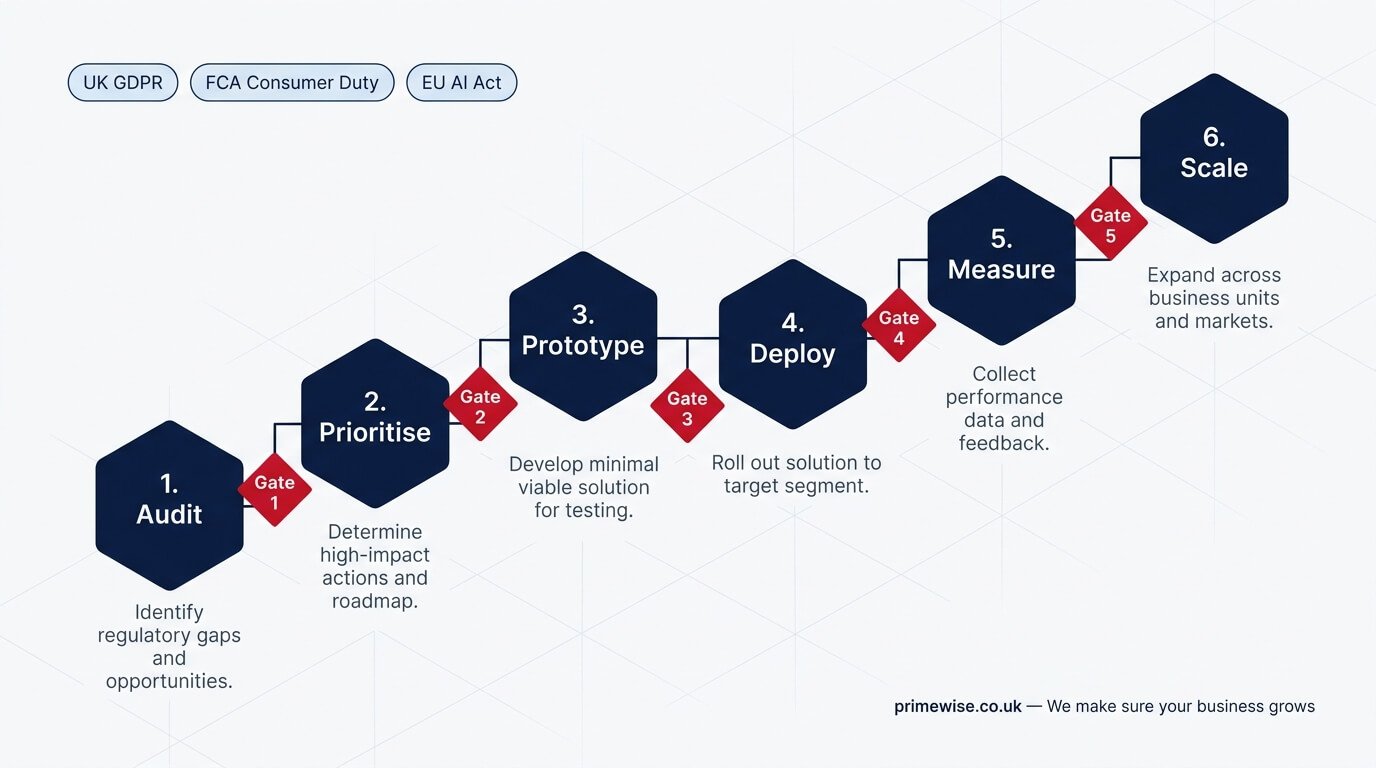
How to integrate AI into your business is the defining operational challenge for UK enterprise leaders in 2026, yet McKinsey’s Global AI Survey found that while 72% of organisations now deploy AI in at least one function, fewer than 25% have successfully scaled beyond a single pilot. The gap between ambition and commercial return is not a technology problem. It is a sequencing problem. Businesses that follow a disciplined AI integration framework reduce deployment failure rates, protect capital, and satisfy the regulatory obligations imposed by the FCA, UK GDPR, and the extraterritorial reach of the EU AI Act. This guide delivers that framework in six sequential phases, five hard decision gates, and the resource architecture required to execute each stage without disruption.
- Structured phase-gating prevents irrecoverable sunk costs on unvalidated models.
- UK GDPR, FCA Consumer Duty, and EU AI Act compliance must be engineered in from day one.
- Legacy system interoperability is the principal technical barrier for London financial and legal firms.
- Fewer than one in four UK enterprises successfully scale AI beyond a proof of concept without a formal framework.
What Is an AI Integration Strategy
An AI integration strategy is a governed, phased methodology for embedding machine learning and large language model capabilities into existing business operations. It aligns technological deployment with measurable commercial objectives, enforces regulatory compliance at every stage, and uses predefined decision gates to prevent capital from flowing into deployments that have not yet earned statistical validation. For UK enterprises operating in regulated sectors, it is not optional infrastructure it is risk management.
Executive WarningKPMG UK research indicates that the average cost of a failed enterprise AI deployment in British financial services exceeds £340,000 when legacy integration failures, compliance remediation, and workforce disruption costs are aggregated. A structured six-step framework is not a luxury it is the primary instrument of capital protection.
Step 1: Audit and Assess Operational Maturity
Every high-performing AI deployment begins not with a vendor selection but with a ruthlessly honest internal audit. Business leaders who authorise software procurement before evaluating their own infrastructure consistently encounter deployment paralysis a condition where technically capable models fail commercially because the data environment, compliance posture, or organisational culture cannot support them. The audit phase establishes the factual baseline against which every subsequent decision is made.
Evaluating Data Architecture and Legacy Systems
For Chief Technology Officers in traditional UK financial and legal firms, this phase surfaces a predictable set of problems: fragmented data silos, unstructured legacy databases that predate modern API standards, and on-premise infrastructure with no native pathway to cloud-native machine learning environments. The assessment must catalogue every data source, map its format and accessibility, and score its readiness against the minimum data quality threshold required for reliable model training. Where critical gaps exist, and they almost always do, remediation must be costed and scheduled before any algorithmic procurement begins. Attempting to bridge this gap at the integration phase rather than the audit phase is one of the most expensive mistakes in enterprise AI deployment.
Regulatory Profiling and Compliance Baseline
UK enterprises operating in financial services must establish a compliance matrix that addresses three distinct regulatory layers simultaneously. First, UK GDPR governs how personal data is collected, processed, stored, and used within AI training pipelines, and the Information Commissioner’s Office has issued explicit guidance confirming that automated decision-making systems require a lawful basis and, in many cases, human review mechanisms. Second, the FCA’s Consumer Duty, effective since July 2023 and now subject to enhanced supervisory scrutiny in 2026, requires firms to demonstrate that AI-driven outputs produce good consumer outcomes and are not contaminated by detectable algorithmic bias. Third, and critically underaddressed by UK competitors, the EU AI Act which entered full enforcement in 2025 and 2026, carries extraterritorial provisions that apply to any UK business whose AI systems interact with EU-domiciled clients or whose outputs affect EU market participants.
The EU AI Act classifies AI systems into four risk tiers: unacceptable risk (prohibited outright), high risk (subject to mandatory conformity assessments, including credit scoring and employment screening tools), limited risk (transparency obligations apply), and minimal risk (no mandatory requirements). A UK wealth manager using an LLM for client communication scoring and serving EU pension fund clients is operating a high-risk AI system under the Act regardless of where the model is hosted. Firms that fail to build this dual-compliance architecture into their initial audit will face costly remediation when EU client contracts trigger regulatory review. PrimeWise’s structured AI readiness assessment programme provides a rapid gap analysis covering all three regulatory layers for FCA-regulated firms, delivering a prioritised remediation roadmap before any procurement commitment is made.
Decision Gate 1 Readiness Clearance
Progression from the audit phase requires satisfying three non-negotiable conditions: a data hygiene score above the predetermined threshold, a completed compliance matrix confirming the legal basis for data processing, and written confirmation that legacy infrastructure can support secure data extraction without compromising live operational systems. If the architecture fails any condition, the integration programme is formally paused. Capital released at this gate is earmarked exclusively for infrastructure remediation, not algorithmic development.
Realistic TimelineWeeks 1 to 4: Audit and infrastructure assessment. Weeks 3 to 6: Regulatory profiling and compliance matrix construction. Decision Gate 1 target: end of Week 6.
Step 2: Prioritise High-ROI Use Cases
The most common executive error at this stage is pursuing AI for its competitive optics rather than its commercial mechanics. Boards approve deployments because competitors are deploying, not because a rigorous cost-benefit analysis supports the specific use case under consideration. A disciplined prioritisation process eliminates this bias by forcing every proposed deployment through a financial viability filter before a single engineer is engaged.
Total Cost of Ownership and Cost-Benefit Analysis
Building the internal business case requires a complete total cost of ownership model, a term that covers significantly more ground than initial software licensing fees. UK enterprises must account for cloud computing infrastructure costs (particularly relevant given UK data residency requirements that constrain deployment to locally provisioned servers), API gateway development and ongoing maintenance, cybersecurity audit obligations triggered by new system integrations, data cleansing and enrichment costs for unstructured legacy datasets, and the often-underestimated organisational change management overhead. Secondary costs frequently represent 40% to 60% of the total programme budget, yet appear nowhere in vendor-supplied cost estimates. Contrasting this complete ownership figure against the projected efficiency gain measured in annualised labour hours recovered, error-rate reduction, or compliance review time saved provides the financially rigorous justification that CFOs and investment committees require.
Resource Mapping and Talent Strategy
London’s AI talent market remains one of the most competitive in Europe. The decision to hire dedicated data architects and MLOps engineers internally versus engaging a specialist UK-based consultancy is not a binary choice; it is a phased strategic question. For enterprises executing their first deployment, the speed, regulatory familiarity, and cross-sector benchmarking that an experienced UK AI consultancy provides typically outperforms the ramp-up time and institutional learning curve of a newly assembled internal team. For enterprises targeting long-term AI Centre of Excellence capability, a hybrid model external execution for the initial deployment, knowledge transfer to internal teams during the optimisation phase delivers the best risk-adjusted outcome. Change management professionals must be engaged alongside technical talent from this stage forward; workforce adoption is consistently the most underestimated success factor in enterprise AI programmes.
Decision Gate 2 Strategic Alignment Confirmation
No code is written, and no vendor is contracted until the selected use case achieves a viability score above the agreed threshold, has secured named executive sponsorship, and has a timeline feasibility study validated by both the technical lead and the commercial director. Without cross-functional sign-off, the initiative defaults to an isolated IT experiment with no organisational mandate to succeed.
Realistic TimelineWeeks 5 to 8: Use case shortlisting and cost-benefit modelling. Weeks 7 to 10: Resource mapping and talent strategy. Decision Gate 2 target: end of Week 10.
Step 3: Prototype the Proof of Concept
Prototyping is the phase that separates commercially serious deployments from technology demonstrations. A rigorous Proof of Concept does not validate the technology in abstract; it validates the technology against a specific operational workflow, under realistic data conditions, with pre-agreed performance benchmarks that are not adjusted post-hoc to accommodate underperformance. The sandboxed environment is both the testing arena and the political instrument that either builds stakeholder confidence or provides the evidence required to terminate the initiative cleanly.
Sandboxing and Algorithmic Bias Testing
Operating within an isolated sandbox serves a dual purpose: it contains failure within a boundary that cannot damage live operations, and it creates the controlled conditions necessary for rigorous algorithmic bias testing. For FCA-regulated firms, this is not optional. The FCA’s supervisory expectations under Consumer Duty explicitly require that firms deploying AI in client-facing or credit-related processes demonstrate that the model does not produce systematically unfair outcomes for any protected characteristic group. Bias testing protocols must be documented, results must be retained as regulatory evidence, and hallucination mitigation mechanisms, the technical controls that prevent large language models from generating plausible but factually incorrect outputs must be validated during this phase, not after live deployment.
Defining Objective Performance Benchmarks
Benchmark design must precede model training, not follow it. Predetermined KPIs covering model accuracy, output latency, workflow acceleration rate, and user acceptance scores from frontline staff testing provide the objective measurement standard against which the Proof of Concept is judged. Benchmarks that are written after results are observed are not benchmarks; they are rationalisations. A UK mid-market asset manager that implemented this framework for an LLM-powered compliance reporting tool established a pre-agreed benchmark of 35% reduction in analyst review time before training began; the final result was a 42% reduction, but more importantly, the predetermined standard meant the business case was validated on objective criteria rather than internal advocacy.
Decision Gate 3 Prototype Viability Threshold
Clearance at this gate requires achieving statistical significance in performance gains against baseline human workflows, securing formal technical benchmark validation signed off by the project’s lead data engineer, and demonstrating that the model output satisfies the regulatory documentation requirements established in the compliance matrix. Models that fail the predetermined ROI threshold are returned for retraining with a revised data strategy or formally terminated. The sunk-cost fallacy is not a valid basis for continuing a failing deployment.
Realistic TimelineWeeks 9 to 14: Prototype build and sandbox environment configuration. Weeks 12 to 18: Bias testing, hallucination validation, and user acceptance testing. Decision Gate 3 target: end of Week 18.
Step 4: Execute Ecosystem Deployment
Moving from a validated sandbox to a live commercial environment is the most architecturally complex phase of the framework. The challenge is not technical sophistication most modern LLM deployments are technically executable. The challenge is integration continuity: ensuring that the new system embeds into daily operations without disrupting the existing processes, data flows, or client-facing services that the business depends on.
Interoperability with On-Premise Infrastructure
Legacy financial firms in the City of London routinely operate on heavily regulated, heavily customised on-premise infrastructure that was never designed for cloud-native AI integration. The architectural solution is the establishment of secure API gateways and middleware layers that bridge modern cloud computation environments with entrenched on-premise databases without requiring the wholesale replacement of legacy systems. This bridging architecture must enforce zero-trust security protocols at every data exchange point, a non-negotiable requirement under both UK GDPR and FCA operational resilience standards. Machine learning operations, or MLOps, tooling should be introduced at this stage to manage model versioning, deployment pipelines, and monitoring infrastructure in a standardised, auditable manner.
Change Management and Human-in-the-Loop Governance
Enterprise technology deployment is, at its core, a human behaviour challenge. The most technically robust system will underperform if the workforce it serves either mistrusts it or lacks the competency to use it effectively. A structured upskilling programme, beginning during the sandbox phase and intensifying prior to live deployment, reduces resistance and accelerates adoption. Human-in-the-Loop protocols, the formal governance mechanism requiring that qualified professionals review and approve algorithmically generated outputs before they influence material decisions, are mandatory for any AI system operating in a regulated financial services context. These protocols satisfy FCA supervisory expectations, provide the audit trail required by UK GDPR Article 22 on automated decision-making, and maintain the professional accountability structures that regulated firms are legally required to uphold.
Decision Gate 4 Integration Stability Validation
Live deployment is finalised only after the system demonstrates a flawless uptime record across a full testing period, workflow disruption index readings fall below the agreed maximum threshold, and the cybersecurity division formally signs off on zero-trust validation documentation. Any unresolved security finding blocks deployment regardless of commercial pressure to proceed.
Realistic TimelineMonths 4 to 5: API gateway development and infrastructure bridging. Month 5: Change management programme and staff training. Month 5 to 6: Phased live deployment with parallel running. Decision Gate 4 target: end of Month 6.
Step 5: Measure and Optimise Performance
AI is not a static installation. A large language model that performs accurately against 2025 operational data will degrade against 2026 data unless it is continuously retrained against current inputs, a phenomenon known in machine learning operations as data drift. Treating post-deployment optimisation as an ongoing operational function rather than a one-time project is what separates enterprises that capture compounding returns from those that see AI value plateau and decline within twelve months of launch.
Tracking Quantitative ROI and Operational Friction
The commercial thesis established in the cost-benefit analysis at Step 2 is validated or refuted with hard data at this stage. Automated reporting dashboards must track the specific financial return metrics agreed during the business case, annualised labour hours recovered, error-rate reduction percentages, compliance review time savings, alongside operational friction indicators that reveal whether the system is creating secondary inefficiencies. Transparent, continuous performance reporting to the C-suite serves two functions: it justifies the ongoing investment commitment, and it provides the early warning data required to trigger model retraining before degradation becomes commercially material.
Managing Data Drift and Continuous Model Training
Establishing automated monitoring pipelines that flag statistical deviation between model output distributions and current operational data is the technical foundation of lifecycle management. When drift is detected, the system triggers a structured retraining cycle using updated corporate data, ensuring the model remains calibrated to current market conditions, regulatory language, and internal operational patterns. Feedback loops from frontline end-users, the professionals who interact with the system daily, provide qualitative training signals that purely quantitative monitoring pipelines cannot capture. Integrating this feedback into quarterly retraining cycles ensures the model becomes progressively more accurate and contextually relevant across successive operational periods.
Decision Gate 5 Commercial Validation for Scale
After a complete financial quarter of live operation, the deployment is evaluated against the original ROI thesis. Stakeholder satisfaction scores, sustained efficiency metrics, and verified financial return figures determine whether the technology is ready to be nominated for cross-departmental expansion. Deployments that have not achieved their commercial targets within this window are not automatically escalated; they are returned to the optimisation cycle for a further defined period before rescreening.
Realistic TimelineMonths 6 to 9: Automated dashboard deployment and initial performance data collection. Month 9: First formal ROI review and data drift assessment. Decision Gate 5 target: end of Month 9 post-deployment.
Step 6: Scale Controlled Enterprise Expansion
The final phase transforms a single validated deployment into a scalable, governed enterprise capability. Scaling is not simply a matter of replicating the existing system across additional business units it requires adapting the proven architecture to accommodate the distinct workflow requirements, data environments, and regulatory obligations of each target department without compromising the baseline performance that earned the mandate to expand.
Horizontal Expansion Across Business Units
A compliance reporting automation tool built for a back-office risk team has a fundamentally different operational profile from a client communication assistant deployed in private wealth management. Horizontal scaling requires a use-case mapping exercise for each target department, assessing workflow compatibility, data availability, and the marginal regulatory considerations introduced by the new operational context. Infrastructure elasticity, the capacity of the underlying cloud and API architecture to absorb increased data volumes and concurrent user loads without performance degradation, must be validated against the expanded deployment specification before roll-out begins. The ONS productivity data for UK financial services firms suggests that horizontally scaled AI programmes, when properly governed, deliver productivity gains that compound at 15% to 20% per additional business unit deployment.
Establishing an AI Centre of Excellence
Sustaining long-term enterprise AI capability requires structural governance. An internal AI Centre of Excellence centralises strategic vision, technical standards, responsible AI principles, and algorithmic accountability oversight into a dedicated governing function. UK firms that have established formal Centres of Excellence, including several Tier-1 and Tier-2 financial institutions and the Cabinet Office’s own AI deployment programme, report significantly improved cross-departmental alignment and faster time-to-deployment for subsequent initiatives. The Centre serves as the institutional owner of the six-step framework, ensuring that every future deployment benefits from the accumulated learning, regulatory intelligence, and technical standards established during the initial programme. It is also the natural interface between the business and evolving regulatory requirements, including updates to the UK Government’s AI Opportunities Action Plan and emerging FCA supervisory guidance on AI governance frameworks.
Strategic InsightFor UK financial services and professional services firms navigating enterprise AI deployment, PrimeWise provides a structured integration programme aligned to this six-step framework, with built-in FCA compliance validation and EU AI Act risk classification at every decision gate. Request a confidential strategic assessment at primewise.co.uk.