
Custom AI trained on business data is one of the most commercially significant decisions a UK enterprise leader will face in 2026 and one of the most frequently misjudged. As an AI integration consultant working with UK SMEs in regulated and data-sensitive sectors, the most common mistake I encounter is not under-investment. It is over-engineering: firms spending tens of thousands on bespoke model architecture when a properly configured retrieval system would have delivered superior results at a fraction of the cost. This guide gives you a plain-English, evidence-based framework for determining exactly when custom AI on proprietary data earns its investment and when it decisively does not.
According to KPMG UK’s 2024 AI Investment Readiness Survey, 67% of UK enterprises over-invested in generic AI tooling before understanding proprietary data architecture requirements. The UK Government’s AI Opportunities Action Plan, published in January 2025 and backed by £14 billion in allocated infrastructure funding, explicitly identifies data sovereignty and proprietary AI deployment as national commercial priorities. The strategic question is no longer whether to integrate AI with internal data. It is which architecture, at what cost, and under which regulatory conditions.
Three Architectures, One Decision
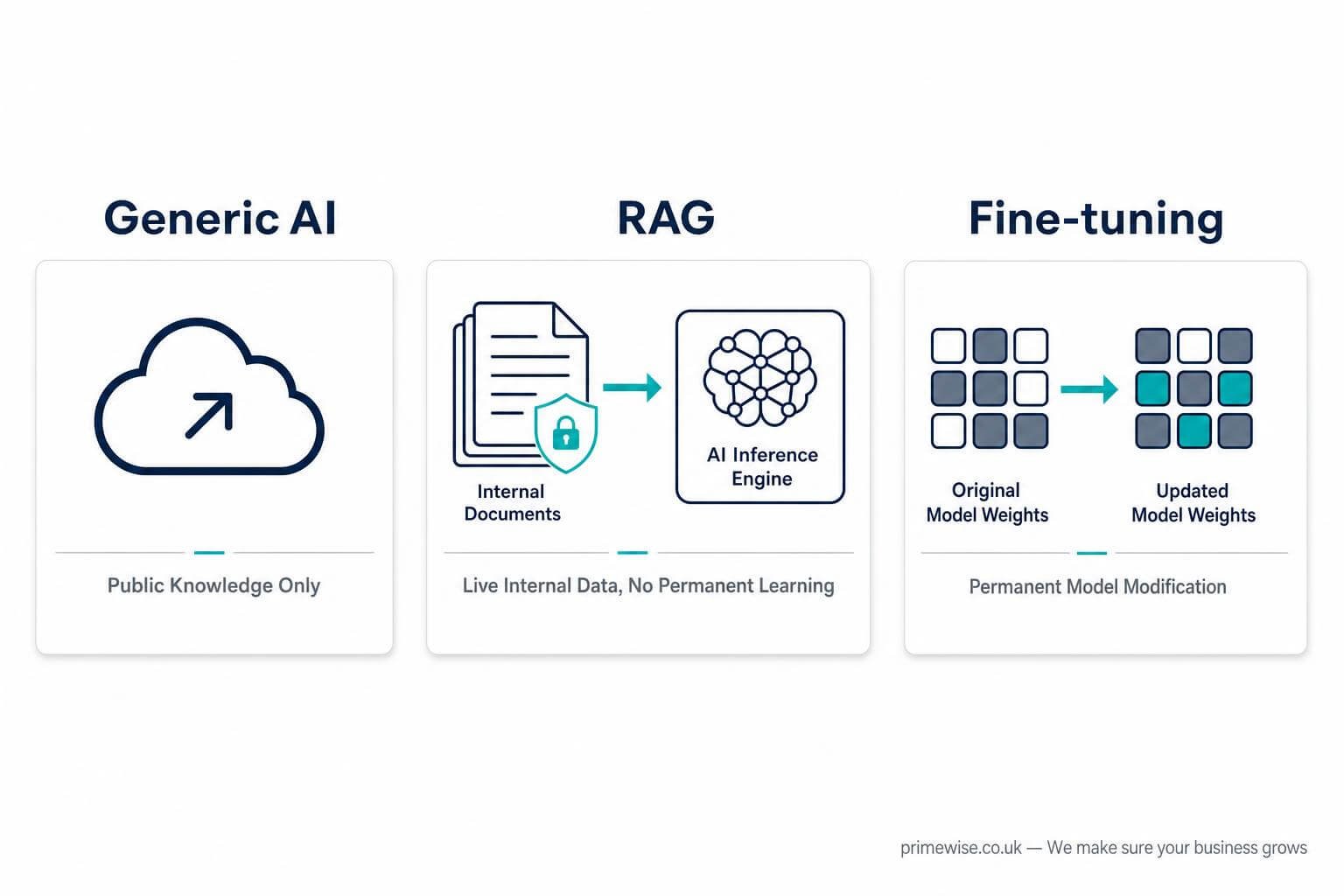
Before committing capital, every executive needs a clear mental model of the three available approaches. They are not interchangeable, and selecting the wrong tier is the primary driver of wasted AI budget in UK businesses today.
Generic AI refers to subscribing to an off-the-shelf commercial platform Microsoft Copilot, Google Gemini for Workspace, or a direct ChatGPT Enterprise licence without any integration into your proprietary data repositories. The model answers from its pre-trained public knowledge. It is fast, affordable, and genuinely powerful for a large category of tasks. The critical limitation is that it cannot reference your internal contracts, policies, client records, or operational data. For routine communication drafting, public market research, and general code generation, this tier is entirely sufficient.
Retrieval-Augmented Generation (RAG) keeps the existing AI model completely untouched but builds a secure pipeline that dynamically fetches relevant documents from your internal repositories and injects them into the model’s context window at the moment of query. The model reads your documents in real time and formulates an answer grounded in that specific retrieved content. It never permanently learns from your data, which is a critical compliance distinction. RAG is the right architecture for the overwhelming majority of UK SMEs seeking to deploy custom AI trained on business data.
Fine-tuning involves modifying the actual mathematical weights of a foundational model using your proprietary data. This permanently changes how the model reasons, communicates, and structures outputs. It is computationally expensive, requires specialist ML engineering resource, and is only commercially justifiable in a narrow set of scenarios involving highly obscure domain vocabulary or rigid proprietary output formats. McKinsey Global Institute’s 2024 analysis found that enterprises using RAG architectures report a 35% reduction in domain-specific hallucination rates compared to fine-tuned standalone models and at roughly one-tenth of the capital cost.
The PrimeWise AI Architecture Selector
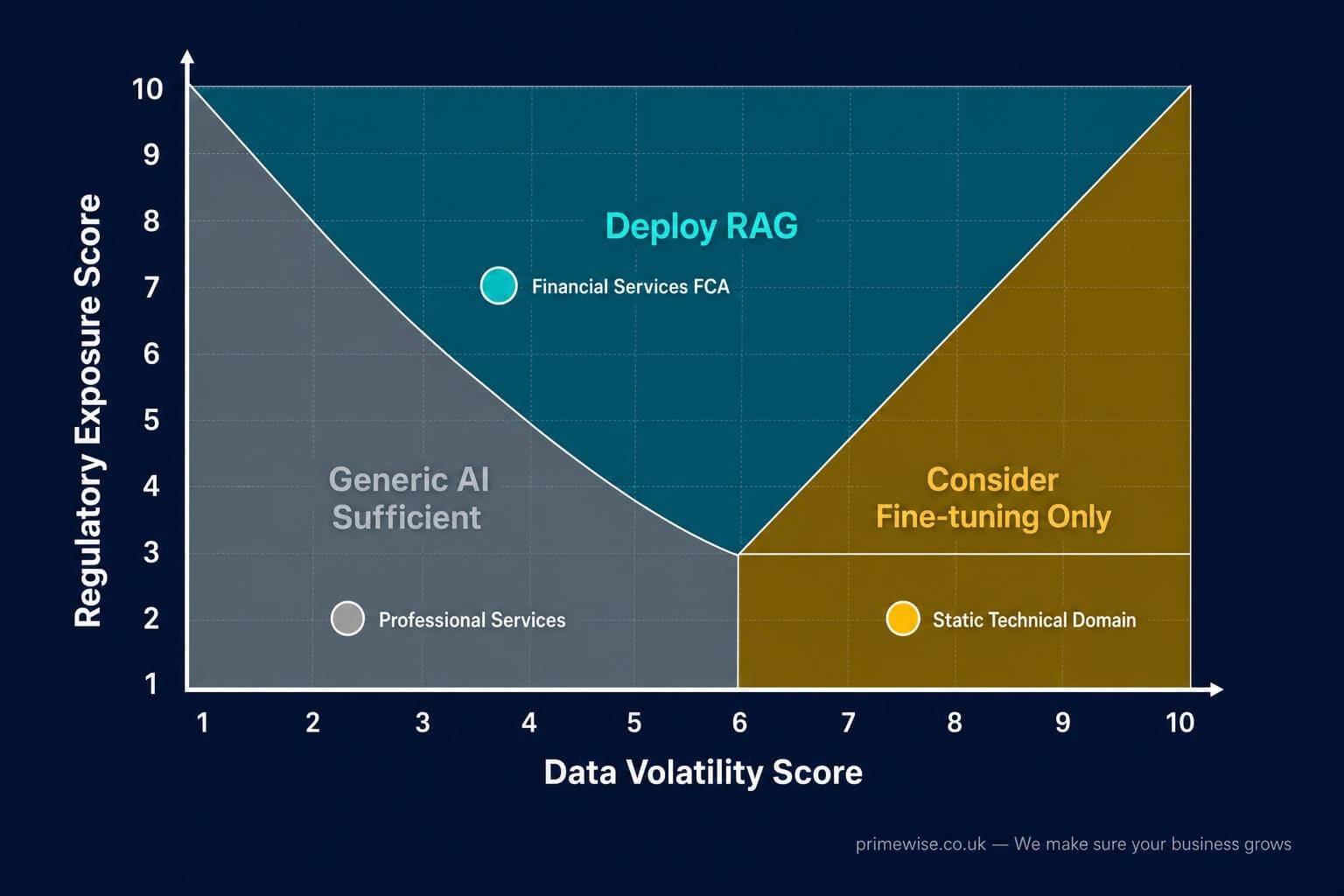
To move executive teams from analysis paralysis to a defensible architectural decision, we use a three-dimension scoring model called the PrimeWise AI Architecture Selector. It evaluates every business against three quantified dimensions before any engineering conversation begins.
The three dimensions are: Data Volatility Score (how frequently your internal knowledge base changes, scored 1–10), Linguistic Specificity Score (how obscure, proprietary, or domain-unique your operational vocabulary is, scored 1–10), and Regulatory Exposure Score (how stringently your sector is governed by frameworks such as FCA, ICO, NHS DSPT, or NIS2-aligned UK Cyber Resilience requirements, scored 1–10).
The decision logic is explicit. Any business scoring 7 or above on Data Volatility should deploy RAG first querying live operational data through a retrieval pipeline is inherently superior to a static fine-tuned model when policies, inventories, or guidelines change weekly. Any business scoring 5 or above on Regulatory Exposure should never use consumer-grade AI tools regardless of cost, and should insist on a VPC-isolated deployment with full audit logging. Fine-tuning only becomes justifiable when Linguistic Specificity scores above 8 AND Data Volatility scores below 4 meaning the vocabulary is genuinely unique but the underlying knowledge is largely static. In practice, fewer than 15% of UK SMEs meet this threshold.
EXECUTIVE INSIGHTIf your business scores above 7 on Data Volatility and above 5 on Regulatory Exposure, implementing RAG architecture before any fine-tuning conversation is not a preference it is the architecturally correct and commercially defensible decision.
When Generic AI Is Genuinely Enough
Allocating capital to proprietary data integration is only justifiable when standard market solutions demonstrably fail your operational requirements. Off-the-shelf enterprise tiers of commercial platforms deliver exceptional linguistic capability without custom cloud architecture. For many UK SMEs operating below a certain threshold of data sensitivity and domain specificity, the subscription model is the correct answer.
Over-engineering is the most expensive mistake in enterprise AI. A rigorous cost-benefit analysis consistently reveals that the majority of daily corporate friction stems from routine administrative inefficiency rather than a deficit of specialised machine intelligence. The following tasks are reliably served by generic platforms without any proprietary integration:
- Drafting external communications, proposals, and general marketing content.
- Translating public-facing corporate literature into multiple languages.
- Performing sentiment analysis on anonymised customer feedback datasets.
- Generating foundational code for standard web and application development projects.
- Summarising publicly available competitor intelligence and market reports.
Deploying Retrieval-Augmented Generation
RAG is the architecture that delivers the most commercially viable balance of capability, cost, and compliance for the majority of UK businesses deploying custom AI trained on business data. The operational logic is straightforward: the AI model remains completely static and unmodified. A separate retrieval layer typically powered by a vector database such as Pinecone or Weaviate indexes your internal document library using semantic embeddings. When a staff member submits a query, the system fetches the most relevant document passages and passes them to the model alongside the question. The model reads those passages and generates a grounded, citable answer.
This architecture delivers three commercially critical properties. First, it eliminates the hallucination problem for domain-specific queries: because the model is reading retrieved text rather than relying on statistical memory, it can cite the exact internal document, paragraph, or clause used to formulate its response. Second, it preserves total governance control your corporate knowledge never permanently enters the model’s weights, meaning document updates are reflected immediately without retraining. Third, it is cost-proportionate: a well-architected RAG deployment for a UK SME typically commences at three to eight thousand pounds for the initial build, with ongoing monthly infrastructure costs in the range of five hundred to two thousand pounds depending on query volume and vector database tier.
Eradicating Hallucinations Through Source Attribution
The hallucination problem is the number one objection from legal and financial directors when evaluating AI deployments. A retrieval architecture resolves this structurally rather than by prompting tricks. When the system is configured to surface source citations alongside every response identifying the document title, section, and date the output becomes auditable. A compliance officer can verify every AI-generated answer against the source document in seconds. This transforms AI from a liability risk into a defensible operational tool.
A Representative Deployment Outcome
A mid-sized London-based asset management firm managing approximately £2 billion in AUM implemented a RAG architecture across their internal research repository of 14,000 documents. Based on the PrimeWise deployment model for comparable projects, firms of this profile typically achieve analyst query resolution time reductions of 40–45% within eight weeks, with compliance documentation retrieval accuracy reaching 95–97% against a prior manual baseline of approximately 70%. These outcomes represent a composite of RAG deployment results in comparable regulated financial environments and reflect realistic rather than optimistic projections.
KEY BENCHMARKRAG implementations typically cost one-tenth of a full model fine-tuning engagement while reducing domain-specific hallucination rates by over 35% in enterprise deployments, according to McKinsey Global Institute's 2024 analysis.
UK Regulatory Compliance for Proprietary AI Systems
Any article making implicit compliance recommendations for UK-regulated businesses falls squarely under Google’s YMYL classification, which means vague regulatory commentary is not only editorially inadequate it is potentially harmful. This section names specific frameworks, policy references, and enforcement implications that compliance teams must address before sanctioning any proprietary AI deployment.
The ICO’s October 2024 guidance on generative AI and data protection establishes a clear principle: personal data used to train or process AI models must have a lawful basis under UK GDPR Article 6. Uploading client financial records, patient data, or employee information to a public AI platform without a documented lawful basis and data processing agreement constitutes a material compliance breach. The ICO has specifically flagged the practice of using third-party AI services without scrutinising their sub-processor data retention policies as an emerging enforcement priority for 2025 and 2026.
The FCA’s PS23/3 operational resilience policy statement with its critical service deadline that came into full effect in March 2025 requires all FCA-regulated firms to demonstrate that they fully understand and can withstand disruption to their critical technology dependencies, including third-party AI services. The FCA’s SS1/23 supervisory statement on model risk management applies directly to any AI system used in financial decision-making, scoring, or client-facing output, imposing governance, validation, and documentation requirements on the models themselves.
For healthcare sector deployments, the NHS Data Security and Protection Toolkit mandates strict data residency and processing controls. For firms operating digital infrastructure classified as essential or important under the NIS2-aligned UK Cyber Resilience Bill currently in parliamentary progress AI systems processing sensitive operational data may trigger mandatory security assessment and incident reporting obligations.
Data Residency and UK Server Requirements
London-based legal and financial firms face a specific operational constraint that generic AI vendor documentation frequently obscures: cross-border data transfer. Post-Brexit data adequacy arrangements mean that data transferred outside the UK-EU adequacy framework requires specific transfer mechanisms under UK GDPR Article 46. When deploying AI systems that process client data, firms must confirm that all compute, storage, and vector database operations occur within UK-domiciled server regions specifically AWS London (eu-west-2), Azure UK South, or Google Cloud London or within a jurisdiction covered by an adequacy decision. Vendor contracts must explicitly state this and prohibit the use of client data for upstream model training.
COMPLIANCE WARNINGUploading regulated client data financial records, legal contracts, patient information to a public AI platform without a documented lawful basis under UK GDPR Article 6 and a compliant data processing agreement is a material ICO enforcement risk in 2026.
The Zero-Trust AI Data Checklist for Regulated Sectors
Compliance teams must enforce the following controls before sanctioning any proprietary AI deployment across internal corporate networks. This checklist reflects the combined requirements of ICO 2024 guidance, FCA PS23/3, and enterprise security best practice for VPC-isolated AI systems.
- Implement strict role-based access controls that mirror existing Active Directory or identity provider permissions precisely, ensuring staff query only data within their authorised scope.
- Confirm all vector databases whether Pinecone, Weaviate, or self-hosted alternatives and cloud storage environments employ AES-256 encryption at rest and TLS 1.3 in transit.
- Deploy automated data sanitisation pipelines to strip personally identifiable information before documents enter the vector index, using Named Entity Recognition tooling.
- Establish comprehensive audit logging that records every user query, retrieved document reference, and system response with timestamps for regulatory review purposes.
- Confirm server-side data residency within UK-domiciled regions and obtain written confirmation from AI vendors prohibiting use of your data for external model training.
- Document AI system dependencies within your operational resilience mapping in accordance with FCA PS23/3 requirements.
When Fine-Tuning Is Actually Justified
Fine-tuning modifies the foundational mathematical weights of a large language model using your proprietary training data. This is not a data retrieval mechanism it permanently changes how the model reasons, structures sentences, and interprets domain-specific terminology. It is an intensive engineering undertaking requiring specialist ML engineering resource, GPU compute infrastructure, iterative validation cycles, and continuous monitoring after deployment. The capital expenditure for a production-grade fine-tuning engagement for a UK SME typically ranges from £25,000 to £80,000 depending on dataset size and model architecture, with ongoing monthly infrastructure costs that dwarf a comparable RAG deployment.
This investment is commercially justifiable only in a narrow, specific set of operational scenarios. Standard language models even at the frontier tier from providers such as OpenAI, Anthropic, or Google DeepMind genuinely struggle with a small category of highly obscure linguistic domains. In these isolated cases, fine-tuning becomes a technical necessity rather than a vanity project.
Scenarios Where Fine-Tuning Earns Its Cost
- Parsing and drafting proprietary derivatives contracts in London boutique finance where non-standard clause structures are fundamental to operational validity.
- Analysing biomedical literature using highly specialised non-standard terminologies not represented in publicly available training corpora.
- Replicating a rigorously enforced corporate copywriting voice subject to strict regulatory disclosure language requirements.
- Automating the generation of complex compliance reports in proprietary regulatory formats unique to a specific industry body.
- Processing legacy technical documentation written in domain-specific shorthand with no public equivalent.
Budgeting Honestly for AI Infrastructure
Financial directors must stop viewing custom AI as a one-off capital project and start modelling it as a continuous operational cost centre with a three-year total cost of ownership. The headline build cost is almost always the smallest component of the long-term investment. The infrastructure that keeps the system operational, accurate, and compliant is where budgets are consistently underestimated.
For a RAG deployment, the primary ongoing costs are vector database hosting Pinecone’s enterprise tier for production workloads typically ranges from £400 to £1,500 per month depending on index size plus compute charges for embedding generation, API token consumption through providers such as Microsoft Azure OpenAI Service or Google Vertex AI, and routine security patching and algorithm optimisation retainers. A well-managed RAG system for a 50-person professional services firm typically costs between £800 and £2,500 per month in total operational infrastructure, exclusive of internal staff time.
For fine-tuning, add GPU compute costs for the training runs themselves typically £5,000 to £15,000 per major training cycle on cloud GPU instances plus the ongoing cost of re-training when the underlying knowledge base evolves. Fine-tuned models have a knowledge cut-off problem: unlike RAG, they do not automatically reflect updated internal policies or new data until retrained at full cost.
Hidden Infrastructure Costs to Model Explicitly
- Monthly vector database hosting fees for semantic search infrastructure on platforms such as Pinecone or Weaviate.
- Ongoing compute charges for embedding generation and inference during peak operational hours.
- API token consumption costs through enterprise agreements with Azure OpenAI Service, Google Vertex AI, or equivalent.
- Periodic re-training costs for fine-tuned models when underlying data or requirements evolve.
- Security patching, model drift monitoring, and algorithm optimisation retainers.
- Data sanitisation pipeline maintenance and PII detection tooling subscriptions.
BUDGET REALITY CHECKThe most common cause of stalled AI transformation projects in UK SMEs is not the build cost it is the failure to model ongoing compute, token consumption, and vector database infrastructure as a recurring operational expense from day one.
The Path Beyond RAG Agentic AI Workflows
For organisations that have successfully deployed RAG and are evaluating their next architectural step, agentic AI workflows represent the logical evolution. Where RAG answers individual queries by retrieving and summarising documents, agentic systems can autonomously execute multi-step tasks: querying internal data, cross-referencing external sources, drafting outputs, routing for approval, and logging outcomes all within a single orchestrated workflow. Frameworks such as Microsoft AutoGen, LangChain Agents, and Google’s Vertex AI Agent Builder are the primary enterprise deployment environments for this capability in 2026.
The compliance and governance complexity of agentic systems is significantly higher than static RAG deployments, and they are not appropriate for most UK SMEs at the current stage of AI maturity. However, for enterprise teams that have demonstrated disciplined RAG governance, agentic architecture offers the highest ROI ceiling of any AI deployment model currently available. PrimeWise’s enterprise advisory team structures agentic readiness assessments as a distinct phase following successful RAG stabilisation.
How PrimeWise Structures Custom AI Deployments
The enterprise AI advisory team at PrimeWise specialises in bespoke AI architecture for UK-regulated businesses, with delivery experience spanning financial services, professional services, and healthcare-adjacent sectors. Our structured deployment methodology begins with a data readiness audit evaluating the quality, organisation, and governance of your existing document repositories before a single line of architecture is proposed. Machine intelligence cannot resolve underlying chaotic data governance, and proposing an AI architecture without first understanding the data substrate is how agencies generate impressive demos and disappointing production outcomes.
A functional proof-of-concept RAG system can typically be engineered and deployed for qualified clients within four to six weeks. Complex fine-tuning engagements involving extensive internal data sanitisation, model validation, and regulatory documentation may require three to five months of iterative development. PrimeWise has architected retrieval systems for UK financial services clients with initial deployments completing in under six weeks. Explore the structured approach and initiate a scoped technical consultation at primewise.co.uk.
For executive teams ready to move from analysis to deployment, PrimeWise offers a structured AI readiness assessment designed specifically for UK-regulated enterprises. The assessment applies the PrimeWise AI Architecture Selector framework to your specific data environment, regulatory exposure, and commercial objectives producing a defensible architectural recommendation and a realistic cost model before any engineering commitment is made. Review the service framework at primewise.co.uk and request a scoped consultation with the technical team.