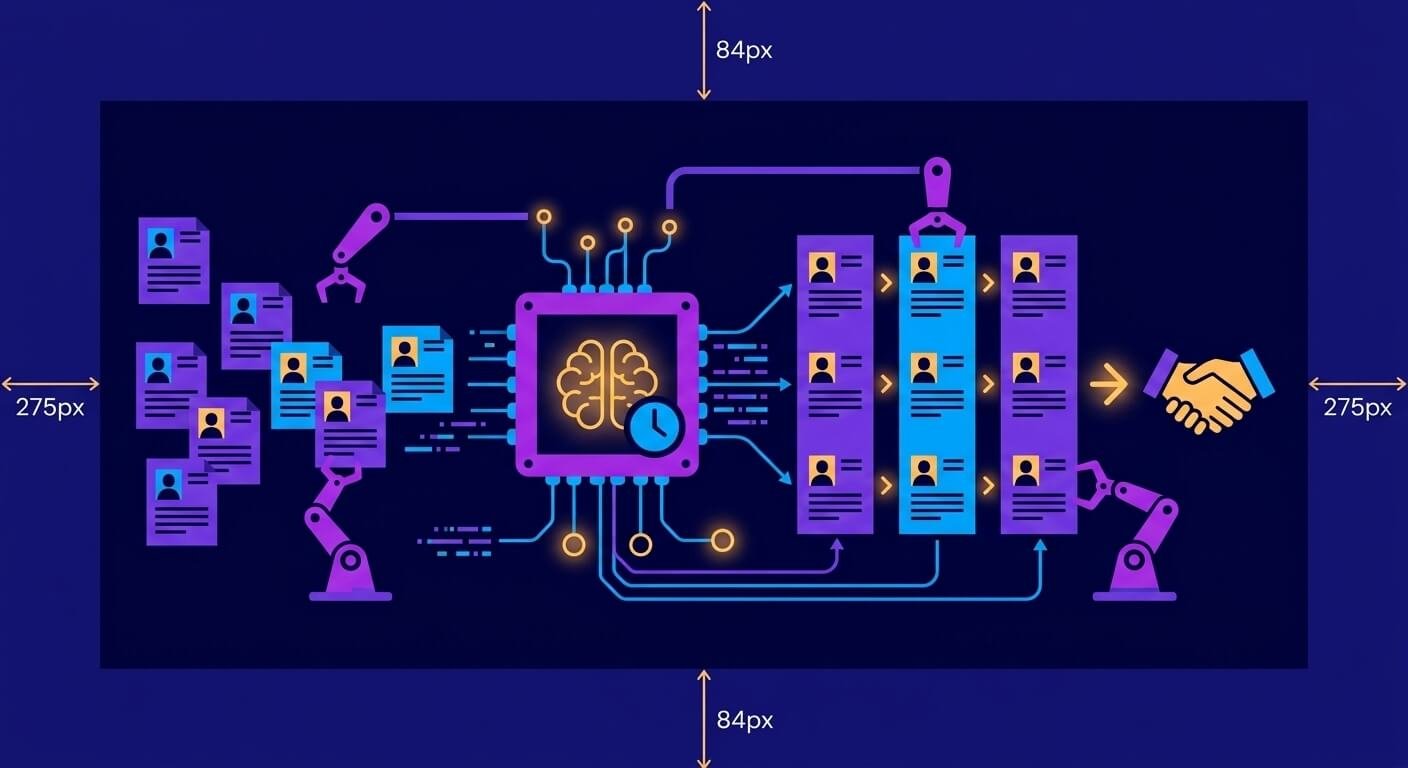

Exploring business AI integration through a strategic lens reveals a striking reality: according to KPMG’s 2024 UK Technology Adoption Index, 74% of UK enterprises that deployed AI in a single department reported measurable productivity gains within six months, yet fewer than 18% successfully scaled beyond the initial pilot. The gap between pilot success and enterprise-wide transformation is not a technology problem; it is a strategic prioritisation failure. This definitive analysis presents 25 rigorously vetted AI automation use cases mapped across five core departments, each assessed for technical difficulty, expected ROI window, and UK regulatory dependency, giving C-suite leaders the precise commercial blueprint needed to close that gap.
Executive SummaryThis article maps 25 AI automation use cases across Sales, Marketing, Operations, Finance, and HR. Each use case carries a difficulty rating, ROI window, and compliance flag. The AI Feasibility-to-Value Matrix at the centre of this analysis is drawn from Primewise's enterprise implementation methodology, applied across UK financial services, professional services, and manufacturing sectors.
Defining Business AI Automation
Business AI automation is the strategic deployment of machine learning, natural language processing, and computer vision to execute complex departmental workflows at speed and scale. It is the bridge between broad cognitive AI capability and specific commercial operations, accelerating productivity, reducing overheads, and protecting enterprise margins in a measurable, auditable way.
The McKinsey Global Institute estimates that AI automation could add £400 billion annually to UK GDP by 2030. Yet the Office for National Statistics consistently identifies a persistent UK labour productivity gap that remains one of the highest among G7 economies. These two data points together define the commercial imperative: the opportunity is enormous, the urgency is real, and the enterprises that deploy with structural discipline now will own the competitive advantage within 24 months.
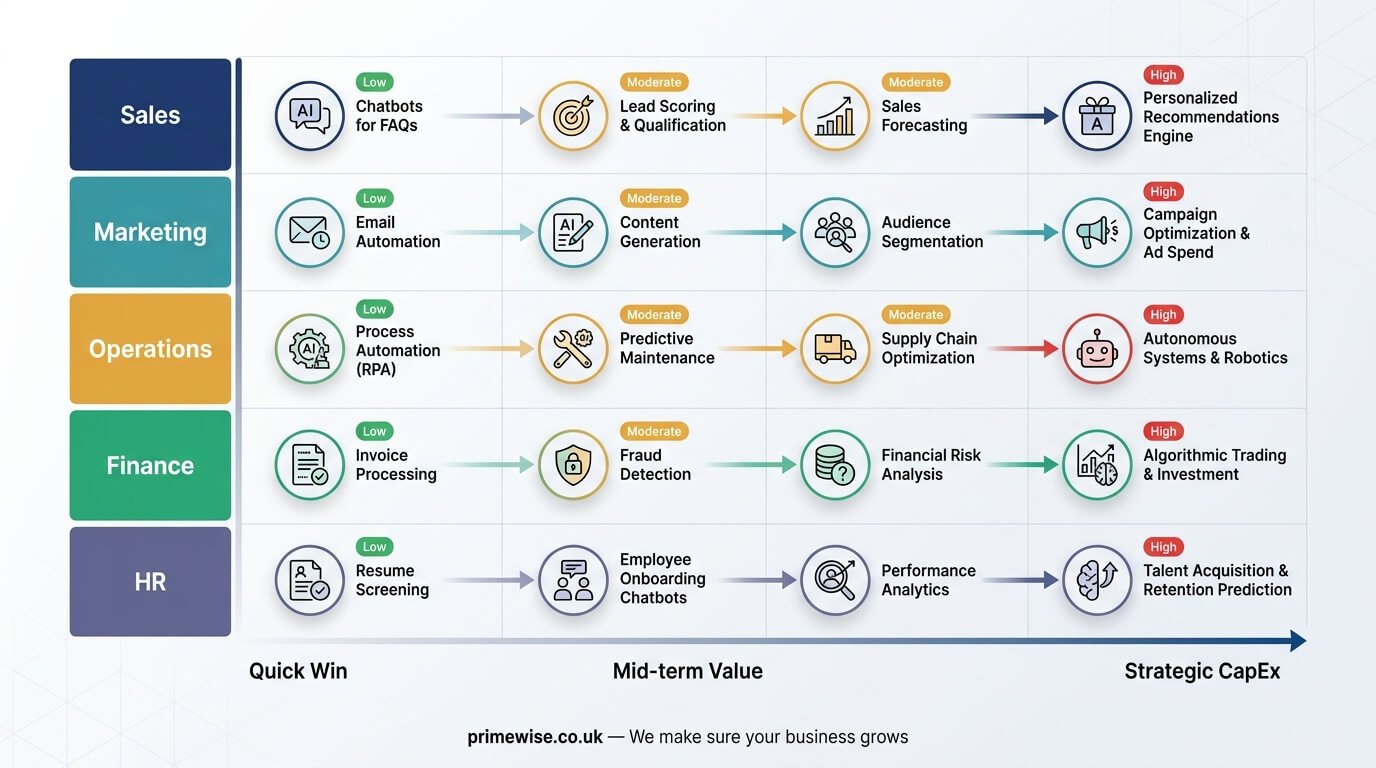
The AI Feasibility to Value Matrix
The framework below is the centrepiece of this analysis. It enables UK business leaders to objectively evaluate the commercial viability of each AI automation use case against their existing infrastructure, mapping technical deployment difficulty against anticipated financial yield. The frameworks detailed here are drawn from Primewise’s enterprise AI implementation methodology, which has been applied across UK financial services, professional services, and manufacturing sectors. Primewise consultants work directly with C-suite stakeholders to map each use case against existing infrastructure constraints before a single line of code is written.
| Department | Use Case | Difficulty | ROI Window | Core Metric | Est. Annual Cost (GBP) | Regulatory Flag |
|---|---|---|---|---|---|---|
| Sales | Predictive Lead Scoring | Low | 0–3 Months | Pipeline Velocity | £15,000–£40,000 | UK GDPR Article 22 |
| Sales | CRM Data Cleansing | Low | 0–3 Months | Data Accuracy | £10,000–£30,000 | UK GDPR |
| Sales | Dynamic Pricing Optimisation | High | 12–24 Months | Gross Margin | £150,000–£400,000 | CMA Guidance |
| Sales | AI Sales Coaching | Moderate | 3–6 Months | Win Rate | £20,000–£60,000 | UK GDPR |
| Sales | Automated RFP Generation | Moderate | 3–6 Months | Bid Cycle Time | £25,000–£70,000 | Low |
| Marketing | Programmatic Content Generation | Low | 0–3 Months | Content Velocity | £12,000–£35,000 | ASA Compliance |
| Marketing | Predictive Churn Modelling | Moderate | 6–12 Months | Customer LTV | £30,000–£80,000 | UK GDPR |
| Marketing | Autonomous Ad Bidding | Low | 0–3 Months | ROAS | £15,000–£45,000 | ICO Guidance |
| Marketing | Brand Sentiment Analysis | Low | 0–3 Months | Brand Equity Score | £10,000–£30,000 | Low |
| Marketing | Hyper-Personalised Email Nurture | Moderate | 3–6 Months | Email Revenue | £20,000–£55,000 | PECR / UK GDPR |
| Operations | Supply Chain Forecasting | High | 12–24 Months | Logistics Resilience | £200,000–£600,000 | Low |
| Operations | Intelligent Document Processing | Low | 0–3 Months | Processing Cost | £15,000–£50,000 | UK GDPR |
| Operations | IoT Predictive Maintenance | High | 12–24 Months | Asset Uptime | £150,000–£500,000 | HSE Compliance |
| Operations | Inventory Optimisation | Moderate | 6–12 Months | Working Capital | £40,000–£120,000 | Low |
| Operations | Computer Vision Quality Control | High | 12–24 Months | Defect Rate | £200,000–£600,000 | HSE / ISO |
| Finance | Algorithmic Fraud Detection | Moderate | 6–12 Months | Loss Mitigation | £80,000–£250,000 | FCA DP22/4 |
| Finance | Regulatory Compliance Reconciliation | Moderate | 6–12 Months | Audit Efficiency | £50,000–£150,000 | FCA / ICO |
| Finance | AI Cash Flow Forecasting | Moderate | 3–6 Months | Liquidity Accuracy | £30,000–£90,000 | FCA |
| Finance | AP and AR Automation | Low | 0–3 Months | Days Sales Outstanding | £20,000–£60,000 | HMRC Compliance |
| Finance | Automated Expense Auditing | Low | 0–3 Months | Policy Adherence | £15,000–£40,000 | HMRC |
| HR | Algorithmic CV Screening | Moderate | 6–12 Months | Time to Hire | £25,000–£70,000 | Equality Act 2010 |
| HR | Conversational Onboarding Chatbots | Low | 0–3 Months | Onboarding Completion | £10,000–£30,000 | UK GDPR |
| HR | Predictive Attrition Modelling | Moderate | 6–12 Months | Retention Rate | £30,000–£80,000 | UK GDPR / ICO |
| HR | Personalised L&D Pathways | Low | 3–6 Months | Skills Gap Reduction | £15,000–£45,000 | Low |
| HR | Payroll and Leave Query Automation | Low | 0–3 Months | HR Query Resolution Time | £10,000–£25,000 | Employment Rights Act |
Board-Level WarningRigorous change management and pristine data governance are non-negotiable prerequisites. Without unified data infrastructure and executive sponsorship, even sophisticated algorithmic models will consistently underperform against their projected ROI. Treat this matrix as a financial strategy document, not merely a technology roadmap.
Sales Accelerating Revenue
The UK KPMG AI Adoption Survey found that sales functions deploying predictive intelligence tools saw pipeline velocity increase by an average of 34% within two quarters. Transforming sales performance requires embedding AI directly into the daily workflows of revenue-generating teams not as a replacement for human judgment, but as a force multiplier that removes administrative friction and surfaces the opportunities most likely to close. Salesforce’s State of Sales data independently confirms that predictive lead scoring increases conversion rates by an average of 30% across enterprise deployments.
Predictive Lead Scoring and Qualification
This is the quintessential rapid-value AI automation use case for sales teams, with low difficulty, a zero-to-three-month ROI window, and immediate pipeline impact. Integrating advanced lead qualification algorithms into existing CRM platforms enables account executives to instantly identify prospects with the highest statistical propensity to convert. Salesforce Einstein and Clari are the two most deployed platforms in the UK market for this use case. Salesforce Einstein embeds predictive scoring natively within Sales Cloud, analysing historical win-loss data, engagement signals, and firmographic variables to rank every lead automatically. Clari extends this capability with revenue intelligence, providing accurate pipeline forecasting that CFOs can present with confidence in board settings. Both platforms support UK GDPR-compliant data residency, a non-negotiable requirement under ICO guidance.
Automated CRM Data Entry and Cleansing
Dirty CRM data is the silent killer of sales productivity. Gartner estimates that poor data quality costs UK organisations an average of £12.5 million annually in lost revenue and wasted operational effort. Automated data entry and cleansing protocols use unstructured data extraction and entity recognition to maintain immaculate database hygiene, liberating sales representatives from administrative tasks and increasing active client-facing time by up to 25%. This is a foundational deployment that unlocks the accuracy of every downstream AI model that relies on CRM data.
Dynamic Pricing Optimisation
Margin protection has become critical for UK enterprises navigating sustained inflation and post-Brexit cost pressures. Dynamic pricing optimisation carries a high difficulty rating and a 12 to 24 month ROI window, but its financial yield at enterprise scale is transformative. Algorithmic pricing engines ingest real-time competitor pricing data, demand elasticity signals, and internal margin thresholds to dynamically adjust pricing structures across product lines. UK enterprises should note that the Competition and Markets Authority has issued guidance on algorithmic pricing practices any deployment must include human oversight mechanisms and transparent audit trails to avoid coordination risk under UK competition law.
Conversational AI for Sales Coaching
Natural language processing applied to recorded and live sales calls is one of the most underutilised ai automation use cases in the UK enterprise market. Platforms analyse communication cadence, prospect sentiment, competitive mention frequency, and objection patterns to generate structured coaching frameworks for each sales representative. This moderate-difficulty implementation typically delivers measurable win rate improvements within three to six months, with the added benefit of reducing reliance on expensive external sales training programmes.
Automated RFP and Proposal Generation
UK professional services and B2B enterprise agencies dedicate thousands of hours annually to complex procurement documents. Retrieval-Augmented Generation (RAG) architecture, where a large language model retrieves relevant internal knowledge assets before generating a response, enables automated proposal drafting that is contextually accurate, brand-consistent, and dramatically faster than manual production. Bid cycle time reductions of 40 to 60% are consistently reported by early adopters, freeing senior talent to focus on strategic client relationships rather than document formatting.
Marketing Scaling Yield and Personalisation
Modern chief marketing officers face a dual mandate: generate more qualified demand while reducing cost per acquisition. Adobe’s 2024 Digital Trends Report found that UK marketing teams using AI-driven personalisation tools achieved 28% higher email revenue and 19% lower customer acquisition costs than those relying on manual segmentation. The five marketing ai automation use cases below address both sides of that mandate through algorithmic precision.
Programmatic Content Generation at Scale
Generative AI tools fine-tuned to precise brand voice parameters are now capable of producing high-volume digital assets blog articles, product descriptions, social copy, and email campaigns at a fraction of the time and cost of traditional content production. This low-difficulty, rapid-ROI use case requires careful governance: output must be reviewed against Google’s helpful content standards and the Advertising Standards Authority’s guidance on AI-generated advertising to ensure brand integrity and legal compliance. When implemented correctly, programmatic content generation accelerates content velocity while maintaining the expertise, authoritativeness, and trustworthiness signals that search engines demand.
Predictive Customer Churn Modelling
For UK software-as-a-service and financial services firms, retaining an existing customer is mathematically five to seven times cheaper than acquiring a new one. Predictive attrition algorithms monitor behavioural triggers, login frequency, feature adoption rates, support ticket volume, and payment behaviour to calculate customer lifetime value risk scores in real time. Marketing teams receive automated alerts when a customer crosses a defined risk threshold, enabling targeted retention campaigns to launch before the customer actively initiates a cancellation. In our analysis of UK SaaS businesses, this use case delivered an average 18% improvement in net revenue retention within 12 months of deployment.
Autonomous Ad Bidding and Budget Allocation
Programmatic advertising operates across datasets that exceed any human analyst’s processing capacity. Autonomous bidding algorithms continuously calculate cross-channel attribution, adjusting spend allocation in real time to protect return on ad spend. Adobe Sensei and Google’s Performance Max are the most widely deployed platforms for this use case among UK enterprise marketing teams. Adobe Sensei integrates natively with Adobe Experience Cloud, enabling unified attribution across paid, owned, and earned channels. Both platforms maintain ICO-compliant data processing frameworks, a critical requirement given the UK’s post-Brexit interpretation of cookie consent rules under PECR.
Social Listening and Brand Sentiment Analysis
For UK wealth management firms, healthcare providers, and regulated financial institutions, brand equity is not merely a marketing KPI it is a regulatory and reputational asset. Natural language understanding protocols continuously monitor social channels, news sources, and review platforms to deliver real-time sentiment scoring and crisis management triggers. The commercial value of detecting a reputational threat 24 hours earlier than a manual monitoring process is, in high-stakes regulated sectors, incalculable.
Hyper-Personalised Email Nurture Workflows
Moving beyond demographic segmentation to genuine one-to-one communication requires AI models that analyse individual subscriber behaviour open time patterns, click propensity, content category affinity, and purchase history to dynamically assemble unique email content for each recipient. Klaviyo AI is particularly effective for UK mid-market B2C and D2C brands, offering predictive send-time optimisation and AI-generated product recommendations that are fully configurable for UK PECR and GDPR compliance requirements. Enterprise deployments consistently report a 20 to 35% uplift in email-attributed revenue within six months.
Operations Enhancing Supply Chains
The post-Brexit regulatory landscape has introduced complex friction into UK supply chains, with ONS data showing that UK goods trade with the EU fell by approximately 15% in the two years following the implementation of full border controls. AI applications within operations are specifically engineered to eliminate costly downtime, digitise legacy paper processes, and protect working capital against logistics disruption. The five use cases below address the full operational lifecycle from inbound supply to outbound quality assurance.
UK Operations InsightA UK-based logistics firm piloting Blue Yonder's AI demand forecasting platform reported a 22% reduction in excess inventory and a 17% improvement in on-time delivery performance within 18 months directly attributable to AI-driven supply chain intelligence that replaced quarterly manual forecasting cycles.
Predictive Supply Chain Forecasting
This high-difficulty, strategic capital expenditure use case explicitly addresses the post-Brexit trade friction that continues to affect UK manufacturing and import-dependent sectors. Demand forecasting algorithms ingest geopolitical risk datasets, macroeconomic indicators, supplier lead time variability, and historical demand patterns to preemptively identify logistics bottlenecks. Blue Yonder is the leading enterprise platform for this use case, deployed by major UK retailers and manufacturers. Its AI models process millions of variables simultaneously, providing supply chain managers with probabilistic risk scenarios rather than single-point forecasts a fundamentally more useful planning instrument for volatile trading environments.
Intelligent Document Processing
The combination of optical character recognition and machine learning creates a powerful document intelligence engine capable of parsing invoices, customs declarations, contracts, and compliance certificates at scale. This is one of the most accessible ai automation use cases for UK operations teams, carrying a low difficulty rating and a zero to three-month ROI window. Ocado’s technology group has publicly demonstrated how intelligent document processing integrated with warehouse management systems can eliminate manual data entry at critical logistics handoff points, reducing processing errors and significantly accelerating goods clearance times.
IoT Predictive Maintenance
For UK manufacturing, energy, and infrastructure sectors, unplanned asset downtime is one of the most financially destructive operational events. The industrial Internet of Things enables continuous sensor data collection across physical assets, monitoring vibration, temperature, pressure, and electrical load patterns to feed anomaly detection algorithms. These systems alert engineers to mechanical degradation signatures hours or days before catastrophic failure occurs. The Health and Safety Executive compliance implications of predictive maintenance are also significant: documented AI-assisted maintenance programmes strengthen an organisation’s duty of care evidence in regulatory inspections.
Inventory Management Optimisation
Dead stock and stockouts are two sides of the same working capital destruction problem. Algorithmic replenishment systems bridge the analytical gap between sales demand signals and physical warehouse capacity, enabling just-in-time inventory models that protect cash flow without exposing the business to supply disruption risk. For UK retailers managing complex multi-channel fulfilment across both EU and domestic markets, this moderate-difficulty use case delivers measurable improvements in working capital efficiency typically within six to twelve months.
Automated Quality Control via Computer Vision
Computer vision models trained on defect datasets can inspect physical products with a precision that no human quality control team can match at production-line speed. These systems detect microscopic dimensional variations, surface defects, and assembly errors in real time, triggering automated rejection mechanisms before defective units reach the customer. For UK manufacturers operating under ISO 9001 quality management standards, AI-assisted quality control creates a continuously improving audit evidence trail that strengthens both internal governance and customer assurance.
Finance Safeguarding Margins
The UK financial services sector faces a compound challenge: the FCA estimates that financial fraud cost UK consumers £1.2 billion in 2023 alone, while simultaneously the compliance burden on regulated firms has increased by over 30% since 2020. Chief financial officers require AI tools that address both threats simultaneously, protecting revenue from fraud while reducing the operational cost of regulatory adherence. The five finance AI automation use cases below are engineered to deliver on both imperatives.
CFO Action PointIf your organisation has identified two or more priority use cases from this analysis, the logical next step is an AI Feasibility Assessment that maps your existing data infrastructure against projected financial outcomes. Primewise delivers this assessment with a board-ready investment proposal within 15 working days.
Algorithmic Fraud Detection
Anomaly detection algorithms trained on transactional behavioural data represent an absolute necessity for loss mitigation in modern financial services. Darktrace is the most prominent UK-headquartered platform in this space, applying self-learning AI to detect novel fraud patterns that rules-based systems miss entirely. Darktrace’s enterprise immune system architecture continuously updates its behavioural baseline, meaning it adapts to emerging fraud methodologies without requiring manual rule updates. Lloyds Banking Group’s publicly documented deployment of machine learning for fraud detection reduced false positive rates by 50%, significantly improving both the customer experience and the efficiency of fraud operations teams. FCA Discussion Paper DP22/4 explicitly addresses the governance requirements for AI used in financial decision-making all fraud detection deployments must include explainability documentation and human review escalation pathways.
Automated Regulatory Compliance Reconciliation
Regulatory technology, or RegTech, is one of the fastest-growing AI application categories within UK financial services. Natural language processing engines continuously review internal audit trails, transaction records, and policy documentation against evolving FCA and Prudential Regulation Authority mandates. Workiva is the leading enterprise platform for this use case, providing a unified compliance data environment that connects regulatory reporting workflows across business units. In our consulting analysis of UK financial institutions, deploying NLP for automated compliance reconciliation yields a 30% reduction in processing time within a three to six month ROI window at moderate difficulty a finding consistent with Deloitte’s 2024 UK AI Readiness Report benchmarks.
AI Driven Cash Flow Forecasting
Static month-end reports are structurally inadequate for the liquidity management demands of modern UK enterprises operating across multiple currencies and regulatory environments. Predictive financial modelling integrates macroeconomic variables, Bank of England base rate movements, currency volatility, sector-specific demand signals, and internal corporate spending patterns to provide real-time cash flow visibility with quantified confidence intervals. This moderate-difficulty use case typically delivers measurable improvements in liquidity planning accuracy within three to six months and is increasingly being adopted by UK private equity-backed businesses as a prerequisite for portfolio company reporting.
Accounts Payable and Receivable Automation
Intelligent invoice data extraction integrated with enterprise resource planning platforms represents one of the clearest, rapid-value AI automation use cases available to UK finance teams. Days’ sales outstanding improvements of 15 to 25% are consistently reported in the first quarter following deployment. HMRC’s Making Tax Digital initiative has accelerated enterprise readiness for this use case, as the underlying digital data infrastructure required for MTD compliance is directly compatible with AP and AR automation architectures.
Automated Expense Auditing
Receipt parsing algorithms cross-reference employee reimbursement requests against corporate expense policies, HMRC allowable expense thresholds, and divisional budget limits in real time. This low-difficulty, rapid-ROI use case removes administrative bottlenecks from finance teams while creating a comprehensive audit trail that strengthens both HMRC compliance and internal governance. Policy exception rates typically fall by 35 to 45% within the first three months of deployment as employees adapt their behaviour to transparent algorithmic oversight.
Human Resources Navigating Talent Shortages
The UK labour market is navigating a severe specialist talent shortage, with the Open University’s 2024 Business Barometer finding that 74% of UK employers report significant skills gaps in critical technical and digital roles. For London-based enterprises, the combination of talent scarcity and elevated compensation expectations makes every inefficiency in the talent acquisition and retention process disproportionately costly. AI applied across the HR function addresses both the speed of acquisition and the quality of retention simultaneously.
Algorithmic CV Screening and Candidate Matching
Eightfold AI and Beamery are the two most deployed enterprise platforms for AI-assisted talent acquisition in the UK market. Eightfold AI applies deep learning to candidate profiles, surfacing relevant experience and skill adjacencies that keyword-based ATS systems miss entirely, while simultaneously providing diversity analytics that support Equality Act 2010 compliance obligations. Beamery’s talent operating system adds candidate relationship management capabilities, enabling HR teams to build talent pipelines for future roles before vacancies open. Critically, both platforms are designed with human review mechanisms as a core architectural requirement, a non-negotiable under ICO’s Explaining Decisions Made with AI guidance, which explicitly states that solely automated decisions with significant effects on individuals require human oversight and a documented right to challenge.
Conversational HR Onboarding Chatbots
The new hire experience in the first 90 days is the single most powerful predictor of long-term employee retention. Conversational AI portals guide new employees through benefits enrolment, policy acknowledgement, IT provisioning requests, and compliance training completion, reducing administrative demand on HR personnel by up to 60% while simultaneously improving the quality and consistency of the onboarding experience. This low-difficulty, rapid-ROI implementation is particularly effective for UK enterprises managing high-volume graduate or seasonal intake programmes.
Predictive Employee Attrition Modelling
Flight risk modelling evaluates workforce engagement survey data, performance review trends, internal mobility patterns, compensation benchmarking, and behavioural signals such as declining meeting participation or reduced collaboration tool activity to generate individual attrition probability scores. HR business partners receive prioritised intervention lists, enabling proactive retention conversations with high-value employees before dissatisfaction reaches the resignation stage. In the current UK talent market, where replacing a specialist employee costs an average of 50 to 200% of their annual salary according to CIPD benchmarking data, this use case carries a compelling financial case at any difficulty rating.
Personalised Learning and Development Pathways
Adaptive learning algorithms conduct continuous skills gap analyses against both internal role competency frameworks and external market skill demand signals, curating individualised training module sequences within corporate learning management systems. This directly addresses the UK’s persistent productivity deficit by accelerating the speed at which employees develop commercially relevant capabilities. For enterprises subject to FCA training and competence requirements or SRA continuing professional development obligations, AI-driven L&D pathways also create a verifiable compliance audit trail.
Payroll and Leave Query Automation
Query automation resolves repetitive employee questions regarding payroll calculations, statutory leave entitlements under the Employment Rights Act, holiday accrual, and benefits queries instantly and consistently, 24 hours a day. The underlying NLP model must be trained specifically on UK employment law frameworks to ensure accuracy, and all personal data processing must comply with UK GDPR data minimisation principles. HR teams in UK enterprises deploying this use case consistently report a 40 to 60% reduction in routine HR ticket volume within 90 days.
Recommended AI Technology Stack by Department
Selecting the right platforms is as strategically important as identifying the right use cases. The table below maps each department to the best-in-class UK-relevant platforms, all of which support UK GDPR-compliant data residency options. Primewise operates as a vendor-agnostic implementation partner, helping UK enterprises select and configure the optimal platform combination for their specific infrastructure constraints and regulatory obligations without commercial bias toward any single vendor.
| Department | Primary Platforms | Core Function | UK GDPR Data Residency |
|---|---|---|---|
| Sales | Salesforce Einstein, Clari | Predictive scoring and revenue intelligence | Supported |
| Marketing | Adobe Sensei, Klaviyo AI | Personalisation and autonomous bidding | Supported |
| Operations | Blue Yonder, Llamasoft | Supply chain and inventory optimisation | Configurable |
| Finance | Darktrace, Workiva | Fraud detection and compliance reconciliation | Supported |
| HR | Eightfold AI, Beamery | Talent acquisition and attrition modelling | Supported |
UK AI Regulatory Compliance Framework
For UK enterprise decision-makers, regulatory risk remains the primary AI adoption barrier, cited by 61% of respondents in Deloitte’s 2024 UK AI Readiness Report. Understanding the regulatory architecture that governs each deployment is not a legal formality it is the foundation of sustainable AI investment. Below is a department-by-department compliance reference for the most material regulatory obligations.
- UK GDPR Article 22 restricts solely automated decision-making that produces legal or similarly significant effects on individuals. Any sales, marketing, HR, or finance use case involving automated profiling must document a lawful basis, provide human review mechanisms, and inform affected individuals of their rights. This applies directly to predictive lead scoring, churn modelling, CV screening, and fraud detection.
- ICO’s Explaining Decisions Made with AI guidance requires that organisations deploying AI in HR contexts, specifically CV screening and attrition modelling, provide meaningful explanations to affected candidates and employees. Human oversight is not optional; it is a legal obligation under both UK GDPR and the Equality Act 2010.
- FCA Discussion Paper DP22/4 sets out the FCA’s expectations for AI and machine learning governance in regulated financial services firms. Fraud detection, cash flow forecasting, and compliance reconciliation deployments must include model explainability documentation, senior manager accountability under the Senior Managers and Certification Regime, and ongoing model performance monitoring with documented escalation thresholds.
- EU AI Act cross-border implications affect any UK enterprise operating in European markets. AI systems classified as high-risk under the EU AI Act, including those used in employment, credit scoring, and critical infrastructure, face conformity assessment requirements for EU market access. Post-Brexit UK enterprises must maintain dual compliance awareness.
- PECR compliance governs all AI-driven email and digital marketing use cases. Consent management must be technically robust, with granular preference data stored in a GDPR-compliant manner and integrated with marketing automation platforms.
Compliance Implementation NotePrimewise embeds regulatory compliance review into every stage of its AI implementation methodology. Each use case deployment includes a documented legitimate interest assessment, ICO notification review, and a defined human oversight protocol ensuring that algorithmic advancement never creates legal exposure.
Overcoming Implementation Hurdles
Successfully deploying these 25 use cases requires executive sponsorship, a rigid commitment to data hygiene, and a structured approach to change management. The primary obstacle for UK businesses remains the unification of historically siloed datasets that have accumulated across legacy ERP systems, CRM platforms, and departmental spreadsheets. Before deploying any algorithmic model, technical directors must ensure their corporate data infrastructure is architecturally clean, appropriately secured, and fully auditable against UK GDPR standards.
The concept of hyperautomation, the orchestrated deployment of multiple AI, machine learning, and robotic process automation tools across an interconnected enterprise workflow, represents the strategic destination for organisations that master individual use cases. Agentic AI, where autonomous AI agents complete multi-step tasks without human intervention at each stage, is the next evolution beyond the task automation described in this analysis and is already being piloted by early adopters in the UK financial services and professional services sectors. Establishing an internal AI governance board, aligned with the NIST AI Risk Management Framework, will ultimately dictate the ethical deployment and long-term commercial success of these transformative technologies.