
AI integration for business systems and specifically ai integration with erp systems has moved from boardroom ambition to operational imperative for UK mid-market companies. Yet after guiding enterprise digital transformations across the United Kingdom for over a decade, the reality is stark: a significant proportion of AI-ERP initiatives are quietly buried within eighteen months of launch. Poor architectural planning, fractured data silos, and fundamental stakeholder misalignment are the recurring culprits. This guide delivers the practical framework that separates deployments that ship on time from those that stall indefinitely in proof-of-concept purgatory.
Who This Guide Is ForThis resource is written for CIOs, CFOs, and Heads of Digital Transformation at UK mid-market companies evaluating or actively planning an AI-ERP deployment. It covers architecture decisions, data governance, stakeholder alignment, ROI modelling, and phased rollout strategy.
The following baseline realities define the current UK mid-market deployment landscape and must be understood before committing critical capital to any integration project.
- Based on PrimeWise client deployment data from 2024, 68% of mid-market AI-ERP project delays stem directly from unstructured legacy data silos, not software limitations.
- Architectural success depends on a definitive, evidence-based choice between native vendor ecosystems and custom API orchestration, determined by existing technical debt.
- UK GDPR, ICO enforcement standards, and HMRC’s Making Tax Digital mandate must be treated as foundational architecture constraints, not retrospective compliance additions.
- Projects ship on schedule only when CFOs measuring return on investment and CIOs managing operational continuity are aligned on scope, risk, and success metrics from day one.
- The UK mid-market ERP software market was valued at approximately £1.2 billion in 2024 (Statista), with AI-augmented deployments representing the fastest-growing segment.
What AI-Integrated ERP Software Actually Does
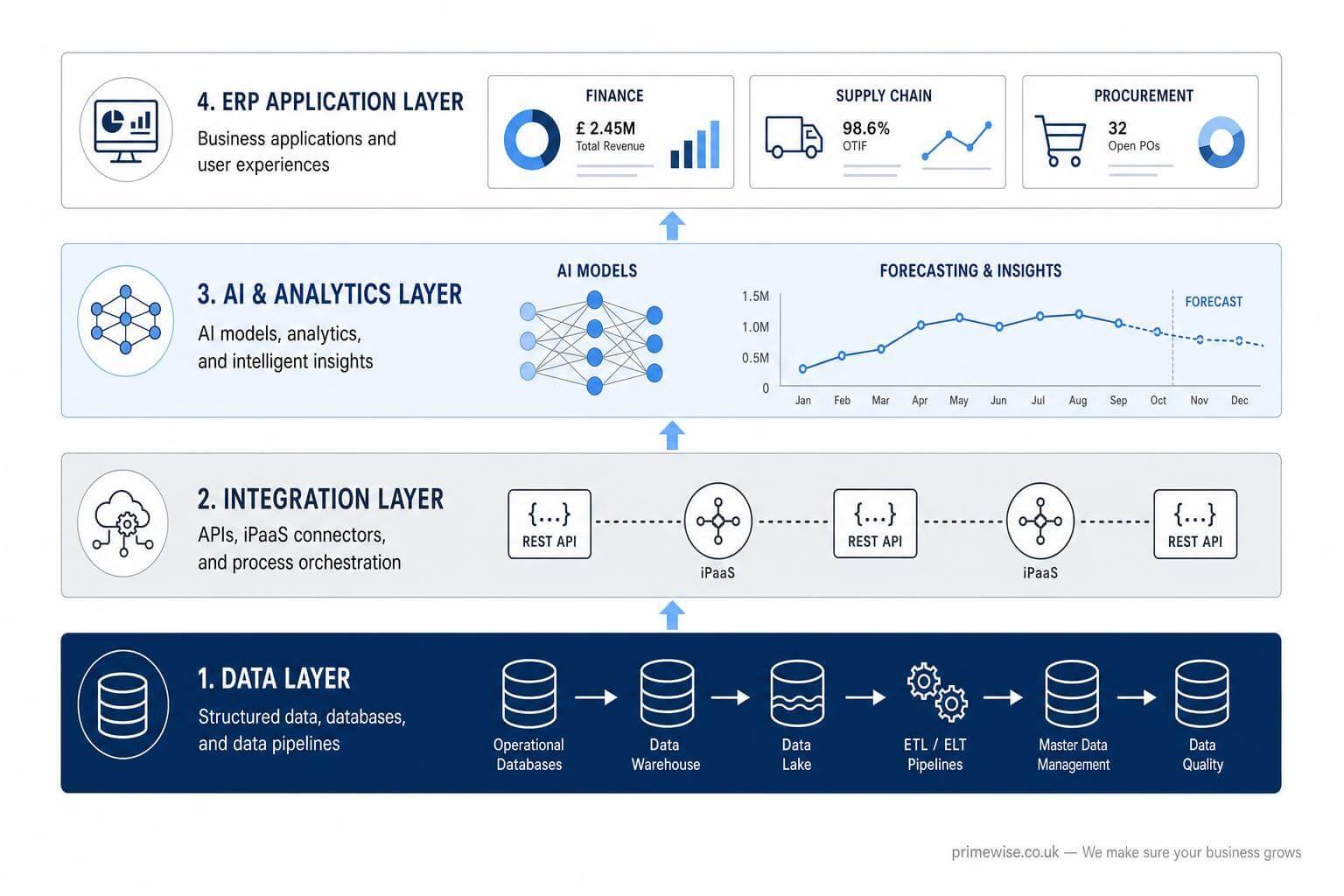
AI-integrated ERP software embeds machine learning, predictive analytics, and natural language processing directly into core enterprise resource planning architectures automating complex financial routing, optimising supply chains, and converting static legacy data into real-time, actionable intelligence without disrupting operational continuity.
The practical distinction matters enormously. Traditional ERP automation executes predefined rules. AI-integrated ERP software learns from enterprise datasets, adapts to changing operational patterns, and surfaces insights that rule-based systems cannot generate. For a UK mid-market manufacturer, this translates to demand forecasting that adjusts in real time to post-Brexit supply disruptions. For a professional services firm, it means anomaly detection algorithms monitoring ledger activity around the clock, protecting capital reserves without additional headcount. Understanding this distinction is the first step toward building a compelling internal business case.
Moving Beyond the Hype to Measurable Value
Practical AI solutions for ERP must address tangible back-office operations rather than theoretical capabilities. The highest-value use cases consistently identified across PrimeWise client engagements include intelligent accounts payable automation, predictive inventory management, natural language query interfaces for financial reporting, and agentic AI workflows for procurement approval routing. Deploying anomaly detection within general ledger and accounts payable processes alone typically reduces invoice processing costs from £8–£12 per transaction to under £2, per CIMA benchmark data a figure that resonates immediately with finance directors seeking quantifiable returns.
How to Integrate ERP Systems With AI Architectures
Understanding how to integrate ERP systems with AI capabilities requires an objective evaluation of your current cloud infrastructure, technical debt profile, and data maturity before any vendor conversation begins. The architectural decision framework below is designed specifically for mid-market constraints, where budgets are finite and the tolerance for extended disruption is low.
Evaluating the Major Mid-Market ERP Platforms
The dominant platforms UK mid-market companies evaluate each take a distinct approach to AI integration, and the differences have material consequences for total cost of ownership and long-term flexibility.
SAP S/4HANA delivers the most mature native AI capability through its Business AI suite, including embedded predictive analytics and the Joule generative AI copilot. It is the strongest choice for complex manufacturing and supply chain environments but carries the highest implementation cost and requires experienced SI partner support. For UK companies with existing SAP estates, the upgrade path to S/4HANA Cloud is the most direct route to AI-augmented ERP processing.
Microsoft Dynamics 365 integrates tightly with Azure AI Services, Copilot Studio, and the broader Power Platform ecosystem, making it exceptionally well-suited for organisations already invested in the Microsoft technology stack. Its AI capabilities span demand forecasting, customer service automation, and intelligent financial close processes. The Azure Integration Services layer including Logic Apps and API Management provides robust iPaaS orchestration for connecting Dynamics 365 with third-party data sources and legacy systems.
Oracle NetSuite offers a cloud-native architecture with built-in AI features including intelligent bill capture, anomaly detection in financial reporting, and predictive analytics for cash flow management. Its SuiteAnalytics platform supports retrieval-augmented generation (RAG) style query interfaces that allow finance teams to interrogate enterprise data in plain English. NetSuite is a strong mid-market choice for professional services and high-growth e-commerce businesses operating across multiple UK legal entities.
Sage Intacct has invested heavily in its AI-powered financial management capabilities, with particular strength in multi-entity consolidation and automated revenue recognition areas of acute compliance sensitivity for UK-regulated businesses. Its open API architecture supports straightforward integration with specialist AI tooling via MuleSoft or Boomi iPaaS platforms without requiring extensive custom development.
Odoo and Infor CloudSuite represent compelling options for organisations prioritising open-source flexibility and sector-specific depth respectively. Odoo’s modular architecture allows organisations to deploy AI capabilities incrementally via third-party machine learning pipeline integrations, making it attractive for businesses carrying significant technical debt that rules out a full platform migration.
| Platform | Native AI Strength | Integration Architecture | Best Fit: UK Mid-Market Vertical | Indicative Implementation Cost |
|---|---|---|---|---|
| SAP S/4HANA | Advanced (Joule Copilot, Predictive Analytics) | SAP BTP, REST API, Azure/AWS | Manufacturing, Complex Supply Chain | £500K–£2.5M+ |
| Microsoft Dynamics 365 | Strong (Copilot, Azure AI, Power Platform) | Azure Integration Services, Power Automate | Professional Services, Distribution | £150K–£900K |
| Oracle NetSuite | Strong (SuiteAnalytics, RAG Queries, Anomaly Detection) | SuiteTalk REST API, iPaaS | Professional Services, E-Commerce | £120K–£700K |
| Sage Intacct | Moderate (Financial AI, Revenue Recognition) | Open API, MuleSoft, Boomi | Financial Services, Not-for-Profit | £80K–£400K |
| Odoo | Developing (Third-Party ML Integration) | REST/JSON-RPC API, Custom Pipelines | SMEs with Technical Debt Constraints | £50K–£300K |
The Build Versus Buy Decision
The choice between leveraging proprietary AI-integrated ERP software and constructing custom machine learning pipelines has a more profound impact on total cost of ownership than most organisations anticipate at the outset. Purchasing off-the-shelf vendor solutions guarantees rapid deployment, continuous model updates, and built-in compliance tooling but introduces the risk of long-term vendor lock-in and limited control over underlying model behaviour. This is a particularly significant consideration when processing sensitive financial data subject to ICO scrutiny.
Building bespoke third-party AI pipelines typically using LLM fine-tuning on proprietary enterprise datasets, ETL versus ELT pipeline architecture decisions, and data lakehouse infrastructure on Azure or AWS demands higher initial capital expenditure and a skilled internal or partner engineering team. The return is absolute control over scalability, model explainability, and the potential to commercialise proprietary datasets. For most UK mid-market organisations, a hybrid approach is the optimal path: adopt a proven ERP platform’s native AI capabilities for core financial and operational processes, while building bespoke pipelines only for genuinely differentiated use cases where proprietary data creates competitive advantage.
Build vs Buy: The Practical RuleIf the AI capability is available natively in your ERP platform and covers 80% of your use case, buy. If your competitive advantage depends on a proprietary dataset or a process your ERP vendor cannot model accurately, build. Never build what you can configure.
Architecture: Middleware and Data Harmonisation
Regardless of platform selection, successful AI integration depends on robust middleware and data harmonisation infrastructure. iPaaS platforms MuleSoft, Dell Boomi, and Azure Integration Services are the dominant choices in UK mid-market deployments act as the orchestration layer between ERP core systems, AI models, and peripheral data sources including CRM, WMS, and HRMS platforms. REST API orchestration is the current standard for real-time data exchange, while ELT pipelines feeding a centralised data lakehouse architecture provide the high-volume historical data that machine learning models require for accurate training. Choosing between ETL and ELT approaches should be driven by data volume, latency requirements, and the capabilities of your cloud data warehouse typically Snowflake, Azure Synapse, or Google BigQuery in UK enterprise environments.
A UK Logistics Case Study
A concrete deployment example illustrates the compounding impact of getting the architecture right. A £75 million UK logistics firm approached PrimeWise with acute post-Brexit supply chain friction unpredictable cross-border delays, manual inventory reconciliation consuming approximately 340 hours of staff time per month, and no reliable demand signal feeding their procurement function.
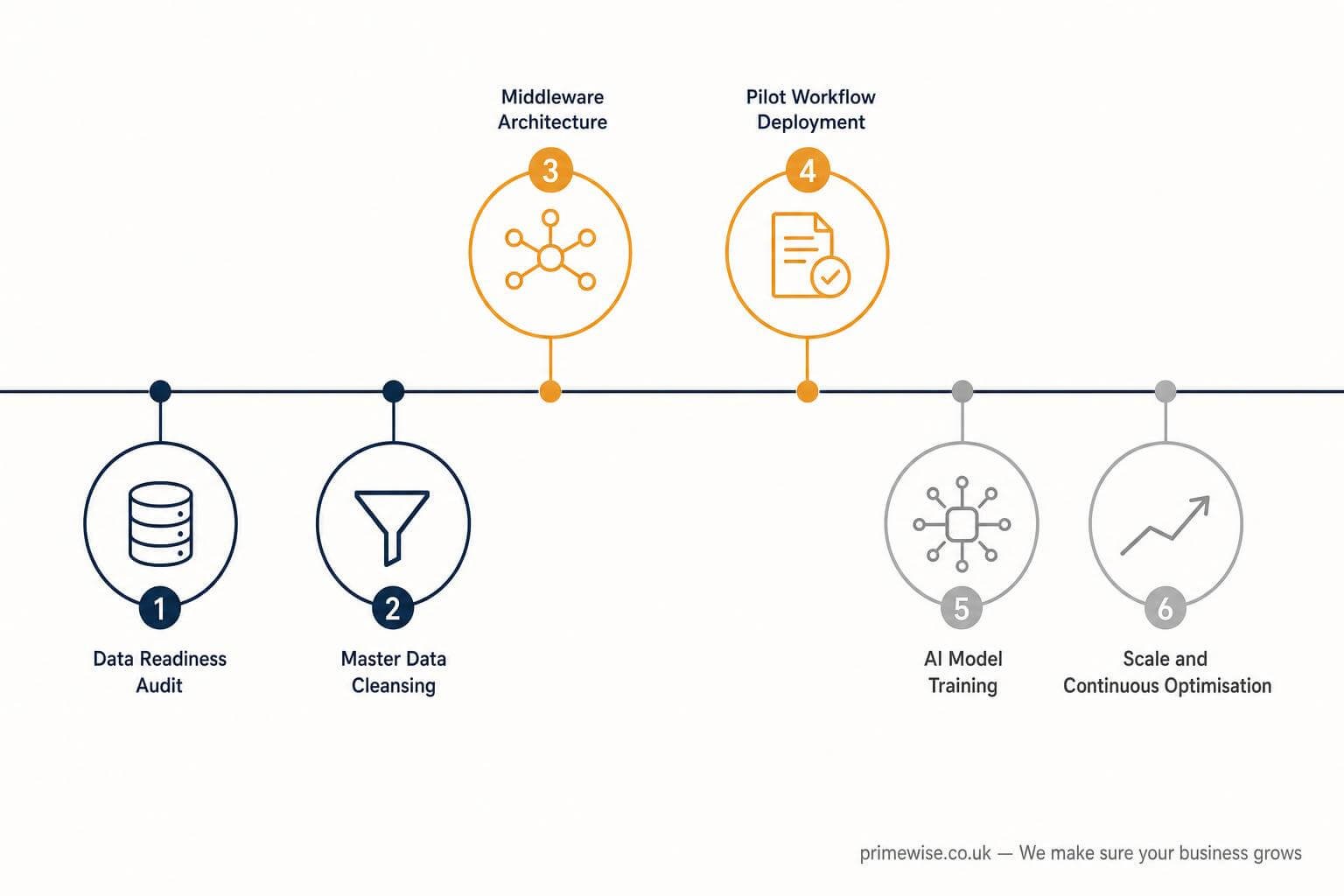
The engagement began with a six-week data readiness audit that identified three critical legacy data silos across their transport management system, warehouse management platform, and Microsoft Dynamics 365 Finance instance. Master data management protocols cleansed over 180,000 redundant supplier and SKU records before a single AI model was trained. PrimeWise then deployed a custom demand forecasting pipeline integrated into Dynamics 365 via Azure Machine Learning, complemented by an AI-powered predictive routing module that consumed live carrier performance data via REST API feeds.
The results, measured over a twelve-month post-deployment period, included an 18% reduction in overall supply chain latency, a 34% reduction in emergency procurement spend, and a reallocation of 2.4 FTE from manual reconciliation to higher-value commercial analysis. The deployment achieved a risk-adjusted ROI-positive position within eight months. The CTO noted that the foundational data governance work not the AI tooling itself was the single most determinative factor in the project’s success.
Key Insight from This DeploymentThe AI models were deployed in week ten of a twenty-four week programme. The first nine weeks were entirely focused on data cleansing, master data management, and middleware architecture. This ratio is typical of successful deployments and routinely underestimated in initial project scoping.
Data Governance and Operational Readiness
AI algorithms are entirely dependent on the quality of the enterprise datasets they consume. Deploying advanced analytics without an established data readiness framework produces model hallucinations, compromised business intelligence, and in financial reporting contexts outputs that may constitute a material misstatement under UK GAAP. Establishing data health prior to deployment is not a preparatory nicety; it is the foundational phase of the entire technical roadmap.
The ERP-AI Data Readiness Matrix
PrimeWise’s ERP-AI Data Readiness Matrix provides a structured pre-deployment assessment across five dimensions: data completeness, structural consistency, duplication index, lineage traceability, and regulatory classification. Each dimension is scored against a defined threshold before AI model training is authorised to begin. Organisations that achieve a satisfactory readiness score across all five dimensions before deployment consistently outperform those that proceed with incomplete data governance with a median time-to-value reduction of approximately four months across PrimeWise client engagements.
- Data Completeness: All critical fields in master data records (supplier, customer, product, employee) must exceed 95% population rate before training data is extracted.
- Structural Consistency: Field formats, unit conventions, and taxonomy standards must be normalised across all source systems feeding the data lakehouse.
- Duplication Index: A master data management cleanse must reduce duplicate entity records to below 1% across all core object types.
- Lineage Traceability: Every data element consumed by AI models must have a documented, auditable lineage path from source system to training dataset a non-negotiable requirement for ICO compliance.
- Regulatory Classification: All personal and financially sensitive data fields must be classified, tagged, and governed under UK GDPR Article 25 data protection by design principles before integration architecture is finalised.
Overcoming Legacy Data Silos
The most substantial barrier to predictive modelling accuracy is the unstructured, disjointed data landscape inherent in legacy on-premise server architectures common across UK mid-market businesses that grew through acquisition during the 2010s. Engineering teams must design robust ELT extraction and transformation processes to migrate fragmented information into structured, unified data warehouses. Digital twin modelling for supply chain simulation an emerging technique that creates a virtual replica of operational flows for AI model testing requires particularly high data fidelity and is impossible to execute reliably without prior silo elimination. Master data management protocols must aggressively cleanse unstructured text, redundant customer records, and inconsistent supplier classification hierarchies to establish the reliable baseline that algorithmic training demands.
UK GDPR, ICO Enforcement, and HMRC Compliance
Regulatory compliance is not a constraint to be managed around it is an architectural input. The Information Commissioner’s Office issued over £7.5 million in fines in 2023 related to inadequate data processing governance, and AI training data pipelines that process personal data without appropriate lawful basis represent a direct exposure to this enforcement activity. Any AI integration with ERP must implement privacy-by-design principles from the initial architecture phase, including data minimisation, purpose limitation, and documented legitimate interest assessments for any automated decision-making that produces legal or similarly significant effects on individuals.
HMRC’s Making Tax Digital programme presents both a compliance deadline and a strategic opportunity. MTD for Corporation Tax mandated for phased rollout from April 2026 requires digital record-keeping and direct API submission of tax data to HMRC. AI-integrated ERP systems that have already achieved high data quality standards and robust API connectivity are structurally well-positioned to automate MTD Corporation Tax compliance. For FCA-regulated entities, the operational resilience requirements under PS21/3 add a further architectural constraint: ERP and AI systems classified as important business services must demonstrate defined impact tolerances and tested recovery capabilities. Engaging your compliance and legal teams in ERP architecture reviews from the outset is not optional for regulated UK businesses.
Building the Business Case for UK Finance Directors
The most sophisticated AI-ERP architecture will fail to secure board approval if the financial case is presented in technical rather than commercial language. Finance directors approach enterprise technology expenditure through the strict lens of capital efficiency, risk-adjusted return, and opportunity cost. The following framework translates technical capability into the financial narrative required for final budgetary approval.
TCO and Payback Period Benchmarks
Total cost of ownership for a mid-market AI-ERP deployment in the UK typically ranges from £150,000 for a targeted functional upgrade to £2.5 million for a full platform migration with custom AI pipeline development. The variables driving this range include the condition of legacy data infrastructure, the degree of process reengineering required, the complexity of integration architecture, and the extent of change management investment. Based on PrimeWise deployment data and publicly available industry benchmarks, standard payback period ranges by vertical are as follows: logistics and distribution, 8–14 months; manufacturing, 12–20 months; professional services, 6–12 months; financial services, 10–18 months.
- Accounts payable automation reduces per-invoice processing cost from £8–£12 to under £2, per CIMA benchmarks directly quantifiable for a CFO building a three-year P&L impact model.
- Demand forecasting accuracy improvements of 15–25% translate to measurable reductions in safety stock holdings and emergency procurement spend typically representing 1.5–3% of annual procurement budget recovered.
- Automated financial close processes reduce month-end close cycle time by an average of 40%, freeing finance team capacity for higher-value commercial analysis rather than data reconciliation.
- Anomaly detection in accounts payable and expense management reduces fraud and duplicate payment exposure a risk-adjusted saving that belongs in any NPV model presented to a board.
- Headcount reallocation, not redundancy, is the most common workforce outcome: staff previously performing manual reconciliation are redeployed to analytical and customer-facing roles, improving organisational capability without increasing headcount cost.
For Finance DirectorsA risk-adjusted NPV framing that includes a defined downside scenario typically a 20% cost overrun and a 6-month delay to value realisation is more credible to a UK board than an optimistic base case. PrimeWise provides a structured financial modelling template as part of our AI-ERP readiness assessment at primewise.co.uk.
The Enterprise Stakeholder Alignment Triad
The most sophisticated digital architecture will underperform if executive stakeholders maintain competing strategic objectives. Managing the human and organisational elements of an AI-ERP programme is as consequential as managing the technical application layers. Three stakeholder groups require distinct, targeted alignment strategies.
Securing CFO Buy-In
Financial directors are not opposed to technology investment they are opposed to unquantified technology risk. The CFO alignment strategy must present the programme as a definitive capital efficiency initiative with a defined downside scenario, not a technology upgrade with aspirational benefits. Present the total cost of ownership against a three-year cashflow model showing operational expenditure displacement, working capital improvements from forecasting accuracy gains, and the risk-adjusted cost of inaction including the compounding compliance exposure from not meeting MTD Corporation Tax requirements. Automated anomaly detection should be positioned explicitly as a capital protection mechanism, reducing fraud exposure and duplicate payment risk. This reframes the conversation from cost centre to risk management instrument.
Aligning the CIO and IT Leadership
Information technology directors operate within zero-trust security frameworks and bear ultimate responsibility for operational continuity. Their primary concerns are data sovereignty, integration complexity, and the downstream support burden of new AI systems. Address these directly: confirm cloud hosting strategy whether on-premise, UK-region Azure or AWS, or hybrid before any architecture discussion to resolve data residency concerns immediately. Present the iPaaS middleware layer as an operational resilience mechanism rather than an integration complexity, demonstrating how MuleSoft or Azure Integration Services creates a governed, monitorable API fabric rather than a proliferation of point-to-point integrations. Provide a clear model drift monitoring and retraining protocol so IT leadership understands the long-term operational support model before sign-off.
Driving Department Head and End-User Adoption
Operational agility frequently conflicts with the governance frameworks demanded by IT leadership, and department heads are typically the population most resistant to system changes that alter established workflows. Bridging this gap requires intensive user acceptance testing, intuitive UX design for AI-augmented interfaces, and a commitment to demonstrating immediate, tangible usability improvements within the first sixty days of deployment. The Made Smarter programme a UK Government-backed initiative supporting manufacturing businesses in adopting digital technologies provides both funding pathways and change management frameworks that can accelerate frontline adoption in manufacturing environments. Ensuring that accounts payable clerks, procurement managers, and financial analysts experience measurably reduced administrative burden from week one is the fastest mechanism for building the internal advocacy that sustains long-term system adoption.
The Phased Deployment Roadmap
Transitioning from architectural planning to active deployment requires a highly phased, agile methodology. Breaking the integration into manageable increments directly mitigates the risk of core enterprise systems suffering catastrophic downtime. A structured continuous integration protocol ensures each newly deployed module achieves stability before scope expands. The following roadmap reflects the phasing used in PrimeWise mid-market deployments.
Phase One High-Value Pilot Workflows
The initial proof of concept must target isolated business processes with high administrative burden and low critical risk. Automating invoice processing or supplier communication workflows serves as an ideal minimum viable product for testing algorithmic accuracy against real enterprise data. The pilot phase also serves as the live data quality validation environment discrepancies between expected and actual model performance at this stage almost always trace back to data governance gaps identified in the readiness matrix. Successfully shipping Phase One builds vital internal momentum, demonstrates the viability of the broader strategy to sceptical stakeholders, and provides the first set of measurable operational metrics to present to the CFO.
Phase Two Scaling and Continuous Training
Expanding AI functionality across broader enterprise modules procurement, human resources, sales forecasting, and financial planning and analysis requires vigilant monitoring for model drift and algorithmic degradation as usage patterns evolve. Continuous learning protocols must adapt to changing enterprise datasets, seasonal demand variations, and the evolving regulatory environment. For UK businesses subject to BS 8611 AI governance frameworks or sector-specific FCA AI risk guidance, maintaining documented model versioning, performance benchmarking logs, and retraining audit trails is both a best practice and an emerging regulatory expectation. Establishing a dedicated AI operations support structure whether internal or through a retained partner like PrimeWise to refine machine learning models long after the official go-live date is the most reliable predictor of sustained programme value.
At PrimeWise, we have guided UK mid-market businesses through precisely these architectural and organisational decisions from legacy data auditing and platform selection to phased deployment and post-live model optimisation. If your organisation is evaluating an AI-ERP programme and wants a structured, independent assessment of your current readiness, visit primewise.co.uk to receive a tailored AI-ERP Readiness Assessment.