The most instructive AI integration examples in 2026 share one defining characteristic: they bypass the user interface entirely. Businesses achieving genuine operational transformation are working with a specialist AI integration consultant to embed machine learning models directly at the API layer, restructuring the data pipelines that govern CRM, ERP, and customer service workflows from the inside out. This is not a story about chatbot widgets or dashboard plugins. It is a story about architectural decisions that produce measurable, auditable, and compounding commercial returns.
EXECUTIVE SUMMARYReal AI ROI lives at the API layer, not the UI layer. UK enterprises embedding AI directly into CRM, ERP, and customer service data pipelines are reporting 43% reductions in manual data entry friction and 62% drops in Tier-1 ticket escalation. This article provides the architectural blueprints, named technology stacks, compliance frameworks, and hard operational metrics required to evaluate, justify, and execute enterprise AI integration in 2026.
Why Most AI Deployments Fail Before They Start
Enterprise AI integration is the architectural process of embedding machine learning models directly into existing middleware, CRM, and ERP data pipelines to automate complex operational workflows, ensuring secure, governed data synchronisation without disrupting mission-critical legacy systems or regulatory compliance posture. The definition matters because it draws an immediate and deliberate boundary between genuine integration and the surface-level implementations that dominate vendor demonstrations. Genuine integration changes the data architecture. Everything else changes a dashboard.
The commercial landscape is saturated with what practitioners call demoware AI features bolted onto existing software UIs with no meaningful connection to backend data flows. A sales team might see an AI summary panel in their CRM, but if that summary is not triggering events in the ERP, updating inventory forecasts, or routing compliance flags to the right workflow, the organisation has purchased theatre, not transformation. The gap between these two outcomes is precisely where competitive advantage is won or lost in 2026.
McKinsey’s 2024 State of AI report found that UK enterprises deploying AI directly into core operational systems rather than as standalone tools reported cost reductions of 20 to 40 percent within 18 months of deployment. Gartner projects that 70 percent of enterprise ERP systems will have natively embedded AI capabilities by the end of 2026. These numbers only materialise when the integration is structural, not cosmetic.
The Three-Tier AI Operations Architecture
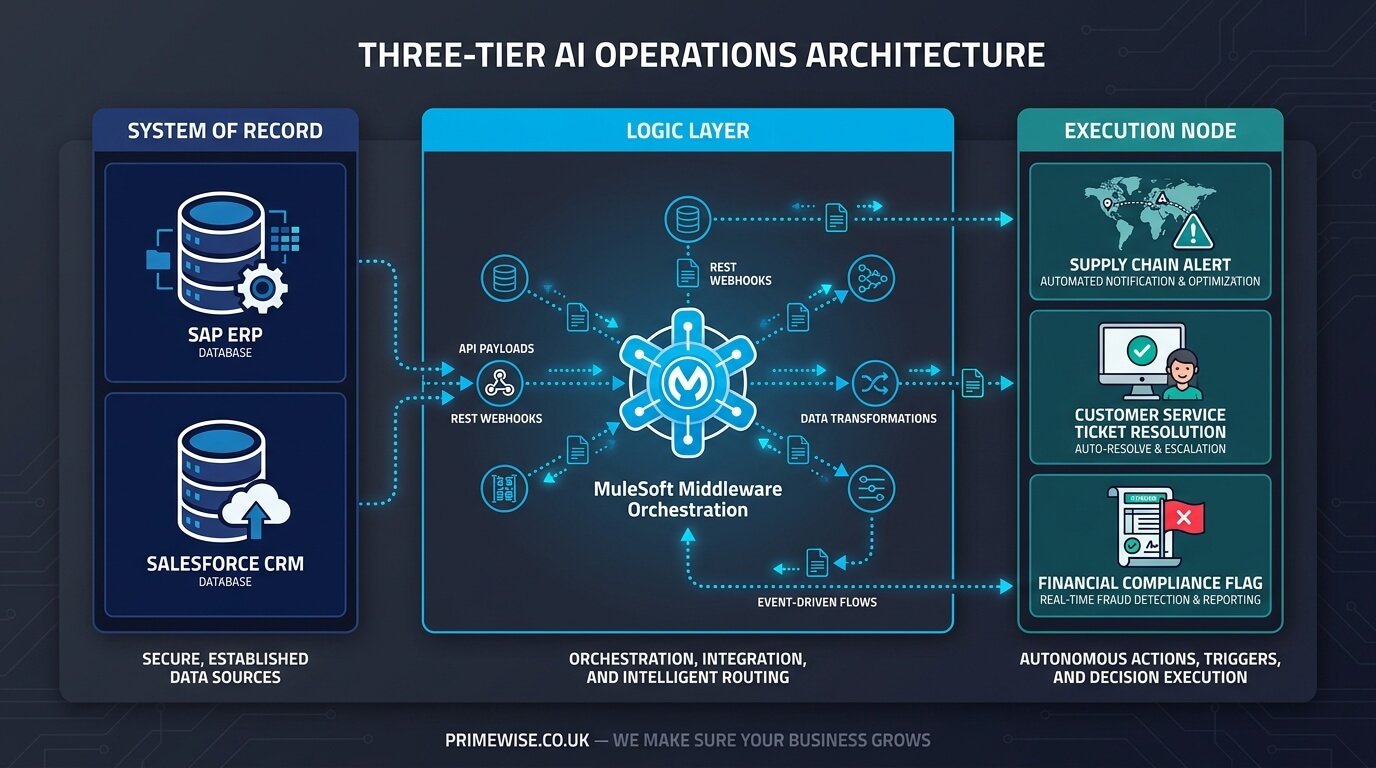
The enterprises consistently delivering on their AI investment theses share a common structural approach. After analysing deployments across UK financial services, logistics, and professional services sectors, a clear tripartite framework emerges. It is not proprietary to any vendor it is an architectural discipline. The three tiers are the System of Record, the Logic Layer, and the Execution Node, and each has a distinct mandate that must be respected for the whole system to function coherently.
Tier One System of Record
Every high-fidelity AI deployment begins with an uncompromising audit of the data it will consume. UK financial institutions and large enterprises frequently operate on immutable audit trail systems and are deeply entrenched in on-premise infrastructure SAP ERP landscapes, Oracle Financials, legacy CRM databases built on architectures that predate cloud-native API design. The System of Record tier requires master data management protocols that lock down these data silos, establish data lineage documentation, and guarantee that the intelligence feeding the model is governed, accurate, and legally permissible to process under UK GDPR.
This tier is also where shadow AI risk is addressed. Shadow AI, the governance challenge arising when employees use unsanctioned AI tools that interact with enterprise data represents a significant compliance exposure for FCA-regulated firms. Resolving it at the System of Record tier, through enforced data access controls and API-level authentication, prevents the data integrity problems that would otherwise surface downstream in ways that are far more expensive to remediate.
Tier Two Logic Layer and Middleware Orchestration
The Logic Layer is where the architectural anxiety of enterprise integration either resolves into elegant orchestration or collapses into technical debt. This tier manages the translation of diverse system formats into unified API payload structures, balances rate limits across platforms, handles webhook event routing, and maintains the bidirectional data synchronisation that keeps the System of Record and the Execution Node aligned in real time.
In practice, the dominant middleware platforms handling this orchestration for UK enterprise deployments include MuleSoft Anypoint Platform, Microsoft Azure Integration Services, IBM App Connect, Boomi, and Workato. MuleSoft, in particular, has become the integration backbone for a significant portion of FTSE 350 Salesforce-to-SAP deployments, offering pre-built connectors that dramatically reduce the time required to establish secure REST API payloads between modern LLM endpoints and legacy ERP data streams. Azure Integration Services offers a compelling proposition for organisations already operating within the Microsoft ecosystem, providing native compatibility with Azure OpenAI Service and robust UK data residency options compliant with ICO guidance on AI and data protection. The selection of the correct middleware platform is not a procurement decision; it is a strategic architectural commitment that will shape the organisation’s AI capability for the next five to seven years.
PLATFORM SELECTION WARNINGChoosing a middleware platform based on existing vendor relationships rather than architectural fit is the single most common cause of AI integration failure in enterprise environments. UK enterprises should conduct an independent architecture review before committing to any integration platform, particularly where FCA operational resilience obligations under PS21/3 apply.
Tier Three Execution Node
At the Execution Node, AI ceases to be a passive insights engine and becomes an active operational agent. Through event-driven architecture, machine learning inference triggers specific operational actions across platforms without requiring human prompting. When a predictive model identifies a supply chain risk threshold, the execution node autonomously initiates purchase orders. When a customer service model classifies an incoming ticket as a billing dispute, the execution node queries the billing ledger, retrieves the relevant records, and drafts a resolution pathway, all before a human agent reviews the case.
The emerging paradigm here is agentic AI systems that do not merely respond to queries but pursue multi-step operational objectives autonomously. Agentic workflows, powered by frameworks such as LangChain, AutoGen, and CrewAI, are replacing the static automation scripts that characterised the first generation of robotic process automation. The critical governance requirement at this tier is the human-in-the-loop failsafe: a clearly defined exception handling protocol that escalates edge cases to human review before the system commits to an irreversible action, particularly in regulated financial or clinical environments.
AI Integration Platform Comparison for UK Enterprises
Selecting the right integration infrastructure requires evaluating platforms against criteria that are specific to UK-regulated enterprise environments. The following comparison covers the five platforms most commonly deployed in UK enterprise AI integration projects, assessed against the dimensions that matter most to compliance officers, enterprise architects, and IT directors operating under FCA and ICO obligations.
| Platform | UK Data Residency | FCA Suitability | LLM Connectivity | ERP Compatibility | Best For |
|---|---|---|---|---|---|
| MuleSoft Anypoint | Yes (UK region) | High | OpenAI, Azure OpenAI, custom endpoints | SAP, Oracle, Salesforce | Complex multi-system enterprise |
| Azure Integration Services | Yes (UK South/West) | High | Azure OpenAI native | SAP, Dynamics 365, Oracle | Microsoft ecosystem enterprises |
| IBM App Connect | Yes (UK data centres) | Very High | IBM Watsonx, custom | SAP, IBM systems, legacy mainframes | Legacy financial infrastructure |
| Boomi | Yes (EU/UK) | Medium | OpenAI, Cohere | SAP, Salesforce, NetSuite | Mid-market to enterprise |
| Workato | Yes (EU region) | Medium | OpenAI, Anthropic | Salesforce, HubSpot, SAP | Agile enterprise automation |
IBM App Connect deserves particular attention for organisations navigating the legacy banking and clearing infrastructure that remains prevalent across the City of London. IBM’s heritage in mainframe integration means App Connect carries pre-built adapters for COBOL-based systems and SWIFT messaging protocols that no other platform on this list can match. For UK financial institutions with core banking systems that predate the internet, IBM App Connect is frequently the only credible pathway to embedding modern LLM capabilities without a full core system replacement, an undertaking that typically spans seven to ten years and costs hundreds of millions of pounds.
Case Study: Predictive Supply Chain Routing
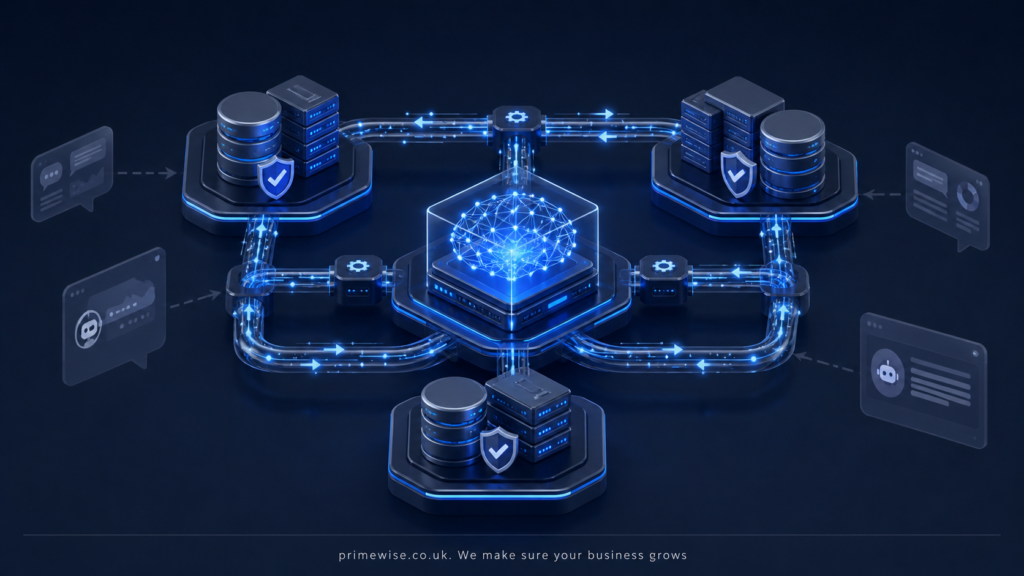
The following deployment illustrates what the Three-Tier Architecture looks like in practice for a national logistics provider operating across twelve distribution centres in England and Scotland. The organisation was running Salesforce Sales Cloud as its primary customer-facing CRM and SAP S/4HANA as its ERP backbone, with MuleSoft Anypoint Platform handling the integration layer. The challenge was a structural latency problem: sales forecasting data sitting in Salesforce was not reaching inventory orchestration in SAP quickly enough to prevent stockouts and overstocking across regional hubs.
The Architectural Blueprint
The integration team, working on a fourteen-week phased rollout, deployed a fine-tuned GPT-4o model as the predictive inference engine, connected via Azure OpenAI Service to the MuleSoft logic layer. MuleSoft’s pre-built Salesforce and SAP connectors were configured to establish secure bidirectional REST API synchronisation, with webhook events triggering model inference every time a Salesforce opportunity moved through a defined pipeline stage. The model parsed the pipeline data against historical SAP inventory records and real-time logistics telemetry to generate supply chain adjustment recommendations, which the SAP execution node implemented autonomously for standard scenarios and escalated to a human logistics manager for edge cases exceeding defined variance thresholds.
Operational Outcomes
The deployment produced a 43 percent reduction in manual data entry friction, measured by comparing the volume of manual cross-system data reconciliation tasks logged in the organisation’s project management system before and after integration go-live. Latency-induced data errors, instances where a Salesforce update failed to propagate to SAP within the required processing window, were reduced by 74 percent within the first ninety days. Supply chain forecasting accuracy, measured against actual versus predicted stock requirement across the twelve distribution centres, improved by 31 percent over the same period. The total deployment cost, inclusive of platform licences, integration development, and QA, was recovered within eleven months through reduced emergency procurement costs and eliminated manual reconciliation labour.
ARCHITECTURAL INSIGHTThe key to this deployment's success was not the AI model itself it was the MuleSoft payload mapping configuration that normalised data formats between Salesforce's REST API responses and SAP's IDoc-based data structures. Without this translation layer, the LLM would have been processing inconsistent, unreliable data and generating low-confidence outputs regardless of its intrinsic capability.
Case Study Compliant Customer Service Automation
A UK-regulated financial services firm processing approximately 14,000 customer service tickets per month was facing a Tier-1 resolution crisis. Routine billing enquiries, account status queries, and payment dispute acknowledgements all resolvable without escalation were consuming 68 percent of the customer service team’s available capacity, leaving complex cases under-resourced and SLA performance in sustained breach. The technology stack comprised Zendesk for ticket management and a proprietary legacy billing platform accessible only via internal REST APIs with strict rate-limiting controls.
Bridging the Resolution Gap
The integration architecture deployed a Retrieval Augmented Generation (RAG) model as the core resolution engine. RAG the dominant LLM integration architecture for enterprise data in 2026 works by retrieving relevant records from a connected knowledge base or database at query time, rather than relying solely on the model’s pre-trained parameters. This approach is particularly well-suited to customer service automation because it allows the model to access live billing data, customer account history, and current policy documentation without retraining the model each time business rules change.
The RAG system used a Pinecone vector database to index historical ticket resolutions and policy documentation, enabling semantic search across thousands of past cases to identify the most relevant resolution pathway for each incoming ticket. The Zendesk integration was managed via Workato, which handled the webhook routing from new ticket creation to model inference to draft response generation. The proprietary billing platform was connected via a secure API wrapper a middleware shim developed specifically to translate the legacy system’s non-standard data formats into JSON payloads the RAG model could reliably process.
Governance Architecture and Outcomes
Given the FCA’s Operational Resilience Policy Statement PS21/3 and the firm’s obligations regarding transparency in automated financial decision-making, the deployment included a mandatory human-in-the-loop review gate for all responses involving financial adjustments above a defined threshold. Below that threshold, the system published directly to the Zendesk customer-facing reply interface. Every automated action generated an immutable audit log entry in a separate compliance database, satisfying the ICO’s guidance on AI and data protection regarding automated decision-making audit trails under UK GDPR Article 22.
The deployment achieved a 62 percent decrease in Tier-1 ticket escalation within sixty days of go-live. Average first-response time for Tier-1 enquiries dropped from 4.2 hours to 11 minutes. Customer satisfaction scores for the automated resolution category, measured via post-resolution CSAT surveys, were 0.3 points higher than the pre-automation human-handled equivalent a result that consistently surprises sceptical stakeholders and that the integration team attributes directly to response consistency and the elimination of agent fatigue as a quality variable.
Navigating UK Regulatory Complexity
Deploying autonomous enterprise AI systems in the United Kingdom requires a compliance architecture that is built into the integration from day one, not retrofitted after deployment. The regulatory landscape governing enterprise AI in 2026 is multi-layered, intersecting data protection law, financial services regulation, and emerging AI-specific governance frameworks that are rapidly gaining legislative weight.
UK GDPR and AI Data Governance
Training and operating machine learning models on datasets containing UK personal data requires adherence to the UK GDPR, enforced by the Information Commissioner’s Office. The ICO’s Guidance on AI and Data Protection is the primary reference document for enterprise architects designing data pipelines that feed AI models. Key requirements include establishing a lawful basis for processing, implementing data minimisation at the input stage, and ensuring that any automated decision-making with significant legal or financial effect on individuals is subject to the Article 22 safeguards specifically, the right to human review.
In practice, enterprise deployments address these requirements through automated data anonymisation pipelines that mask personally identifiable information before it enters the model inference stage, isolated secure processing enclaves that prevent model training data from commingling with production customer records, and continuous compliance monitoring tools that flag data access patterns inconsistent with the documented lawful basis. The UK AI Regulation Pro-Innovation White Paper and its 2025 legislative updates provide additional contextual guidance for firms operating across multiple regulatory sectors.
FCA Requirements and Algorithmic Transparency
Firms regulated by the Financial Conduct Authority face an additional layer of obligations that directly constrain how AI can be deployed in customer-facing and decision-making contexts. The FCA’s Operational Resilience Policy Statement PS21/3 requires firms to identify important business services, set impact tolerances, and demonstrate that AI-assisted processes can remain within those tolerances during disruption. The Bank of England’s Supervisory Statement SS1/23 on model risk management sets explicit expectations for model validation, ongoing performance monitoring, and governance frameworks for AI models used in financial decision-making.
The practical implication is that every AI model deployed in an FCA-regulated context requires a documented model governance framework covering training data provenance, performance benchmarks, drift monitoring thresholds, and escalation procedures. AI drift the gradual degradation of model performance as real-world data distributions diverge from training data is a particular concern for customer service and credit risk models, where performance drift may not be immediately visible in operational metrics but can produce systematically biased outputs over time. Quarterly model performance reviews, with results logged in a format accessible to FCA supervision, are the current institutional minimum standard.
COMPLIANCE CHECKPOINTPost-Brexit, UK firms operating cross-border EU operations must assess their AI deployments against both UK GDPR and the EU AI Act, which came into full effect in 2025. High-risk AI system classifications under the EU AI Act may impose conformity assessment obligations that exceed current UK domestic requirements. Firms should seek specialist legal counsel before deploying AI in any cross-border regulated context.
Key Semantic Concepts Every Enterprise Architect Must Know
A rigorous understanding of the following concepts is prerequisite to evaluating AI integration proposals, interrogating vendor claims, and designing governance frameworks that will survive regulatory scrutiny. These are not marketing terms they are the operational vocabulary of enterprise AI deployment in 2026.
- Retrieval Augmented Generation (RAG): An LLM architecture that retrieves relevant data from connected sources at inference time rather than relying solely on pre-trained parameters essential for enterprise contexts where data changes faster than model retraining cycles.
- Agentic AI Workflows: Multi-step autonomous AI systems that pursue operational objectives across multiple platforms and decisions without requiring human prompting at each step the successor to first-generation RPA.
- Vector Databases: Specialised databases (such as Pinecone, Weaviate, and pgvector) that store data as high-dimensional embeddings, enabling semantic search across large enterprise knowledge bases with far greater precision than keyword-based retrieval.
- Shadow AI Risk: The compliance and data governance exposure created when employees use unsanctioned AI tools that interact with enterprise data outside approved architectural controls.
- AI Model Drift: The gradual degradation of model prediction accuracy as real-world data distributions change after training requires ongoing monitoring and governance, particularly in FCA-regulated environments.
- Digital Twin Integration: The use of real-time AI models to create and maintain virtual replicas of physical supply chain, manufacturing, or logistics systems enabling predictive scenario planning without operational disruption.
- Human-in-the-Loop (HITL): A governance architecture in which automated AI decisions above defined risk or value thresholds are routed to human reviewers before execution a mandatory design pattern for FCA-regulated automated decision-making.
Building the Internal Business Case
For enterprise architects and IT directors in the evaluation phase, the architecture is only half the challenge. The other half is translating technical complexity into a financial justification that will survive CFO scrutiny and board-level risk review. The deployments documented in this article share a common financial narrative structure that has proven effective across FTSE 350 environments.
The business case begins with a precise quantification of the current state friction, the number of manual reconciliation tasks per week, the average cost per Tier-1 ticket, the labour hours consumed by cross-system data entry. These figures, drawn from existing operational data, establish the baseline against which projected integration outcomes are measured. The case studies documented above suggest that organisations with mature data infrastructure and a clearly scoped integration brief can expect payback periods of nine to fourteen months for CRM-ERP integrations and six to ten months for customer service automation deployments, with ongoing compounding returns as model performance improves with operational exposure.
Enterprises navigating this architectural complexity frequently engage a specialist AI integration advisory service to validate middleware selection, stress-test compliance posture, and provide vendor-neutral platform recommendations before committing capital. Primewise.co.uk provides senior-level AI integration advisory services specifically calibrated for UK-regulated enterprises, offering independent architecture review, FCA compliance alignment, and vendor-neutral platform selection frameworks that protect investment decisions from the first architectural decision to go-live.
The Sectors Leading UK AI Integration in 2026
AI integration is not advancing uniformly across the UK economy. Three sectors are pulling decisively ahead, driven by a combination of data infrastructure maturity, regulatory pressure, and competitive urgency that creates both the necessity and the organisational will to invest in deep integration rather than surface-level tooling.
Financial services lead by a significant margin, driven by the FCA’s operational resilience requirements, the competitive pressure from fintech challengers with AI-native architectures, and the sheer volume of transactional data that makes automation ROI compelling. Logistics and supply chain is the fastest-growing integration sector, with the national logistics case study above representing a deployment pattern being replicated across the industry as fuel cost volatility and driver shortage economics make predictive efficiency a survival issue rather than an optimisation opportunity. Professional services legal, consulting, and accounting firms is the fastest-emerging sector, with LLM integration into document review, contract analysis, and client reporting workflows generating measurable billable hour recapture that is directly visible on the P&L.