
Should I hire an AI consultant or agency or build the capability entirely in-house? If you are an Operations Director, COO, or CTO steering a significant AI transformation programme, this is the highest-stakes resourcing decision you will make this fiscal year. As a former Head of Operations who has personally managed all three delivery models within the same business, I can confirm that selecting the wrong approach does not merely slow your programme down it derails it entirely. The three primary AI resourcing models available to UK enterprises are engaging a specialist AI integration consultant, contracting an independent AI consultant, or building a dedicated in-house engineering team. Each carries fundamentally different implications for speed, cost, compliance, and long-term intellectual property control. This article gives you the operational data, the regulatory context, and the diagnostic framework to make the correct decision with confidence.
The Three AI Delivery Models Defined
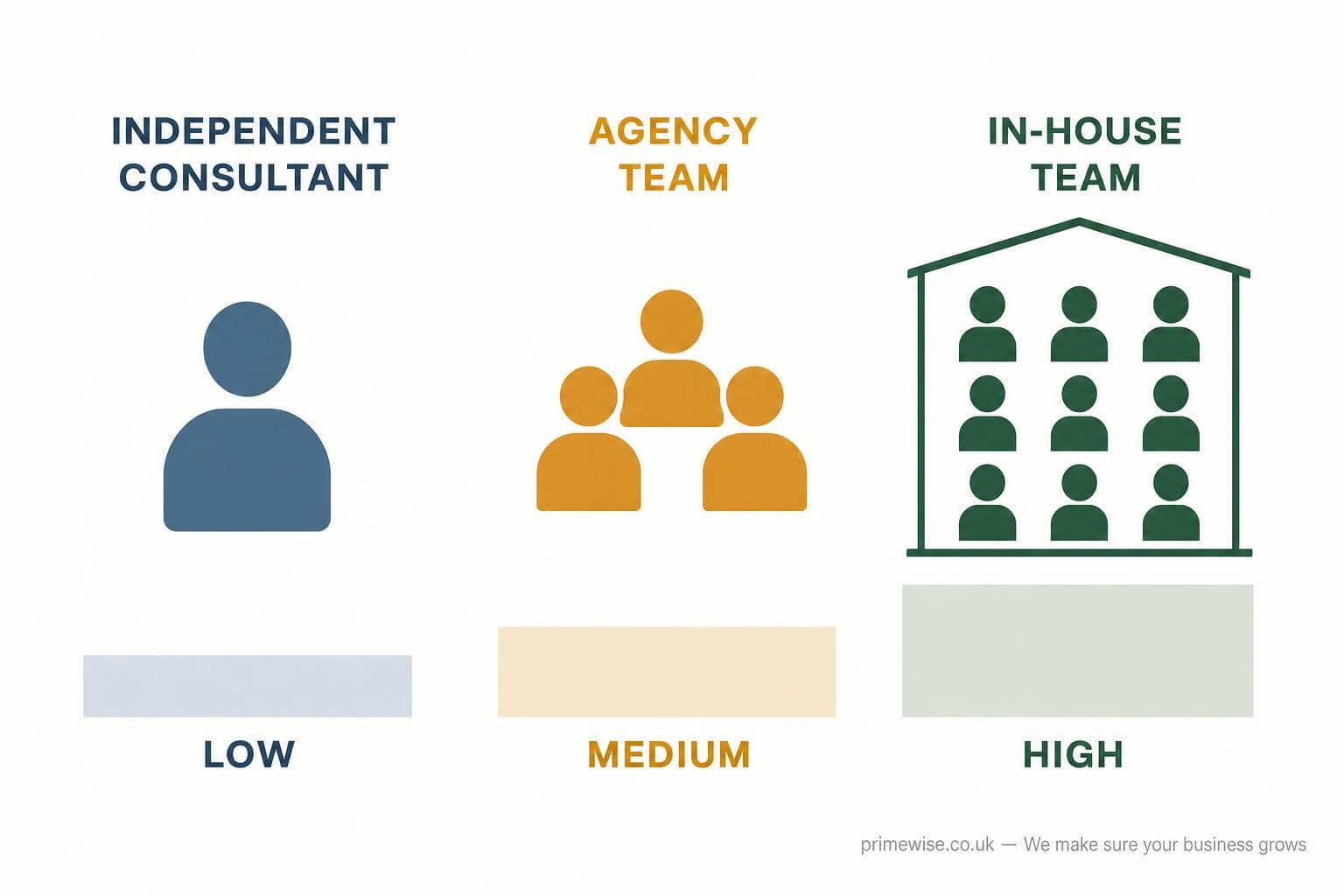
Before comparing the models, establishing precise definitions prevents the costly misalignments that cause AI programmes to stall at procurement stage. An independent AI consultant is a senior practitioner typically a specialist in machine learning, LLMOps, or data architecture engaged on a time-and-materials basis to provide strategic advisory, technical validation, or targeted algorithmic development. Their value is depth, not breadth. An AI automation agency is a multi-disciplinary firm deploying integrated teams of data scientists, cloud architects, security engineers, and project managers to design, build, and deploy production-ready AI systems under a fixed-price contractual framework. Building in-house means recruiting, onboarding, and retaining a permanent engineering function to develop proprietary AI systems owned entirely by the business, governed by your internal cybersecurity and IP frameworks from day one.
Executive ClarityThe single most common procurement mistake is treating these three models as interchangeable. They are not. Each model maps to a specific set of internal capabilities, risk tolerances, and timelines. Selecting the wrong model against the wrong organisational baseline is the primary driver of AI programme failure in UK enterprises.
The Operational AI Evaluation Matrix
The following matrix is drawn directly from operational programme data and reflects the realistic performance characteristics of each model across the five pillars that matter most to executive leadership teams. Read this as a procurement instrument, not a theoretical framework.
| Evaluation Pillar | Independent AI Consultant | AI Automation Agency | In-House Engineering Team |
|---|---|---|---|
| Speed to Value | 2–4 weeks for strategy roadmap | 6–12 weeks to live deployment | 4–8 months before development begins |
| Year-One TCO (UK) | £60k–£180k (open-ended daily rates) | £40k–£150k (fixed-price contract) | £250k–£400k+ (salaries, recruitment, licensing) |
| IR35 Risk | High medium and large enterprises liable | None B2B contract, no off-payroll exposure | None permanent employment basis |
| UK GDPR and FCA Alignment | Variable depends on individual practitioner rigour | High built into system architecture from inception | Highest full internal data sovereignty |
| IP Retention | Risk of orphaned technology post-engagement | Contractually defined agency transfers IP on completion | Total all algorithms owned outright |
| Scalability | Low single practitioner bandwidth constraint | High team scales with programme demands | Medium constrained by recruitment pipeline |
| Governance Accountability | Advisory only execution risk remains internal | Contractual SLA agency accountable for deliverables | Full internal control requires senior technical leadership |
| Recommended For | Strategic validation, pre-build technical review | End-to-end enterprise deployment, compliance-critical sectors | Long-term proprietary algorithm development at scale |
Accountability and Project Governance
Navigating the accountability structures of an AI programme is where most operational leaders underestimate complexity. Independent consultants operate in an advisory capacity by design. The intellectual insight they provide is genuinely valuable, but the burden of translating that insight into deployed, functional systems remains entirely with your internal technical leads. When the engagement concludes often abruptly as scopes change there are rarely robust handover protocols, leaving your engineers maintaining systems they did not build and cannot safely modify. I witnessed this pattern repeatedly: a brilliantly designed strategy document sitting unused because the internal team lacked the engineering bandwidth to execute it.
An AI automation agency operationalises accountability through legally binding Service Level Agreements. Deliverables are defined, milestone-gated, and contractually enforced. The agency carries professional indemnity insurance underwriting their technical architecture, which means financial and reputational risk is distributed rather than concentrated internally. Building in-house delivers the tightest governance control of all three models, but only if your organisation already has a technically literate senior leader capable of managing a complex engineering function day-to-day a Chief AI Officer or a Director of Engineering with MLOps experience. Without that leadership layer, internal teams drift, sprint velocity collapses, and the programme stalls precisely when commercial stakeholders expect acceleration.
Depth of Technical Expertise and Scalability
Transitioning an AI programme from a controlled pilot to enterprise-wide deployment demands multi-disciplinary engineering capabilities that a single practitioner simply cannot provide. Integrating Large Language Models whether Azure OpenAI Service, AWS Bedrock, or Google Vertex AI into production digital infrastructure requires simultaneous competency across data engineering, cloud architecture, security compliance, and prompt engineering. A highly skilled independent consultant may master two or three of these disciplines deeply, but they become an operational bottleneck the moment the programme requires capabilities outside their core domain.
Agencies deploy blended teams specifically assembled around programme requirements, achieving scalability that mirrors Agile AI Sprint methodology and established MLOps frameworks. In-house teams can eventually develop comparable depth, but achieving it requires a recruitment cycle that, in the current London technology market, routinely extends six to nine months before a coherent cross-functional team is operational. According to the Harvey Nash Digital Leadership Report, AI and machine learning roles in the UK now take an average of four months longer to fill than equivalent software engineering positions, which has a direct and compounding impact on time-to-value calculations.
Speed to Market and Time to Value
In the current commercial environment, every quarter of operational delay represents measurable competitive disadvantage, particularly when AI-enabled competitors are compressing their own decision cycles. Speed-to-value is therefore not a secondary metric it is frequently the decisive procurement criterion for operations leaders working within defined fiscal quarter deadlines.
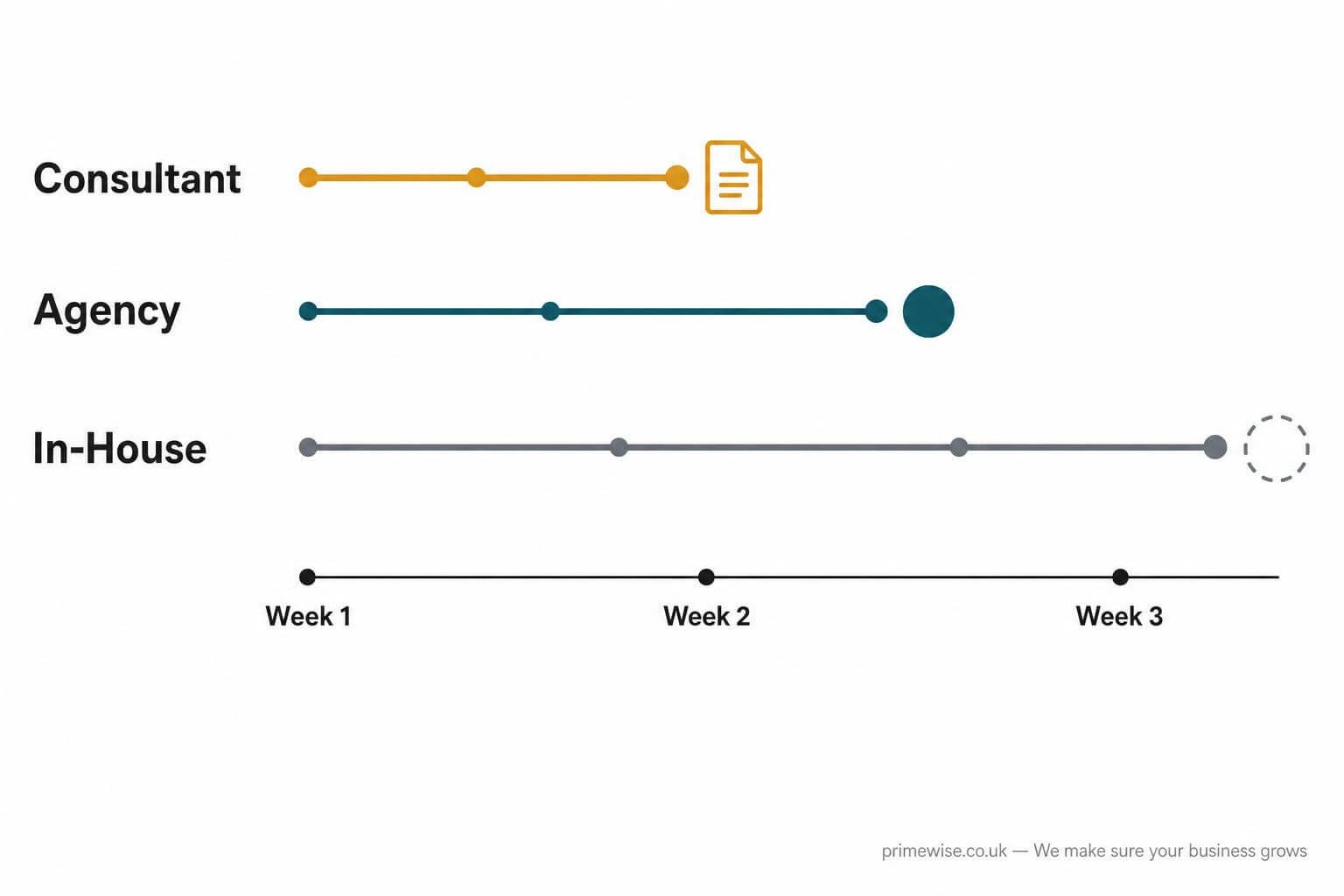
The deployment timeline data is unambiguous. An independent consultant can produce a comprehensive technical strategy and a costed implementation roadmap within two to four weeks invaluable for securing executive buy-in or validating an existing internal hypothesis before committing capital. An AI automation agency, engineered specifically for rapid production deployment, will typically transition a programme from initial discovery to a live, functional, compliance-tested system within six to twelve weeks. Building in-house cannot compete on this dimension: even with aggressive hiring, the earliest realistic date for meaningful engineering output is four to eight months post-commencement, accounting for recruitment, onboarding, technical alignment, and initial sprint planning. McKinsey’s 2024 Global AI Survey found that 65% of organisations now regularly use generative AI, up from 33% in 2023 those that moved fastest captured the greatest margin advantage in their respective sectors.
Data Governance and Regulatory Compliance
For UK enterprises particularly those in financial services, legal, healthcare, and any sector subject to FCA or ICO oversight data governance is not a post-deployment consideration. It must be architected into the system from inception, and your resourcing model determines how reliably this happens. The UK GDPR Article 22 framework imposes strict obligations around automated decision-making, requiring explicit lawful basis, meaningful human oversight mechanisms, and documented impact assessments. The FCA’s PS24/1 guidance on AI model risk in financial services further places explicit governance obligations on any firm deploying third-party AI systems including obligations around model explainability, bias monitoring, and ongoing audit trails.
Engaging an independent consultant on a short-term basis introduces meaningful data security risk if access protocols, data residency requirements, and post-engagement credential revocation are not stringently managed by your internal IT security function. Reputable AI automation agencies design UK GDPR-compliant and FCA PS24/1-aligned architectures as standard, typically evidenced through ISO 27001 certification and Data Processing Agreements embedded in the master services contract. In-house teams offer the ultimate data sovereignty zero external access to proprietary datasets but this advantage is only realised if your existing cybersecurity framework is already enterprise-grade, with network segmentation, data classification policies, and role-based access controls already operational.
Regulatory AlertThe ICO's 2024–2025 consultation on AI Liability and Algorithmic Accountability signals a significant tightening of automated decision-making obligations under Article 22 UK GDPR. Any resourcing model that does not embed compliance review at the architecture stage before a single line of production code is written is building future liability directly into its technical stack.
Total Cost of Ownership and Hidden Expenses
Procurement teams that evaluate AI resourcing purely on headline quotes consistently underestimate the true Total Cost of Ownership, often by a factor of two to three times the initial figure. The hidden cost dimension is where resourcing decisions that looked commercially attractive in procurement become catastrophic by year two.
Independent consultants operate on premium daily rates typically £800 to £1,800 per day for senior practitioners in the London market, classified as operational expenditure which accumulate rapidly when projects encounter the scope extensions that are almost universal in enterprise AI engagements. A three-month strategic engagement can easily escalate to a seven-month commitment with no contractual ceiling on cost. AI automation agencies command a meaningful upfront investment, but fixed-price contracting eliminates financial surprises across the delivery phase, converting unpredictable operational expenditure into a clearly bounded capital investment. The ongoing retainer for system maintenance and iterative optimisation is similarly scoped and predictable. Building in-house is the most expensive option at any time horizon under five years. KPMG UK’s 2025 Technology Talent Report confirms that senior machine learning engineers in London now command base salaries of £95,000 to £140,000, before employer National Insurance contributions at 13.8%, pension obligations, software licensing for tools such as Databricks or Snowflake, specialist recruitment fees typically exceeding 20% of first-year salary, and ongoing training expenditure. A modestly resourced in-house AI team of four to five engineers will routinely absorb £350,000 to £500,000 in year-one operational expenditure before a single system reaches production.
Navigating the UK Digital Landscape
The operational reality of resourcing AI in the United Kingdom is shaped by legislative and economic pressures that have no equivalent in the US or European markets. Ignoring these realities does not eliminate the risk it simply defers the financial penalty to a later, more damaging stage of the programme.
IR35 legislation governing off-payroll working represents one of the most significant compliance risks in the independent consultant model for medium and large enterprises. HMRC’s Status Determination Statement process requires your business to assess whether the engagement resembles a disguised employment relationship. If the consultant works exclusively for your organisation, attends internal meetings as a team member, and is subject to day-to-day management direction, the engagement is highly likely to trigger IR35 resulting in retroactive tax liability, National Insurance arrears, and potential investigation. Engaging a fully incorporated AI automation agency eliminates this risk entirely, as the contractual relationship is unambiguously business-to-business. The Employment Rights Act 2025 further complicates the classification of AI contractors versus permanent employees, introducing additional documentation obligations that many in-house procurement teams are not yet equipped to navigate.
InsightThe UK Government's AI Opportunities Action Plan, published January 2025, projects £400bn in economic gains from AI adoption across UK industries. Businesses that secure robust, compliant AI infrastructure now will be structurally advantaged to capture a disproportionate share of this value as regulatory and market conditions mature.
The London technology talent market compounds these pressures. Competing for senior AI engineers against global technology conglomerates who offer equity compensation, flexible working arrangements, and the commercial prestige of working on globally scaled systems places mid-market UK firms at a structural disadvantage when building in-house. The result is extended vacancy periods, costly counter-offer cycles, and the persistent risk of key-person dependency, where a single engineer’s departure can effectively halt an entire AI programme. Primewise.co.uk works specifically with UK-based operations and technology leaders to design AI deployment strategies that account for these precise local constraints, providing compliance-aligned delivery frameworks that eliminate IR35 exposure and integrate FCA governance requirements from the outset.
Why AI Programmes Fail in Practice
Systemic failure in enterprise AI integration is almost never caused by flawed technology. The root cause, in the vast majority of cases, is a fundamental mismatch between the resourcing model selected and the internal capabilities available to support it. The pattern is remarkably consistent across sectors and organisation sizes.
Programmes fail when internal teams lack the engineering bandwidth to execute a consultant’s strategy, leaving sophisticated roadmaps unimplemented while the business continues to incur advisory fees. They fail when organisations attempt to build in-house without the technical leadership required to manage complex machine learning talent, resulting in engineering functions that produce technically impressive prototypes that never reach production. Poor intellectual property handover from temporary contractors produces orphaned technology systems that internal teams cannot update, scale, or safely maintain which ultimately requires complete redevelopment at significant additional cost. Poor data governance during the build phase creates regulatory exposure that surfaces during FCA or ICO audit cycles, often years after the original programme concluded.
A mid-market UK financial services firm with £180 million annual turnover engaged an AI automation agency for automated credit risk decisioning. Deployment was completed in nine weeks. Compliance sign-off against FCA PS24/1 was achieved at week eleven. Operational cost reduction of 34% was realised within six months of go-live, with full IP transfer completed at programme close. The same firm had previously attempted an independent consultant-led approach over a fourteen-month period, which produced a comprehensive strategy document but zero production systems, at a cost exceeding £200,000 in accumulated daily fees.
The Diagnostic AI Resourcing Decision Framework
Translating the evaluation matrix into an actionable procurement decision requires an honest internal assessment against a defined set of organisational criteria. The following framework maps your specific constraints to the model most likely to deliver the highest risk-adjusted return.
- If your organisation lacks internal engineering bandwidth and requires a live, compliant production system within a defined fiscal quarter, engage an AI automation agency.
- If you need technical validation of an existing internal strategy before handing off to your own capable developers, contract an independent AI consultant for a time-bounded strategic review.
- If your organisation has a five-year-plus strategic horizon, significant capital reserves, and an existing technically literate leadership layer, invest in building an in-house engineering function.
- If you operate in a regulated sector financial services, healthcare, legal and require guaranteed FCA or ICO-aligned architecture, the agency model eliminates the compliance architecture risk that the consultant model introduces.
- If IR35 compliance is a board-level concern, the agency model is the only resourcing option that eliminates this liability entirely by virtue of its corporate contractual structure.
- If intellectual property ownership is a primary strategic objective, define your IP transfer protocol contractually before any agency engagement commences reputable agencies will accommodate this without negotiation friction.
Organisations that have mapped their constraints to the agency model consistently report accelerated deployment timelines and significantly reduced compliance risk. Primewise.co.uk provides a no-obligation AI readiness assessment specifically designed for UK Operations Directors, delivering a scoped commercial proposal within five business days that reflects the precise regulatory and operational context of your sector. If your procurement team is operating within a defined fiscal quarter deadline and requires a fixed-cost deployment proposal aligned with UK GDPR and FCA standards, this assessment provides the commercial clarity your board requires before capital is committed.
Evaluating an AI Automation Agency Before You Sign
Selecting an agency is itself a procurement process that demands rigorous due diligence. The AI services market in the UK contains a significant number of firms offering AI transformation capabilities that are not substantiated by genuine enterprise delivery experience. Before signing any master services agreement, your procurement team should require the following: ISO 27001 certification or equivalent information security accreditation; demonstrated experience delivering against FCA PS24/1 or UK GDPR Article 22 in your specific sector; fixed-price contract structure with clearly defined milestone-based payment schedules; explicit IP assignment clauses transferring all developed assets to the client on final payment; professional indemnity insurance of no less than £2 million; and named case studies from comparable UK enterprise engagements, ideally with referenceable contacts.
Procurement ChecklistRequest a Data Processing Agreement, a named Technical Lead with verifiable credentials, and a documented system handover protocol before any scoping workshop. Agencies that resist providing these artefacts at pre-contract stage are signalling governance immaturity that will manifest as delivery risk later in the programme.
Can Smaller UK Businesses Afford an AI Automation Agency
The perception that AI automation agencies operate exclusively at enterprise scale is commercially outdated. The market has matured significantly since 2023, and a growing number of UK-based agencies now offer modular, phased engagement structures specifically designed for SMEs and mid-market firms with more constrained capital budgets. A phased approach beginning with a defined discovery and architecture sprint priced between £8,000 and £20,000 allows smaller organisations to validate the commercial case and establish technical architecture before committing to a full build investment. This structure also provides a low-risk mechanism for evaluating agency capability and cultural fit before entering a longer contractual relationship. The critical commercial insight is that a fixed-price agency engagement of £45,000 delivering a production-ready AI system within ten weeks frequently generates a faster and more measurable return than twelve months of accumulated consultant daily rates that never produce a deployable asset.