The debate over AI workflow automation service versus traditional robotic process automation is one of the most consequential infrastructure decisions facing UK technology leaders right now. Stop conflating the two. AI automation vs traditional automation is not a generational replacement story it is a precise engineering question about which tool fits which task. Deploying generative AI where deterministic RPA excels is as costly a mistake as refusing to integrate cognitive intelligence where unstructured data defeats your rule-based bots. The organisations winning in 2026 are those that have stopped asking which technology is better and started asking which pattern is correct for each workflow class.
Executive SummaryTraditional RPA remains unbeatable for deterministic, legacy-system, and compliance-critical workflows. AI automation wins where unstructured data, dynamic decisions, and variable inputs defeat rigid scripting. The optimal enterprise architecture combines both in a hybrid model where AI acts as the cognitive interpreter and RPA executes safely within legacy systems. The Automation Cognitive Threshold Model, developed by PrimeWise, identifies the exact point at which AI augmentation becomes economically justified.
The Automation Divide Defined
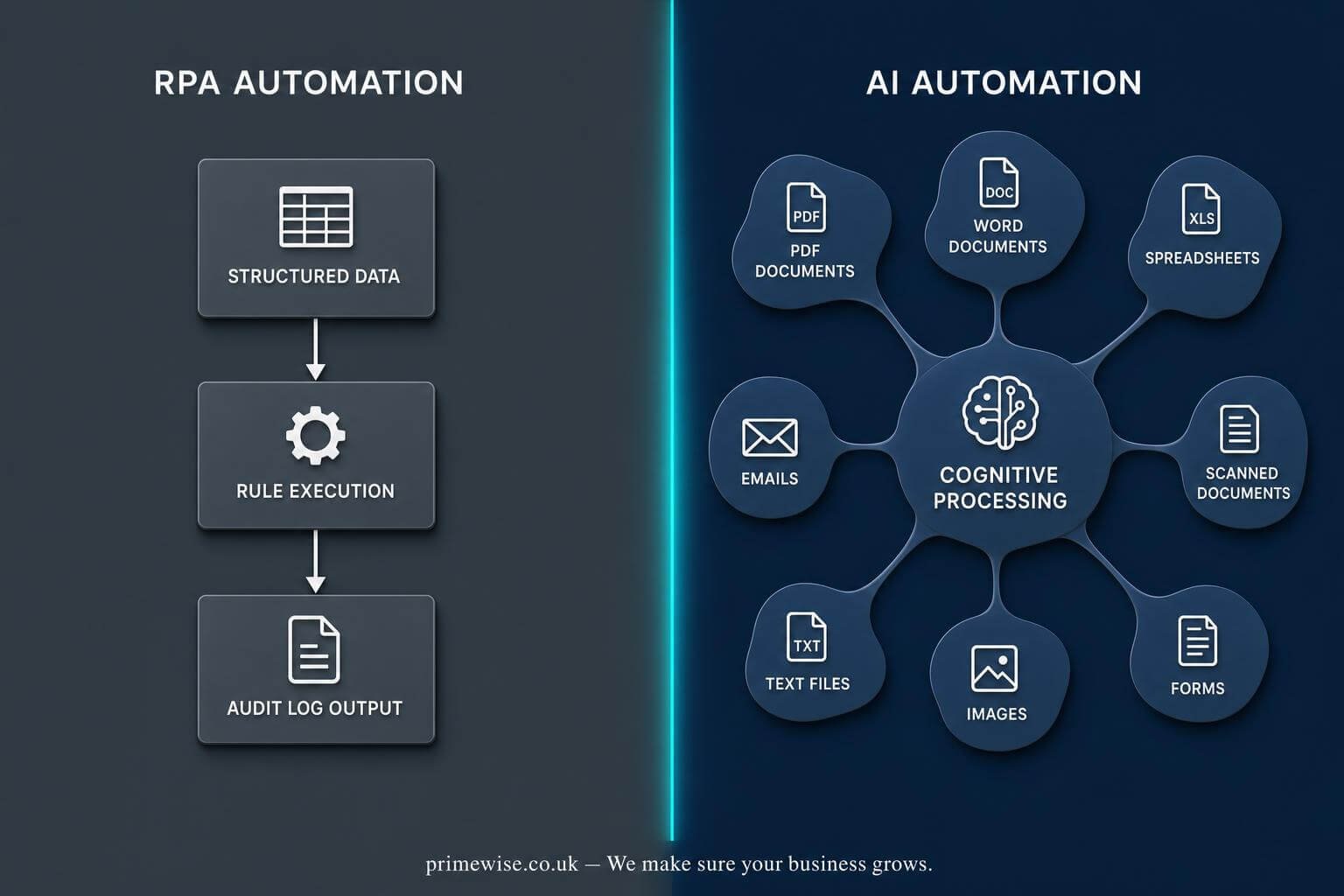
Traditional RPA executes deterministic, rule-based tasks through step-by-step scripted logic. It interacts directly with application user interfaces entering data, navigating screens, triggering transactions without requiring an underlying API. AI automation handles probabilistic, cognitive processes: extracting meaning from unstructured documents, interpreting variable inputs, and making context-sensitive decisions that no fixed rule set can anticipate. Understanding this boundary is the foundational requirement for any sound automation investment decision.
| Process Attribute | Winning Technology |
|---|---|
| Structured, rule-bound data entry | RPA |
| Unstructured documents and variable inputs | AI Automation |
| Absolute regulatory auditability required | RPA |
| Legacy system with no API | RPA |
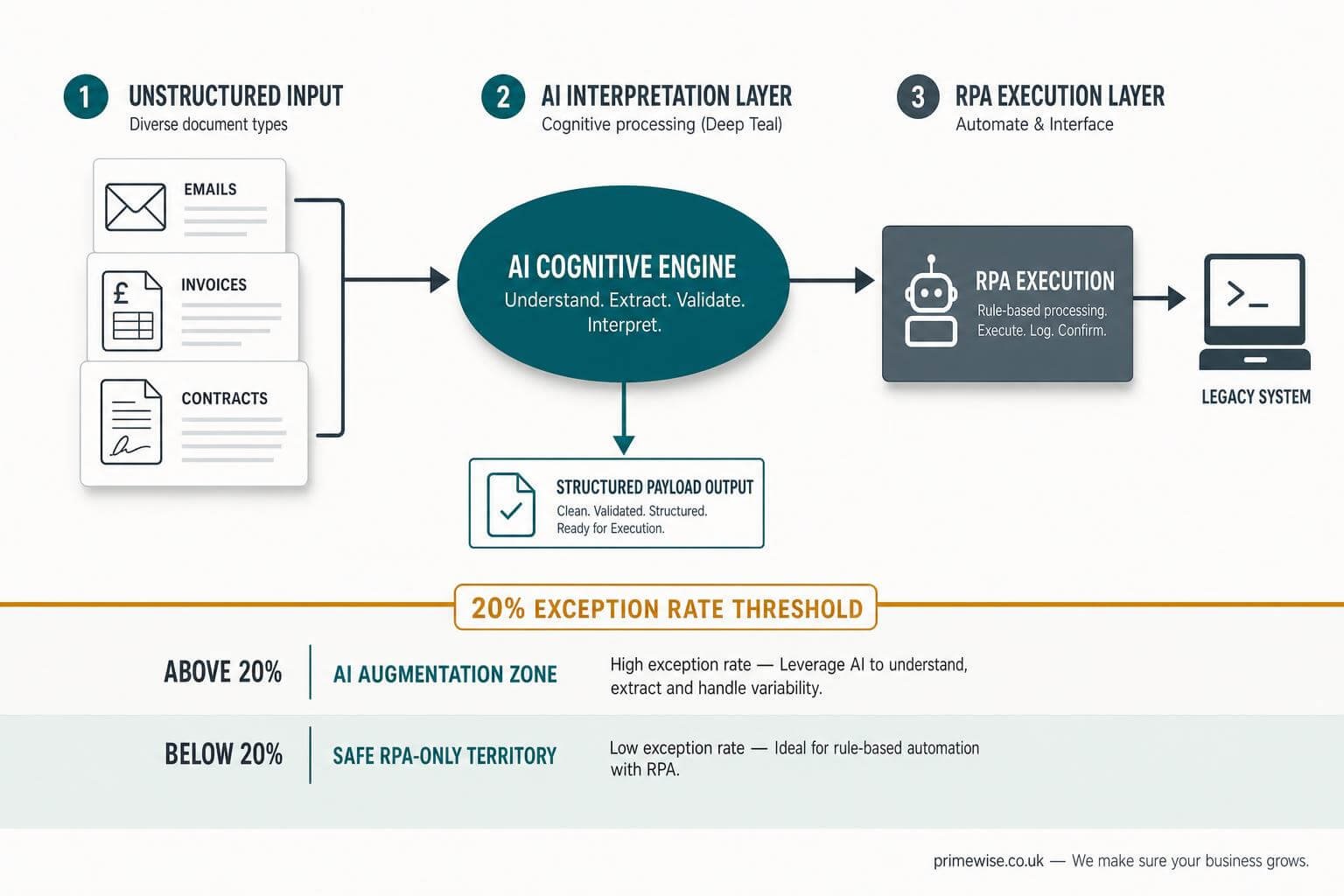
| Exception rate above 20% due to unstructured inputs | AI Augmentation Required |
| Sensitive UK citizen data sovereignty concerns | On-premise AI or RPA |
| Dynamic decision-making across variable contexts | AI Automation |
Where Traditional RPA Remains the Right Answer
Technology leaders who have invested in established workflow bots can hold that position with confidence. RPA continues to deliver superior, predictable returns in specific operational scenarios where rigid rule adherence and absolute process fidelity are non-negotiable. The question is never whether RPA is outdated it is whether your target workflow is deterministic enough to be fully described by rules.
Bridging Legacy Infrastructure in the City
London’s established financial institutions operate on complex webs of older technology AS/400 systems, legacy mainframe cores, and older COBOL-based banking platforms that predate modern cloud architecture by decades. These environments frequently lack REST APIs or any modern integration surface, making UI-layer surface automation the only viable bridge. Platforms such as UiPath, Blue Prism, and Automation Anywhere have all invested deeply in mainframe terminal emulation and legacy screen-scraping capabilities precisely because this integration gap is not closing quickly. Bots navigate these environments with mathematical precision, executing transactions that keep critical operations moving without requiring multi-million-pound core system replacements that carry their own project risk.
Auditability Under FCA and PRA Regulation
The UK Financial Conduct Authority’s operational resilience rules, reinforced by PS21/3 and the Consumer Duty framework introduced in 2023, impose stringent requirements for algorithmic explainability in automated financial workflows. Traditional scripted automation excels here. Because every action follows a deterministic rule, the sequential event log generated by an RPA bot constitutes a complete, human-readable audit trail. Compliance teams can identify the exact rule that triggered any given action with zero ambiguity. This stands in direct contrast to the explainability risk posed by deep learning inference, where the Prudential Regulation Authority’s own supervisory guidance has flagged black-box decision-making in regulated processes as an emerging area of scrutiny.
Compliance WarningUnder the FCA's Consumer Duty and PRA operational resilience frameworks, automated decisions affecting retail customers must be explainable. Black-box AI inference in direct execution roles carries significant regulatory exposure for UK financial institutions. RPA's deterministic audit trail remains the compliance-safe execution layer.
Where AI Changes the Automation Economics
Cognitive intelligence justifies its higher complexity and variable cost structure the moment a workflow encounters inputs that cannot be fully described by a finite rule set. The critical inflection point is unstructured data at volume. When document templates change, email formats vary, or contract language is non-standard, rule-based bots fail with brittle predictability. AI-driven orchestration frameworks, including those built on LangChain or AutoGen agent architectures, transform these failure points into handled exceptions.
Conquering Unstructured Data at Scale
The operational superpower of modern large language model integration is semantic understanding of variable inputs. Natural language processing pipelines can extract relevant data fields from disorganised email threads, non-standard invoice formats, bespoke contract clauses, and multi-language financial disclosures without requiring a template update every time the source format changes. A cognitive agent assesses context dynamically and extracts the required variables, passing a clean, structured payload downstream for deterministic execution. This is not a replacement for your existing automation it is the preprocessing layer that makes your existing automation resilient to real-world document variance.
UK GDPR and Data Sovereignty Architecture
Passing sensitive UK citizen financial data through US-hosted public cloud LLM endpoints introduces immediate UK GDPR Article 44 compliance exposure around international data transfers. Regulated organisations processing personal financial data through cognitive workflows must architect accordingly deploying secure cloud enclaves within UK data centre regions, utilising locally hosted open-weight models, or implementing aggressive PII tokenisation and masking before any data leaves the organisation’s control boundary. The UK National AI Strategy’s governance framework further encourages sovereign AI capability, signalling regulatory direction of travel toward on-premise or UK-residency AI processing for sensitive sectors.
The True Total Cost of Ownership
Traditional RPA carries a predictable cost structure: annual platform licensing from vendors such as UiPath or Blue Prism, standard bot maintenance overhead, and scheduled development effort for process changes. AI automation introduces a fundamentally different economic model variable token costs per inference call, model hosting or API subscription fees, compute overhead for document preprocessing, and periodic fine-tuning or prompt engineering investment. According to Gartner’s 2025 Intelligent Automation Market Guide, organisations that fail to model AI inference costs at projected transaction volumes routinely discover that per-unit processing costs exceed their original business case assumptions by 30 to 60 percent. Rigorous total cost of ownership modelling is not optional before an AI automation commitment at enterprise scale.
The Automation Cognitive Threshold Model
The most important diagnostic tool for technology leaders evaluating AI augmentation of existing RPA workflows is the Automation Cognitive Threshold Model, a framework developed and deployed by PrimeWise across enterprise automation engagements with UK financial services clients. The model provides a mathematically grounded answer to the question that every CIO eventually faces: at what exact point does integrating AI into an RPA workflow become economically justified?
The core formula is straightforward:
Cognitive Integration ROI = (Monthly Exception Volume × Average Human Review Cost) − (Monthly Token Cost + Model Hosting Cost)
When this value turns positive, AI augmentation is justified. When it remains negative, the process is not complex enough to warrant cognitive overhead and should remain on deterministic RPA. As a practical benchmark calibrated to UK operational costs: a workflow processing 2,000 documents per month with a 25 percent exception rate, where each human exception review costs £18 in FTE time at London rates, generates £9,000 in monthly manual handling cost. If the AI inference layer costs £1,200 per month in tokens and hosting, the ROI is clearly positive at £7,800 net monthly benefit. The model also establishes a critical threshold rule any deterministic workflow suffering an exception rate above 20 percent due to unstructured or variable inputs has crossed the cognitive threshold and requires AI augmentation to remain economically viable.
Framework AccessPrimeWise has developed a pre-built Automation Cognitive Threshold Assessment template calibrated to UK financial services operational costs and FTE rates. UK organisations benchmarking their automation architecture can request a complimentary copy at primewise.co.uk.
Hybrid Production Patterns That Work
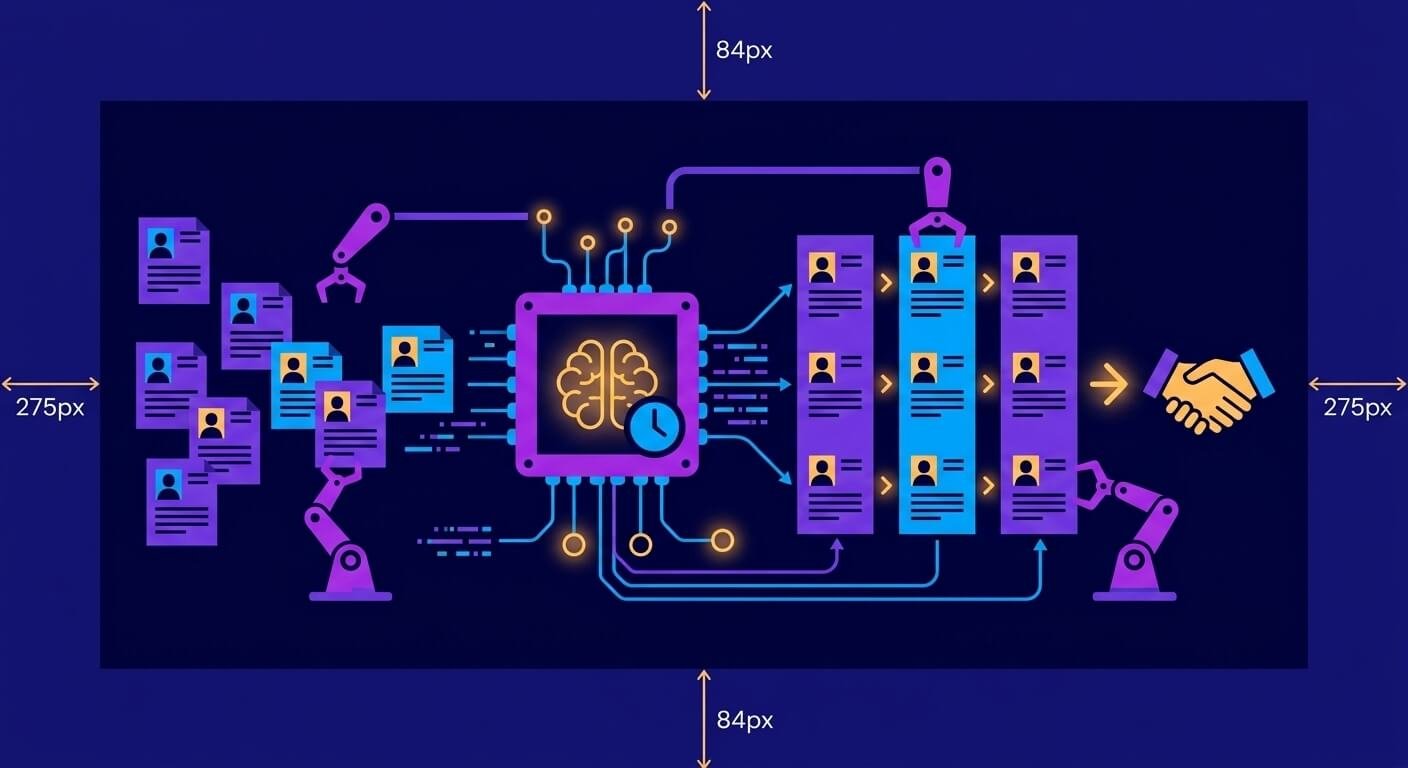
The most resilient and commercially effective enterprise automation architectures in 2026 treat AI and RPA as complementary layers within a unified hyperautomation strategy the term Gartner uses to describe the disciplined, business-driven approach of identifying, vetting, and automating as many processes as possible using a combination of automation technologies. In practice, the pattern is consistent across successful deployments: the AI layer handles semantic interpretation of incoming unstructured data, produces a clean structured output, and passes that deterministic payload to the RPA layer for safe, auditable execution within legacy systems. Model Context Protocol, the emerging standard for AI agent tool-use that reached production maturity in 2025, provides the integration handoff layer that makes this pattern technically robust and maintainable.
Tier-One Retail Bank Case Study
A PrimeWise client engagement in Q3 2025 with a tier-one UK retail bank illustrates the commercial impact of this architectural blueprint applied to Know Your Customer onboarding. The institution’s existing pure-RPA KYC workflow was processing approximately 4,500 onboarding documents per month but suffering a 31 percent exception rate driven by non-standard document formats, handwritten annotations, and multi-language identity documents all inputs that fell outside the deterministic rule set. The workflow was generating over 1,390 manual exception reviews per month, each requiring an average of 22 minutes of a compliance analyst’s time at a fully loaded cost of £42 per hour.
PrimeWise transitioned the institution to a 60/40 hybrid automation model: a cognitive document interpretation layer using a locally hosted LLM within a UK-residency cloud enclave for UK GDPR compliance, feeding a clean structured payload into the existing Blue Prism RPA layer for core system entry. The result was a 43 percent reduction in exception-handling costs compared to the standalone RPA architecture, elimination of 8,000 hours of annual manual unstructured data review, and full preservation of the deterministic RPA audit trail required by the FCA. Full engagement details are available under NDA upon request.
An Honest Assessment of Technology Flaws
Operational resilience in automation requires an unsentimental view of what each technology fails at. Both RPA and AI carry distinct failure modes that must be governed explicitly rather than discovered in production.
- RPA brittleness: scripted bots break when a target application undergoes a UI update, a screen element is repositioned, or a field label changes a high-frequency failure mode in systems that receive regular vendor patches.
- AI hallucinations: large language models can generate confident, syntactically plausible, but factually incorrect outputs a critical failure mode when the extracted value feeds a financial transaction or compliance record.
- RPA scalability ceiling: horizontal scaling of bot fleets carries per-licence costs that grow linearly with volume, which can erode ROI at high throughput without architectural restructuring.
- AI inference latency: real-time transaction workflows may find LLM inference latency incompatible with sub-second SLA requirements, requiring careful architecture to avoid downstream pipeline bottlenecks.
- AI model drift: LLM outputs can shift subtly over time as underlying models are updated by providers, introducing non-determinism into what appeared to be a stable workflow a governance risk specific to managed API-based AI services.
Governance PrincipleEstablish a human-in-the-loop validation checkpoint for all AI inference outputs that feed regulated financial decisions. Use deterministic RPA exclusively as the execution layer. This single architectural rule eliminates the primary governance risk of hybrid automation deployments.
Implementing a Robust Automation Strategy
For technology and operations leaders building or reviewing their automation roadmap, the implementation sequence matters as much as the technology selection. Begin with a complete process audit that classifies every candidate workflow against the structured or unstructured data dimension and the regulatory explainability requirement. Workflows in the structured and explainability-critical quadrant belong on RPA. Workflows in the unstructured or high-exception-rate quadrant are candidates for AI augmentation or a hybrid pattern. Deploy the Automation Cognitive Threshold Model to quantify the economic case for each AI integration before any budget commitment. Ensure your data residency and UK GDPR architecture is designed before cognitive workflows reach production, not after. And treat every RPA-to-AI handoff point as a formal governance checkpoint with defined validation criteria and exception escalation paths.
UK organisations that want to benchmark their current automation architecture against 2026 best practice or that need a structured assessment to build an internal business case can request PrimeWise’s complimentary Automation Maturity Assessment at primewise.co.uk. The assessment maps your existing estate against the hybrid patterns described here and produces a prioritised roadmap calibrated to UK regulatory and operational requirements.