

AI automation ROI is the financial metric that separates genuine enterprise value creation from expensive technological theatre, and building a defensible calculation requires far more than dividing hours saved by hourly rate. Before committing capital to any AI automation roadmap, financial decision-makers need a rigorous, formulaic methodology that withstands boardroom scrutiny, satisfies FCA regulatory governance requirements, and accounts for the hidden ongoing costs that destroy anticipated returns by year two. This article provides exactly that a practitioner-built framework used to justify, stress-test, and occasionally reject AI workflow investments inside UK financial services organisations.
What AI Automation ROI Actually Means in Financial Terms
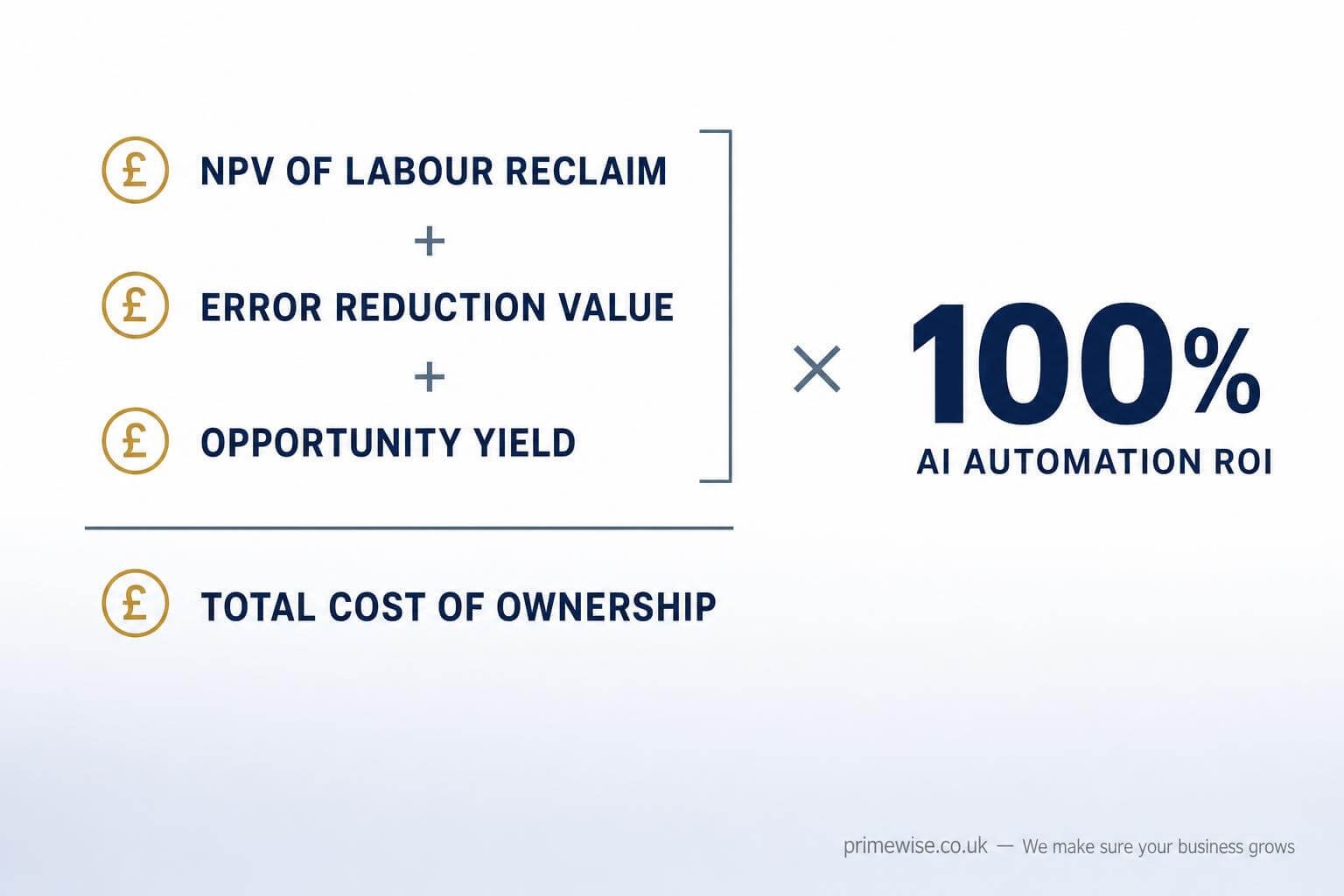
AI automation ROI is the net financial return generated by implementing algorithmic workflows, expressed as a percentage of total investment. The precise definition matters because vague productivity metrics time saved, processes accelerated fail every serious financial review. A defensible calculation anchors on the net present value of measurable automation benefits minus the total cost of ownership, divided by that same total cost, multiplied by one hundred to express as a percentage.
This distinction between theoretical efficiency and quantifiable financial return is what separates approved business cases from rejected ones. A KPMG UK 2025 Enterprise AI Adoption Survey found that 67% of CFOs cited unmeasured total cost of ownership as the primary reason automation business cases failed internal financial review. The framework presented here eliminates that failure mode systematically.
The Explicit ROI Formula Every CFO Needs
Before analysing individual cost and benefit pillars, the core calculation must be stated in precise, extractable terms. This formula is the foundation of every boardroom-ready automation business case and should appear verbatim in any investment proposal submitted for approval.
AI Automation ROI (%) = [(NPV of Labour Reclaim + Error Reduction Value + Opportunity Yield) Total Cost of Ownership] ÷ Total Cost of Ownership × 100
To make this concrete rather than conceptual, consider a realistic UK financial services example. A London-based compliance team of eight FTEs with fully loaded costs of £85,000 per annum each handles document review. Automating 60% of that volume yields an annual labour reclaim of £408,000. Error reduction in a regulatory filing context, where each manual error costs an estimated £4,200 in remediation and audit time, adds a further £63,000 annually at current defect volumes. Against a total first-year cost of ownership of £180,000 covering implementation, API consumption, governance oversight, and human-in-the-loop auditing the resulting ROI is 83%. That figure survives boardroom challenge because every input is sourced, loaded, and defensible. This is the standard to aim for before committing a single pound of development budget.
The Four-Pillar AI Defensibility Matrix
Evaluating enterprise AI investment requires a structured methodology that strips away industry hype and replaces it with quantitative assessment across four distinct financial dimensions. The Four-Pillar AI Defensibility Matrix provides exactly this structure, ensuring that no significant cost or benefit category is omitted from the business case. Each pillar addresses a specific financial question that CFOs, CTOs, and Heads of Operations routinely ask during investment review.
Pillar One Fully Loaded Labour Reclaim
Translating time savings into hard financial data begins with rejecting the basic salary calculation. In the London financial sector, true labour arbitrage demands calculating the fully loaded FTE cost reclaimed a figure that integrates base salary, employer national insurance contributions at 13.8%, pension auto-enrolment at a minimum 3% employer contribution, software licensing per seat, office facility overhead allocation, and management supervision costs. For a mid-level financial analyst in the City earning £65,000 base, the fully loaded annual cost typically reaches £88,000 to £94,000 when all employer obligations and overhead allocations are included.
The labour reclaim calculation then identifies the precise proportion of that individual’s cognitive load that algorithmic execution can legitimately replace. A process mining audit using tools such as Celonis or UiPath Process Mining quantifies exact task-level time allocation before any automation assumption is made. Skipping this step produces inflated reclaim figures that collapse under scrutiny. The output of Pillar One is a specific annualised sterling figure representing the capacity freed for redeployment, not merely hours theoretically saved on a spreadsheet.
Pillar Two Error Reduction Valuation
Operational error costs represent one of the most quantifiable and frequently underestimated avenues for AI automation ROI. The valuation formula is straightforward and should be applied to every candidate workflow during feasibility assessment.
Error Reduction Value = (Cost per Error × Current Annual Error Volume) (Cost per Error × Projected AI Error Volume)
Within UK financial services, the cost per error extends well beyond immediate remediation time. It encompasses regulatory reporting obligations under FCA supervisory expectations, internal audit review hours, potential client relationship repair costs, and in Material cases, formal enforcement exposure. When a human document review process yields a 3.2% defect rate across 2,000 annual filings, and AI implementation reduces that rate to 0.4%, the error reduction value at £4,200 per incident reaches £235,200 annually. That figure translates directly into protected regulatory capital and reduced compliance risk two arguments that resonate powerfully at board level in FCA-regulated environments. This pillar also functions as a risk mitigation argument that complements the cost-saving narrative.
Pillar Three Opportunity Cost and Strategic Yield
Linking unlocked human capacity to high-margin strategic growth initiatives is the most intellectually powerful component of the business case, and the one most frequently omitted from financially conservative automation proposals. The opportunity cost framework asks a specific question: if algorithmic execution absorbs 60% of a specialist’s repetitive workload, what is the financial value of redirecting that 60% toward complex client advisory, business development, or risk intelligence functions?
Strategic yield modelling answers this question with financial precision. If a displaced analyst’s reallocation toward institutional client advisory generates an incremental £120,000 in annual fee revenue a conservative estimate within a City financial services context that opportunity yield should be included in the NPV calculation as a confirmed benefit, not a speculative bonus. The McKinsey Global Institute 2024 analysis of UK financial services automation found that organisations successfully reallocating displaced FTE capacity to strategic roles achieved payback periods averaging 14 months, compared to 26 months for organisations that simply reported headcount reduction. Opportunity cost modelling is what separates a cost-cutting narrative from a growth-enabling business case and the latter is significantly more likely to receive approval.
Pillar Four Hidden Total Cost of Ownership
The fourth pillar is where most enterprise AI ROI models collapse by year two. Treating algorithmic infrastructure as a singular capital expenditure is a fundamental financial error. The true total cost of ownership is an ongoing operational expenditure that must be modelled across the full deployment lifecycle typically a minimum of three years for accurate NPV calculation.
The granular cost categories that must be captured within Pillar Four include the following items, each of which carries specific cost implications in the UK regulatory context.
- LLM fine-tuning and prompt engineering maintenance ongoing specialist engineering hours required to prevent accuracy degradation as input data evolves
- API token consumption costs variable and volume-dependent, requiring quarterly consumption audits to prevent budget overrun
- Cloud compute and infrastructure scaling AWS, Azure, or Google Cloud provisions that scale non-linearly with deployment volume
- Human-in-the-loop quality assurance regulatory necessity in FCA-supervised workflows, not an optional cost line
- Model drift monitoring and recalibration NLP models deployed in financial services lose between 12% and 18% predictive accuracy within 18 months without active recalibration, per 2024 MIT Sloan Management Review benchmarks
- Data Protection Officer salary UK market rate £60,000 to £90,000 annually for ICO-registered financial organisations handling automated decision-making
- FCA algorithmic accountability audit preparation estimated £15,000 to £40,000 per major deployment cycle under PS23/16 operational resilience rules
- GDPR Article 22 automated decision-making compliance reviews mandatory for any AI system generating consequential outputs affecting individuals
Each of these cost lines must appear as a named budget allocation in the business case, not as a residual contingency. The Data Protection and Digital Information Act 2024 and the FCA’s PS23/16 operational resilience framework create specific, costed compliance obligations that no competitor organisation can afford to treat as optional. Presenting these costs transparently with legislative references elevates the business case from operational proposal to boardroom-grade governance document.
UK REGULATORY COST REALITY CHECKFCA algorithmic accountability audit preparation costs between £15,000 and £40,000 per major deployment cycle. A DPO at UK market rates adds £60,000 to £90,000 annually. These are structural TCO items under PS23/16 and GDPR Article 22 not contingency lines. Every automation business case submitted to a UK financial services board must include both figures explicitly.
Why Enterprise AI ROI Models Fail by Year Two
Industry analysis consistently identifies a documented failure pattern in enterprise automation deployments: positive ROI projections that look compelling at implementation collapse within 24 months due to a single critical omission. Organisations budget for deployment but not for the continuous technical debt generated by predictive accuracy decay. This is not a marginal miscalculation it is the structural reason the majority of enterprise AI business cases fail to deliver their projected returns beyond the initial honeymoon period.
The practical consequence is that algorithmic systems left without active maintenance begin generating outputs of deteriorating quality. In financial services contexts, where regulatory accuracy standards are non-negotiable, degraded AI outputs create exactly the kind of compliance exposure that the automation was originally designed to eliminate. Model drift is not a hypothetical risk it is an engineering certainty that must be planned for financially from day one.
Ongoing Maintenance Versus Setup Costs
Treating AI as a one-time capital expenditure misrepresents the economic structure of algorithmic infrastructure. Post-deployment, the financial model must shift to operational expenditure to fund continuous prompt engineering, model recalibration cycles, database vector updates, and integration maintenance as upstream data sources evolve. RPA versus LLM cost comparison analysis consistently shows that large language model deployments carry disproportionately higher maintenance costs than rule-based robotic process automation a distinction that must inform workflow selection before implementation begins. Intelligent process automation ROI projections that conflate setup costs with total ownership costs produce systematically overestimated returns and systematically underestimated operational risk.
UK Regulatory Adherence as a Structural Cost
Operating within the British financial sector introduces governance costs that are genuinely premium by global comparison. The UK government’s pro-innovation AI framework set out through the AI Safety Institute and the FCA’s algorithmic accountability expectations requires rigorous human oversight of automated outputs in regulated workflows. This means hiring data science professionals with demonstrable expertise in UK GDPR compliance and FCA supervisory expectations, at salary bands that reflect London market rates rather than offshore alternatives. The UK AI Liability Framework proposals currently under parliamentary consideration introduce additional documentation requirements for explainability costs that forward-looking business cases should begin provisioning for now. Excluding these regulatory line items from the total cost of ownership is not a financial oversight; it is a governance failure.
EXECUTIVE INSIGHTThe cost of doing nothing is not zero. If legacy financial operations consume fully loaded FTE costs while competitor organisations deploy AI-assisted workflows, the productivity gap compounds annually. ONS data on UK financial sector output per worker shows stagnating productivity trends that automation directly addresses. The defensible business case quantifies both sides of this equation the cost of transformation and the cost of standing still.
Workflow Prioritisation Which Processes to Assess First
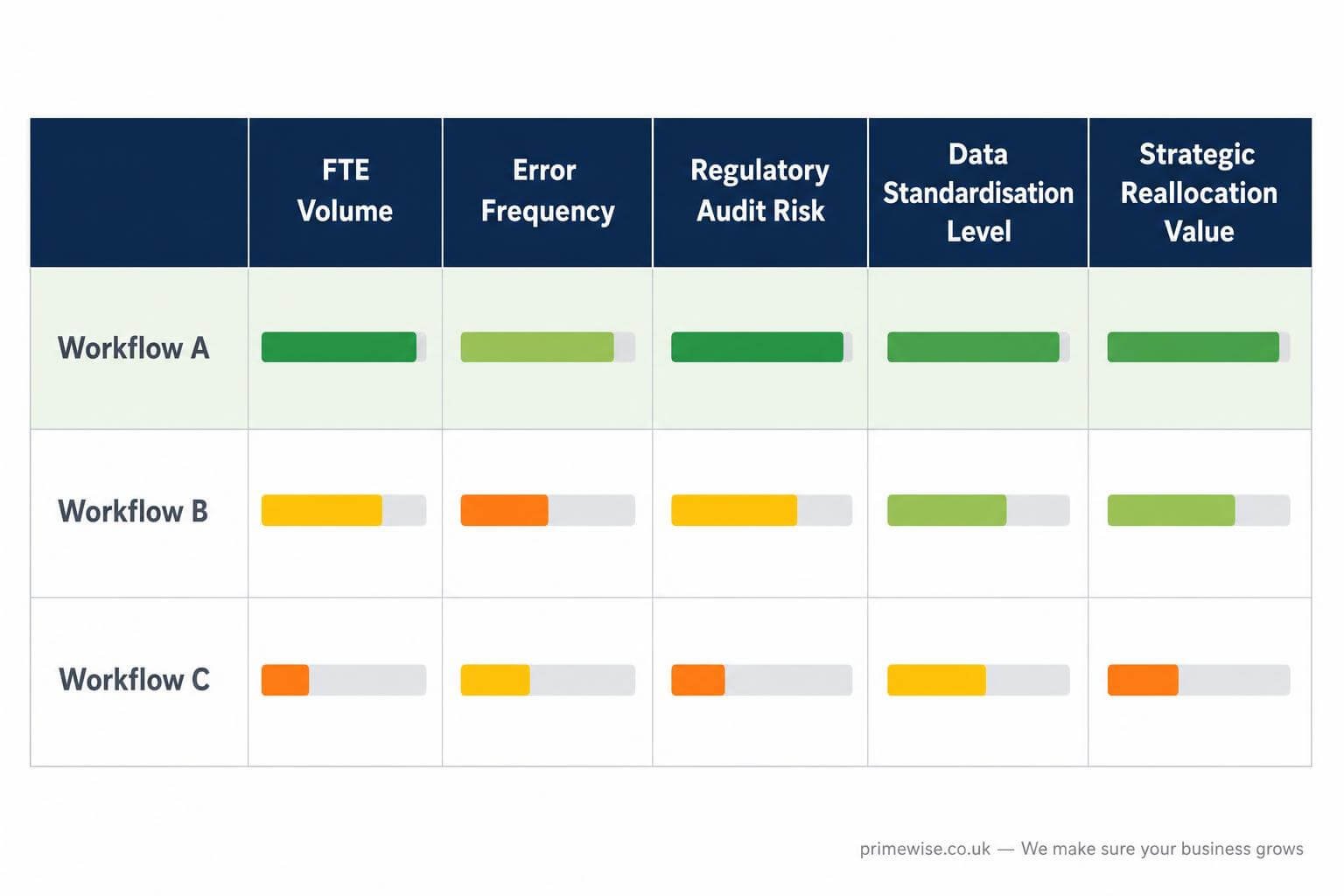
No executive team has the bandwidth to simultaneously evaluate every candidate workflow for automation viability. A disciplined prioritisation approach focuses analytical resources on the processes most likely to deliver defensible returns within acceptable risk parameters. The following five-dimension scorecard applied during the initial scoping phase rapidly qualifies which workflows merit full ROI modelling and which should be deprioritised or excluded entirely from the automation pipeline.
Process mining should precede any prioritisation decision. Tools such as Celonis, UiPath Process Mining, and IBM Process Mining generate objective task-level data that eliminates assumption-based workflow assessment. Without this empirical baseline, FTE displacement modelling produces estimates rather than calculations a distinction that sophisticated financial reviewers will identify and challenge immediately.
- FTE volume processes consuming the highest aggregate fully loaded FTE hours generate the largest potential labour reclaim
- Error frequency high defect rate processes produce the most significant error reduction valuation and risk mitigation benefit
- Regulatory audit risk workflows touching FCA-supervised outputs or personal data under GDPR carry compliance cost implications that inflate both the benefit and the governance TCO
- Data standardisation level highly structured, consistent data inputs are prerequisites for reliable algorithmic performance; unstructured or irregular data increases maintenance costs dramatically
- Strategic reallocation value processes where displaced specialist capacity can be credibly redirected to high-margin advisory or business development roles generate the highest opportunity yield
An automation business case template built on these five dimensions produces an immediately comparable portfolio view of all candidate workflows enabling leadership to rank investment priorities objectively rather than on the basis of departmental lobbying or technology enthusiasm.
Quantifying the Cost of Doing Nothing
Every automation business case must include a credible financial model of the alternative scenario maintaining current manual processes unchanged. This is not a rhetorical device; it is a financially rigorous comparison that transforms the investment conversation from optional improvement to competitive necessity.
The cost of doing nothing model calculates the long-term financial trajectory if current manual workflows remain unaltered across a three-year horizon. Inputs include projected labour cost inflation at UK wage growth rates, increasing error volumes as transaction scale grows, and the compounding efficiency gap created by competitor organisations that have already deployed AI-assisted workflows. ONS productivity data for the UK financial sector provides the macroeconomic context output per worker metrics that contextualise exactly why algorithmic process mining and FTE displacement modelling are strategic necessities rather than optional productivity experiments. When the cost of inaction exceeds the total cost of ownership for automation over the modelling period, the investment case becomes structurally unavoidable rather than merely attractive.
PRIMEWISE ADVISORYOrganisations requiring a bespoke defensibility model calibrated to UK FCA-regulated workflows can access PrimeWise's proprietary AI ROI assessment framework at primewise.co.uk. Pre-deployment TCO audits specifically structured for UK financial services firms navigating PS23/16 compliance are available on a confidential engagement basis.
Building the Final Boardroom-Ready Business Case
Assembling the four pillars into a single, integrated financial document requires a specific sequencing discipline. Begin with the opportunity statement the cost of doing nothing expressed in annual sterling figures. Follow with the explicit ROI formula populated with workflow-specific data. Present the TCO breakdown with each governance cost line explicitly named and legislatively referenced. Close with a sensitivity analysis that models returns under conservative, base, and optimistic assumptions for labour reclaim and error reduction. This structure mirrors the analytical framework that institutional investment committees use for capital allocation decisions, which is precisely the level of rigour required when securing approval from a board that includes non-executive directors with financial services backgrounds.
The automation business case template built on this four-pillar structure has one additional function beyond securing approval it creates the measurement baseline against which actual deployment performance is tracked quarterly. Without a documented pre-deployment baseline, post-implementation reviews have no objective reference point, making it impossible to identify model drift, governance cost overruns, or opportunity yield shortfalls before they compound into material financial problems. Building the measurement framework into the business case document from the outset is the distinguishing mark of a practitioner-grade ROI methodology versus a presentation-grade one. To request a confidential AI ROI stress-test for your specific workflow portfolio, visit primewise.co.uk.