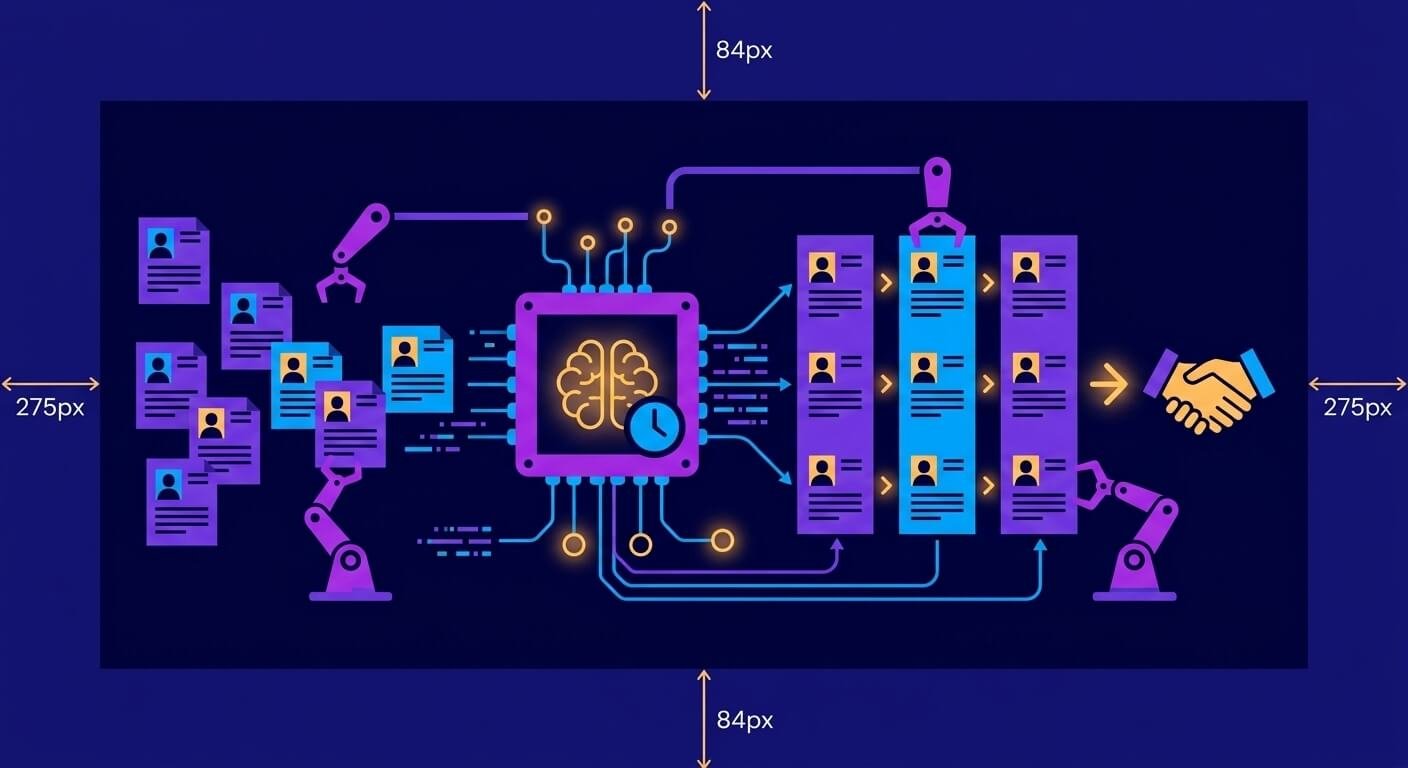

Finding the right AI automation agency UK-wide is one of the highest-stakes procurement decisions a business leader will make in 2026. The London market alone has tripled in vendor density since 2023, flooding Shoreditch, King’s Cross, and the wider tech corridor with opportunistic wrapper agencies masquerading as genuine machine learning engineering firms. Get this decision wrong and you face six months of stalled pilots, drained budgets, and a board that has lost confidence in AI entirely. Get it right and a compliant, revenue-generating system can be live within 90 days. This article gives you the exact framework to tell the difference including real pricing benchmarks, a rigorous vetting matrix, UK regulatory requirements, and a week-by-week pilot roadmap built specifically for the UK mid-market.
PrimeWise.co.uk operates as a specialist UK AI automation consultancy with a structured 90-day enterprise pilot framework built specifically to meet these exacting standards. The insights below reflect direct experience deploying AI systems inside UK financial services, professional services, and operational environments where regulatory failure is never an option.
What a Genuine UK AI Automation Agency Actually Does
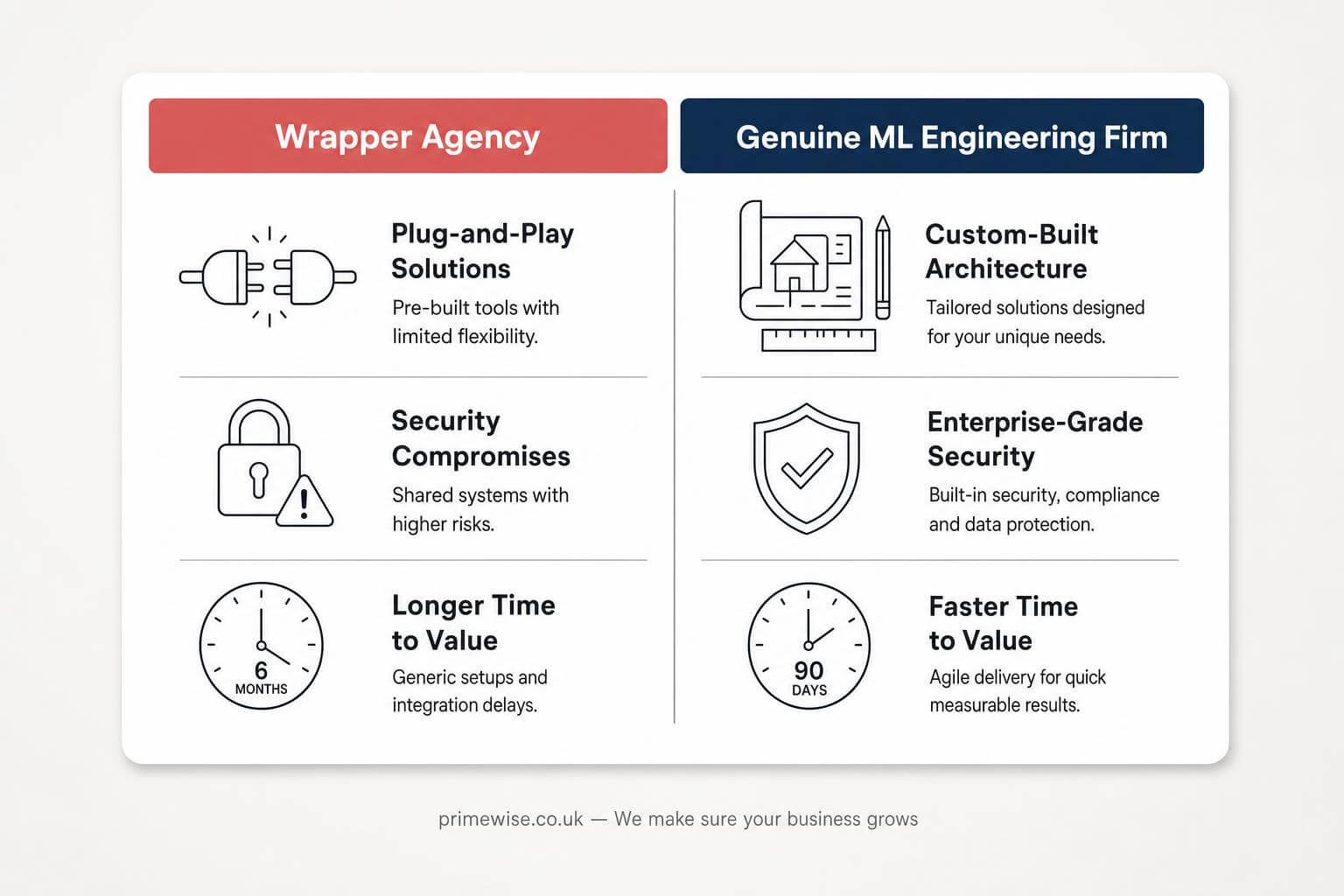
A genuine UK AI automation agency designs, engineers, and deploys bespoke artificial intelligence systems tailored to local compliance requirements, legacy infrastructure realities, and sector-specific operational bottlenecks. This is categorically different from configuring an off-the-shelf SaaS platform or wrapping a public API in a basic interface.
High-calibre agencies function as strategic technical partners. They bring backend engineering depth knowledge of RAG (Retrieval Augmented Generation) architecture, vector database implementation, fine-tuning versus prompt engineering trade-offs, and secure API integration alongside the commercial intelligence to align technical delivery with measurable business outcomes. If a vendor cannot clearly articulate the difference between fine-tuning a foundation model and building a retrieval-augmented pipeline, they are not an engineering agency. They are a reseller.
EXECUTIVE INSIGHTThe single most expensive mistake UK mid-market firms make is conflating AI consultancy with AI engineering. Strategy without execution capability costs you six months minimum. Demand proof of build, not proof of PowerPoint.
The London AI Vendor Landscape in 2026
London’s position as Europe’s leading technology hub creates a paradox for procurement teams. The concentration of talent is genuine the capital hosts world-class ML engineers from DeepMind alumni networks, leading UK universities, and international financial technology firms. But that same gravitational pull attracts a disproportionate number of undercapitalised startups and no-code operators who have learned to speak the right language without possessing the underlying capability to execute enterprise-grade deployments.
According to DSIT’s AI Sector Survey and corroborating data from Beauhurst’s UK Tech Tracker, the number of UK companies self-identifying as AI service providers grew by over 340 percent between 2021 and 2024. The vast majority of this growth represents software resellers, automation consultants working exclusively with Zapier or Make.com, and early-stage product companies pivoting into services. Genuine ML engineering firms those capable of building isolated secure environments, fine-tuning models on proprietary data, and integrating with legacy enterprise systems remain a small, identifiable subset of that market.
Why Shoreditch Saturation Matters for Your Procurement Process
The geographic clustering of vendors in London’s tech hubs creates a superficial impression of competition that can mislead even experienced procurement teams. When five agencies with similar websites and comparable case study language are shortlisted, the instinct is to treat them as equivalent and negotiate on price. This is a critical error. Technical capability variance between genuine ML engineering teams and sophisticated no-code operators is enormous and that variance will only become visible at the point of legacy system integration, which is precisely when it is most expensive to discover.
The London AI Vendor Vetting Matrix
The following framework distils the core evaluation criteria that separate technically credible agencies from plausible-sounding impostors. Apply this matrix during initial qualification calls before investing time in formal proposal processes.
| Evaluation Criteria | Red Flag Indicators | Green Flag Indicators | Verification Method |
|---|---|---|---|
| Engineering Architecture | References only named SaaS platforms; cannot explain model selection rationale | Discusses RAG, fine-tuning, vector DBs, and security architecture unprompted | Ask for a technical architecture overview from a previous project |
| Data Security Standards | Vague on data residency; no DPA ready; cannot confirm UK server locations | Holds or is pursuing ISO 27001; produces UK GDPR Article 28 DPA on request | Request their standard Data Processing Agreement before engagement |
| Regulatory Compliance Knowledge | Unaware of ICO generative AI guidance or FCA PS21/3 operational resilience | Proactively references sector-specific regulatory obligations | Ask directly: how do you ensure LLM outputs comply with FCA PS21/3? |
| Commercial Track Record | Under 2 years of filed Companies House accounts; no named enterprise clients | Minimum 2 years of accounts; verifiable case studies with quantified outcomes | Check Companies House filing history independently |
| Legacy Integration Capability | No experience with enterprise middleware, ERP, or core banking APIs | Demonstrates REST/GraphQL API integration with named enterprise systems | Request a technical discovery questionnaire and assess response quality |
Identifying Genuine Engineering Depth Beyond the Pitch
The evaluation criteria above provide a structural framework, but the most reliable signal of genuine engineering capability emerges in unscripted technical conversation. Ask an agency to walk you through how they would handle hallucination mitigation in a document processing workflow. Ask them to explain their approach to building isolated sandbox environments for testing against sensitive data. Ask what happens when an LLM output triggers a compliance flag what is the escalation architecture? Skilled machine learning engineers engage with these questions with energy and specificity. No-code operators deflect, generalise, or pivot to platform demonstrations.
- Demand detailed written explanations of their proprietary data orchestration methodology
- Verify their ability to build and maintain isolated sandbox environments compliant with your data classification policy
- Request architectural diagrams showing precisely how private enterprise data is handled, stored, and deleted
- Assess their internal standards for LLM hallucination detection and automated output validation
- Ask for a sample Data Processing Agreement compliant with UK GDPR Article 28 before any engagement begins
- Verify ISO 27001 certification or an equivalent accredited data security framework
- Confirm that all model inference and data processing occurs on UK-sovereign infrastructure
- Check Companies House registration and review a minimum of two years of filed accounts
DUE DILIGENCE CHECKPOINTRequest a technical architecture document from any shortlisted agency before entering commercial discussions. A genuine engineering team will produce this within 48 hours. A wrapper agency will send you a capabilities deck.
UK AI Regulatory Landscape in 2026
Regulatory compliance is not a secondary consideration in UK AI procurement it is a foundational requirement that determines whether a deployment is legally sustainable. The UK’s regulatory framework for AI in 2026 is multi-layered, sector-specific, and materially different from EU AI Act obligations, making it an area where overseas or generalist agencies consistently fail enterprise clients.
The ICO’s updated guidance on generative AI and data protection, published in alignment with the UK’s National AI Strategy, establishes clear obligations around transparency, purpose limitation, and data minimisation when deploying large language models in commercial contexts. Any agency that cannot articulate how their architecture satisfies these ICO requirements is operating outside acceptable governance standards. The UK AI Safety Institute, established at the Bletchley Park summit and now operating under DSIT oversight, provides red-teaming frameworks and evaluation benchmarks that leading agencies actively reference when assessing model safety in enterprise deployments.
Sector-Specific Compliance Requirements
Beyond the baseline ICO framework, sector regulators impose obligations that a competent agency must navigate proactively. For FCA-regulated investment firms, this means demonstrating alignment with PS21/3 operational resilience policy statements, ensuring all automated decision-making components have documented impact tolerances and recovery time objectives. For firms operating under PRA (Prudential Regulation Authority) supervision, model risk management frameworks must account for AI-generated outputs in stress testing and capital adequacy reporting contexts. For NHS trusts and healthcare organisations, the NHS Digital Data Security and Protection Toolkit provides the relevant compliance baseline, and any agency deploying AI in clinical or administrative pathways must demonstrate explicit familiarity with its requirements.
- FCA-regulated firms: confirm alignment with PS21/3 operational resilience and SUP 15.3 incident reporting obligations
- PRA-supervised banks and insurers: verify the agency understands model risk management under SS1/23 supervisory statement
- NHS and healthcare organisations: require demonstrated knowledge of the NHS DSPT and clinical safety standards DCB0129 and DCB0160
- Legal services firms: confirm awareness of SRA guidance on AI use in client-facing work and confidentiality obligations
- All sectors: verify that LLM inference does not occur on infrastructure that trains on your proprietary data by default
REGULATORY WARNINGOffshore and generalist agencies routinely overlook the distinction between UK GDPR and EU GDPR post-Brexit. They are materially different legal frameworks. An agency that conflates them has not done the work to operate safely in the UK enterprise market.
UK Market Pricing and Commercial Expectations
Transparent financial benchmarking is essential for maintaining executive alignment throughout an AI transformation programme. Artificially suppressed procurement budgets are one of the primary drivers of failed engagements not because cost-consciousness is wrong, but because below-market pricing in the London AI engineering market is almost always a reliable indicator of below-market capability.
The Robert Half UK Technology Salary Guide and Tech Nation Salary Benchmarks consistently show that senior data scientists and ML engineers in London command permanent salaries between £90,000 and £160,000 annually. When translated into consulting economics with overhead, expertise premium, and commercial margin, the resulting day rates are not negotiable to any significant degree. Budget expectations built around offshore rate cards will not secure the talent required for compliant, enterprise-grade UK deployments.
Realistic London Day Rates for AI Engineering Talent
Elite technical talent in the current London market operates within a well-documented rate band. Senior data scientists with enterprise deployment experience typically command between £700 and £1,200 per day. Machine learning engineers with specialisation in LLM fine-tuning, RAG architecture, or enterprise API integration command £800 to £1,500 per day. AI integration strategists and technical programme leads sit between £600 and £950 per day. These figures reflect the specialised mathematical, architectural, and regulatory expertise required for compliant enterprise deployments they are not inflated and should not be treated as opening positions in a negotiation.
Budgeting for Your Initial AI Pilot
A secure, custom-engineered proof of concept built by a reputable UK AI automation agency will require a capital commitment of between £15,000 and £50,000 for the initial engagement phase. The lower end of this range applies to narrowly scoped single-workflow automations with clean, accessible data and minimal legacy integration requirements. The upper end reflects deployments involving complex legacy system integration, sensitive regulated data, bespoke model fine-tuning, and sector-specific compliance architecture. Chief Financial Officers who receive proposals materially below £15,000 for enterprise AI pilots should treat this as a strong signal that the vendor has either underestimated the technical scope or intends to monetise through post-pilot change requests.
The 90-Day AI Pilot Deployment Roadmap
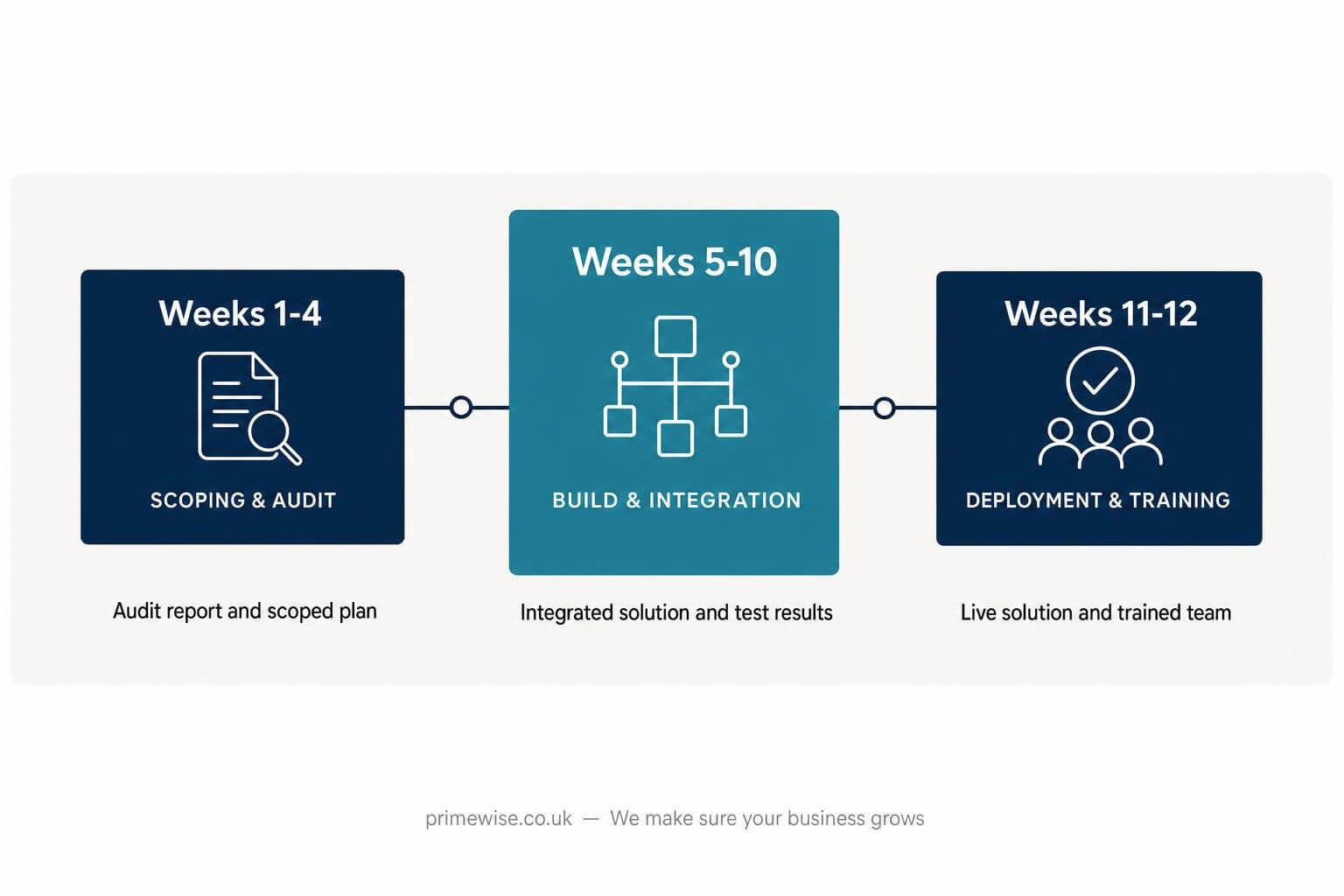
The most visible differentiator between a technically credible UK AI agency and a disorganised vendor is the rigour of their delivery framework. A disciplined 90-day roadmap is not an arbitrary marketing claim it is a direct consequence of having the engineering depth, project governance standards, and regulatory knowledge to execute without avoidable delays. The six-month deployment failure pattern that plagues UK mid-market AI projects is almost always traceable to poor scoping, inadequate data readiness assessment, and regulatory non-compliance discovered mid-build.
Weeks 1 to 4 Scoping, Security Audits, and Data Readiness
The foundational phase establishes the conditions for successful delivery and must be completed before any architecture or code is produced. During weeks one and two, the agency conducts executive discovery workshops to map operational bottlenecks, identify automation opportunity prioritisation, and establish the commercial success metrics against which the pilot will be evaluated. Weeks three and four focus entirely on legacy data audit, infrastructure assessment, and security perimeter design including data classification, residency confirmation, DPA execution, and regulatory compliance mapping against the relevant sector framework. Any agency that skips this phase or compresses it below two weeks is creating debt that will surface as delays at the build stage.
Weeks 5 to 10 Architecture Build and API Integration
The core engineering phase begins only once the foundational scoping and security work is fully complete. During this period, the agency builds the bespoke LLM architecture whether RAG-based retrieval, fine-tuned model deployment, or hybrid pipeline within isolated sandbox environments that replicate the production security parameters exactly. Backend API integrations with existing enterprise systems are developed, tested, and documented during this phase, with closed-loop validation cycles ensuring that automated outputs are accurate, hallucination-resistant, and compliant with sector-specific decision-making standards. Bi-weekly progress reviews with named technical leads are a standard governance requirement, not an optional add-on.
Weeks 11 to 12 Deployment, Testing, and Stakeholder Training
The final phase operationalises the system and ensures the enterprise workforce can adopt it without friction. Production deployment is preceded by formal security testing, penetration testing where required by sector regulation, and sign-off from the client’s data protection officer or compliance lead. Stakeholder training is conducted in person for complex financial and operational workflows this is one of the most significant practical advantages of engaging a London-based partner over a nearshore or offshore alternative. The local presence enables real-time iteration, hands-on workshop delivery, and the kind of contextual problem-solving that cannot be replicated in asynchronous remote handovers.
UK AI Automation Use Cases by Sector
Understanding where AI automation delivers measurable ROI in the UK market accelerates the scoping process and sharpens the business case for board-level approval. The following sector applications represent the highest-traction deployment categories based on current UK enterprise engagement patterns.
In financial services, the leading use cases are KYC and AML document processing automation, trade surveillance alert triage, regulatory report generation, and client communication workflow acceleration. For investment management firms operating under FCA oversight, automated compliance monitoring tools that flag policy breaches before they reach the regulator represent a particularly high-value application. In legal services, contract review automation, due diligence acceleration, and matter summary generation are driving significant efficiency gains at Magic Circle and regional law firms alike. For NHS trusts and healthcare commissioners, clinical pathway optimisation, referral letter processing, and administrative workflow automation represent high-volume, high-impact opportunities where the AI safety and data governance frameworks are well-established. In professional services and consulting, automated client reporting, proposal generation assistance, and internal knowledge retrieval systems built on proprietary document archives are consistently delivering measurable FTE cost savings within the first quarter of deployment.
City of London Financial Services Case Study
A prominent London-based wealth management firm managing assets in excess of £2 billion engaged a nearshore AI vendor in early 2024 on a projected six-month engagement to automate their compliance document processing workflow. Eight weeks into the project, an internal audit revealed that the vendor’s cloud architecture was routing client data through servers outside UK jurisdiction, breaching both the firm’s internal data sovereignty policy and its FCA-supervised operational resilience framework. The engagement was terminated immediately at a sunk cost of approximately £68,000.
The firm subsequently engaged a specialist London-based AI consultancy with explicit FCA compliance architecture experience. Within eight weeks less time than the failed engagement had consumed before discovery the new partner delivered a fully compliant, bespoke document processing model built on UK-sovereign infrastructure, integrating directly with the firm’s existing document management system via a secure API layer. The result was a 73 percent reduction in manual compliance auditing hours, an estimated annual FTE saving of £310,000, and a deployment that passed the firm’s internal data protection officer review without a single remediation requirement. The critical difference was not budget the second engagement cost marginally more but technical depth, regulatory knowledge, and the governance discipline to identify compliance risk at scoping rather than at deployment.
KEY OUTCOME73% reduction in manual compliance auditing hours. £310,000 estimated annual FTE saving. Delivered in 8 weeks on UK-sovereign infrastructure after a failed 6-month nearshore engagement. The difference was engineering depth and regulatory knowledge, not budget.
Why Enterprises Choose PrimeWise as Their UK AI Partner
PrimeWise.co.uk delivers bespoke AI automation for UK enterprises operating in regulated industries where engineering precision and compliance credibility are non-negotiable. The firm’s 90-day pilot framework is built around the exact scoping, security, and deployment standards outlined in this article not as aspirational positioning, but as a contractual delivery commitment backed by named technical leads and sector-specific regulatory expertise.
PrimeWise’s technical differentiators include guaranteed UK data residency on all pilot and production deployments, FCA-compliant operational resilience architecture as a default rather than an optional add-on, and a named data protection officer review process integrated into every client engagement. For enterprises seeking a structured initial conversation, PrimeWise offers a complimentary due diligence briefing conducted under NDA to benchmark your current vendor shortlist against these technical and regulatory standards. For financial services firms specifically, a structured 90-day deployment pathway scoping session is available upon request, designed to align the technical scope with your existing FCA obligations before a single line of code is written.