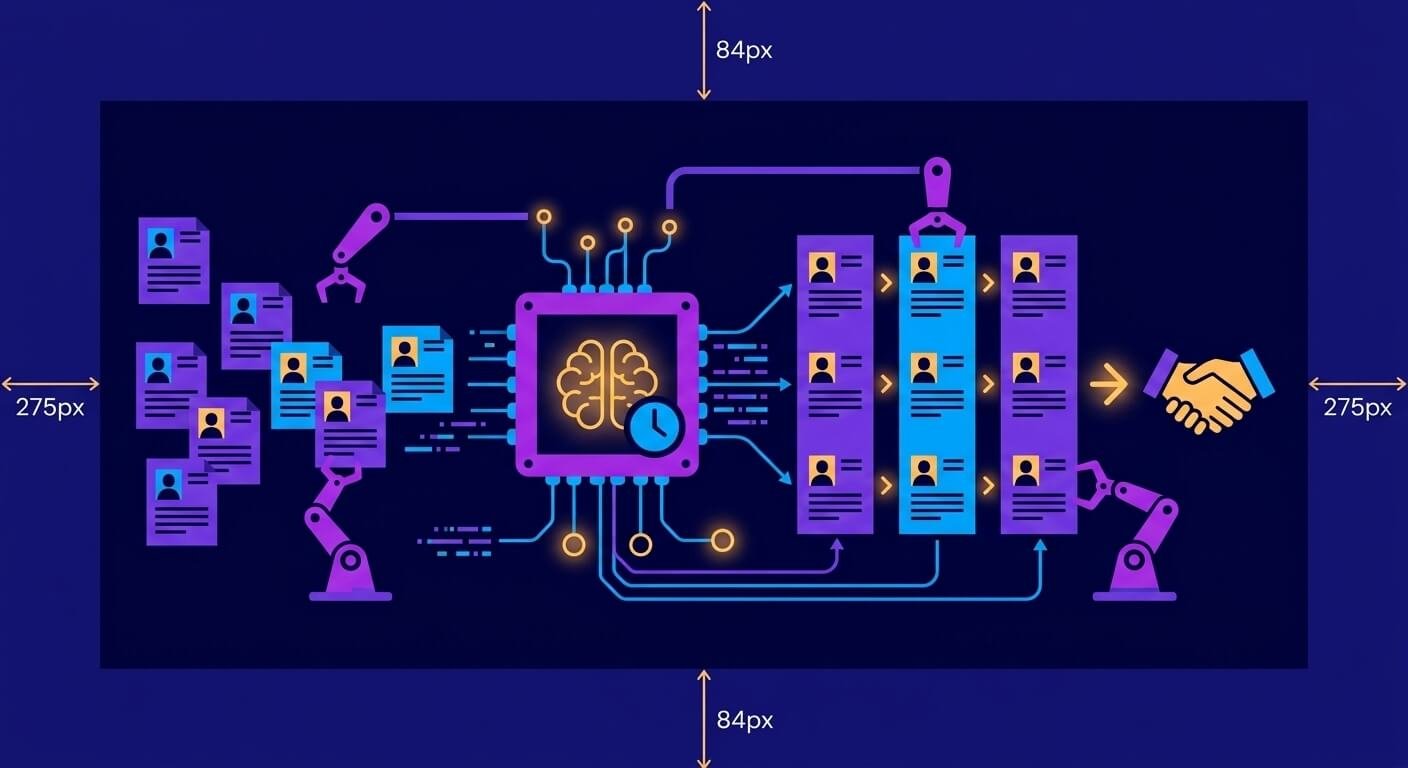

The debate around ai agents vs chatbots is no longer theoretical it is directly determining where UK financial services firms win or lose their technology budgets in 2026. A Bank of England survey found that 72% of UK financial institutions had deployed or piloted conversational AI, yet only 14% reported measurable middle-office efficiency gains. That gap exists because most firms deployed the wrong tool. If your organisation is evaluating custom AI agent integration for the first time, the decision you make at the architectural level will either unlock genuine workflow automation or lock you into an expensive FAQ engine dressed up as transformation.
EXECUTIVE SUMMARYStandard chatbots deflect 30–40% of Tier-1 retail enquiries but cannot execute tasks. Scoped AI agents with tool-calling capability reduce end-to-end middle-office processing cycles by up to 60%. Deploying the wrong tier wastes capital, stalls compliance teams, and creates operational bottlenecks that human staff then inherit. Primewise advises UK financial institutions on selecting, scoping, and deploying the correct tier of AI automation. Explore our technology advisory framework at primewise.co.uk.
Defining the Architectural Divide
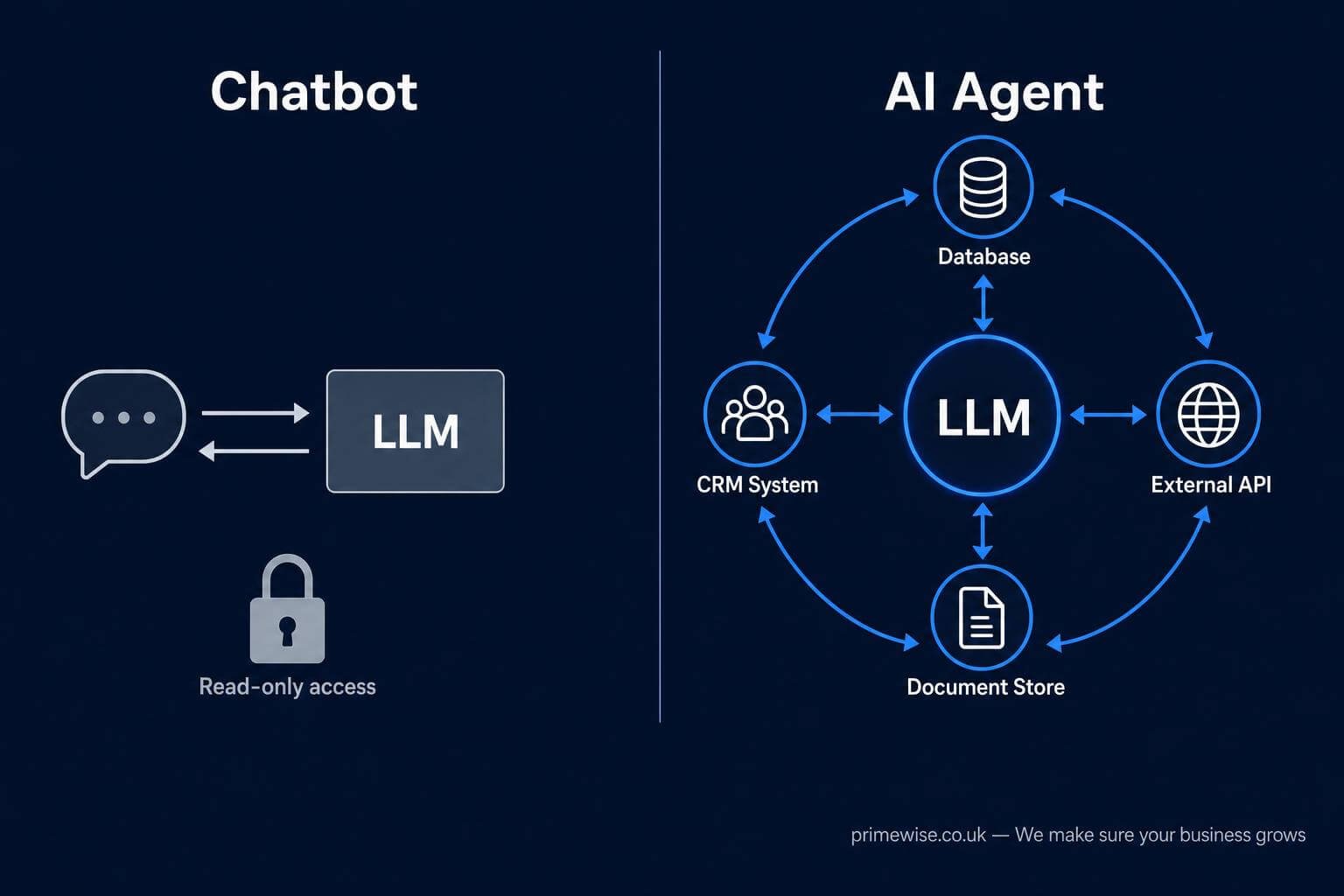
The marketplace conflates conversational interfaces with autonomous systems at an alarming rate. Before approving any technology spend, procurement leaders must understand what separates these two fundamentally different architectures. A chatbot is a reactive, stateless conversational interface that answers questions using pre-defined data. An AI agent is a proactive, stateful system equipped with tool-calling capabilities, enabling it to execute multi-step workflows, read and write live data, and make autonomous decisions within defined boundaries.
| Dimension | Conversational Chatbot | Scoped AI Agent |
|---|---|---|
| Memory Architecture | Stateless no persistent context between sessions | Stateful retains context and workflow state across steps |
| Tool-Calling Capability | None read-only retrieval from vector database | Full interfaces with CRM, core banking, sanction databases |
| Execution Capability | Retrieves and presents static information only | Executes sequential logic, writes data back to systems |
| FCA Audit Complexity | Low simple transcript logging | Higher requires immutable tool-call and decision audit trail |
| Ideal UK Use Case | Retail FAQ triage, branch locator, password reset | KYC extraction, commercial loan qualification, HITL document processing |
| Relevant Frameworks | Retrieval-Augmented Generation (RAG) | ReAct agent framework, LangChain, AutoGen, multi-agent orchestration |
| CRM Integration Examples | Salesforce Financial Services Cloud (read-only) | Temenos T24, Salesforce Financial Services Cloud (read-write) |
The Reactive Nature of Conversational Chatbots
Modern chatbots are fundamentally stateless LLM wrappers application programming interface layers built atop Large Language Models that operate strictly in a read-only capacity. They require a human prompt to generate a response, parse natural language effectively, and retrieve static information from a vector database using retrieval-augmented generation (RAG). This makes them highly effective as advanced FAQ engines for high-volume, low-complexity interactions. Because they carry no independent agency, however, they cannot update customer records, trigger downstream workflows, integrate with systems like Salesforce Financial Services Cloud in a write capacity, or adapt to edge cases outside their predefined conversational tree without triggering an immediate human handoff. In a busy retail banking environment, that limitation is acceptable. In a commercial lending operation, it is commercially catastrophic.
The Proactive Power of Scoped AI Agents
Unlike reactive wrappers, AI agents are engineered with genuine agency and persistent stateful memory. These systems use tool-calling architecture the defining capability that separates agentic AI architecture from conversational AI allowing them to interface directly with core banking infrastructure, CRM platforms such as Temenos T24, and external data sources such as sanction screening APIs. An agent built on frameworks like LangChain or AutoGen can ingest an unstructured document, query an internal database to verify entity data, logically determine the next required action in a multi-step sequence, and write the result back into the system of record. This is not a chatbot with better prompting. This is a digital worker executing sustained workflow automation under defined operational constraints. The distinction between stateless and stateful AI systems is the single most important architectural concept a financial services technology leader must internalise before committing capital.
The Commercial Reality for UK Financial Operators
Translating architectural differences into commercial outcomes is where the ai agents vs chatbots debate becomes a capital allocation decision. The London financial services environment carries some of the highest middle-office human capital costs in the world. The financial case for automation is clear but only when the correct tool is matched to the correct problem.
Deflection Metrics Versus True Workflow Automation
Industry performance data reveals a stark contrast between the two paradigms. Standard chatbot deployments in retail banking environments consistently report deflection rates of 30 to 40 percent for basic customer queries a genuine but modest operational saving. True workflow automation via human-in-the-loop (HITL) agent deployments targets a fundamentally different metric: end-to-end cycle time. In enterprise environments, appropriately scoped agents handling middle-office tasks such as generative AI middle office banking processes have demonstrated processing time reductions of up to 60 percent, altering the operational economics of the firm rather than simply deflecting volume. These are not equivalent wins. One reduces inbound noise. The other eliminates structural operational overhead.
Capital Allocation and the Over-Engineering Trap
Procurement teams must guard against two symmetrical failures. Deploying a complex, tool-calling agent to handle basic branch opening hours enquiries is a severe misallocation of capital incurring unnecessary engineering, integration, and maintenance overhead for a task a £12-per-month chatbot subscription handles adequately. Conversely, deploying a stateless chatbot to support a commercial lending triage team will yield negligible return on investment: the system will fail immediately when required to process nuanced multi-step document verification, and the human workforce will inherit the exact bottleneck the technology was procured to eliminate. Autonomous workflow automation in the UK financial sector demands architectural specificity, not vendor generalism.
CAPITAL ALLOCATION WARNINGDeploying an AI agent where a chatbot suffices wastes engineering budget. Deploying a chatbot where an agent is required creates compliance risk and operational failure. The correct tool is determined by task complexity and data write requirements not vendor marketing language.
A Real-World Deployment Scenario
To move beyond theory, consider this composite deployment drawn from the operational profile of a mid-size UK asset manager with £2.4 billion in assets under management and a 45-person operations team.
The firm’s KYC onboarding process was averaging 4.2 business days per client. The bottleneck was not a lack of staff effort it was the sequential, manual nature of document ingestion, entity extraction, sanctions screening via LexisNexis Bridger Insight, and risk-tier assignment. Each step required a human analyst to complete one task before passing to the next, with no system-level orchestration binding the workflow together.
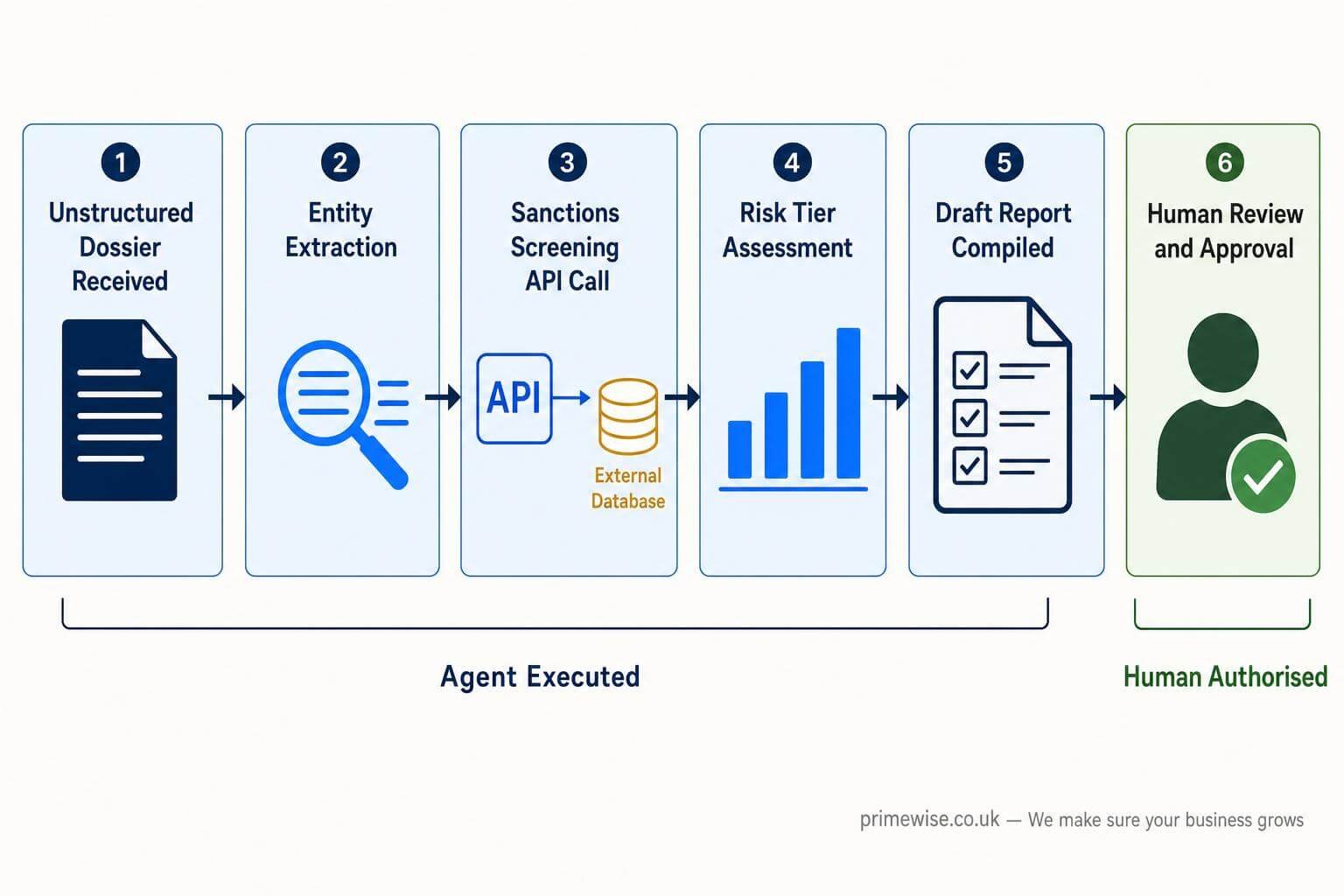
A scoped AI agent was deployed using a ReAct agent framework with tool-calling integrations into the firm’s internal CRM and the LexisNexis Bridger Insight API. The agent was configured in a strict human-in-the-loop configuration: it could ingest, extract, cross-reference, and draft a structured risk assessment autonomously, but a qualified compliance analyst was required to review and approve the output before any record was finalised. The agent operated without write access to final client records until human sign-off was confirmed.
The outcome: average KYC processing time fell from 4.2 days to 11 hours. Cost per onboarding case reduced by 63%. Over an 18-month operational period, the firm recorded zero FCA breach incidents attributable to the automated workflow. The critical lesson was not the technology itself it was the human-in-the-loop configuration for edge cases that exceeded the agent’s confidence thresholds, which prevented the automation from becoming a compliance liability.
ADVISORY NOTEPrimewise designs and deploys scoped AI agents for UK financial services operators using human-in-the-loop frameworks aligned to FCA Consumer Duty requirements. Our advisory process begins with your regulatory environment and operational matrix. Request a scoped consultation at primewise.co.uk.
Actionable Use Cases in UK Financial Services
Categorising internal processes by complexity and data sensitivity ensures that technology procurement aligns directly with the operational matrix of the business. The ai agents vs chatbots decision is not a universal judgement it is a task-by-task assessment.
Retail Banking Applications for Chatbots
For high-volume, low-complexity interactions, stateless conversational interfaces remain highly appropriate and cost-effective. In retail banking, chatbots are the correct tool for Tier-1 triage: answering standard queries regarding account fees, locating nearby ATMs, guiding users through password reset protocols, and surfacing product information from a vector database. Because these tasks do not require the system to execute complex logic, interact with live records, or alter sensitive data autonomously, the lower build cost and simplified maintenance of a chatbot-as-FAQ-engine provides an optimal return on investment. Attempting to deploy a multi-agent orchestration system for these tasks is architectural overkill with no commercial justification.
The Agentic Advantage in KYC and Commercial Lending
In highly regulated, complex environments particularly those involving LLM tool-calling in financial services the agentic advantage becomes decisive. KYC document extraction and commercial loan lead qualification are canonical examples. An autonomous agent can receive an unstructured corporate onboarding dossier, use named entity recognition to extract relevant financial entities, cross-reference those entities against global sanction databases via external API calls, evaluate the result against internal risk-tier thresholds, and compile a structured assessment for human review all within a single orchestrated workflow. This is AI in RegTech UK operating at its appropriate deployment tier: not replacing compliance judgement, but eliminating the mechanical steps that previously consumed analyst hours. The difference between AI agent vs RPA (robotic process automation) is also worth noting here: RPA executes rigid, rule-based scripts, while an AI agent handles unstructured inputs and adapts its reasoning pathway dynamically. For document processing involving variable formats, agents outperform RPA decisively.
Navigating UK Regulatory Constraints
Deploying advanced computational systems within the British financial sector requires strict adherence to a layered regulatory framework. Operators cannot pursue automation efficiency at the expense of data sovereignty or consumer protection. AI agent compliance framework in the UK is not optional architecture it is a deployment prerequisite.
FCA Consumer Duty and Decision Auditability
The Financial Conduct Authority’s Consumer Duty framework, implemented under PS24/1 and its subsequent implementation review, mandates fair customer treatment and entirely transparent decision-making processes across all customer-affecting workflows. The PRA’s CP26/23 model risk management principles additionally require that AI systems used in credit or risk decision pathways are subject to rigorous model governance. The UK AI Safety Institute’s guidance on autonomous system oversight, published in Q1 2025, further reinforces the requirement for human oversight checkpoints in high-stakes automated workflows. Unlike opaque algorithmic black boxes, properly engineered AI agents are built with explicit observability: every tool-call, database query, and logical deduction is logged into an immutable audit trail. This ensures that any automated triage or lead qualification can be reviewed by compliance teams to confirm that no algorithmic bias has unfairly disadvantaged a retail or commercial client. For a detailed regulatory framework, operators should reference fca.org.uk and the Bank of England’s AI guidance directly.
UK GDPR Data Sovereignty and API Risk
Transmitting personally identifiable financial data to global, third-party LLM API endpoints introduces severe compliance exposure under the ICO’s updated UK GDPR binding guidance on automated decision-making under Article 22. Sending client PII to a US-hosted foundation model API without explicit data processing agreements, data residency controls, and purpose limitation documentation is not a permissible architecture for regulated UK firms. The solution is localised data processing: private cloud infrastructure, on-premise model deployments, or UK-sovereign cloud arrangements with providers holding the appropriate data processing agreements. Strict data sanitisation protocols stripping or pseudonymising PII before any external API interaction must be embedded at the agent’s tool-call boundary layer. Firms that deploy agents without addressing these controls are not optimising their operations; they are creating regulatory liability.
The Autonomy vs Risk Control Decision Matrix
Technology leaders need a structured, repeatable framework to evaluate which system is appropriate for each internal process. The following binary decision matrix is designed specifically for UK financial services operators navigating the ai agents vs chatbots assessment.
Begin by mapping the targeted internal workflow against two primary axes. First, does the task require the system to write data to any internal or external system, or does it only retrieve and display static information? If the answer is retrieval only, the task is a prime candidate for a stateless chatbot. If the task requires writing, updating, or triggering downstream actions, an AI agent is the correct architecture. Second, overlay data sensitivity: does the process involve PII, financial records, or regulated credit data? High sensitivity combined with write requirements mandates a human-in-the-loop agent configuration the agent executes the mechanical steps autonomously, but a qualified human authorises the final output before it is committed to the system of record. Low sensitivity combined with retrieval-only requirements is the chatbot domain.
- Retrieval only, low sensitivity: deploy a stateless conversational chatbot
- Retrieval only, high sensitivity: deploy a chatbot with escalation routing to human agents
- Write capability required, low sensitivity: deploy a scoped agent with logging
- Write capability required, high sensitivity: deploy a human-in-the-loop agent with immutable audit trail
- Multi-step unstructured data processing: deploy a scoped agentic AI architecture not RPA, not a chatbot
- Real-time regulated decision: always deploy human-in-the-loop no fully autonomous execution
This framework eliminates the vendor hype variable from the procurement conversation. The assessment is binary, task-specific, and directly traceable to FCA Consumer Duty and UK GDPR compliance requirements. Applying it consistently across your internal process inventory will produce a prioritised automation roadmap grounded in architectural reality rather than technology marketing.
NOT SURE WHICH TIER YOUR BUSINESS NEEDSPrimewise provides a structured 90-minute technology scoping session for UK financial services operators. We map your internal workflows against our Autonomy vs Risk Control Matrix and deliver a clear deployment recommendation aligned to your FCA obligations. Book directly at primewise.co.uk.
Author
This article was written by the Primewise advisory team AI agent implementation specialists with hands-on experience building scoped, monitored business agents for lead qualification, document processing, and customer support triage in FCA-regulated environments. Primewise works exclusively with UK financial services operators, advising on agentic AI architecture, tool-calling integration design, and human-in-the-loop compliance frameworks. Our consultants have supported deployments across retail banking, commercial lending, and asset management operations teams. For independent regulatory reference, all guidance is cross-referenced against current FCA, PRA, and ICO published frameworks.