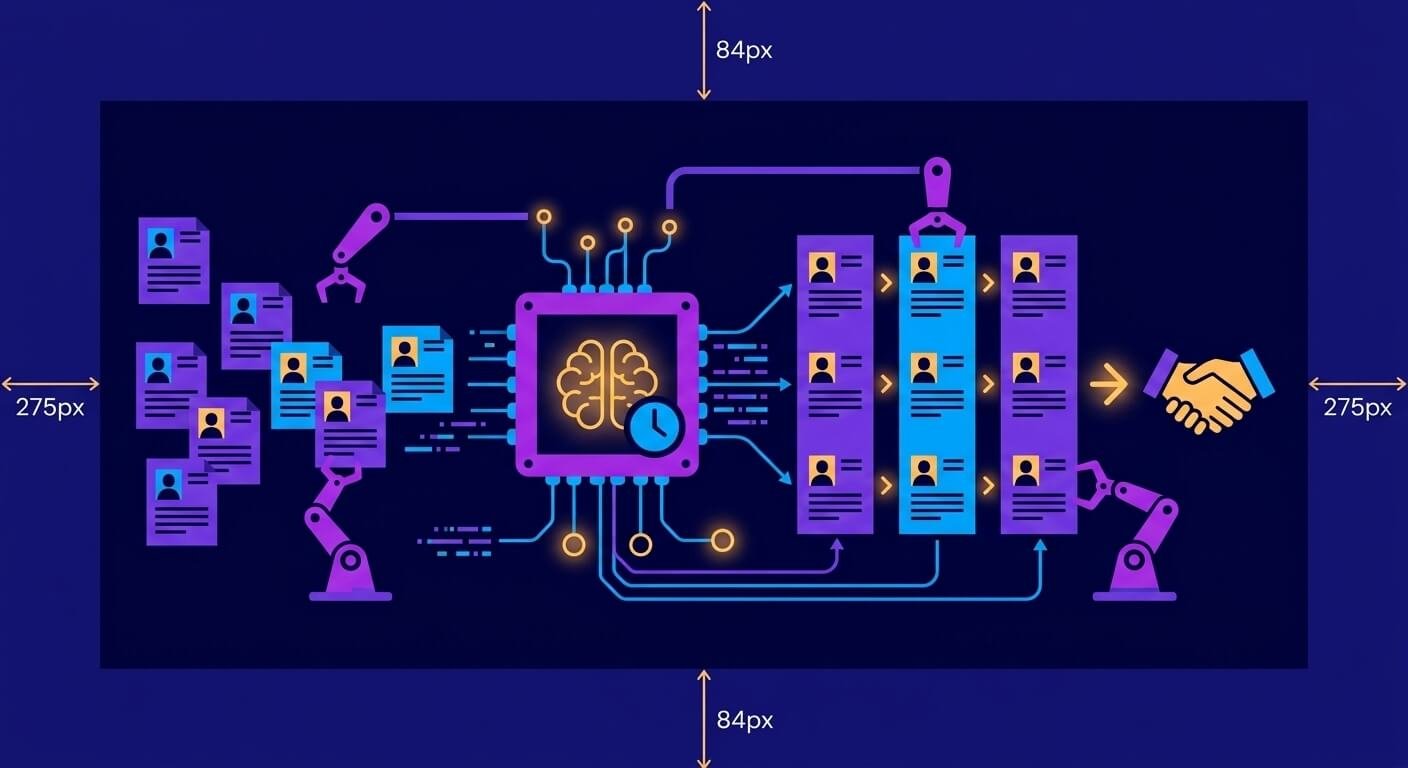

AI integration for business systems and specifically ai integration with xero quickbooks has moved from a forward-looking experiment to an operational necessity for UK finance teams in 2026. Finance directors and controllers managing growing transaction volumes, post-Brexit VAT complexity, and the escalating demands of HMRC’s Making Tax Digital programme are finding that manual workflows are simply incompatible with the pace of modern business. This guide delivers a definitive, implementation-ready framework: the specific tools, the compliance checkpoints, the risk mitigation protocols, and the business case structure you need to deploy AI-enabled accounting confidently and correctly. According to Xero’s State of Small Business UK report, businesses using automated reconciliation and bank feed intelligence save between five and ten hours per week on routine bookkeeping hours that skilled finance professionals can redirect toward analysis and strategic advisory work.
Understanding AI in UK Accounting Software
Before deploying any tool, finance leaders must understand precisely what they are buying. The term artificial intelligence is applied loosely across the accounting software market, and conflating rules-based automation with genuine machine learning or with emerging generative AI leads to poorly scoped deployments and unmet expectations.
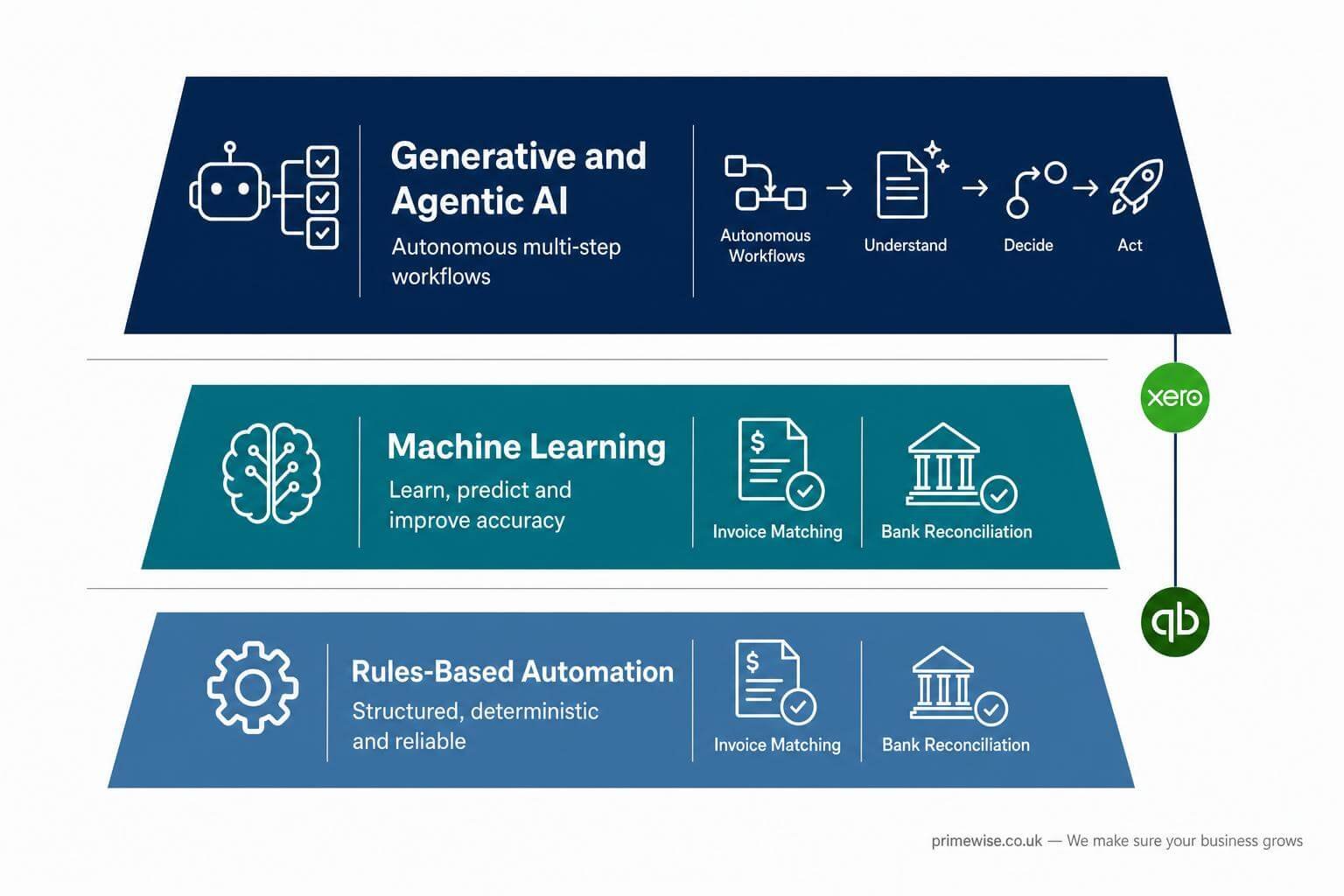
AI integration with Xero and QuickBooks involves connecting intelligent automation tools via secure APIs to replace manual accounting workflows including bank reconciliation, supplier invoice capture, and expense categorisation while maintaining strict data synchronisation, general ledger accuracy, and unbroken digital links for HMRC compliance. There are three distinct layers of intelligence operating across the current UK accounting ecosystem, and understanding each one is essential before committing budget.
Rules-Based Automation Versus Machine Learning
Rules-based automation executes predefined conditional logic for example, automatically categorising every invoice from a specific supplier code into the same nominal ledger account. It is fast, predictable, and transparent. However, it breaks the moment it encounters an unfamiliar data pattern and requires manual rule maintenance as supplier relationships and cost structures evolve. Most entry-level automation within Xero and QuickBooks Online operates at this layer.
Machine learning models, by contrast, learn from historical ledger patterns to make probabilistic predictions about new transactions. Xero’s bank feed auto-categorisation and QuickBooks’ transaction matching engine both incorporate supervised ML at varying levels of sophistication. These models improve over time as the system ingests more confirmed transaction data, which is why early deployment accuracy is typically lower than performance after three to six months of active use.
Generative AI and Agentic Finance Workflows
The most significant development entering the UK accounting market in 2025 and 2026 is generative AI and what practitioners are calling agentic AI systems capable of executing multi-step, autonomous actions within accounting platforms without requiring step-by-step human instruction. Intuit has integrated its native Intuit Assist AI assistant directly into QuickBooks, enabling natural language queries against financial data, automated anomaly detection, and draft narrative explanations of variances. Xero has accelerated its own AI feature roadmap, incorporating predictive cash flow signals and intelligent payment prompts. These native capabilities represent genuine generative AI layered on top of the existing ML infrastructure, and they are already live in UK-facing product builds. Understanding this distinction rules automation, ML categorisation, and generative or agentic AI allows finance directors to construct a technology stack that is appropriately sophisticated for their transaction complexity without over-engineering for marginal gains.
Native Platform Features Versus Third-Party AI Tools
A critical architectural decision for every UK finance team is determining which workflows to service through native platform intelligence and which to route through specialist third-party applications. Getting this balance wrong is expensive either through paying for redundant capabilities or through deploying tools that cannot communicate cleanly with one another, fracturing the digital links that HMRC requires under Making Tax Digital.
Native machine learning within Xero and QuickBooks handles standard auto-categorisation, basic invoice scanning, and payment matching reasonably well for low-to-medium transaction volumes. These out-of-the-box capabilities suit businesses with straightforward supplier relationships and single-currency operations. The moment an SME scales to multi-entity consolidations, post-Brexit cross-border VAT, or high-volume accounts payable automation across dozens of supplier relationships, native tools reach their functional ceiling.
Third-party specialist applications connect to both platforms via the Xero App Store and the QuickBooks app ecosystem, extending capability through purpose-built AI engines. These tools deploy advanced optical character recognition, proprietary document understanding models, and dedicated compliance logic that native platforms are structurally unable to replicate at the same depth. The following section profiles the leading tools currently serving the UK market with proven integration records across both platforms.
Leading AI Tools for UK Xero and QuickBooks Users
Selecting the right application layer is the difference between a productive automation programme and an expensive integration project that consumes more resource than it saves. Each tool described below has been assessed for its specific AI capability, its compatibility with both Xero and QuickBooks Online, and its relevance to distinctly UK compliance requirements including MTD digital links, post-Brexit VAT handling, and UK GDPR data sovereignty.
Dext (formerly Receipt Bank) is the market-leading intelligent document processing platform for UK SMEs and has the deepest presence in the Xero partner channel. Its AI engine automatically extracts line-item data from supplier invoices, receipts, and bank statements using a combination of OCR and a trained document understanding model that has been refined on millions of UK-format documents. Critically for MTD compliance, Dext maintains an unbroken digital link from document capture through to ledger posting, meaning extracted data is never routed through a spreadsheet or manual export stage. The platform supports both Xero and QuickBooks Online integrations with real-time sync and is UK GDPR compliant with server infrastructure operating within the UK and EU.
Syft Analytics is an AI-driven financial reporting and consolidation platform with deep Xero integration that is gaining significant traction among UK finance directors managing multi-entity structures. Its machine learning layer identifies anomalies in reporting data, flags variance drivers automatically, and generates board-ready narrative commentary from raw financial data reducing the time from ledger close to executive pack from days to hours. For finance teams supporting FRS 102 compliance under UK GAAP, Syft provides structured reporting templates that align AI-generated narratives with the disclosure requirements of the standard.
Fathom is a forecasting and performance management application that integrates with both Xero and QuickBooks Online, deploying predictive modelling to generate rolling cash flow forecasts, KPI dashboards, and scenario planning tools from live ledger data. UK finance directors use Fathom specifically to translate AI-enabled real-time financial reporting into board-level strategic intelligence, moving the finance function from historical record-keeping to forward-looking advisory positioning.
AutoEntry, now part of the Sage ecosystem but retaining independent integrations with Xero and QuickBooks, provides OCR-driven data extraction from invoices, bank statements, and expenses. Its strength lies in handling the diverse range of UK supplier invoice formats including those from international suppliers operating under post-Brexit customs documentation requirements with high-accuracy extraction and automated VAT identification logic.
Chaser and Satago both bring AI-powered accounts receivable automation to the Xero and QuickBooks ecosystems. Chaser uses predictive behavioural scoring to determine optimal chasing sequences for overdue invoices, while Satago incorporates AI credit risk assessment directly within the accounts receivable workflow. For UK SMEs managing late payment risk a persistent challenge in the British business environment these tools create a measurable reduction in debtor days without increasing administrative headcount.
Airwallex and Wise Business address the multi-currency reconciliation challenge that is particularly acute for UK businesses operating across European and global supply chains following Brexit. Both platforms integrate with Xero and QuickBooks to provide AI-assisted matching of foreign currency transactions against ledger entries, automatically applying the correct exchange rate methodology and flagging unrealised gain and loss positions for review.
TOOL SELECTION INSIGHTNo single third-party AI application covers every workflow. The optimal UK finance stack typically combines one intelligent document capture tool (such as Dext or AutoEntry), one reporting and forecasting layer (Fathom or Syft), and one receivables management tool (Chaser or Satago) all connected to the core Xero or QuickBooks ledger via certified API integrations that preserve MTD digital links.
Mapping Touchless Workflows Across Your Finance Function
Identifying which manual workflows to automate first is a strategic decision, not a technical one. The highest-value targets are those that consume the most skilled staff time, carry the highest error risk, or create the most significant bottlenecks in the month-end close cycle. The following workflow maps illustrate how AI transforms three high-impact processes.
Automated Bank Reconciliation via Open Banking
Manual bank reconciliation is typically the single largest time drain in a UK SME finance function. The UK’s Open Banking framework built on PSD2-derived regulation and administered by the Open Banking Implementation Entity mandates that UK banks provide secure, standardised API feeds to authorised third parties. Both Xero and QuickBooks exploit these feeds to ingest real-time transaction data directly into the ledger environment, eliminating the manual bank statement import process entirely. AI matching engines then process BACS, CHAPS, and Faster Payments transactions against outstanding invoices and purchase orders, applying learned matching logic that accounts for partial payments, bulk transfers, and timing differences between invoice date and settlement date. For multi-currency operations, intelligent reconciliation applies the correct exchange rate from a live feed and flags residual currency exposure for human review. According to industry benchmarks cited in ICAEW’s AI in Practice guidance, finance teams deploying AI-assisted reconciliation consistently report a reduction in reconciliation time of sixty to seventy percent compared with manual processes.
Intelligent Supplier Invoice Processing
Accounts payable automation in the UK context extends well beyond basic OCR. Intelligent document processing platforms like Dext analyse the full semantic content of a supplier invoice extracting header data, line items, VAT registration numbers, and tax treatment codes and cross-reference the extracted data against the corresponding purchase order and delivery note in a three-way match workflow. This three-way match is particularly significant for UK businesses navigating post-Brexit import VAT and Postponed VAT Accounting, where the correct tax treatment depends on the supplier’s country of establishment, the goods category, and the import declaration reference. An AI system trained on UK VAT rules will identify the correct treatment far more reliably than a manual coding process, reducing the risk of VAT reclaim errors that can trigger HMRC compliance checks. Automated approval routing then dispatches invoices above predefined spend thresholds to the appropriate budget holder for digital sign-off before posting, maintaining an auditable internal control trail throughout.
AI-Powered Cash Flow Forecasting
Cash flow forecasting with AI represents one of the highest-value automation use cases available to UK finance directors in 2026. Tools like Fathom connect to live Xero or QuickBooks data to generate rolling thirteen-week and twelve-month cash flow projections, incorporating machine learning predictions of debtor payment behaviour based on historical settlement patterns for each customer. The system automatically updates forecast models as new invoices are raised and payments are received, providing the finance director with a continuously accurate liquidity position without requiring manual spreadsheet maintenance. For businesses subject to MTD for Income Tax Self-Assessment which applies to sole traders and partnerships with turnover above £50,000 from April 2026 and above £30,000 from April 2027 accurate real-time cash flow intelligence is directly relevant to quarterly reporting obligations and tax payment planning.
The Five-Point AI Audit Readiness Framework
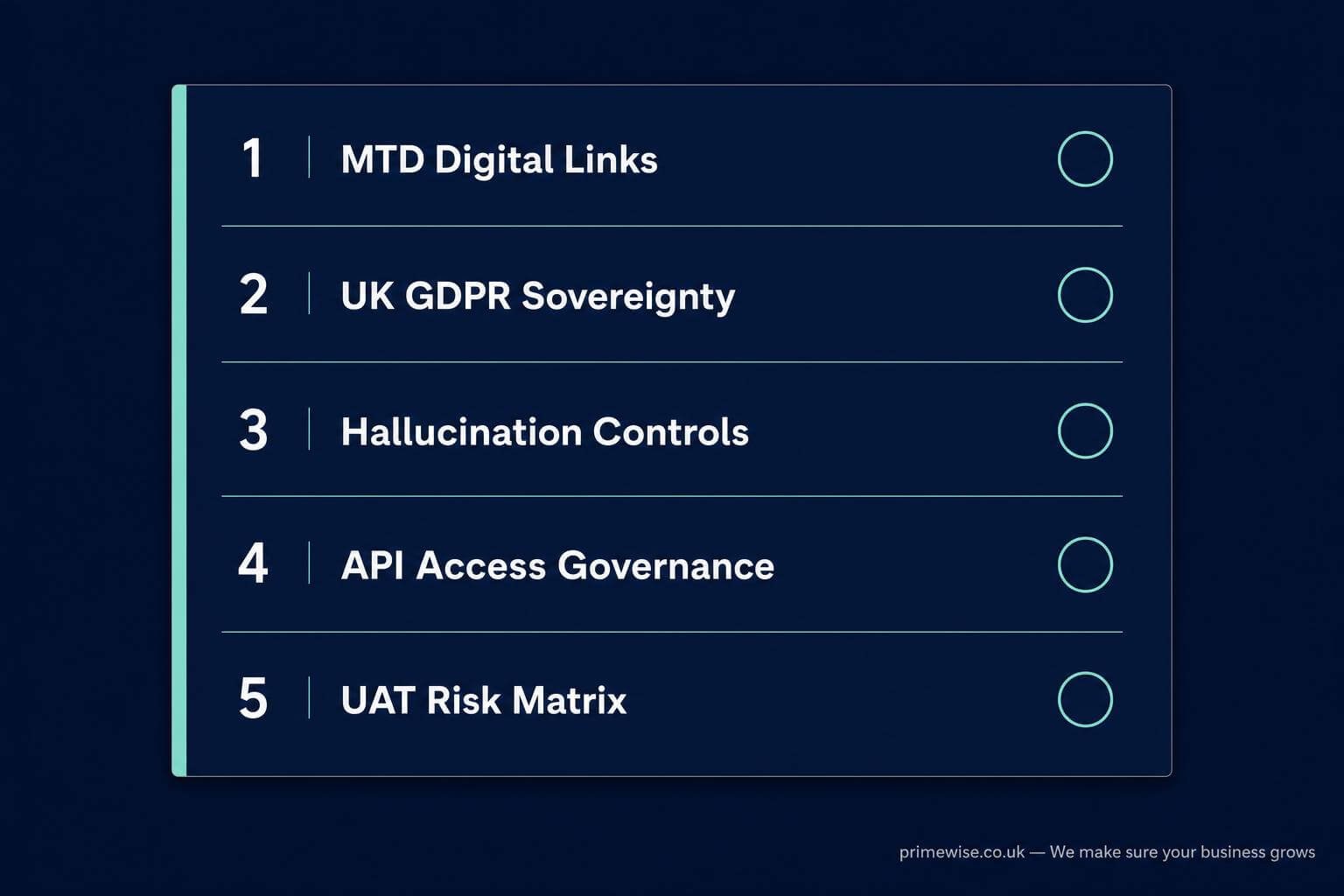
Deploying AI tools within a regulated financial environment requires a structured governance framework that can be presented to the board, to external auditors, and to HMRC if challenged. The following framework addresses the five highest-risk areas identified in pre-deployment assessments conducted across UK SME finance functions, with quantified stakes for each risk to support board-level risk appetite discussions.
Preserving Digital Links for Making Tax Digital
MTD for VAT requires that every digital record from the original transaction through to the VAT return submission is connected by an unbroken chain of digital links no manual re-keying, no copy-and-paste steps, and no spreadsheet intermediaries. HMRC issued over 19,000 VAT penalty notices in 2023–24 related to digital record-keeping failures, and enforcement intensity is set to escalate significantly as MTD for Income Tax Self-Assessment begins its phased rollout from April 2026. Any AI tool that exports data to a local file before importing it to Xero or QuickBooks breaks this digital link and creates a compliance exposure regardless of the accuracy of the underlying data. Finance teams must require written confirmation from every software vendor that their API integration maintains a fully automated, unbroken data pathway from document capture to ledger posting to VAT return calculation and should verify this claim by tracing a test transaction through the complete data flow before live deployment.
UK GDPR and Data Sovereignty Assurance
AI tools processing supplier invoices, payroll data, or customer payment records are processing personal data within the scope of UK GDPR. The ICO’s maximum penalty for a serious data breach is £17.5 million or four percent of global annual turnover whichever is higher making vendor due diligence a board-level risk item rather than an IT procurement checkbox. Finance directors must obtain a signed Data Processing Agreement from every AI vendor confirming: the geographic location of all cloud servers processing UK data, the legal basis for data transfer outside the UK where applicable, and a binding commitment that financial data will never be used to train public large language models without explicit consent. This last point is particularly significant for generative AI tools that may incorporate user data into model training pipelines by default unless opt-out is explicitly requested and contractually confirmed.
Preventing AI Hallucinations in Ledger Coding
Algorithmic inaccuracies in automated coding where an AI system assigns an incorrect nominal code, VAT treatment, or cost centre allocation are not merely administrative inconveniences. A miscoded expense category can generate a VAT reclaim error worth thousands of pounds and expose the business to a HMRC compliance check with associated professional costs and management time. The risk is highest during initial deployment before the model has been trained on sufficient confirmed historical data. Finance teams must implement a confidence threshold protocol: transactions where the AI’s categorisation confidence score falls below a defined threshold typically sixty to seventy-five percent depending on transaction materiality are automatically quarantined for human review before posting. This human-in-the-loop safeguard prevents unverified data from entering the general ledger while the system builds accuracy over time, and the threshold can be progressively relaxed as the model’s confirmed accuracy record on your specific data improves.
AUDIT POSTURE WARNINGAI confidence thresholds must be documented in your internal controls framework and reviewed at every periodic audit. If HMRC or an external auditor challenges a ledger entry, you must be able to demonstrate precisely which transactions were human-reviewed and which were autonomously posted, with timestamps and user IDs for every intervention.
API Governance and Role-Based Access Control
Every API connection between an external AI tool and your Xero or QuickBooks environment represents a potential security exposure. The principle of least privilege must govern every integration: third-party tools should receive only the minimum permissions necessary to perform their specific function, never unrestricted administrative access to the full accounting environment. Finance directors should implement OAuth token expiration policies that automatically revoke and require re-authentication of third-party API connections at defined intervals typically every ninety days and should maintain a live register of all active API connections with the business justification, data access scope, and responsible owner documented for each. Read-only or draft-only API permissions should be enforced wherever the tool’s function does not require write-back capability, and any tool requiring broad write access should be subject to enhanced due diligence and board-level approval. Aligning this governance framework with FRS 102 internal control disclosure requirements ensures that your API security posture is already documented in the format your auditors expect.
Pre-Deployment Testing and the Risk Matrix
No AI tool should transition from configuration to live production without a structured user acceptance testing phase conducted in a sandbox environment isolated from live financial data. The risk matrix underpinning this testing phase should document: the specific financial scenarios tested, the accuracy rate achieved against known correct outputs, the escalation protocol for scenarios where the system underperformed, and the sign-off authority required before live deployment is authorised. Comprehensive UAT documentation serves a dual purpose it validates the tool’s technical performance and it creates the board-level evidence base required to demonstrate that the adoption decision was governed by a rigorous process rather than commercial enthusiasm. Finance directors should schedule a formal post-implementation review at thirty and ninety days to compare live accuracy rates against UAT benchmarks and adjust confidence thresholds accordingly.
How PrimeWise Supports UK Finance Teams Through AI Accounting Transformation
The governance framework above represents significant complexity for finance teams already managing demanding operational workloads. PrimeWise works directly with UK CFOs, Finance Directors, and Financial Controllers to assess their current accounting stack, map the highest-value automation opportunities within their Xero or QuickBooks environment, and design a deployment plan that satisfies HMRC compliance requirements, UK GDPR obligations, and internal audit standards simultaneously. Rather than a generic technology recommendation, PrimeWise delivers a structured, risk-quantified roadmap that gives the board the confidence to approve investment and gives the finance team the operational blueprint to execute it.
TAKE THE NEXT STEPSpeak to a PrimeWise specialist to audit your current accounting stack and identify your highest-value AI automation opportunities with full MTD compliance and UK GDPR assurance built in from day one.
Building the Business Case for Finance Automation Investment
Securing board approval for AI integration investment requires translating technical capability into quantified financial outcomes. The business case must speak the language of the executive committee return on investment, payback period, risk reduction, and strategic competitive positioning rather than the technical specifications of API integrations or machine learning confidence scores.
The ROI calculation for a UK SME deploying a full AI-enabled accounting stack typically encompasses four measurable value streams. Direct labour cost reduction arises from eliminating manual data entry and reconciliation hours, which at a senior bookkeeper or accounts assistant billing rate generates a calculable annual saving. Audit preparation cost reduction follows from the comprehensive digital audit trails generated automatically by AI tools, which materially compress the time external auditors spend on fieldwork and reduce the associated professional fees. Error correction cost avoidance quantifies the professional costs and potential penalties associated with VAT errors, miscodings, and compliance failures that the AI governance framework is specifically designed to prevent. Finally, strategic value creation the hardest to quantify but arguably the most significant reflects the commercial value of finance leadership that can advise on real-time business performance rather than reporting historical results three weeks after the period end.
- Accelerated month-end close cycles that give executive stakeholders real-time financial intelligence for faster, better-informed strategic decisions.
- Measurable reduction in temporary staffing costs historically required during peak audit and year-end periods.
- Enhanced fraud detection through consistent AI monitoring of supplier payment patterns and anomaly flagging across high-volume transaction flows.
- Seamless transaction volume scalability that supports business growth without proportional headcount increases in the finance function.
- MTDfIT readiness that positions the business ahead of the April 2026 compliance deadline for sole traders and the April 2027 deadline for partnerships.
- FRS 102 and UK GAAP alignment through AI-generated reporting outputs that conform to the narrative disclosure and presentation standards required under UK accounting standards.
A well-constructed business case for AI accounting integration positions the investment not as a cost centre efficiency initiative but as a strategic capability build one that simultaneously reduces operational risk, accelerates financial intelligence, and repositions the finance function as a driver of enterprise value rather than an administrative overhead. The finance teams that execute this transition in 2026 will have a structural competitive advantage over peers still managing the same workflows manually that dominated finance departments a decade ago.