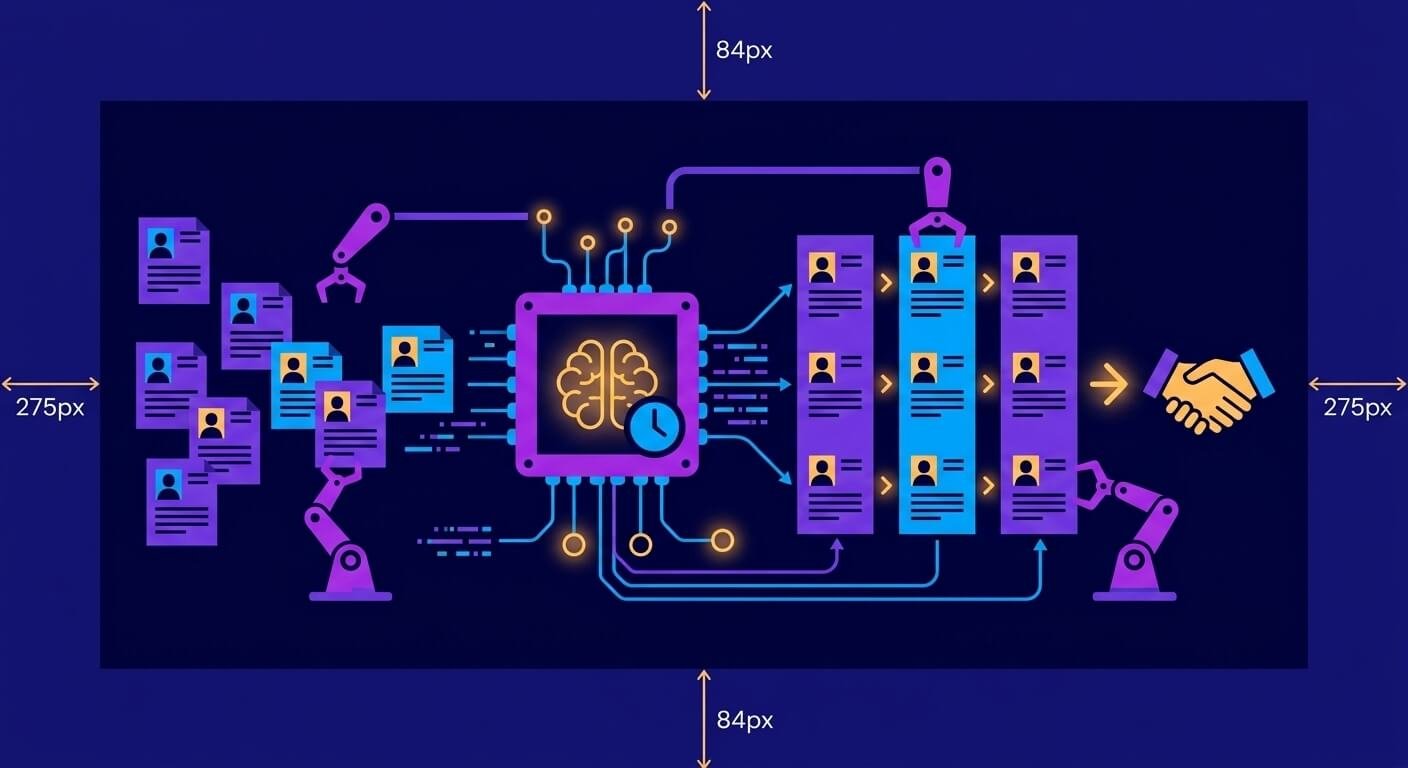

AI automation for SaaS companies has shifted from a competitive advantage to a survival-level operational imperative. Working as an AI integration consultant across the UK’s most ambitious B2B SaaS teams, one pattern emerges consistently: firms stalling between £1M and £20M ARR are not failing due to a lack of product quality or market demand they are failing because their revenue operations cannot process opportunity at the speed the market delivers it. According to McKinsey’s 2025 State of AI report, B2B SaaS companies that have fully integrated AI-driven RevOps workflows report a 23% reduction in customer acquisition cost and a 31% improvement in lead-to-close velocity within 18 months of deployment. This playbook details exactly how to build that architecture.
Executive Summary
- Eliminate Operational Friction: Intelligent workflows bridge the gap between marketing-qualified leads and closed-won revenue, preventing pipeline leakage at every stage of the funnel.
- Scale Without Proportional Headcount: Autonomous lead qualification agents offset premium London SDR talent costs while accelerating prospect response times from hours to seconds.
- The Zero-Touch Handoff: Seamless CRM integration ensures pristine data flows from the first interaction through to automated customer success onboarding sequences.
- Enterprise-Grade Compliance: Architectures must strictly adhere to UK GDPR and ICO guidance on automated decision-making whilst managing PII across multi-currency EMEA expansions.
What Is AI Automation in the SaaS Context
Understanding what is ai automation specifically within a SaaS revenue environment is the essential baseline before any strategic deployment. In plain terms, it is the integration of machine learning, natural language processing, and predictive analytics into revenue operations to autonomously execute complex, multi-step workflows that would otherwise require human intervention. Unlike legacy CRM automation that executes fixed rule-based triggers, modern AI systems adapt in real time: they interpret unstructured conversational data, evaluate prospect intent signals from dozens of behavioural inputs simultaneously, and make probabilistic routing decisions without manual instruction. For a scaling software business, this means the gap between a prospect’s first engagement and a qualified discovery call can collapse from 48 hours to under four minutes.
The Difference Between RPA and Cognitive AI Workflows
Revenue operations teams often conflate robotic process automation with genuine AI automation, and the distinction matters enormously at scale. RPA executes predefined scripts it copies a field, pastes a value, sends a templated email. It has zero tolerance for ambiguity and breaks the moment an input deviates from its programming. Cognitive AI workflows, by contrast, evaluate context. They understand that a prospect who visited a pricing page three times in two days and downloaded a security whitepaper represents a fundamentally different intent signal than one who opened a single nurture email six weeks ago. This contextual reasoning capability is what transforms automation from a cost-saving tool into a genuine revenue acceleration engine. For SaaS firms asking what is ai saas in the operational sense, the answer is precisely this: software that learns, adapts, and acts with increasing precision over time.
The UK SaaS Landscape in 2026
The UK remains Europe’s dominant SaaS ecosystem, with Tech Nation reporting that British software companies attracted over £9.4 billion in venture investment across 2024 and 2025 combined. However, scaling beyond £1M ARR into the £10M–£20M bracket has become disproportionately expensive. The average base salary for a mid-level Sales Development Representative in London now sits between £45,000 and £62,000, exclusive of on-target earnings, national insurance contributions, and benefits meaning a team of four SDRs represents an annual spend exceeding £350,000 before a single quota is hit. Simultaneously, UK buyers have become measurably more discerning: the average B2B SaaS purchase now involves 6.8 stakeholders and spans 84 days from first touch to contract signature, according to Gartner’s 2025 B2B Buying Report. These two pressures rising talent costs and elongating sales cycles make AI-driven RevOps not merely attractive but structurally necessary for any UK firm serious about reaching £20M ARR without haemorrhaging capital.
UK Market Reality CheckA Series B SaaS firm operating in London's fintech corridor reduced their SDR headcount cost by 40% within six months of deploying an AI qualification layer while simultaneously increasing qualified pipeline by 58%. The AI layer processed over 4,200 inbound leads in month one; the previous human team had capacity to manually work 600.
AI Automation and the UK Regulatory Environment
The UK’s AI Safety Institute, established under the Bletchley Declaration framework, has continued to develop sector-specific guidance that intersects directly with revenue operations tooling. Critically, the ICO’s guidance on automated decision-making under UK GDPR Article 22 applies directly to AI-driven lead scoring and qualification systems particularly where a scoring decision results in a prospect being excluded from a sales process entirely without human review. SaaS firms must ensure that any AI qualification model processing personal data has an explicit lawful basis, a transparent data processing agreement, and a documented human override mechanism. Non-compliance carries fines of up to 4% of global annual turnover, making compliance architecture a commercial as much as a legal priority.
The AI-Driven RevOps Maturity Model
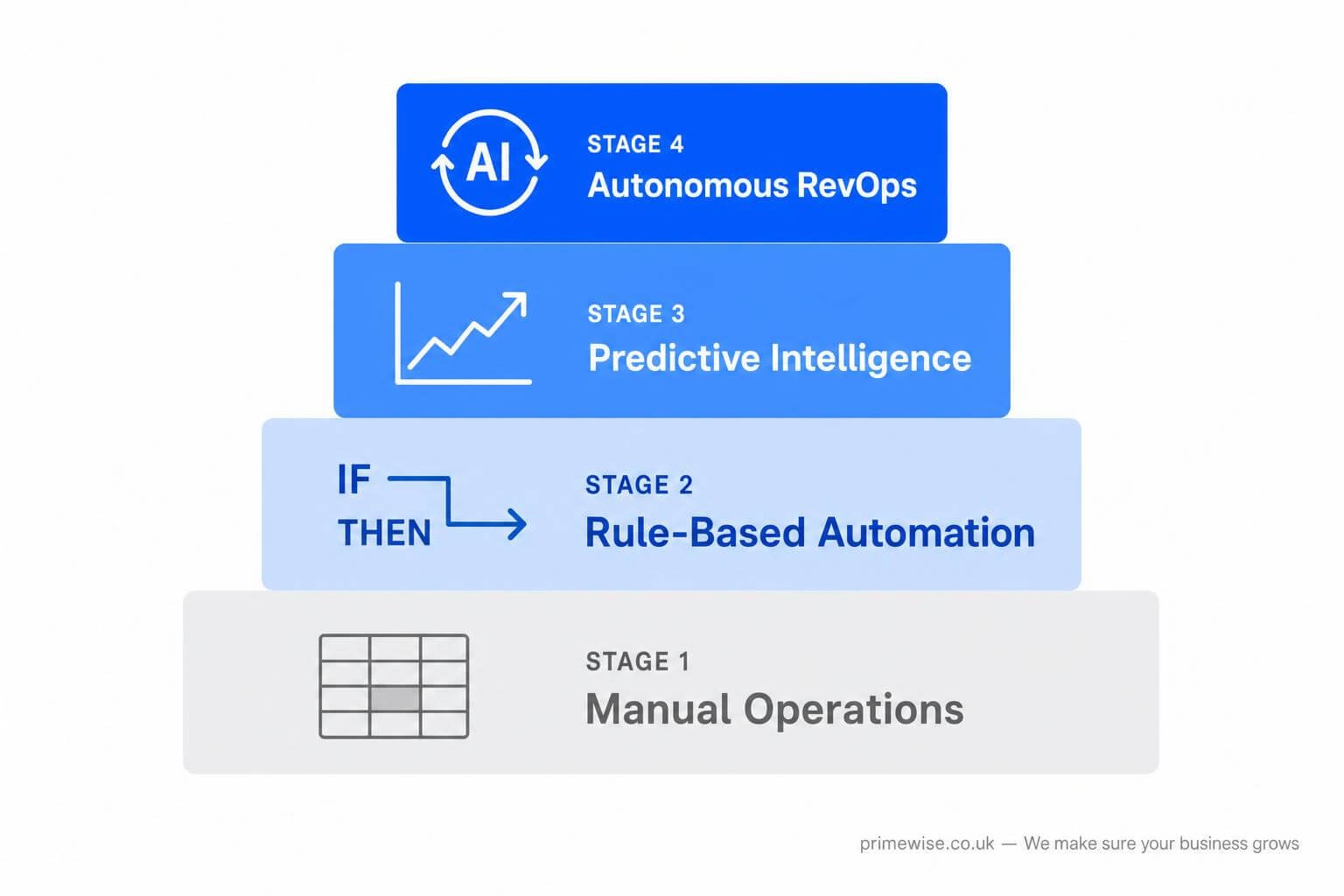
Sustainable scaling requires a structured framework for understanding where your revenue operations currently sit and what the next stage of AI integration looks like. The AI-Driven RevOps Maturity Model maps a company’s progression across four distinct stages: Manual Operations, where data lives in spreadsheets and CRM hygiene is inconsistent; Rule-Based Automation, where basic triggers handle email sequences and deal stage movements; Predictive Intelligence, where machine learning models score leads, forecast churn, and surface expansion signals; and Autonomous RevOps, where AI agents orchestrate the full revenue lifecycle from first touch to renewal with minimal human intervention. Most £1M–£5M ARR SaaS firms sit firmly at stage two. The strategic objective is reaching stage three within 12 months and stage four within 24 the performance differential at stage four is where the £20M ARR ceiling becomes achievable.
Achieving this progression requires breaking down the departmental data silos that prevent machine learning models from accessing a complete picture of the customer journey. Marketing attribution data, SDR call recordings, product usage telemetry, and support ticket sentiment must all flow into a unified data environment. Platforms like Clari and Gong are specifically designed to aggregate these signals into a Revenue Intelligence layer that sits above the CRM, providing leadership with real-time pipeline visibility and automated bottleneck detection that no human analyst could replicate at scale.
Solving the Leaky Funnel Problem
The leaky funnel is the most expensive silent killer in a scaling SaaS business. Research by Lead Response Management consistently demonstrates that the probability of qualifying a B2B lead drops by over 80% if the response time exceeds five minutes from form submission yet the average human SDR response time in UK SaaS firms is 42 minutes during business hours, and functionally zero outside them. AI qualification agents eliminate this decay entirely. Tools like Qualified, Artisan, and 11x deploy conversational AI agents that engage website visitors and inbound leads the moment they express intent, scoring their budget, authority, need, and timeline in real time before seamlessly routing high-probability prospects directly into a sales executive’s calendar. The financial impact is immediate: firms deploying these systems typically report a 40% reduction in customer acquisition cost and a 3x faster lead-to-opportunity conversion rate within the first quarter of deployment.
For UK SaaS Leadership TeamsPrimewise provides bespoke AI automation audits tailored to firms scaling between £1M and £20M ARR, combining deep CRM integration expertise with UK GDPR-compliant deployment frameworks. Engage the team at primewise.co.uk to map your specific RevOps architecture.
Mapping the AI SaaS Tech Stack
Building an effective AI RevOps infrastructure requires deliberate architectural planning rather than ad hoc tool adoption. The foundational layer is always the CRM Salesforce and HubSpot remain the dominant enterprise platforms in the UK mid-market, and any AI tooling deployed must integrate natively via API-first connectors rather than fragile third-party bridges. Above the CRM sits the Revenue Intelligence layer, where platforms like Gong process call and email data to extract deal risk signals and coaching insights automatically. Above that sits the Qualification and Orchestration layer, where AI agents like Qualified or Artisan manage top-of-funnel engagement. The final layer is the Analytics and Forecasting layer, where tools like Clari apply machine learning to pipeline data to generate commit forecasts and identify expansion opportunities. LLM-powered CRM enrichment tools complete the stack by automatically populating contact and account records with firmographic data, technographic signals, and intent scores derived from third-party data sources eliminating manual data entry entirely and ensuring the CRM remains the single source of truth it was always designed to be.
Transforming Top-of-Funnel Lead Qualification
Traditional lead scoring models assign arbitrary point values to static behaviours a whitepaper download earns ten points, a pricing page visit earns twenty but this approach fundamentally misrepresents purchase intent because it treats all behaviours as equal regardless of context, frequency, or sequence. AI-powered intent scoring analyses hundreds of micro-behavioural signals simultaneously: the specific sequence of pages visited, the velocity of engagement over a rolling 72-hour window, firmographic fit against your ideal customer profile, technographic data revealing which competing platforms the prospect currently uses, and dark funnel signals from third-party intent networks like Bombora. The result is a dynamic, continuously recalibrated intent score that reflects a prospect’s actual proximity to a purchasing decision rather than their willingness to consume free content.
Deploying AI Agents for Real-Time Intent Scoring
Intelligent qualification agents function as an always-on frontline layer for your sales team, processing conversational data and web engagement telemetry in real time without fatigue, time zone constraints, or inconsistent messaging. Platforms like Artisan’s AI SDR, Ava, and 11x’s Alice are built on large language models fine-tuned for sales contexts they engage prospects in natural, contextually relevant conversations, ask qualifying questions that map to your specific sales methodology, and pass structured qualification data directly into the CRM record before the conversation ends. Critically, these systems also support signal-based selling by triggering outbound sequences autonomously when a target account exhibits high-intent behavioural patterns visiting a competitor comparison page, posting a job listing for a role your platform addresses, or receiving a new round of funding that indicates budget availability. This transforms outbound from a volume game into a precision instrument.
The Zero-Touch SaaS Sales Handoff Matrix
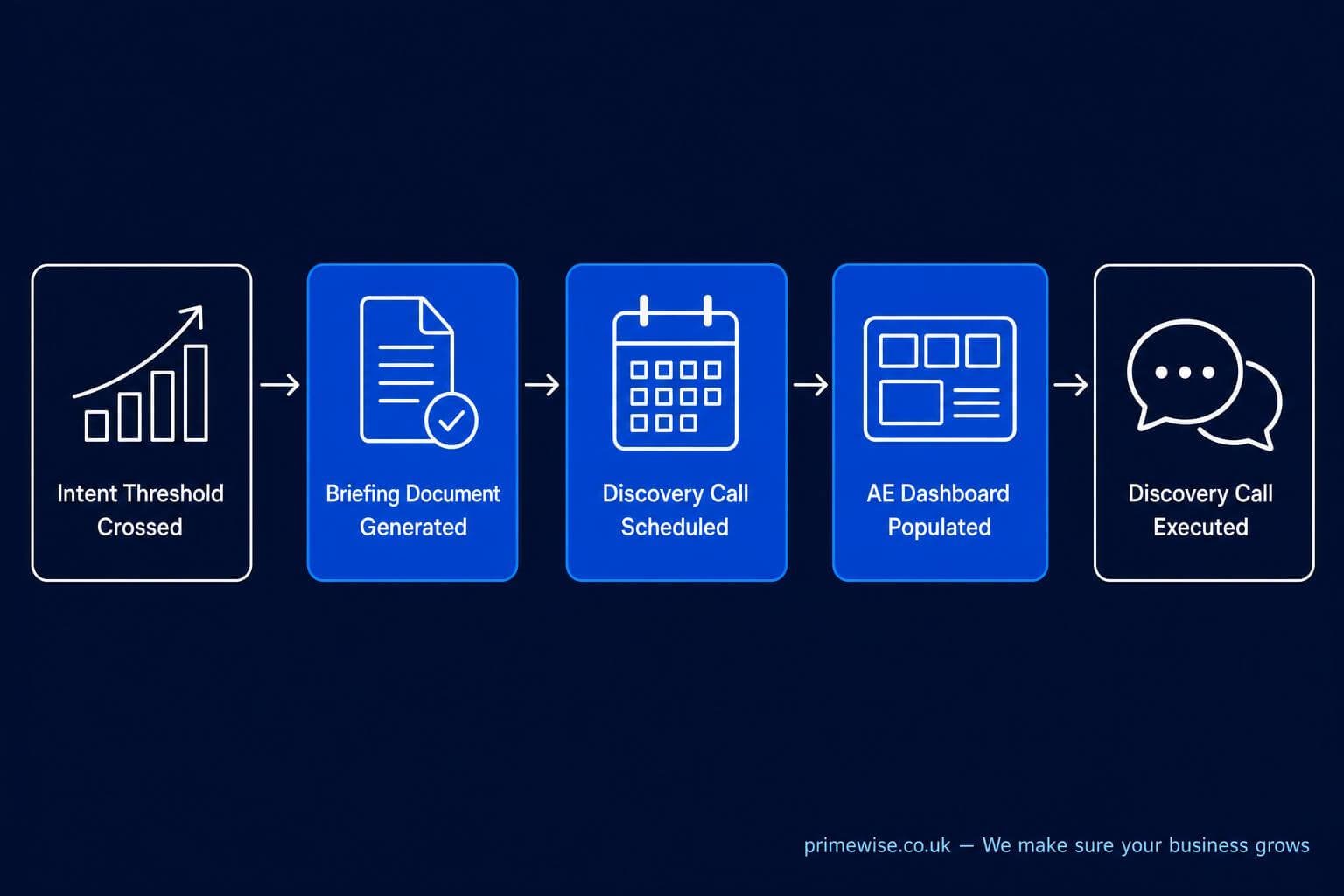
The transition between marketing engagement and sales execution remains the most fragile point in the revenue funnel, accounting for an estimated 27% of pipeline leakage across the UK mid-market SaaS sector. The Zero-Touch Handoff Matrix addresses this systematically. When a prospect crosses the algorithmic intent threshold a composite score derived from behavioural, firmographic, and temporal signals the system executes a precise sequence without human initiation: it generates a bespoke briefing document summarising the prospect’s engagement history and likely pain points, schedules the discovery call within the Account Executive’s availability window, sends a personalised confirmation sequence to the prospect, and populates the AE’s dashboard with context-rich talking points aligned to the prospect’s specific industry, company size, and identified objections. The Account Executive arrives at the call informed, prepared, and selling not administrating.
Accelerating Customer Onboarding and Retention
In subscription software, the revenue relationship begins at contract signature but the economic value is determined entirely by what happens in the subsequent 90 days. Product adoption velocity, feature engagement depth, and time-to-first-value are the three metrics that most accurately predict 12-month Net Revenue Retention and all three are directly addressable through intelligent onboarding automation. AI-powered onboarding sequences monitor initial user behaviour at the event level, detecting precisely where new clients encounter friction, abandon a workflow, or fail to activate a key feature, and dynamically adjusting the content delivery sequence in response. A client who completes account configuration in the first session receives immediate advanced feature guidance; a client who abandons the setup wizard triggers a proactive outreach sequence from their Customer Success Manager before frustration becomes a churn signal.
Proactive Churn Reduction Through Predictive AI
High churn is the structural enemy of ARR growth. A business adding £200K in new ARR monthly while losing £150K to churn is effectively running to stand still. Predictive churn models built on product usage telemetry, support interaction frequency, NPS survey sentiment, and billing behaviour can identify accounts at elevated churn risk with statistically significant accuracy 45 to 90 days before the renewal decision. When the model flags an at-risk account, the system autonomously triggers a targeted re-engagement workflow: the Customer Success Manager receives a prioritised alert with a recommended intervention strategy, personalised educational content is delivered to the account’s primary users, and an executive business review is scheduled if the account exceeds a defined revenue threshold. This shift from reactive damage control to proactive relationship management is where AI automation delivers its most measurable impact on Net Revenue Retention and NRR above 120% is the single most important metric for achieving premium SaaS valuation multiples at exit.
AI Test Automation for Platform Reliability
Software reliability is directly correlated with customer satisfaction, product adoption, and ultimately retention. Implementing AI test automation for SaaS ensures that every product update, bug fix, or new feature release is evaluated against thousands of real-world user scenarios before it reaches the live environment. Modern AI testing platforms, including Testim and Mabl, use machine learning to generate and maintain test cases autonomously, adapting to UI changes without requiring manual test script updates a critical capability for fast-moving SaaS engineering teams shipping weekly releases. For scaling firms in active onboarding phases, a single unstable release that disrupts a new client’s first week experience can permanently damage the retention trajectory of that account. Continuous AI-driven testing eliminates this risk and ensures the platform remains stable precisely when the stakes are highest.
AI SaaS Pricing Models and Implementation Economics
One of the most common barriers to AI RevOps adoption among UK mid-market SaaS firms is financial uncertainty specifically, the difficulty of accurately forecasting total cost of ownership against expected returns. Understanding ai saas pricing requires distinguishing between three dominant commercial models that have emerged in the market. Consumption-based billing charges based on the volume of data processed, workflows executed, or API calls made per month this model scales directly with business activity and is particularly well-suited to firms experiencing rapid lead volume growth. Seat-based subscriptions charge a fixed monthly fee per user and are easier to budget but can become economically inefficient as AI usage scales beyond the human team’s capacity to consume its outputs. Outcome-based pricing, increasingly common among premium AI RevOps vendors, charges based on defined commercial outcomes such as qualified meetings booked or revenue directly attributed to AI-sourced pipeline this model aligns vendor incentives perfectly with client objectives and is rapidly becoming the preferred structure for enterprise deployments.
UK Mid-Market Pricing BenchmarksTypical AI RevOps implementation costs for UK mid-market SaaS firms range from £2,500 per month for modular workflow automation tooling to £15,000 or more per month for fully managed intelligent revenue operations platforms. Set against the £80,000 to £120,000 annual cost of a single senior London-based SDR, the ROI case becomes structurally compelling within the first two quarters of deployment.
EMEA Expansion and Multi-Currency Revenue Operations
As UK-based software companies scale into the broader EMEA market, revenue operations complexity increases exponentially. Cross-border expansion introduces multi-currency transactions, VAT and GST variance by jurisdiction, distinct data residency requirements under various national implementations of GDPR equivalents, and the challenge of maintaining a consolidated financial view across entities operating in different legal frameworks. AI-powered revenue operations platforms address this directly by automatically reconciling multi-currency transaction data, applying correct taxation logic by jurisdiction, and delivering real-time consolidated financial dashboards that surface global ARR, net revenue retention, and expansion motion performance without requiring a dedicated international accounting function. For UK SaaS firms targeting EMEA growth, this capability transforms international expansion from an operational complexity into a strategic growth lever.
Safeguarding Data and UK GDPR Compliance
Feeding prospect and client data into machine learning models introduces legal obligations that cannot be treated as secondary considerations. Under UK GDPR, the use of automated decision-making systems that produce legally significant or similarly significant effects on individuals which includes automated lead disqualification and scoring requires either explicit consent or a compelling legitimate interest basis, must be disclosed in the firm’s privacy notice, and must include a mechanism for human review upon request. The ICO has specifically addressed AI-driven profiling in its guidance on data protection and AI, noting that organisations must conduct Data Protection Impact Assessments before deploying high-risk automated processing systems. Practically, this means SaaS firms must implement PII anonymisation protocols before data enters the training or scoring pipeline, establish documented data processing agreements with every AI vendor in the stack, and maintain audit logs of automated decisions sufficient to demonstrate compliance under regulatory scrutiny.
Managing PII Within Lead Scoring Architectures
Handling Personally Identifiable Information within AI lead scoring models demands a layered technical and procedural approach. At the data ingestion layer, sensitive identifiers including full names, direct email addresses, and phone numbers must be tokenised or pseudonymised before entering the model’s feature set, with the key held separately in a compliant data store. Enrichment data sourced from third-party platforms like Clearbit or ZoomInfo must be verified to originate from GDPR-compliant sources with appropriate data subject consent. At the output layer, scoring decisions must be explainable meaning the model must be capable of articulating, in human-readable terms, the primary factors that contributed to a given score, satisfying both the ICO’s explainability guidance and the legitimate business need of sales teams who must trust and act on the model’s outputs. Firms that build compliance architecture into the AI stack from day one, rather than retrofitting it post-deployment, consistently achieve faster regulatory clearance and stronger enterprise client trust.
High-Impact AI SaaS Ideas for Internal Operations
Beyond the core RevOps architecture, there is a broader landscape of ai saas ideas that scaling firms can implement to generate compounding operational returns. Autonomous competitive intelligence agents continuously monitor competitor pricing pages, product update announcements, and review platform sentiment, delivering structured briefings to sales and product teams without manual research effort. LLM-powered contract analysis tools review MSAs and SOWs against standard terms, flagging risk clauses and accelerating legal review cycles from weeks to hours. Dynamic pricing engines evaluate prospect firmographics, engagement depth, and real-time market signals to recommend personalised subscription packaging and discount thresholds, maximising both conversion probability and average contract value simultaneously. AI-driven expansion motion detectors analyse product usage telemetry and support interactions to identify accounts approaching natural upsell inflection points alerting Customer Success Managers to engage with upgrade conversations precisely when the client is most receptive. Each of these represents a distinct ai saas business capability that compounds in value as the underlying data set grows with the business.
The Strategic Case for Acting in 2026
The window for early-mover advantage in AI-driven RevOps is narrowing. UK SaaS firms that have already integrated cognitive qualification layers, predictive churn models, and zero-touch handoff architectures are operating with a structural cost and velocity advantage that compounds quarterly. Their customer acquisition costs are declining as their models improve. Their NRR is climbing as proactive intervention replaces reactive firefighting. Their EMEA expansion is accelerating because multi-currency operations have been automated rather than staffed. For firms still operating with predominantly manual revenue operations in 2026, the gap is not merely a technology lag it is a valuation gap. Investors applying SaaS revenue multiples in the current market assign materially higher multiples to businesses demonstrating operational leverage, and AI-driven RevOps is the most direct and measurable path to achieving it.
The architecture described in this playbook from intent-scoring qualification agents through zero-touch handoff matrices to predictive churn intervention is not theoretical. It is deployable today, on existing CRM infrastructure, within UK GDPR compliance frameworks, and at cost points that generate positive ROI within two quarters for firms operating above £1M ARR. The question is not whether to build it. The question is how quickly you can.
Ready to Build Your AI RevOps ArchitecturePrimewise works exclusively with B2B SaaS leadership teams scaling between £1M and £20M ARR. If you are ready to eliminate pipeline leakage, reduce CAC, and build a revenue engine that scales without proportional headcount, visit primewise.co.uk to begin your bespoke AI automation audit.