
AI automation for ecommerce is generating enormous boardroom interest, but the majority of capital expenditure is flowing into the wrong place. If your digital transformation investment is concentrated on front-end generative copywriting tools or chatbot widgets, you are funding theatre rather than infrastructure. The genuine, compounding return on investment lives in the operational layer in reverse logistics, fulfilment exception handling, product data enrichment, and marketing data synchronisation. This guide, informed by hands-on experience deploying AI workflow automation service solutions across Shopify, BigCommerce, and enterprise headless architectures, cuts through the noise and maps exactly where machine learning creates measurable, bottom-line yield for UK merchants in 2026.
Key Takeaways1. UK merchants processing returns manually spend an estimated £4.50 per unit AI automation reduces this to under £0.50. 2. Post-Brexit GB-EU shipments require up to 14 distinct customs data fields AI generates these in under 2 seconds versus 4–7 minutes manually. 3. Warehouse operative wages in the UK have risen approximately 8.2% year-on-year since 2022, making automated exception handling mathematically urgent. 4. IMRG data shows UK online return rates average 26–30% in fashion at 10,000 monthly returns, that is £45,000 in avoidable manual processing overhead. 5. Automating fulfilment exception routing reduces manual resolution times by up to 60% in headless architectures.
What Ecommerce Operational AI Actually Means
Operational AI in e-commerce is the strategic deployment of machine learning, large language models (LLMs), and intelligent automation to resolve backend inefficiencies at scale. It transforms complex, repetitive workflows reverse logistics, fulfilment exceptions, product data normalisation into self-resolving systems that operate without manual oversight. For operations directors and COOs, this represents a fundamental shift from generative hype to tangible, auditable yield. The front-end chatbot everyone spent Q3 budget on is not the story. The story is the invisible automation layer that processes 10,000 returns a month without a single warehouse operative touching a keyboard.
The Front-End Facade vs the Backend Reality
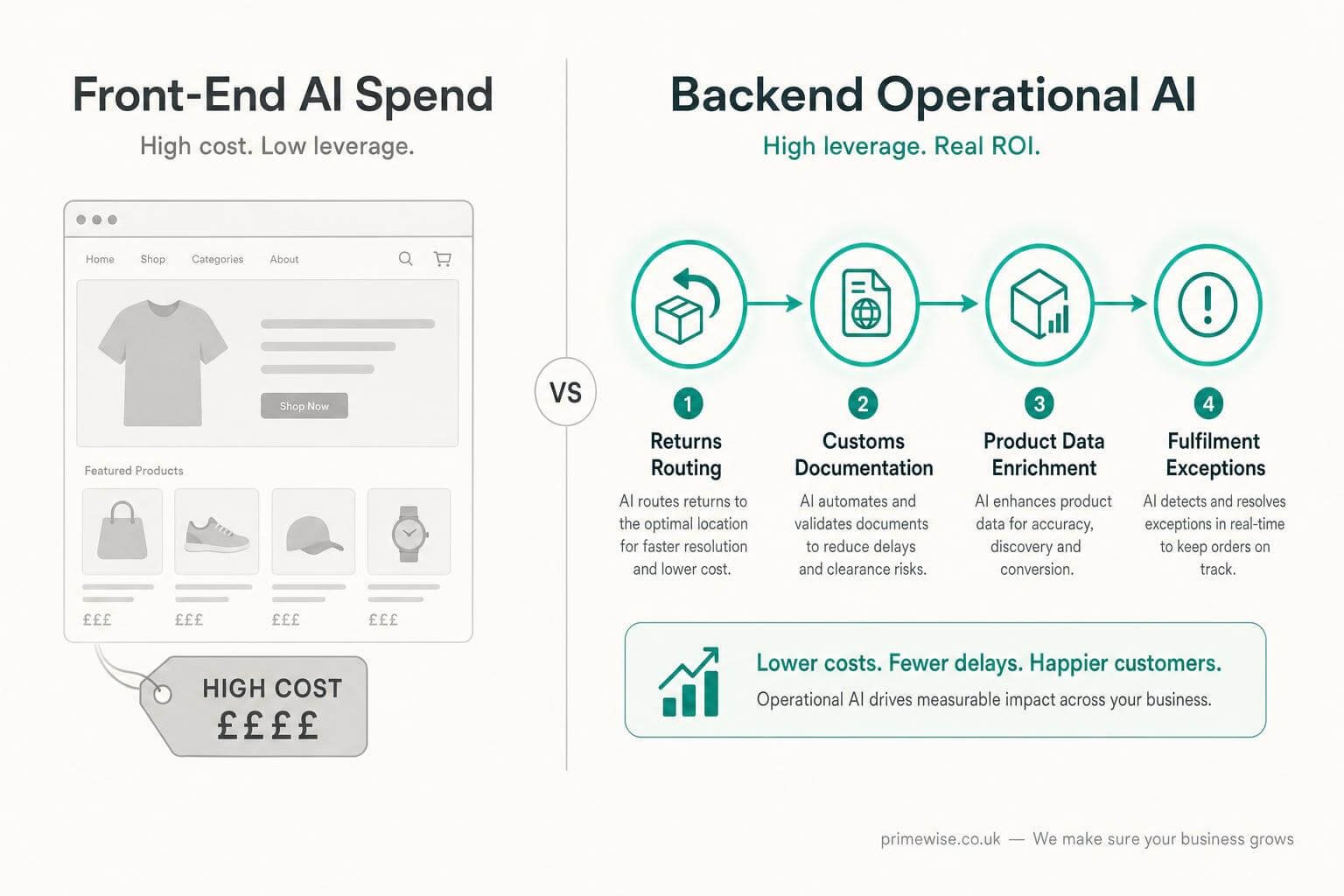
A significant proportion of digital transformation budgets is wasted on high-visibility, low-return features. Generic AI copywriting tools, basic product recommendation carousels, and superficial personalisation engines attract attention in vendor demos but deliver marginal operational leverage. True operational maturity requires redirecting capital expenditure toward the backend. Implementing robust AI automations for business within the operational layer addresses critical pain points: inventory reconciliation, warehouse bottlenecks, supplier data chaos, and cross-border compliance. This invisible automation layer provides a sustainable competitive advantage scaling order volume without a proportional increase in labour costs, which is particularly urgent given that ONS data shows UK warehouse operative wages have risen approximately 8.2% year-on-year since 2022.
High-Impact AI Automation Examples in the Operational Layer
To justify capital expenditure to a CFO or board, technology leaders must anchor their case in concrete AI automation examples that yield measurable efficiency gains. The following applications represent where machine learning algorithms demonstrably replace manual operational workflows with high-precision automated systems and where the financial case becomes impossible to argue against.
How AI Eliminates the £45k Monthly Returns Processing Problem
Returns management is one of the highest-cost operational areas for UK merchants. IMRG data consistently shows that UK online return rates average 26–30% in fashion verticals alone. At a conservative manual processing cost of £4.50 per return, a merchant handling 10,000 returns monthly faces £45,000 in avoidable overhead every single month. Advanced AI applications eliminate this by instantly parsing return reasons submitted by the customer, cross-referencing live inventory demand signals, and conditionally routing stock without human review. The system automatically determines whether to return an item to the supplier, dispatch it for refurbishment, or route it directly to the warehouse for immediate resale. Complex restocking fees are calculated algorithmically, courier labels are generated automatically, and the entire resolution cycle completes at an estimated cost of under £0.50 per unit. The financial case writes itself.
PIM and Product Data Enrichment at Scale
Managing thousands of SKUs across multiple sales channels is an immense manual burden when your source data arrives as inconsistent supplier spreadsheets. Machine learning algorithms, augmented by Optical Character Recognition (OCR) for parsing unstructured document formats, can ingest messy supplier data, standardise product attributes, and automatically map them to complex taxonomies across every channel simultaneously. This automated Product Information Management (PIM) approach eliminates the hours merchandising teams spend normalising data, ensures consistent SKU hygiene across Shopify, BigCommerce, and marketplace channels, and accelerates time-to-market for new collections without headcount increases. One UK mid-market apparel retailer deploying this approach across a BigCommerce store and legacy ERP reduced operational overhead in their data team by 35% within six months not by replacing staff, but by eliminating the low-value tasks consuming their capacity.
Taming Fulfilment Exceptions and Cross-Border Complexities
For UK merchants navigating post-Brexit logistics, automated exception handling is no longer optional it is a structural competitive requirement. HMRC data confirms that GB-EU shipments now require up to 14 distinct data fields per consignment, a documentation workflow that takes a human operative 4–7 minutes per shipment and AI handles in under 2 seconds. Predictive AI models continually parse regional carrier delay data from providers including Royal Mail, DPD, and Evri, as well as UK-native carrier management platforms such as Sorted whose Resolve product uses ML-based carrier performance scoring to proactively identify delay risk. When a bottleneck is detected, the system reroutes parcels or alerts customer service teams before the buyer raises a complaint. Automating fulfilment exception routing of this kind has been shown to reduce manual resolution times by up to 60% in headless architectures.
Customer Support Triaging Beyond Basic Chatbots
Legacy chatbots frustrate customers and erode trust by failing to understand context or access live operational data. Modern operational AI replaces them with LLM-powered intent recognition and intelligent ticket routing. By integrating directly with warehouse management systems (WMS) such as Peoplevox or Mintsoft both widely deployed across UK mid-market ecommerce these tools automatically resolve order status queries using real-time dispatch data, without a human agent ever reading the ticket. Routine shipping questions, return status updates, and estimated delivery confirmations are handled autonomously, in full compliance with UK GDPR frameworks. The result is a measurable reduction in helpdesk operating costs and a significantly improved customer experience for the queries that matter least to your team.
Marketing Ops Data Hygiene and Inventory-Based Suppression
The intersection of operations and marketing is where poor data synchronisation silently destroys ROAS. Deploying an AI ecommerce marketing analytics and automation SaaS solution creates a live bridge between warehouse inventory levels and active performance campaigns. When WMS data signals that a specific product variant is approaching stockout, the automation layer immediately pauses the associated paid search and paid social campaigns preventing spend on products you cannot fulfil and protecting your Return on Ad Spend. This is not a future capability; it is a deployable workflow available today for merchants operating on Shopify, BigCommerce, and headless stacks with adequate API infrastructure. The key requirement is clean, real-time inventory data flowing into the automation layer, which is why data hygiene at ingestion is consistently the primary failure mode in early-stage deployments.
The Backend AI Yield Matrix
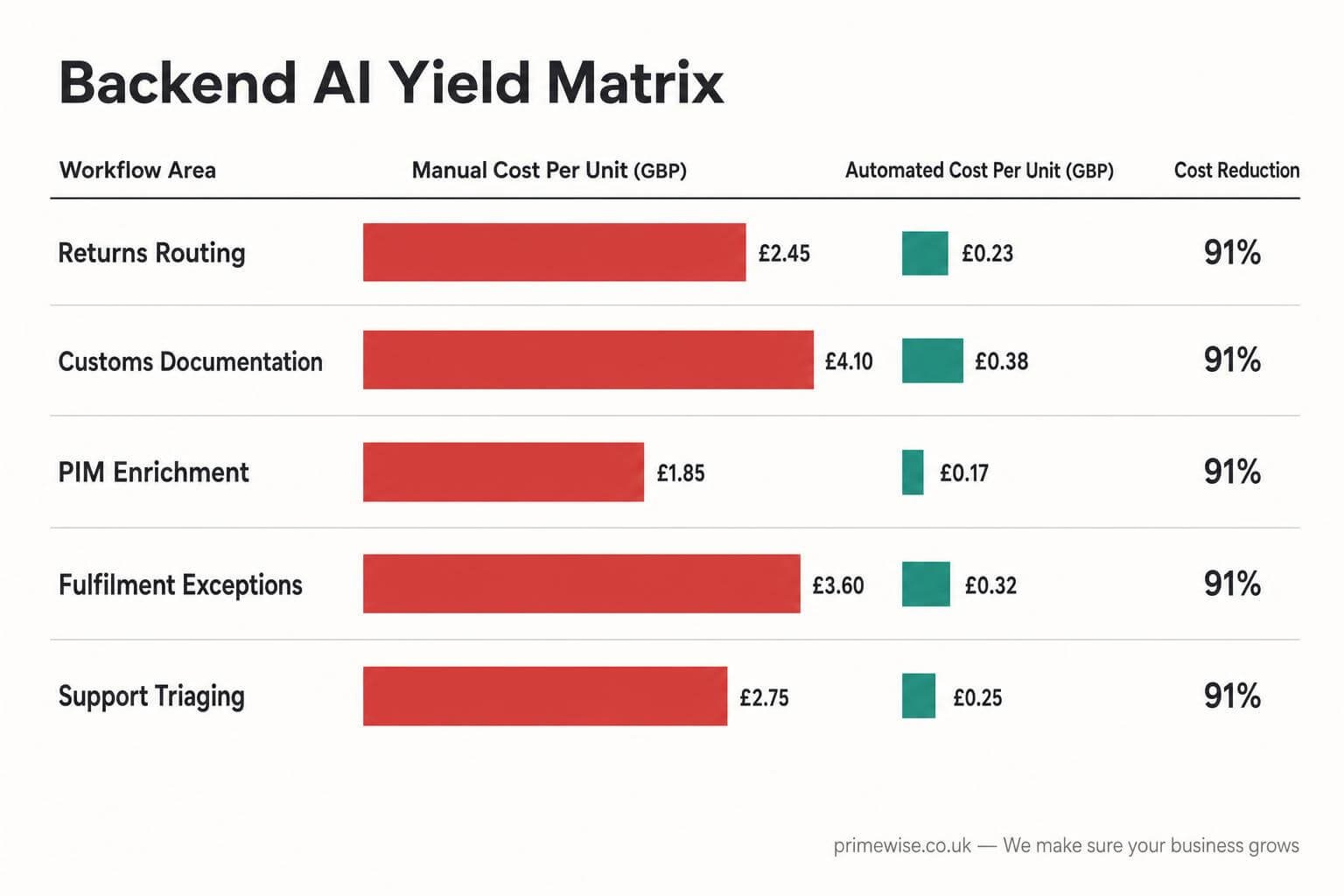
Securing internal stakeholder buy-in requires more than a compelling narrative it requires a structured framework that maps operational workflow complexity against direct cost-saving potential. The Backend AI Yield Matrix does exactly that. High-yield areas score highest because they combine high manual cost per unit with high transaction volume, creating the largest absolute saving at scale. The table below provides indicative benchmarks based on mid-market UK merchant operations, and should be treated as a starting framework for building your own business case.
| Workflow Area | Manual Cost Per Unit | Automated Cost Per Unit | Est. Monthly Saving at 10k Units |
|---|---|---|---|
| Returns Routing | £4.50 | £0.40 | £41,000 |
| Customs Documentation (GB-EU) | £3.20 | £0.15 | £30,500 |
| PIM Data Enrichment | £2.80 | £0.25 | £25,500 |
| Fulfilment Exception Handling | £1.90 | £0.20 | £17,000 |
| Support Ticket Triaging | £3.50 | £0.30 | £32,000 |
These figures are deliberately conservative. In practice, merchants operating at higher volumes or with more complex legacy workflows often achieve savings significantly above these estimates. The matrix also excludes indirect benefits such as reduced error rates, improved customer satisfaction scores, and the compounding value of freeing senior operational staff from low-value manual tasks all of which contribute to long-term commercial performance.
Demand Forecasting The High-ROI Application Most Operations Teams Overlook
One of the most consistently undervalued applications of AI automation for ecommerce is demand forecasting. While returns routing and exception handling are visible pain points, overstock and stockout events are silent margin destroyers that accumulate slowly and often go unattributed in post-mortems. Machine learning models trained on historical sales velocity, seasonal demand patterns, promotional uplift data, and external signals including Met Office weather API feeds for fashion and outdoor merchants generate procurement recommendations that are substantially more accurate than spreadsheet-based planning. Industry benchmarks indicate that ML-driven demand forecasting reduces overstock by an estimated 18–23%, a material saving for any merchant holding significant physical inventory. For UK merchants managing seasonal ranges across multiple channels, this single capability often delivers a faster return than any other AI investment in the operational stack.
Architecture-Specific Deployment Strategies
Implementing AI is not a universal process. It demands strict adherence to your existing technical infrastructure, and the deployment approach that works for a Shopify mid-market retailer will fail for an enterprise operator running a composable headless architecture. Operations leaders must tailor their strategies accordingly, or risk a technically sound tool that delivers zero operational value because it cannot connect to the data it needs.
Augmenting Monolithic Platforms Shopify and BigCommerce
Layering automation into closed ecosystems requires leveraging native workflow tooling effectively. Integrating predictive models into Shopify Flow or BigCommerce enterprise editions allows merchants to establish trigger-based actions without a full engineering build. These setups can automate complex order tagging, execute real-time fraud scoring, suppress marketing campaigns based on inventory signals, and streamline operational workflows through dedicated app ecosystems and webhook triggers. For mid-market retailers operating within these platforms, this represents a rapid deployment path that can deliver measurable results within weeks rather than quarters provided the underlying data feeding the triggers is clean and consistent.
Composable and Headless Architectures and API-Driven AI
Enterprise operators leveraging composable commerce benefit from the full power of API-driven AI workflows. In a headless setup operating on MACH principles Microservices, API-first, Cloud-native SaaS, Headless AI operates as bespoke middleware. It ingests legacy data from ERP systems, processes it through machine learning models, and pushes enriched output to the frontend via APIs. This architecture supports infinite scalability and allows for the deployment of agentic AI workflows, where autonomous AI agents chain multiple operational tasks detecting a fulfilment exception, rerouting the carrier, updating the CRM record, and suppressing the associated ad campaign without a single human touchpoint. For enterprise merchants, this is the architectural destination. The journey to get there requires either significant internal engineering resource or a specialist implementation partner.
What a Realistic AI Automation Rollout Looks Like in 90 Days
One of the most common failure modes in operational AI deployment is an absence of phased planning. Merchants often attempt to deploy multiple automation layers simultaneously, encounter data hygiene problems at the ingestion stage, and abandon the project before realising any return. A structured 90-day approach prevents this.
- Days 1–30 Audit and Data Readiness: Map current manual workflows by cost and volume. Identify the top three high-yield candidates from the Backend AI Yield Matrix. Audit data sources for completeness, consistency, and API accessibility. Poor data hygiene at ingestion is the single most common cause of failed AI deployments.
- Days 31–60 Integration and Testing: Deploy the first automation layer typically returns routing or fulfilment exception handling in a sandbox environment. Validate against live operational data. Test edge cases including carrier API failures, missing product attributes, and ambiguous return reason codes.
- Days 61–90 Live Deployment and Measurement: Move to production with defined success metrics cost per unit processed, exception resolution time, manual touchpoints per workflow. Establish a baseline comparison against pre-automation figures and report against the Backend AI Yield Matrix.
Investment Brackets for UK Mid-Market MerchantsTypical AI automation deployments for mid-market UK ecommerce businesses range from £15,000 for a focused single-workflow integration (e.g., returns routing on Shopify) to £80,000 or more for a multi-layer, headless architecture build with custom ERP middleware. Investment level should be determined by your transaction volume, data complexity, and the number of workflows being automated simultaneously not by vendor tier alone.
Vendor Selection SaaS Tools vs Specialist AI Automation Companies
Choosing the correct integration partner or software platform is the decision that most frequently determines whether an operational AI rollout succeeds or stalls. The market broadly divides into two categories: standardised SaaS tools offering rapid implementation for common workflows, and specialist AI automation companies building custom infrastructures for merchants with complex legacy systems, highly specific data silos, or non-standard operational logic. Understanding which category your operation falls into before committing budget is non-negotiable.
When evaluating AI automation companies specifically, the following criteria should form your assessment framework. First, confirm UK data residency compliance post-Schrems II, this is critical for any merchant trading with EU customers and storing personal data within automated workflows. Second, assess integration depth with UK-native WMS platforms such as Peoplevox and Mintsoft, as well as carrier management tools like Sorted. A vendor without native connectors to these platforms will require expensive custom development at your cost. Third, scrutinise pricing structures outcome-based pricing, where the vendor’s fee is tied to measurable operational savings, indicates genuine confidence in their model. Time-and-materials contracts place all delivery risk on the client.
When to Engage a Specialist AI Automation Agency for Ecommerce
A business should transition from off-the-shelf SaaS to a specialist AI automation agency for ecommerce when native platform limitations are actively stalling operational growth. This inflection point typically occurs when a retailer requires bespoke middleware to bridge an outdated ERP system with a modern headless frontend, when custom logic is necessary for advanced algorithmic pricing and predictive stock routing, or when multiple operational workflows need to be chained into a single agentic process that no single SaaS product can replicate out of the box.
For UK merchants at this operational inflection point, PrimeWise (primewise.co.uk) specialises in bespoke AI automation architecture for mid-market and enterprise ecommerce operators from ERP middleware integration and predictive returns routing to demand forecasting models and agentic workflow design. Their operational diagnostic identifies precisely which workflows will yield the highest ROI before a single line of code is written, ensuring capital expenditure is directed with surgical precision rather than deployed speculatively.
Common Failure Modes to AvoidThe three most frequent causes of failed AI automation rollouts are: (1) poor data hygiene at the ingestion stage AI models cannot perform accurately on inconsistent or incomplete data; (2) vendor lock-in on closed SaaS platforms that cannot connect to your specific WMS or ERP; and (3) internal change management resistance, where operational teams distrust automated outputs and continue manual override behaviour, negating the efficiency gains entirely.
How Examples of AI in Ecommerce Deliver Measurable ROI
Understanding how AI is used in ecommerce at an operational level means looking beyond the visible consumer-facing features and examining where algorithmic decision-making replaces high-volume manual processes. The most lucrative examples of AI in ecommerce operations occur entirely out of sight of the customer in the warehouse management layer, the logistics data pipeline, the product information system, and the carrier network. Each of these areas shares a common characteristic: high transaction volume combined with low individual complexity, which is precisely the environment in which machine learning models outperform human operatives by the widest margin. The cumulative effect across an operation processing over 1,000 orders per day is not incremental improvement it is structural cost transformation.
If your ecommerce operation processes more than 1,000 orders per day and you are evaluating where AI automation will deliver measurable ROI within the next 12 months, PrimeWise offers a no-obligation operational audit that maps your specific workflow costs against automation potential. Request yours at primewise.co.uk.