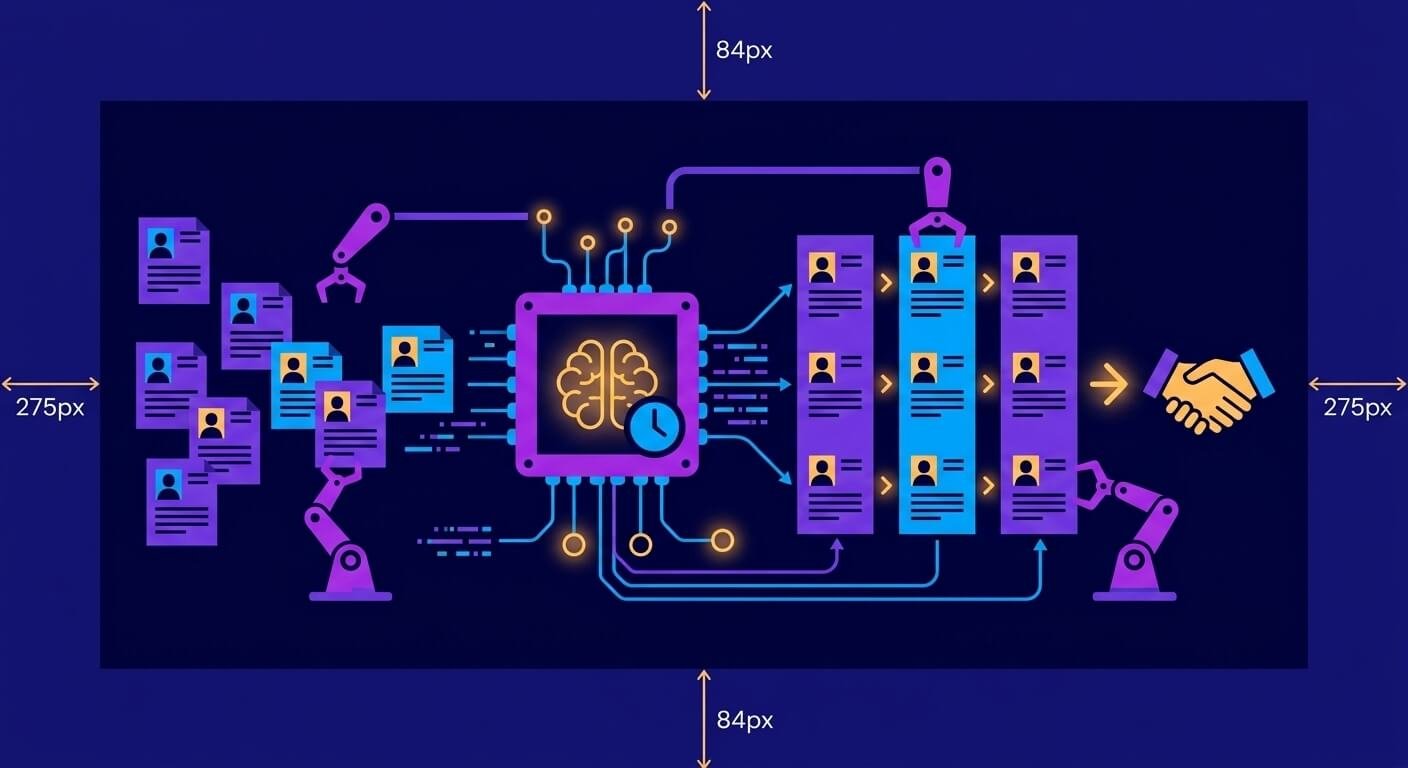

Understanding what should an AI automation roadmap include is the single most important question a UK mid-market executive can ask before committing capital to any AI programme. Yet sixty-eight percent of UK mid-market AI deployments stall at the legal or IT review stage not because the technology fails, but because vendor sales decks are mistaken for genuine execution plans. A real roadmap bridges the gap between theoretical ROI and operational reality, satisfying the distinct governance demands of Finance, IT, Legal, and Operations simultaneously. This article presents the exact framework, sequence, deliverables, and dependency logic that separates a roadmap built to survive your organisation from one built to win a procurement meeting.
Executive SummaryA credible AI automation roadmap must include: a Four-Pillar Feasibility Matrix covering IT, Legal, Finance, and Operations; a phased 12-month execution timeline with hard ROI tollgates; mandatory deliverables including UK GDPR data-lineage checkpoints and cross-functional RACI matrices; explicit legacy infrastructure dependency mapping; and compliance alignment with ICO automated decision-making guidance and FCA operational resilience frameworks. PrimeWise builds these frameworks from direct deployment experience across 40+ UK mid-market engagements.
The Difference Between a Vendor Roadmap and an Execution Roadmap
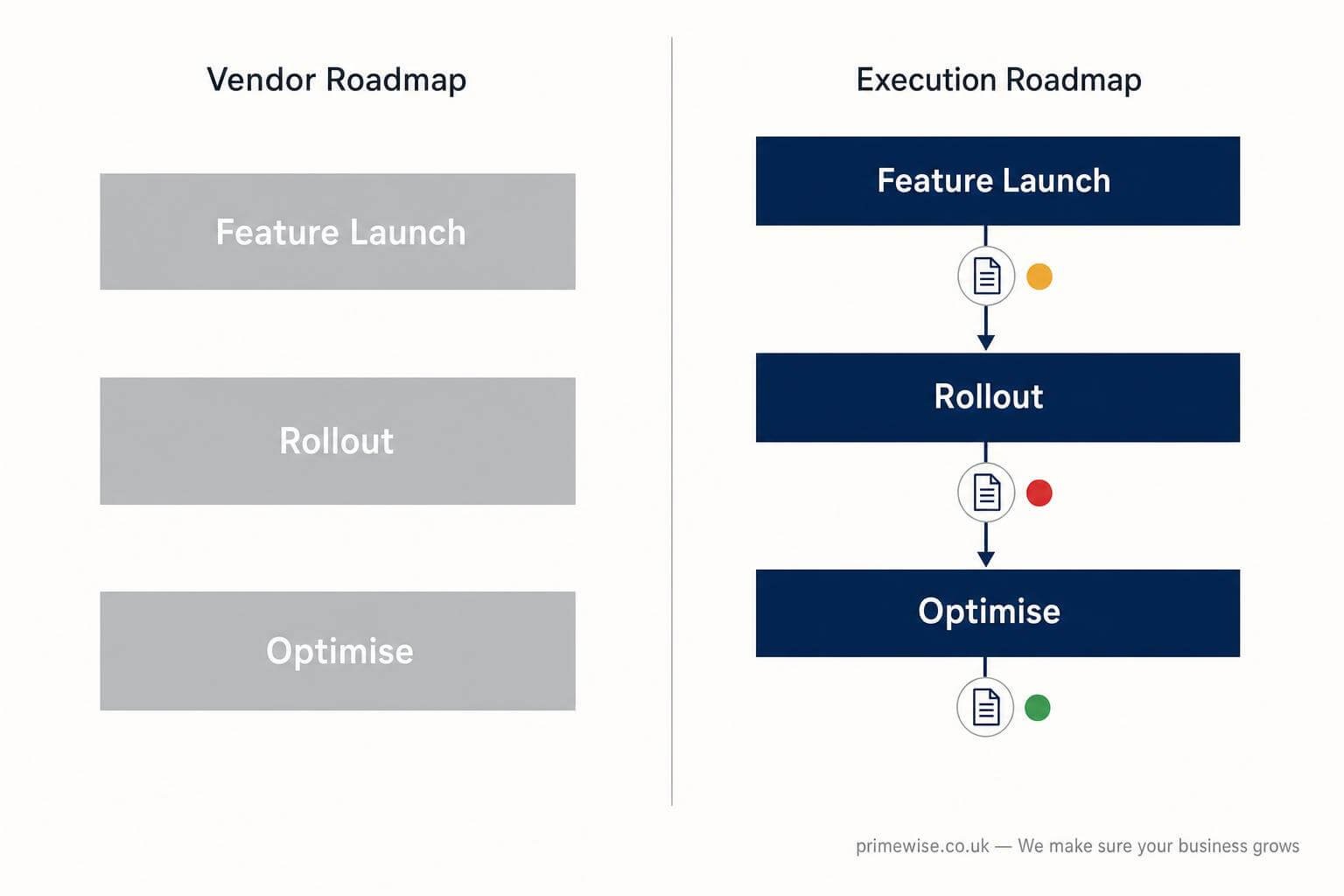
An AI automation roadmap is a cross-functional execution framework that sequences artificial intelligence deployment across a defined timeline, specifying mandatory deliverables, risk mitigation protocols, and technical dependencies required to integrate AI safely within legacy IT environments whilst satisfying legal and financial governance. It is categorically different from an AI strategy, which defines vision and commercial objectives. The roadmap defines the operational sequence that makes that vision survivable inside a real organisation with real constraints.
The word “actually” in the question most executives ask reflects a genuine suspicion: that what they have been shown is a polished narrative, not a working plan. That suspicion is correct in the majority of cases. Vendor roadmaps are built to reduce friction in the sales cycle. Execution roadmaps are built to reduce friction in the deployment cycle and these are opposing design philosophies. A vendor roadmap presents AI as a phased feature rollout. An execution roadmap presents AI as a governance event, a technical integration challenge, and a change management programme, sequenced precisely so that no single department can block progress by discovering unmitigated risk too late.
Why AI Projects Stall Before They Start
The primary failure mode in UK mid-market AI deployment is not technical it is procedural. Procurement is completed, licences are signed, and only then does the IT security team conduct a vendor risk assessment that surfaces data residency concerns. Legal discovers that the proposed workflow triggers UK GDPR Article 22 restrictions on automated decision-making. Finance cannot approve the next tranche of capital expenditure because no formal ROI baseline was established in Phase 1. Each of these scenarios is entirely predictable and entirely avoidable with the right sequence. PrimeWise’s proprietary deployment data across more than 40 UK mid-market engagements consistently identifies the same root cause: governance was treated as a final review rather than a foundational input.
RPA Versus LLM Integration Roadmaps
A critical source of C-suite confusion in 2026 is the conflation of robotic process automation roadmaps with large language model integration roadmaps. RPA deployment automating deterministic, rule-based processes using tools such as UiPath or Microsoft Power Automate carries a fundamentally different risk profile, governance requirement, and technical dependency map than deploying a large language model into customer-facing or decision-influencing workflows. LLM integration demands model explainability assessments under FCA guidance, data provenance tracking for training and fine-tuning data, and ongoing machine learning drift monitoring. An RPA roadmap that has been repurposed to govern an LLM deployment is one of the most common and most costly errors a UK mid-market firm can make. Your roadmap must specify which class of AI it governs from day one.
The Four-Pillar AI Feasibility Matrix
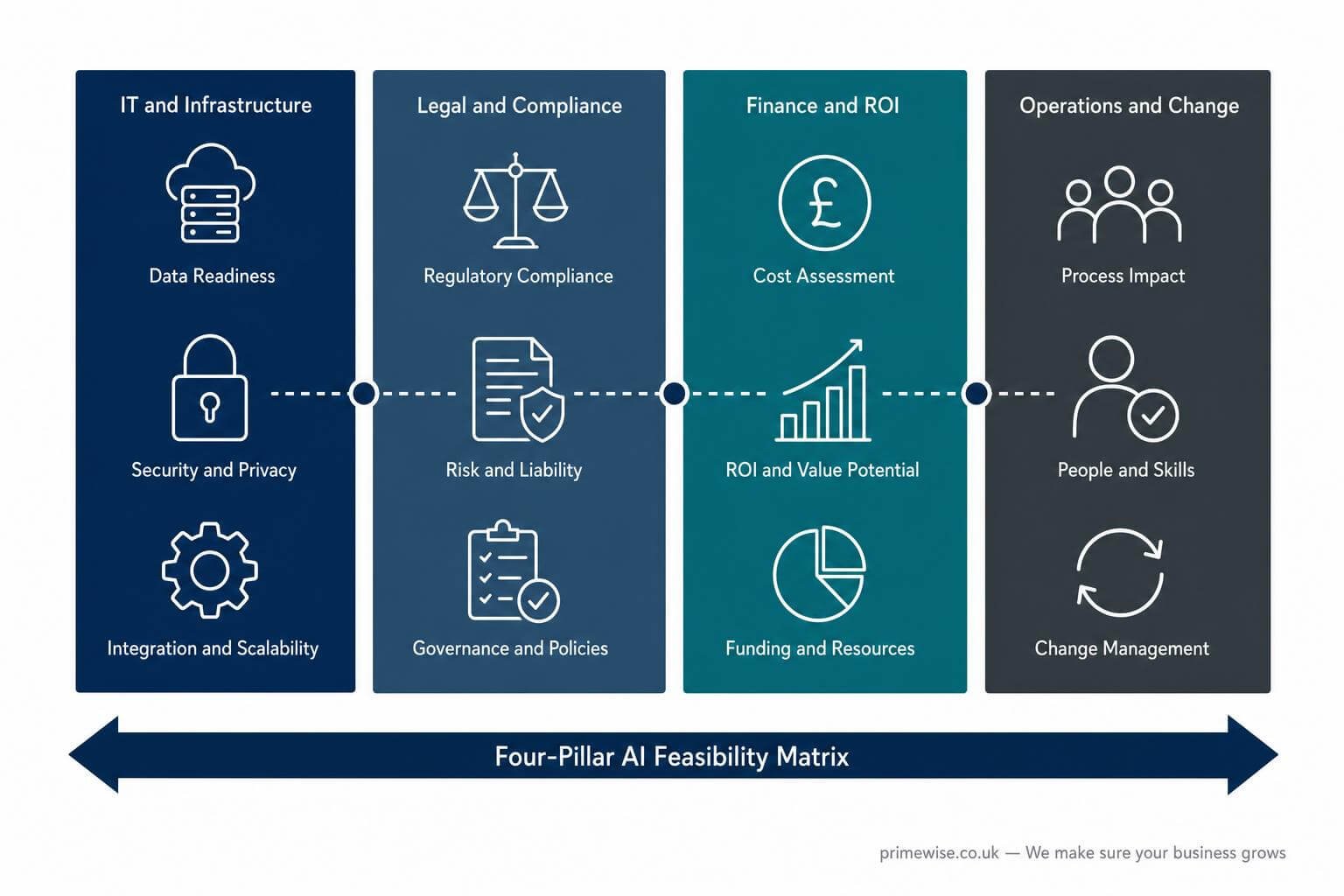
To prevent any single department from blocking deployment through late-stage risk discovery, every AI automation roadmap requires a structured alignment mechanism that runs parallel to technical delivery. PrimeWise developed the Four-Pillar AI Feasibility Matrix from direct client experience, and it remains the most robust pre-deployment tool for UK mid-market organisations navigating complex internal governance. The matrix evaluates four non-negotiable domains IT and Infrastructure, Legal and Compliance, Finance and Commercial Viability, and Operations and Change Readiness simultaneously, before a single line of integration code is written. The critical insight is that these pillars are interdependent: a gap in one creates a blocking condition in another.
IT and Infrastructure Prerequisites
Technical directors require concrete, documented assurances before authorising any AI integration into a live enterprise environment. This pillar conducts a systematic audit of the existing data architecture, maps all relevant application programming interface connectivity, models cyber threat vectors introduced by AI endpoints, and evaluates information security posture against the proposed deployment model. For UK mid-market firms which frequently operate hybrid environments combining Microsoft Azure or AWS cloud infrastructure with on-premise servers, legacy ERP systems such as Sage 200 or Microsoft Dynamics 365, and older FCA-regulated core banking platforms the API security mapping alone can surface blocking dependencies that would otherwise only appear in Month 8. Shadow IT risk, where line teams have begun using consumer AI tools outside of IT governance, must also be assessed and mitigated at this stage. ISO/IEC 42001, the AI management system standard published in 2023 and directly applicable to UK mid-market compliance programmes, provides a structured checklist for this pillar.
Legal Compliance and UK GDPR Alignment
For firms operating under regulatory oversight, particularly those subject to Financial Conduct Authority supervision, compliance is not a review stage. It is a design input. This pillar enforces UK GDPR data-lineage checkpoints from the first day of discovery, ensures alignment with Information Commissioner’s Office guidance on automated decision-making under Article 22, and maps the deployment against the FCA’s AI and Machine Learning Discussion Paper (DP5/22) and its operational resilience implications under PS21/3. For dual-regulated firms, the Prudential Regulation Authority’s model risk management expectations must also be addressed at this stage. An algorithmic impact assessment, documenting the potential for bias, explainability gaps, and unintended consequential outcomes, is a mandatory deliverable for any AI workflow that touches customer data or influences a regulated decision. Firms that address this pillar in Month 1 consistently reach full deployment faster than those that treat it as a legal sign-off event in Month 11.
Finance and Commercial ROI Tollgates
Chief Financial Officers express legitimate concern about capital programmes built on vendor-projected ROI figures that cannot be independently verified or operationally reproduced. This pillar establishes a formal financial governance structure from the outset, defining the capital allocation tranches, the cost-benefit baseline methodology, and critically, the hard performance thresholds that must be met before Phase 2 funding is released. A defensible pilot should demonstrate a minimum 15 to 25 percent reduction in process cycle time, or a quantified reduction in manual exception-handling hours, before scaling approval is granted. These numbers must be agreed in writing between Finance and the project sponsor before the pilot begins, not after it concludes. Without a pre-agreed ROI tollgate, CFO approval for scaling becomes a negotiation rather than a governance event.
CFO WarningReleasing Phase 2 capital without a pre-agreed, quantified ROI tollgate is the single most common cause of AI programme cancellation in the UK mid-market. Define the threshold before the pilot begins not after you need the result to justify it.
Operations and Change Management Readiness
Technology fails when the workforce is not prepared to receive it. This pillar evaluates operational readiness across line teams, assesses the degree of workflow disruption the deployment will introduce, and designs a change management programme calibrated to actual resistance points rather than generic training schedules. The Prosci ADKAR model, Awareness, Desire, Knowledge, Ability, Reinforcement, provides a proven structure for sequencing workforce enablement. Critically, this pillar also maps the interdependencies between operational workflows and the technical integration points identified in the IT pillar, ensuring that line teams are not asked to adopt new processes before the underlying system integration is stable and tested.
The 12-Month AI Automation Blueprint
A phased 12-month timeline transforms the Four-Pillar Matrix from a diagnostic tool into an operational delivery plan. Each phase has defined entry criteria, mandatory deliverables, and explicit exit conditions so that progress is governed by evidence rather than elapsed time. This structure is the primary mechanism for avoiding pilot purgatory, the chronic condition in which an AI deployment completes a successful pilot but never reaches enterprise scaling because no formal approval pathway was defined at the outset.
Months 1 to 3 Discovery and Data Readiness
No algorithmic model can be responsibly deployed without first establishing the quality, governance, and sovereignty of the data it will consume. The initial quarter is governed entirely by foundational work: a comprehensive data readiness assessment, UK GDPR data-lineage mapping, vendor risk assessments covering large language model data sovereignty, an information security questionnaire aligned to the proposed architecture, and the formation of a cross-functional governance charter that establishes accountability before deployment begins. The output of this phase must include a signed-off AI governance charter, a completed algorithmic impact assessment, and an approved vendor risk register. If the IT and Legal pillars of the feasibility matrix have not reached a satisfactory baseline by the end of Month 3, the roadmap must not progress to the pilot phase. This is not a delay it is the tollgate function operating as designed.
Months 4 to 6 Pilot Deployment and System Hardening
The pilot phase deploys the AI model into a sandboxed environment that mirrors live operational conditions without exposing production systems to uncontrolled risk. During this period, API integrations are stress-tested against legacy infrastructure, operational bottlenecks are catalogued, and the change management programme begins its initial workforce engagement activities. System hardening the process of reducing the attack surface of the AI environment through endpoint security controls, access management protocols, and penetration testing is a non-negotiable activity during this phase, not an afterthought. The pilot must operate for a minimum of eight weeks before any performance data is considered statistically reliable for the ROI tollgate review.
Months 7 to 9 Financial ROI Review and Recalibration
The ROI tollgate inserted between the pilot and scaling phases is the structural mechanism that protects enterprise capital from premature commitment. A cross-functional review board comprising representatives from Finance, IT, Legal, and the line operation evaluates pilot performance against the pre-agreed thresholds established in the Finance pillar of the feasibility matrix. Three outcomes are possible: the pilot meets threshold and proceeds to scaling, the pilot partially meets threshold and enters a defined recalibration cycle, or the pilot fails threshold and the programme is formally paused with a documented root-cause analysis. All three outcomes are legitimate. The third outcome, handled transparently, protects significantly more capital than a programme that proceeds to scaling on optimistic assumptions. If your current AI programme lacks a formal ROI tollgate framework, PrimeWise offers a no-obligation 60-minute AI Feasibility Assessment designed specifically for UK mid-market firms navigating governance complexity request yours at primewise.co.uk.
Months 10 to 12 Enterprise Scaling and Optimisation
The final quarter provides the structured pathway from controlled pilot to full organisational adoption. Activities in this phase concentrate on managed enterprise rollout, continuous model performance monitoring, machine learning drift detection and correction, and the formalisation of an ongoing AI governance review cycle aligned to ICO and FCA guidance update cadences. The NIST AI Risk Management Framework provides a robust structure for the ongoing governance activities that must be embedded into normal operations at this stage, ensuring that the programme does not revert to an ungoverned state once the project team disbands. A formal review cadence quarterly at minimum should be documented and owned by a named internal governance lead before the programme is considered complete.
Avoiding Pilot PurgatoryPilot purgatory occurs when a successful AI pilot cannot proceed to scaling because no approval pathway was defined at the outset. The 12-month blueprint resolves this by embedding the ROI tollgate and scaling criteria into the roadmap before the pilot begins.
Non-Negotiable Deliverables for Every AI Roadmap
A genuine execution roadmap produces concrete, auditable artefacts not presentation slides. The following deliverables are the minimum required set for any UK mid-market AI deployment that must survive Finance, IT, Legal, and Operations review. Their absence from a proposed roadmap is the clearest possible signal that what you are looking at is a sales deck.
- Data readiness assessment documenting data quality, completeness, and governance baseline across all in-scope data sources
- UK GDPR data-lineage map tracing personal data flows from source through AI processing to output and storage, aligned to ICO guidance
- Vendor risk assessment covering large language model training data provenance, data residency, sub-processor agreements, and deletion protocols
- Information security questionnaire completed against the proposed technical architecture, including API security, endpoint controls, and penetration testing schedule
- Algorithmic impact assessment evaluating bias risk, explainability obligations, and FCA-relevant model risk considerations
- Cross-functional RACI matrix defining accountability for every phase, every deliverable, and every failure scenario across Finance, IT, Legal, and Operations
- AI governance charter establishing the cross-functional steering group, escalation pathway, and review cadence
- Pre-agreed ROI tollgate thresholds with quantified performance benchmarks approved by Finance before the pilot phase begins
- Operational redundancy and failure protocol documenting system fallback procedures, incident escalation ownership, and business continuity provisions
- Machine learning drift monitoring plan specifying detection methodology, review frequency, and recalibration authority
Legacy Infrastructure and Dependency Mapping
The UK mid-market relies more heavily on legacy infrastructure than any comparable market segment in Western Europe. Established financial and professional services firms in London frequently operate core systems that were not designed for API-first integration: on-premise server environments, Sage 200 accounting platforms, Microsoft Dynamics 365 deployments with significant customisation, older SAP configurations, and proprietary core banking systems running on infrastructure that predates modern cloud security standards. An AI automation roadmap that assumes a clean, cloud-native environment will fail on contact with this reality.
Effective dependency mapping requires a technical architect to walk every proposed AI integration point backwards from the model to the data source, documenting every system handoff, every authentication mechanism, every data transformation layer, and every potential point of failure. Where legacy systems cannot support direct API integration, middleware solutions Microsoft Azure API Management, MuleSoft, or Boomi must be evaluated and their implementation timelines built into the roadmap sequencing. Data mesh architecture, which distributes data ownership to domain teams rather than centralising it in a single data lake, is an increasingly viable alternative for organisations whose legacy environment makes centralised data consolidation impractical. The dependency map is not a background technical document it is a governance deliverable that Legal and IT must both sign off before the pilot begins.
UK Regulatory Context Every AI Roadmap Must Address
Unlike jurisdictions operating under a single prescriptive AI regulation, UK mid-market firms face a multi-regulator environment in which AI governance obligations emerge from several overlapping frameworks. Each of the following must be explicitly addressed within the roadmap documentation, not simply acknowledged in a compliance statement.
- UK GDPR Article 22 restrictions on solely automated decision-making with legal or similarly significant effects, enforced by the ICO with guidance updated in 2023 and 2024
- FCA AI and Machine Learning Discussion Paper DP5/22 the foundational regulatory reference for AI deployment in FCA-regulated firms, with model explainability and operational resilience as primary themes
- FCA Operational Resilience Policy Statement PS21/3 establishing impact tolerance obligations that AI-dependent processes must be mapped against
- PRA Model Risk Management Principles SS1/23, applicable to PRA-regulated firms deploying AI in risk-relevant workflows, requiring model validation, governance, and documentation standards
- ISO/IEC 42001 the international AI management system standard, providing a certification-ready framework for internal AI governance that satisfies both ICO and FCA documentation expectations
- UK AI Safety Institute Voluntary Commitments Framework the 2024 framework relevant to frontier AI model deployment, increasingly referenced in regulated sector procurement due diligence
Firms that treat regulatory alignment as a legal department responsibility, rather than a roadmap design input, consistently discover compliance gaps at the worst possible moment during a live audit, following a processing incident, or when a pilot workflow is already embedded in a customer-facing process. Building regulatory checkpoints into the roadmap timeline, with named sign-off owners and documented evidence requirements, converts compliance from a risk into a competitive advantage during procurement and client due diligence.
A UK Financial Services Deployment What Actually Changed
A UK-based independent wealth manager with approximately £2.3 billion in assets under management approached PrimeWise having already spent four months attempting to deploy an automated client onboarding workflow. The vendor roadmap they had been provided contained a feature rollout schedule and a projected 40 percent reduction in onboarding time but no legacy integration strategy for their on-premise server environment, no UK GDPR data-lineage checkpoint, and no ROI tollgate mechanism. The programme had stalled because IT had not signed off on the vendor’s API access requirements and Legal had identified an Article 22 exposure in the automated KYC decisioning workflow.
By applying the Four-Pillar AI Feasibility Matrix, PrimeWise realigned IT and Legal around a revised technical architecture that routed the automated decisioning through a human-in-the-loop validation step, satisfying both the Article 22 obligation and the IT security requirement simultaneously. A formal ROI tollgate was established with Finance, a cross-functional RACI matrix was created, and the pilot was relaunched into a sandboxed environment within six weeks. The result was a 34 percent reduction in average client onboarding time within five months of full deployment, full FCA compliance, and a programme that had recovered four months of lost time compared to the original vendor timeline. This outcome is replicable. PrimeWise guides UK mid-market executives through every phase of this framework from data readiness to enterprise scaling with full accountability at every tollgate.
What to Do NextThree options, ranked by commitment level: (1) Request a no-obligation 60-minute AI Feasibility Assessment at primewise.co.uk designed for UK mid-market firms navigating governance complexity. (2) Download PrimeWise's AI Automation Roadmap template covering all 12 phases and mandatory deliverables. (3) Read the companion article on UK GDPR compliance requirements for AI deployments in regulated sectors.