AI adoption and automation support is now one of the largest capital line items on UK corporate balance sheets, yet McKinsey’s 2024 State of AI report found that only 11% of firms achieve scaled deployment. Boards across London’s professional services and mid-market sectors are authorising six and seven-figure investments in cognitive tools, only to watch daily active usage collapse within weeks of launch. This is not a technology problem. It is a human one. At Primewise, we have guided over fifty UK mid-market firms through precisely this transition, and the pattern of failure is remarkably consistent: the tools work, the people do not use them, and the capital quietly drains away.
What AI Change Management Actually Means
AI adoption and change management is the strategic, human-centric process of aligning workplace culture, role redesign, and performance metrics with artificial intelligence deployments. It ensures staff transition from fearing workforce redundancy to actively embedding automation into their daily operational habits. It is emphatically not a software rollout. It is an organisational redesign programme that happens to involve software.
The distinction matters because every firm that conflates the two ends up in the same place: a shiny platform, an underwhelmed IT department claiming success, and a workforce that has quietly reverted to spreadsheets. Understanding this difference is the prerequisite for everything that follows.
Why Traditional Change Management Fails for AI
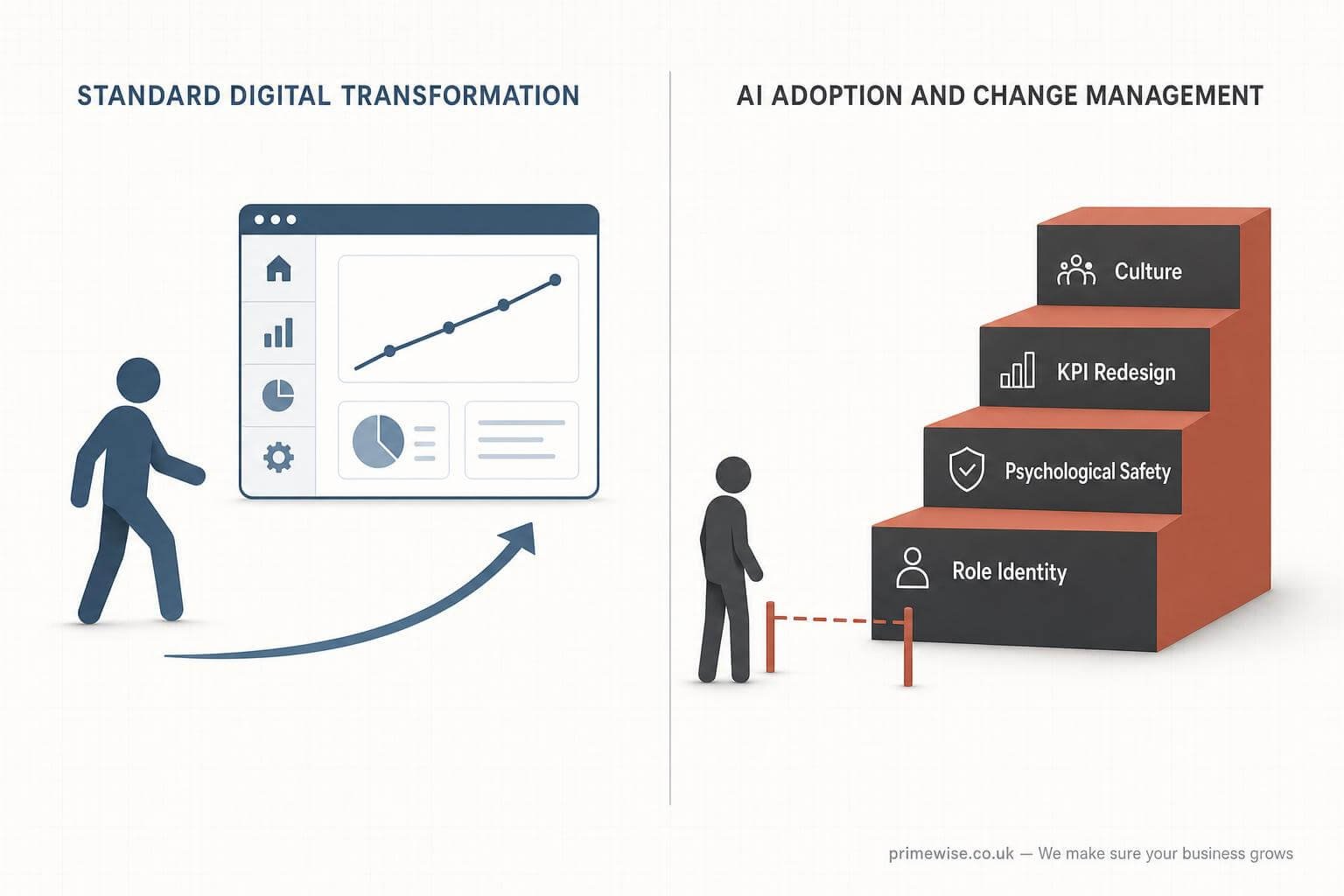
Standard IT deployment playbooks are structurally incompetent when applied to cognitive technologies. They were designed for a world where the primary challenge was behavioural adjustment, teaching staff to navigate a new interface, follow a revised process, or log data into a different system. Generative AI presents a categorically different psychological challenge.
An Existential Threat Versus a New Interface
When an employee is asked to adopt a new CRM system, the implicit message is: your job continues, only slightly differently. When they are asked to work alongside a large language model that can draft their reports, synthesise their research, and generate their client communications, the implicit message, however unintended, is: your job may not continue at all. Traditional change management reads this as a training problem. It is actually an existential anxiety problem, and the intervention required is fundamentally different.
This distinction explains the phenomenon Primewise calls shadow rejection, the silent, unvoiced drift back to legacy processes that masquerade as adoption inertia. Employees do not raise objections in all-hands meetings. They simply do not open the application after the mandatory training week ends. CIPD’s 2024 People and Technology survey found that 61% of employees in professional services reported feeling that AI tools were introduced without adequate explanation of how their role would change. That anxiety, left unaddressed, is the primary driver of stalled ROI.
The IT and Operations Silo Problem
A second structural failure occurs at the departmental boundary. IT declares a successful deployment when the software is installed, integrations are live, and licences are assigned. Operations inherits a tool that has been technically validated but not operationally embedded. The workflows have not been redesigned around the capability. The job descriptions have not been updated. The KPIs still reward the manual behaviours the tool was supposed to replace. The result is a £340,000 annualised capital drain for a fifty-person advisory team operating at 8% daily active usage, a figure that applies to dozens of mid-market firms simultaneously right now.
Executive WarningIf your AI rollout dashboard shows a usage spike during training week followed by a steep drop-off within 30 days, you are not experiencing a technology failure. You are experiencing shadow rejection. The intervention required is cultural, not technical.
The UK Context That Makes This Harder
Deploying cognitive tools within the UK’s regulatory and labour relations landscape adds a layer of complexity that generalist change management frameworks routinely overlook. The ONS productivity data tells a stark macro story: UK output per hour worked has grown approximately 0.5 percentage points per year below G7 peers since 2019, with technology under-utilisation consistently cited as a primary structural cause. For C-suite leaders, AI adoption is therefore not merely an operational efficiency question it is a national competitiveness obligation.
Navigating UK GDPR, TUPE, and the ICO Guidance
The legal exposure associated with poorly managed AI rollouts in the UK is significant and specific. Under Article 22 of UK GDPR, employees have explicit rights regarding automated decision-making that directly affects them a provision the ICO has actively enforced in financial services and HR contexts since 2023. Any AI deployment that touches performance management, client allocation, or workflow prioritisation triggers these obligations. Firms must document their lawful basis, implement human review mechanisms, and maintain transparent records of how automated outputs are used in consequential decisions.
In unionised environments or during restructuring, the TUPE framework introduces additional obligations. The UK Government’s AI Opportunities Action Plan, published in January 2025, explicitly encourages proactive employee consultation as a condition of accessing certain adoption incentive programmes. Firms that treat legal compliance as a post-deployment consideration rather than an integration design requirement routinely generate union grievances, ICO investigations, and costly remediation processes that dwarf the original technology investment.
Compliance InsightThe ICO's guidance on automated decision-making under Article 22 of UK GDPR is not aspirational it carries enforcement teeth. Any AI tool that influences performance reviews, task allocation, or client-facing outputs requires a documented human review mechanism and a transparent employee communication strategy before deployment, not after.
Reinvesting Time Saved into Revenue Growth
The productivity argument for AI adoption in UK professional services is compelling when framed correctly. The challenge is that the time saved by automation does not automatically translate into revenue. If reclaimed hours simply dissolve into longer lunch breaks or lower-stakes administrative tasks, the ROI case collapses. Leadership must establish explicit time-reinvestment metrics from day one, tracking how efficiently recovered hours are channelled into client advisory work, business development, and higher-margin service delivery. This is the bridge between operational efficiency and measurable commercial return.
The Primewise EPIC Adoption Framework
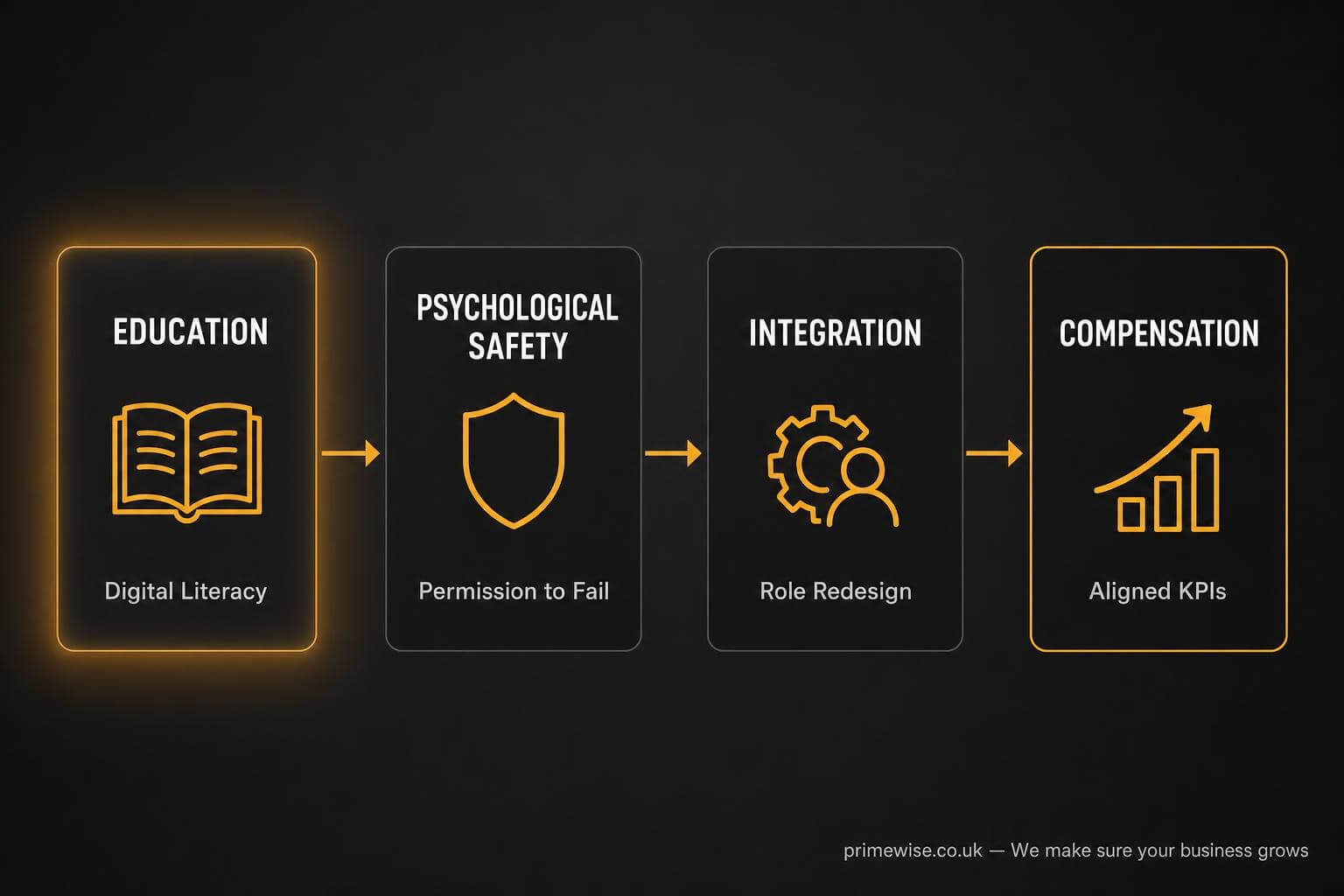
Primewise developed the EPIC Adoption Framework specifically for mid-market firms navigating their first or second-generation AI deployment. It addresses the four failure modes that generic change management programmes consistently miss: inadequate education, absent psychological safety, unchanged role structures, and misaligned financial incentives. Each pillar is a discrete intervention with a diagnostic entry point and a measurable outcome.
Education Building Genuine Digital Literacy
Training that stops at prompt engineering is training that stops too early. The EPIC framework requires that employees understand not just how to use an AI tool, but what it fundamentally cannot do. This means explicitly discussing hallucination rates, the limitations of large language models in jurisdictional legal contexts, and the scenarios where human judgment is not merely preferable but legally required. When staff understand the boundaries of the technology, two things happen simultaneously: their fear of replacement diminishes, and their quality control instincts improve. Both outcomes accelerate adoption.
Common Failure Point: Firms that run a single two-hour training session and assume literacy has been achieved. Digital literacy for AI tools requires iterative exposure, structured Q&A sessions, and a designated internal champion who can field live questions as staff encounter real-world edge cases.
Diagnostic Question for Leadership: Can your median employee articulate two specific limitations of the AI tool you have deployed? If not, your education pillar has not been implemented.
Psychological Safety: Designing Permission to Fail
Staff will not experiment with tools they believe could expose their incompetence during the learning curve, particularly in high-performance cultures where output quality is closely monitored. Psychological safety in the context of AI adoption means leadership explicitly communicating and demonstrating through their own behaviour that incorrect prompts, suboptimal outputs, and trial-and-error experimentation are expected and valued. This is not a soft cultural aspiration. It is a hard adoption prerequisite.
Common Failure Point: Senior leaders who publicly endorse AI adoption but privately demand polished outputs from day one, creating a double bind that paralyses junior staff from engaging meaningfully with the tool.
Diagnostic Question for Leadership: In the last 30 days, has any senior leader in your organisation shared a prompt that produced a poor output and discussed what they learned from it? If the answer is no, psychological safety is absent.
Integration The AI Role Redesign Matrix
The Primewise AI Role Redesign Matrix is a structured HR framework that translates individual job descriptions from task-execution language into AI-management language. Instead of an analyst being evaluated on the number of reports produced, they are evaluated on the accuracy of AI-generated outputs they have reviewed, the quality of prompts they have constructed, and the strategic insights they have derived from synthesized data. This is not semantics, it is a fundamental reorientation of where human value sits in an AI-augmented workflow.
Human resources departments must lead this process, working alongside operations and line managers to identify which responsibilities are genuinely transferable to automation, which require human oversight, and which are entirely irreplaceable by machine. The output is an updated job architecture that positions every affected employee as an essential, high-value participant in the AI-augmented process rather than a redundant legacy function.
Common Failure Point: Firms that deploy AI into workflows without updating job descriptions at all, leaving employees in the psychologically untenable position of being evaluated on manual output volumes while being expected to use a tool that reduces manual output volume.
Diagnostic Question for Leadership: Have your HR and operations teams jointly reviewed and updated the job descriptions of every role the AI tool directly affects? If job descriptions were last updated before the deployment decision, your integration pillar is incomplete.
Compensation Rewarding High-Leverage Outcomes
The EPIC framework’s final pillar is where most programmes fail most expensively. If your performance management system still rewards lawyers by billable hour, financial advisers by the number of portfolio reviews completed manually, or analysts by report volume, you have constructed a financial incentive system that actively punishes AI adoption. This is not a cultural nuance it is a structural contradiction that no amount of executive communication will overcome.
Firms retaining billable-hour models in legal, financial, or consulting functions are statistically the highest-risk cohort for shadow rejection across our entire client base. The intervention requires a KPI redesign that measures the quality of AI-managed outputs, strategic value delivered to clients, and the productive reinvestment of time recovered through automation. When compensation follows the new behaviour, adoption follows compensation.
Common Failure Point: Treating KPI redesign as a future-state consideration rather than a prerequisite for deployment. Employees make a rational economic calculation about whether AI adoption serves their interests within the current incentive structure. If it does not, they will not adopt regardless of how compelling the technology is.
Diagnostic Question for Leadership: Does your current performance management system financially reward an employee who uses AI to double their strategic output, or does it penalise them for reducing their manual task volume? The answer determines your adoption ceiling before a single licence is activated.
Strategic InsightThe Primewise EPIC Adoption Framework is not a communications plan it is an operational redesign programme. Firms that implement all four pillars simultaneously before deployment consistently achieve sustained daily active usage above 60%. Firms that implement them sequentially or selectively average below 20%.
Case Study Reversing a Stalled AI Rollout in UK Wealth Management
A 500-person wealth management firm headquartered in London’s EC2 corridor invested significantly in deploying a large language model integrated directly into their portfolio reporting and client communication infrastructure. The platform was technically sophisticated, well-integrated, and supported by a credible vendor. The rollout followed a standard IT deployment model: a mandatory training week, written guidance documentation, and a helpdesk function for technical queries.
Within four weeks of launch, daily active usage had collapsed to 8% of the workforce. Senior analysts with AUM responsibilities ranging from £50M to £200M had quietly reverted to their previous manual consolidation processes, citing concerns about the accuracy of automated insights and uncertainty about professional liability when AI-generated outputs were included in client-facing materials.
The Intervention Shifting Metrics and Redesigning Roles
Primewise was engaged to conduct a Change Readiness Diagnostic, which identified all four EPIC failure modes operating simultaneously. The education pillar had not addressed professional liability boundaries. Psychological safety was absent in a performance culture where client-facing errors carried significant reputational risk. Job descriptions had not been updated to reflect the AI-managed analyst model. And the KPI structure still evaluated analysts on manual reporting volume rather than strategic client advisory output.
The intervention ran over eleven weeks. KPIs were redesigned to measure proactive client advisory calls enabled by recovered reporting time. Analyst job descriptions were rewritten using the AI Role Redesign Matrix, explicitly positioning the human review of AI outputs as the primary value-add function. A structured psychological safety programme was delivered by line managers trained by Primewise. Legal and compliance education sessions addressed professional liability in the context of AI-assisted reporting.
The outcome: a 65% higher sustained adoption rate within the following fiscal quarter. The reallocation of approximately 2,400 analyst hours per quarter toward client-facing advisory activities generated an estimated £1.2M in incremental advisory revenue within six months. More significantly, analyst attrition during the period dropped to zero a direct consequence of role redesign that positioned staff as more strategically valuable rather than more operationally threatened.
Replication PathwayFirms experiencing similar adoption plateaus can request a confidential Change Readiness Diagnostic at primewise.co.uk a board-level assessment that delivers a scored cultural readiness index and a customised integration roadmap within five business days.
Diagnosing Your Firm’s Cultural Readiness
Before authorising further AI software procurement, executive teams must objectively evaluate the cultural and operational conditions that will determine whether the next deployment succeeds or silently fails. The following indicators provide an honest diagnostic framework applicable across professional services, financial advisory, legal, and management consulting functions.
Early Warning Signs of Quiet Failure
The clearest early indicator is the usage-cliff pattern: a spike during mandatory training week followed by a steep decline within 30 days. Secondary indicators include siloed adoption where only the IT department or a small cohort of early adopters engages consistently, while front-line operational staff remain effectively disengaged. Additional red flags include an increase in workaround documentation, internal guides and templates that bypass the AI tool entirely and informal peer communication characterised by skepticism rather than curiosity.
- Usage drops below 15% daily active users within 30 days of launch
- Adoption concentrated exclusively in technical or innovation teams
- Front-line staff unable to articulate a single use case relevant to their daily role
- No update to job descriptions or KPIs since deployment decision
- Senior leadership using the tool privately but not publicly modelling its use
- HR and operations absent from the deployment governance structure
The 90-Day Remediation Plan
Organisations recognising these patterns must act before the cultural window closes. A structured remediation process begins with a deliberate pause on further technical deployments additional features, integrations, or platform expansions must wait until cultural foundations are established. Primewise’s 90-day remediation sequence begins with an anonymous staff sentiment survey to establish an honest baseline of fear, confusion, and unmet expectations. This data drives a customised EPIC implementation plan rather than a generic change communications campaign.
Weeks one through four focus on leadership alignment and education redesign. Weeks five through eight address role redesign and KPI restructuring. Weeks nine through twelve implement the psychological safety programme and relaunch with revised success metrics. Organisations requiring an accelerated intervention can access Primewise’s structured Change Readiness Diagnostic a confidential, board-level assessment available at primewise.co.uk which provides a scored readiness index and a customised integration roadmap within five business days.
How AI Change Management Compares to Standard Digital Transformation
A common executive misconception is that a firm’s track record of successful digital transformation programmes ERP migrations, CRM rollouts, cloud transitions provides adequate organisational capability for AI adoption. It does not, and the gap is larger than most leadership teams expect.
| Dimension | Standard Digital Transformation | AI Adoption and Change Management |
|---|---|---|
| Primary Challenge | Behavioural adjustment to new interface | Existential anxiety about role relevance |
| HR Involvement | Communications support | Role redesign and KPI restructuring lead |
| Training Scope | Process and interface competency | Digital literacy, limitations, and liability |
| Success Metric | Task completion in new system | Strategic output quality and time reinvestment |
| Legal Exposure | Data migration compliance | UK GDPR Article 22, ICO automated decision-making, TUPE |
| Timeline | Implementation-driven | Culture-driven, minimum 90-day foundation |
The table above reflects a consistent finding across Primewise’s client base: firms that approach AI adoption using their existing digital transformation playbook consistently underinvest in the human elements and overinvest in the technical ones. The ratio of resource allocation should, in most mid-market contexts, be inverted from what leadership initially plans.