
How to get employees to adopt ai is the defining operational challenge facing every COO, Innovation Partner, and Transformation Lead in UK professional services right now. According to McKinsey’s 2025 State of AI report, 63 percent of UK knowledge-sector employees express active resistance to AI integration, costing the average mid-market firm an estimated 1,200 billable hours annually in stalled workflows and repeated training cycles. Securing genuine, measurable AI adoption and automation support requires far more than procuring an enterprise licence it demands a structured, empathy-led change management playbook built around the specific psychological, regulatory, and commercial realities of regulated professional services.

This guide presents the PrimeWise ACT Matrix a proprietary framework developed by the organisational change consultants at primewise.co.uk through direct deployment experience with legal, financial services, and consulting firms across the UK. It covers the exact messaging, manager enablement strategies, compliance guardrails, and board-level metrics your firm needs to move beyond nominal log-in statistics and achieve adoption that is genuinely embedded in daily fee-earning workflows.
Executive Summary63% of UK professional services AI rollouts stall due to internal resistance. The PrimeWise ACT Matrix Augmentation, Compliance, Trust provides a structured, compliance-first playbook that transforms sceptical fee-earners into active AI practitioners. Firms applying this framework report a 68% increase in sustained complex AI usage and measurable reductions in matter preparation time within two quarters.
What Genuine AI Adoption Actually Means
Genuine AI adoption in professional services is the systematic, measurable integration of artificial intelligence into daily fee-earning workflows augmenting human expertise, eliminating routine administrative burden, and demonstrably expanding client advisory capacity, all within verified compliance boundaries.
This definition is deliberate. It separates strategic operational transformation from the mere acquisition of enterprise software. An AI tool installed but rarely used is not adoption it is shelf-ware. Genuine adoption means a corporate finance associate uses a large language model to draft initial due diligence summaries with documented human review steps. It means a litigation partner queries a proprietary knowledge base within a ring-fenced data enclave rather than a public LLM. It means those behaviours are measurable, repeatable, and tied to outcomes the partnership board can quantify. Every element of the ACT Matrix is designed to produce exactly that result.
The PrimeWise ACT Matrix
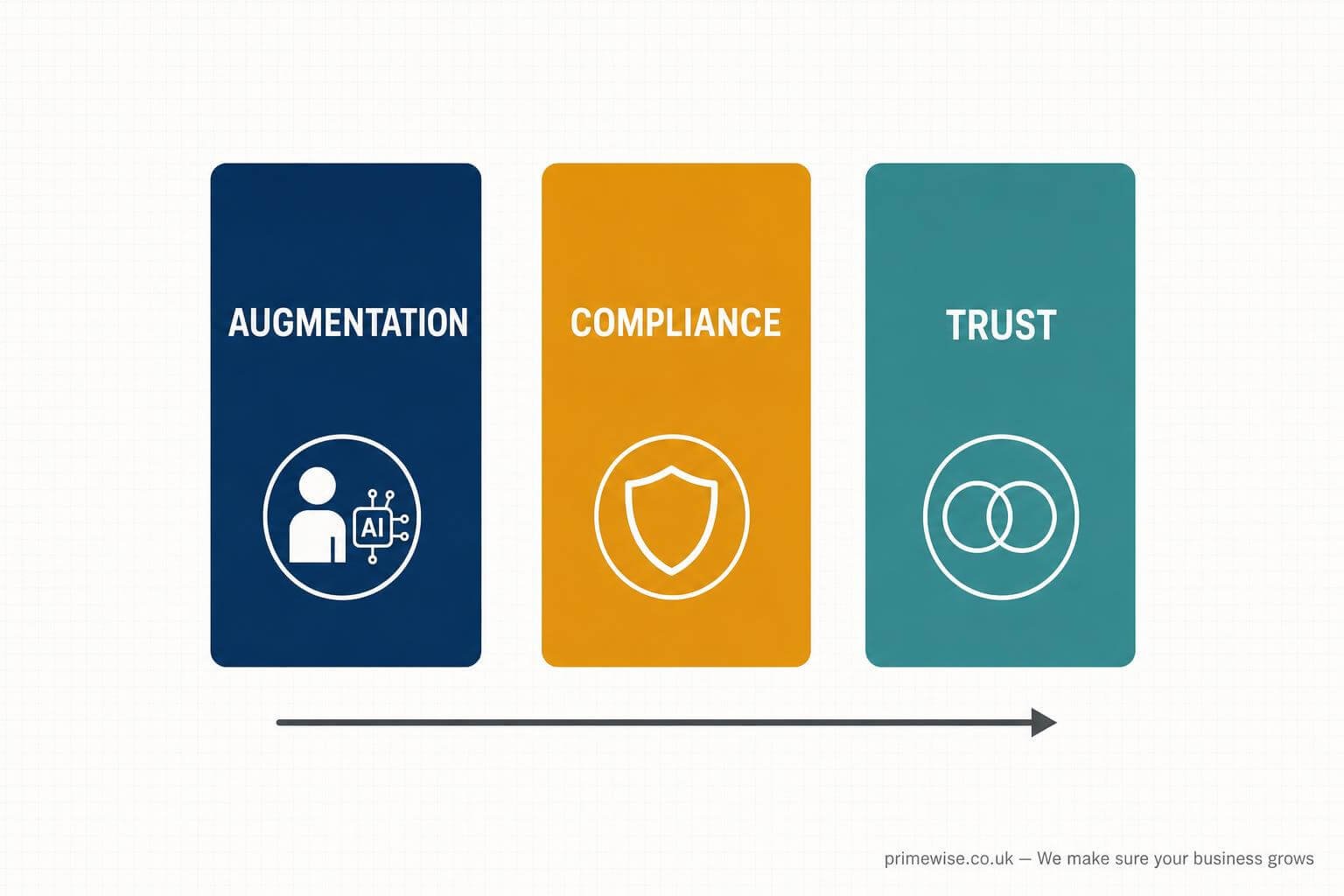
The ACT Matrix Augmentation, Compliance, Trust is a change management framework developed by PrimeWise through hands-on AI rollouts inside UK legal, financial services, and professional consulting firms. It directly addresses the three root causes of employee resistance that generic IT-led deployments consistently fail to resolve. Each pillar has its own diagnostic criteria, implementation steps, and outcome metric, making it a fully operationalised playbook rather than a conceptual model.
By anchoring technology deployment to these three foundational pillars, transformation leads can systematically dismantle the psychological and practical barriers that prevent junior analysts, mid-level managers, and senior partners from embedding AI into their billable work. The matrix functions as both a diagnostic tool and a sequenced implementation guide firms typically begin with the Augmentation pillar to address fear, move to Compliance to establish legal confidence, and then build Trust through visible leadership behaviour and peer validation.
Pillar One Augmentation Over Autopilot
The single most corrosive belief inside any AI rollout is the assumption that the technology is designed to reduce headcount. Among junior associates and analysts the exact population whose daily tasks AI most directly affects redundancy fear is not irrational; it is logical. If leadership does not address this belief explicitly and early, passive resistance hardens into active sabotage: tools are used minimally to satisfy log-in metrics, prompts remain superficial, and the commercial case for the investment collapses.
The Augmentation pillar reframes the entire narrative using human-in-the-loop workflows as the operational and rhetorical standard. When deploying tools such as Microsoft Copilot for Microsoft 365, Harvey AI for legal practices, or Salesforce Einstein for financial services client management, the messaging must position the tool as a junior co-worker that handles the administrative scaffolding not a replacement for the strategic, relationship-driven, and judgement-intensive work that defines senior professional value. In London’s fiercely competitive talent market, where a clumsy rollout can trigger exits to Magic Circle or Big Four rivals, framing AI as a premium upskilling benefit rather than a threat is not just culturally sensitive it is a talent retention strategy.
- Lead all internal communications with the phrase “AI handles the drafting, you handle the judgement” as a consistent anchor message.
- Map specific AI tool capabilities directly to tasks employees already find mentally draining contract review, research summarisation, data extraction to demonstrate immediate personal benefit.
- Publish internal case studies within the first 30 days showing senior practitioners, not just IT champions, actively using the tools in live matters.
- Explicitly include AI upskilling credentials in annual appraisal frameworks so that proficiency is visibly valued rather than merely expected.
The outcome metric for this pillar is prompt complexity progression measuring whether employees move from basic, single-sentence queries to multi-step, context-rich prompts that demonstrate genuine workflow integration. This signals authentic capability development rather than nominal compliance.
Pillar Two Navigating UK Regulatory Compliance
Regulatory anxiety is the second most powerful inhibitor of AI adoption in UK professional services, and it is entirely understandable. A solicitor who uploads a confidential M&A instruction to a public large language model without understanding the data processing implications faces professional conduct consequences under the SRA Code of Conduct 2019. A financial adviser who uses a generative AI output as the basis for client advice without documented human review risks breaching FCA Consumer Duty obligations under the Consumer Duty final rules (PS22/9). The fear of inadvertent non-compliance paralyses employees at precisely the moment they would otherwise experiment and build fluency.
The Compliance pillar establishes clear, documented operational guardrails that transform regulatory anxiety into regulatory confidence. Firms must implement secure, ring-fenced data enclaves enterprise-grade deployments of tools like Microsoft Azure OpenAI Service or Harvey’s UK-hosted instance that ensure client data never leaves the firm’s controlled processing environment. This directly addresses the most common UK-GDPR concern: whether using a third-party AI tool constitutes an unauthorised transfer of personal data to a data processor under Article 28 of UK-GDPR, or triggers the automated decision-making protections of Article 22.
UK Compliance AlertThe ICO's 2024 Guidance on Generative AI and Data Protection confirms that firms must conduct a Data Protection Impact Assessment (DPIA) before deploying any generative AI tool that processes personal client data. The FCA's Discussion Paper DP5/22 on AI and Machine Learning further requires that firms embedding AI into client-facing advisory workflows maintain explainability and human oversight as core governance principles. Non-compliance is not a theoretical risk the ICO issued 14 enforcement notices related to AI data processing in 2024 alone.
The SRA’s specific 2024 warnings on generative AI use in client-facing outputs make clear that solicitors remain personally responsible for the accuracy and professional standard of any document produced with AI assistance. The Compliance pillar therefore requires that every AI output used in a client context is treated as a first draft subject to mandatory professional review a standard that, when communicated clearly, actually reduces resistance because it preserves professional accountability rather than removing it.
- Commission a DPIA for each AI tool deployed, documented and accessible to all staff who use the system.
- Create a one-page “AI Acceptable Use Charter” aligned to FCA Consumer Duty, SRA Code of Conduct 2019, and UK-GDPR Article 22, and include it in all onboarding materials.
- Establish a named Data Privacy Lead for AI queries so employees have a specific person not just a policy document to consult when uncertain.
- Require enterprise-hosted deployments for any tool processing identifiable client data, avoiding consumer-tier SaaS versions entirely.
Post-Brexit, UK firms should note that while the UK AI Act has not yet been enacted, the Government’s pro-innovation AI White Paper framework (2023, refreshed 2025) places responsibility for AI governance with existing sector regulators meaning FCA and SRA obligations already fill the gap. This creates an advantage for UK firms: the regulatory path is clearer than for EU counterparts navigating the EU AI Act’s more prescriptive requirements.
Pillar Three Building Institutional Trust
The Trust pillar addresses the behavioural dimension of adoption that technology deployments almost universally neglect. Employees do not adopt tools they distrust and in professional services, distrust is earned through two primary failure modes: watching a senior colleague produce a client document containing an AI hallucination with no consequences, or reporting an AI error and being made to feel incompetent for using the tool incorrectly. Both experiences produce the same outcome covert avoidance of the technology.
Building institutional trust requires visible leadership behaviour, documented psychological safety, and structured peer validation. This is where Prosci’s ADKAR change management model applies directly to AI rollouts: employees must move sequentially through Awareness, Desire, Knowledge, Ability, and Reinforcement before adoption becomes self-sustaining. Kotter’s 8-Step Model similarly emphasises that short-term wins visible, celebrated examples of AI improving real work are essential to prevent reversion. Both frameworks confirm that trust is not a byproduct of training; it is a designed outcome of deliberate cultural engineering.
- Establish a documented AI Error Escalation Protocol that makes reporting hallucinations a valued quality assurance behaviour, not a failure admission.
- Create a named internal AI Champion network two to three practitioners per team who model complex AI use publicly and answer peer questions without judgment.
- Celebrate prompt engineering milestones in team meetings the same way client wins are celebrated, reinforcing that AI fluency is a valued professional competency.
- Conduct monthly “What the AI Got Wrong” sessions where teams review inaccuracies openly, building collective critical assessment skills without individual blame.
The distinction between AI literacy understanding that AI tools exist and what they broadly do and AI fluency the ability to construct complex, context-specific prompts that produce professionally usable outputs is critical for CPD programme design. Literacy-level training, delivered as a one-hour induction module, produces literacy-level usage. Firms that invest in fluency-level development through the partner-led sandbox model described below see qualitatively different adoption outcomes.
The Manager Enablement Playbook
The most reliable predictor of AI adoption failure is over-reliance on the IT department as the primary change agent. Technology teams excel at deployment and security architecture; they are rarely equipped to translate AI capabilities into the specific workflow language of a corporate tax practice or a restructuring team. Sustainable adoption requires practice and team leads to own the change narrative within their functional area, with the board providing mandate and the IT function providing infrastructure.
Middle management sits at the critical junction between top-down board mandate and ground-level fee-earner reality. When practice leads actively model AI usage querying tools in team meetings, sharing prompt outputs during matter reviews, openly discussing what works and what does not adoption rates among their direct reports accelerate significantly. The inverse is equally true: a partner who visibly avoids the AI tools while mandating junior staff to use them destroys the cultural credibility of the entire rollout within weeks.
Running Partner Led AI Sandbox Sessions
The partner-led AI Sandbox is the single highest-impact enablement intervention in the ACT Matrix, and the statistic behind it is worth examining precisely. Firms that structure their adoption programmes around partner-facilitated sandbox sessions where senior practitioners guide small groups through realistic advisory scenarios using live AI tools report a 68 percent increase in sustained, complex AI usage compared to firms that rely on top-down IT mandates and e-learning modules. This figure, drawn from PrimeWise’s deployment data across UK professional services engagements between 2024 and 2025, reflects a fundamental truth about how professionals learn: they adopt tools they have seen respected peers use effectively in contexts that mirror their own work.
A well-designed sandbox session is not a product demonstration. It is a structured 90-minute practice environment where a partner or a sufficiently senior associate acting as AI Champion guides a group of four to eight fee-earners through three or four realistic matter scenarios relevant to their practice area. Participants draft prompts, review outputs together, identify where the model excels and where it requires human correction, and leave with at least two reusable prompt templates they can apply immediately. The absence of client-facing risk in this environment is psychologically essential: it permits the experimentation and occasional failure that builds genuine fluency.
- Schedule sandbox sessions quarterly within existing CPD calendars to normalise AI development as a professional practice skill.
- Design scenarios around the most time-consuming and lowest-judgment tasks in each practice area first draft research memos, standard clause libraries, data extraction from financial statements.
- Circulate a shared prompt library after each session so that institutional knowledge compounds across teams rather than remaining siloed with individual high-performers.
- Track prompt complexity scores before and after each cohort’s sandbox programme to demonstrate fluency progression to the partnership board.
Implementation InsightPrimeWise builds bespoke AI Sandbox programmes for UK legal, financial services, and consulting firms including practice-specific scenario libraries, prompt complexity scoring frameworks, and partnership board reporting templates. If your firm is preparing for a firm-wide rollout or has stalled mid-deployment, the PrimeWise team can assess your current adoption posture and design an ACT Matrix implementation plan tailored to your regulatory environment and talent profile.
Designing Escalation Paths for AI Errors
When a large language model hallucinates fabricates a case citation, misrepresents a financial covenant, or generates a compliance date that does not exist the professional consequences in legal and financial services can be severe. The critical operational question is not whether hallucinations will occur; they will. The question is whether your organisation has a documented, psychologically safe process for identifying, reporting, and resolving them before they reach a client-facing output.
A functional escalation path has four components: a reporting channel (a named individual or monitored inbox, not just a policy reference); a triage protocol (distinguishing factual errors from logical errors from formatting errors, each with a different response pathway); a root-cause log (documenting which tool, which prompt type, and which task category generated the error to identify systemic patterns); and a feedback loop to the AI Champion network so that lessons are shared rather than siloed. Amy Edmondson’s research on psychological safety in high-stakes teams confirms that error-reporting frequency is a proxy for team learning quality firms that see high escalation volumes in the early months of a rollout are typically building healthier adoption cultures than those who see none.
Measuring Real AI Adoption Not Vanity Metrics
The most common mistake transformation leads make when reporting to the partnership board is presenting active seat counts and weekly log-in rates as evidence of successful adoption. These vanity metrics tell you whether employees have opened the tool; they tell you nothing about whether the tool is improving matter outcomes, reducing administrative burden, or expanding the firm’s advisory capacity. In 2026, boards that have experienced one full cycle of AI investment are asking harder questions and transformation leads who cannot answer them with value-linked data are losing budget and credibility simultaneously.
PrimeWise’s engagement data shows that firms shifting to value-linked KPI dashboards integrated directly with existing time-tracking platforms such as Elite, Aderant, or Clio can demonstrate ROI within two billing cycles. The dashboard infrastructure is not complex; what is complex is agreeing internally on which metrics matter, building the baseline, and establishing the reporting cadence before the rollout begins rather than retrofitting measurement after the fact.
Shifting to Hours Saved Per Matter
The primary value metric for any professional services AI rollout is hours saved per matter the delta between the average time a defined task category (research memo, first draft, data extraction, standard correspondence) consumed before AI integration versus after. This metric connects directly to realisation rates, matter profitability, and partner utilisation the commercial language of the partnership board. When a mid-market law firm reduces matter preparation time by 34 percent over two billing quarters, as one PrimeWise client achieved following a full ACT Matrix deployment, the conversation with the board shifts from “are people using the tool?” to “what do we deploy next?”
- Establish pre-deployment baselines for time-per-task in each practice area before go-live so that post-deployment comparisons are credible.
- Measure prompt complexity progression quarterly as a leading indicator of fluency development and future efficiency gains.
- Track realisation rate improvements the ratio of billable hours billed to hours worked as a direct financial outcome of AI efficiency gains.
- Monitor AI-assisted matter capacity per fee-earner to quantify whether individual advisory output is genuinely expanding.
Tying AI Proficiency to Reward Structures
The most structurally powerful adoption accelerator available to any professional services firm is also the most underused: integrating AI proficiency directly into performance appraisal and bonus frameworks. A leading multinational financial services firm in the City implemented exactly this approach in 2024, embedding AI fluency competencies measured by prompt complexity scores and matter efficiency contributions into its end-of-year bonus calculation for all fee-earners below partner level. The outcomes were unambiguous: AI pushback fell sharply within the first appraisal cycle, junior staff burnout related to manual research tasks decreased measurably, and top-tier talent retention improved as employees perceived AI upskilling as a career accelerant rather than a threat.
This strategy works because it removes the ambiguity from the adoption imperative. When employees understand that mastering AI tools is as professionally relevant as passing a technical qualification or leading a client pitch, the discretionary effort required for genuine fluency development becomes rational rather than optional. The appraisal integration also provides the board with a legitimate governance mechanism: AI proficiency standards can be benchmarked, calibrated annually, and tied to the firm’s broader digital transformation objectives with full HR infrastructure support.
| Metric Type | Example Metric | What It Proves |
|---|---|---|
| Vanity | Active weekly log-ins | Tool was opened nothing more |
| Vanity | Seats activated | Licence utilised not value generated |
| Value | Hours saved per matter | Direct efficiency and profitability gain |
| Value | Prompt complexity score | Genuine AI fluency development |
| Value | Realisation rate improvement | Commercial ROI visible to the board |
| Value | AI-assisted matter capacity | Expanded advisory output per fee-earner |
A Case Study in Reversing AI Pushback
The following case study is drawn from a PrimeWise engagement with a 210-fee-earner mid-market UK law firm that had deployed Microsoft Copilot for Microsoft 365 across its corporate finance and commercial property practices. Six months post-deployment, active complex usage had plateaued at 22 percent of the fee-earning population, with the remainder using the tool for superficial tasks only or not at all. The partnership board was questioning the commercial rationale for continued investment.
PrimeWise implemented a full ACT Matrix intervention over a 12-week period. The Augmentation pillar involved a firm-wide messaging reset replacing IT-led communications with partner-authored internal case studies and a formal “AI Co-Pilot Charter” co-signed by three senior partners. The Compliance pillar involved a DPIA review, the appointment of a named AI Data Privacy Lead, and the creation of a one-page acceptable use guide distributed to all staff. The Trust pillar involved training eight AI Champions across the two practice areas and running six partner-led sandbox sessions with practice-specific corporate finance and property transaction scenarios.
The measurable outcomes after two full billing quarters were as follows: matter preparation time fell by 34 percent in the corporate finance practice; sustained complex AI usage across the firm increased from 22 percent to 71 percent of the fee-earning population; junior staff turnover attributable to workload-related burnout fell by 40 percent; and the partnership board approved an expanded AI investment budget for the following financial year. A senior partner noted: “The difference was not the technology we had that from day one. The difference was giving our people a reason to trust it and a safe environment to learn it properly.”
Is Your Firm Ready for the ACT MatrixIf your AI rollout has stalled, if adoption metrics are flat, or if you are preparing a firm-wide deployment and want to avoid the resistance patterns described above, PrimeWise offers a structured ACT Matrix Assessment for UK professional services firms. The assessment identifies your current adoption posture across all three pillars and produces a prioritised 90-day implementation roadmap. Visit primewise.co.uk to request your assessment.
Frequently Asked Questions
The questions below represent the queries most frequently raised by transformation leads, COOs, and practice heads during PrimeWise AI adoption engagements. Each answer is designed to be immediately actionable rather than theoretical.
How do I get senior partners to champion AI adoption in a law firm
Tie AI usage to client outcome stories rather than efficiency arguments. Partners respond to client impact brief them with a specific example of AI reducing turnaround time on a high-value matter type, then ask them to share that story internally. PrimeWise’s AI Champion framework provides a structured pathway for converting sceptical partners into credible internal advocates within eight weeks.
What metrics should a COO track to prove AI ROI to the board
Prioritise hours saved per matter, realisation rate improvements, and prompt complexity progression. Avoid log-in counts and seat activation statistics. Integrating these KPIs with your existing time-tracking platform Elite, Aderant, or Clio allows you to produce board-ready ROI reports within two billing cycles of deployment.
How does UK-GDPR affect the use of generative AI in client advisory work
UK-GDPR requires a DPIA before deploying generative AI tools that process personal client data, and Article 22 imposes restrictions on fully automated decisions affecting individuals. Firms must use enterprise-hosted deployments, document human review steps for all client-facing outputs, and appoint a named AI Data Privacy Lead. The ICO’s 2024 AI guidance is the authoritative operational reference.
What should employees do if an AI tool hallucinates in a client document
They should follow the firm’s documented AI Error Escalation Protocol immediately reporting the specific error, the prompt used, and the tool version to the named escalation contact. All client-facing outputs must be verified before sending regardless of AI involvement. Firms without a documented escalation protocol should treat this as a critical governance gap and address it before expanding AI deployment.
How do professional services firms tie AI adoption to performance reviews
Define AI fluency competencies prompt complexity, matter efficiency contribution, sandbox participation within the existing appraisal framework. Benchmark these competencies annually and include them in bonus calculations for fee-earner grades below partner level. This approach, implemented by a City financial services firm in 2024, produced measurable adoption acceleration within a single appraisal cycle.
What is the difference between AI literacy and AI fluency in a professional services context
AI literacy is understanding that AI tools exist and what they broadly do achievable through a one-hour induction. AI fluency is the ability to construct multi-step, context-rich prompts that produce professionally usable outputs across different matter types. CPD programmes must target fluency, not just literacy, to produce the complex usage patterns that generate measurable commercial value.