What should an AI readiness audit include? Based on our assessments of over 50 UK SMEs and scaleups across fintech, SaaS, and professional services, 68% fail their initial audit due to fragmented legacy data architectures and undisclosed technical debt, not a lack of ambition. The organisations that successfully deploy AI at commercial scale share one defining trait: they validated readiness before committing capital. At Primewise, we developed the 4-Pillar Commercial Day-One Framework precisely because the market was saturated with high-level consulting that looked credible in a pitch deck but collapsed on day one of an engineering sprint. This is your definitive UK buyer’s checklist, the same criteria we apply to every commercial engagement.
WHO THIS CHECKLIST IS FORThis guide is written for C-suite executives, procurement leads, and senior technology directors at UK SMEs and scaleups who are actively evaluating AI consulting proposals or preparing to commission a readiness audit. If you are comparing vendor scopes or seeking budget justification for board approval, every section of this checklist applies directly to your situation.
What Is an AI Readiness Audit
An AI readiness audit is a structured, evidence-based evaluation of an organisation’s data infrastructure, operational workflows, governance posture, and commercial viability for artificial intelligence deployment. It establishes a verified baseline before any software build is approved or consulting budget is committed. The output is not a slide deck it is an engineering-ready roadmap that a development team can act on from day one. For C-suite buyers, it functions as the commercial due diligence layer that separates high-probability AI investments from expensive, technically underpowered experiments.
Why the Market Is Full of AI Snake Oil
The rapid proliferation of AI consulting has created a buyer’s market saturated with theoretical frameworks that lack engineering substance. Many vendors deliver polished discovery workshops and generic maturity models without ever interrogating the actual data pipelines, API architecture, or MLOps infrastructure. The consequence is predictable: scaleups commission bespoke large language model builds on the back of inadequate data foundations, only to encounter catastrophic scope creep, cost overruns, and board-level credibility damage. A legitimate AI readiness audit is adversarial by design it is structured to surface problems before they become liabilities, not to validate a vendor’s preferred solution. According to McKinsey’s 2024 State of AI report, over 70% of organisations that have attempted to scale AI pilots beyond proof-of-concept have encountered significant data quality or integration failures. UK-specific research from the Confederation of British Industry reinforces this, identifying data governance gaps as the primary barrier to AI adoption among British mid-market firms. The checklist below is designed to prevent exactly this outcome.
The 4-Pillar Commercial Day-One Framework
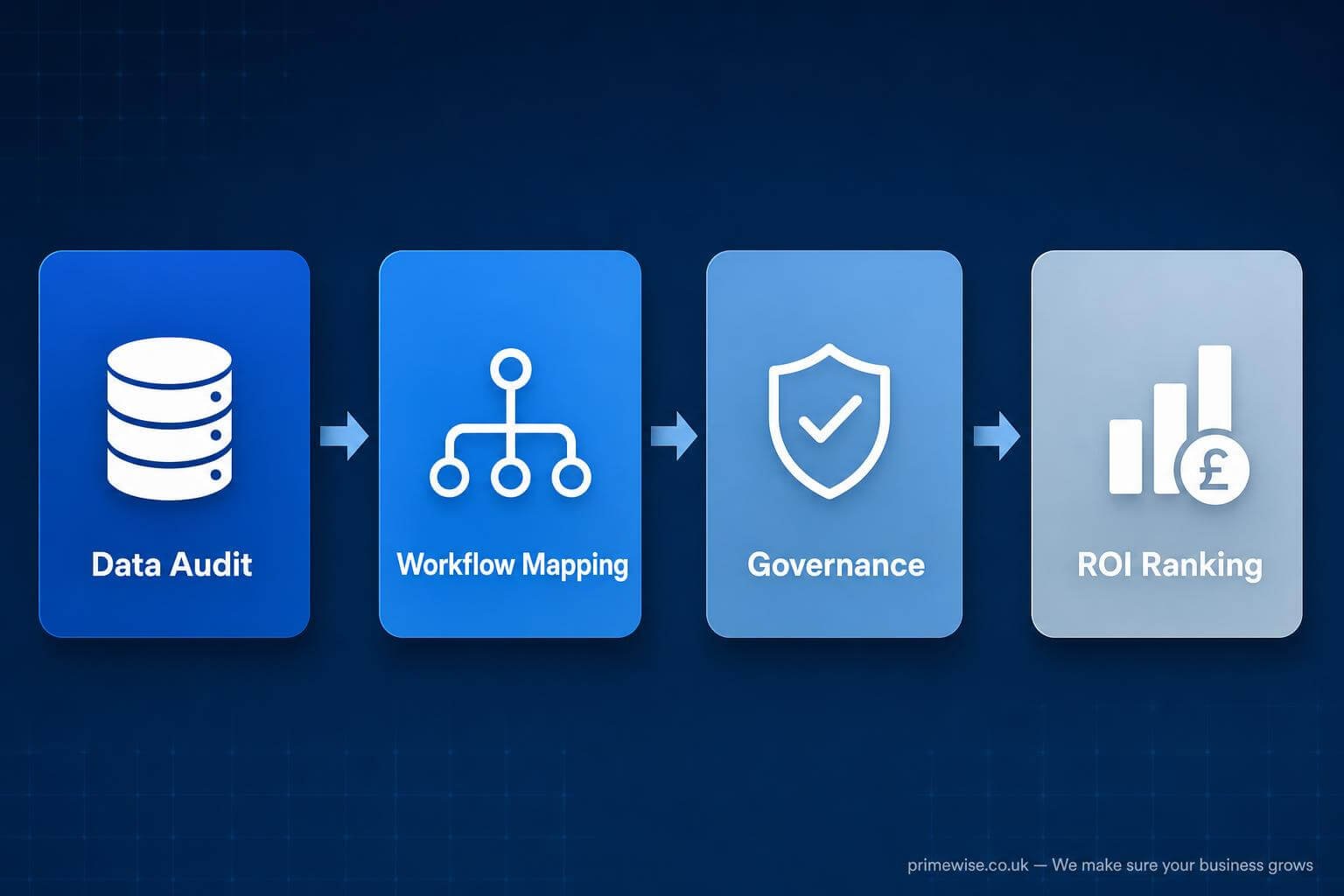
At Primewise, the Commercial Day-One Framework was built through repeated exposure to the gap between what vendors promise in discovery and what engineers encounter on project initiation. The framework is structured around four pillars, each with discrete evaluation criteria, and it is applied sequentially to ensure that every downstream pillar rests on a validated upstream foundation. The goal is not to produce a readiness score it is to produce an actionable, board-presentable investment decision. Below is how each pillar operates in practice.
Pillar One: Deep-Dive Data Audit and Pipeline Assessment
Machine learning models are entirely dependent on the quality, accessibility, and structural consistency of the data they consume. A surface-level data review checking that a CRM exists or that data is stored in the cloud, is commercially inadequate. A rigorous pillar one assessment interrogates data lineage, meaning how data moves from source systems through transformation layers to reporting endpoints, and flags every point of potential contamination or loss. This includes a direct evaluation of CRM data cleanliness, API accessibility and authentication reliability, the volume and classification of unstructured data silos, and the organisation’s current MLOps infrastructure maturity. The assessment must also evaluate vector database readiness for organisations considering retrieval-augmented generation (RAG) architectures, as well as the feasibility of synthetic data generation where training data volumes are insufficient. Organisations that skip this pillar and proceed directly to model selection routinely discover mid-build that their data is too fragmented, inconsistently labelled, or legally restricted to serve the intended use case. The cost of that discovery at sprint three is approximately four to six times higher than addressing it at audit stage.
Your audit vendor should deliver a complete data infrastructure map that includes every primary and secondary data source, transformation dependency, ingestion frequency, and identified gap. If they cannot produce this document, the engagement lacks the engineering rigour required to protect your capital.
Pillar Two: Strategic Workflow Mapping and Human-in-the-Loop Design
The transition from data readiness to operational deployment requires a systematic methodology for identifying which business processes are genuine candidates for automation and which require preserved human judgment. This is where many AI consulting engagements fail commercially by over-automating tasks that carry regulatory, ethical, or reputational risk, or by applying expensive AI engineering to low-friction processes that would be better served by a simple rule-based system. Strategic workflow mapping begins by cataloguing all high-friction, manual, repetitive processes across the organisation, ranked by time cost, error rate, and revenue impact. Each process is then evaluated against three dimensions: automation viability, model explainability requirements, and human-in-the-loop operational touchpoints. Human-in-the-loop design is not a limitation; it is a governance mechanism. For FCA-regulated firms or professional services organisations where decisions carry legal weight, the audit must specify exactly where human oversight is mandatory, where it is advisory, and where automation can operate independently. Change management for AI deployment, including skills gap assessment and internal AI Centre of Excellence readiness, must also be scoped at this stage, as operational resistance is consistently underestimated as a deployment risk.
Pillar Three: UK Governance Posture and Compliance Protocols
Governance is the pillar most frequently reduced to a compliance checkbox by inadequate vendors, and it is the pillar most likely to create material business risk if treated superficially. In 2026, the UK regulatory landscape for AI is both more demanding and more specific than it was during the initial wave of AI adoption. A board-ready governance assessment must address several distinct layers of regulatory exposure. The UK GDPR, and specifically Article 22 rights regarding automated decision-making, requires that any AI system making decisions with significant personal impact must be auditable, explainable, and contestable. The ICO’s updated Guidance on AI and Data Protection establishes clear obligations around algorithmic transparency, lawful basis for processing, and data minimisation that directly constrain how AI models can be trained and deployed.
For fintech and financial services organisations, the FCA’s AI and Machine Learning Discussion Paper (FS22/5) and its operational resilience implications are non-negotiable inputs to any governance assessment. The UK AI Safety Institute’s evaluation frameworks, while currently focused on frontier models, set the directional standard for what responsible AI deployment documentation will be expected to contain as regulatory requirements mature. The UK Government’s Pro-Innovation AI Regulation White Paper’s five cross-sector principles safety, security, fairness, accountability, and contestability provide the structural scaffolding for any governance checklist that needs to survive board scrutiny or regulatory enquiry. Proprietary IP protection strategies, algorithmic bias testing documentation, and a clear data retention and deletion schedule complete the governance deliverable set. An audit that does not address all of these layers is not a governance assessment it is a liability deferral.
REGULATORY WARNING FOR FCA-REGULATED FIRMSIf your organisation operates under FCA supervision, your AI readiness audit must explicitly address FS22/5 compliance and operational resilience obligations. An audit that omits FCA-specific AI governance requirements exposes your firm to supervisory risk and cannot be used as evidence of responsible AI deployment in a regulatory review.
Pillar Four: Pre-Build ROI Ranking and Commercial Justification
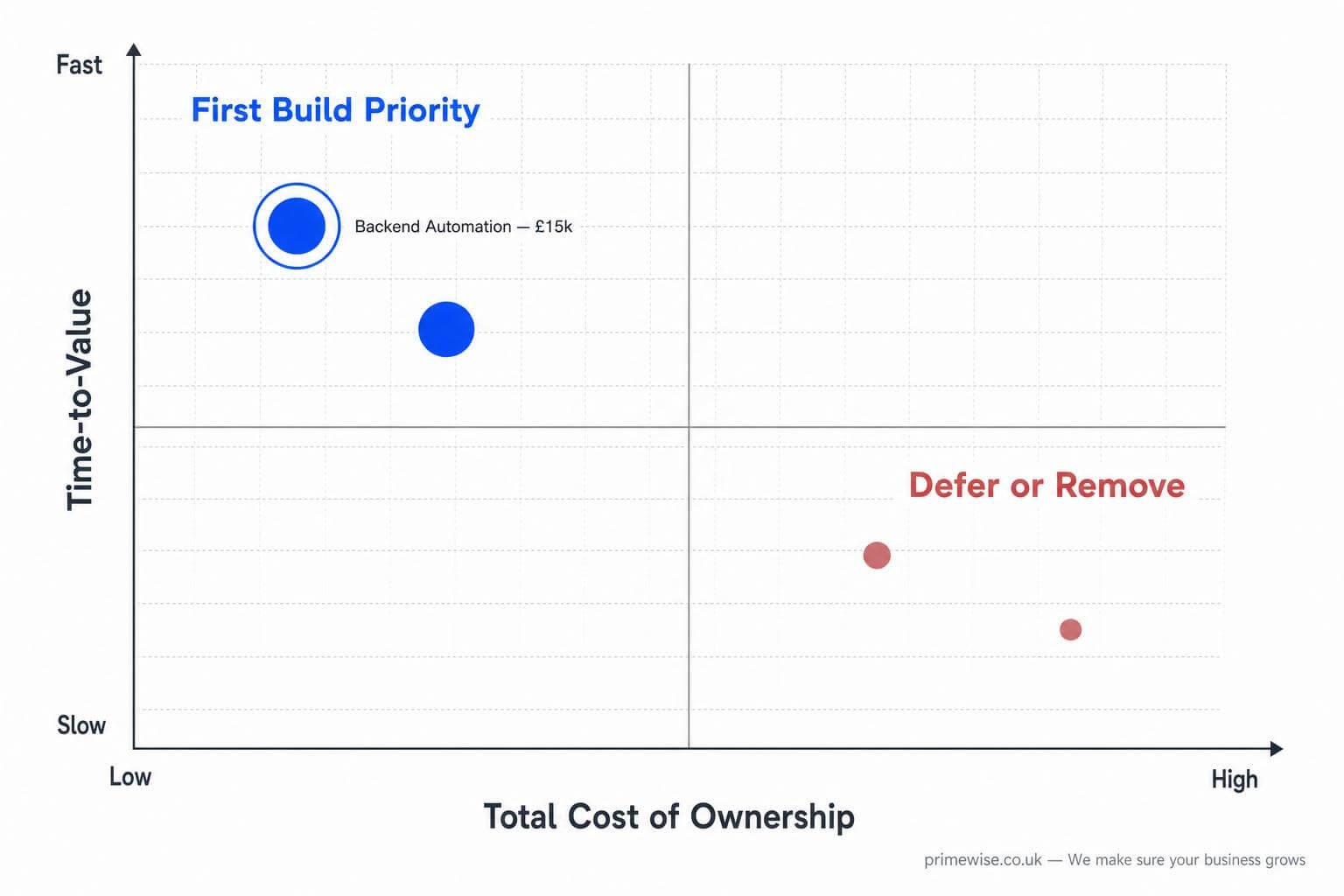
The Pre-Build ROI Ranking is the proprietary matrix we use at Primewise to score every proposed AI use case before a single line of code is written or a vendor contract is signed. It operates on two primary axes: Time-to-Value, which measures how quickly the deployed use case will generate measurable commercial return, and Total Cost of Ownership (TCO), which accounts for implementation cost, integration complexity, ongoing model maintenance, and the premium cost of AI engineering talent in the London and UK tech market. Each proposed use case is plotted against these axes and ranked. Use cases that score high on Time-to-Value and low on TCO are designated first-build priorities. Use cases with high TCO and speculative value are deferred or removed from scope entirely.
This framework prevented one of our clients, a B2B SaaS firm at Series B, from committing a £340,000 LLM chatbot build that the audit revealed was built on a fragmented webhook architecture incapable of real-time data ingestion. By redirecting engineering resources to resolving that foundational bottleneck first, the firm achieved a 47% reduction in backend process latency within 60 days at a total cost of £15,000. The ROI ranking did not just save capital, it resequenced the entire build roadmap to deliver commercial value in the correct order. Any audit that concludes without a pre-build ROI ranking is leaving the most important commercial question unanswered.
What Deliverables Should an AI Readiness Audit Produce
Setting a high benchmark for deliverables is the most effective way to distinguish a commercially rigorous audit engagement from a theoretical consulting exercise. The following deliverables represent the minimum acceptable output standard. If a vendor proposal does not include all of these components, treat the omission as a disqualifying red flag during vendor due diligence.
- A complete data infrastructure map covering all primary and secondary data sources, transformation dependencies, and identified pipeline gaps
- An unstructured data silo inventory with a classification framework and a remediation priority ranking
- A workflow automation matrix ranking all identified high-friction processes by automation viability, time cost, and human-in-the-loop requirements
- A governance compliance checklist aligned to UK GDPR Article 22, ICO AI guidance, FCA FS22/5, where applicable, and the UK Pro-Innovation AI Regulation White Paper principles
- A rigorous algorithmic bias testing documentation framework with defined testing protocols and acceptable threshold ranges
- A Pre-Build ROI Ranking matrix scoring all proposed AI use cases by Time-to-Value and Total Cost of Ownership
- A granular Technical Debt Report identifying all legacy tech stack vulnerabilities, integration constraints, and engineering prerequisites
- A 90-Day Execution Roadmap structured as a sequenced integration guide with defined milestones, resource requirements, and success metrics
- A vendor procurement shortlist with evaluation criteria aligned to the specific technical and commercial requirements identified in the audit
Why a Generic Executive Summary Is Not Acceptable
A significant proportion of AI consulting engagements conclude with a polished PDF containing high-level observations, strategic recommendations, and a readiness score presented as a traffic light matrix. This is commercially insufficient. A readiness score without an engineering-actionable technical debt report does not prevent capital misallocation it documents it retrospectively. The 90-Day Execution Roadmap and the Technical Debt Report are the two deliverables that separate a commercial audit from a strategic overview. The roadmap must specify sprint sequences, technology dependencies, and the critical path to first deployment. The technical debt report must name specific legacy systems, quantify the remediation cost, and sequence the resolution work within the roadmap. Your development team should be able to initiate work on day one of the engagement without requiring a clarification call.
Internal Versus External Versus Full Commercial Audit
C-suite buyers at the decision stage of the procurement cycle are routinely evaluating three options: conducting the audit using an internal data science team, commissioning a lightweight external review, or engaging a full commercial audit practice. Each option carries a distinct risk profile, deliverable standard, and total cost implication. The comparison below reflects real market conditions in the UK in 2026, based on published consulting benchmarks and our own commercial experience across enterprise and mid-market engagements.
| Dimension | Internal Audit | Lightweight External Review | Full Commercial Audit (Primewise) |
|---|---|---|---|
| Objectivity | Low internal bias blind spots are common | Moderate limited by scope constraints | High adversarial, engineering-led assessment |
| Technical Depth | Variable dependent on team capability | Moderate typically surface-level data review | Full covers MLOps, data lineage, RAG readiness |
| Regulatory Knowledge | Often outdated ICO and FCA updates frequently missed | Generic rarely addresses FS22/5 or Article 22 | Current aligned to 2026 UK regulatory landscape |
| Deliverable Format | Internal report rarely board-presentable | Slide deck or high-level summary | Technical Debt Report, ROI Matrix, 90-Day Roadmap |
| Typical UK Cost Range | Internal resource cost typically underestimated | £3,000 – £10,000 | £8,000 – £25,000 for SME engagements |
| Time to Completion | 6–12 weeks competing with BAU priorities | 2–3 weeks | 4–6 weeks |
| Board-Level Credibility | Low internal conflict of interest perception | Moderate lacks engineering validation | High independently verified, investor-grade |
Internal data science teams possess invaluable knowledge of the proprietary tech stack, but they are structurally disadvantaged by familiarity bias the tendency to underweight the severity of known technical debt because it has been tolerated operationally for an extended period. An objective third-party audit eliminates this bias and prevents internal politics from obscuring engineering flaws that would derail a build at execution stage. For organisations seeking investor-grade documentation or preparing for FCA submissions, only a full commercial audit produces deliverables with sufficient independence and rigour to satisfy external scrutiny.
PRICING CONTEXT FOR UK BUYERSUK boutique AI readiness audits typically range from £8,000 to £25,000 for SME engagements. Enterprise engagements at Big Four consultancies routinely reach £75,000 to £150,000 for comparable scope. Primewise delivers the full 4-Pillar Commercial Day-One Framework, inclusive of all nine deliverables listed above, within the SME investment range. Book a discovery call at primewise.co.uk to receive a scope-specific investment figure within 48 hours.
The AI Readiness Buyer’s Checklist Three Tiers of Readiness
The following tiered checklist is drawn directly from the Primewise scoring methodology. Your organisation’s current position across these criteria determines whether you are Pre-Readiness, Conditionally Ready, or Deployment Ready. Use this framework to assess your internal state before engaging a vendor, or to evaluate the comprehensiveness of a vendor proposal you have already received.
Pre-Readiness Data foundations require significant remediation before any AI build is viable.
- No documented data lineage exists across primary source systems
- CRM data contains significant duplication, missing fields, or inconsistent formatting at a rate exceeding 20%
- APIs across core business systems are undocumented or lack reliable authentication protocols
- No formal UK GDPR data processing register exists for AI-relevant data categories
- No algorithmic bias testing framework has been defined or applied to existing automated systems
- AI use case selection has been driven by vendor recommendations rather than internal workflow analysis
Conditional Readiness Core infrastructure is viable but governance or commercial justification gaps must be resolved before build approval.
- Primary data sources are documented but transformation pipelines have known quality gaps
- High-friction workflow candidates have been identified but not formally ranked by automation viability
- UK GDPR compliance documentation exists but Article 22 automated decision-making rights have not been specifically addressed
- A preliminary AI use case list exists but has not been evaluated against a Time-to-Value and TCO matrix
- MLOps infrastructure is in place but has not been assessed for AI-specific deployment requirements
Deployment Ready All four pillars are validated and the organisation is commercially authorised to proceed to build.
- A complete, current data infrastructure map exists with documented lineage, quality metrics, and remediation history
- High-friction workflows have been ranked, human-in-the-loop touchpoints are defined, and change management planning is underway
- A full governance compliance pack has been reviewed by legal counsel and aligned to ICO guidance, FCA requirements where applicable, and the UK AI Regulation White Paper principles
- A Pre-Build ROI Ranking has been completed and the first-build use case has been commercially authorised at board level
- A 90-Day Execution Roadmap and Technical Debt Report have been produced and reviewed by the engineering lead
WHERE DOES YOUR ORGANISATION SITIf your assessment places you at Pre-Readiness or Conditional Readiness, the most capital-efficient next step is a full commercial audit before any vendor engagement proceeds. Proceeding to build from either of those positions statistically multiplies implementation cost and reduces the probability of achieving first-deployment commercial return. Book your Primewise discovery call at primewise.co.uk.
A Case Study: Scrapping a £340k LLM Build
One of the most instructive engagements in our practice involved a B2B SaaS firm at Series B stage, operating in the UK with 80 to 150 employees and a board-approved AI budget of £340,000 allocated to a bespoke LLM customer service chatbot. The initial vendor proposal was technically credible on the surface it included a modern stack, a phased delivery plan, and a polished ROI projection. What it did not include was a data infrastructure assessment. When we applied the Primewise 4-Pillar framework, Pillar One revealed that the firm’s backend architecture relied on a fragmented webhook system with no reliable real-time data ingestion capability. The proposed LLM chatbot could not access live customer account data the core feature the board had approved the budget to deliver.
The Pre-Build ROI Ranking placed the webhook remediation as the correct first build, at an implementation cost of £15,000. Within 60 days of completing that remediation, the firm achieved a 47% reduction in backend process latency, unlocking the data infrastructure required for the original LLM use case and generating a measurable commercial return before the larger build was even initiated. The CTO, whose identity we protect by agreement, described the audit as “the decision that prevented a catastrophic capital misallocation.” The ROI ranking did not simply save £325,000 it restructured the build sequence to generate value in the correct commercial order. That is the purpose of a rigorous AI readiness audit: not to delay deployment, but to ensure that when capital is committed, it deploys against a validated foundation.
What Credentials Should Your AI Audit Consultant Hold
Vendor due diligence in AI consulting is complicated by the absence of a single universally recognised professional qualification. However, a credible AI readiness consultant in the UK in 2026 should demonstrate several verifiable competencies. Engineering depth is non-negotiable the lead consultant must have demonstrable hands-on experience with data engineering, MLOps infrastructure, or AI systems architecture, not solely strategic advisory. Regulatory currency is essential: the consultant must be able to evidence familiarity with the ICO’s current AI guidance, FCA FS22/5 implications, and the UK AI Regulation White Paper. Sector-specific experience matters significantly in regulated verticals. A consultant who has not previously audited a fintech or FCA-regulated professional services firm will underestimate the governance complexity of those engagements. Request a sample Technical Debt Report and a sample 90-Day Execution Roadmap from any shortlisted vendor. A consultant who cannot or will not provide sanitised examples of these deliverables has likely never produced them to a commercial standard.
Is an AI Readiness Audit Tax-Deductible Under UK R&D Relief
This is one of the most commercially valuable and least discussed questions in UK AI procurement, and the answer is nuanced but favourable. Under HMRC’s Research and Development Expenditure Credit (RDEC) scheme and the merged R&D relief scheme that came into effect for accounting periods beginning on or after 1 April 2024, qualifying expenditure on AI-related projects can attract significant tax relief. An AI readiness audit that is directly preparatory to a qualifying R&D project where the project involves scientific or technological uncertainty that the organisation is actively seeking to resolve may constitute qualifying expenditure under the scheme. Specifically, costs associated with staff time, external consultant fees, and data infrastructure assessment that directly enable a qualifying AI development project have been accepted by HMRC as qualifying costs in reviewed cases. We strongly recommend engaging a specialist R&D tax credit adviser to assess the specific eligibility of your audit and build expenditure. For many UK SMEs, this effectively reduces the net cost of a full commercial AI readiness audit by 15% to 27% depending on the applicable relief rate and the firm’s tax position. This is a material consideration for CFOs evaluating the investment case for an audit engagement and one that competing vendors rarely raise proactively.