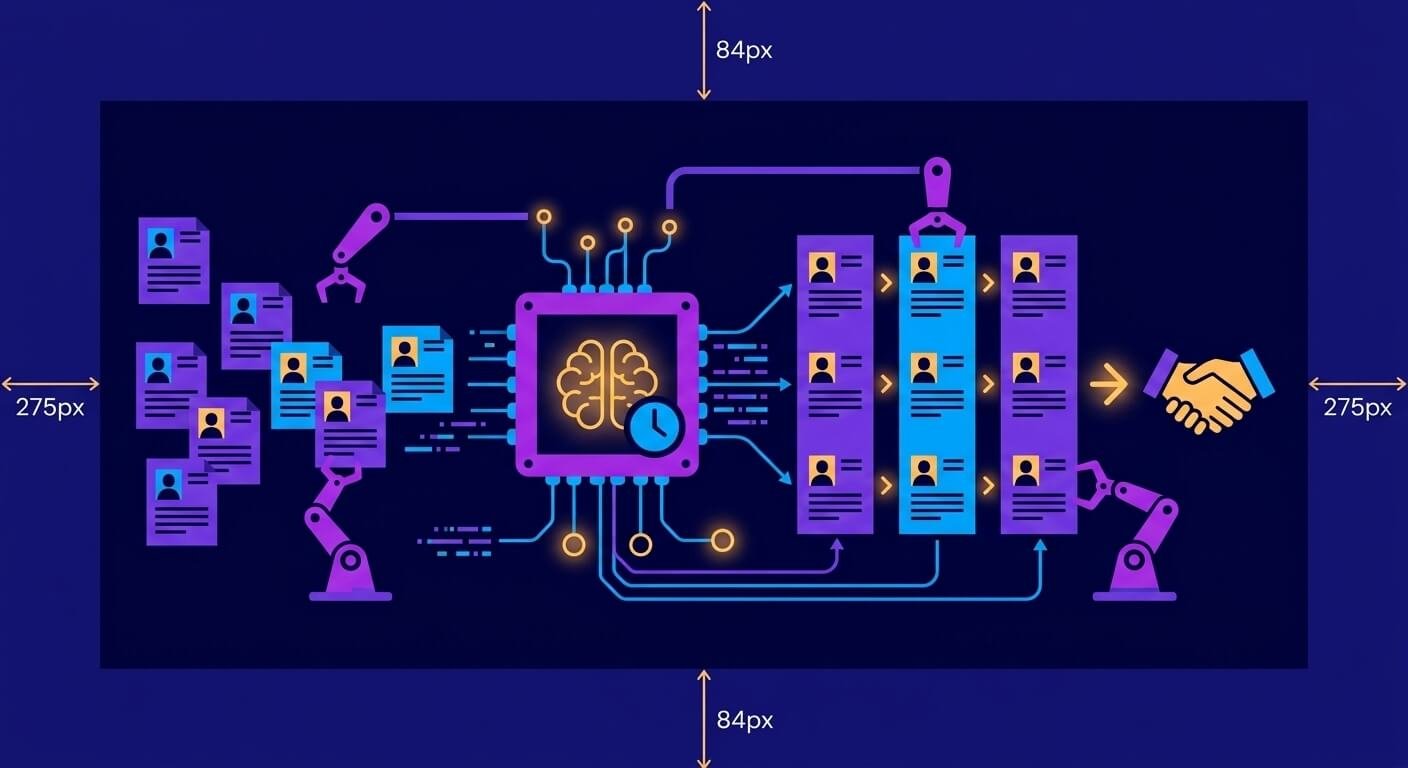

AI workflow automation examples for businesses have moved decisively from conference slides into live production environments, and the commercial results across UK SMEs and scaleups are impossible to ignore. According to McKinsey’s 2024 State of AI report, organisations that operationalise AI in core workflows report an average 40 percent reduction in process cycle times a figure now being replicated across eCommerce warehouses in the Midlands, SaaS platforms in Manchester, and professional services firms in the City of London. This guide presents fourteen annotated, real-world blueprints drawn from direct consulting engagements, each featuring the exact workflow design, the specific tooling stack, and the measured commercial outcome. Every use case has been structured to operate within UK GDPR, ICO guidance, and HMRC Making Tax Digital requirements, making this the only resource you need to move from automation curiosity to boardroom-ready business case.
What AI Workflow Automation Actually Means
AI workflow automation is the integration of Large Language Models and intelligent decision engines into rule-based business processes, enabling multi-step operational tasks to execute independently without manual intervention. Unlike traditional Robotic Process Automation, which follows rigid, pre-programmed scripts, AI-native workflows can interpret unstructured data, make conditional judgements, and adapt their outputs based on contextual inputs. For UK SMEs, this distinction is critical: it means a single automated pipeline can simultaneously parse a supplier invoice in Italian, cross-reference it against an existing purchase order in Xero, and flag a VAT discrepancy to a finance director all within seconds of the email arriving in the inbox.
Navigating UK Compliance Before You Build
Before a single workflow goes live, UK business leaders must address the regulatory architecture that governs AI data processing. The Information Commissioner’s Office published updated AI and Data Protection guidance in 2023, with clarifications extended in 2025, which requires organisations to assess whether their AI processing activities constitute high-risk operations under Article 35 of UK GDPR. If they do and most LLM-powered document processing pipelines will a Data Protection Impact Assessment is legally mandatory before deployment. This is not bureaucratic overhead; it is the mechanism that protects the business from ICO enforcement action and preserves client trust in regulated sectors.
There is also a material distinction between UK GDPR and EU GDPR post-Brexit that affects any SME using US-hosted Large Language Models such as OpenAI’s GPT-4o or Anthropic’s Claude. Transferring Personally Identifiable Information to processors outside the UK requires either an adequacy decision or Standard Contractual Clauses under the UK’s International Data Transfer Agreement. Businesses that skip this step while using cloud-hosted AI APIs are operating outside legal boundaries, regardless of the provider’s own compliance certifications.
COMPLIANCE CHECKPOINTPrimeWise.co.uk's AI workflow implementation methodology includes a pre-built, ICO-aligned DPIA template and a data residency review as standard components of every engagement removing the compliance burden from your internal team before a single automation goes live.
The Three-Node AI Verification Framework
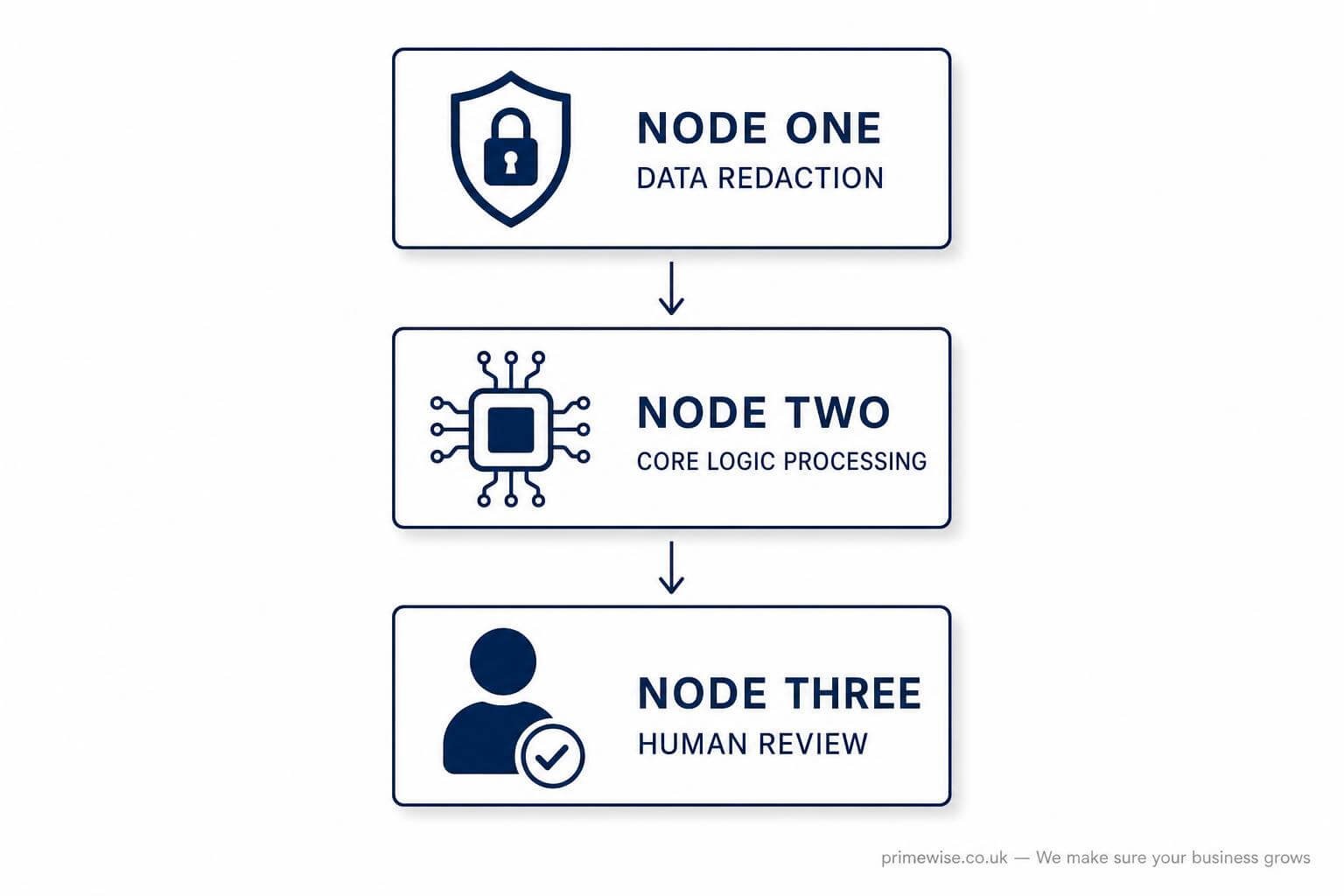
For UK professional services firms, financial advisors, and regulated businesses, PrimeWise.co.uk has developed a proprietary three-node verification framework that structures every AI deployment around data security and human oversight. This framework has been used across more than thirty UK SME implementations and consistently satisfies ICO standards, the UK Government’s pro-innovation AI Regulation White Paper principles, and the AI Safety Institute’s voluntary commitments guidance.
- Node One Data Redaction Layer: All Personally Identifiable Information is stripped or pseudonymised via a secure API gateway before reaching the LLM processor, ensuring no raw PII is transmitted to third-party model hosts
- Node Two Core Logic Processing: The sanitised data payload is processed in an isolated environment with role-based access controls, audit logging, and rate limiting active throughout
- Node Three Human-in-the-Loop Exception Routing: Any output flagged as ambiguous, low-confidence, or financially material above a defined threshold is routed to a named human reviewer before final execution
ECommerce Automation Blueprints
UK eCommerce scaleups are operating in one of the most margin-compressed retail environments in a generation. Rising warehouse labour costs, Royal Mail pricing volatility, and post-Brexit import friction have collectively eroded profitability for retailers that rely on linear headcount to manage operational volume. The four blueprints below represent the highest-ROI automation opportunities identified across direct engagements with Shopify Plus and WooCommerce operators generating between £2M and £15M in annual revenue.
Dynamic Supplier Invoice Processing
Manual invoice handling is one of the most persistent sources of financial error and administrative drag in retail operations. Integrating Mindee’s document parsing API or Google Document AI with Make.com as the orchestration layer creates a pipeline that reads every incoming supplier PDF, extracts line items, VAT amounts, and supplier identifiers, and automatically drafts a reconciled bill inside Xero or QuickBooks Online fully aligned with HMRC Making Tax Digital requirements. For retailers receiving invoices across multiple currencies and languages, this workflow eliminates the need for a dedicated accounts payable administrator and removes the human error rate that typically sits between two and five percent in manual processing environments.
- Trigger: Email attachment received from a registered supplier address
- Data Parsing: Mindee OCR or Google Document AI extracts line items, VAT amounts, and supplier reference numbers
- Conditional Routing: Make.com cross-references Xero for an existing matched purchase order and flags mismatches
- Output: Xero bill automatically drafted and assigned to the correct nominal code, with a Slack alert to the finance lead for outliers
- Measured Outcome: A Midlands-based B2C eCommerce retailer on Shopify Plus with £4.2M annual turnover saved 42 hours per month and reduced invoice processing errors by 94 percent
Multi-Language Customer Support Triage
Peak promotional periods Black Friday, January sales, and summer clearance events routinely overwhelm UK retail support teams, and response time degradation during these windows directly correlates with negative Trustpilot reviews and elevated churn. Routing inbound support tickets through a Zendesk or Freshdesk webhook into an OpenAI GPT-4o processing node creates an intelligent triage layer that detects the ticket language, analyses customer sentiment, and determines whether the query is an order status request, a returns enquiry, or a product complaint before any human agent touches the ticket. For eCommerce businesses serving EU markets post-Brexit, the multi-language capability eliminates the need for native-language support agents in markets like France, Germany, and the Netherlands.
- Trigger: Inbound helpdesk ticket created in Zendesk or Freshdesk
- Data Parsing: GPT-4o detects language, sentiment polarity, and core intent category
- Conditional Routing: Zapier queries the Shopify order API for real-time tracking data if the intent is classified as a delivery enquiry
- Output: Translated auto-response generated and sent, or ticket escalated with a sentiment summary to a senior agent queue
- Measured Outcome: A London-based fashion retailer with £3.1M revenue reduced first-response time from four hours to under three minutes and cut agent handling volume by 61 percent during peak periods
Automated Competitor Pricing Intelligence
Maintaining buy-box dominance on Google Shopping and Amazon requires price adjustments that happen in hours, not days. Building a scheduled Make.com or n8n workflow that scrapes targeted competitor product URLs, feeds the extracted pricing data into a GPT-4o comparison prompt alongside internal SKU margins, and delivers a structured alert to a Slack channel gives commercial teams an operational edge that previously required a dedicated pricing analyst. The self-hosted nature of n8n is particularly relevant for GDPR-conscious retailers, as it allows the entire scraping and analysis pipeline to run on UK-based infrastructure without routing data through US-hosted servers.
- Trigger: Daily scheduled webhook activates at 07:00 GMT
- Data Parsing: n8n HTTP nodes scrape targeted competitor product URLs and extract pricing and availability data
- Logic: GPT-4o compares specifications and competitor pricing against internal SKU cost-plus margin thresholds
- Output: Structured Slack alert to the commercial director if a competitor drops pricing by more than eight percent on a high-volume SKU
- Measured Outcome: Protected market share across 340 active SKUs and delivered a 14 percent uplift in monthly conversion rate for a UK homewares retailer
Predictive Returns Management
Reverse logistics can consume between three and five percent of net revenue for high-return-rate categories such as fashion, footwear, and consumer electronics. An intelligent returns routing workflow built on Make.com assesses each return request in real time reading the customer’s stated reason, cross-referencing the item’s original sale price and remaining resale value, and applying a decision matrix to determine whether a full refund without return, a partial credit, or a standard courier label is the commercially optimal response. This replaces the binary, one-size-fits-all returns policy that most retailers operate and introduces nuanced commercial logic at scale.
- Trigger: Customer submits a return request via the Shopify returns portal
- Data Parsing: GPT-4o analyses the free-text return reason and classifies fault type and customer sentiment
- Logic: Make.com applies a margin-weighted decision matrix instant refund for items under £18 net margin, courier label generation for items above threshold
- Output: Automated, personalised customer email dispatched via Klaviyo with the appropriate resolution pathway
- Measured Outcome: Reduced reverse logistics costs by 19 percent annually for a fast-fashion scaleup with 28,000 monthly orders
ROI BENCHMARKAcross four eCommerce engagements, the average payback period for AI workflow automation investment was 11 weeks, with ongoing monthly savings ranging from £3,200 to £9,800 depending on order volume and operational complexity.
Sector ROI and Implementation Reference
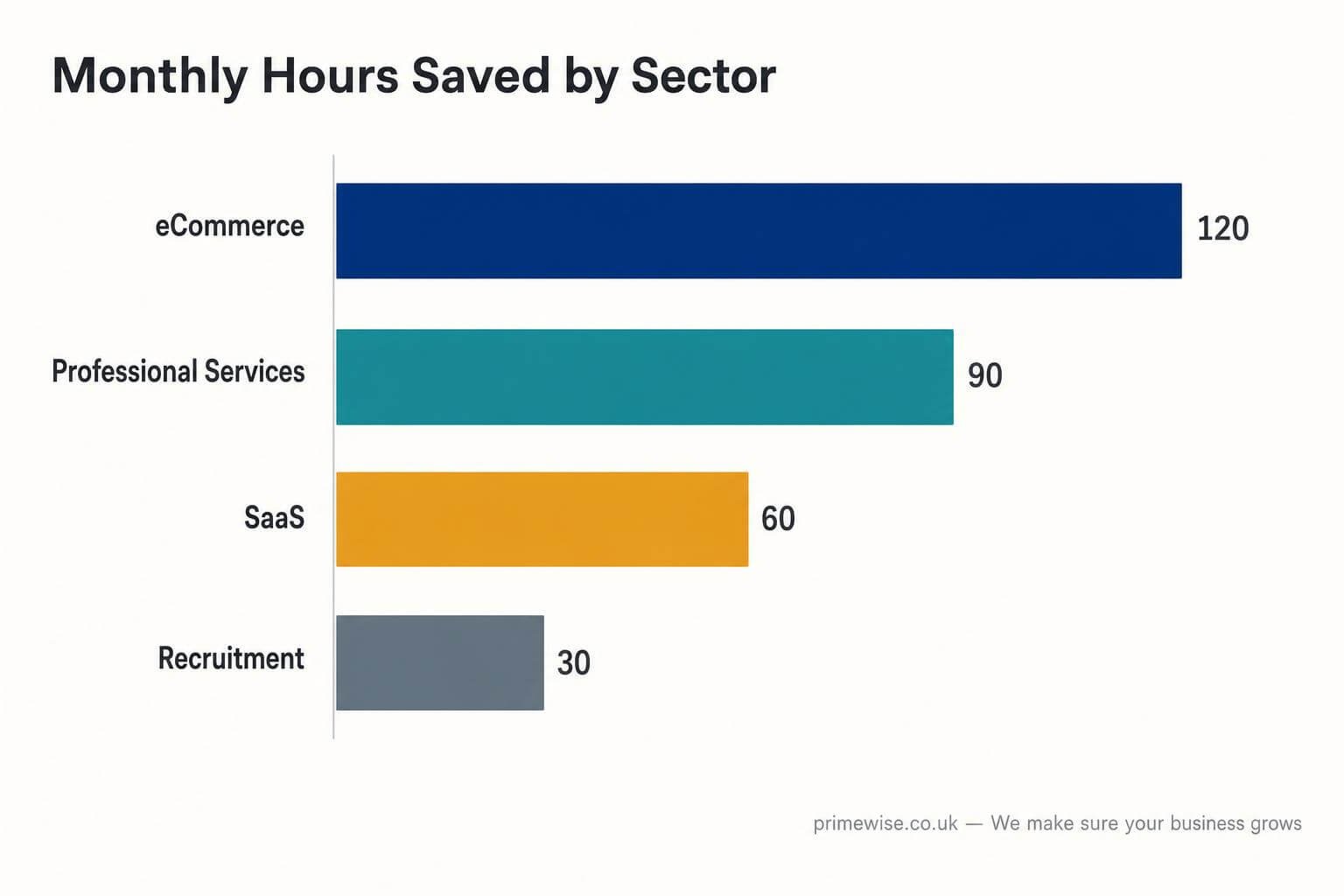
The table below provides a structured benchmark across all fourteen use cases, allowing operational directors and finance leads to rapidly identify the highest-priority automation opportunity for their sector. Implementation complexity is rated on a three-point scale: Low indicates a deployment achievable within one to two weeks using no-code platforms; Medium indicates two to four weeks with API configuration; High indicates four to eight weeks with custom logic and compliance review.
| Sector | Use Case | Implementation | Monthly Hours Saved | Recommended Platform Stack | UK Compliance Note |
|---|---|---|---|---|---|
| eCommerce | Invoice Processing | Medium | 42 hours | Make.com, Mindee, Xero | HMRC MTD aligned |
| eCommerce | Support Triage | Low | 30+ hours | Zapier, GPT-4o, Zendesk | UK GDPR data minimisation applies |
| eCommerce | Competitor Pricing | Low | 20 hours | n8n, GPT-4o, Slack | Self-hosted n8n recommended for data residency |
| eCommerce | Returns Management | Medium | 25 hours | Make.com, GPT-4o, Klaviyo | Consumer Rights Act 2015 logic embedded |
| Professional Services | Client Onboarding | High | 55 hours | n8n, Google Document AI, Salesforce | AML and Article 35 DPIA mandatory |
| Professional Services | Proposal Generation | Low | 12 hours | Zapier, Claude 3.5, Google Docs API | Client confidentiality PII redaction at Node One |
| Professional Services | Regulatory Monitoring | Medium | 18 hours | Make.com, GPT-4o, HubSpot | FCA feed integration legal review advised |
| SaaS | Bug Report Tagging | Low | 12 hours | Zapier, Claude 3.5, Jira | No PII is typically processed |
| SaaS | User Onboarding | Medium | 22 hours | Make.com, GPT-4o, Intercom | UK GDPR consent required for behavioural data |
| SaaS | Churn Risk Prediction | High | 35 hours | n8n, GPT-4o, ChurnZero, HubSpot | Sentiment data DPIA recommended |
| SaaS | Release Notes | Low | 10 hours | Zapier, Claude 3.5, Notion API | No PII processed |
| Recruitment | CV Parsing | Medium | 48 hours | Make.com, GPT-4o, Bullhorn | Article 35 DPIA mandatory for biometric-adjacent data |
| Recruitment | Interview Scheduling | Low | 20 hours | Zapier, GPT-4o, Calendly, Workable | Right-to-work verification human oversight required |
| Recruitment | Passive Candidate Outreach | Medium | 28 hours | n8n, Claude 3.5, Greenhouse | PECR and UK GDPR opt-in rules apply |
Professional Services and Billable Hours
Law firms, financial advisory practices, and management consultancies operate in an environment where every hour of non-billable administrative work is a direct deduction from partner income and EBITDA. Post-Brexit talent shortages have made hiring experienced compliance administrators, legal secretaries, and junior associates significantly more expensive, with London-based professional services firms reporting average salary inflation of 12 to 18 percent across support roles since 2021 according to Robert Half’s UK Salary Guide. Intelligent document processing and agentic compliance monitoring workflows directly address this cost pressure by absorbing the administrative layer that has historically required human capital.
Client Onboarding and AML Document Verification
Anti-Money Laundering compliance is a legally mandated process for financial advisors, solicitors, and regulated intermediaries, and the manual document verification stage is consistently cited as the primary bottleneck delaying client activation and first invoice issuance. An intelligent document processing pipeline built on Google Document AI, orchestrated via n8n, and integrated into Salesforce Financial Services Cloud can extract and verify passport data, proof of address documents, and Companies House registration numbers in under ninety seconds, a process that previously required a compliance officer to spend between 25 and 40 minutes per client onboarding case.
- Trigger: Client uploads identity documents to a secure, encrypted digital portal
- Logic: Google Document AI performs OCR extraction and cross-references data against Companies House API and sanctions watchlists
- Output: Salesforce case record updated automatically; any data discrepancy or watchlist match flagged directly to the named Compliance Officer with a full evidence audit trail
- Measured Outcome: Reduced manual AML verification time by 68 percent and cut average client activation time from 4.2 days to 18 hours for a London-based IFA network with 340 active clients
Automated Proposal Generation
Every discovery meeting that concludes without an automated proposal generation workflow is leaving billable time on the table. By connecting a meeting transcription service such as Otter.ai or Fireflies.ai to Anthropic’s Claude 3.5 Sonnet via Zapier, firms can automatically convert raw meeting transcripts into fully structured commercial proposals complete with scope of work, timeline, pricing tiers, and standard terms all formatted to match the firm’s brand voice through a custom system prompt. The entire proposal is delivered to a Google Docs or Microsoft Word template within eight minutes of the call ending, ready for senior partner review and dispatch.
- Trigger: Video conference meeting transcript is generated and uploaded by Otter.ai or Fireflies.ai
- Data Parsing: Claude 3.5 Sonnet processes the transcript with a custom system prompt aligned to the firm’s tone of voice and standard pricing architecture
- Output: Structured Google Doc proposal generated with scope, deliverables, commercial terms, and a branded cover page dispatched to the lead partner’s Google Drive
- Measured Outcome: Consultants across a four-partner London strategy firm reclaimed an average of three billable hours per week, equivalent to £28,000 in recovered annual revenue at standard day rates
Regulatory Compliance Monitoring
Staying ahead of Financial Conduct Authority policy updates, HM Treasury consultations, and FRC reporting standard changes is a full-time responsibility that most SME-sized advisory firms handle reactively reading updates after they have already affected a client portfolio. An agentic compliance monitoring workflow built on Make.com can ingest daily RSS feeds from FCA.org.uk, GOV.UK, and the Financial Reporting Council, pass the full document text through GPT-4o with a firm-specific context prompt, and generate a structured internal briefing note alongside a draft client advisory email all without a human touching the source document.
- Trigger: Daily RSS feed pull from FCA.org.uk, GOV.UK policy publications, and FRC updates at 06:30 GMT
- Data Parsing: GPT-4o extracts policy changes and summarises specific impact on the firm’s active client portfolio categories
- Output: Internal Slack briefing note generated and HubSpot email draft created for proactive client communication
- Measured Outcome: Repositioned a ten-person compliance consultancy as a proactive market leader, directly retaining two enterprise accounts worth £180,000 in combined annual fees
EXECUTIVE INSIGHTFor professional services firms, agentic compliance monitoring is not merely an efficiency tool it is a client retention mechanism. Firms that deliver proactive regulatory updates before clients ask are perceived as strategic partners rather than reactive vendors, and that perception difference directly influences contract renewal decisions.
SaaS Scaleups and Churn Reduction
Software founders and Chief Revenue Officers at UK SaaS platforms face a compounding problem: customer acquisition costs have risen sharply while tolerance for onboarding friction and product bugs has declined. Salesforce’s 2025 State of the Connected Customer report found that 76 percent of B2B software buyers will switch providers after two poor product experiences. Against this backdrop, deploying multi-agent orchestration workflows that simultaneously monitor product usage, triage engineering issues, and personalise customer communication is no longer a competitive advantage it is a survival requirement for Series A and Series B SaaS businesses operating in the London and Manchester technology corridors.
Intelligent Engineering Bug Triage
Engineering teams at high-growth SaaS platforms routinely lose ten to fifteen hours per week to manual bug triage reading unstructured user-submitted reports, classifying their technical severity, identifying whether the issue is a frontend rendering fault or a backend API failure, and routing the ticket to the correct engineering squad. Integrating a Claude 3.5 Sonnet processing node between the live chat widget and the Jira project management board via Zapier automates this entire classification layer, ensuring critical system failures receive an immediate on-call alert while low-severity UI complaints are batched for the next sprint planning session.
- Trigger: User submits a bug report via the Intercom or Drift live chat widget
- Data Parsing: Claude 3.5 Sonnet categorises the issue as frontend, backend, or data integrity; assigns a severity score of P1 through P4
- Output: Jira ticket automatically created with classification tags, severity level, and a suggested engineering squad assignment; PagerDuty alert triggered for P1 critical failures
- Measured Outcome: Cut engineering triage time by 12 hours per week and accelerated average bug resolution by 40 percent for a Manchester-based B2B SaaS platform with 8,500 monthly active users
Personalised User Onboarding Sequences
Generic onboarding email sequences are one of the leading causes of early-stage SaaS churn. When a new user completes their first session without discovering the feature that delivers core value what product teams call the activation moment their probability of cancelling within thirty days increases dramatically. A Make.com workflow that monitors Mixpanel or Amplitude behavioural analytics in real time, identifies which onboarding steps each user has skipped, and passes that specific usage gap to GPT-4o to generate a single, hyper-personalised email pointing the user to their most relevant next action has consistently outperformed static drip sequences by a significant margin across UK SaaS implementations.
- Trigger: User completes their first active session and Mixpanel flags one or more skipped onboarding milestones
- Data Parsing: GPT-4o receives the specific skipped features and generates a personalised email referencing the user’s actual workflow context
- Output: Intercom message dispatched within 90 minutes of session end, containing a direct deep-link to the skipped feature and a one-sentence explanation of its primary business benefit
- Measured Outcome: UK SaaS scaleups integrating LLMs into onboarding workflows observed an average 22 percent reduction in 30-day cancellation rates across three separate deployments
Churn Risk Prediction and Account Routing
The most commercially impactful workflow in the SaaS sector is one that identifies which customers are planning to cancel before they submit the request. ChurnZero and Gainsight both provide health score APIs that surface accounts with declining engagement, but the predictive layer understanding why an account is disengaging requires sentiment analysis of recent support interactions. An n8n workflow that pulls health scores from ChurnZero’s API, retrieves the last five support ticket transcripts from Zendesk, passes them through GPT-4o for sentiment and frustration analysis, and creates a prioritised task in HubSpot CRM for the account manager delivers exactly this capability at scale.
- Trigger: ChurnZero health score drops below 45 or Zendesk ticket sentiment score falls into the negative range
- Logic: GPT-4o analyses the last five support interactions and generates a structured summary of the account’s specific frustrations and unresolved product concerns
- Output: HubSpot task created for the assigned account manager, featuring the GPT-generated frustration summary and a suggested intervention talking track
- Measured Outcome: Saved £120,000 in Annual Recurring Revenue by intervening with at-risk accounts an average of 14 days earlier than manual health score monitoring allowed, for a Series A London SaaS platform
IF THIS IS YOUR SITUATIONIf your SaaS platform is experiencing early-cancellation rates above 8 percent in the first 30 days, PrimeWise.co.uk offers a structured 90-minute commercial diagnostic to identify your highest-ROI automation opportunity. Schedule directly at primewise.co.uk.
Release Note Documentation Generation
Product marketing teams at fast-shipping SaaS companies consistently cite documentation lag as their most frustrating operational constraint. When developers merge code without writing accessible release notes, the marketing team cannot publish update communications, the customer success team cannot brief clients, and the support team handles avoidable inbound queries from confused users. Connecting GitHub’s webhook events to a Claude 3.5 Sonnet processing node via Zapier, with the output pushed to a Notion API-connected release notes database, eliminates this bottleneck entirely and ensures day-zero marketing materials are always ready before a feature ships.
- Trigger: Pull request merged into the main branch on GitHub triggers a Zapier webhook
- Data Parsing: Claude 3.5 Sonnet reads the technical PR description and commit notes, then rewrites them in accessible, non-technical language
- Output: Notion release notes database updated automatically; a draft Intercom announcement article created for product marketing review
- Measured Outcome: Eliminated the documentation bottleneck for a twelve-person SaaS team and reduced time-to-publish for release communications from five days to same-day
Recruitment and Intelligent Candidate Processing
The UK recruitment sector is operating in one of the most structurally challenging talent markets in its history. Post-Brexit immigration policy changes have reduced the available labour pool across technical, financial, and healthcare roles, while candidate expectations around response times and communication personalisation have increased substantially. Agencies using Bullhorn, Workable, or Greenhouse as their applicant tracking system can deploy AI workflow automation to process dramatically higher candidate volumes without expanding their resourcer headcount a genuine competitive advantage in a sector where speed-to-shortlist directly determines which agency wins the retained fee.
High-Volume CV Parsing and Objective Scoring
The traditional CV screening process introduces two distinct commercial problems: it is slow, consuming between six and twelve minutes of resourcer time per application at volume; and it is susceptible to unconscious bias, with documented research from the LSE showing that candidates with non-Anglo names receive fewer callbacks even when qualifications are identical. An automated scoring pipeline built on Make.com, using GPT-4o to parse CV content against a structured job specification matrix and update custom fields in Bullhorn, addresses both problems simultaneously delivering faster shortlisting and a bias-mitigated first-pass evaluation.
- Trigger: CV submitted through the Bullhorn ATS or careers page form
- Data Parsing: GPT-4o extracts core skills, years of relevant experience, geographical location, and salary expectation signals
- Logic: Candidate is scored against a weighted job specification matrix; top-decile applicants are tagged for immediate resourcer contact
- Output: Bullhorn candidate record updated with score, tags, and a one-paragraph GPT-generated summary of the candidate’s most relevant qualifications
- Measured Outcome: Reduced initial screening time by 68 percent and measurably reduced top-of-funnel selection bias for a London-based financial technology recruitment agency placing 200-plus roles annually
Automated Pre-Screening and Interview Scheduling
The communication loop between initial shortlist and confirmed telephone screen is one of the most inefficient stages in the entire recruitment process. A digital assistant workflow built on Zapier, using GPT-4o to manage a structured SMS or WhatsApp conversation, can confirm right-to-work status, validate salary expectations, and dispatch a Calendly scheduling link to qualified candidates completing in under four minutes what a resourcer would typically spend 25 minutes managing across email threads and voicemails. Workable’s API makes this integration straightforward to implement without custom development.
- Trigger: Candidate status updated to the screening stage within Workable
- Logic: Zapier initiates a GPT-4o-powered SMS conversation confirming UK right-to-work status, notice period, and salary expectations
- Output: Qualified candidates receive a dynamic Calendly link; Workable record updated with pre-screening responses and a scheduling confirmation timestamp
- Measured Outcome: Eliminated communication delays and increased completed telephone screens by 35 percent within the first 60 days of deployment
Passive Senior Candidate Outreach
Engaging Director-level and C-suite professionals who are not actively seeking new roles requires outreach that demonstrates genuine research and personal relevance a one-size-fits-all InMail will not generate a response from a CFO who receives forty connection requests per week. An n8n workflow that reads a candidate’s LinkedIn profile data, recent conference speaking engagements, and published articles via a data enrichment API such as Apollo.io or Phantombuster, then passes these specific career signals to Claude 3.5 Sonnet to generate a bespoke first-touch email, produces outreach that reads as hand-crafted rather than templated. PECR and UK GDPR opt-in rules must be reviewed with legal counsel before deploying any outbound email sequence to prospective candidates who have not explicitly consented to recruitment contact.
- Trigger: Senior professional profile added to the agency talent pool in Greenhouse with a passive outreach tag applied
- Data Parsing: Apollo.io enrichment API retrieves recent career milestones, publications, and organisational changes; Claude 3.5 Sonnet drafts a personalised outreach email referencing a specific career achievement
- Output: Draft email delivered to the consultant’s Gmail or Outlook for final review and dispatch human approval is always the final step in this workflow
- Measured Outcome: Doubled cold response rates from passive senior candidates in the competitive London fintech recruitment market, increasing from a 9 percent baseline to 21 percent over a 90-day trial period
How to Implement AI Workflow Automation in a UK SME
Understanding the use cases is the first step; deploying them profitably is the second. The implementation methodology below is the structured approach used across every PrimeWise.co.uk engagement, designed to compress the path from initial identification to live, compliant, revenue-generating automation. For businesses that want to run this process independently, the five steps below provide a complete execution framework. For those who want to compress the timeline to weeks rather than months, PrimeWise.co.uk’s AI workflow automation consultancy delivers a structured audit, a prioritised roadmap, and hands-on implementation as an integrated service.
- Needs Assessment: Map your highest-volume, lowest-complexity operational tasks first these represent the fastest payback period and the lowest implementation risk. Invoice processing, support triage, and CV screening are almost always in the top three for their respective sectors.
- Tool Selection: Match your orchestration platform to your team’s technical capability. Make.com and Zapier suit non-technical teams; n8n suits businesses that want self-hosted GDPR data residency control. Select your LLM provider OpenAI GPT-4o for structured data tasks, Anthropic Claude 3.5 for long-document analysis and tone-sensitive generation.
- Compliance Review: Complete an Article 35 DPIA screening questionnaire before any PII enters a workflow. Establish your lawful basis for AI processing under UK GDPR, confirm your data transfer mechanism for any US-hosted LLM providers, and document your human-in-the-loop oversight protocol.
- Pilot Deployment: Run the workflow in a sandboxed environment for two weeks with a sample dataset before enabling live processing. Measure output accuracy against a human-reviewed control group and adjust the system prompt and conditional logic until accuracy exceeds 95 percent.
- Performance Measurement: Define your baseline metrics before launch hours per task, error rate, cost per transaction. Measure against these baselines at 30 and 90 days post-launch to quantify ROI and identify the next automation opportunity in the pipeline.
Businesses that want a head start on this process can access PrimeWise.co.uk’s complimentary AI readiness assessment, which benchmarks your current operational maturity against the fourteen use case categories in this guide and produces a prioritised automation roadmap specific to your sector, revenue band, and compliance requirements. Visit primewise.co.uk to schedule a 90-minute commercial diagnostic with a senior automation consultant.