AI automation agency vs in-house is the defining procurement question facing UK operations and engineering leaders right now. If you are a COO, CTO, or Operations Director evaluating your first serious AI initiative, the wrong choice will either drain your engineering budget through compounding technical debt or delay your competitive advantage by the better part of a financial year. This framework, drawn from direct experience building internal automation teams and running AI automation consultancy engagements, gives you the exact financial and operational data to make a sound, board-level decision including a bridge strategy that the most commercially agile UK enterprises are quietly deploying right now.
The Core Build vs Buy Dilemma
The build versus buy decision in AI automation is a procurement question with hard financial consequences. It requires choosing between hiring internal engineers for bespoke automation or contracting a specialist agency partner. The decision hinges on four measurable variables: total cost of ownership, deployment speed, technical debt accumulation, and the acute UK engineering talent shortage. Neither route is universally correct. The commercially optimal path depends entirely on your firm’s internal operational maturity, the strategic criticality of the workflow being automated, and how much budget volatility your board can absorb over a 24-month horizon.
Understanding this dilemma requires stripping out vendor marketing noise and looking at the operational reality on both sides. Internal builds offer theoretical control and long-term IP ownership but carry a punishing hidden cost structure that most SME financial models dramatically underestimate. Agency partnerships offer speed, predictability, and maintained expertise but raise legitimate questions around data sovereignty, vendor dependency, and intellectual property retention. The framework below resolves both sets of concerns with specifics.
Total Cost of Ownership for UK Businesses
Cost comparisons in this space are routinely misleading because they focus exclusively on headline salary versus retainer. A genuine total cost of ownership analysis must account for every financial commitment across the full operational lifecycle, from recruitment to ongoing maintenance. The table below provides the foundational comparison, but the numbers following it are where the real decision is made.
| Cost Category | In-House Engineering Team | AI Automation Agency Partner |
|---|---|---|
| Base Expenditure | £80,000 to £120,000 salary | £30,000 to £60,000 retainer |
| Employer Overheads | 20% NI, pension, and benefits | Zero additional overhead |
| Recruitment and Onboarding | High agency fee, 4 to 6 month lag | Zero fee, immediate deployment |
| Annual Maintenance Tax | £25,000 to £40,000 per complex sequence | Included in retainer agreement |
| IR35 Exposure | High risk with contractor engagements | Zero clean B2B contract |
The True Cost of an Internal AI Engineering Team
Experienced AI engineers and automation architects in the UK currently command base salaries between £80,000 and £120,000, with London roles frequently exceeding that ceiling due to regional salary premiums. According to Reed Technology’s 2024 salary benchmarking data, demand for machine learning and automation engineers has outpaced supply for three consecutive years, creating a seller’s market that consistently inflates compensation packages. Layering employer National Insurance contributions, statutory pension mandates under auto-enrolment, and competitive benefit packages onto that base figure produces a true annual payroll commitment of £100,000 to £150,000 for a single mid-to-senior hire.
Beyond salary, the recruitment process itself carries a substantial financial and operational cost. A standard UK technology recruitment cycle spans four to six months, consuming significant executive bandwidth across the hiring manager, operations leadership, and technical review panels. Recruitment agency fees for specialist AI roles typically run at 15 to 20 percent of first-year salary, adding £12,000 to £24,000 to the initial acquisition cost. Even after a successful hire, the onboarding lag during which the engineer must learn your systems, data architecture, and business logic delays genuine engineering output by a further four to eight weeks. The commercial consequence is that meaningful automation returns are postponed by the better part of a financial year from the initial decision point.
EXECUTIVE WARNINGThe UK digital skills gap is not a temporary condition. The British Chambers of Commerce's 2024 Digital Skills Audit found that 76% of UK businesses report difficulty recruiting technical talent. For AI and machine learning roles specifically, competition from hyperscalers and well-funded scaleups means SME recruitment cycles routinely extend beyond six months. This structural scarcity must be factored into every internal build timeline.
The Hidden Technical Debt Black Hole
Building intelligent automation is capital intensive. Maintaining it is where operational budgets haemorrhage. This is the cost that kills internal build business cases in year two and three, and it is almost universally absent from initial financial modelling. Bespoke automation pipelines built on modern AI infrastructure whether using open-source orchestration tools like n8n, workflow platforms like Make.com or Zapier at enterprise tier, or direct API integrations with large language model providers are structurally fragile. They depend on third-party API contracts that change on the vendor’s schedule, not yours.
Every major AI model provider OpenAI, Anthropic, Google DeepMind operates rolling deprecation cycles on their API endpoints. When a model version is deprecated or a rate limit structure changes, every downstream automation that depends on it breaks or degrades. Detecting that degradation, diagnosing the root cause, and re-engineering the affected sequence requires your internal engineer to context-switch from development work into reactive maintenance. Based on operational data from enterprise automation engagements, organisations should model a 20 to 30 percent annual maintenance burden on any complex bespoke automation sequence, equating to approximately £25,000 to £40,000 per sequence per year in fully-loaded internal engineering cost. For a business running three to five automation pipelines, this maintenance tax alone frequently exceeds the cost of a full agency retainer.
This phenomenon is increasingly categorised under the broader concept of hyperautomation governance the operational discipline of managing, monitoring, and maintaining a portfolio of interconnected AI workflows at scale. Gartner identifies hyperautomation governance as one of the top operational risk areas for enterprises scaling AI in 2025 and 2026, precisely because the compounding maintenance burden is systematically underestimated during procurement.
KEY INSIGHTInternal AI teams carry an average hidden technical debt tax of £25,000 to £40,000 annually per complex automation sequence due to API deprecation cycles and model drift. For businesses running three or more pipelines, this maintenance burden routinely exceeds the entire cost of an agency retainer a figure that rarely appears in initial build business cases.
Time to Value as a Commercial Imperative
Speed to operational deployment is not a vanity metric. In the context of AI automation, time-to-value directly determines how quickly a capital allocation generates measurable return, and that return timeline has direct implications for cash flow, board confidence, and competitive positioning. Prolonged implementation cycles erode anticipated ROI by extending the period during which the business absorbs costs without realising benefits.
The Internal Hiring and Onboarding Lag
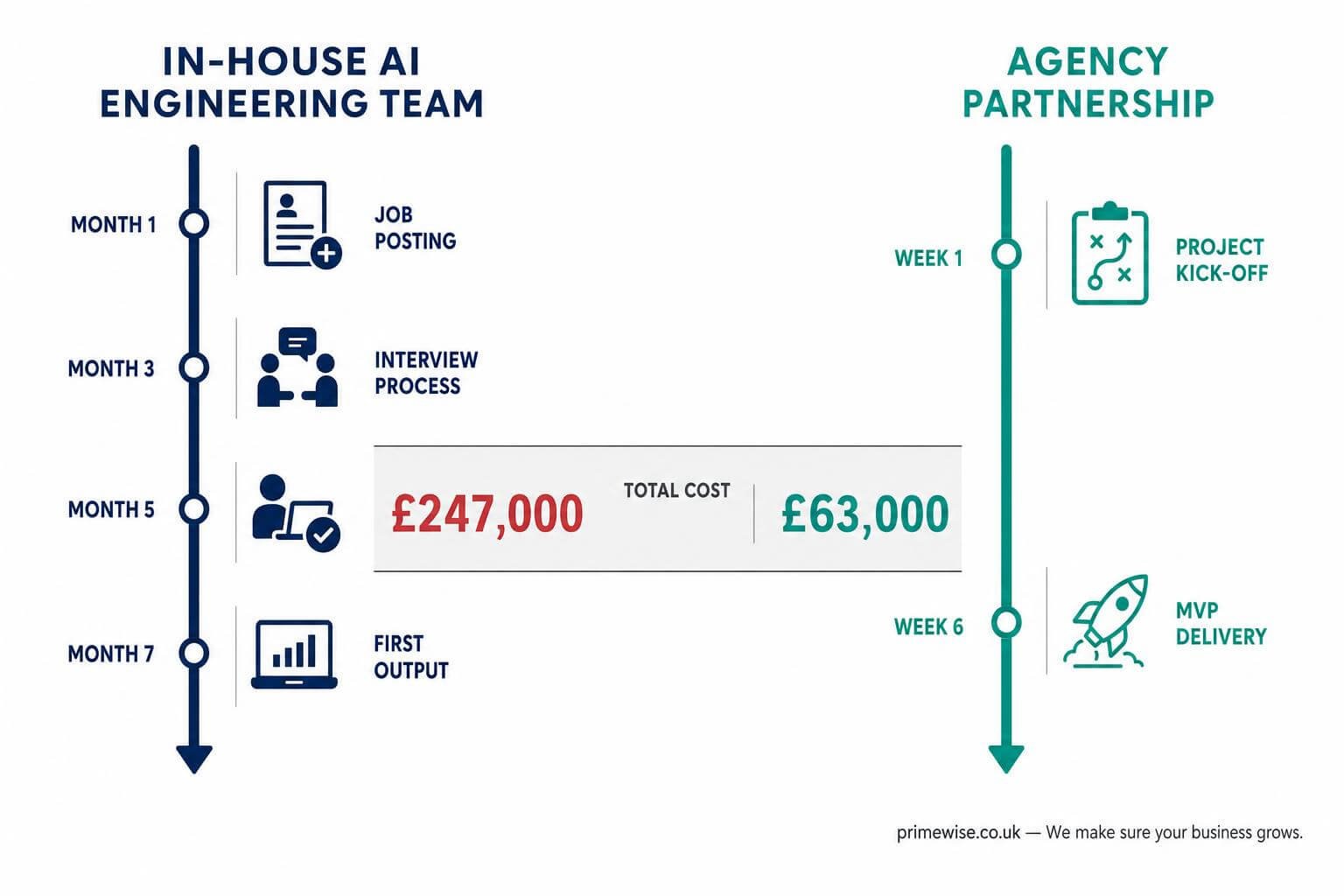
The internal build route imposes a severe and unavoidable time tax. Working through a realistic internal hiring timeline: job specification drafting and internal sign-off typically requires two to three weeks, active recruitment and shortlisting spans six to twelve weeks, technical assessment and offer stages add two to four weeks, and standard notice periods for experienced engineers run one to three months. A conservative end-to-end timeline from decision to first engineering output sits at five to seven months. An optimistic one, where every stage executes flawlessly, rarely falls below four months. During this entire period, the business is absorbing opportunity cost the value of the automation workflows that could have been live and generating operational savings.
Achieving Rapid Deployment with an Agency
A specialist agency operates with pre-built infrastructure, established platform integrations, and a team that has already navigated the architectural decisions your internal engineer would spend their first month discovering. Reputable UK AI automation agencies can deliver a minimum viable product within 30 to 60 days of project kick-off. This is not a marketing claim it is an operational reality enabled by reusable automation frameworks, established API integrations across the major AI platforms, and delivery methodologies refined across multiple client engagements.
The commercial implication is significant. An agency-delivered MVP in week six means the business can begin measuring actual workflow performance, quantifying time savings, and building the ROI evidence that justifies further automation investment all before an internal hire would have cleared their notice period. For UK SMEs operating within quarterly reporting cycles and tight cash flow constraints, this compression of the value realisation timeline is frequently the single most commercially compelling argument for the agency route.
A UK SME Scenario That Makes the Numbers Real
Theoretical cost comparisons are useful but abstract. The following anonymised scenario, based on a composite of real UK SME engagements, makes the financial framework tangible for operational leaders preparing a board-level procurement case.
A 45-person Leeds-based financial services firm evaluated building an internal NLP pipeline for client onboarding automation. The initial business case modelled an internal build at £95,000 for a senior engineer hire. When fully-loaded costs were applied employer NI, recruitment fees, onboarding lag, and the first-year maintenance burden on a three-pipeline architecture the 18-month total cost of ownership reached £247,000. Against this, an agency retainer delivered a working MVP in 52 days at a total 18-month cost of £63,000, including comprehensive maintenance and model drift management. Qualifying expenditure under HMRC’s Research and Development Tax Relief scheme reduced the net agency cost to approximately £44,100. The agency route delivered a verified, maintained automation stack at roughly 18 percent of the internal build’s total cost over the same period.
STRATEGIC INSIGHTThis scenario is representative, not exceptional. The gap between projected internal build costs and actual TCO widens significantly once recruitment lag, employer overheads, and the ongoing maintenance burden are modelled correctly. Before any board presentation, operations leaders should stress-test their internal build business case against a fully-loaded 24-month TCO model, not a headline salary figure.
The UK SME Automation Procurement Matrix
To move beyond abstract cost comparisons, operational leaders need a structured scoring framework that maps their specific initiative against the procurement routes available. The matrix below evaluates five weighted criteria and produces a directional recommendation. Each criterion is scored on a scale of one to five, with the scoring guide provided beneath each row.
| Decision Criterion | Score 1 to 5 | Agency Wins If | In-House Wins If |
|---|---|---|---|
| Strategic Differentiation | How core is this workflow to your competitive advantage? | Score 1 to 3 operational, not proprietary | Score 4 to 5 fundamental IP advantage |
| Data Sensitivity | How regulated is the data passing through this pipeline? | Score 1 to 3 standard GDPR compliance sufficient | Score 4 to 5 bespoke security architecture required |
| Internal Technical Maturity | Does your team have the skills to build and maintain this? | Score 1 to 3 capability gap exists | Score 4 to 5 strong existing AI engineering bench |
| Budget Certainty Requirement | How critical is predictable monthly expenditure? | Score 3 to 5 volatility is unacceptable | Score 1 to 2 capital expenditure model preferred |
| Time-to-Value Urgency | How soon does this automation need to be operational? | Score 3 to 5 current quarter deployment required | Score 1 to 2 6 to 12 month horizon acceptable |
If your combined score across all five criteria produces a majority of agency-favourable indicators, the agency partnership route is the commercially optimal path. If your strategic differentiation and internal maturity scores are both four or five, and your time-to-value urgency is low, an internal build may be justified over a 36-month horizon. In most UK SME contexts, however, the procurement matrix will point consistently toward the agency route or the bridge strategy described below.
Deploying the Agency to In-House Bridge Strategy
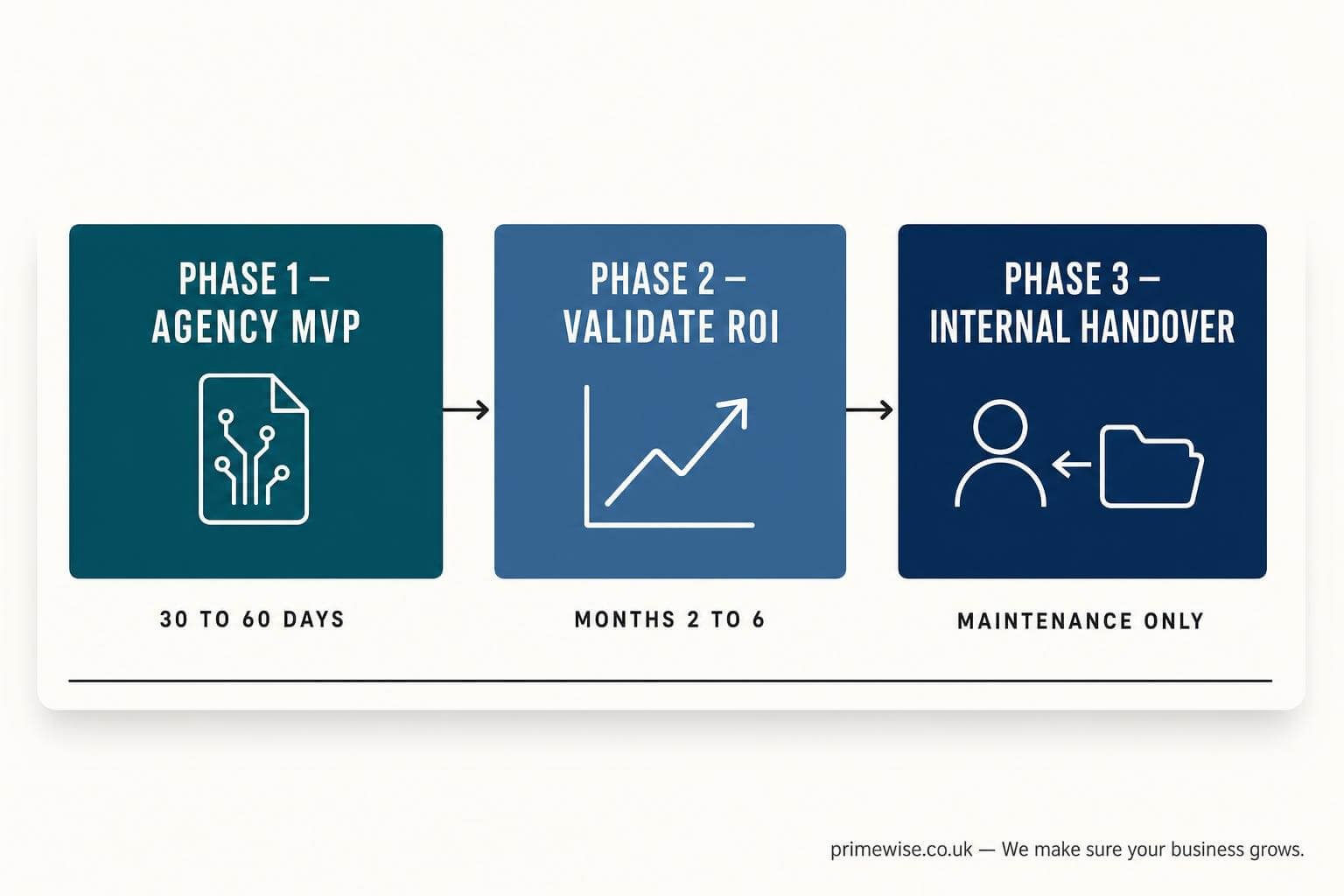
The bridge strategy is the approach that commercially sophisticated UK enterprises are increasingly adopting, and it resolves the false binary between pure outsourcing and pure internal builds. The methodology works in three phases. In phase one, a specialist agency is commissioned to engineer the initial automation solution, establish comprehensive process documentation, and deliver a working MVP within 30 to 60 days. This phase captures the speed advantage of the agency route and generates the ROI evidence needed to justify further investment. In phase two, the business operates and monitors the live system under the agency’s SLA, using the performance data to validate the business case with rigour. In phase three, once ROI is proven and the workflow is stable, the enterprise hires an internal engineer not to build, but to maintain. This is a materially different and lower-cost hire than a senior automation architect, and the agency’s documentation provides the technical handover materials that make the transition seamless.
The bridge strategy captures the commercial benefits of both routes: agency speed and expertise during the high-risk initial build phase, followed by cost-optimised internal ownership once the system is proven and stable. It also eliminates the most dangerous risk of the pure internal build committing significant capital to a system architecture that may not deliver the anticipated ROI before that ROI has been empirically validated.
In-House Build Risk Register
Abstract risk discussion is insufficient for board-level procurement decisions. The following risk register quantifies the specific failure modes associated with each route, providing the structured evidence base that governance and risk committees require.
| Risk Category | In-House Severity | Agency Severity | Mitigation Note |
|---|---|---|---|
| Key Person Dependency | High single point of failure | Low team coverage under SLA | Agency SLA guarantees continuity regardless of staff changes |
| API Deprecation Response Time | High reactive, unplanned sprint | Low proactive, SLA-governed | Agencies monitor deprecation notices and pre-build mitigations |
| GDPR Breach Liability | Medium internal, contained | Medium shared, contractually allocated | Data processing agreements must explicitly allocate liability |
| IR35 Misclassification Exposure | High freelancer engagements risky | None clean B2B contract | B2B agency contracts are outside IR35 scope by definition |
| Model Drift Detection Lag | High no monitoring baseline | Low continuous monitoring included | Agencies include performance monitoring in standard retainers |
| Vendor Lock-in | Low internal control | Medium mitigated by contract terms | Require IP ownership clauses and code escrow in agency contracts |
Navigating Data Governance and Security
Data governance is not a secondary consideration for UK businesses integrating AI automation it is a primary architectural constraint that shapes every procurement decision. For organisations in financial services, legal, healthcare, or any sector handling regulated personal data, the security posture of an automation pipeline is a compliance requirement, not a preference. The UK GDPR, enforced by the ICO, mandates that all data processing activities are conducted under a lawful basis, with appropriate technical and organisational measures in place regardless of whether processing is performed internally or by a third-party processor.
Ensuring GDPR Compliance and Data Sovereignty
When engaging an external agency, the business acts as the data controller and the agency acts as a data processor under Article 28 of UK GDPR. This relationship must be formalised through a Data Processing Agreement that specifies the scope of processing, the geographic location of data storage and processing, the security standards applied, and the procedures for data subject rights requests and breach notification. Reputable UK-based agencies will have this documentation prepared as standard and will be able to confirm that all data processing occurs within UK or EEA-compliant geographic boundaries. The UK Government’s 2024 AI Regulation White Paper further reinforces the expectation that AI deployments in regulated sectors operate within documented governance frameworks a requirement that applies equally to internal builds and agency-delivered systems.
Retaining Intellectual Property and Vendor Autonomy
Protecting proprietary workflow logic requires meticulously negotiated commercial agreements before project commencement. Every agency contract must include explicit clauses that assign full intellectual property ownership to the client upon project completion or payment, grant unrestricted access to all proprietary code and configuration files, specify whether the solution uses open-source components such as n8n or custom-developed modules, and include clear exit provisions that facilitate a smooth transition to internal management or a successor agency. Without these provisions, the risk of vendor lock-in is genuine and commercially damaging. Firms like Primewise, a UK-based AI automation agency, publish structured retainer tiers that include IP assignment as a contractual baseline, covering MVP build, ongoing maintenance, and R&D-compliant invoicing providing the kind of commercial transparency that makes the procurement decision straightforward.
UK Regulatory and Tax Considerations
The procurement route chosen for AI automation has direct and material implications for UK tax compliance and financial relief eligibility. Operations leaders must understand these implications before finalising capital allocation, as the difference between routes can alter the effective net cost of an initiative by 20 to 30 percent.
The IR35 Contractor Risk Profile
Engaging freelance AI contractors rather than permanent employees or agency partners carries substantial regulatory risk under the UK’s off-payroll working rules, commonly known as IR35. Following the 2021 reforms to Chapter 10 of ITEPA 2003, responsibility for determining IR35 status shifted to the engaging business for medium and large companies. An AI engineer or automation architect engaged through a personal service company who works predominantly for a single client, within that client’s control, and as an integral part of their operations, will almost certainly be determined inside IR35. The consequences of misclassification include PAYE and National Insurance back-payments, penalties, and interest a risk profile that HMRC’s own guidance confirms applies across the full chain of the engagement. A clean business-to-business contract with an established limited company agency is outside IR35 scope by definition, completely eliminating this exposure.
Maximising HMRC Research and Development Tax Credits
Both internal payroll and qualifying external agency costs can constitute eligible expenditure for HMRC’s Research and Development Tax Relief scheme, provided the work meets the criteria of scientific or technological uncertainty under the scheme’s definitions. For SMEs, the current enhanced R&D relief structure allows qualifying companies to claim a significant percentage of qualifying expenditure as a tax deduction or credit. Agency costs qualify as externally provided workers or subcontractor costs under the scheme’s rules, subject to the 65 percent cap on subcontractor expenditure that applies to SME claimants. Partnering with an agency that provides detailed, HMRC-compliant invoicing that clearly delineates qualifying R&D activities from non-qualifying project management or operational support dramatically simplifies the audit trail and maximises the claimable relief. Innovate UK grant funding may also be available for automation initiatives with demonstrable innovation credentials, with the agency’s documentation providing the technical evidence base required for applications.
A Structured Path to the Right Decision
The build versus partner decision in AI automation is not a philosophical question it is a financial and operational one with quantifiable answers. The evidence across TCO modelling, time-to-value analysis, risk profiling, and regulatory exposure points consistently in the same direction for the majority of UK SMEs: agency partnership, or the bridge strategy, delivers superior commercial outcomes at lower risk during the critical first phase of AI adoption.
The internal build route remains the correct answer when the automation represents a genuine, proprietary competitive differentiator, when internal technical maturity is high, and when the business has the financial and operational runway to absorb a 12-month deployment cycle. These conditions describe a minority of UK SME AI initiatives. For the majority operational efficiency automation, client-facing workflow improvements, back-office pipeline optimisation the agency route delivers the MVP faster, at lower total cost, with predictable expenditure and maintained expertise throughout the operational lifecycle.
To receive a compliant TCO analysis benchmarked against your specific operational profile and procurement context, Primewise offers a no-commitment UK SME Automation Procurement Assessment for operations and technology leaders evaluating their options. The assessment maps your initiative against the procurement matrix above, models the fully-loaded 24-month cost comparison for your specific context, and provides a clear, data-backed recommendation that will withstand board and finance committee scrutiny.
NEXT STEP FOR OPERATIONS LEADERSIf your AI automation initiative needs to be operational within the current financial quarter, the internal hiring route cannot deliver that outcome. Request Primewise's UK SME Automation Procurement Assessment to receive a fully-loaded TCO comparison and procurement recommendation tailored to your operational profile before committing capital to a route that may not serve your commercial timeline.