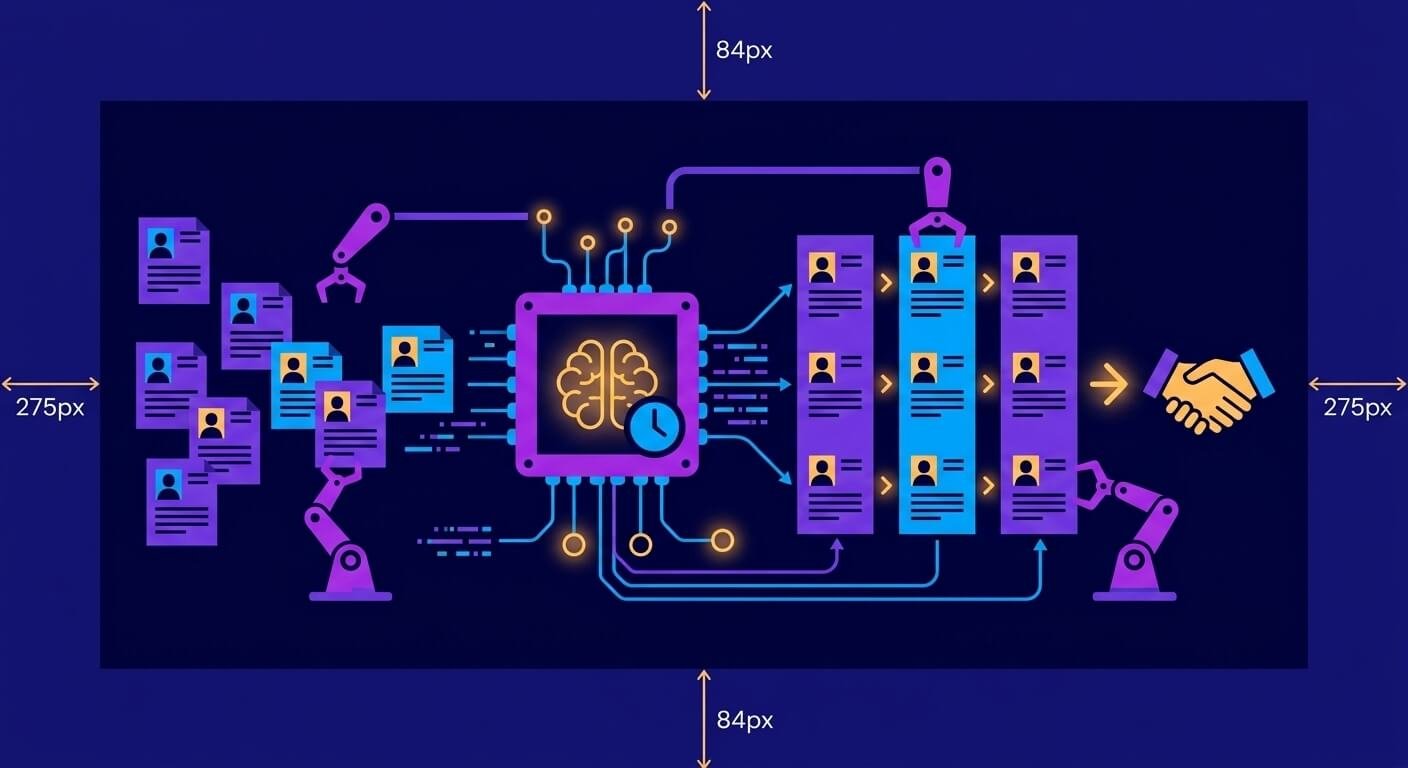

The questions to ask before hiring an AI automation agency are not optional due diligence they are the single line of defence separating a transformative enterprise deployment from a six-figure write-off. The UK’s AI investment surge has created a predatory vendor market where an estimated 68% of enterprise AI engagements fail to deliver measurable ROI within 18 months, primarily because procurement teams lack the technical vocabulary to distinguish genuine implementation engineers from agencies selling slideware. According to McKinsey’s 2025 State of AI report, 72% of enterprise AI deployments fail to reach production scale. For financial services firms operating under FCA oversight, selecting the wrong AI automation agency does not merely waste capital it creates direct regulatory exposure under UK GDPR, the FCA’s PS21/3 policy statement, and the emerging obligations of the UK AI and Data (Use and Access) Bill currently progressing through Parliament.
Who This Guide Is ForThis resource is written for procurement leads, C-suite executives, and IT directors in UK enterprises particularly in financial services, legal, and healthcare who are actively evaluating AI automation vendors and preparing to issue or score an RFP. It delivers the exact diagnostic questions that separate genuine implementation partners from agencies operating purely on narrative.
What a Genuine AI Automation Agency Actually Is
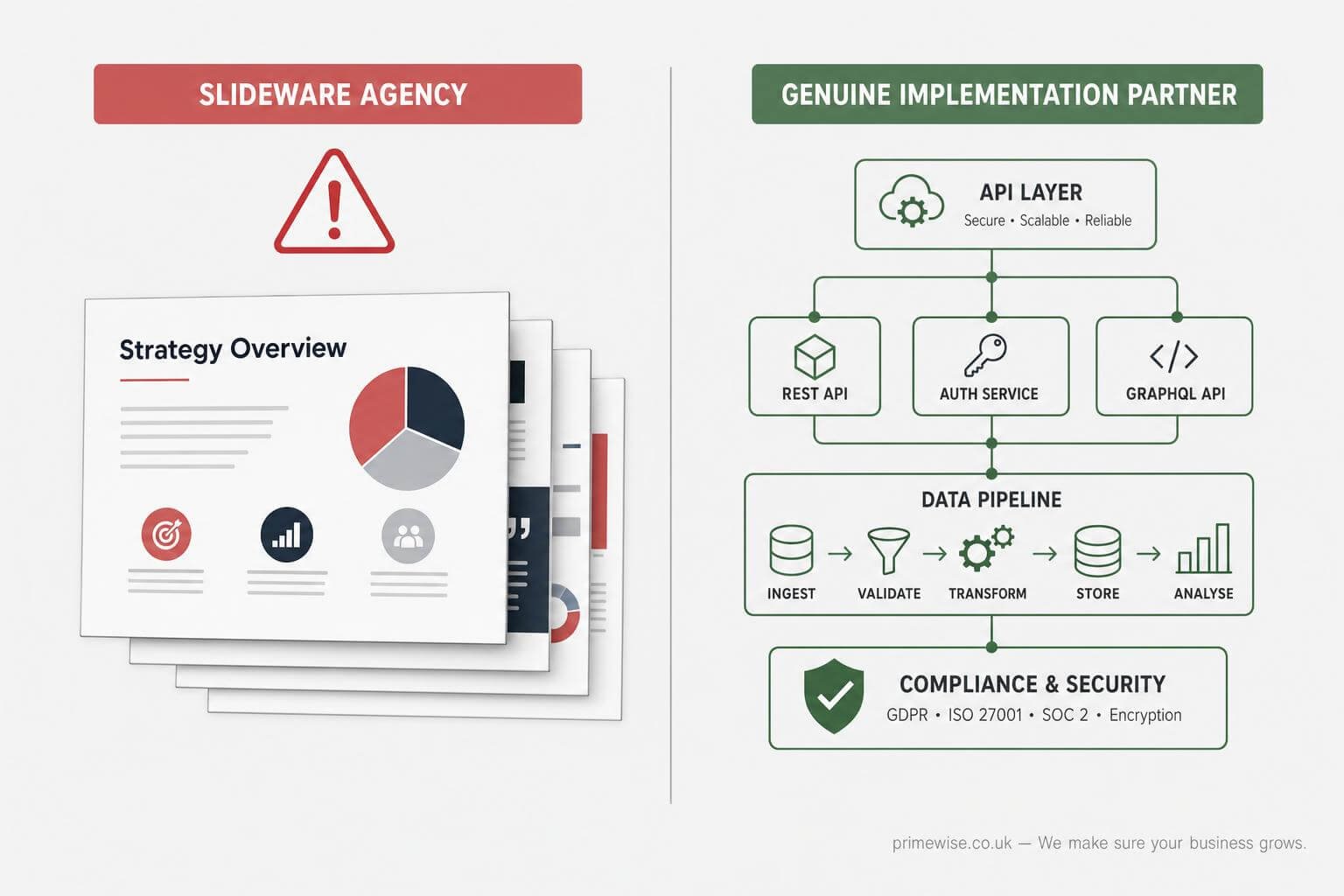
A genuine AI automation agency operates as a highly technical implementation partner that engineers custom machine learning models and integrates generative AI securely with legacy enterprise systems. These firms guarantee local data sovereignty, ensure strict compliance with UK GDPR and Financial Conduct Authority guidelines, and act as an architectural extension of your internal IT infrastructure. They transcend prompt engineering entirely building secure, scalable automated workflows that embed into regulated operational environments without creating compliance liability. The critical distinction is that a genuine partner employs disciplined software engineers and data scientists, not content strategists repurposed as AI consultants.
The AI Vendor Viability Scoring Matrix
Vendor due diligence demands a structured, empirical framework. The AI Vendor Viability Scoring Matrix below provides procurement teams with a quantifiable method for evaluating any prospective agency across the five dimensions that most accurately predict deployment success and long-term enterprise value. Use this matrix during RFP scoring or live vendor interviews to generate an objective benchmark across your shortlist.
| Evaluation Dimension | 1 Weak | 3 Adequate | 5 Exemplary |
|---|---|---|---|
| Technical Architecture | Relies solely on off-the-shelf SaaS wrappers with no custom engineering | Demonstrates API integration capability with some bespoke elements | Designs fully custom ML pipelines with documented orchestration frameworks |
| MLOps Maturity | No defined process for model monitoring or drift detection | Basic monitoring in place; manual intervention required | Automated CI/CD pipelines, drift alerts, and continuous retraining protocols |
| UK Regulatory Compliance | Generic GDPR awareness; no FCA-specific knowledge | References UK GDPR and ICO; limited FCA depth | Explicitly references FCA DP5/22, Article 22 GDPR, and ICO AI guidance |
| Data Sovereignty | Processing defaults to US or EU cloud regions | Can accommodate UK hosting with additional configuration | All LLM processing ring-fenced by default within certified UK data centres |
| Post-Deployment Accountability | No named technical lead; generic SLA language | Named project manager assigned; SLAs present but vague | Named senior UK-based architect; financially backed SLAs with uptime guarantees |
Any agency scoring below 18 out of 25 on this matrix should be removed from your shortlist regardless of commercial proposal attractiveness. A low composite score across regulatory compliance and data sovereignty constitutes an automatic disqualifier for UK financial, legal, or healthcare entities.
The Slideware Agency ThreatThe enterprise AI hype cycle has generated a significant population of marketing agencies masquerading as technical integrators. They excel at producing persuasive slide decks but fundamentally lack the software engineering discipline required to deploy functional ML models into production. Engaging these vendors introduces critical vulnerabilities into financial operations and creates serious compliance exposure under FCA and UK GDPR frameworks.
Phase 1 Technical Competency and Infrastructure
The initial vetting phase must ruthlessly filter out agencies relying on SaaS wrappers and prompt engineering theatre. Every question in this phase targets verifiable technical depth the type of answer a competent agency gives instantly and an opportunistic one struggles to construct under pressure. A failure to provide specific, methodologically grounded responses at this stage is a conclusive signal to end the evaluation.
Question 1 How Do You Handle LLM Hallucination and Model Drift
This is the single most diagnostic question in the entire evaluation. Genuine ML engineers will immediately describe their production-grade guardrails in concrete terms: Retrieval-Augmented Generation architectures that ground model outputs in verified enterprise data, calibrated temperature and top-p settings tuned per use case, semantic caching layers that reduce hallucination frequency at scale, and automated drift detection pipelines that trigger retraining when output distribution deviates beyond defined statistical thresholds. Opportunistic vendors will offer reassurances phrases like “our models are highly accurate” or “we review outputs regularly” without any methodological substance. The absence of RAG architecture as a named strategy alone is a credible red flag.
Question 2 How Do You Integrate AI with Legacy Enterprise Systems
Operational continuity is a non-negotiable requirement for enterprise technology leaders. A qualified agency will immediately outline an integration approach built on API microservices, containerisation using Docker or Kubernetes, and robust CI/CD pipelines that allow incremental deployment without forcing system-wide downtime. They will also demonstrate familiarity with legacy middleware environments particularly relevant in UK financial services where core banking platforms, insurance policy engines, and compliance reporting systems were often built on architectures dating back two decades. Ask specifically whether they have integrated with UK Open Banking standards and CMA9 infrastructure. Any agency that cannot speak fluently to staged rollout methodology without downtime does not have the enterprise architecture experience your deployment requires.
Question 3 What Is Your Preferred Orchestration Framework and Why
Demanding a specific architectural answer on orchestration immediately distinguishes experienced engineers from prompt-layer operators. Credible agencies will demonstrate proficiency in frameworks such as LangChain for multi-step LLM chain management or LlamaIndex for structured document retrieval and RAG pipeline construction. They should also be able to articulate the trade-offs between these tools when to use LangGraph for stateful agentic workflows versus simpler chain architectures and explain how their chosen framework integrates with bespoke enterprise data models. A vendor who defaults to a single generic answer without comparative rationale has likely never deployed these frameworks in a true enterprise production environment.
Question 4 How Do You Manage Technical Debt During Rapid Deployment
Rapid prototyping creates technical debt that can collapse under real enterprise workloads within months of deployment. A premier agency will enforce rigorous version control through Git-based workflows, mandate automated unit and integration testing at every sprint, and architect for horizontal scalability from the first design session rather than retrofitting it post-launch. Ask directly whether they maintain a technical debt register and how frequently it is reviewed with the client. Agencies that treat debt management as a secondary concern rather than a core engineering discipline are building systems that will require expensive rebuilds within 12 to 18 months precisely when the commercial relationship becomes most difficult to exit.
Phase 2 UK Compliance, Data Sovereignty and Regulation
Navigating UK-specific compliance is entirely non-negotiable for financial, legal, and healthcare entities. The regulatory landscape has materially evolved in 2025 and 2026 the FCA’s Discussion Paper DP5/22 on AI and Machine Learning in Financial Services, the ICO’s updated Guidance on AI and Data Protection published in 2024, and the UK AI and Data (Use and Access) Bill each impose obligations that a genuinely expert agency must reference without prompting. The Bank of England’s 2023 survey found that 72% of UK financial firms were already using AI in some form, making regulatory fluency a baseline expectation rather than a differentiator.
Question 5 How Does Your Deployment Model Guarantee UK GDPR and FCA Compliance
The vendor response to this question must feature specific legal and technical mechanisms, not generic assurances. Look for references to Data Protection Impact Assessments conducted before model training begins, role-based access controls enforced at the data pipeline level, and clear alignment with the FCA’s PS21/3 policy statement on operational resilience. Any hesitation, deflection to legal counsel, or absence of named regulatory frameworks is an immediate disqualifier for UK financial entities. A genuinely compliant agency maintains these frameworks as operational infrastructure not as documents retrieved in response to client challenges.
Question 6 What Is Your Data Governance Protocol for Sanitising PII
Catastrophic data breaches frequently originate in the model training phase, where PII enters pipelines without adequate sanitisation controls. A superior agency deploys tokenisation to replace identifiable fields with non-reversible surrogate values, strict data masking at ingestion, and differential privacy techniques that add calibrated statistical noise to training datasets without compromising model utility. Ask specifically whether they can demonstrate that zero raw PII enters any training pipeline unencrypted and whether this guarantee is contractually enforceable. The ICO has issued enforcement guidance specifically addressing AI training data practices an agency unfamiliar with this guidance has not operated within regulated UK environments.
Question 7 Can You Guarantee UK-Based Data Residency for All LLM Processing
International data transfer introduces material compliance risk under UK GDPR, particularly following the revocation of certain adequacy decisions. Demand absolute contractual clarity on whether all LLM inference and training processing occurs within UK-certified data centres. A credible agency will utilise cloud infrastructure specifically ring-fenced to UK regions typically Microsoft Azure UK South, AWS eu-west-2, or sovereign cloud deployments and will provide written confirmation of this architecture as part of the engagement agreement. An agency that hedges on this question or describes UK hosting as an optional premium add-on is operationally unsuitable for regulated sector deployments.
Question 8 How Do Your Solutions Align with ICO Guidance on Automated Decision-Making
Article 22 of the UK GDPR imposes strict restrictions on solely automated decisions that produce legal or similarly significant effects on individuals. An expert agency will proactively address this by architecting algorithmic transparency into every workflow maintaining decision audit logs, ensuring explainability at the model output layer, and mandating human-in-the-loop intervention checkpoints for all high-consequence automated pathways. They should also reference the ICO’s specific AI and Automated Decision-Making guidance and demonstrate how their deployment architecture operationalises the right to human review. This is not a theoretical compliance question it is a functional design requirement with direct enforcement implications.
Regulatory Developments You Must ReferenceAny agency claiming deep UK financial AI expertise must be able to discuss without prompting: the FCA's DP5/22 Discussion Paper on AI in Financial Services, the ICO's 2024 updated AI and Data Protection guidance, Article 22 of the UK GDPR on automated decision-making, and the UK AI and Data (Use and Access) Bill. If these documents are unfamiliar to your prospective agency, they are not operating at the required regulatory depth.
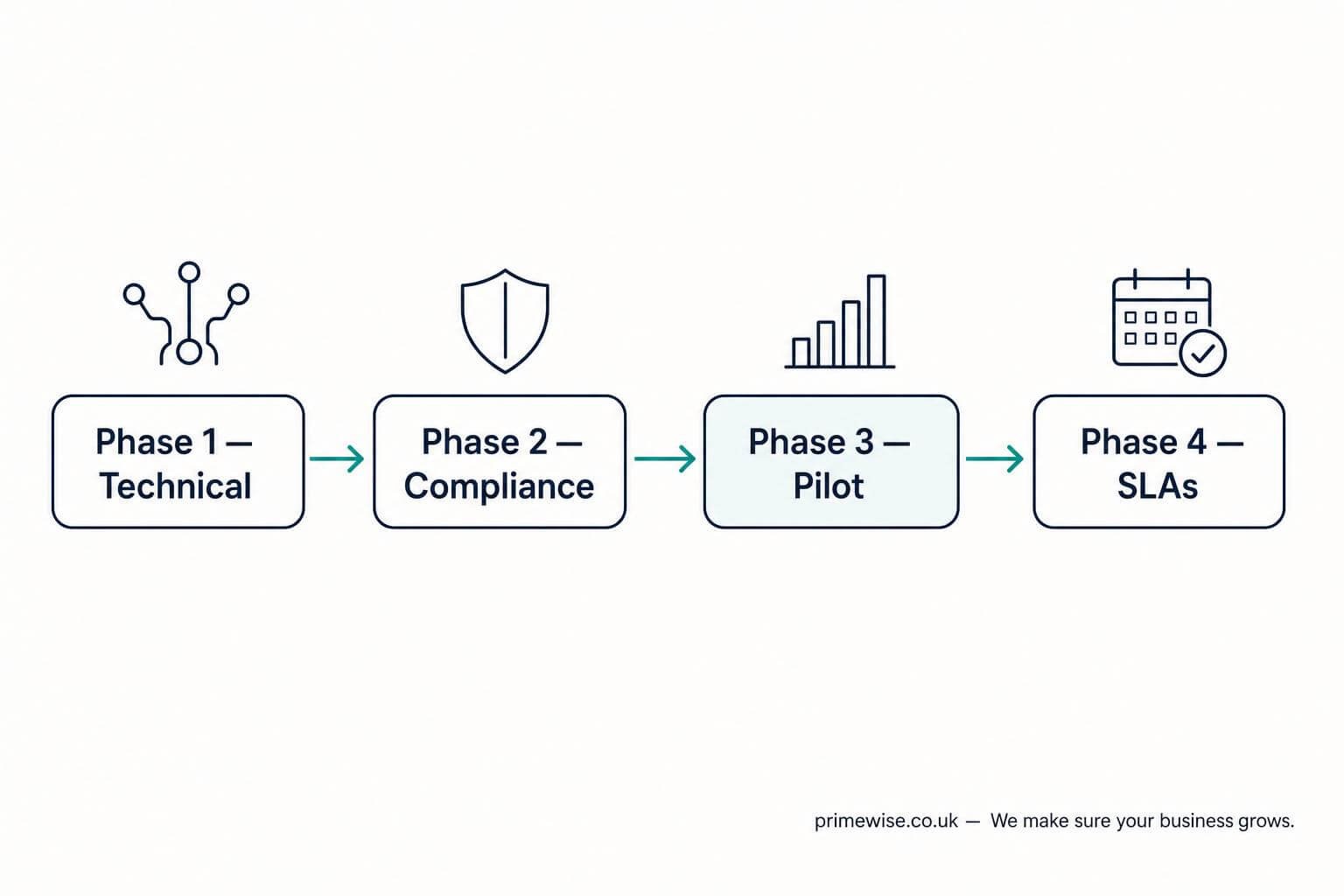
Phase 3 Proof of Concept Parameters and ROI Validation
A successful AI engagement requires a structured, low-risk commercial entry point that protects enterprise capital while generating the empirical evidence needed to justify full-scale deployment. This phase is where genuinely accountable agencies distinguish themselves from those optimising for contract size rather than client outcomes. Independent research from Accenture’s 2024 Banking Technology Vision report indicates that well-scoped AI automation pilots in UK financial services deliver measurable efficiency gains of 20 to 35% in targeted process areas within 90 days of deployment when properly scoped and governed.
Question 9 How Do You Scope, Price and Measure an AI Pilot
This question directly exposes commercial accountability. A credible UK AI implementation agency will present a fixed-price Proof of Concept typically ranging between £20,000 and £50,000 depending on data complexity, API availability, and legacy integration requirements tied directly to strictly defined KPIs agreed before work begins. These KPIs should include measurable operational metrics such as processing time reduction, error rate improvement, or cost per transaction change rather than vanity outputs like “models deployed” or “workflows created.” Any agency demanding large upfront capital expenditure without defined success metrics, or proposing time-and-materials billing for a pilot phase, is structurally incentivised to extend engagements rather than prove value. Request a detailed written scope document before any commercial discussion advances.
Question 10 Can You Present a Data Architecture Case Study in UK Financial Services
Theoretical capability is insufficient. The agency must present a concrete before-and-after data architecture case study situated within the UK financial sector demonstrating their input data state, the integration architecture selected, the compliance guardrails implemented, and the post-deployment KPI outcomes achieved. Anonymisation is acceptable and expected for confidentiality reasons, but the architectural detail must be specific. A credible case study will articulate the legacy system constraints encountered, the regulatory friction points navigated, and the measurable commercial outcomes produced. Agencies without this type of documented delivery evidence have not successfully navigated the complexity of your environment and should be deprioritised accordingly. PrimeWise, for example, publishes structured case study documentation for its UK financial services deployments precisely because this type of transparent accountability is the standard that procurement teams should expect from every candidate on their shortlist.
Phase 4 Post-Deployment SLAs, Accountability and Scaling
The operational lifecycle of a machine learning model begins immediately after launch. Without active maintenance, ML models degrade a phenomenon known as model drift as the real-world data they encounter diverges from their training distribution. This final procurement phase ensures the selected agency operates as a long-term strategic partner rather than a project-based vendor whose engagement ends at go-live. The accountability structures established at contract stage determine the quality of support received 18 months into deployment, long after the initial commercial enthusiasm has dissipated.
Question 11 What SLAs Do You Offer for Ongoing Maintenance and Model Retraining
Machine learning models require active, continuous management to maintain accuracy in production. A commercially accountable agency will provide explicit Service Level Agreements specifying maximum allowable model drift thresholds before retraining is triggered, defined uptime guarantees for all automated workflows, and scheduled fine-tuning cycles tied to agreed performance baselines. Critically, these SLAs must carry financial consequences a premium implementation partner assumes both legal and financial responsibility for operational uptime and long-term algorithmic accuracy rather than offering best-effort commitments with no commercial downside. Review the SLA document before contract execution and ensure it references specific performance metrics rather than generic availability language.
Question 12 Who Is Accountable for This Project After the Contract Is Signed
Post-sale abandonment is one of the most prevalent and damaging failure modes in enterprise AI procurement. The bait-and-switch pattern senior architects in the sales process, junior offshore teams in delivery must be contractually eliminated. Demand a named, senior, UK-based technical lead whose direct accountability for stakeholder management and project outcomes is written into the engagement agreement. This individual should be accessible to your internal team, not mediated through an account management layer. Ask to meet this person before signing. Any agency that cannot or will not name their post-contract technical lead during the sales process is signalling exactly the accountability gap that will define your delivery experience.
The Red Flag and Green Flag Vendor Matrix
Procurement and IT teams require an actionable checklist to score vendor responses rapidly during the formal RFP process. The following matrix provides objective benchmarks based on the diagnostic questions above. Use it alongside the AI Vendor Viability Scoring Matrix to generate a composite evaluation score. Any single Red Flag response in the compliance or data sovereignty categories constitutes grounds for immediate removal from the shortlist the commercial risk is disproportionate to any potential cost saving.
- Green Flag Unprompted, detailed explanation of specific MLOps orchestration frameworks, drift detection thresholds, and CI/CD pipeline architecture
- Green Flag Proactive confirmation that all model processing is ring-fenced within certified UK data centres, provided in writing as a default contractual term
- Green Flag Fixed-price pilot scoping with KPIs agreed upfront, a named technical lead, and a documented case study from a relevant regulated UK sector
- Green Flag Spontaneous reference to FCA DP5/22, ICO AI guidance, and Article 22 UK GDPR without client prompting
- Red Flag Guarantees of predictive accuracy above 95% without detailing hallucination mitigation, RAG architecture, or statistical confidence frameworks
- Red Flag Deflecting or vague responses to Article 22 GDPR, FCA compliance requirements, or ICO data protection obligations
- Red Flag Inability or reluctance to name the specific senior engineer responsible for post-deployment delivery before contract execution
- Red Flag Time-and-materials billing proposed for the pilot phase with no defined success criteria or commercial accountability structure
PrimeWise The Benchmark This Framework DescribesPrimeWise operates as a UK-headquartered AI implementation partner that has engineered compliant automation workflows for financial services firms operating under FCA oversight. Their engagement model begins with a fixed-price, KPI-bound Proof of Concept precisely the commercial structure this framework recommends demanding from any AI automation agency. Enterprise procurement teams can initiate a technical discovery conversation at primewise.co.uk.
Additional Qualifications to Verify Before Shortlisting
Beyond the 12 diagnostic questions, procurement teams should verify a set of foundational organisational credentials that indicate operational maturity and regulatory accountability. ISO 27001 certification demonstrates that the agency operates a formally audited information security management system a baseline expectation for any vendor handling enterprise data in regulated environments. Cyber Essentials Plus accreditation, administered by the National Cyber Security Centre, provides government-backed validation of the agency’s cybersecurity posture. ICO registration is a legal requirement for any organisation processing personal data in the UK and its absence is an immediate disqualifier. FCA authorisation status should be confirmed where the agency is advising on or implementing systems that interact directly with regulated financial activities. When evaluating MLOps maturity specifically, reference the Google MLOps Maturity Model agencies operating at Level 0 employ entirely manual processes, Level 1 delivers pipeline automation, and Level 2 achieves full CI/CD automation for ML systems. A production-grade enterprise partner should demonstrate Level 1 maturity at minimum and Level 2 capability for complex deployments.