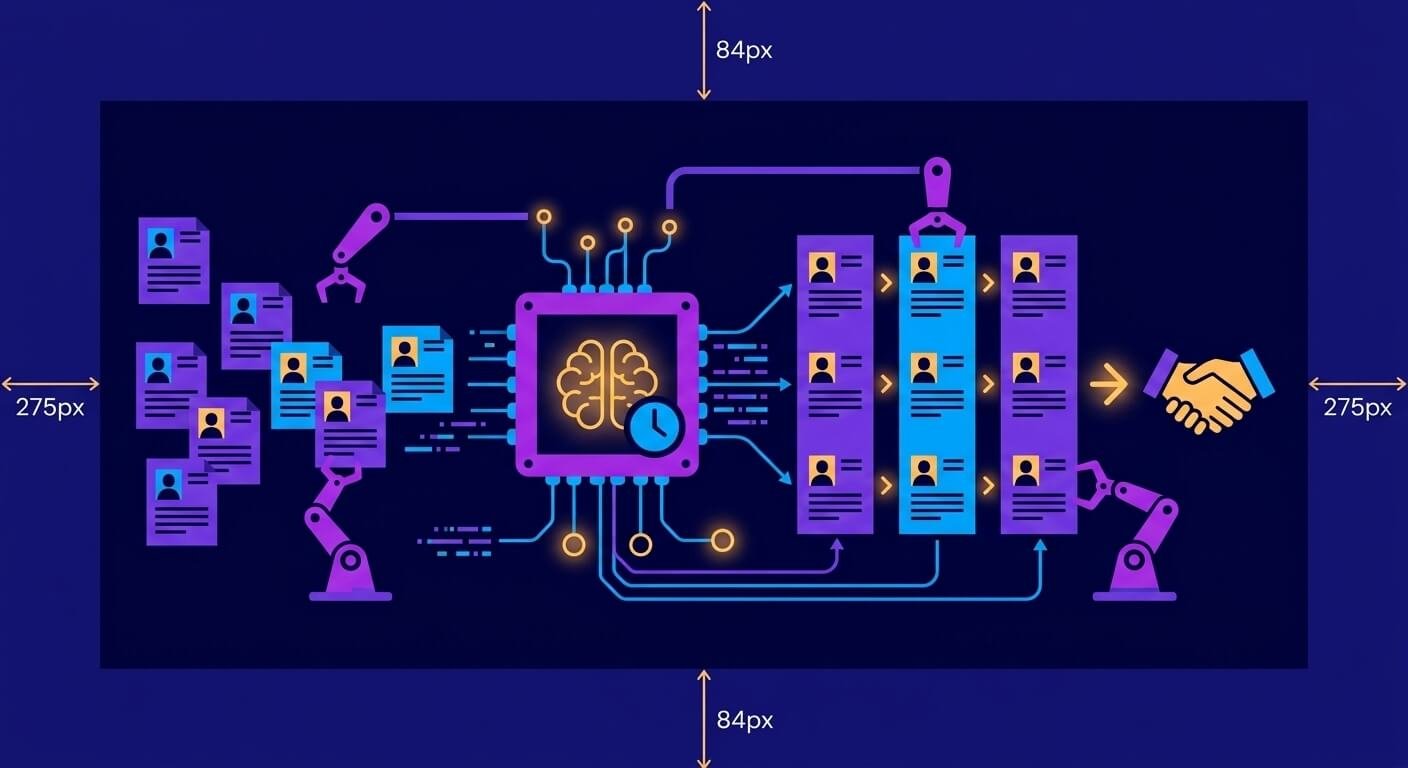

Knowing how to choose an AI automation agency is now one of the most financially consequential decisions a UK enterprise leader will make. A 2024 McKinsey Global Survey found that 60% of enterprise AI deployments fail to achieve projected ROI within 24 months a figure that rises to 74% in UK financial services firms and the predominant cause is not technical malfunction. It is user adoption failure. The capital deployed vanishes not because the technology breaks, but because the workforce quietly stops using it. This playbook exists to close that gap, giving procurement teams a rigorous, battle-tested framework for selecting a partner who delivers measurable operational change rather than another expensive addition to the enterprise shelfware graveyard.
Executive Summary
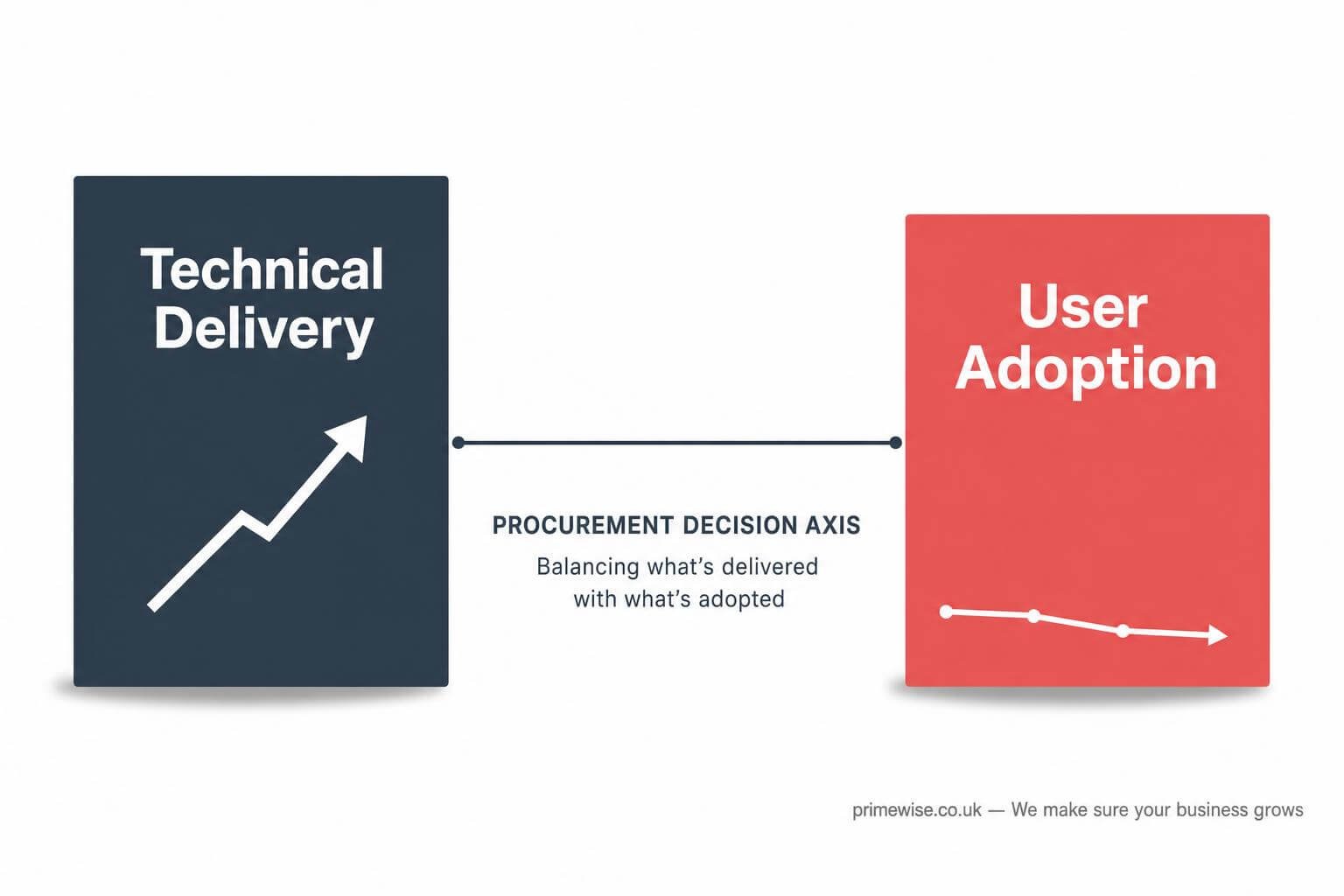
UK enterprise and financial leaders face a structurally broken vendor market in which agencies routinely prioritise technical deployment over human adoption. The result is a systemic pattern of high-specification AI tools that deliver near-zero operational value. This playbook provides a procurement framework covering problem-first scoping, the Buyer AI Adoption Matrix, adoption-centric reference checking, contractual safeguards, and UK regulatory compliance. The objective is singular: to help you identify the rare agency that builds tools your workforce will genuinely use, and to bind that commitment into every commercial clause of your agreement.
Why Most Enterprise AI Tools Become Shelfware
Shelfware syndrome is the defining capital destruction event of the current enterprise technology cycle. It occurs when organisations procure advanced AI automation systems that score highly on functional specifications but suffer from critically low daily active user rates within ninety days of launch. Gartner estimates that by 2025, 85% of AI projects will deliver below their expected business outcomes, with poor user experience and inadequate change management cited as the primary failure vectors in post-mortem analyses. For UK financial and legal institutions, the compounding effect of legacy IT complexity and risk-averse workforces makes adoption failure not merely likely but structurally probable unless addressed at the procurement stage.
The root cause is rarely a defective algorithm. It is operational friction interfaces that alienate non-technical staff, workflows that ignore undocumented workarounds, and deployment strategies that treat training as a final-day afterthought. Understanding this distinction is the single most important conceptual shift any procurement leader can make before engaging a single vendor.
THE SHELFWARE COST REALITYUK enterprises collectively lose an estimated £2.3 billion annually on underutilised enterprise software licences. For AI automation specifically, the sunk cost compounds because the integration, data migration, and change management expenditure is non-recoverable once a tool is abandoned. The financial risk is not the licence fee it is the total cost of failed transformation.
The Sunk Cost Trap in AI Procurement
Enterprise procurement teams frequently compound the initial error by continuing to fund tools that demonstrate clear adoption failure signals in the first thirty days post-launch. The psychological mechanism driving this behaviour is the sunk cost fallacy the irrational tendency to protect prior investment by doubling down on failing initiatives rather than pivoting strategy. Recognising this pattern early, and building contractual exit mechanisms before signing, is the structural safeguard that separates sophisticated buyers from those who repeat the cycle indefinitely.
The Problem-First Scoping Framework
The most reliable early signal of a high-quality AI automation agency is a categorical refusal to propose a technology solution before conducting a forensic audit of your existing operational workflows. This problem-first approach directly eliminates the information asymmetry that dominates B2B technology sales, where vendors routinely engineer use cases around their existing product capabilities rather than your genuine operational bottlenecks.
A credible partner will insist on exhaustive process mapping before any technical architecture is discussed. They will want to understand which tasks consume disproportionate staff time, where data entry is duplicated across legacy systems, and which compliance checkpoints create measurable throughput delays. Only after this diagnostic phase should a solution architecture even be drafted.
The Tech Stack First Trap
Agencies that open their first meeting with a demonstration of their proprietary large language model, their pre-built RPA connectors, or their agentic AI orchestration layer are signalling a fundamental commercial misalignment. A mature solution architect is technology-agnostic at the discovery phase. The priority is diagnosing the human workflow problem. When a vendor leads with their stack, they are implicitly telling you that your operational reality will be shaped around their product capabilities not the inverse. This procurement pattern is the single most reliable predictor of a disconnected tool that employees will route around within weeks of deployment.
In 2026, the distinction between Robotic Process Automation, Intelligent Process Automation, and Agentic AI systems is commercially significant. RPA executes deterministic, rule-based tasks. IPA adds machine learning to handle variability. Agentic AI autonomously plans and executes multi-step reasoning workflows. A vendor who cannot clearly explain which architecture applies to your specific use case, and why, is not operating at the level your enterprise requires.
Mapping Human Workflows and Legacy Infrastructure
Integrating modern AI into the entrenched legacy systems typical of London’s financial and legal institutions demands exceptional architectural competence combined with deep operational empathy. An effective agency must demonstrate a proven methodology for auditing current IT infrastructure, mapping API ecosystems, and identifying the shadow IT solutions unauthorised workarounds that staff have built themselves to compensate for system deficiencies that represent the true operational baseline.
Shadow IT risk in legacy financial institutions is consistently underestimated during procurement. When frontline workers have spent years building their own Excel macros, Outlook rules, and informal data transfers to compensate for system gaps, any new AI tool must address these hidden workflows explicitly. Agencies that discover these workarounds in live production rather than during scoping will invariably deliver a solution that conflicts with the actual daily operational reality of your workforce.
SCOPING CHECKLISTBefore progressing any vendor to the shortlist stage, confirm they have committed to: a minimum two-week operational shadowing phase with frontline staff, a full legacy system API audit, documented process mapping reviewed by operations leads, and identification of all informal workarounds currently in use.
The Buyer AI Adoption Matrix
Evaluating prospective AI automation agencies requires a structured mechanism that measures two independent axes simultaneously: technical delivery capability and change management maturity. Most procurement evaluations over-index on the former and ignore the latter entirely, which is precisely how technically functional but operationally useless tools get contracted and funded.
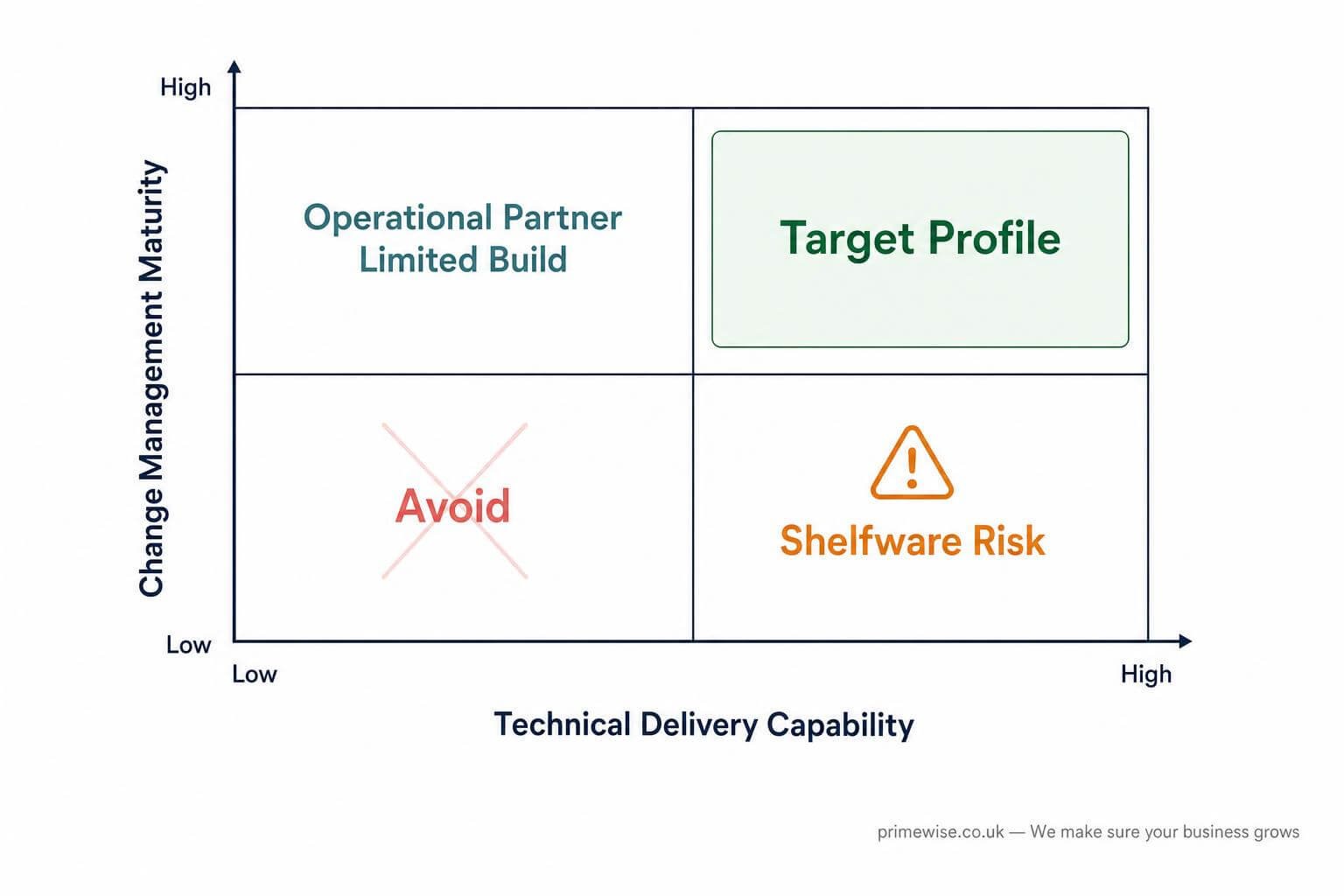
The Buyer AI Adoption Matrix maps prospective vendors across four distinct quadrants, giving procurement teams an objective positioning framework before commercial negotiations begin.
- Quadrant One High Technical, Low Change Management: The classic shelfware risk profile. The agency builds sophisticated, architecturally sound systems that staff do not adopt. This is the most common vendor profile in the current market and the most dangerous procurement outcome.
- Quadrant Two Low Technical, High Change Management: An operationally empathetic partner with limited build capability. Suitable only for low-complexity automation projects. Will struggle with enterprise-scale or regulated financial services deployments.
- Quadrant Three Low on Both Axes: Avoid unconditionally. These vendors typically compete on price and deliver neither technical quality nor adoption support.
- Quadrant Four High Technical, High Change Management: The target partner profile. Rare in the current market. Identifiable through adoption metrics, frontline shadowing methodologies, UAT-first development processes, and contractual accountability for post-launch daily active user rates.
Score each shortlisted vendor against this matrix using the reference checklist questions detailed below. Agencies that resist being evaluated against change management criteria framing adoption as the client’s responsibility rather than a shared deliverable are self-identifying as Quadrant One operators regardless of their technical credentials.
Assessing Operational Empathy and UX Design
Operational empathy is the defining characteristic separating agencies that build tools staff genuinely want to use from those that build tools staff are instructed to use and quietly abandon. During vendor evaluation, procurement teams must rigorously examine the proposed user experience methodology. Specifically, ask to review the UX research artifacts from previous engagements journey maps, usability testing reports, and interface iteration logs. Absence of these materials confirms the agency treats UX as cosmetic rather than functional.
A partner with genuine operational empathy will assign dedicated UX researchers to the discovery phase, not the delivery phase. They understand that a financial analyst processing trade confirmations, a compliance officer reviewing flagged transactions, and a legal secretary managing document workflows each have fundamentally different cognitive loads, technical proficiencies, and tolerance for interface complexity. One-size-fits-all interfaces are the fastest pathway to non-adoption.
User Acceptance Testing as a Foundational Deliverable
Agile development environments frequently treat User Acceptance Testing as a brief final gate before go-live. A premier automation agency structurally embeds UAT as the first major milestone in the Statement of Work, not the last. This means prototype testing begins within weeks of project initiation, with continuous feedback loops involving the frontline staff who will use the system daily not only the project sponsors who commissioned it.
If a vendor’s proposed project plan positions UAT as a two-week phase immediately preceding launch, that is a contractual red flag requiring immediate renegotiation. The feedback architecture must be established before a single line of production code is written. Agencies operating under an AI Centre of Excellence model typically embed this practice by default, treating end-user feedback as a primary engineering input rather than a post-build quality check.
The Adoption-Centric Reference Checklist
Generic client testimonials and satisfaction scores are commercially worthless at this procurement stage. Enterprise buyers must conduct targeted reference calls with past clients, specifically focused on post-deployment adoption outcomes rather than delivery experience. The goal is to extract granular operational intelligence that reveals whether the agency’s tools actually changed how people work or simply added another system to the login rotation.
Request a minimum of three references from projects of comparable scale and regulatory complexity to your own. For UK financial services procurement, insist on at least one reference from a regulated firm operating under FCA oversight. Generic enterprise references from unregulated sectors do not validate the competencies that matter most in your operating environment.
Uncompromising Questions for Past Clients
The following questions are designed to bypass surface-level satisfaction responses and extract operationally specific intelligence. Each question is structured to surface concrete evidence of adoption performance, change management quality, and legacy system integration competence.
- Did agency analysts physically shadow your frontline workers for a minimum of two weeks before proposing any technical architecture?
- What was your daily active user rate at ninety days post-launch, and how did it compare to the contractual benchmark agreed in the SOW?
- How rapidly did the agency respond and iterate when initial user feedback indicated resistance or friction in the first thirty days?
- Did the final deliverable integrate seamlessly with your existing legacy systems without requiring redundant manual data entry?
- Were user training materials differentiated by technical proficiency level, and was training delivered iteratively rather than as a single pre-launch event?
- Did the agency conduct a formal Change Resistance Index assessment before deployment, and how did they use that data to shape the rollout strategy?
- What does your Total Cost of Ownership look like at twelve months compared to the initial projection presented during procurement?
Measuring Post-Launch Daily Active User Rates
The definition of deployment success must shift decisively from on-time delivery to sustained end-user adoption. Industry benchmark data suggests that a successfully integrated enterprise automation tool should achieve between 65% and 80% daily active user penetration within the intended user group by day ninety post-launch. Tools falling below 40% DAU at this benchmark are demonstrating early-stage shelfware trajectory and require immediate intervention.
When vetting agencies, demand historical DAU data across their previous enterprise deployments. Agencies who cannot or will not provide this data are almost certainly concealing poor adoption outcomes. Firms like Primewise, a specialist AI automation agency working within UK financial services, operate with post-deployment adoption metrics as a standard transparency commitment publishing ninety-day DAU benchmarks as a baseline expectation. This level of accountability should be the procurement standard, not an exception.
ADOPTION BENCHMARKA well-integrated enterprise AI automation tool should achieve 65–80% daily active user penetration within its target user group by day 90 post-launch. Demand this benchmark contractually. If a vendor resists including it in the SLA, treat that resistance as a definitive red flag.
Silent Warning Signs Your Agency Will Deliver Shelfware
The later stages of vendor evaluation often obscure critical failure signals beneath polished presentations and sophisticated marketing materials. Having reviewed hundreds of agency proposals across enterprise procurement engagements, the warning signs below represent the most consistent predictors of post-deployment abandonment. None of these are dramatic or immediately obvious they are quiet, structural indicators of a vendor who will deliver a technically functional but operationally isolated tool.
Weaponised AI Jargon as a Masking Mechanism
A reliable indicator of an inadequate vendor is the persistent deployment of dense AI terminology agentic orchestration layers, multi-modal transformer architectures, neural symbolic reasoning pipelines deployed not to educate but to obscure. When an agency relies on technical complexity to avoid answering direct operational questions, they are almost certainly masking either significant technical debt in their delivery methodology or a fundamental absence of change management capability. True operational partners articulate complex solutions with complete clarity, ensuring every stakeholder understands exactly what will change in their daily working environment and why.
Test this immediately in the first meeting. Ask the agency to explain, in plain English with no technical vocabulary, how their proposed solution will change the daily workflow of a specific frontline role in your organisation. Agencies that cannot do this in three minutes or less without reaching for a jargon safety blanket are not operationally mature enough for enterprise deployment.
No Frontline Shadowing in the Project Plan
Building automation tools in isolation from the end-user environment is a structurally guaranteed pathway to failure. If a vendor’s project plan contains no explicit commitment to workflow observation, no frontline shadowing phase, and no human-in-the-loop engagement methodology, they cannot deliver a highly adopted tool regardless of the technical quality of their build. This is not a preference it is an operational fact borne out consistently across enterprise deployment post-mortems.
An ISO 42001-aligned AI governance framework, which defines responsible AI development and deployment standards, should include mandatory human oversight checkpoints throughout the build process. Agencies operating without any reference to structured AI governance frameworks are operating below the standard that UK regulated environments require in 2026.
Vendor Lock-In Architecture
Agencies that build on proprietary platforms with limited API portability, non-standard data schemas, or closed model architectures create vendor lock-in that exponentially increases your Total Cost of Ownership and eliminates your ability to migrate or evolve the solution as your operational needs change. Demand a written data portability commitment and a vendor lock-in mitigation strategy in the initial commercial proposal. The absence of either is a significant contractual risk signal that must be resolved before any agreement is signed.
Contractual Safeguards and UK Regulatory Compliance
Securing a premier AI automation partner requires robust commercial safeguards embedded directly within the Master Services Agreement, not appended as annexures that can be quietly deprioritised during delivery. Enterprise procurement must ensure the selected agency shares the operational risk of deployment, with financial incentives structurally aligned to adoption outcomes rather than delivery milestones.
Structuring Statements of Work Around Adoption Metrics
Traditional milestone payment structures tied exclusively to technical delivery dates create a fundamental misalignment of incentives. The agency is financially incentivised to ship not to ensure the shipped tool is used. Restructuring the Statement of Work so that final milestone payments are released only upon achieving predetermined daily active user thresholds transfers meaningful financial risk back to the vendor and creates a shared commercial interest in genuine adoption.
Specifically, the SOW should contain three adoption-linked payment gates: a thirty-day post-launch UAT completion payment requiring documented evidence of iterative user feedback integration; a sixty-day payment requiring the DAU rate to exceed a minimum agreed threshold, typically 45% to 55% of the target user population; and a ninety-day final payment requiring DAU to reach the full contracted benchmark, typically 65% to 80%. Agencies who resist this payment structure are explicitly signalling they do not expect their tool to achieve sustained adoption.
Navigating FCA Compliance and UK GDPR Data Residency
For UK financial and investment institutions, outsourcing AI automation development introduces regulatory complexities that require explicit contractual treatment. The FCA’s Supervisory Statement SS2/21 on operational resilience mandates that firms identify and protect their important business services, with specific obligations regarding the mapping, testing, and management of third-party technology dependencies including AI vendors. The FCA’s Policy Statement PS21/3 further requires regulated firms to conduct thorough third-party risk assessments covering data security, operational continuity, and exit management for all material outsourcing arrangements.
Contracts must mandate strict UK data residency protocols, ensuring all training data, inference processing, and model outputs remain within UK data centre boundaries unless explicit ICO approval has been obtained for cross-border data flows. The selected agency must demonstrate a documented command of UK GDPR Article 28 processor obligations, and the MSA must include specific provisions requiring the agency to notify the regulated firm within 72 hours of any personal data breach affecting the deployed system.
Alignment with the UK Government’s pro-innovation AI Whitepaper principles context-specific, principle-based AI governance rather than prescriptive regulation should also be evidenced in the agency’s internal governance documentation. Agencies operating without reference to the Department for Science, Innovation and Technology’s DSIT AI guidance frameworks are not operating at the regulatory maturity level that UK financial services procurement requires in 2026.
REGULATORY ESSENTIALS FOR UK FINANCIAL SERVICESYour AI automation MSA must explicitly address: FCA SS2/21 operational resilience obligations, PS21/3 third-party risk management requirements, UK GDPR Article 28 data processor clauses, ICO-approved data residency protocols, and ISO 42001 AI governance alignment. Any agency unable to evidence compliance with each of these frameworks should be removed from the shortlist.
The UK AI Automation Market in 2026
The scale of investment and the corresponding scale of failure in UK enterprise AI automation has reached a point where regulatory bodies and institutional investors are beginning to treat adoption metrics as material disclosure items. The Department for Science, Innovation and Technology projects UK enterprise AI spend to exceed £18 billion by 2026, with financial services, legal, and professional services sectors accounting for the largest share of deployment budgets. Against this backdrop, Forrester research indicates that fewer than one in three UK enterprise AI automation projects achieves its projected productivity uplift within the first twelve months a figure consistent with ONS productivity data showing minimal output improvement in London’s financial services sector despite record technology investment.
The implication for procurement teams is structural rather than incidental. The market has a systemic agency quality problem, and the burden of identifying the minority of vendors operating at the required standard falls entirely on the buyer. This playbook, and the procurement framework it contains, is designed to make that identification process systematic, rigorous, and commercially defensible at board level.
From Evaluation to Decision
The final stage of agency selection requires translating the Buyer AI Adoption Matrix assessment, the reference call intelligence, and the contractual negotiation outcomes into a single, board-ready procurement recommendation. Every element of the evaluation framework outlined here contributes a weighted data point to that recommendation. No single signal positive or negative should override the aggregate picture.
Enterprise leaders who complete this process systematically will find that the shortlist of agencies genuinely capable of delivering high-adoption AI automation in a UK regulated environment is significantly shorter than the initial vendor landscape suggests. This is not a failure of the market it is a feature of a maturing discipline in which operational excellence and technical excellence are only now beginning to converge in the same firms.
Procurement teams evaluating AI automation partners can benchmark shortlisted agencies directly against the Buyer AI Adoption Matrix criteria detailed in this playbook. Primewise provides an initial operational workflow diagnostic designed specifically for UK enterprise and financial services firms request a no-obligation scoping session at primewise.co.uk to establish your baseline before the next board approval cycle.
DECISION-STAGE ACTIONBefore board submission, every shortlisted agency should have been scored against the Buyer AI Adoption Matrix, provided verifiable 90-day DAU data from comparable deployments, confirmed FCA and UK GDPR compliance capability in writing, and accepted adoption-linked milestone payment structures in the commercial proposal.