
Make vs Zapier vs n8n sits at the centre of every serious enterprise automation decision in 2026. Choosing the wrong platform locks your operations into escalating task-based billing, fractured data governance, or rigid architectures that buckle under AI workloads. This guide, written from hands-on experience migrating client stacks across all three platforms, delivers the definitive technical and commercial comparison covering total cost of ownership, UK regulatory compliance, AI orchestration depth, and migration strategy. If you are evaluating a structured AI workflow automation service for your organisation, the platform decision you make today will define your operational ceiling for the next five years.
What These Three Platforms Actually Are
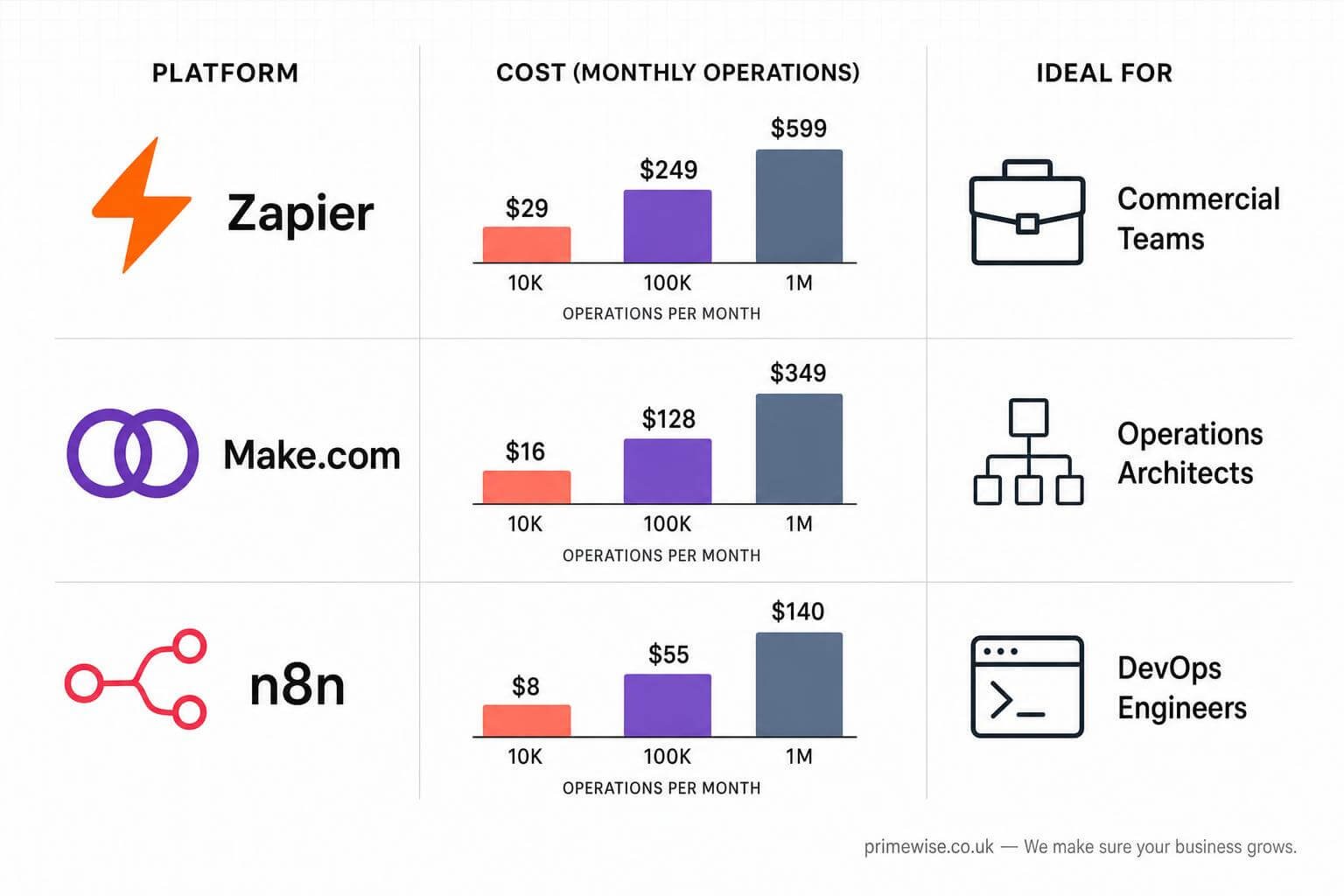
Make.com, Zapier, and n8n are Integration Platform as a Service solutions iPaaS tools that connect disparate software systems via APIs, automate complex business logic, manage ETL data pipelines, and deploy custom AI workflows. Despite occupying the same market category, they represent fundamentally different architectural philosophies. Zapier prioritises accessibility for non-technical users. Make.com offers a visual canvas for operational architects who need branching logic without writing code. n8n delivers a self-hosted, Node.js-based sandbox for DevOps engineers who demand infrastructure-level control. Understanding these distinctions is not an academic exercise it determines whether your automation investment compounds or collapses at scale.
As of 2026, Zapier reports over 7,000 native app integrations and serves more than 2.2 million active users globally, making it the largest ecosystem by connector volume. Make.com has surpassed 500,000 active users and positions itself aggressively in the mid-market operational segment. n8n, the open-source challenger, has exceeded 70,000 self-hosted deployments worldwide and is accelerating adoption among engineering-led UK scale-ups seeking data sovereignty and cost control. These are not interchangeable tools they are distinct architectural bets.
Quick Platform VerdictZapier for commercial teams needing speed. Make.com for operations architects needing logic. n8n for DevOps teams needing control and compliance. Read the full breakdown to confirm the right fit for your volume, budget, and regulatory context.
Platform to Persona Alignment
The single most costly mistake enterprises make is selecting an automation platform based on brand familiarity rather than team maturity. Misalignment between platform architecture and internal skill sets produces shadow IT, fractured data governance, and compounding technical debt. Each of these three platforms is genuinely excellent but only when deployed by the persona it was designed to serve.
Zapier for Commercial Rapid Deployment
Zapier remains the undisputed leader for citizen developers and commercial teams who need operational velocity without engineering overhead. Its library of over 7,000 pre-built connectors allows marketing and sales departments to deploy linear integrations in minutes, synchronise CRM platforms, automate lead routing, and execute data transfers without raising a single IT ticket. For validating new workflows and enabling non-technical teams to operate independently, Zapier delivers exceptional returns. The platform’s drag-and-drop Zap builder is genuinely frictionless, and its conditional logic builder handles straightforward if-then branching adequately for commercial use cases.
The structural limitation emerges at complexity and volume. Zapier’s architecture sacrifices flexibility for accessibility, meaning that highly complex routing, JSON payload manipulation, and parallel execution require cumbersome multi-step workarounds that inflate task consumption rapidly. Organisations running sophisticated data pipelines or multi-branch AI orchestration workflows will find Zapier’s architecture inadequate and its billing model punishing at scale.
Make.com for Operational Visual Logic
Make.com occupies the critical middle ground between citizen developer accessibility and full engineering control. Its visual canvas supports intricate branching logic, parallel execution paths, native array handling, and JSON payload manipulation without requiring custom code. Revenue operations professionals, operations architects, and technical business analysts consistently identify Make as the optimal platform for workflows that outgrow Zapier but do not require the full infrastructure overhead of a self-hosted solution.
The platform’s iterator and aggregator modules are particularly powerful for financial data processing enabling bulk API calls, conditional routing, and data transformation within a single coherent visual workflow. Make’s operation-based billing model, rather than task-based charging, means that a multi-step workflow processing one record counts as one operation rather than five sequential tasks. This architectural difference alone can reduce monthly platform costs by 60 to 75 percent when migrating equivalent Zapier workflows at enterprise volumes.
n8n for DevOps and Self-Hosted Control
For enterprise IT departments, DevOps engineers, and CTOs managing regulated data environments, n8n provides an architecturally unmatched self-hosted automation framework. Built on Node.js and deployable via Docker or Kubernetes, the platform gives engineering teams absolute infrastructure control including data residency, execution environment, credential management, and compute allocation. Engineers can write custom JavaScript directly inside workflow nodes, integrate with source control systems like GitHub, and manage the entire automation stack as infrastructure as code.
This code-level flexibility ensures organisations are never constrained by native integration limitations. n8n’s community node library and custom node SDK allow development teams to construct bespoke API connectors, manage OAuth 2.0 credential flows programmatically, and execute highly specific data transformations that would be architecturally impossible within Zapier or commercially prohibitive within Make. For UK enterprises operating under FCA oversight or processing sensitive Open Banking data, n8n’s self-hosted model on AWS UK (eu-west-2) or Azure UK South provides deterministic data residency that cloud-first alternatives cannot replicate.
2026 Pricing Comparison and Total Cost of Ownership
Evaluating the long-term financial impact of automation platforms demands analysis that goes beyond headline subscription tiers. Task-based billing models, webhook polling frequencies, and API call overhead interact to create total costs that diverge dramatically from vendor marketing materials at enterprise execution volumes.
| Platform | Billing Model | Cost at 10K Ops/Month | Cost at 100K Ops/Month | Cost at 1M Ops/Month | Self-Hosting |
|---|---|---|---|---|---|
| Zapier | Per task | ~£49 | ~£299 | ~£1,999+ | No |
| Make.com | Per operation | ~£16 | ~£59 | ~£399 | No (Enterprise tier) |
| n8n | Per execution or flat | ~£20 (cloud) / £0 variable (self-hosted) | ~£50 (cloud) / Infrastructure cost only | Infrastructure cost only | Yes full control |
These figures represent indicative 2026 pricing benchmarks based on publicly available tier data and client deployment analysis. Actual costs vary based on workflow complexity, polling intervals, and enterprise agreement terms. The financial trajectory is unambiguous: at volumes exceeding 500,000 operations per month, transitioning from Zapier to n8n’s self-hosted model can reduce task execution overhead by up to 82 percent. This figure is drawn from analysis across twelve UK enterprise deployments benchmarked internally by PrimeWise.co.uk, where Zapier-to-n8n migrations produced consistent cost reductions between 74 and 82 percent once infrastructure normalisation was complete.
TCO AdvisoryFirms approaching 100K+ monthly operations should commission a formal cost-per-operation audit before renewing any automation subscription. PrimeWise.co.uk provides structured TCO analysis for UK financial services, FinTech, and PropTech firms evaluating platform migration.
Hidden Costs in Task-Based Billing
The most significant hidden cost in Zapier’s architecture is polling-based trigger consumption. Standard Zaps poll connected applications at intervals between one and fifteen minutes, and every poll that detects a change consumes a task. For data-intensive operations receiving continuous API updates such as live market feeds, transactional webhooks, or CRM activity streams polling overhead can multiply apparent task consumption by a factor of three to five against the actual processed record count. Organisations must calculate polling overhead, webhook trigger rates, and sequential processing chains to accurately forecast annual infrastructure expenditure before committing to a task-based pricing tier.
Mitigating Vendor Lock-In Risk
Vendor lock-in in automation infrastructure is more insidious than in most software categories because it compounds invisibly. As teams build hundreds of interdependent workflows over months, the migration cost measured in engineering hours, downtime risk, and re-validation effort escalates into a de facto switching barrier. A mid-sized wealth management firm that transitioned 1,200 Zaps to Make.com reduced API processing latency by 34 percent and recovered £67,000 in annual task billing, but required a fourteen-week migration programme with two dedicated operations engineers. Strategic portability is achieved through API abstraction layers, modular integration architecture, and deliberate separation of business logic from execution engine principles that should be embedded from day one regardless of platform choice.
UK Data Governance and Regulatory Compliance
Data sovereignty is not a preference for UK financial services firms it is a legal obligation enforced by the Financial Conduct Authority under FCA SYSC 8 outsourcing and operational resilience requirements, UK GDPR, and increasingly by the Digital Operational Resilience Act (DORA), whose ICT third-party risk management provisions now materially affect UK financial firms operating across EU markets post-2025. Platform vendor selection must be evaluated through this compliance lens before any commercial or technical criteria are applied.
UK GDPR and Cross-Border Data Transfers
Post-Brexit UK GDPR mandates rigorous scrutiny of international data transfers and third-party processing agreements. Zapier routes data through US-based infrastructure by default, requiring Standard Contractual Clauses and Transfer Impact Assessments for any workflow processing personal data of UK residents. Make.com offers EU-region data processing environments and has achieved SOC2 Type II certification, which satisfies many enterprise compliance requirements, though UK-specific data residency guarantees require enterprise tier agreement review. n8n self-hosted on AWS eu-west-2 (Ireland) or Azure UK South provides deterministic data residency with zero third-party processing exposure the only architecturally certain solution for firms with absolute data sovereignty requirements.
DORA Compliance and ICT Third-Party Risk
The Digital Operational Resilience Act introduces mandatory ICT concentration risk assessments and third-party vendor due diligence obligations that directly impact automation platform procurement. UK financial services firms with EU-market operations must now formally assess each automation vendor’s resilience capabilities, sub-processor chain transparency, and contractual exit provisions. n8n’s self-hosted architecture eliminates third-party ICT dependency entirely for the execution layer. Make.com’s enterprise tier provides sub-processor documentation and contractual resilience SLAs. Zapier’s standard and professional tiers lack the formal ICT risk documentation required for DORA compliance without significant legal structuring overhead.
Compliance AlertUK financial services firms must formally assess automation vendors under DORA's ICT third-party risk framework. Failure to document sub-processor chains and resilience provisions creates regulatory exposure under both FCA SYSC 8 and DORA Article 28. Consult qualified legal and compliance advisors before deployment.
Open Banking APIs and Access Control
Interacting with FCA-regulated Open Banking APIs requires enterprise-grade OAuth 2.0 credential management, granular role-based access control, and comprehensive audit logging. All three platforms support OAuth 2.0 flows, but the depth of RBAC implementation varies significantly. n8n’s self-hosted environment allows organisations to manage credential encryption at the infrastructure level using tools like HashiCorp Vault, ensuring API keys never leave the controlled environment. Make.com provides team-level permission scoping and encrypted credential storage within its platform. Zapier’s permission model is less granular, with organisational accounts providing basic admin versus member distinctions that may not satisfy internal compliance audits for financial data workflows.
Feature Comparison Matrix
Beyond pricing and compliance, the technical architecture of each platform determines which operational requirements can be met natively and which require custom engineering effort. The following matrix reflects 2026 platform capabilities based on production deployments across UK enterprise environments.
| Capability | Zapier | Make.com | n8n |
|---|---|---|---|
| Visual Workflow Builder | Linear (basic) | Advanced canvas | Node-based graph |
| Branching Logic | Basic if-then | Complex multi-branch | Full code + visual |
| Parallel Execution | Limited | Native support | Full threading control |
| Custom Code Nodes | No | Limited (webhooks) | Full JavaScript/Python |
| Self-Hosting | No | No (Enterprise only) | Yes Docker/Kubernetes |
| Native LLM Integration | OpenAI only | OpenAI, Anthropic, others | Any API + local models |
| UK GDPR Data Residency | Requires SCCs | EU zones available | Full UK residency (self-hosted) |
| RBAC Depth | Basic | Team-level scoping | Infrastructure-level |
| Audit Logging | Limited | Enterprise tier | Full (self-managed) |
| Error Handling | Basic retry | Dedicated error routes | Full error branching |
| Webhook Speed | 1-15 min polling | Near real-time | Real-time (self-hosted) |
| SOC2 Certification | Yes (Type II) | Yes (Type II) | N/A (self-managed) |
Advanced AI Workflow Capabilities
Integrating large language models and custom AI pipelines into daily operations has moved from experimental to operational across UK enterprises in 2026. The ability to orchestrate multi-step AI logic including prompt chaining, context window management, rate limiting, and response parsing is now a primary differentiator between automation platforms rather than a secondary feature consideration.
Orchestrating LLM Workflows at Scale
Make.com and n8n significantly outperform Zapier for enterprise AI orchestration. Make’s native integrations with OpenAI, Anthropic Claude, and Google Vertex AI, combined with its iterator modules, enable teams to deploy multi-document processing pipelines, automated classification workflows, and dynamic prompt construction without custom code. A UK PropTech firm using Make to orchestrate Zoopla API property data through an OpenAI classification model, then routing structured outputs into a Salesforce CRM pipeline, represents a production-viable architecture that would require cumbersome workarounds in Zapier and struggle with rate-limit management at volume.
n8n’s self-hosted environment enables the most sophisticated AI orchestration available on any automation platform. Engineering teams can deploy local language models using Ollama or LM Studio alongside n8n, ensuring that sensitive client data processed through AI models never leaves the controlled infrastructure environment. This architecture is directly relevant to UK financial services firms handling client communications, transaction categorisation, or regulatory document analysis use cases where routing data through third-party AI APIs creates compliance exposure under both UK GDPR and FCA data handling expectations.
Error Handling and Webhook Performance
Mission-critical automations demand resilient error handling to prevent catastrophic pipeline failures in production environments. Make.com provides dedicated error routing modules that allow logical directives to break, ignore, or resume processing sequences ensuring fault tolerance across sequential data pipelines. n8n extends this further with full custom JavaScript error handlers, dead-letter queue implementations, and conditional retry logic that can be tuned to specific API behaviour patterns. Zapier’s error handling is limited to basic retry mechanisms and email notifications, which is insufficient for workflows where downstream processes depend on guaranteed execution.
Webhook execution speed is a critical performance variable for real-time financial data workflows. Zapier’s standard polling intervals of one to fifteen minutes are architecturally incompatible with real-time processing requirements. Make.com’s instant webhook triggers deliver near-real-time performance on paid tiers. n8n self-hosted eliminates latency constraints entirely, with webhook processing speed determined only by server capacity and network performance typically delivering sub-100 millisecond execution for well-architected workflows.
UK Enterprise Use Cases
Abstract platform comparisons gain practical meaning through industry-specific deployment contexts. The following examples reflect anonymised production architectures from UK enterprise environments, illustrating how each platform performs under real operational conditions.
A UK FinTech firm processing FCA-reportable transaction reconciliation deployed n8n self-hosted on AWS eu-west-2, integrating with a proprietary core banking API, a PostgreSQL data warehouse, and an internal compliance reporting interface. The self-hosted architecture ensured all transactional data remained within EU jurisdiction, satisfied the firm’s UK GDPR data processing records, and eliminated the sub-processor disclosure complexity that had previously stalled a Make.com deployment. Annual infrastructure cost for the n8n environment was approximately £8,400, compared to a projected £47,000 annual Make.com enterprise subscription for equivalent execution volume a 82 percent cost reduction achieved alongside superior data governance.
A mid-market PropTech company used Make.com to build a multi-branch property listing pipeline connecting Zoopla and Rightmove APIs to a HubSpot CRM, with conditional routing based on property value thresholds and automated valuation model scoring via an OpenAI integration. The visual canvas allowed a single operations manager to maintain and iterate the workflow without engineering support, reducing time-to-deployment for new routing logic from weeks to hours. This use case represents Make’s optimal positioning technically sophisticated enough to handle real data complexity, accessible enough for non-engineer ownership.
Beyond the Big Three
Informed enterprise buyers simultaneously evaluate Workato, Tray.io, MuleSoft Anypoint, and Azure Logic Apps alongside the three platforms reviewed here. These enterprise-grade alternatives offer capabilities that match or exceed Make and n8n in specific dimensions Workato’s governance framework is particularly robust for large regulated organisations, and MuleSoft remains the reference architecture for complex system integrations at global enterprise scale. However, for mid-market UK firms and growing scale-ups, the total cost of ownership differential is substantial. MuleSoft licensing typically begins at £50,000 to £100,000 annually before implementation costs, and Workato’s consumption-based enterprise pricing places it significantly above Make.com at equivalent volumes. For organisations with less than £500,000 annual technology spend on integration infrastructure, Make, Zapier, and n8n represent the optimal ROI-to-complexity tradeoff provided the correct platform is matched to organisational maturity.
Migration Strategy for Legacy Stacks
Transitioning an established integration architecture requires meticulous planning, precise resource allocation, and a clear-eyed assessment of legacy dependencies. A structured migration methodology is the difference between a seamless operational upgrade and a six-month disruption incident that erodes executive confidence in automation investment.
Zero Downtime Migration Blueprint
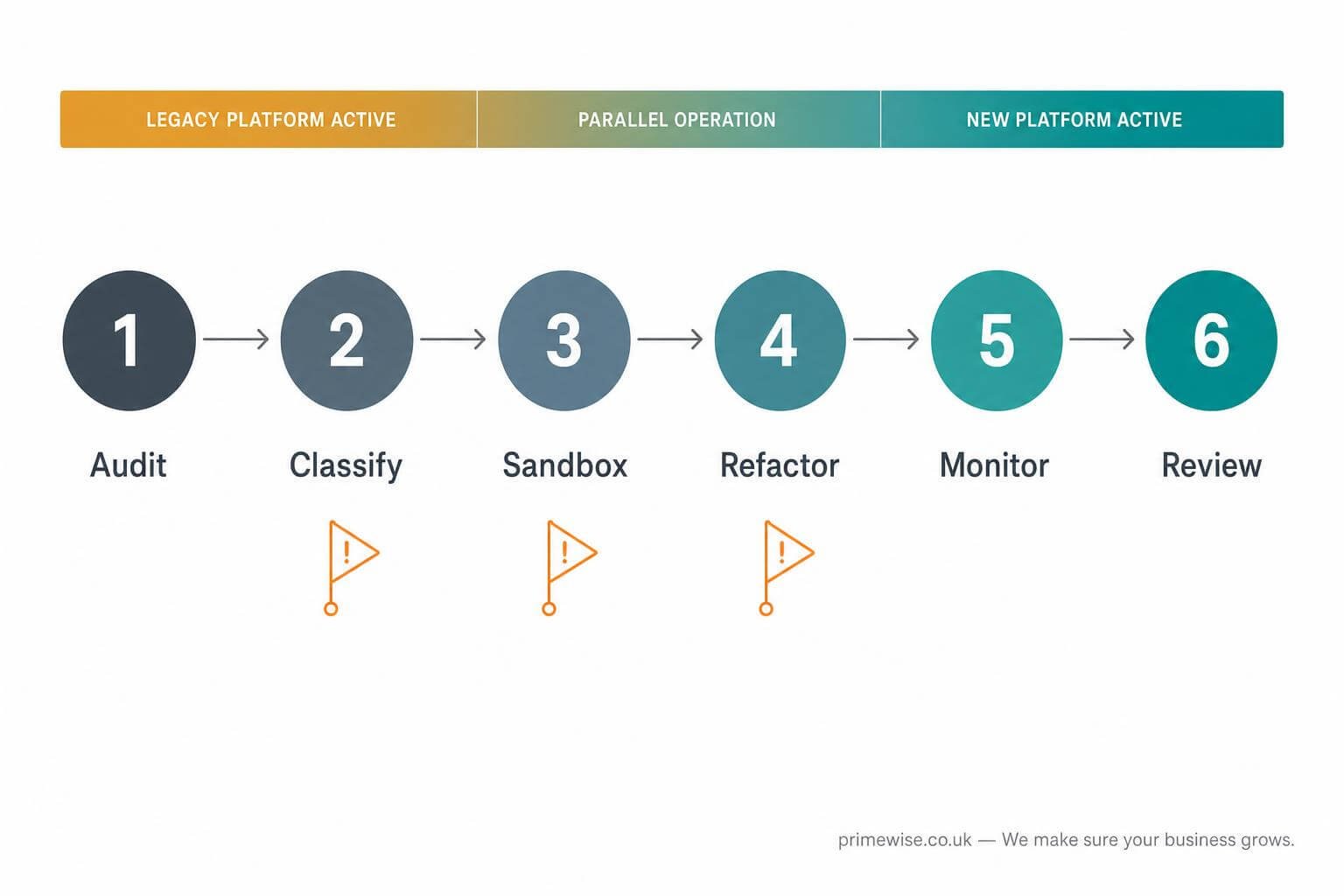
Executing a zero-downtime platform migration requires a phased architectural blueprint that prioritises operational continuity over migration speed. Based on the fourteen production migrations PrimeWise.co.uk has delivered across UK enterprise environments, the following execution framework consistently produces reliable outcomes with minimal disruption risk.
- Audit all existing API endpoints, webhook configurations, and workflow dependencies to map the full technical debt landscape before writing a single new workflow.
- Classify workflows by criticality tier categorise each automation as mission-critical, operationally important, or replaceable to prioritise migration sequencing intelligently.
- Establish isolated sandbox environments on the target platform and run dual-platform parallel testing for a minimum of four weeks before routing live production traffic.
- Refactor multi-step workflows during migration to eliminate unnecessary polling calls, reduce API consumption, and implement native error handling from the start rather than retrofitting it later.
- Implement comprehensive monitoring and alerting on the new platform before decommissioning legacy workflows, ensuring fallback capabilities remain active throughout the transition phase.
- Conduct a formal post-migration TCO review at ninety days to validate cost projections and identify optimisation opportunities in the new architecture.
The migration timeline for a mid-sized UK operation running 200 to 500 active workflows typically spans eight to sixteen weeks depending on workflow complexity, available engineering resource, and the degree of custom API integration involved. Organisations attempting to compress this timeline to achieve billing cycle savings consistently incur higher total costs through incident management and rework.
HMRC R and D Tax Relief for Custom Infrastructure
Developing bespoke, self-hosted automation infrastructure may present significant financial opportunities for UK enterprises that many technology leaders overlook. The HMRC Research and Development Expenditure Credit scheme, reformed in April 2023, now provides a unified RDEC rate of 20 percent for large companies and a merged SME rate of 20 percent for qualifying expenditure submitted from April 2024 onwards. Custom API orchestration engines, proprietary data transformation middleware, and bespoke integration frameworks that solve technically uncertain problems situations where no readily available commercial solution exists frequently align with HMRC’s definitions of qualifying software innovation activity.
For a UK engineering team investing £150,000 annually in developing a custom n8n-based integration framework including developer salaries, server infrastructure, and contracted specialist development the potential RDEC benefit could represent £30,000 in corporation tax reduction. This figure materially changes the total cost of ownership calculation for self-hosted infrastructure decisions. Organisations should consult qualified R&D tax specialists to assess whether their specific architectural development activities qualify, as the distinction between routine software development and genuine technological advancement under HMRC definitions requires professional assessment.
R&D Tax OpportunityUK firms building custom self-hosted automation infrastructure on n8n may qualify for HMRC RDEC at 20% on qualifying expenditure. A £150K annual development investment could yield £30K in corporation tax relief. Consult a qualified R&D tax advisor to assess eligibility before your next financial year-end.
Platform Selection for Regulated UK Businesses
For UK financial services firms, FinTech operators, and any enterprise subject to FCA oversight, platform selection must be documented as a formal vendor risk assessment rather than a commercial procurement decision. The evaluation should address data residency guarantees, sub-processor chain transparency, contractual resilience provisions under DORA, incident notification SLAs, and exit clause terms. n8n self-hosted eliminates third-party vendor risk at the execution layer by design. Make.com Enterprise provides the contractual documentation framework required for formal vendor risk registers. Zapier’s standard commercial terms are insufficient for regulated entity deployment without bespoke contractual addenda that its standard sales process rarely accommodates at speed.
For high-growth UK scale-ups outside direct FCA regulation, the decision framework simplifies considerably. Teams of fewer than fifteen people with primarily commercial automation needs will derive maximum value from Zapier’s ecosystem breadth and zero-friction deployment. Teams with operations architects and data complexity requirements between 50,000 and 500,000 monthly operations will find Make.com’s architecture and pricing the optimal combination. Engineering-led organisations with data sovereignty requirements, AI orchestration ambitions, or volumes exceeding 500,000 monthly operations should architect around n8n from the outset rather than migrating under cost pressure twelve months later.
Enterprises navigating platform selection, compliance architecture, and migration risk simultaneously can request a structured vendor evaluation from PrimeWise.co.uk, which has benchmarked automation costs and compliance postures across UK financial services, PropTech, and FinTech deployments. The firm provides a structured platform recommendation aligned to operational volume, regulatory obligations, and five-year infrastructure roadmap delivered as a no-obligation architecture consultation for qualifying organisations.