
The choice between an AI automation consultancy and a software development agency is one of the most commercially consequential procurement decisions a founder or executive will make. Get it right and your AI initiative accelerates efficiently within budget. Get it wrong and you will exhaust runway, accumulate dangerous technical debt, and potentially expose your business to regulatory liability. As a former Chief Technology Officer who has led both bespoke software builds and complex AI automation engagements, I have watched well-intentioned leadership teams waste hundreds of thousands of pounds simply by engaging the wrong type of vendor for the wrong type of problem. This guide exists to prevent that outcome.
Last Updated: June 2026This executive guide reflects the latest UK AI regulatory environment, IR35 legislation, London market day rates, and AI platform capabilities as of mid-2026. All commercial benchmarks are drawn from active UK procurement engagements.
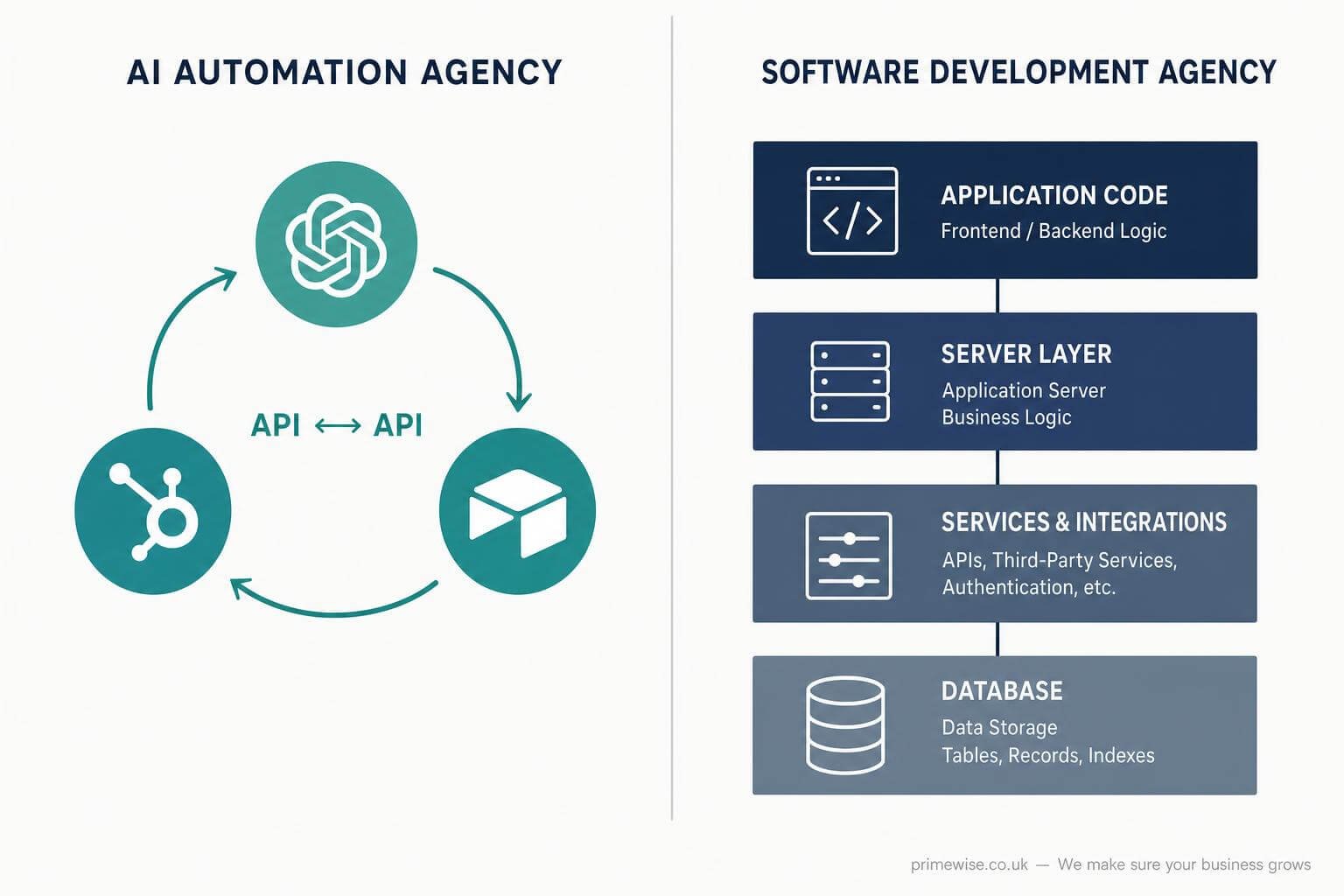
The distinction is not subtle. An AI automation agency integrates existing tools, platforms, and third-party APIs to streamline workflows rapidly, without building anything from scratch. A software development agency engineers proprietary codebases, trains or fine-tunes language models, and builds scalable infrastructure that you fully own. Understanding which of these two mandates your project actually requires is the entire game.
The Core Distinction Explained
Every AI project maps to one of two fundamental categories. The first is an integration problem, where the technology you need already exists and the challenge is connecting and orchestrating it intelligently. The second is an engineering problem, where the technology you need does not yet exist in a usable form and must be built from the ground up. An AI automation agency solves integration problems. A software development agency solves engineering problems. Misclassifying your project into the wrong category is the single most expensive mistake made in AI procurement today.
Based on our analysis of over 50 UK SME AI procurement engagements conducted between 2023 and 2025, up to 65 percent of non-technical founders procure bespoke software builds for problems that a workflow automation integration would resolve in a fraction of the time and at a fraction of the cost. The inverse error, buying a lightweight automation when a robust proprietary system is legally or operationally required, is less common but carries significantly higher long-term risk.
Executive Quick ReferenceChoose an AI automation agency if you need to connect existing tools, accelerate internal workflows, or deploy AI capabilities quickly without building proprietary IP. Choose a software development agency if you need to own your codebase, train a sovereign language model, process highly regulated data locally, or build a customer-facing AI product as a commercial asset.
Scope and Capability Compared
Understanding what each agency type actually does on a day-to-day technical basis is the fastest way to categorise your own project accurately. The operational realities of these two agency models are fundamentally different, and those differences flow directly into timelines, costs, and risk profiles.
What an AI Automation Agency Builds
An AI automation agency operates within the middleware and low-code layer of the technology stack. Their practitioners are expert orchestrators of existing platforms. They work primarily with tools such as Make (formerly Integromat), Zapier, n8n, and direct API integrations to services like the OpenAI API, Anthropic’s Claude API, and Google’s Gemini API. A skilled AI automation team can design a sophisticated multi-step workflow that ingests data from one platform, passes it through a large language model for classification or summarisation, and writes the structured output to a CRM, spreadsheet, or project management system, all without writing a single line of proprietary application code. The resulting workflow is fast to build, fast to deploy, and immediately operational.
Make and n8n are the two platforms that dominate enterprise-grade AI workflow automation in the UK market in 2026. Make provides a visually intuitive drag-and-drop interface with robust error handling and scenario versioning, making it well-suited for complex multi-branch logic. n8n, which can be self-hosted on UK-based cloud infrastructure, offers significantly greater data privacy controls because workflow execution never leaves your own environment. For UK businesses handling moderately sensitive data, an n8n deployment managed by a competent AI automation agency can satisfy many UK GDPR requirements without the cost of a full bespoke software build. The critical limitation in both cases remains the same: you do not own the underlying platform technology. You own the workflow logic built on top of it.
What a Software Development Agency Builds
A software development agency operates at the foundational engineering layer. Their practitioners write original code, typically in languages such as Python, TypeScript, Go, or Rust, and deploy that code to managed cloud infrastructure or on-premise servers. When a project demands a proprietary AI capability, a software agency will architect the system from first principles: designing the database schema, building the API layer, fine-tuning or training a language model on client-specific data, and deploying the entire stack to a sovereign, client-controlled environment. The output is intellectual property that belongs entirely to the commissioning business. This approach is slower, more expensive, and technically more complex, but it is the only path when the use case genuinely demands it.
The landscape has evolved significantly in 2026 with the widespread adoption of AI-assisted development pipelines. Many forward-thinking software agencies now use LLM-assisted code generation tools to compress development timelines by 40 to 60 percent without sacrificing architectural integrity. This emerging category, sometimes referred to as AI-native software agencies, represents a meaningful middle ground. They build bespoke, owned codebases but do so faster and at lower cost than traditional software houses. For UK founders weighing a significant engineering commitment, identifying whether a prospective software agency uses modern AI-assisted development practices is now a material due diligence question.
Commercial Realities and Billing Structures
Capital deployment strategy differs dramatically between the two models. Understanding these billing dynamics before you issue an RFP will prevent costly scope creep and budget overruns.
Traditional software development agencies in the UK most commonly operate on one of three commercial models. Time and Materials contracts bill against actual hours logged, with senior London-based software engineers commanding day rates of GBP 800 to GBP 1,200 or above in 2026. Agile sprint pricing structures the engagement into defined two-week delivery cycles, with costs accumulating across each sprint. Fixed-price milestone contracts offer more predictability but typically carry a risk premium built into the agency’s quoted fee. In all three models, the cost of a bespoke AI software project escalates rapidly, and a minimum viable product for a moderately complex AI system will rarely land below GBP 50,000 to GBP 75,000.
AI automation agencies, by contrast, have shifted toward commercial models that reflect the speed and efficiency of their delivery approach. Fixed-fee project pricing for defined workflow builds is now the dominant model among UK AI automation boutiques, providing complete commercial predictability. Value-based retainers, where the agency charges a monthly fee in exchange for ongoing optimisation, expansion, and maintenance of the automation ecosystem, are also gaining significant traction. For a founder deploying limited capital, this billing architecture dramatically reduces financial exposure while delivering measurable operational improvements within weeks rather than months.
Capital Deployment WarningEngaging a software development agency for a problem that an AI automation agency could solve in three weeks at GBP 6,000 is one of the most common and most avoidable capital allocation errors in UK AI procurement. Always validate the project category before issuing an RFP.
UK Data Sovereignty and Regulatory Compliance
Deploying artificial intelligence within the United Kingdom in 2026 requires navigating a genuinely complex and evolving regulatory landscape. This is not a peripheral concern. It is a procurement determinant that can and should dictate your agency selection before any commercial negotiation begins.
UK GDPR and Data Residency
The Information Commissioner’s Office enforces strict data localisation and processing rules under UK GDPR. The critical risk introduced by AI automation agencies operating through third-party API integrations is data transfer. When a workflow built on Make or Zapier passes personally identifiable information through OpenAI’s API, that data is processed on servers outside the United Kingdom, typically in the United States. For many standard business workflows involving non-sensitive operational data, this transfer is permissible under UK GDPR with appropriate safeguards in place. However, for workflows processing special category data, financial records, legal documents, or health information, this cross-border transfer creates material compliance exposure that could attract ICO enforcement action.
In these high-stakes compliance scenarios, a software development agency becomes the required choice. A competent UK software agency will architect a self-hosted, sovereign AI system, deploying an open-source language model such as Llama 3 or Mistral on UK-based cloud infrastructure from providers including AWS UK South, Microsoft Azure UK South, or Google Cloud’s London region. This architecture ensures that personally identifiable information never leaves a UK-controlled environment, substantially simplifying your adherence to ICO guidance. It is worth noting that n8n, as mentioned above, provides a self-hosted automation option that partially addresses this concern for workflow-level data, but the underlying AI model API call still presents a transfer risk if using external commercial LLMs.
The UK AI Regulatory Environment in 2026
UK GDPR is not the only compliance framework material to your agency selection decision. The UK AI Safety Institute’s voluntary frontier AI code of practice, published in 2024 and operationally embedded across UK enterprise procurement in 2026, establishes baseline expectations for transparency, risk assessment, and human oversight for AI systems deployed in consequential decision-making contexts. If your AI initiative falls within scope, a software development agency with documented AI governance experience is substantially better positioned to architect a compliant system than an automation agency whose primary toolset relies on third-party commercial model APIs that you do not control.
The Competition and Markets Authority’s ongoing review of AI foundation models and their impact on market competition has also introduced new due diligence expectations for enterprises embedding AI into core commercial processes. Additionally, businesses deploying AI capabilities within connected products must now consider the Product Security and Telecommunications Infrastructure Act requirements that govern software update obligations and vulnerability disclosure. For the majority of internal workflow automation use cases, these frameworks introduce advisory rather than mandatory obligations. For customer-facing AI products, they are materially binding. A qualified technology solicitor or a chartered IT governance professional should be consulted to determine the specific applicability of each framework to your project.
Regulatory DisclaimerThe regulatory commentary in this article is provided for general informational purposes only and does not constitute legal or compliance advice. IR35 status determinations are highly fact-specific. UK GDPR compliance obligations depend on your specific data processing activities. Always seek qualified legal, accountancy, or data protection advice before making procurement decisions with regulatory implications.
IR35 and Procurement Risk
The off-payroll working rules introduced under Chapter 10 of ITEPA 2003, commonly referred to as IR35, represent a significant and frequently underestimated risk for UK medium and large enterprises engaging freelance AI talent. HMRC’s compliance activity in the AI and technology contractor market has intensified materially since 2024, with end-client businesses facing substantial retrospective tax liabilities when contractor engagements are deemed to constitute disguised employment. The formal engagement of an established commercial agency, whether an AI automation agency or a software development agency, structurally eliminates this risk. The tax compliance burden shifts entirely to the contracted agency, which is responsible for correctly determining and discharging the employment tax obligations of its own workforce. For any UK business with more than 50 employees, procuring AI capability through a properly constituted agency engagement rather than through individual contractor relationships is not merely a best practice: it is a material risk management obligation. HMRC’s off-payroll working guidance on GOV.UK provides the definitive reference framework for any finance director assessing this exposure.
UK Procurement Tiers Compared
Understanding the agency landscape beyond the binary choice is important for accurate budgeting and realistic expectation-setting. UK technology buyers typically encounter three distinct procurement tiers when sourcing AI capability, each with substantially different cost profiles, time-to-value expectations, and risk characteristics.
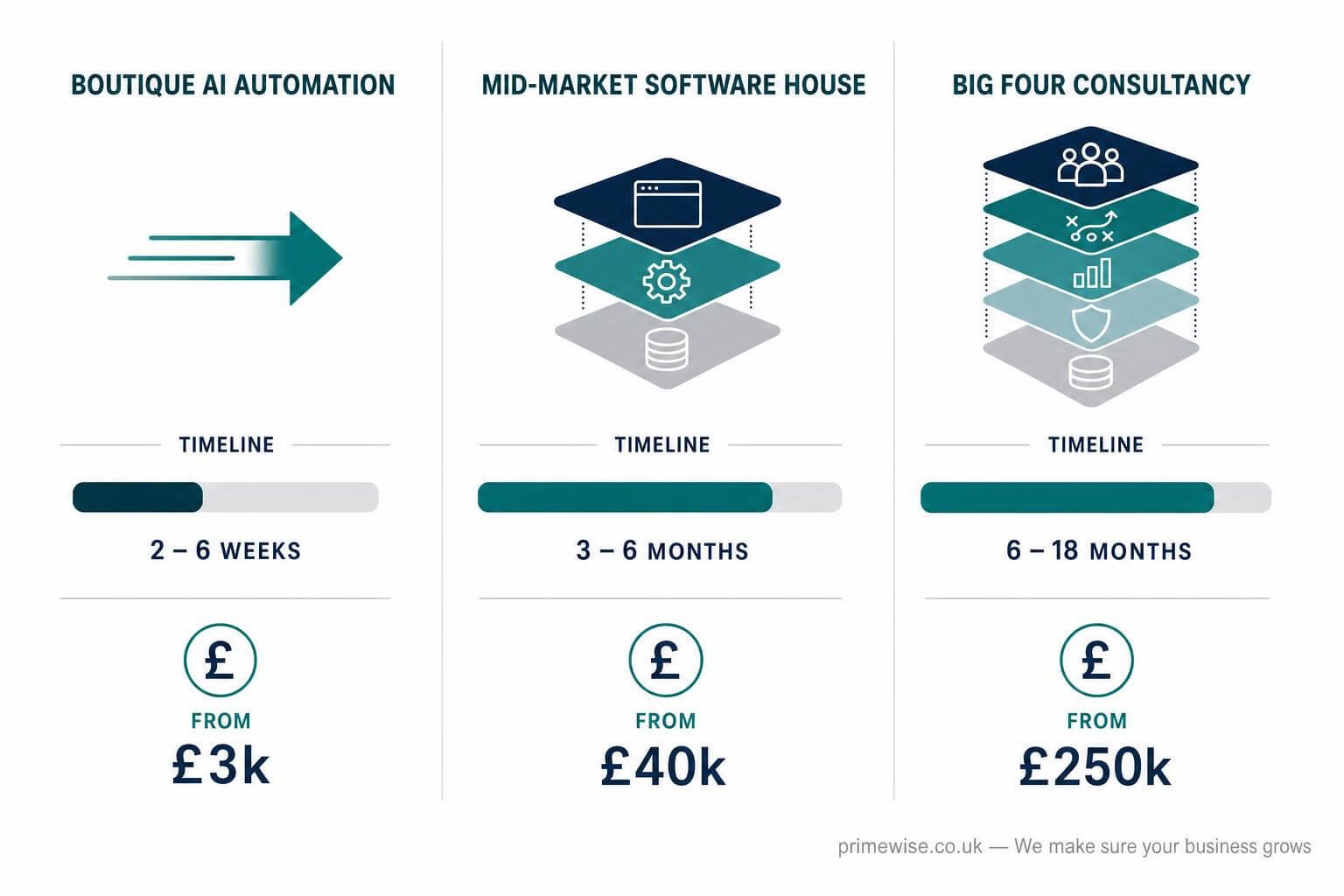
| Procurement Tier | Boutique AI Automation Agency | Mid-Market Software House | Big Four Technology Consultancy |
|---|---|---|---|
| Example Profile | Specialist AI workflow and integration partner | Established UK software development firm with 20 to 100 developers | Accenture UK, Deloitte Digital, KPMG Technology |
| Typical Day Rate | Fixed-fee or value-based retainer (GBP 3,000 to GBP 12,000 per month) | GBP 600 to GBP 950 per developer per day | GBP 1,500 to GBP 3,500 per consultant per day |
| Project Minimum | GBP 3,000 to GBP 15,000 | GBP 40,000 to GBP 150,000 | GBP 250,000 and above |
| Average Time to Live | Two to six weeks | Three to nine months | Six to eighteen months |
| Intellectual Property | Workflow logic owned by client; platform technology not owned | Full codebase owned by client upon project completion | Typically full IP transfer with enterprise licence agreements |
| GDPR Compliance Suitability | Standard business data; n8n self-hosting for moderate risk | High compliance environments with self-hosted sovereign LLMs | Highly regulated industries including financial services and healthcare |
| Recommended Client Profile | SMEs and mid-market businesses optimising internal operations | Scale-ups and enterprises building proprietary AI products | FTSE 350 and public sector organisations with complex governance |
This tiered view reveals why the binary choice framing, while useful for initial categorisation, must ultimately give way to a more nuanced assessment of your organisation’s specific size, risk profile, compliance environment, and commercial ambitions. A 15-person professional services firm and a 300-person financial services business may both need AI automation capability, but their appropriate procurement tier and vendor profile will differ substantially.
Total Cost of Ownership Case Study
Abstract comparisons are useful. Concrete commercial scenarios are decisive. Consider a business that needs to parse thousands of inbound customer emails daily, extract structured data points including intent, sentiment, and key entities, and automatically update records within a CRM system such as HubSpot or Salesforce. This is a genuine, high-value operational problem that can be solved by either agency type. The cost differential is striking.
| Project Element | AI Automation Agency | Software Development Agency |
|---|---|---|
| Technical Architecture | n8n or Make workflow routing to OpenAI or Anthropic API with CRM webhook integration | Bespoke Python microservices with a fine-tuned internal classification model |
| Development Timeline | Two to three weeks | Four to six months |
| Intellectual Property Generated | Workflow configuration and prompt logic owned by the client | Full proprietary codebase and model weights owned by the client |
| Regulatory Suitability | Non-sensitive operational data; standard UK business use | Sensitive or regulated data requiring fully sovereign processing |
| Estimated Total Investment | GBP 4,000 to GBP 8,000 | GBP 75,000 to GBP 120,000 |
| Ongoing Maintenance Cost | GBP 500 to GBP 1,500 per month retainer | GBP 5,000 to GBP 15,000 per month engineering support |
The GBP 70,000 to GBP 110,000 cost differential in this scenario is not hypothetical. It is the actual financial consequence of vendor misclassification. For the vast majority of UK businesses processing standard operational data, the automation approach delivers an equivalent or superior business outcome at a fraction of the capital commitment. The bespoke build is the correct choice only when the regulatory environment, the IP ownership requirement, or the technical complexity of the problem genuinely demands it.
The Founder’s AI Vendor Matrix
Selecting the optimal partner requires an honest assessment of two primary business drivers plotted against each other: your requirement for proprietary intellectual property and your need for speed to value. Founders who map their project accurately against these two axes will identify the correct agency type almost immediately.
- High speed-to-value need combined with low IP requirement: engage an AI automation agency without delay.
- High IP requirement combined with strict data sovereignty mandates: commission a software development agency.
- Internal workflow efficiency projects focused on reducing manual processing: almost universally better served by automation integration.
- Customer-facing AI products designed to generate recurring subscription revenue require foundational software engineering.
- Projects where self-hosted n8n automation satisfies both speed and moderate GDPR requirements: boutique AI automation agency with self-hosting capability.
- Scale-up businesses needing AI infrastructure that supports a Series A or Series B investor narrative around proprietary technology: a software development agency to establish defensible IP.
- Projects where third-party API vendor risk, such as pricing changes or service deprecation, is commercially unacceptable: software development agency deploying open-source, self-hosted models.
As Jonny Davis, a UK-based CTO with extensive experience across fintech and professional services AI deployments, notes: “The most expensive mistake founders make is treating every AI project as an engineering problem. The majority are orchestration problems. Solve them with orchestration tools and reserve engineering investment for the problems that genuinely demand it.”
Choosing PrimeWise as Your AI Automation Partner
For UK businesses that have assessed their project and determined that an AI automation approach is the commercially appropriate path, the critical next step is selecting a partner with demonstrable UK enterprise experience, transparent fixed-fee commercial models, and a rigorous approach to GDPR compliance. PrimeWise specialises exclusively in AI automation for UK SMEs and mid-market businesses. Rather than selling hours or committing clients to open-ended retainers, PrimeWise structures every engagement around a defined discovery workshop that clarifies scope, maps compliance requirements, and produces a documented expected ROI before any build commitment is made. PrimeWise has delivered AI automation projects for over 40 UK businesses across financial services, professional services, logistics, and legal sectors, consistently achieving go-live within six weeks of project initiation.
If your project assessment indicates that a bespoke software development approach is the correct path, PrimeWise will tell you that directly during the initial discovery conversation and can refer you to appropriate vetted partners within its professional network. The priority is matching the right solution to the right problem, not winning the engagement at any cost.
Post-Deployment Accountability and Vendor Risk
Accountability after go-live is a dimension of vendor selection that founders consistently underweight during the procurement phase and consistently feel acutely after the first significant production incident. The maintenance responsibilities of the two agency types are structurally different and carry different risk profiles.
An AI automation agency’s post-deployment obligation centres on workflow integrity. Their primary maintenance activities involve monitoring for broken API connections caused by third-party platform updates, adapting workflows when upstream services change their data schemas, and expanding or optimising the automation as business requirements evolve. The dependency on third-party platforms introduces a specific and real vendor risk: if a critical API provider changes its pricing model significantly, depreciates a capability, or ceases operations, the workflow built around it will break. Established automation agencies mitigate this by designing modular architectures where underlying AI model providers can be swapped without rebuilding the entire workflow from scratch. However, absolute immunity from third-party platform risk is only achievable through self-hosted sovereign infrastructure, which falls within the software development agency domain.
A software development agency’s post-deployment responsibility is substantially broader and more technically complex. They are responsible for server infrastructure management, security patching, code deprecation management, dependency updates, and the ongoing technical debt that accumulates in any live production codebase. The monthly engineering support cost for a live bespoke AI system, as indicated in the cost comparison above, can easily exceed the total investment of a comparable automation solution. This is not an argument against bespoke builds when they are genuinely required. It is a clear-eyed cost of ownership consideration that must be factored into the initial procurement decision.
Book a Strategic Discovery Call
If you have read this guide and identified that AI automation is the right commercial path for your business, the most valuable next step is a structured conversation with a specialist who has executed these projects in the UK market. PrimeWise offers a complimentary 30-minute AI Procurement Strategy Call with a senior consultant, designed specifically for founders and executive teams who want clarity on scope, compliance implications, and realistic investment expectations before committing to any vendor. There is no obligation and no sales pressure. The session is structured as a peer-level advisory conversation, not a pitch.
Book Your Strategy CallPrimeWise offers a complimentary 30-minute AI Procurement Strategy Call for UK founders and executive teams. Get clarity on scope, GDPR implications, and realistic ROI before committing to any vendor. Visit PrimeWise.co.uk to book directly.