

A fractional CMO for scaleups is one of the most capital-efficient decisions a UK founder can make in the twelve months before opening a data room to institutional investors. Series A and B venture capitalists do not fund potential they fund proof. They scrutinise marketing efficiency with forensic precision, demanding repeatable pipeline data, validated unit economics, and a go-to-market narrative that holds up under board-level interrogation. When your marketing function cannot answer those questions, it becomes a risk flag. When it can, it becomes your most powerful commercial credibility signal.
Who This Article Is ForThis guide is written for UK-based founders and CEOs with 12 to 36 months of trading history who are preparing for a Series A or Series B raise and need to understand exactly how fractional CMO leadership transforms marketing from a burn-rate concern into an investor-grade asset.
What a Fractional CMO for Series A and B Actually Does
A fractional CMO operating at Series A and Series B stage is not a consultant who produces slide decks. They are an embedded, part-time executive who takes direct ownership of go-to-market strategy, unit economics optimisation, and the commercial narrative that institutional investors interrogate during due diligence. They sit at the intersection of growth strategy and financial accountability building the evidence base that proves your customer acquisition model is repeatable, scalable, and efficient enough to absorb a significant capital injection without eroding gross margins.
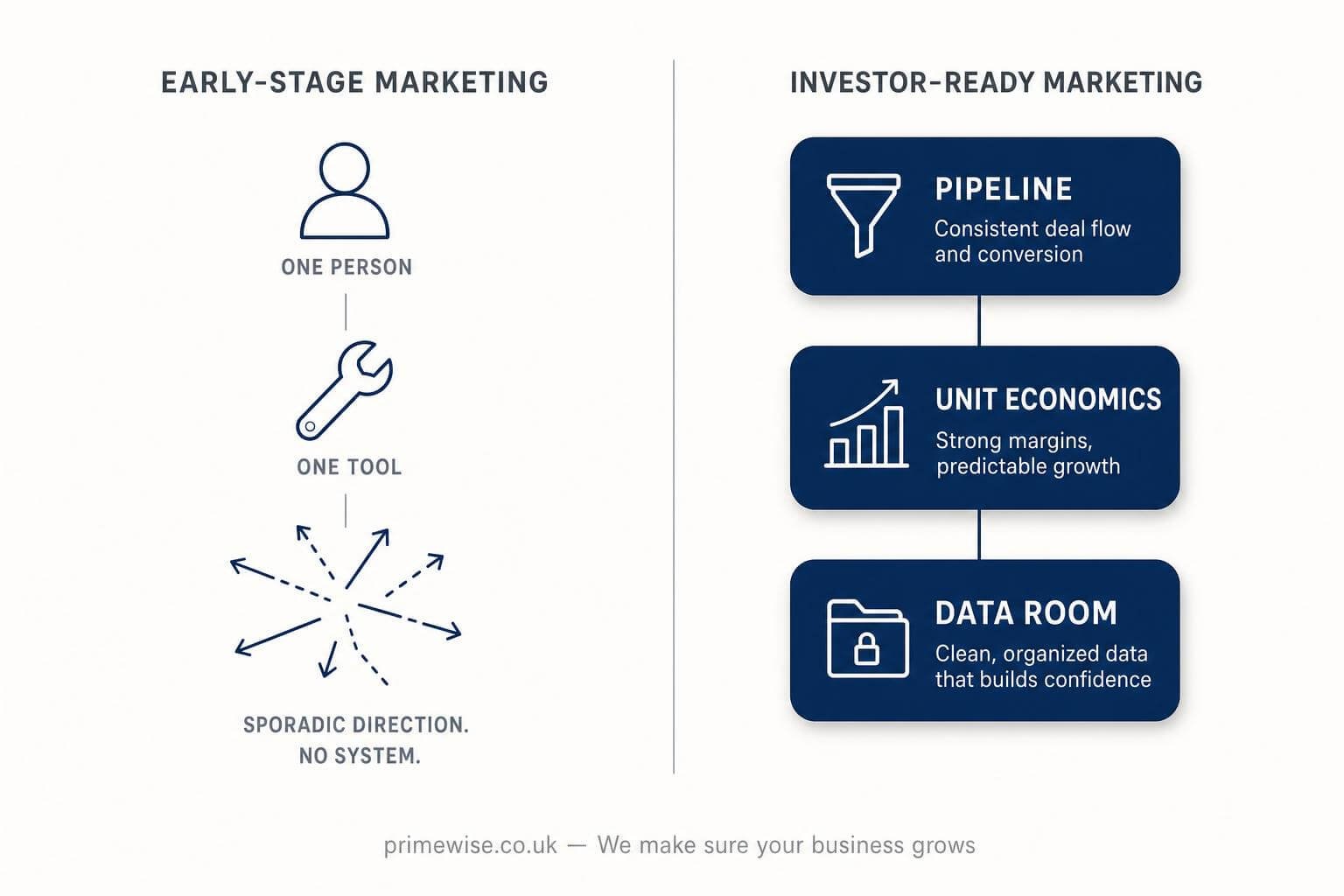
The distinction matters because early-stage marketing leadership is rarely built for investor scrutiny. Founding teams are rightly focused on product-market fit and early revenue, not on constructing the attribution infrastructure, cohort retention analysis, and pipeline coverage ratios that a Balderton Capital or Notion Capital partner will interrogate on page forty of your data room. A fractional CMO bridges that gap without the eighteen-month runway required to hire, onboard, and ramp a full-time executive.
The UK Venture Capital Context Founders Must Understand
The UK funding environment in 2025 and 2026 operates under conditions that directly shape what investors expect from your marketing function. According to Beauhurst, UK scale-ups raised approximately £14.4 billion in venture and growth capital in 2024, but deal volume at Series A remained selective, with investors conducting longer and more rigorous commercial due diligence than in the 2020 to 2022 peak cycle. Atomico’s State of European Tech report consistently highlights that European founders and UK founders in particular face investors who prioritise capital efficiency and sustainable unit economics over the growth-at-all-costs playbook that defined Silicon Valley funding in the previous decade.
Moving Beyond SEIS and EIS Capital
Most UK founders building toward Series A have benefited from SEIS and EIS-backed angel funding, where investor expectations around governance, data rigour, and marketing accountability are relatively lenient. The transition into institutional venture capital represents a categorical shift. Series A firms whether Octopus Ventures, LocalGlobe, or a US crossover fund entering the UK market require access to comprehensive data rooms that validate commercial traction with indisputable accuracy. They expect board-level reporting frameworks, clean attribution models, and marketing spend tied directly to pipeline output. A fractional CMO implements this governance infrastructure before the raise, not during it.
Capital Efficiency Over Growth at All Costs
London and wider UK venture capital is notably more conservative than its US counterpart. Investors such as those at Notion Capital and Albion VC have been vocal about prioritising net revenue retention, payback periods, and gross margin preservation over headline growth rates. This matters for how you structure and present your marketing strategy. A fractional executive who understands the UK VC psychology will ensure every pound of marketing spend is tied to a measurable commercial output, and that your investor narrative leads with efficiency rather than ambition. This conservative framing builds trust with the institutional partners who will ultimately decide your valuation.
The Investor-Ready Marketing Matrix
To pass rigorous commercial due diligence at Series A or B, your marketing function must satisfy four interconnected dimensions of investor confidence. The framework below developed through direct experience supporting UK B2B SaaS and fintech scale-ups through institutional raises provides a structured methodology for building an investor-grade marketing operation from the ground up.
Demonstrating Credible TAM Penetration
Venture capitalists begin their evaluation by questioning whether your target market is large enough to deliver the ten-times or greater return their fund model requires. A vague or top-down TAM calculation will not survive a serious Series B investment committee. A fractional CMO conducts rigorous bottom-up market sizing, defining the Total Addressable Market, the Serviceable Addressable Market, and the Serviceable Obtainable Market with the precision of a financial analyst. By clearly mapping an Ideal Customer Profile against verifiable market data sourced from providers such as Dealroom, CB Insights, or sector-specific industry bodies the marketing function presents a defensible penetration roadmap rather than an aspirational number on a slide.
Engineering Sustainable Unit Economics
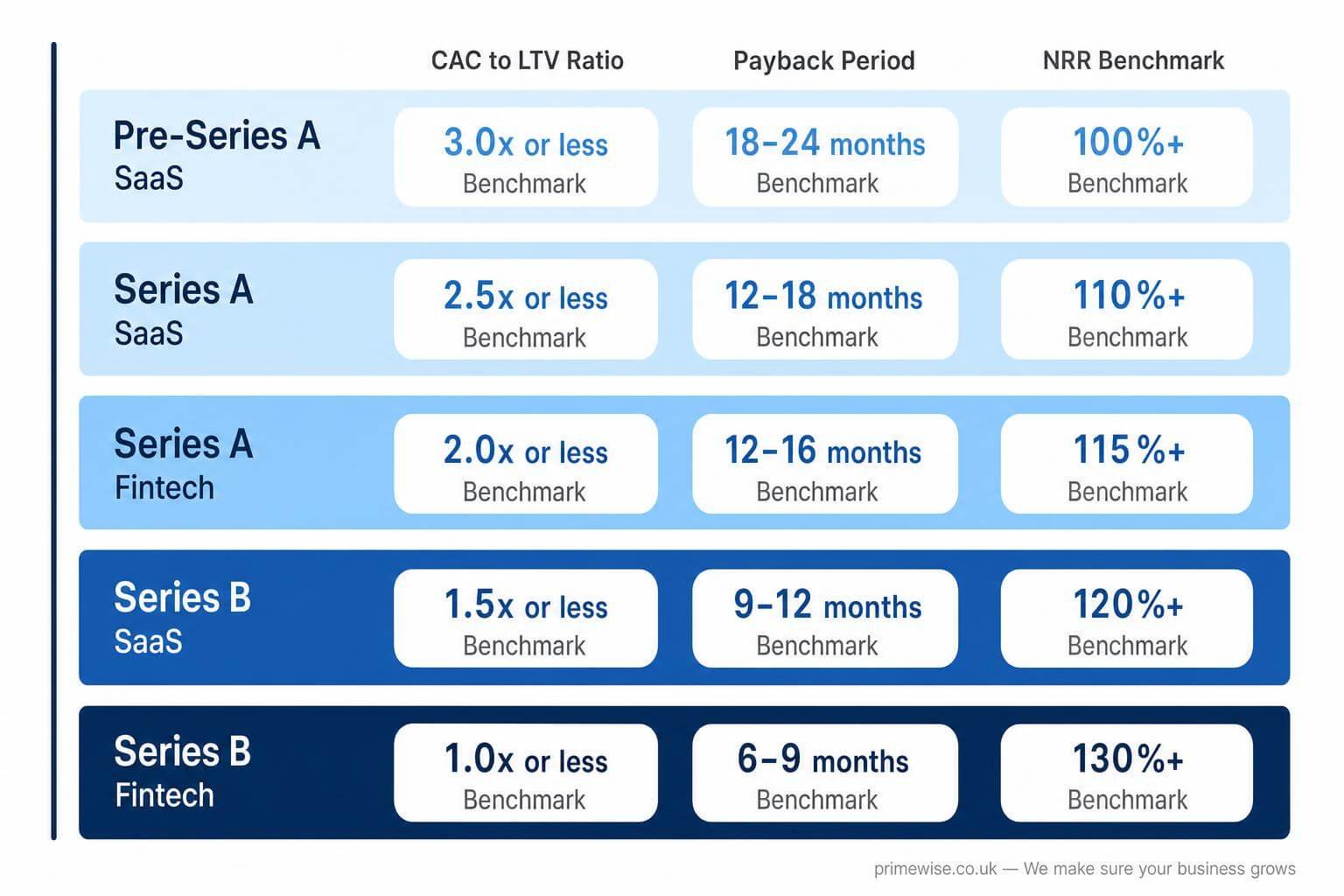
This is the single most scrutinised dimension of marketing performance at Series A and B. Hard financial benchmarks provide the definitive proof that analytical investors require before committing capital. The table below outlines the tiered unit economics expectations that UK-focused institutional investors increasingly apply across different funding stages and sectors.
| Funding Stage | Sector | Minimum CAC:LTV Ratio | Target Payback Period | NRR Benchmark |
|---|---|---|---|---|
| Pre-Series A | B2B SaaS | 3:1 | Under 18 months | Above 100% |
| Series A | B2B SaaS | 3:1 to 4:1 | Under 15 months | Above 105% |
| Series A | B2B Fintech | 3:1 minimum | Under 18 months | Above 100% |
| Series B | B2B SaaS | 4:1 or above | Under 12 months | Above 110% |
| Series B | B2B Fintech | 3.5:1 or above | Under 14 months | Above 108% |
Top-quartile UK VCs including Notion Capital and Balderton Capital increasingly treat net revenue retention above 110% as a de facto prerequisite at Series B, particularly in B2B SaaS. A fractional CMO stress-tests your current performance against these benchmarks and builds the optimisation roadmap required to meet or exceed them before your first institutional meeting.
Building a Repeatable Revenue Pipeline
Series B investment committees look for one thing above almost everything else in marketing: repeatability. A pipeline built on founder relationships, conference serendipity, or one high-performing content piece is not a system. It is a risk. A fractional CMO implements a demand generation engine governed by sophisticated revenue operations, aligning tools such as HubSpot or Salesforce CRM with intent data sources and product analytics platforms like Segment or Amplitude. The output is a documented, measurable pipeline process with defined lead-to-opportunity conversion rates, sales velocity metrics, and pipeline coverage ratios all formatted for direct inclusion in your data room.
Establishing Defensible Brand Differentiation
Qualitative brand assets must translate into quantitative competitive moats. Strong positioning is not a marketing luxury it is a financial efficiency driver. A company with clear, differentiated positioning commands better pricing power, attracts inbound demand more cost-effectively, and demonstrates to investors that market share gains are protected from immediate erosion by well-capitalised incumbents. A fractional CMO conducts competitive landscape analysis against your most relevant adversaries, builds a positioning framework anchored in genuine customer evidence, and ensures that the brand narrative in your investor deck is consistent with the operational reality in your data room.
Fractional Versus Full-Time Marketing Leadership
The UK technology sector faces an acute and well-documented shortage of experienced scale-up marketing executives. In London specifically, hiring a full-time CMO with verifiable Series B experience typically requires a total compensation package of £180,000 to £250,000 plus meaningful equity dilution. For a company with eighteen months of runway preparing for a raise, that cost profile is difficult to justify and the eighteen-month onboarding and ramp cycle means the hire may not be fully productive until after the round closes.
A fractional CMO engagement typically costs between £3,000 and £8,000 per month depending on days committed and the complexity of the mandate. This means a twelve-month pre-raise programme costs between £36,000 and £96,000 a fraction of a full-time hire, and one that preserves runway, reduces burn rate, and keeps equity on the cap table for the investors you are about to court.
PrimeWise and the Investor-Ready Growth FrameworkPrimeWise works exclusively with UK-based Series A and B scale-ups, providing embedded fractional CMO leadership that builds investor-grade marketing operations from the ground up. If your raise is within the next six to twelve months, the time to start is now.
PrimeWise partners with founders who are within six to eighteen months of a raise and need to transform their marketing function into a commercial credibility signal. The engagement model is designed to deliver immediate strategic clarity, operational momentum, and a fully packaged investor narrative without the cost, risk, or equity dilution of a full-time executive hire. Review PrimeWise’s Investor-Ready Growth Framework to understand exactly how this works in practice for UK scale-ups at your stage.
The Pre-Raise Marketing Roadmap
Securing institutional venture capital requires meticulous preparation across a structured timeline. The following twelve-month roadmap reflects the operational sequence a fractional CMO follows to ensure that all commercial metrics are optimised and packaged before the first investor meeting.
Phase One Strategic Audit and Realignment
During the first three months, the fractional CMO halts wasteful expenditure and conducts a rigorous marketing audit across all channels, tools, and team structures. This includes a full assessment of the existing technology stack consolidating fragmented tools into a coherent martech architecture centred on a CRM such as HubSpot or Salesforce, a customer data platform such as Segment, and a product analytics layer such as Mixpanel or Amplitude. The go-to-market strategy is realigned to prioritise the Ideal Customer Profile segments with the highest LTV and lowest CAC. Burn rate reductions are implemented immediately, giving the CEO a clean commercial baseline from which to build the investor narrative.
Phase Two Pipeline Generation and Metric Optimisation
Months four through eight are dedicated to building and stress-testing the growth engine. Performance marketing campaigns are launched, refined, and scaled using the Pirate Metrics framework Acquisition, Activation, Retention, Revenue, and Referral to ensure every stage of the funnel is tracked, measured, and improvable. Cohort analysis is used to identify the customer segments delivering the strongest retention and expansion revenue. Self-sustaining growth loops are engineered where product usage and customer success create organic referral and expansion mechanisms. This phase produces the empirical evidence that transforms anecdotal commercial traction into statistically defensible proof of repeatability.
Phase Three Data Room Compilation and Narrative Packaging
In the final trimester before the raise, all marketing operations are tied directly to the due diligence checklist. The fractional CMO compiles cohort retention data, channel-level attribution models, financial forecasting assumptions, and customer acquisition metrics into a structured commercial data room. Crucially, this data is packaged within an investor narrative that addresses the specific concerns of UK institutional investors capital efficiency, TAM defensibility, and path to profitability. The output is not a collection of dashboards. It is a compelling, scrutiny-proof commercial story backed by irrefutable evidence.
UK Governance and Compliance Considerations
For UK founders in regulated sectors such as fintech, insurtech, or healthtech, the governance requirements at Series A and B extend beyond financial metrics. The FCA’s expectations around financial promotions and marketing compliance become directly relevant to institutional investors who are conducting regulatory risk assessments as part of their due diligence. A fractional CMO with UK regulatory awareness ensures that all marketing activities including performance campaigns, content marketing, and lead generation programmes are structured in ways that will not create regulatory exposure flags in an investor’s legal review.
UK GDPR compliance is also a critical data room consideration. The customer data used to construct attribution models, cohort analyses, and lifetime value calculations must be collected, stored, and processed in strict accordance with ICO guidance. Investors examining your marketing data infrastructure will increasingly assess whether customer data practices expose the business to regulatory penalty risk. Additionally, as companies approach Series B and begin to attract scrutiny from funds influenced by FRC governance principles, the board-level reporting discipline that a fractional CMO instils becomes a visible and valued signal of organisational maturity.
Marketing as the Definitive Credibility Signal
The most important reframe a founder can make before entering the institutional fundraising process is this: your marketing function is not a cost centre that investors reluctantly tolerate. It is the operational proof that your business model works at scale. Companies that have restructured their marketing operations through fractional leadership consistently present more compelling investor narratives not because they have hidden weaknesses, but because they have built the evidence base to prove their strengths with data that withstands forensic scrutiny.
UK B2B SaaS and fintech founders who engage fractional marketing leadership early in the pre-raise cycle report cleaner data rooms, shorter due diligence timelines, and stronger valuation outcomes. The reason is straightforward: when marketing can demonstrate a three-to-one or better CAC:LTV ratio, a payback period trending below twelve months, net revenue retention above 110%, and a pipeline coverage ratio of three-times or more against target ARR, investors are not taking a bet on future performance. They are making a calculated decision based on present evidence. That is the commercial credibility signal that closes rounds.