

A senior marketing leadership crisis is almost always the hidden engine behind a fractional CMO after agency failure engagement and recognising that distinction early is what separates a rapid commercial recovery from a prolonged, expensive spiral. For C-suite executives in the UK financial sector, a collapsed agency relationship is not merely a vendor problem. It represents a compounding erosion of capital, market momentum, and board-level confidence that demands immediate, structured intervention. This article provides the definitive executive playbook: a practical, sequenced guide to diagnosing exactly what failed, deploying the right interim solution, and rebuilding a marketing function that generates measurable pipeline rather than just activity reports.
The financial exposure is significant. Premium agency retainers in London frequently exceed £15,000 to £40,000 per month for mid-market financial services firms. When that investment produces no qualified pipeline, the sunk cost is only part of the damage. The opportunity cost the market share ceded whilst a dysfunctional agency relationship continues is often far greater. Acting decisively is a commercial imperative, not a leadership preference.
Why Agency Relationships Fail in UK Financial Services
The prevailing narrative inside most boardrooms is that the agency simply was not good enough. In the majority of cases, that narrative is incomplete and dangerously misleading. According to the IPA Effectiveness Databank, approximately 60 per cent of B2B marketing budgets are spent on activity that is never rigorously measured against commercial outcomes. When accountability is absent from the outset, no agency regardless of capability can reliably deliver pipeline growth. Research into UK B2B marketing breakdowns consistently identifies an internal leadership void as the primary driver of failure in over 70 per cent of engagements in the financial sector, not vendor incompetence.
The FCA’s own enforcement data compounds this picture. Non-compliant financial promotions reported to the regulator increased by 31 per cent between 2022 and 2024, with a significant proportion originating from campaigns created by generalist agencies without embedded financial services expertise. This regulatory exposure amplifies the commercial damage of a failed engagement considerably, transforming a wasted marketing budget into a potential enforcement liability.
Understanding the true root cause requires separating two fundamentally different failure modes. The first is an agency execution deficit the agency had a sound brief but consistently failed to deliver competent work. The second, and more common, is an internal strategy gap the agency was operating without adequate commercial direction, measurable objectives, or regulatory guardrails. Both require different remedies, and conflating them is the most expensive mistake a leadership team can make.
EXECUTIVE WARNINGBefore replacing your agency, conduct an honest internal audit. If your firm cannot articulate a defined target audience profile, a differentiated value proposition, and clear pipeline KPIs, the root cause of failure almost certainly sits internally not with the vendor.
The Agency Strategy Gap Matrix Explained
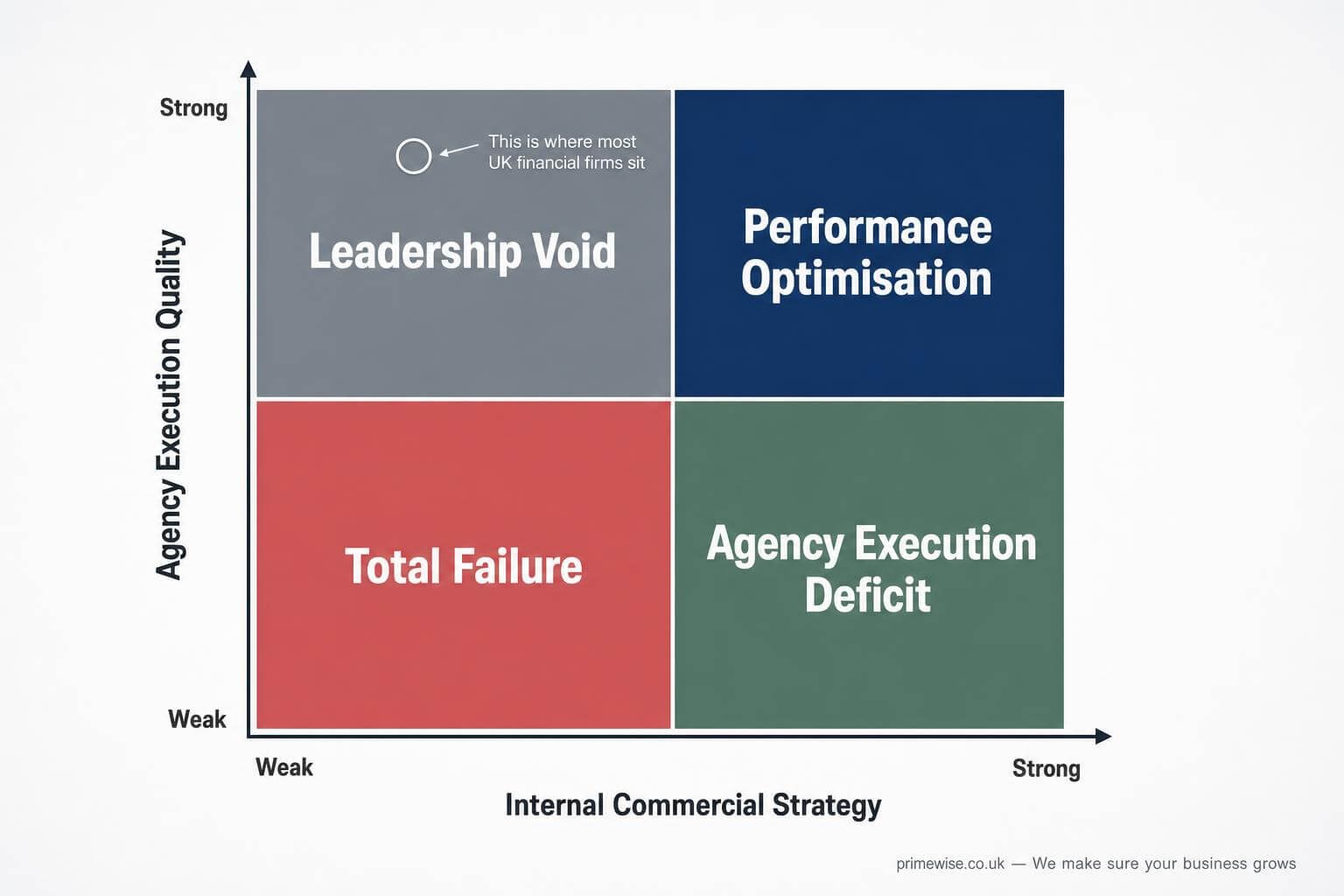
The Agency Strategy Gap Matrix is a proprietary diagnostic framework designed to replace emotional blame with objective commercial analysis. It evaluates your marketing ecosystem across two primary axes: the quality of your internal commercial strategy and the competence of your external tactical execution. Rather than treating the agency relationship as a binary success-or-failure event, the matrix reveals precisely where the breakdown occurred and which intervention is most appropriate. This distinction directly determines whether you need a new agency, a new internal leader, or both.
The matrix operates as a four-quadrant model, and every agency failure in the UK financial sector maps cleanly into one of these quadrants. Understanding which quadrant your firm occupies is the essential first step before any recovery investment is authorised.
- Quadrant One Total Failure: Weak internal strategy combined with weak agency execution. Neither party has provided commercial direction or competent delivery. This quadrant requires a complete reset: interim strategic leadership deployed first, followed by a full vendor replacement process once the strategy is defined.
- Quadrant Two Agency Execution Deficit: Strong internal strategy but weak external execution. The business knows precisely what it wants commercially, but the agency consistently fails to deliver. This quadrant calls for vendor replacement under tighter contractual controls, with the internal strategy preserved and used as the new brief.
- Quadrant Three Internal Leadership Void: Weak internal strategy but strong agency execution. The agency is technically capable but is operating without a coherent brief, defined audience profiles, or measurable goals. This is the most common failure mode in UK financial services and is the precise scenario where a Fractional CMO delivers the highest immediate ROI.
- Quadrant Four Performance Optimisation: Strong internal strategy combined with strong agency execution. The relationship is fundamentally functional and requires fine-tuning rather than structural intervention. Incremental KPI refinement and contract optimisation are sufficient here.
The practical value of this matrix lies in its ability to prevent the most damaging and common recovery mistake: replacing the agency when the real problem is an absence of internal strategic ownership. Firms that skip this diagnostic step frequently spend a second six-figure budget with an equally capable new agency and achieve identical results because the root cause remains unaddressed.
KEY INSIGHTThe Agency Strategy Gap Matrix consistently reveals that Quadrant Three strong agency capability wasted by weak internal direction accounts for the majority of UK financial services marketing failures. The agency is rarely as incompetent as the post-failure debrief suggests.
What a Fractional CMO Actually Does in the First 60 Days
A Fractional Chief Marketing Officer is an embedded, part-time executive who provides board-level strategic leadership without the overhead or commitment of a full-time hire. In the context of a post-failure recovery, their mandate is unambiguously commercial: halt capital erosion, diagnose the systemic failure, restructure vendor relationships, and build an execution-ready strategy that agencies can reliably deliver against. Unlike a marketing consultant who produces recommendations for others to implement, a Fractional CMO assumes direct operational ownership of the marketing function from day one.
For UK financial services firms, the fractional model carries a specific structural advantage. An experienced interim marketing executive with embedded FCA compliance knowledge can simultaneously rebuild commercial strategy whilst ensuring all external communications meet the Financial Conduct Authority’s COBS 4 financial promotions standards and the requirements of the Consumer Duty regulations introduced in 2023. This dual capability commercial strategy and regulatory oversight is rarely available through a generalist hire and is almost never present in a standard agency relationship.
Days One to Fifteen Commercial Triage and Vendor Audit
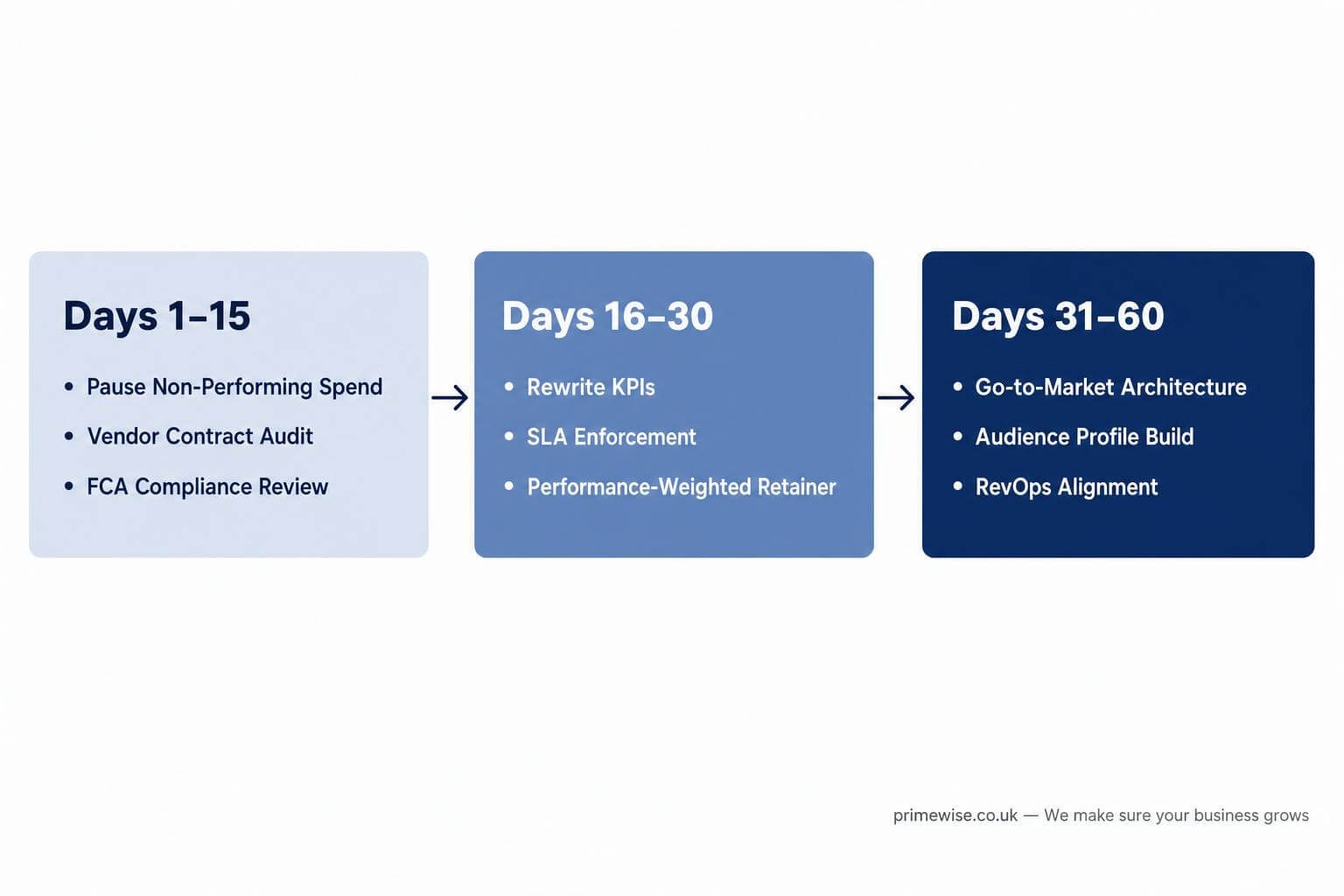
The first fifteen days are dedicated entirely to stopping the financial bleeding. Every active marketing initiative is audited against a single commercial criterion: is this activity generating qualified pipeline, or is it burning capital? Campaigns that cannot demonstrate a measurable contribution to the sales function are paused immediately, regardless of how recently they were launched or how much creative investment they represent. This discipline is uncomfortable but non-negotiable continued spend on non-performing activity whilst conducting a recovery is indefensible at board level.
Simultaneously, all existing vendor contracts are reviewed in full. The audit assesses whether agency fees are structured against deliverable outputs or commercial outcomes, identifies any contractual obligations that lock the firm into continued spend, and evaluates the genuine capability of the current roster against the firm’s actual commercial requirements. At this stage, no vendor replacement decisions are made the goal is diagnostic clarity, not reactive termination.
Days Sixteen to Thirty Contract Reset and KPI Realignment
With the triage phase complete, the focus shifts to establishing rigorous commercial controls across all vendor relationships. Every agency retained at this point must accept a restructured engagement framework. Service Level Agreements are rewritten to specify response times, escalation protocols, and deliverable quality standards. More critically, the Key Performance Indicators that govern agency accountability are fundamentally redesigned soft marketing metrics such as impressions, reach, and social engagement are removed as primary measures and replaced with commercially meaningful indicators including Marketing Qualified Leads, Sales Qualified Leads, cost-per-SQL, and pipeline velocity measured in days from first contact to opportunity.
This KPI realignment also introduces performance-weighted remuneration where contractually viable. Rather than a fixed retainer regardless of commercial output, a portion of the agency’s monthly fee typically fifteen to twenty-five per cent is linked directly to the achievement of pipeline milestones. This shared-risk structure fundamentally realigns the agency’s financial incentives with the firm’s revenue generation goals. When an agency’s income depends on qualified pipeline, agency behaviour changes immediately and measurably.
Days Thirty-One to Sixty Strategic Architecture and Execution Alignment
The final phase moves from stabilisation to structured growth. A comprehensive go-to-market architecture is developed that defines the firm’s precise target audience profiles, differentiating value proposition, competitive positioning, and primary commercial channels. This strategic foundation which should have existed before the original agency engagement was commissioned becomes the single source of commercial truth that all subsequent vendor activity is derived from and measured against.
The execution alignment phase also addresses the marketing technology stack. A thorough audit of the firm’s CRM infrastructure, marketing automation capabilities, and attribution modelling reveals whether the technical environment can actually support the commercial strategy being built. This is a frequently overlooked failure point: firms occasionally discover that their agency was not solely responsible for poor pipeline data the internal technology stack provided no reliable mechanism for tracking leads from first touch to revenue. Resolving this infrastructure gap is essential before any new demand generation activity is launched.
FCA Compliance as a Competitive Differentiator
For UK financial services firms, regulatory compliance in marketing is not a constraint on commercial growth it is a mechanism for achieving it. Firms that build FCA-compliant marketing infrastructure from the strategy level, rather than retrofitting compliance as a legal review at the end of the process, consistently produce higher-converting campaigns with shorter approval cycles. The competitive advantage is structural: whilst generalist competitors wait three to four weeks for compliance sign-off on campaigns built without regulatory consideration, a firm with compliance embedded at the strategy level moves content through approval in days.
The specific regulatory obligations most frequently missed by generalist agencies include COBS 4.2 requirements governing fair, clear, and not misleading communications, the Consumer Duty’s outcome-focused standards for retail and professional client communications introduced under PS22/9, and the FCA’s specific guidance on financial promotions for high-net-worth individuals and sophisticated investors. Non-compliance in any of these areas exposes the firm to formal investigation, significant financial penalties, and reputational damage that no marketing recovery can easily repair.
COMPLIANCE ALERTCOBS 4.2 and Consumer Duty obligations apply to all digital marketing channels including paid search, social media, and email. A failed agency engagement that produced non-compliant financial promotions may require a proactive disclosure review before new campaigns are launched your Fractional CMO should conduct this assessment in Week One.
Restructuring Agency Contracts for Commercial Performance
The structural reform of agency contracts is one of the highest-leverage activities a Fractional CMO executes during a post-failure recovery. Most agency agreements in the UK market are drafted to protect the agency’s revenue, not the client’s commercial outcomes. Extended notice periods, broad deliverable definitions, and the absence of any performance-related accountability are standard features of retainer agreements that have never been challenged by a senior marketing leader on the client side.
Demand generation and lead generation are not interchangeable terms, and the distinction matters enormously when restructuring these agreements. Lead generation typically refers to the tactical capture of contact information through gated content, paid media, or direct outreach. Demand generation is the broader strategic function of creating commercially motivated intent in the target audience before they actively enter a buying process. A restructured agency contract must specify which of these functions the vendor is being retained for, how success is measured in each case, and what the commercial consequence is of consistent underperformance against defined benchmarks.
Brand safety in financial promotions adds an additional contractual dimension that most standard agency agreements fail to address. The contract must define clear protocols governing which channels, audiences, and content categories are permissible, who holds final compliance approval authority on all external communications, and what the remediation process is if non-compliant material is published. These provisions protect the firm legally whilst creating an internal accountability structure that generalist agencies are rarely accustomed to navigating.
A Mid-Market Financial Services Recovery in Practice
A London-based B2B investment management firm with assets under management in the £200 million to £400 million bracket had engaged a nationally recognised digital agency on a £22,000 per month retainer for eleven months. At the point of intervention, the engagement had consumed over £240,000 in fees. The pipeline contribution was zero qualified institutional leads. The FCA compliance review conducted in Week One identified three active campaign assets in breach of COBS 4.2 standards none of which had been reviewed by a qualified compliance officer before publication.
The Agency Strategy Gap Matrix assessment placed the firm firmly in Quadrant Three: the agency was not wholly incompetent, but it had been operating for eleven months without defined target audience profiles, without institutional buyer personas, and without a single commercially meaningful KPI. The agency had been reporting on sessions, impressions, and content downloads none of which had any defined relationship to the firm’s actual commercial objectives of increasing institutional AUM and generating introductions to family office allocators.
The sixty-day intervention produced the following measurable outcomes: all three non-compliant campaign assets were removed, rewritten to COBS 4.2 standard, and resubmitted for compliance approval within Week Two. The retainer was restructured to a performance-weighted model with twenty per cent of the monthly fee tied to SQL generation. New institutional target audience profiles were built using data from the Investment Association and Companies House. By day sixty, the firm recorded its first four qualified institutional introductions, a customer acquisition cost reduction of 40 per cent against the previous eleven-month baseline, and a fully documented go-to-market strategy that the board approved as the commercial framework for the following financial year.
COMMERCIAL OUTCOMEWithin 60 days: three non-compliant assets removed and rewritten, retainer restructured to performance model, four qualified institutional introductions generated, and a 40% reduction in customer acquisition cost. The agency did not change. The strategic direction did.
If this scenario mirrors your current commercial position, Primewise provides specialist Fractional CMO engagements exclusively for UK financial services firms. Our interim marketing leaders carry embedded FCA compliance knowledge, operate under structured 60-day turnaround frameworks, and are typically deployed within 72 hours of brief. You can explore how we execute this recovery process at primewise.co.uk.
Revenue Operations Alignment After the Reset
A Fractional CMO operating in isolation from the sales and customer success functions will produce a strategically coherent marketing plan that fails commercially for entirely different reasons. Revenue Operations the integrated alignment of marketing, sales, and customer success around a unified commercial pipeline is the structural framework that prevents this secondary failure mode. During the sixty-day recovery, the interim marketing leader must establish formal pipeline handoff protocols between marketing and sales, define the precise criteria that distinguish a Marketing Qualified Lead from a Sales Qualified Lead, and ensure that the CRM infrastructure captures the full buyer journey from first marketing touch to closed revenue.
CMO-as-a-Service models, which have emerged as the dominant commercial structure for fractional leadership in 2025 and 2026, typically include RevOps alignment as a core deliverable rather than an optional add-on. This is a meaningful structural shift from earlier fractional engagement models, which frequently treated sales-marketing alignment as the sales director’s responsibility. In the UK financial services context where the average B2B sales cycle for institutional mandates can span six to eighteen months precise attribution of marketing activity to pipeline velocity is commercially essential, not aspirational.
When a Fractional CMO Is Not the Right Solution
Intellectual honesty demands acknowledging that the fractional model is not universally appropriate, and a responsible interim marketing leader will tell you this directly during an initial assessment rather than after fees have been committed. There are specific scenarios where a Fractional CMO engagement will not resolve the underlying commercial problem.
- Product-market fit has not been established: If the core proposition of the firm has not been validated with real institutional buyers, no marketing strategy however sophisticated will generate sustainable pipeline. The problem is commercial, not strategic, and requires a product or proposition review before marketing investment is appropriate.
- The failure is purely operational: If the agency possessed the correct strategic brief but the internal CRM infrastructure, data governance, or sales process was too underdeveloped to convert leads, the priority is operational rather than strategic. A technology implementation or RevOps specialist may deliver more immediate value than a Fractional CMO.
- The business requires full-time executive presence: Firms managing marketing functions with five or more direct reports, multiple simultaneous product launches, and a marketing budget exceeding £2 million annually typically require a permanent, full-time CMO rather than a fractional arrangement. The breadth and pace of decision-making at that scale demands consistent, embedded leadership that a part-time model cannot reliably provide.
- The board cannot commit to strategic direction: A Fractional CMO can build a commercially robust strategy, but the strategy requires board alignment and consistent executive sponsorship to execute. If the leadership team is fundamentally divided on commercial priorities, the absence of internal consensus will undermine the recovery regardless of the quality of the external strategic input.
Presenting these constraints is not a disqualification of the fractional model it is evidence of the diagnostic rigour that distinguishes a genuinely experienced interim marketing leader from a vendor simply seeking to convert an enquiry. The right engagement starts with an honest assessment, not a sales pitch.
The Marketing Due Diligence Standard for Future Engagements
One of the most commercially valuable outputs of a post-failure recovery is the implementation of marketing due diligence protocols that prevent a recurrence. Due diligence in agency selection a process that most firms apply rigorously when selecting legal counsel or fund administrators but almost never when appointing a marketing partner involves a structured evaluation of the agency’s genuine capability against the specific requirements of the engagement before a contract is signed.
A rigorous due diligence process for a UK financial services marketing engagement includes: verification of the agency’s demonstrated experience producing FCA-compliant financial promotions, reference checks specifically with clients in regulated sectors rather than general B2B references, a technical assessment of the agency’s marketing technology stack compatibility with the firm’s existing CRM infrastructure, a commercial model review to identify whether the proposed retainer structure creates alignment or misalignment of incentives, and a defined measurement framework agreed contractually before work commences. Firms that implement this standard consistently report significantly shorter paths to commercial performance with new agency relationships because the brief, the accountability framework, and the compliance guardrails are embedded from day one rather than retrofitted after the first review cycle.