
A fractional CMO for professional services firms is a part-time Chief Marketing Officer who delivers C-suite commercial strategy to SRA-regulated law firms, FCA-authorised advisory businesses, and ICAEW-member accountancy practices, typically engaged for two to four days per month at £3,000–£8,000 per month, generating predictable mandates without the overhead of a full-time executive hire. If your firm’s revenue still depends on which partners attended which networking dinner last quarter, that sentence describes the strategic gap this role exists to close.
This article is written specifically for Managing Partners, Senior Partners, and Heads of Business Development at UK professional services firms who have already recognised a structural deficit in their commercial function and are now evaluating how to resolve it. Whether you lead a Top 50 accountancy practice, a boutique management consultancy, an SRA-regulated law firm, or an FCA-authorised wealth advisory, the core challenge is identical: your firm needs scalable, non-referral mandate generation, and the traditional marketing approaches available to you have not delivered it.
Fast Facts: UK Professional Services MarketingProfessional and business services contributed approximately £252 billion to UK GDP in 2024 (ONS). Full-time CMO remuneration in London ranges from £180,000 to £240,000 plus NIC contributions and benefits (Hays UK Marketing Salary Guide 2025/2026). The average UK B2B sales cycle in professional services runs between six and eighteen months. A fractional engagement can reduce commercial leadership costs by approximately 60% compared to a full-time hire. 78% of UK mid-tier consultancies report difficulty generating non-referral leads.
What a Fractional CMO Actually Does Inside a Partnership
The definition matters because it is widely misunderstood. A fractional CMO is not a senior consultant who reviews your website and produces a marketing plan that sits in a shared drive. Inside a partnership model, the role functions as the commercial architect of the firm’s entire go-to-market operation. That means designing and owning the mandate generation strategy, establishing pipeline architecture across practice areas, coaching equity partners into visible thought leadership positions, directing any junior marketing staff or retained agencies, and reporting commercial progress directly to the Managing Partner or Executive Committee. The distinction between this role and a marketing manager is categorical, not incremental.
Where a junior marketing manager coordinates events, manages social media schedules, and procures brochures, the fractional CMO sets the commercial logic that determines whether those activities have any mandate-generating purpose at all. Where a digital agency delivers tactical SEO or paid search output, the fractional CMO determines whether those channels are even the right investment for a firm with a twelve-month sales cycle and a £250,000 average mandate value. The role is strategic authority operating at board level, deployed on a cost structure that mid-tier UK firms can absorb without threatening Profit Per Equity Partner.
The Referral Trap Is a Structural Risk
For decades, the Square Mile and broader UK professional services market operated on a culture of network capital and entrenched referral relationships. A partner who had spent fifteen years building relationships with a cluster of IFAs, corporate solicitors, or Big Four alumni had, in effect, a proprietary revenue stream. That model delivered consistent income, required minimal marketing infrastructure, and aligned perfectly with the professional culture of understated relationship management over overt promotion.
That model is now structurally vulnerable. Market saturation across accountancy, legal, and advisory has compressed differentiation. The digitisation of B2B procurement means that senior in-house counsel, finance directors, and chief operating officers now conduct substantive vendor research before any relationship is activated. According to Gartner’s B2B buying research, enterprise buyers now complete between 57% and 70% of their decision-making process before engaging a supplier directly. Referrals activate this process they do not replace it. A firm with no independent visibility, no authoritative digital presence, and no content demonstrating technical depth will lose mandates to competitors who have those assets, even when the referral is warm.
Building a Mandate Generation Architecture
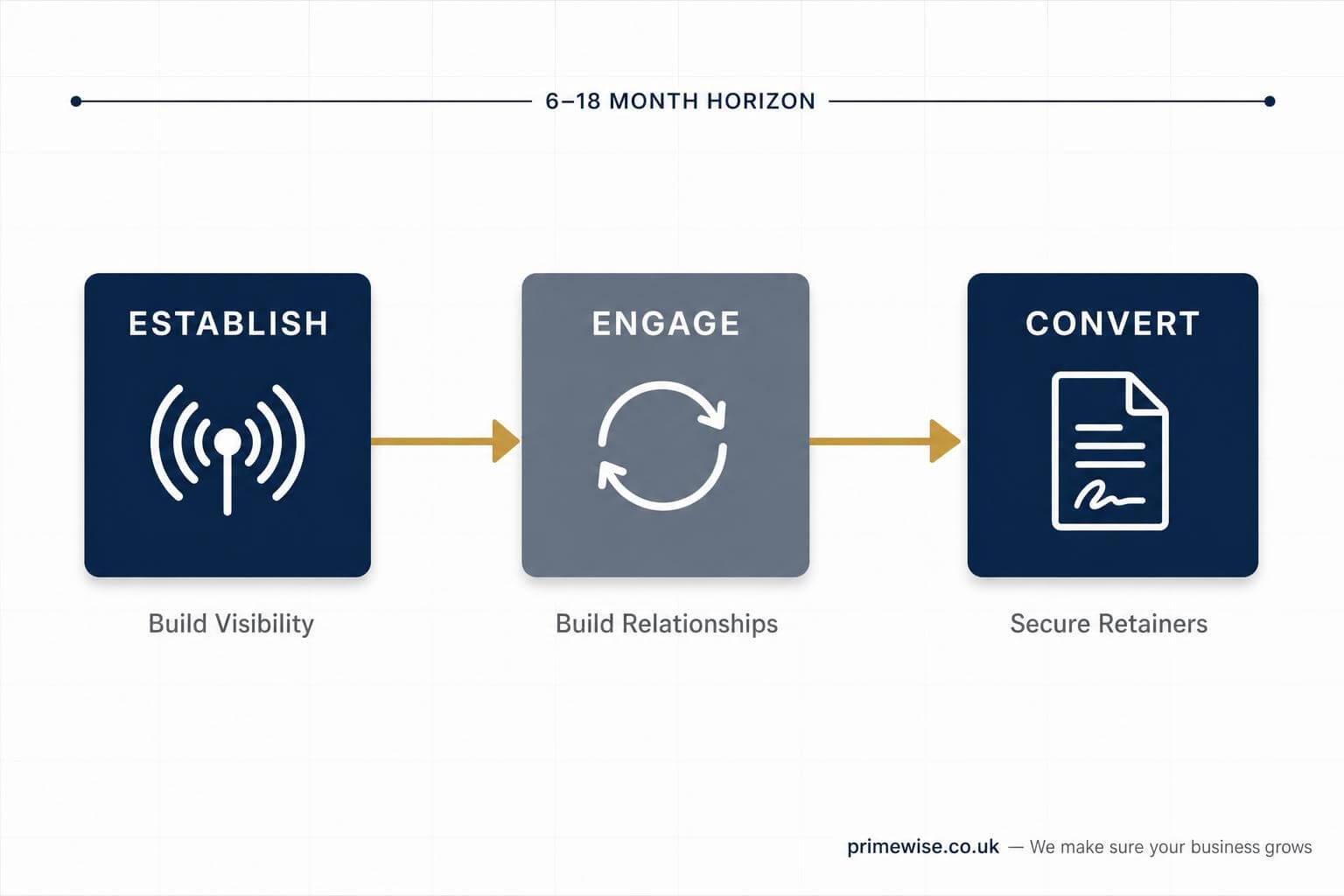
Transitioning from referral dependency to structured mandate generation requires what we term the Referral-to-Retainer Bridge, a proprietary framework that maps the journey from initial market visibility through to formal client retention across a professional services sales cycle. The framework operates in three sequential phases: Establish, Engage, and Convert. The Establish phase builds the firm’s authoritative market presence through targeted thought leadership, regulatory commentary, and sector-specific content. The Engage phase activates that presence through structured prospect nurturing, ensuring that decision-makers who have consumed the firm’s content are systematically moved toward a commercial conversation. The Convert phase applies structured business development support at the point where relationship capital meets formal procurement, ensuring that fee-earners are equipped to close without feeling that they are selling.
PrimeWise’s proprietary Mandate Generation Framework was developed specifically to operationalise this transition, having been deployed across SRA-regulated and FCA-authorised environments across the UK. The architecture is designed to respect the firm’s compliance obligations while building a reliable, measurable pipeline that operates independently of any single partner’s network.
Navigating UK Regulatory Constraints in Marketing
Marketing in regulated UK professional services sectors is not a minor operational consideration it is a fundamental design constraint that shapes every tactical decision a fractional CMO makes. Under FCA COBS 4, financial promotions must be fair, clear, and not misleading, with specific restrictions on the claims that advisory and wealth management firms can make in public-facing content. Under the SRA Code of Conduct 2019, Chapter 8 governs referral arrangements and the conditions under which firms can make introductory payments or receive referral fees, with significant implications for partnership marketing strategies. ICAEW’s ethical standards place additional constraints on client solicitation practices for accountancy practices, particularly around the perception of independence.
A fractional CMO with genuine sector experience navigates these constraints as a matter of professional competence, not as an afterthought. The strategic output is marketing that is simultaneously compliant and commercially ambitious a balance that generic marketing agencies operating outside the sector routinely fail to achieve, often exposing the firms they serve to regulatory risk.
Regulatory Marketing NoteAll marketing strategies for SRA-regulated firms, FCA-authorised businesses, and ICAEW member practices must be reviewed against sector-specific compliance obligations before deployment. Fractional CMO engagements through PrimeWise include regulatory alignment as a standard component of strategic design.
Protecting Profit Per Equity Partner
The financial case for fractional commercial leadership is most clearly articulated through its impact on Profit Per Equity Partner, the metric that ultimately governs partner satisfaction, talent retention, and competitive positioning for mid-tier UK firms. Every decision about marketing investment exists in direct tension with PEP. A full-time CMO hire at London market rates does not simply cost a salary it costs employer NIC contributions, pension obligations, benefits, office infrastructure, and the management overhead of a permanent senior employee. The total cost of employment for a senior marketing executive in London regularly exceeds £280,000 per annum when all components are included.
A fractional engagement at £6,000 per month, representing a mid-range retainer for a genuinely experienced sector specialist, costs £72,000 per annum. The differential is approximately £208,000 per year in preserved partnership distributions. Across a five-partner equity structure, that differential represents over £40,000 per partner per year in protected PEP before any commercial return from the engagement is considered. The financial logic is not marginal, it is categorical.
The Executive Talent Comparison
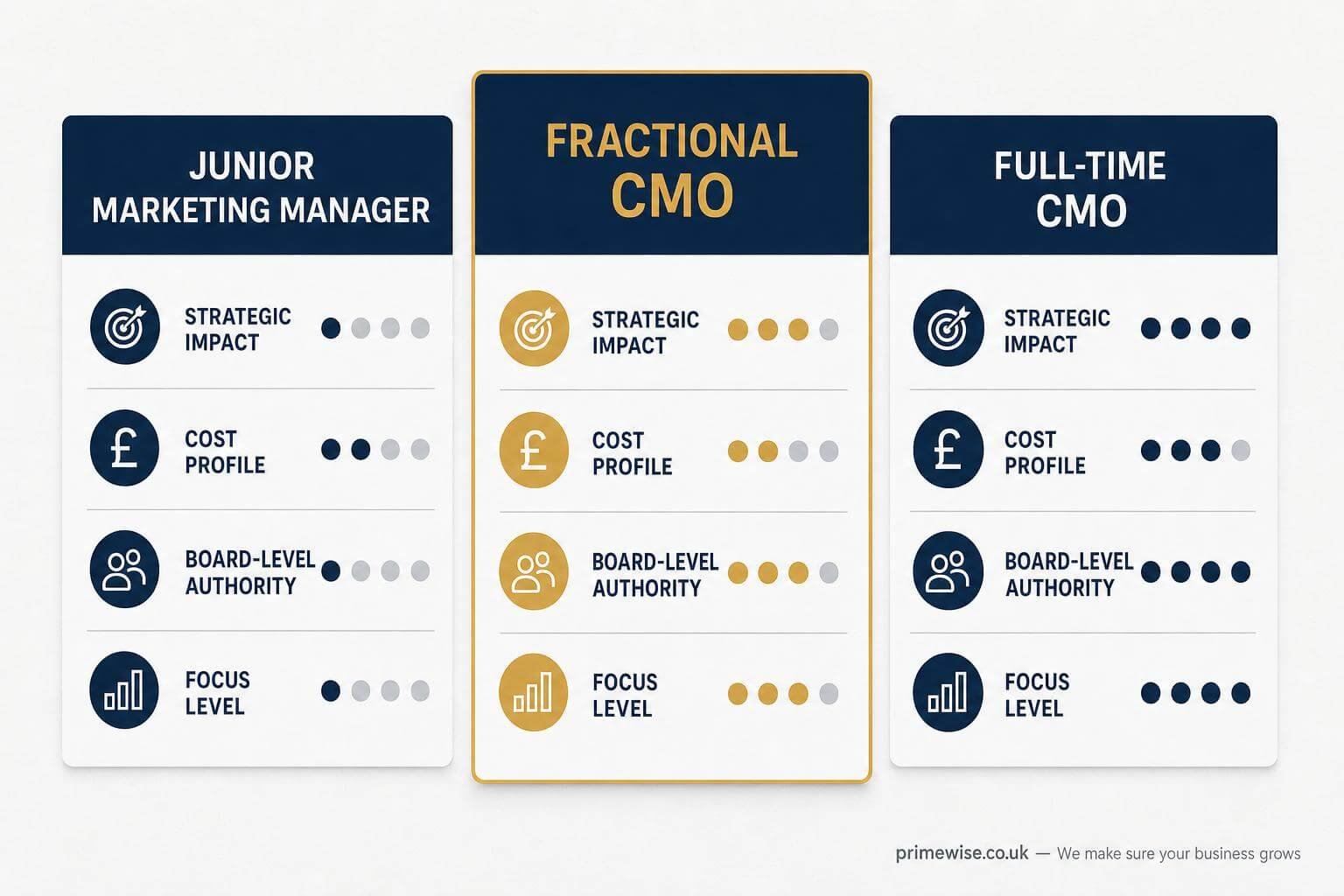
The following table presents a structured comparison of the three commercial leadership options available to mid-tier UK professional services firms, expanded to reflect the dimensions that matter to Managing Partners making this decision. Full-time CMOs deliver maximum strategic impact but impose maximum operational expenditure, long commitment horizons, and significant organisational management overhead. Junior marketing managers impose minimal cost but deliver minimal strategic impact. They execute tactics without the authority or experience to set commercial direction. The fractional model delivers equivalent strategic impact to a full-time hire, with optimised cost, a flexible commitment structure, and the sector-specific regulatory experience that generic marketing hires rarely possess.
| Dimension | Full-Time CMO | Fractional CMO | Junior Marketing Manager |
|---|---|---|---|
| Strategic Impact | High | High | Low |
| Annual Cost (Total) | £220,000–£280,000+ | £36,000–£96,000 | £35,000–£55,000 |
| Commitment Horizon | 12–24 months minimum | 3–12 months, scalable | Ongoing permanent |
| Regulatory Sector Experience | Variable | Specialist by design | Rare |
| Time to First Commercial Impact | 3–6 months (onboarding) | 4–8 weeks | Tactical only |
| Suitable Firm Size | 100+ fee-earners | 20–150 fee-earners | Any |
| PEP Protection | Negative pressure | Neutral to positive | Minimal pressure |
PEP Modelling OfferManaging Partners at UK professional services firms interested in modelling the PEP impact of fractional commercial leadership can request a confidential commercial audit via PrimeWise.
Overcoming Internal Cultural Resistance
Perhaps the most underestimated challenge in deploying any modern go-to-market strategy inside a UK professional services partnership is not the strategy itself it is the culture in which it must operate. British professional services firms carry a deeply embedded ethos of understated expertise. Partners built careers on the principle that technical excellence speaks for itself, that self-promotion is gauche, and that the appropriate way to develop business is through quiet, relationship-based trust-building over the years. Introducing structured marketing into this environment can feel, to equity partners, like an attack on the values that built the firm.
This resistance is not irrational. It reflects a genuine and historically validated model of professional development. The fractional CMO’s task is not to dismiss it but to work with it to demonstrate that modern mandate generation, done correctly, is an amplification of professional authority rather than a replacement for it. The framing that works in practice is not “we need to do more marketing” but rather “we need to ensure that the expertise in this firm reaches the people who most need it.” That reframe changes the conversation from promotion to service, and in a partnership culture, it is the reframe that creates permission for action.
The Partner-Led Growth Matrix
The Partner-Led Growth Matrix is a proprietary framework for systematically activating fee-earners as visible market authorities without requiring them to engage in anything that feels like direct sales. The matrix maps each equity partner across two axes: technical depth (the specificity and depth of their sector expertise) and market visibility (their current profile within the target client community). Partners with high technical depth and low market visibility represent the highest commercial opportunity, as they have substantive expertise that high-value clients need, but no structured channel through which that expertise generates inbound interest.
For these partners, the fractional CMO designs a targeted thought leadership programme that channels their expertise into a regular cadence of sector-specific commentary, regulatory analysis, and client-relevant insight. This might take the form of LinkedIn articles on HMRC consultation responses for a tax partner, a co-authored analysis of Consumer Duty implementation for an FCA-authorised advisory firm, or a structured series on the Economic Crime and Corporate Transparency Act 2023 for a commercial disputes practice. Each piece of content is designed to demonstrate expertise to a defined target audience not to sell, but to establish the cognitive authority that makes a formal approach from a prospective client the natural next step.
Aligning Siloed Practice Areas
Beyond individual partner activation, the fractional CMO addresses the structural challenge that afflicts almost every mid-tier UK firm above a certain size: the silo problem. Tax, audit, corporate finance, employment, and litigation teams frequently operate as independent commercial units with their own BD priorities, their own client relationships, and limited awareness of the cross-selling opportunities that exist across the firm. From a client’s perspective, this fragmentation is invisible they see a firm, not a set of departments. From a commercial perspective, the fragmentation is costly because the total relationship value available from any given enterprise client is never fully captured.
The fractional CMO’s role in this context is to design an account-based marketing approach at the firm level, identifying the highest-value client relationships and target prospects, mapping the full scope of services relevant to each, and creating a coordinated engagement plan that presents a unified, multi-disciplinary solution. This is where the fractional model’s board-level authority becomes commercially decisive: only a leader with genuine cross-practice credibility and a Managing Partner mandate can break down the political barriers between departments that protect their client relationships from internal “interference.”
Realistic ROI Timelines for Professional Services
One of the most important functions a fractional CMO performs in the early weeks of an engagement is managing expectations, specifically, the expectation that marketing investment will produce mandate wins within the first quarter. In professional services B2B, this expectation is commercially illiterate. The procurement processes of enterprise clients in financial services, infrastructure, private equity, and the public sector routinely involve multiple stakeholders, formal tender processes, legal review, and incumbent relationship management. A new advisory relationship does not emerge from a LinkedIn post; it emerges from sustained, credible market presence over a period that typically runs between six and eighteen months before the first formal instruction.
Acknowledging this reality is not pessimism, it is the foundation of a credible strategy. A fractional CMO who promises mandate wins within ninety days is either misrepresenting the market or proposing a tactical approach so transactional that it undermines the firm’s positioning. The firms that build the most durable mandate generation engines are those that commit to the full timeline with appropriate milestones at each phase.
Phased Strategic Rollout
A structured fractional CMO engagement for a mid-tier UK professional services firm typically follows a phased rollout across three distinct stages. In months one and two, the focus is diagnostic: auditing existing marketing assets, mapping the firm’s current pipeline, assessing the partner landscape against the Partner-Led Growth Matrix, and establishing a go-to-market strategy aligned to the firm’s specific practice areas, target client profile, and regulatory environment. In months three through six, the emphasis shifts to establishing thought leadership content, activating partner profiles, building sector-specific digital authority, and warming the prospect base with credible, expertise-led content. From month six onward, the Engage and Convert phases activate, with structured prospect nurturing, business development support for fee-earners, and formal pipeline tracking against mandate targets. By month twelve, firms with consistent implementation typically report measurable improvements in non-referral pipeline quality and volume.
UK Accountancy Firm Case Study
The following case study is drawn from a fractional CMO engagement with a UK-based accountancy practice with between 40 and 120 fee-earners, operating across audit, tax, corporate finance, and business advisory. The firm had experienced consistent year-on-year revenue, but growth had plateaued. New mandate generation was almost entirely dependent on referrals from three senior equity partners, creating a significant succession and concentration risk. The firm had a junior marketing coordinator in post but no commercial strategy, no defined target client profile, and no structured thought leadership output.
The fractional CMO engagement began with a full commercial audit, followed by the deployment of a targeted LinkedIn thought leadership programme across three practice heads covering Making Tax Digital implementation, audit reform implications under the UK Corporate Governance Code, and corporate finance considerations for founder-led businesses approaching exit. Simultaneously, a structured referral partner programme was established with a network of top-tier IFAs and corporate solicitors, converting informal referral relationships into a documented, reciprocal arrangement with defined engagement protocols. A content series on the practical implications of R&D tax credit reforms was distributed to a segmented prospect list of qualifying manufacturing and technology businesses.
Within twelve months, the firm recorded a 35% increase in high-value mandates originating outside the existing partner network. Non-referral pipeline, measured as formal prospect conversations initiated by inbound interest rather than partner introduction, increased from near zero to representing 28% of total new business activity. These results did not emerge from increased marketing spend the total fractional engagement cost was significantly below the alternative of a full-time senior hire but from the deployment of a coherent, sequenced, expertise-led go-to-market strategy designed specifically for the firm’s regulatory environment and cultural constraints.
Key Result35% increase in high-value mandates within 12 months. Non-referral pipeline grew from near zero to 28% of total new business activity. Achieved without increasing headcount or total marketing spend.
Sector-Specific Considerations by Firm Type
Professional services is not a monolithic category, and the mandate generation strategy for a Big Four-adjacent accountancy practice differs materially from that of a boutique management consultancy or an FCA-authorised discretionary fund manager. The following section addresses the distinct commercial and regulatory pressures facing the three primary sub-verticals for which fractional CMO engagements are most commonly deployed in the UK market.
Top 50 Accountancy Practices
Accountancy firms in the Top 50 face a specific commercial inflection point driven by the UK Audit Reform agenda, the implementation of the Audit, Reporting and Governance Authority (ARGA), and the continued evolution of Making Tax Digital. These regulatory developments create a defined window of genuine market differentiation firms that establish authoritative positions on the implications of ARGA for audit committee responsibilities, or on MTD for income tax self-assessment for professional partnerships, can capture high-value advisory mandates from businesses actively seeking guidance on compliance. The ICAEW’s Practice Benchmarking Survey consistently identifies new service line development as a top-three growth priority for mid-tier practices. A fractional CMO with accountancy sector experience designs the go-to-market strategy that converts that ambition into a structured client acquisition pipeline.
SRA-Regulated Law Firms
For law firms navigating the SRA’s updated Standards and Regulations and the commercial implications of the Economic Crime and Corporate Transparency Act 2023, the mandate generation challenge is compounded by professional conduct obligations around client solicitation and referral fee restrictions under SRA Code Chapter 8. The Legal Services Board’s research consistently identifies legal services as among the lowest-trust professional categories in the UK consumer and B2B perception index creating both a challenge and an opportunity for firms that can genuinely demonstrate expertise and transparency. A fractional CMO structures the firm’s market communications to build demonstrable expertise-based trust over time, using regulatory commentary, published client outcome data where permissible, and structured thought leadership to differentiate from competitors whose marketing remains generic and compliance-driven rather than commercially strategic.
FCA-Authorised Advisory and Wealth Management Firms
Consumer Duty, implemented in July 2023 and now embedded in FCA supervisory expectations, has fundamentally changed the marketing and communications obligations of FCA-authorised firms. Under Consumer Duty, firms must demonstrate that their communications support good client outcomes a standard that, when applied strategically, becomes a powerful mandate generation tool rather than a compliance burden. A fractional CMO for an FCA-authorised advisory or wealth management firm designs content and communications strategies that simultaneously meet Consumer Duty communication standards and position the firm as the most credible, client-outcome-focused choice in its target market. The overlap between compliance and commercial differentiation in this environment is significant and systematically underexploited by most mid-tier advisory firms.
Is a Fractional CMO Right for Your Firm
Not every firm is at the right stage for fractional commercial leadership. The model delivers maximum return when deployed in organisations that have reached a specific inflection point where the existing approach to business development is clearly insufficient for the growth targets set by the partnership, but where the firm is not yet at a scale that justifies the cost and commitment of a full-time C-suite hire. The following criteria are designed as a self-qualification framework for Managing Partners considering this decision.
- Your firm has 20 or more fee-earners but no dedicated commercial director or Head of BD with strategic authority
- Total firm revenue sits between £2 million and £20 million per annum
- More than 60% of new mandates in the last 24 months originated from existing partner relationships or direct referrals
- Your junior marketing function is executing activities events, social posts, website updates without a clearly defined go-to-market strategy
- Equity partners are reluctant to engage in business development activities that feel like direct sales or self-promotion
- The firm has identifiable target client segments but no structured programme for reaching and converting them
- You are preparing for a succession transition where key-partner revenue concentration represents a risk to the firm’s valuation
If three or more of these criteria describe your firm’s current position, the structural case for fractional commercial leadership is strong. PrimeWise works with UK professional services firms across accountancy, legal, management consulting, and financial advisory to design and deploy mandate generation strategies that protect PEP, respect partnership culture, and build durable non-referral pipeline. A confidential commercial audit is available to qualifying firms as the first step.
Key Strategic Concepts Defined
For practice managers, junior partners, or business development leads conducting initial research on behalf of senior leadership, the following definitions clarify the core terminology used throughout this article.
- Mandate Generation is the structured process of attracting, engaging, and converting high-value client instructions through a defined go-to-market strategy rather than through passive referral or chance relationship activation
- Profit Per Equity Partner (PEP) the principal profitability metric for UK partnership structures, calculated as net profit divided by the number of equity partners; the primary financial argument for fractional over full-time commercial leadership
- Go-To-Market Strategy is the firm-level commercial plan, defining target client segments, value proposition, channel selection, and pipeline management processes that direct all marketing and business development activity
- Thought Leadership Marketing a non-promotional approach to market visibility in which equity partners and senior fee-earners publish substantive expertise-led content to build authority with target client audiences, generating inbound interest without direct solicitation
- Account-Based Marketing (ABM) a B2B strategy in which marketing and business development resources are concentrated on a defined list of high-value target accounts rather than distributed across broad-awareness activities
- Partner-Led Growth Matrix a PrimeWise proprietary framework mapping equity partners by technical depth and market visibility to identify and activate the highest-value thought leadership opportunities within the firm
- Referral-to-Retainer Bridge a PrimeWise proprietary framework sequencing the transition from referral-dependent new business to structured, non-referral mandate generation across a defined twelve to eighteen month programme