
The first 90 days of the fractional CMO determine everything. When you work with a fractional CMO, you are not hiring a consultant who delivers a deck and disappears. You are integrating a senior commercial operator who must diagnose, restructure, and accelerate your revenue engine within a defined window. According to the Chartered Institute of Marketing’s 2025 Salary Report, the median UK CMO salary exceeds £145,000 per annum. Fractional engagement, typically priced between £8,000 and £20,000 per month, depending on days committed and sector complexity, represents a capital-efficient alternative for Series A to Series C businesses that need board-level marketing leadership without the full-time overhead. The first quarter is the proof of concept. Get it wrong and you burn capital. Get it right and you unlock compounding commercial momentum.
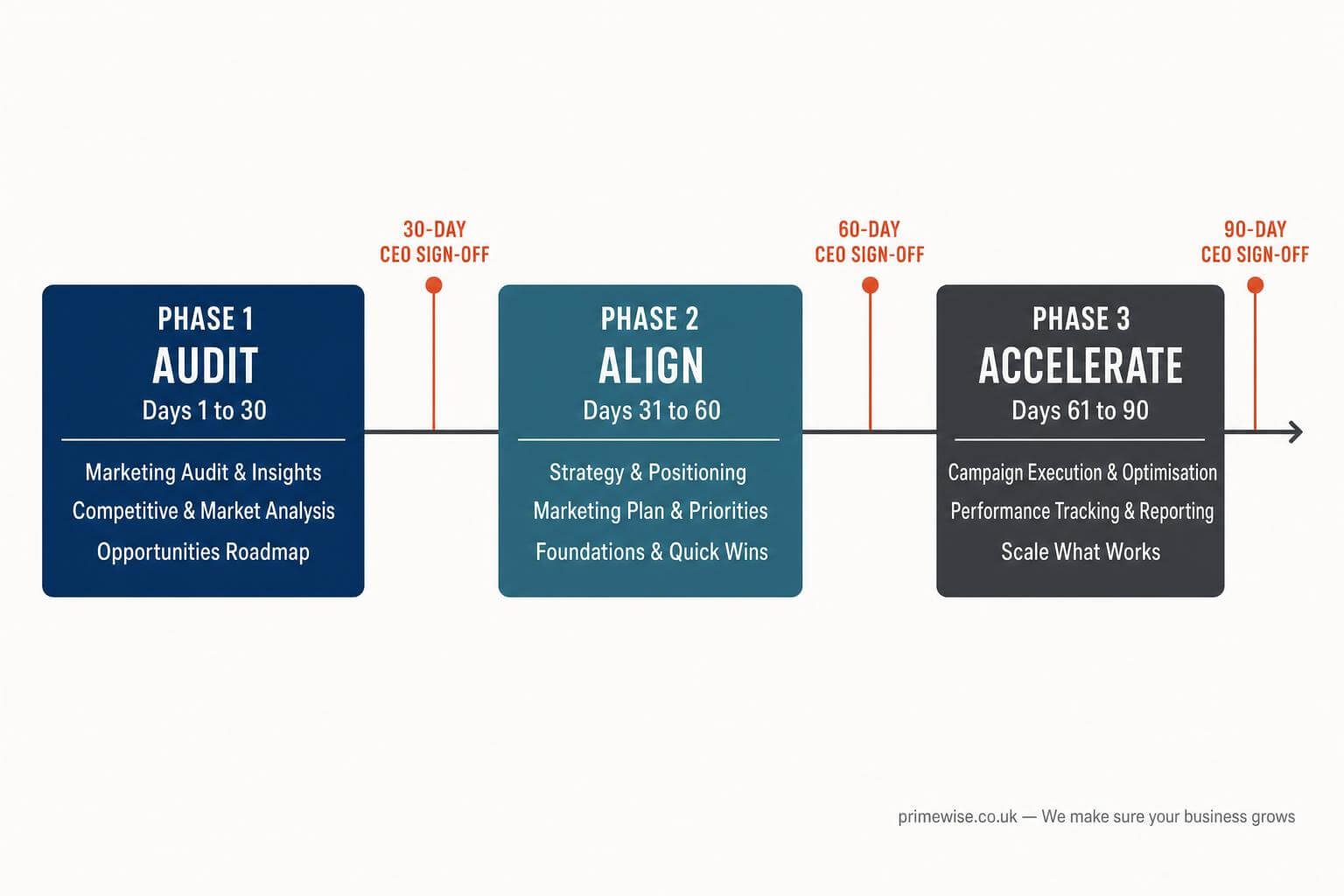
The Audit-Align-Accelerate FrameworkThis article follows the AAA fCMO Methodology a proprietary three-phase onboarding model used by experienced fractional marketing leaders across UK SMEs and funded startups. Phase 1: Audit (Days 1–30). Phase 2: Align (Days 31–60). Phase 3: Accelerate (Days 61–90). Each phase has defined deliverables, CEO sign-off milestones, and measurable outputs.
Why the First 90 Days Are Non-Negotiable
A full-time CMO hired into a scaling business typically takes six to eight months to reach full strategic velocity navigating internal politics, building team trust, and completing a gradual onboarding process. A fractional marketing leader does not have that runway. The commercial mandate is compressed by design. Within ninety days, the fractional executive must deliver a forensic audit of the existing marketing engine, a restructured go-to-market strategy aligned with board-level objectives, and live campaigns generating a measurable pipeline. This is not a theoretical framework. It is the operational standard that separates high-performing fractional engagements from expensive disappointments. The structure below reflects what a practising fractional CMO with over fifteen years of live UK engagements actually delivers, not what looks good on a proposal.
Phase One: The Commercial Diagnostic
The first thirty days are strictly forensic. Before a single pound is deployed into new campaigns, the fractional executive must build an objective, evidence-based picture of the commercial landscape. This phase is uncomfortable for many founders and leadership teams because it surfaces operational realities that have been ignored or normalised. That discomfort is the point. The diagnostic creates the factual foundation for every strategic decision that follows.
Auditing the Marketing Engine and Revenue Operations
Revenue operations alignment is the first area of investigation. The fractional CMO conducts a deep technical review of the relationship between sales and marketing functions, analysing lead velocity rates, historical conversion data at each pipeline stage, and the quality of handoffs between teams. This diagnostic typically exposes significant friction within the CRM, whether that is Salesforce, HubSpot, or a less sophisticated system and reveals critical gaps in the marketing technology stack. In the majority of UK SME engagements, this audit uncovers duplicate tooling, orphaned automation sequences, and attribution models that are either broken or entirely absent. Identifying these issues early prevents capital from being allocated based on misleading performance data.
UK GDPR and ICO Compliance Baseline
Operating within the UK requires absolute adherence to data protection standards that carry genuine financial and reputational risk. The fractional executive conducts a structured baseline audit of Information Commissioner’s Office compliance and UK GDPR protocols across all active marketing channels. This includes reviewing consent mechanisms on web forms, auditing email database provenance, assessing cookie consent management platforms, and verifying data processor agreements with all active vendors. For funded startups operating under EIS or SEIS advance assurance conditions, documented compliance is not optional it directly affects scheme eligibility and investor confidence. Neglecting this audit in month one creates compounding legal risk that becomes exponentially more expensive to resolve later.
Identifying Common Month One Blockers
Systemic resistance is a predictable feature of fractional onboarding, not an exception. The most common blockers encountered across UK engagements include legacy technology debt where critical platforms are undocumented or inaccessible, historical sales-marketing friction where both teams operate with conflicting definitions of a qualified lead, and founder-led bottlenecks where decision-making authority remains highly centralised and approval cycles stall execution. By mapping these operational hurdles explicitly within the first two weeks, the fractional leader sets realistic expectations with the board and prevents early momentum from collapsing under the weight of unresolved structural issues.
CEO Sign-Off End of Month OneAt the close of Day 30, the fractional CMO presents the State of the Nation diagnostic report to the board. This document covers: the current marketing technology audit and identified debt, revenue operations gaps and CRM health assessment, ICO and UK GDPR compliance status, and a prioritised list of immediate quick wins awaiting authorisation. CEO sign-off on this report and the activation of quick wins is mandatory before Phase Two begins.
Phase Two Strategy Alignment and Commercial Restructuring
With a clear diagnostic in hand, the second month transitions from analysis to architecture. Every strategic decision made in this phase is directly informed by the evidence gathered in Phase One. The objective is to produce a coherent, board-approved commercial blueprint that aligns every marketing pound with measurable business outcomes. This is where the fractional CMO earns a significant portion of their fee by making difficult, data-backed recommendations about budget allocation, vendor relationships, and strategic priorities that internal teams are often too close to the business to make objectively.
Rationalising London Agency Retainers Against Nearshore Talent
Bloated agency retainers are one of the most consistent findings in UK fractional engagements. Premium London agencies frequently charge retainer rates that reflect their W1 postcode as much as their performance. The fractional executive conducts a rigorous vendor audit, benchmarking the output and cost-per-commercial-result of existing agency partners against highly capable nearshore alternatives in markets such as Eastern Europe, South Africa, and South Asia. This exercise routinely identifies savings of £2,000 to £8,000 per month without any reduction in the quality of creative, paid media, or technical deliverables. Recovered budget is then reallocated into higher-converting channels identified during the diagnostic phase, directly improving capital efficiency without requiring additional board investment.
Aligning Strategy with SEIS and EIS Board Expectations
For UK-funded startups, the marketing strategy must satisfy a layer of commercial obligation that purely organic businesses do not face. HMRC requires EIS-qualifying companies to demonstrate genuine commercial activity and a credible growth trajectory to maintain scheme eligibility and satisfy advance assurance conditions. Marketing spend must be documented as growth-oriented activity not administrative overhead to align with standard SEIS and EIS shareholder agreement reporting requirements. A fractional CMO’s structured KPI framework, when designed correctly, provides investors with precisely the visibility they need: customer acquisition cost trends, pipeline velocity, and revenue attribution by channel. This positions the fractional engagement not merely as a marketing function but as a direct contributor to investor relations and capital protection. Referencing HMRC’s EIS compliance guidelines directly within the strategic roadmap signals commercial maturity to London-based VC partners and angel networks.
Building the Annual Marketing Roadmap
The culmination of Phase Two is a definitive twelve-month strategic plan. This document is not a marketing calendar with campaign ideas. It is a commercial instrument that maps specific activities to revenue outcomes, defines the KPI framework against which the fractional CMO will be held accountable, and establishes a revised budget with clear channel allocation rationale. The roadmap must survive scrutiny from a CFO as well as a CMO. It outlines exact timelines for campaign deployment, identifies the internal and external resources required at each stage, and sets clear milestones for the subsequent nine months of the engagement.
CEO Sign-Off End of Month TwoAt the close of Day 60, the CEO and board formally review and approve the 12-Month Marketing Roadmap, the revised budget allocation, the vendor restructuring decisions, and the agreed KPI framework. This sign-off signals the complete transition from strategic planning to live tactical execution. Without this formal approval, Phase Three cannot begin at full operational velocity.
Phase Three Execution, Scaling, and Closed-Loop Reporting
The final month of the onboarding cycle demands full operational velocity. Frameworks are replaced by live market activity. The fractional executive assumes total accountability for pipeline generation, campaign performance, and revenue attribution. This is the phase that distinguishes a genuinely embedded fractional leader from a strategic consultant the willingness and capability to be measured against real commercial outcomes, in real time, without qualification.
Deploying Prioritised Campaigns and Activating Automation
Tactical execution is the defining characteristic of Phase Three. The marketing function launches the highest-priority campaigns identified in the strategic roadmap typically a combination of paid search restructuring, account-based marketing sequences for enterprise targets, and content-led demand generation for mid-market audiences. Concurrently, marketing automation workflows are activated within the CRM to nurture incoming leads through defined qualification stages, ensuring the sales pipeline operates efficiently and reduces manual intervention from an already stretched internal team. In B2B SaaS and fintech engagements, this automation infrastructure frequently delivers the most measurable early ROI, as re-engaging dormant pipeline can generate revenue without additional acquisition spend.
Establishing the Executive Reporting Dashboard
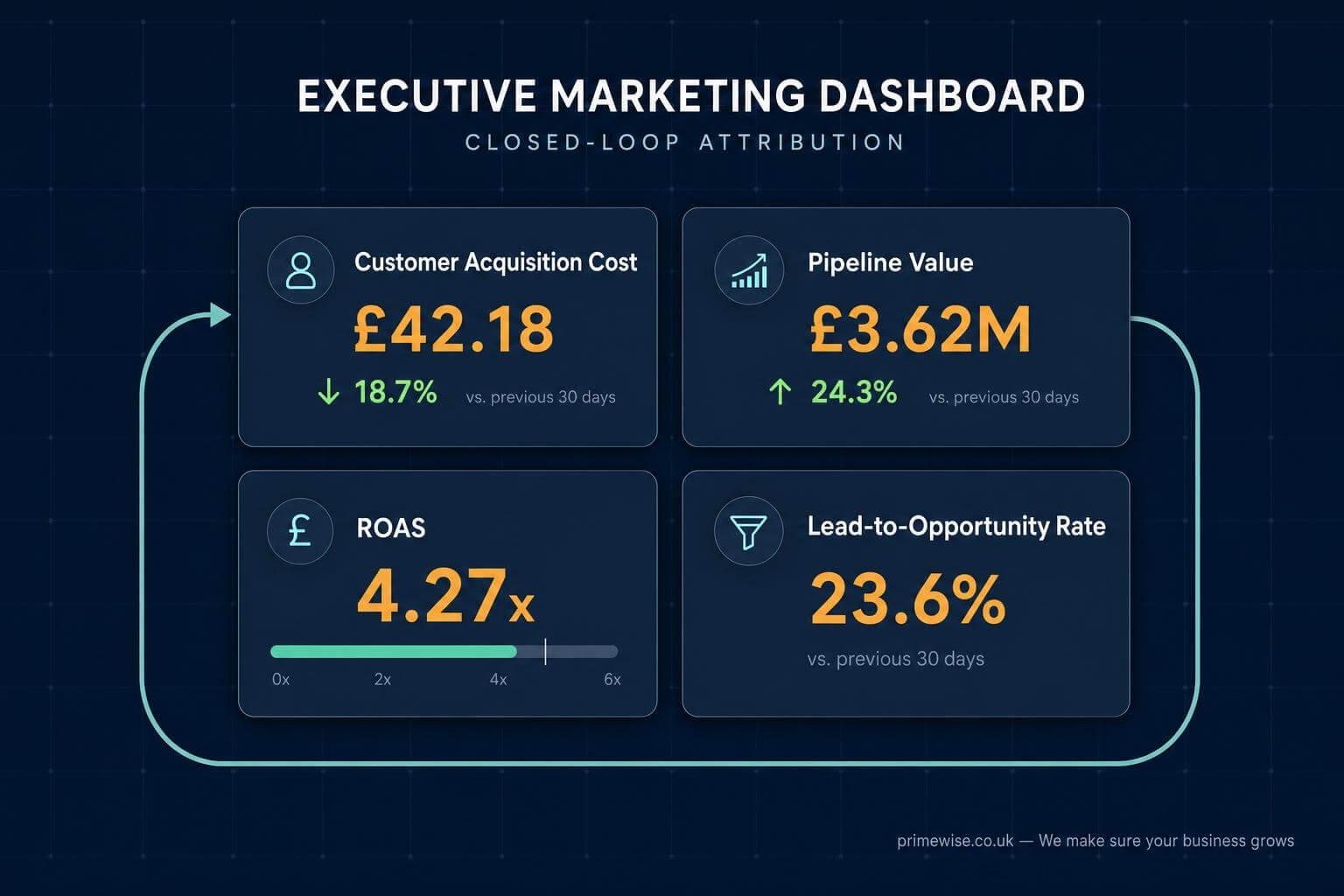
Financial transparency is non-negotiable for a high-performing fractional engagement. A closed-loop reporting dashboard is deployed to track the commercial metrics that matter at board level: customer acquisition cost by channel, marketing-sourced pipeline value, lead-to-opportunity conversion rate, and customer lifetime value projections. Tools such as HubSpot’s Revenue Attribution reports, Google Looker Studio, or Salesforce Tableau provide the real-time visibility required. The critical distinction between a competent fractional CMO and an exceptional one is the ability to connect marketing activity directly to revenue outcomes to show the board not just that impressions and clicks increased, but that specific campaigns generated specific pipeline value at a specific cost. This closed-loop attribution model is the commercial language that earns long-term board confidence.
CEO Sign-Off End of Month ThreeThe ninety-day cycle closes with a comprehensive quarterly performance review. The fractional CMO presents initial ROI attribution data, pipeline generated by channel, CAC versus target benchmarks, and the confirmed operational cadence for the subsequent nine months. CEO approval of this review formally transitions the engagement from probationary onboarding to a sustained commercial partnership.
The 90-Day Fractional CMO Delivery Timeline
The table below provides a structured reference for CEOs and boards managing a fractional CMO engagement. Each phase maps specific deliverables to ownership responsibilities and expected outputs, creating a clear accountability framework for both parties.
| Phase | Days | Primary Deliverable | Owner | CEO Sign-Off Required |
|---|---|---|---|---|
| Audit | 1–30 | State of the Nation diagnostic report, UK GDPR audit, tech stack assessment, quick wins list | Fractional CMO | Diagnostic report and quick win activation |
| Align | 31–60 | 12-month marketing roadmap, revised budget, vendor restructuring, KPI framework, SEIS/EIS alignment | Fractional CMO + Board | Annual roadmap and budget plan |
| Accelerate | 61–90 | Live campaign deployment, CRM automation activation, closed-loop executive dashboard, Q1 attribution report | Fractional CMO | Q1 performance review and 9-month cadence |
Case Study Eliminating Wasted Ad Spend in UK Fintech
Concrete financial outcomes validate the methodology more effectively than any theoretical framework. The following anonymised case study reflects a real engagement structure and commercially representative benchmarks from UK fractional CMO practice.
A London-based Series A financial technology firm engaged a fractional marketing executive to audit their stalling acquisition channels. Monthly paid search spend of approximately £22,000 was generating declining return, and three separate agency contracts covering paid media, SEO, and content were consuming over £14,000 per month in retainer fees with no unified attribution model. Within the first thirty days, the forensic diagnostic identified £67,000 in annualised wasted paid search spend across the three agency accounts, driven by overlapping keyword targeting, absent negative keyword management, and bid strategies optimised for impressions rather than commercial conversion.
Following account restructuring and the consolidation of two agency contracts into a single nearshore performance team at a combined monthly cost of £6,200, the recovered budget was reallocated into a sequenced email automation programme targeting 4,200 existing leads in the dormant pipeline. By day 45, the client achieved a 3.2x return on ad spend across restructured paid channels and reduced customer acquisition cost from £312 to £118 within the first quarter. The executive dashboard, deployed in week eight, provided the board and EIS investors with real-time visibility of pipeline attribution for the first time in the company’s history. Primewise.co.uk provides this structured onboarding framework specifically designed for UK businesses engaging fractional executive leadership including the diagnostic tools, vendor benchmarking methodology, and reporting infrastructure used in this engagement.
Thinking About Engaging a Fractional CMO?If you are a UK CEO evaluating fractional marketing leadership for the first time, the Primewise team offers a no-obligation commercial diagnostic to assess your current marketing engine, identify immediate revenue opportunities, and outline exactly what a structured 90-day engagement would deliver for your specific business. Request your commercial diagnostic at primewise.co.uk.
What to Prepare Before Day One
The speed and depth of the Phase One diagnostic is directly determined by how well the business prepares for the fractional CMO’s arrival. CEOs who compile commercial documentation in advance compress the audit timeline by two to three weeks and ensure that quick wins can be authorised earlier. Before the first day, business leaders should consolidate all historical sales performance data segmented by channel and period, compile existing agency contracts with performance benchmarks and current monthly spend, prepare full software access credentials for all marketing and CRM platforms, document any known compliance concerns or outstanding ICO correspondence, and provide a clear written summary of the board’s top three commercial objectives for the next twelve months. This preparation signals organisational readiness and allows the fractional executive to deliver the State of the Nation report with significantly greater depth and precision.
Fractional CMO Versus Full-Time CMO The Commercial Case
The comparison between fractional and full-time marketing leadership is fundamentally a question of capital efficiency versus organisational permanence. A full-time CMO at the median UK salary of £145,000 per annum represents a total employment cost including National Insurance contributions, benefits, and pension of approximately £175,000 to £190,000 annually. Recruitment typically adds a further £25,000 to £40,000 in agency fees, and the average time-to-full-productivity for a senior marketing hire in a scaling UK business is six to eight months. Fractional engagement eliminates recruitment cost entirely, compresses time-to-value from eight months to ninety days, and provides access to a practitioner who has navigated identical commercial challenges across multiple industries and funding stages. For Series A to Series C businesses with marketing budgets below £500,000 per year, the fractional model almost universally delivers superior capital efficiency.
Related Strategic Considerations for UK Business Leaders
Understanding the fractional CMO engagement in isolation understates the broader strategic context in which it operates. Business leaders evaluating this model should also be familiar with the following interconnected disciplines and market considerations that frequently arise within a ninety-day onboarding cycle.
- Fractional marketing director UK engagements share the same AAA methodology but are often scoped at a more tactical execution level than pure C-suite fractional roles.
- Outsourced CMO for startups typically involves a higher proportion of foundational infrastructure work, building the marketing engine from scratch rather than auditing and optimising an existing one.
- B2B demand generation strategy is frequently the central output of Phase Three, with account-based marketing sequences forming the primary pipeline growth mechanism for enterprise-focused businesses.
- Revenue operations alignment between sales and marketing remains the single most common source of pipeline leakage identified during Phase One diagnostics across UK engagements.
- Marketing technology stack audit outcomes frequently reveal that businesses are paying for three to five tools that duplicate functionality, with consolidation generating immediate monthly savings.
- Growth marketing leadership in funded startups must balance short-term acquisition efficiency with the longer-term brand equity investment required to reduce CAC over time.
- Series A marketing strategy must prioritise channel repeatability over volume, proving that a single acquisition channel can scale predictably before investing in diversification.
- CMO-as-a-Service models, which Primewise.co.uk operates within, provide ongoing fractional leadership beyond the initial ninety days, maintaining strategic continuity without the cost of a permanent hire.
- Interim marketing director costs in the UK typically range from £600 to £1,200 per day for genuinely senior practitioners, making the monthly retainer model more cost-predictable for budget-conscious boards.
Frequently Asked Questions
The following questions reflect the most common commercial queries raised by UK CEOs and board members evaluating or actively managing a fractional CMO engagement.