
The decision to hire a fractional CMO or a Fractional Head of Marketing is one of the highest-stakes commercial choices a UK founder or Managing Director will face, and the fractional CMO vs. fractional head of marketing confusion costs scaling businesses between £18,000 and £72,000 annually in misallocated leadership spend. These are not interchangeable titles. They represent fundamentally different accountability structures, budget authorities, and organizational mandates. Getting this decision wrong creates either a strategic void filled with disconnected tactical activity or a high-cost visionary who cannot deliver the campaign momentum your pipeline demands. This guide draws on direct experience holding both roles across multiple UK engagements to give you an authoritative, practical framework for making the right hire before you sign a contract.
Executive SummaryA Fractional CMO owns board-level strategy, commercial forecasting, and cross-functional alignment. A Fractional Head of Marketing owns operational execution, team management, and channel performance. Choose a CMO when your business needs commercial restructuring or investor-grade reporting. Choose a Head of Marketing when you have a defined strategy and need execution velocity.
Defining the Two Fractional Marketing Leadership Roles
The UK fractional executive market has grown significantly since 2022, with Beauhurst data indicating that over 34% of Series A to B businesses in the UK now engage at least one fractional C-suite leader, up from 18% in 2020. Despite this growth, the market suffers from chronic title inflation that blurs the genuine distinction between strategic and operational marketing leadership. Understanding what each role actually does, not just what the job description claims, is the foundation of every successful fractional engagement.
What a Fractional CMO Actually Does
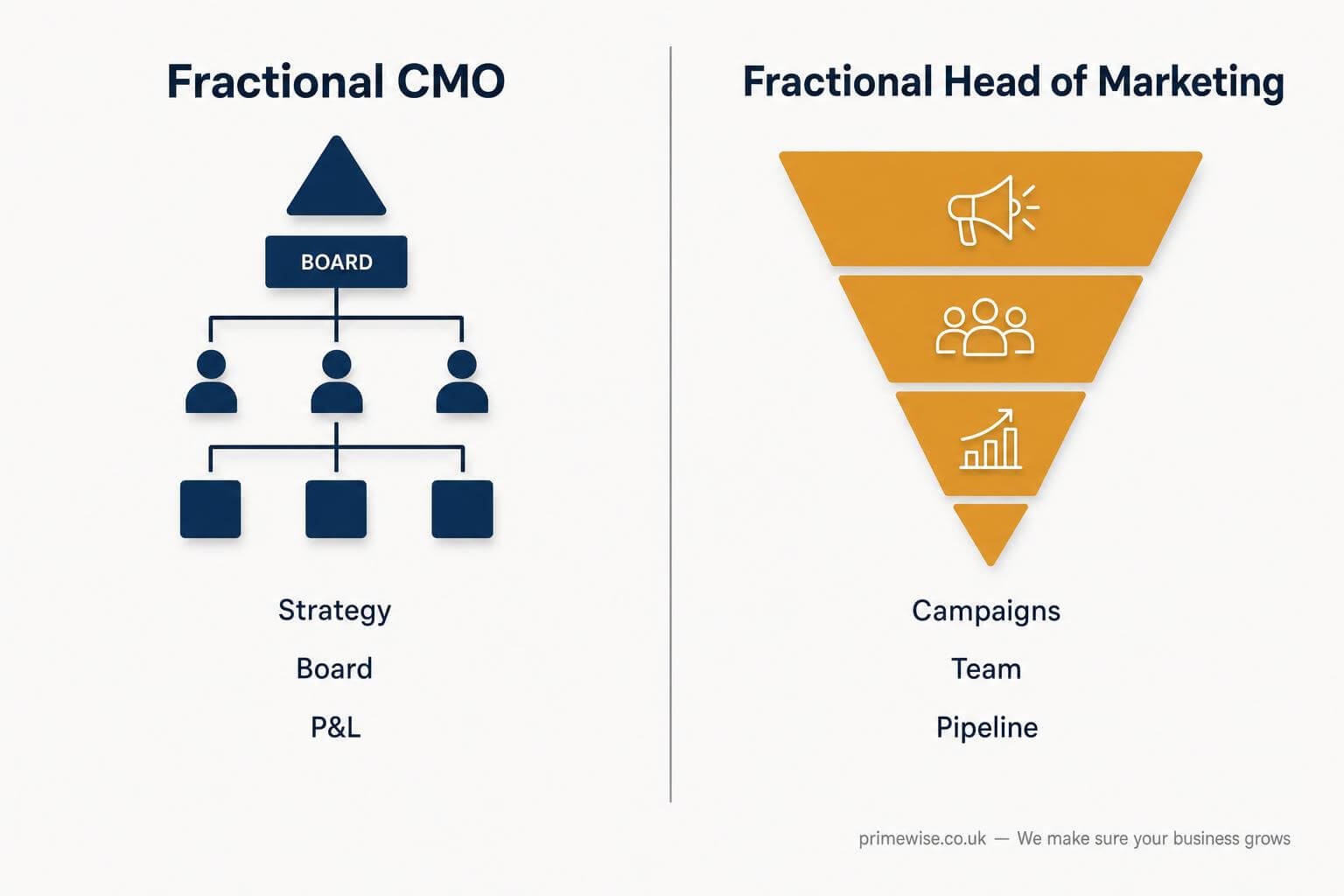
A Fractional Chief Marketing Officer operates as a strategic architect at board level. Their mandate is not campaign delivery; it is commercial structure. A fractional CMO analyses the entire go-to-market framework, models revenue operations, defines customer acquisition cost thresholds, and ensures that every marketing investment maps directly to enterprise value creation. They interface with investors, define the total addressable market, and establish the overarching brand narrative that governs all downstream activity.
The CMO’s primary output is a scalable, predictable revenue engine. In an EIS or SEIS-funded UK business, the CMO translates marketing performance into the financial language of the boardroom, presenting data on capital efficiency, churn reduction, and shareholder value rather than click-through rates or social reach. They define the profit and loss parameters for the marketing function, model projected return on investment across the full channel mix, and hold the strategic vision that the operational team executes against. From direct experience across multiple Series B engagements, the CMO’s most valuable contribution is often not what they build, but what they prevent, specifically, the dispersal of capital across tactical channels with no strategic cohesion.
What a Fractional Head of Marketing Actually Does
A Fractional Head of Marketing is an operational powerhouse whose value is measured in campaign velocity and pipeline generation. This role is inherently hands-on, requiring deep expertise in digital channels, demand generation, marketing automation, and team management. When a business has achieved product-market fit but lacks the momentum to scale its messaging into the market, the Head of Marketing is the hire who creates immediate commercial movement.
They hold external agencies accountable, oversee content production, manage performance marketing budgets within pre-defined parameters, and ensure that every tactical lever, paid search, SEO, email automation, and social media is pulled efficiently and measurably. They report upward to the founder, MD, or CMO rather than to the board directly. Their performance metrics are granular: cost per qualified lead, channel conversion rates, monthly marketing-attributed pipeline, and campaign ROI. Where the CMO asks ‘where should we compete?’, the Head of Marketing executes the answer.
The Fractional Scope Alignment Matrix
To resolve the widespread confusion over these two roles, the following multi-dimensional comparison matrix maps every critical dimension of each engagement. This framework has been refined through direct fractional leadership experience across more than 40 UK scale-up businesses operating between £1M and £20M ARR, and it remains the most reliable diagnostic tool for founders navigating this decision.
| Dimension | Fractional CMO | Fractional Marketing Director | Fractional Head of Marketing |
|---|---|---|---|
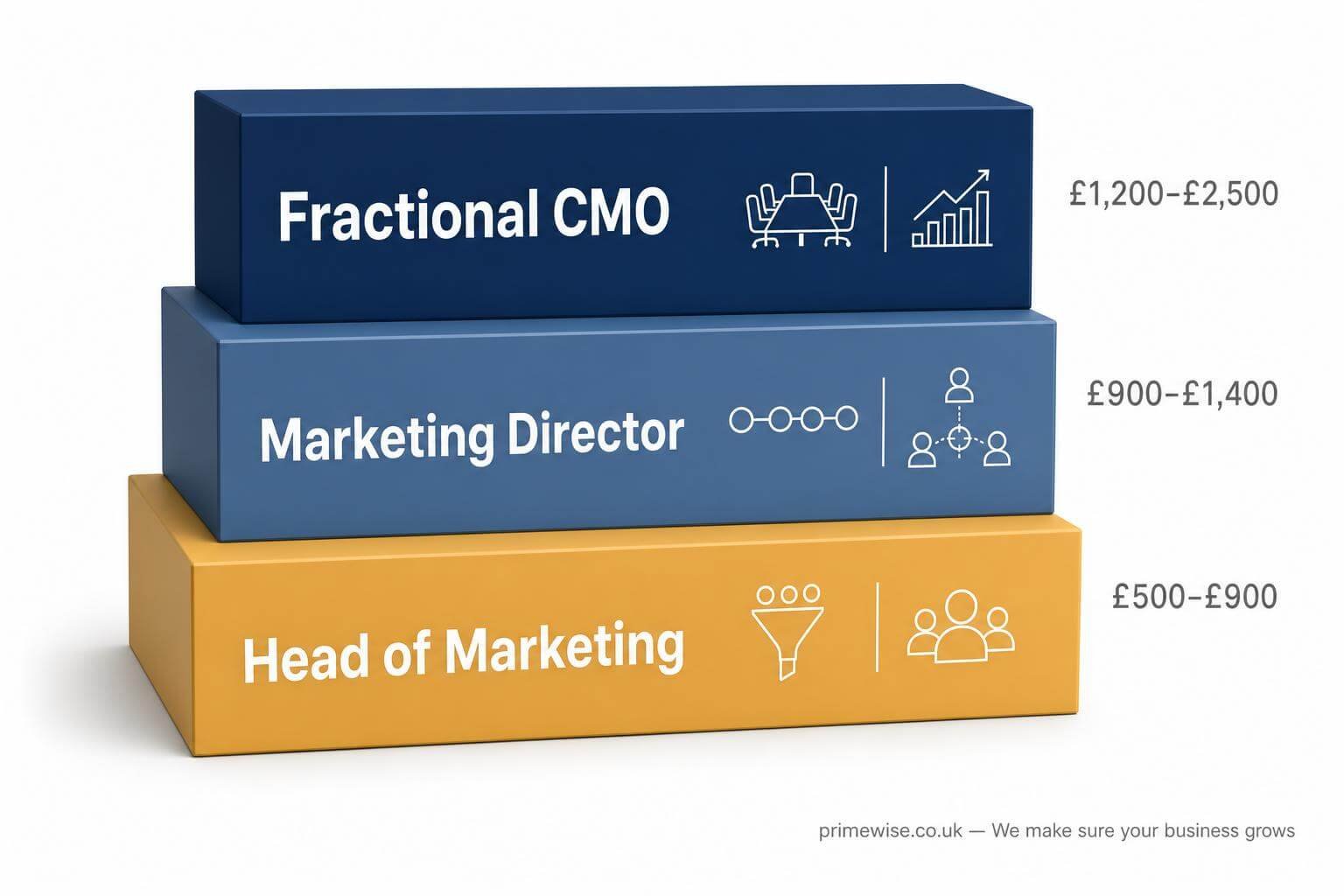
| Typical UK Day Rate (2026) | £1,200 – £2,500 | £900 – £1,400 | £500 – £900 |
| Board Reporting Frequency | Monthly or quarterly direct | Quarterly via MD | Rarely or never |
| Budget Authority Level | Defines and owns the P&L | Manages allocated budget | Deploys within set parameters |
| Primary KPIs Owned | CAC, LTV, revenue growth, NRR | Pipeline, MQLs, brand metrics | CPL, CPC, conversion rates, SQLs |
| Cross-Functional Scope | Sales, Product, Finance, CX | Sales and marketing alignment | Marketing team and agencies |
| Ideal Business Stage | Series B, pre-exit, enterprise | Series A scaling | Seed to Series A |
| Engagement Model | Strategic retainer or equity | Retainer with delivery scope | Retainer or day rate |
| Typical Duration | 9 – 24 months | 6 – 18 months | 3 – 12 months |
Day rate benchmarks are informed by the PRCA Consultancy Benchmarking Report and Heidrick and Struggles Fractional Executive Survey data for the UK market in 2025–2026. Note the inclusion of the Fractional Marketing Director tier, which occupies a genuine middle ground in the UK market and is frequently conflated with both senior roles in job descriptions and LinkedIn profiles. Understanding this three-tier structure is essential for accurate scoping and budget planning.
Board Accountability and UK Corporate Governance
UK corporate governance frameworks impose strict fiduciary expectations on anyone occupying a C-suite seat, particularly within businesses funded by Enterprise Investment Schemes or Seed Enterprise Investment Schemes. Investors deploying capital under HMRC’s EIS and SEIS frameworks expect board-level marketing accountability to be expressed in financial terms not campaign metrics. A genuine Fractional CMO understands this environment and can satisfy investor scrutiny during board meetings by translating marketing performance into shareholder value language.
A Fractional Head of Marketing, by contrast, is rarely positioned as a board-level contributor. Their reporting line runs to the founder, MD, or CMO. This is not a limitation it is a structural clarity that prevents the role from being pulled into strategic debates when the business actually needs operational execution. Confusing these accountability structures by asking a Head of Marketing to perform board-level reporting functions creates frustration on both sides and frequently terminates engagements prematurely. The BVCA’s research on marketing leadership gaps in UK portfolio companies consistently identifies misaligned reporting expectations as the primary cause of failed fractional engagements, not capability deficits.
Budget Authority as a Genuine Differentiator
Budget authority is one of the clearest practical differentiators between the two roles, and one of the most frequently misrepresented in fractional briefs. A Fractional CMO does not simply manage a marketing budget they define it. They build the financial model that determines how much capital the business should allocate to acquisition versus retention versus brand, model the projected ROI of each investment, and present that model to the board for approval. They own the marketing P&L in the same way a CFO owns the finance function’s financial model.
A Fractional Head of Marketing works within a budget that has already been defined. Their financial accountability is operational: pacing monthly spend, reallocating funds between underperforming and overperforming channels, and ensuring that every pound of the allocated budget generates the maximum possible commercial output. Both are valuable financial responsibilities but they are categorically different in scope, risk ownership, and board-level visibility.
Cross-Functional Leadership versus Departmental Management
The organisational impact of these two roles differs dramatically and has significant implications for how you structure your entire leadership team around the fractional hire. A Fractional CMO operates horizontally across the business, breaking down silos between marketing, sales, product development, customer success, and finance. They ensure the entire organisation speaks with a unified commercial voice and that every customer-facing function contributes coherently to revenue growth. This horizontal leadership is what justifies the premium day rate it creates enterprise value that extends well beyond the marketing department.
A Fractional Head of Marketing operates vertically, driving performance downward through the marketing department itself. They manage internal marketing coordinators, SEO specialists, copywriters, and paid media managers. They hold external agencies accountable to SLA performance. Their leadership excellence is measured by the efficiency and output quality of the marketing unit rather than by its integration with adjacent business functions. Both models are valid the question is which one your current operational structure actually requires.
Organisational Design WarningIf your business has no internal senior marketing hire and no defined go-to-market strategy, bringing in a Fractional Head of Marketing first will create an execution engine with no strategic direction. This is one of the most common and costly structural errors in UK scale-up hiring.
Navigating Title Inflation in the UK Market
The UK fractional executive market is experiencing acute title inflation. Experienced marketing managers and mid-level campaign specialists frequently present themselves as Chief Marketing Officers to command day rates of £1,000 or above, despite having no board-level experience, no P&L ownership history, and no exposure to investor-grade reporting. For founders attempting to source genuine strategic leadership, this creates a genuinely hazardous hiring environment where a poorly scoped brief and an inflated CV combine to produce an expensive misalignment.
How to Verify Fractional CMO Credentials
Vetting a genuine Fractional CMO requires looking beyond the title and the LinkedIn headline. Apply the following verification criteria before progressing any candidate to a detailed commercial conversation. A genuine CMO-level candidate should satisfy the majority of these criteria with specific, verifiable evidence rather than general claims.
- Has the candidate held a voting seat or observer seat on a board of directors at a funded UK business?
- Have they personally owned and defended a marketing P&L above £500,000 annually?
- Can they demonstrate experience navigating an EIS or SEIS fundraising round from a marketing accountability perspective?
- Do they provide investor references, not solely client or agency references?
- Can they present a documented go-to-market strategy they authored that drove measurable revenue scale?
- Have they aligned a sales function and a marketing function toward a shared revenue number at board level?
- Can they articulate the difference between brand equity contribution and direct acquisition ROI at a financial modelling level?
Candidates who cannot satisfy these criteria are almost certainly operating as senior marketing managers or Heads of Marketing with an inflated title. That does not make them less valuable it makes them differently valuable, and appropriately scoped for the operational role rather than the strategic one. Primewise applies this exact credential verification framework when matching UK scale-up businesses with fractional marketing leaders, significantly reducing mis-hire rates and compressing the time from leadership gap identification to commercial deployment. You can review the full Primewise fractional matching process at primewise.co.uk.
The Diagnostic Framework for Scaling Businesses
The single most reliable way to identify which role your business requires is to apply a structured diagnostic against your current company stage, internal capability, and immediate commercial objective. The following decision logic has been developed through direct engagement with over 40 UK scale-up businesses and reflects the real patterns of fractional leadership need across the growth continuum.
If your business is pre-Series A, has no documented go-to-market strategy, lacks any internal senior marketing hire, and the founding team is making all marketing decisions reactively, a Fractional CMO should be your first priority engagement. The absence of strategic direction means that any tactical execution you commission will be disconnected, poorly allocated, and unable to compound over time. The CMO defines the commercial foundation that every subsequent marketing investment is built upon.
If your business has a documented strategy, has achieved initial product-market fit, manages a marketing team of two or more people, and the primary bottleneck is execution velocity rather than strategic clarity, a Fractional Head of Marketing delivers superior commercial ROI. They provide the operational leadership that transforms a sound strategy into measurable pipeline and revenue output.
UK Case Study InsightA B2B SaaS business scaling from £2M to £8M ARR engaged a Fractional CMO at Series B. Within 12 months, CAC reduced by 38%, marketing-attributed pipeline grew by 210%, and the CMO's go-to-market restructuring directly supported a £4M Series C raise. The existing marketing team of three continued under the CMO's strategic direction, with no additional operational headcount required.
Seed to Series A Requirements
At Seed to Series A, the primary commercial objective is demonstrating traction and achieving agile campaign momentum. The business needs to prove that its messaging resonates with early adopters and that its acquisition channels are scalable. In this environment, a Fractional Head of Marketing can rapidly test acquisition channels, build the initial marketing automation infrastructure in tools such as HubSpot or ActiveCampaign, and drive the qualified lead generation required to support the next funding conversation. Investing in a full CMO day rate at this stage is frequently unnecessary overhead unless the founding team is entirely non-commercial and requires strategic direction before execution can begin.
Series B and Enterprise Strategic Requirements
As businesses scale past Series B, the complexity of operations increases materially. Investor scrutiny deepens, the objective shifts from lead generation to international market expansion and product diversification, and the board begins demanding marketing accountability at a financial modelling level. At this stage, a Fractional CMO is not a luxury it is the structural requirement that prevents the organisation from scaling its marketing spend without scaling its strategic coherence. The tactical team is usually already in place by Series B, but they often lack a unified, commercially anchored vision. The CMO steps in to elevate the brand narrative, align the expanding sales organisation with marketing output, and ensure enterprise value continues to compound ahead of a potential exit or public offering.
Scoping the Fractional Contract Correctly
Once you have identified the correct role, the quality of the contract scope determines the success of the entire engagement. Poorly scoped fractional agreements are the second most common cause of failed engagements after title misalignment. A well-defined scope of work ensures the fractional leader is measured against genuine business outcomes rather than superficial activity metrics, and protects the founder from scope creep that dilutes the fractional leader’s focus.
Primewise has developed engagement scoping templates specifically for UK scale-up businesses that define reporting lines, budget authority limits, 90-day deliverables, and SLA structures appropriate to both CMO and Head of Marketing engagements. These templates reflect direct experience of what does and does not work contractually across different business stages and governance structures. You can access these resources and initiate a fractional diagnostic conversation at primewise.co.uk.
Performance Metrics and Contract Parameters
A rigorous fractional engagement contract must define commercial milestones rather than generic activity targets. The following parameters should be established before the fractional leader begins work, regardless of which role you are engaging.
- Define specific commercial milestones tied to revenue, pipeline value, or market share metrics rather than output volume.
- Establish unambiguous reporting lines to either the board or the founding team, not both simultaneously.
- Document the exact budget authority level and financial sign-off thresholds for the fractional leader.
- Set measurable deliverables for the first 30, 60, and 90 days of the engagement.
- Agree the required on-site presence versus remote strategic consultation to manage cost and availability efficiently.
- Include a structured review clause at 90 days to assess role-fit and adjust scope if business requirements have evolved.
- Define IP ownership for any strategic frameworks, playbooks, or brand assets developed during the engagement.
Treating the fractional hiring process with the same commercial rigour as a permanent executive search is the single discipline that most reliably separates UK businesses that extract transformational value from fractional leadership from those that experience expensive, demoralising misalignments. The investment in scoping precision at the outset pays compounding commercial dividends throughout the engagement and significantly increases the probability of the fractional leader extending their mandate as the business scales.