

The questions to ask before hiring a fractional CMO are the single most powerful tool a UK founder or managing director can deploy at the decision stage. Choosing the wrong person to hire a fractional CMO can cost a scale-up six figures and six months of hard-won growth momentum. At Primewise, we have developed a proprietary vetting framework used by PE-backed and venture-funded UK firms to assess fractional marketing executives across all 12 of these critical dimensions separating genuine operational practitioners from rebranded consultants who will deliver a strategy deck and disappear.
Who This Guide Is ForThis framework is designed for founders, CEOs, and MDs at UK SMEs and scale-ups who have already decided to explore the fractional CMO model and are now in the active vetting and procurement phase. Every question below has been tested across more than 50 real fractional engagements.
Before diving into the 12 questions, here is a rapid-reference list so you can anchor each section during your interview process.
- Can you walk me through a specific campaign you personally executed from brief to result?
- How many concurrent clients are you currently managing, and what is your absolute cap?
- What does your availability look like during a crisis, and what is your guaranteed response window?
- If another client demands emergency bandwidth, how do you protect my retained hours?
- Can you describe your experience navigating FCA Consumer Duty compliance within a marketing campaign?
- How have you adapted a scaling framework to meet a VC or PE exit timeline?
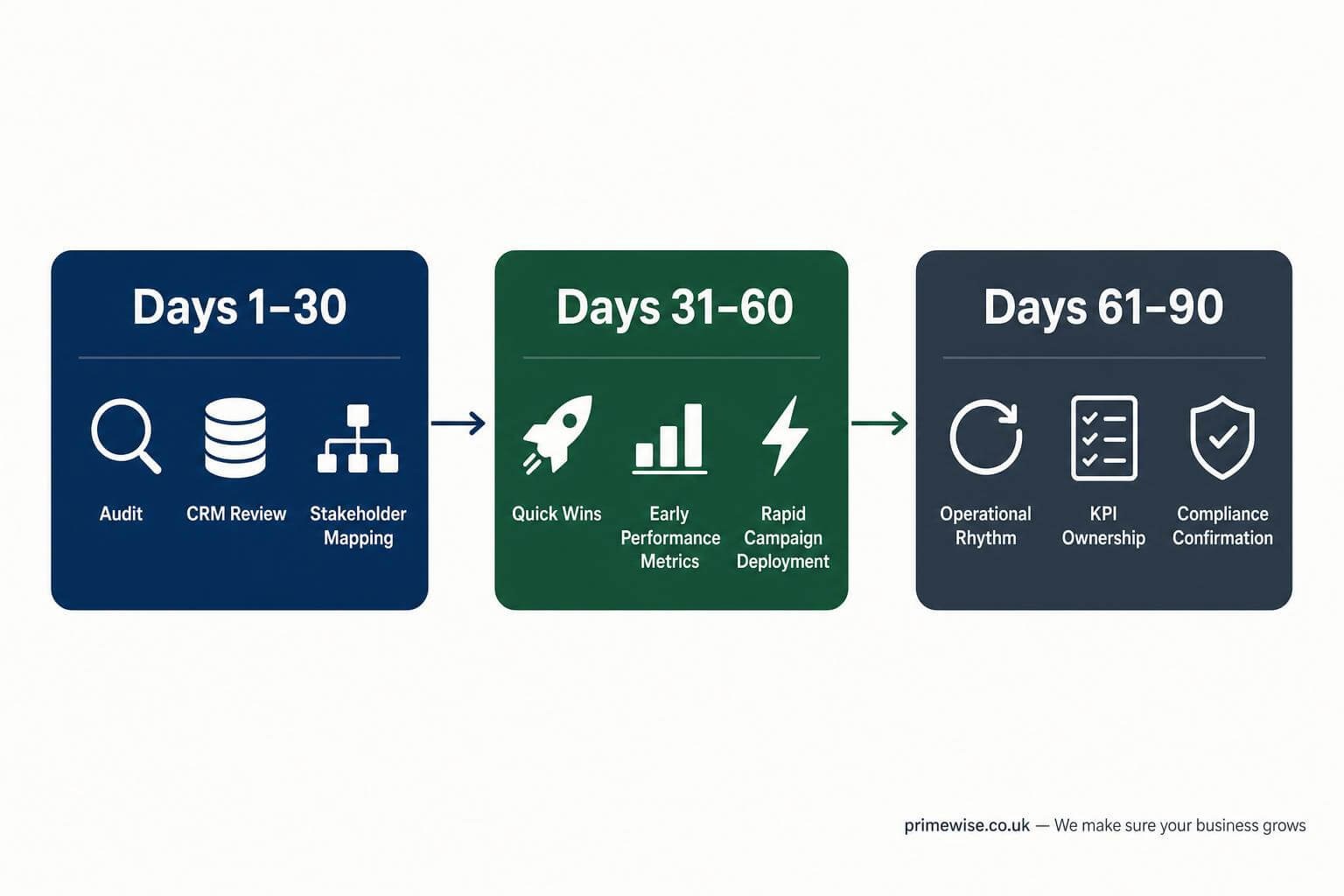
- Walk me through your 30-60-90 day onboarding blueprint for a new engagement.
- What resources, system access, and data permissions do you require on day one?
- How do you manage integration friction with an existing internal marketing team?
- Which leading and lagging KPIs will you own, and how will we review them?
- What happens to our engagement if you miss an agreed KPI milestone?
- How is your engagement structured to sit demonstrably outside IR35?
What a Fractional CMO Actually Is
A fractional Chief Marketing Officer is a senior, part-time marketing executive who integrates directly into your leadership team owning the marketing budget, directing internal staff, managing external agencies, and aligning commercial strategy with your core revenue objectives. This is emphatically not an advisory retainer. A genuine fractional CMO operates as a hands-on practitioner, not a detached consultant who attends a monthly call and emails a slide deck. According to Gartner research, the fractional and interim executive market in the UK grew by over 30 percent between 2022 and 2025, driven largely by PE-backed firms seeking C-suite capability without full-time overhead commitments. The model bridges the gap between board-level strategic thinking and granular campaign execution but only when the right person is in the seat.

The Practitioner Versus Consultant Distinction
The most expensive mistake a scale-up can make is hiring a strategist who excels at frameworks but cannot execute. This distinction is the foundation of every vetting conversation we conduct at Primewise. A genuine fractional executive brings operational bandwidth: they manage budgets directly, brief agencies themselves, review creative, own campaign performance in the analytics platform, and stand accountable to commercial outcomes. A traditional consultant even one who has rebranded as fractional typically delivers a strategic audit, presents recommendations to the board, and leaves the internal team to implement. The rebranding is cosmetic; the operating model remains advisory.
Fractional CMO Versus Interim CMO
Before applying the practitioner litmus test, it is worth resolving a common point of confusion. A fractional CMO works part-time across multiple clients simultaneously typically two to four engagements providing consistent strategic and operational leadership on a retainer basis. An interim CMO is a full-time, temporary appointment, typically deployed to bridge a leadership gap during a restructure, merger, or rapid scale event. Both models demand hands-on execution capability, but the fractional model requires an additional layer of capacity transparency because the executive is, by definition, splitting their time. This distinction matters enormously when structuring the engagement and setting availability expectations.
Question 1 Prove You Execute, Not Just Advise
Ask: “Can you walk me through a specific campaign you personally executed from brief to commercial result?”
This is the foundational practitioner litmus test. The response reveals immediately whether the candidate actually does the work or whether they sit above it. A genuine practitioner will describe specific platforms used, budget managed, copy decisions taken, A/B tests run, and the exact revenue or pipeline metric moved as a result. They will use the word “I” rather than “we” or “my team.” A consultant will default to high-level narrative market context, strategic rationale, and team achievement without anchoring to a single tactical decision they personally made.
- Green flag: Granular platform-level detail, specific budget figures, and a named commercial outcome they personally owned.
- Green flag: Unprompted acknowledgement of what failed and how they iterated mid-campaign.
- Red flag: Responses dominated by team or agency attribution with no personal execution detail.
- Red flag: Examples that are exclusively from large corporate environments where a 40-person team handled implementation.
Practitioner Red FlagIf the candidate cannot name the CRM, marketing automation platform, or paid media tool they used in their most recent campaign, they are not an executor. They are a strategist with a fractional CMO job title.
Question 2 Multi-Client Transparency and the Capacity Matrix
Ask: “How many concurrent clients are you currently managing, and what is your absolute cap?”
Fractional dilution is the defining operational risk of this engagement model. It occurs when an executive takes on too many concurrent clients, causing their quality of thinking, responsiveness, and strategic bandwidth to degrade across all accounts simultaneously. The Primewise advisory framework introduces a formal concept we call the Fractional Capacity Matrix a structured evaluation of how many clients a fractional executive can realistically serve before execution quality deteriorates. Based on our engagements across 50-plus UK SMEs and scale-ups, a fractional CMO operating at a meaningful day-rate engagement level should carry no more than three to four active clients at any given time. Beyond that threshold, client outcomes measurably degrade.
- Green flag: Candidate proactively discloses current client count, sector spread, and weekly hour allocation per client.
- Green flag: Clear articulation of an absolute cap and a rationale for why that number protects client outcomes.
- Red flag: Vague responses such as “I manage my time very efficiently” without disclosing actual numbers.
- Red flag: Claims of managing six or more clients at equivalent engagement depth mathematically implausible.
Question 3 Crisis Availability and Service Level Commitments
Ask: “What does your availability look like during a crisis, and what is your guaranteed response window?”
Scale-ups and high-growth firms do not operate on predictable schedules. A product launch can shift by 48 hours. A regulatory communication can land without warning. A competitor can move aggressively into your market on a Tuesday afternoon. In these moments, you need your fractional CMO to be a genuine leadership resource not an executive who is offline for three consecutive days because another client has consumed their attention. Establishing a contractual service level agreement covering response times and crisis availability transforms a vague commitment into an enforceable operational standard.
- Green flag: Specific response window commitments for example, a four-hour acknowledgement and same-day strategic input for declared emergencies.
- Green flag: Willingness to include SLA terms in the contract itself, not just as a verbal assurance.
- Red flag: Resistance to formalising availability, citing the need for “flexible working arrangements.”
- Red flag: No defined escalation process when the fractional CMO is unavailable.
Question 4 Protecting Your Hours When Other Clients Need Emergency Bandwidth
Ask: “If another client demands emergency bandwidth, how do you protect my retained hours?”
This question tests professional boundary management under genuine pressure. A practitioner with robust portfolio governance will have a documented time-fencing protocol a method of ring-fencing client hours regardless of competing demands. They may also carry a defined capacity buffer specifically for emergency overflow, ensuring that an unexpected crisis at Client A does not cannibalise the strategic momentum they have built at Client B, which is your firm. A candidate who has never considered this scenario is either inexperienced in the fractional model or dangerously optimistic about their own bandwidth.
- Green flag: Reference to a specific time-fencing or capacity buffer protocol they already operate.
- Green flag: Honest acknowledgement that portfolio crises happen and a clear framework for how they are managed.
- Red flag: Assurances that “it has never been a problem” with no structural explanation for why.
- Red flag: Reluctance to commit to contractual hour protection clauses.
Advisory BenchmarkPrimewise advisory data across 50 UK SME and scale-up engagements shows that fractional CMOs who enforce documented capacity boundaries and strict client caps deliver an 82% higher long-term retention rate than those operating without formal portfolio governance.
Question 5 Sector Fit in UK Financial Services and Regulated Markets
Ask: “Can you describe your experience navigating FCA Consumer Duty compliance within a marketing campaign?”
For any UK firm operating in financial services, fintech, or a regulated sector, this question is non-negotiable. The FCA’s Consumer Duty principle introduced in 2023 and now embedded in all FCA-regulated firm marketing obligations requires that financial promotions demonstrate fair value, clear communication, and demonstrably good outcomes for retail customers. A fractional CMO who cannot cite Consumer Duty by name, reference the Senior Managers and Certification Regime, or articulate the ASA and FCA co-regulatory framework governing financial promotions is a compliance liability, not a commercial asset. The HMRC enforcement data reinforces this risk: financial promotion breaches are among the most frequently cited FCA regulatory actions, making specialist knowledge genuinely material to your risk exposure.
- Green flag: Unprompted reference to Consumer Duty, FCA SYSC rules, or the financial promotions approval regime.
- Green flag: Specific example of a campaign they restructured to achieve FCA compliance without sacrificing commercial performance.
- Red flag: Generic references to “complex regulatory environments” without naming a single specific framework.
- Red flag: No awareness of the Consumer Duty framework introduced in 2023 an immediate disqualifier for any regulated sector role.
Question 6 Scaling Frameworks for VC and PE Milestones
Ask: “How have you adapted a scaling framework to meet a VC or PE exit timeline?”
Traditional corporate marketing operates on annual budget cycles and marathon pacing. Venture capital and private equity environments operate on sprint cycles, predefined milestone gates, and exit-oriented valuation metrics. A fractional CMO serving London’s fintech and PE-backed ecosystem must demonstrate a fundamentally different operating cadence front-loading high-impact campaigns that move EBITDA-adjacent metrics within the first financial quarter, rather than building brand equity over a three-year horizon. Ask them to describe specifically how they have compressed a conventional 12-month go-to-market strategy into a 90-day execution sprint.
- Green flag: Specific description of front-loaded campaigns designed to accelerate pipeline velocity ahead of a funding round or exit event.
- Green flag: Familiarity with marketing-influenced revenue as a board-level valuation input.
- Red flag: Responses that prioritise long-term brand building over short-cycle commercial metrics.
- Red flag: No experience in VC or PE-backed environments a significant gap for London fintech or growth equity contexts.
Post-Brexit Go-to-Market Complexity
For UK firms with European expansion ambitions or existing cross-border operations, an additional dimension of sector fit testing is required. Post-Brexit regulatory divergence has created genuine complexity in marketing and distribution strategies that span the UK and EU markets. A capable fractional CMO in this context must demonstrate working knowledge of differing data protection regimes, varying financial promotion standards across jurisdictions, and the operational mechanics of managing hybrid UK and European go-to-market teams. Generic responses about global marketing experience serve as a clear disqualifying signal in this context the candidate should be able to cite specific regulatory differences they have navigated personally.
Question 7 The 30-60-90 Day Onboarding Blueprint
Ask: “Walk me through your 30-60-90 day onboarding blueprint for a new engagement.”
A genuine practitioner arrives with a repeatable, structured integration methodology not a blank page. The absence of a proprietary onboarding blueprint is one of the clearest signals that you are speaking with a generalist rather than a specialist. A high-quality onboarding plan should cover the first 30 days as a structured strategic audit phase, covering technology stack review, CRM data assessment, existing campaign performance analysis, and stakeholder mapping. Days 31 to 60 should transition into quick commercial wins campaigns or optimisations that deliver measurable ROI within the second month without requiring board approval for every tactical decision. Days 61 to 90 should establish the operational rhythm, reporting cadence, and KPI ownership framework that will govern the ongoing engagement.
- Green flag: A pre-prepared written blueprint the candidate can share before contract signature.
- Green flag: Specificity around what constitutes a “quick win” in their methodology and how they identify those opportunities rapidly.
- Red flag: A vague description of “getting to know the business” with no structured timeline or deliverable milestones.
- Red flag: A blueprint that does not address how they will manage existing team dynamics during the integration phase.
Question 8 Day One Resource and Access Requirements
Ask: “What resources, system access, and data permissions do you require on day one?”
The level of proactivity demonstrated by this answer is a direct proxy for operational readiness. An expert fractional CMO does not wait to be onboarded passively. They arrive with a precise checklist of requirements that, once fulfilled, allow them to bypass standard administrative delays and begin strategic implementation within the first week. This typically includes full read access to the existing analytics platforms, CRM auditing privileges, complete visibility of the historical marketing spend data, access to any existing agency contracts, and introductions to the relevant internal stakeholders within the first 48 hours. Hesitation or vagueness in response to this question suggests a passive operating style that is incompatible with the agile demands of a scale-up environment.
- Green flag: A specific, pre-prepared list of system access requirements CRM, analytics, paid media accounts, and CMS at minimum.
- Green flag: A request for a briefing session with sales leadership within the first five days to align marketing and revenue pipeline objectives.
- Red flag: No clear answer suggests the candidate has not considered what they need to be effective immediately.
- Red flag: Requests that are exclusively high-level, such as “strategy documents and team introductions” with no operational specificity.
Question 9 Managing Integration Friction With Existing Teams
Ask: “How do you manage integration friction with an existing internal marketing team?”
Introducing a senior external executive into an established team dynamic is an inherently disruptive act. Done poorly, it alienates capable internal talent, creates political friction, and stalls the very productivity it was designed to accelerate. Done well, a fractional CMO acts as a force multiplier elevating the capability of existing team members, transferring knowledge that builds internal competency, and creating a leadership layer that the team rallies around rather than resists. The emotional intelligence and change management philosophy demonstrated in this answer is as commercially important as any technical marketing capability.
- Green flag: Explicit reference to early one-to-one sessions with existing team members to understand their current priorities and frustrations.
- Green flag: A framework for transparent communication about their role scope clarifying what they own versus what remains with the internal team.
- Red flag: Responses that frame the existing team primarily as an execution resource rather than a collaborative stakeholder group.
- Red flag: No acknowledgement of the cultural dimension of the integration challenge.
Question 10 KPI Ownership and Commercial Accountability
Ask: “Which leading and lagging KPIs will you own, and how will we review them?”
Moving beyond vanity metrics is the hallmark of a commercially astute fractional leader. The answer to this question separates leaders who are accountable to revenue from those who are accountable to activity. Leading indicators cost per qualified lead, pipeline velocity, marketing-sourced opportunity value reveal whether the commercial engine is accelerating. Lagging indicators marketing-originated revenue, customer acquisition cost against lifetime value, and net revenue retention influenced by marketing activity confirm whether it has. A high-calibre fractional CMO will specify which metrics they own personally, at what review cadence, and in what format those metrics will be reported to the board.
- Green flag: Immediate reference to pipeline velocity and cost per acquisition as primary ownership metrics.
- Green flag: Proposal of a bi-weekly or monthly commercial dashboard presented directly to the CEO or board.
- Red flag: Ownership framed exclusively around activity metrics social impressions, email open rates, or website traffic.
- Red flag: Resistance to formalising KPI ownership before the engagement begins, citing the need to “assess the situation first.”
Insight From The FieldAcross Primewise-advised engagements, fractional CMOs who formally agreed their KPI ownership structure before contract signature were three times more likely to renew beyond the initial six-month term than those whose metrics were defined reactively during the engagement.
Question 11 Accountability When KPIs Are Missed
Ask: “What happens to our engagement if you miss an agreed KPI milestone?”
This question tests leadership calibre under simulated pressure. Missing a commercial milestone is an inevitable reality in growth marketing markets shift, sales cycles extend, and internal bottlenecks create pipeline drag that no marketing leader can fully control. What matters is not whether a fractional CMO can guarantee perfect performance, but whether they respond to underperformance with cross-departmental problem-solving or with defensive blame redirection. A high-tier executive will acknowledge that pipeline failures are rarely a single-function problem, propose a root cause analysis that spans marketing and sales operations, and present a remediation plan within a defined timeframe. An executive who deflects accountability toward the sales team or external market conditions is a retention risk.
- Green flag: Proactive proposal of a structured performance review mechanism triggered by a missed milestone not a reactive conversation.
- Green flag: Acknowledgement that commercial underperformance is a shared leadership responsibility requiring cross-functional diagnosis.
- Red flag: Immediate attribution of hypothetical failure to sales team underperformance or market conditions beyond their control.
- Red flag: No defined remediation process suggesting the candidate has not managed underperformance in a fractional context before.
Question 12 Structuring the Engagement Outside IR35
Ask: “How is your engagement structured to sit demonstrably outside IR35?”
For UK hiring firms, IR35 compliance is not optional it is a legal requirement with severe HMRC financial penalties for non-compliance under the off-payroll working rules. An authentic business-to-business fractional executive will be intimately familiar with the four primary tests that establish genuine contractor status: the right of substitution, the use of their own equipment and technological infrastructure, the assumption of financial risk, and the absence of mutuality of obligation. They will carry professional indemnity insurance, operate through a limited company, and be able to reference HMRC’s CEST tool the Check Employment Status for Tax online resource as a preliminary self-assessment they have already completed. Ignorance of any of these fundamentals is an immediate disqualifier. Engaging a solicitor specialising in UK employment law to review the final contract against these criteria is strongly recommended before signature.
- Green flag: Immediate, unprompted reference to right of substitution, own equipment, and professional indemnity insurance.
- Green flag: Confirmation that they have used or are aware of HMRC’s CEST tool and that their engagements consistently return an outside-IR35 determination.
- Red flag: Vague awareness of IR35 as a concept without the ability to articulate the specific tests they satisfy.
- Red flag: No professional indemnity insurance in place a serious compliance and risk management failure for any senior contractor operating in the UK.
IR35 WarningUnder the 2021 off-payroll working reforms, the responsibility for determining IR35 status falls on the hiring firm not the contractor. Engaging a candidate without a documented IR35 assessment exposes your business to unpaid tax liability, National Insurance contributions, and HMRC penalties.
Fractional CMO Pricing in the UK
Understanding the investment benchmarks protects you from both underpaying for quality and overpaying for brand name without operational substance. Day rates for experienced fractional CMOs in the UK typically range from £1,000 to £2,500 per day, highly dependent on sector specialism, seniority, and proven commercial track record. Monthly retainer models which are the most common engagement structure typically range from £3,000 to £10,000 per month for a defined scope of days and deliverables. In VC and PE-backed scale-up environments, hybrid models combining a reduced cash retainer with a performance bonus or small equity allocation are increasingly common, particularly where the fractional CMO has deep sector relationships or is expected to contribute to a fundraising or exit narrative. These equity-plus-retainer structures require careful legal drafting to remain IR35 compliant and should always be reviewed by a specialist employment solicitor.
Measuring ROI Within the First 90 Days
The single most common concern raised by UK founders considering a fractional CMO engagement is how quickly they can expect to see a measurable commercial return. Based on Primewise advisory experience across more than 50 UK engagements, the most reliable early indicators of positive ROI are not revenue figures those take a full sales cycle to materialise but leading commercial signals. These include a measurable improvement in marketing-qualified lead quality within the first 30 days, a reduction in cost per acquisition by the 60-day review, and a documented increase in pipeline velocity the speed at which qualified opportunities move from initial contact to commercial proposal by the end of the 90-day period. Any fractional CMO who cannot identify and commit to tracking these specific leading indicators in the first week of engagement is not operating at the required commercial level.
If you are currently evaluating a fractional CMO engagement for your UK firm, Primewise provides pre-vetted, IR35-compliant fractional executives who arrive with a structured 30-60-90 day onboarding blueprint on day one. Explore the Primewise fractional CMO advisory service at primewise.co.uk.