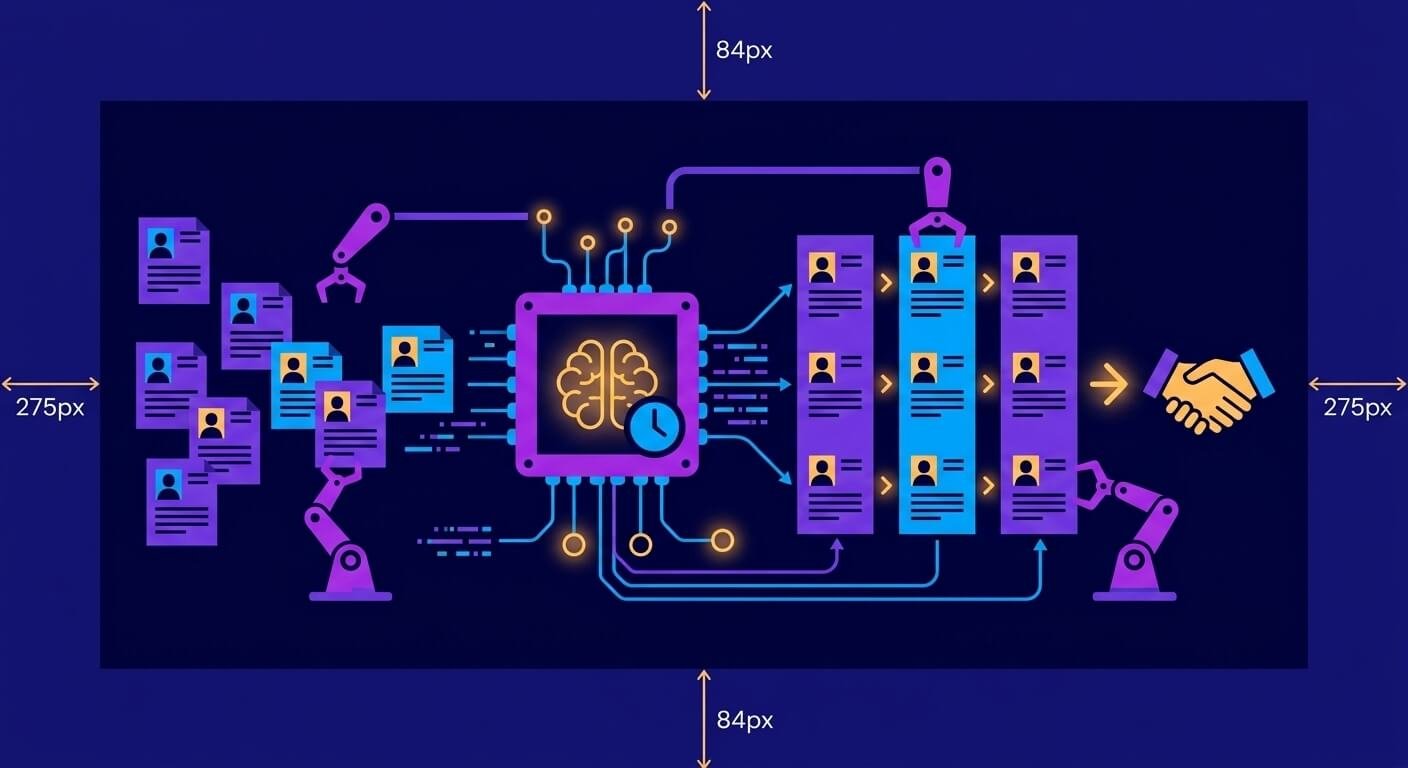

Fractional CMO for PE-backed businesses is no longer a contingency measure it is a deliberate, thesis-aligned commercial lever that the most disciplined UK operating partners deploy to compress hold periods and maximise exit multiples. Portfolio companies entering the critical twelve to twenty-four month pre-exit window routinely lack the calibre of commercial leadership required to execute a ruthless value-creation plan. A full-time CMO search burns three to six months and saddles the Selling, General, and Administrative expenses line with base salary, bonuses, equity dilution, and long-term severance liability a structurally inefficient choice when the investment clock is running. Primewise.co.uk has supported fractional commercial leadership deployments across UK PE-backed businesses spanning B2B SaaS, healthcare services, and specialist manufacturing, delivering measurable EBITDA enhancements within the first hundred days. This guide is the definitive operational resource for operating partners, deal partners, and portfolio company CEOs evaluating the fractional model ahead of a liquidity event.
Who This Guide Is ForThis resource is written for Private Equity Operating Partners stress-testing the fractional CMO model against their value-creation thesis, Deal Partners validating commercial due diligence readiness ahead of a secondary buyout or AIM listing, and Portfolio Company CEOs seeking interim executive leadership to bridge a critical commercial gap pre-exit. If you operate in any of these roles in the UK mid-market, every section of this guide is written specifically for you.
Defining the Fractional CMO in Private Equity
A fractional CMO operating within a private equity context is a part-time, senior commercial executive typically with direct PE portfolio experience who is deployed into a portfolio company to accelerate revenue growth, optimise the customer acquisition cost structure, and drive margin accretion within a compressed investment timeline. Unlike a marketing consultant who delivers recommendations, a fractional CMO holds an executive mandate: they sit within the leadership team, own the commercial KPIs, and are operationally accountable to the operating partner and portfolio CEO simultaneously. The engagement is structured to be plug-and-play no lengthy onboarding, no equity dilution, no severance risk with immediate deployment into the value-creation plan.
The structural distinction matters enormously in a PE context. Traditional marketing consultants advise and depart. Fractional CMOs execute and remain accountable. For an operating partner managing multiple portfolio positions simultaneously, this distinction is the difference between a resource that generates a presentation deck and a resource that generates EBITDA. According to BVCA data, the average hold period for a UK mid-market buyout sits between four and six years, with the final twelve to twenty-four months representing the highest-leverage window for commercial value creation ahead of a liquidity event. Deploying fractional commercial leadership during this window is not a cost it is a capital-efficient investment with a calculable return on enterprise value.
The Commercial Velocity Framework A 100-Day Playbook
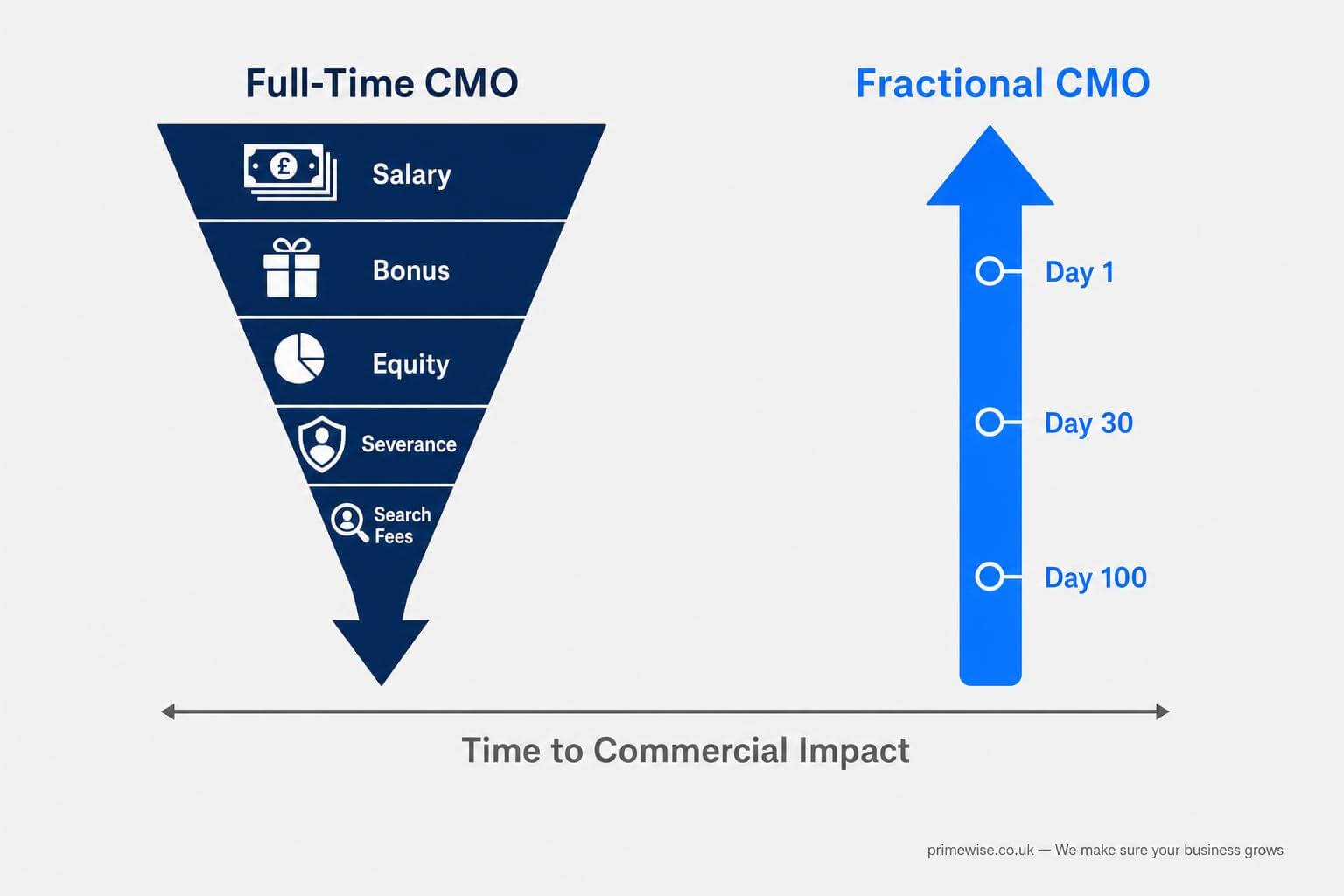
Operating partners demand speed to impact. Vague month-by-month plans do not survive contact with a rigorous value-creation committee. The Commercial Velocity Framework is a proprietary, stage-gated operational structure used by Primewise.co.uk to deliver defensible commercial improvements within the first hundred days of a fractional CMO engagement. Each stage has named deliverables, defined KPI thresholds, and clear go or escalate decision gates the kind of structure that belongs in a Management Information pack and withstands Commercial Due Diligence scrutiny.
Stage One Commercial Audit and Funnel Triage
Days one through thirty are non-negotiable: stop the bleed before scaling anything. The fractional CMO conducts a full commercial audit across all go-to-market channels, producing a defensible baseline of Customer Acquisition Cost, Lifetime Value, and the blended LTV:CAC ratio by channel. Any performance marketing channel delivering below a 2.5x LTV:CAC ratio is immediately paused. Revenue Operations infrastructure CRM data integrity, lead attribution models, MQL-to-SQL conversion tracking is audited and corrected to ensure Management Information pack data is reliable before it reaches any prospective buyer. The audit deliverable is a prioritised commercial triage report, segmented by capital impact, presented to the operating partner by Day 30.
- Establish a defensible LTV:CAC baseline per channel, with any channel below 2.5x flagged for immediate pause or reallocation
- Audit CRM data integrity and lead attribution to eliminate revenue operations blind spots
- Identify and cease negative-yield performance marketing spend within the first two weeks
- Align sales and marketing data reporting to produce a clean MI pack baseline by Day 30
- Deliver a capital-prioritised triage report to the operating partner and portfolio CEO
Stage Two Repositioning and CAC Optimisation
Days thirty-one through sixty shift from defensive triage to offensive repositioning. With clean data established and inefficient spend eliminated, the fractional CMO deploys reallocated budget into high-intent channels that demonstrate positive LTV:CAC trajectories. This phase focuses on brand repositioning to capture higher-value customer segments a critical lever for expanding Net Revenue Retention, which is an increasingly prominent metric in SaaS and recurring-revenue PE exits. A target of LTV:CAC above 3.5x on scaled channels is the go-gate for Stage Three. Critically, the efficiencies generated in this phase self-fund the next stage of investment, avoiding any request for additional capital from the sponsor.
- Redeploy paused budget into the top two or three channels demonstrating LTV:CAC above 3.0x
- Reposition the commercial proposition to attract higher-value enterprise customer segments
- Implement Net Revenue Retention tracking as a core board-level metric if not already present
- Target a blended LTV:CAC of 3.5x or above as the go-gate for full scaling in Stage Three
Stage Three Scaling Revenue and Margin Accretion
Days sixty-one through one hundred connect tactical execution to the Value Creation Plan. Proven, capital-efficient growth engines are scaled systematically, with every pound of incremental revenue tracked against its direct contribution to EBITDA. The fractional CMO presents a pre-exit Commercial Scorecard to the operating partner by Day 100 a structured document that maps marketing KPIs directly to exit multiple impact, demonstrating commercial readiness for a Commercial Due Diligence process. This document becomes part of the commercial data room and functions as a proactive CDD defence asset.
- Scale the two highest-performing acquisition channels with full capital allocation
- Produce a pre-exit Commercial Scorecard mapping KPIs to exit multiple impact
- Populate the commercial data room with defensible revenue projections and customer retention analytics
- Present a post-hundred-day Value Creation Plan update to the operating partner and investment committee
The EBITDA Mathematics of Exit Multiple Expansion
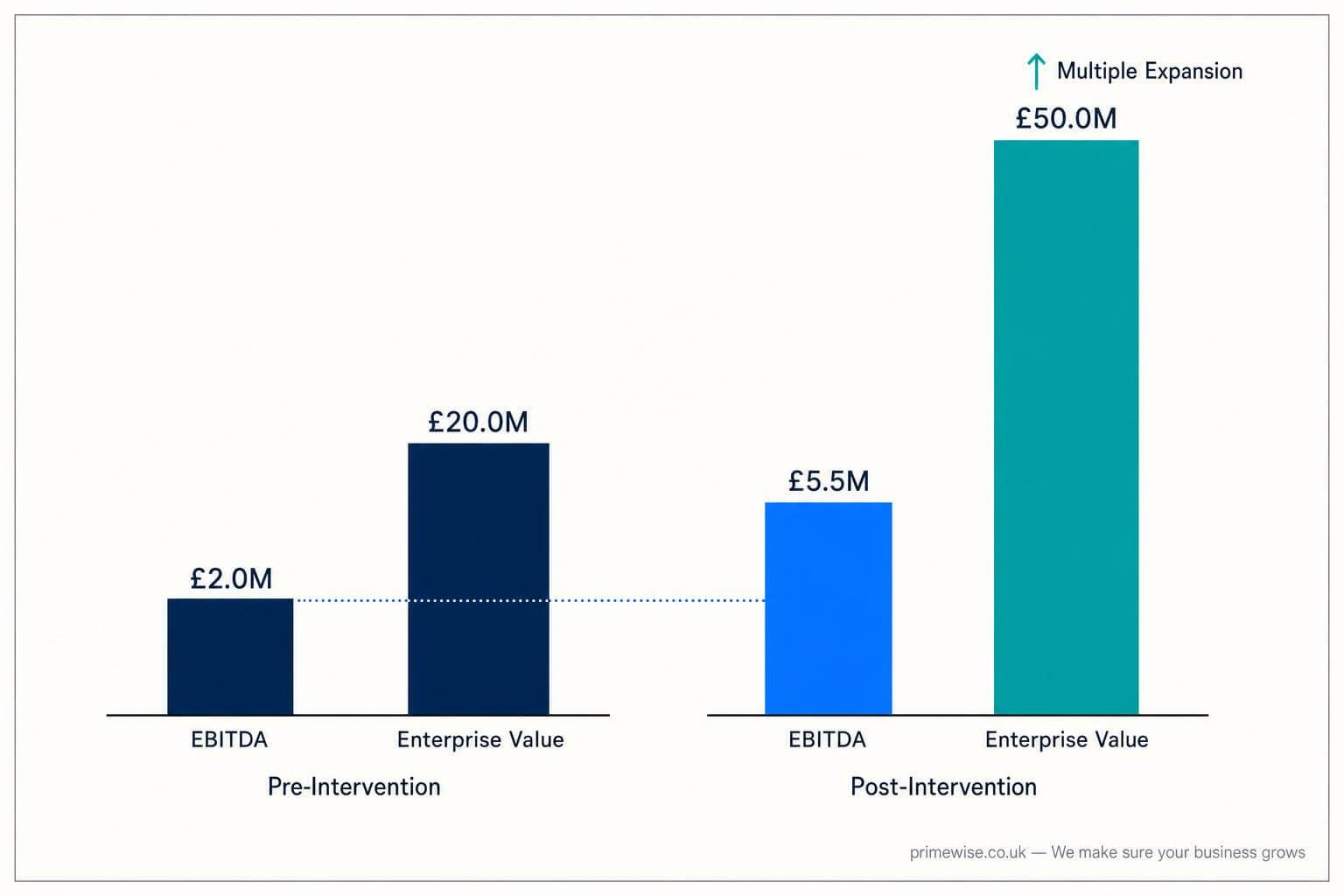
Private equity partners operate in the language of multiples and bottom-line impact. The mathematical case for deploying a fractional CMO is not abstract it is arithmetic. Understanding how marketing efficiency improvements flow directly through to enterprise value is the core justification for every pound invested in fractional commercial leadership, and it is a calculation every operating partner should be running before the pre-exit window opens.
Consider a representative UK mid-market portfolio company generating ten million pounds in EBITDA, operating in a sector where the prevailing exit multiple is eight times EBITDA. A fractional CMO engagement, costing approximately one hundred and fifty to two hundred and fifty thousand pounds annually for a senior, PE-experienced commercial executive, delivers a fifteen percent reduction in blended Customer Acquisition Cost across the primary growth channels. That fifteen percent CAC reduction, in a business spending two million pounds annually on customer acquisition, generates a three hundred thousand pound annual saving flowing entirely to the EBITDA line. At an eight-times exit multiple, that three hundred thousand pound EBITDA improvement creates two point four million pounds of incremental enterprise value from a sub-two-hundred-and-fifty-thousand-pound investment. That is a return on capital deployed that most organic growth initiatives cannot approach.
Important CaveatActual enterprise value uplift varies materially based on sector-specific EBITDA multiples, deal structure, management incentive scheme costs, and EBITDA normalisation adjustments during vendor due diligence. The example above is illustrative. Primewise.co.uk provides portfolio-specific commercial impact assessments contact us to model the exact EV uplift applicable to your portfolio company before committing to any commercial intervention.
Capital Efficiency Versus the Full-Time CMO Cost
The fully-loaded annual cost of a permanent, PE-calibre Chief Marketing Officer in the UK mid-market in 2026 spans from two hundred and fifty thousand to four hundred thousand pounds when base salary, performance bonus, pension contribution, employer National Insurance, long-term incentive plan or equity allocation, and executive search fees are aggregated. On a typical private equity deal, equity dilution for a C-suite hire also compresses the sponsor’s equity return a structurally damaging trade-off during a pre-exit window where every basis point of return matters. A fractional CMO engagement from Primewise.co.uk eliminates equity dilution entirely, carries zero severance liability, requires no executive search fee, and can be deployed within fourteen days of initial commercial health assessment dramatically outperforming the three to six month recruitment timeline of a permanent hire on every capital efficiency metric that operating partners actually measure.
Fractional CMO in Buy-and-Build Strategies
Buy-and-build is the dominant value-creation strategy in UK mid-market private equity in 2025 and 2026, with Beauhurst data indicating that platform acquisitions with bolt-on strategies consistently outperform single-asset holds on EBITDA multiple expansion at exit. The fractional CMO role in a buy-and-build context extends beyond the platform business it becomes the integrating commercial intelligence across every acquired entity. This is a materially different and more complex mandate than a standalone pre-exit turnaround, and it is one that fractional executives with PE portfolio experience are uniquely positioned to execute.
Brand harmonisation post-acquisition is the first commercial priority. Acquired businesses frequently arrive with fragmented brand architectures, conflicting customer value propositions, and siloed CRM databases all of which destroy the cross-sell revenue synergies that justified the acquisition premium. A fractional CMO designs and implements a unified brand architecture within the first sixty days post-acquisition, creating a coherent go-to-market identity that communicates the combined entity’s enhanced value proposition to existing and prospective customers. Simultaneously, the commercial leader maps cross-sell and upsell revenue opportunities across the combined customer base a process that, when executed correctly, can generate incremental revenue without incremental customer acquisition cost, directly expanding EBITDA margin. For operating partners managing multiple acquisitions within a single hold period, deploying a fractional CMO as the continuous commercial integrator across all acquired entities is substantially more capital-efficient than hiring a permanent CMO for each platform or bolt-on.
AI-Augmented Commercial Infrastructure
Commercial Due Diligence criteria have evolved materially in 2026. Acquirers particularly private equity firms and strategic trade buyers with sophisticated operating partner functions now specifically evaluate whether a portfolio company has implemented AI-augmented marketing operations, predictive churn modelling, and first-party data infrastructure. A portfolio company that cannot demonstrate a clean, compliant, algorithmically-enhanced commercial operation is increasingly marked down during the CDD process, regardless of headline revenue performance. This represents both a risk and an asymmetric opportunity for operating partners who move early.
A fractional CMO with current AI-augmented revenue operations expertise deploys a suite of tools that transform the commercial infrastructure from manual to intelligent. HubSpot AI and Salesforce Einstein are the most widely adopted platforms in UK mid-market PE portfolios, providing AI-powered lead scoring, automated pipeline management, and predictive deal velocity analytics that make the commercial operation both more efficient and more defensible in a CDD context. Sector-specific predictive analytics platforms including those tailored to SaaS churn prediction, manufacturing demand forecasting, and healthcare patient lifetime value modelling provide the kind of proprietary commercial intelligence that significantly increases CDD scores with sophisticated acquirers. Crucially, first-party customer data infrastructure compliant with UK GDPR and audited by a qualified Information Commissioner’s Office framework review is now treated as a balance sheet asset rather than a marketing support function. A fractional CMO who builds this infrastructure pre-exit is directly creating a commercial asset that acquirers pay a premium to acquire.
Navigating the UK Mid-Market PE Landscape
The UK lower-mid and mid-market private equity environment presents a distinct set of commercial challenges that a generalist marketing executive cannot navigate effectively. Post-Brexit commercial friction has altered customer acquisition economics in sectors with significant European supply chain exposure. Localized UK C-suite talent shortages in commercial roles have extended executive search timelines to an average of four to six months in 2025 a timeline that is commercially disastrous during a pre-exit window. Operating partners who understand these structural constraints are increasingly turning to the fractional model as the structurally superior solution for commercial leadership in the twelve to twenty-four month pre-exit phase.
Bolstering CDD Scores for Secondary Buyouts
During a secondary buyout or an AIM listing, incoming acquirers conduct exhaustive Commercial Due Diligence a process that has grown materially more rigorous following a period of elevated deal multiples and heightened investor scrutiny. The fractional CMO’s role in CDD preparation is not passive. At Primewise.co.uk, the pre-exit Commercial Scorecard produced at Day 100 is specifically structured to pre-empt the standard CDD questionnaire framework used by the major UK mid-market advisers including Deloitte, KPMG, and Clearwater International. Revenue projections are stress-tested against market share data, customer retention cohort analysis, and channel concentration risk the exact dimensions that CDD teams probe most aggressively. High CDD scores translate directly into premium valuations, reduced price chip risk during exclusivity, and smoother transaction closures.
UK GDPR and Customer Data Asset Valuation
Customer lists and data-driven marketing assets are scrutinised intensively during any UK merger and acquisition process. Non-compliance with the Information Commissioner’s Office and UK GDPR regulations is not merely a reputational risk it is a direct valuation risk that can trigger price adjustments, deal conditions, or complete transaction collapse. A fractional CMO engaged pre-exit implements a structured data compliance protocol: a full audit of consent architecture, data processing agreements, subject access request procedures, and marketing permission records, followed by remediation of any compliance gaps and documentation suitable for a legal due diligence data room. This transforms what was previously a risk line in the CDD report into a demonstrable commercial asset with verified compliance credentials.
Turnaround Case Studies Sanitised Portfolio Data
Demonstrating a genuine track record of executing commercial turnarounds within UK PE portfolio contexts is the most critical trust signal for a time-pressured operating partner evaluating a fractional CMO engagement. The following case studies are sanitised to protect confidentiality but retain the specific methodological detail and quantitative outcomes that distinguish genuine operational experience from theoretical frameworks.
UK B2B SaaS Portfolio Company Secondary Buyout Exit, 2024. A UK-based B2B SaaS business, Series B equivalent revenue scale, was acquired by a lower-mid-market PE firm targeting an eighteen-month hold to secondary buyout. At acquisition, the portfolio company presented a monthly churn rate of four point two percent and a blended Customer Acquisition Cost that had increased forty-one percent year-on-year, compressing EBITDA margins to eleven percent against a sector benchmark of twenty-two to twenty-five percent for comparable SaaS businesses at exit. Primewise.co.uk deployed a fractional CMO with direct SaaS RevOps experience within eleven days of the operating partner engagement. The Stage One audit identified three performance marketing channels delivering negative LTV:CAC ratios, which were immediately paused, releasing one hundred and eighty thousand pounds of annual spend for reallocation. A full Revenue Operations restructure was implemented in Days 15 through 45, correcting CRM attribution errors that had been systematically overreporting Marketing Qualified Lead volumes meaning the true MQL-to-SQL conversion rate improved from a reported nineteen percent to a genuine thirty-one percent once accurate tracking was in place. The repositioned enterprise customer acquisition programme, launched in Month Two, drove a forty-three percent reduction in blended CAC within ninety days. At exit, the business demonstrated an EBITDA margin of twenty-nine percent an eighteen percentage point improvement supporting a 10x exit multiple against the original thesis of 7.5x.
UK Specialist Manufacturing Portfolio Company Trade Sale Exit, 2024. A UK specialist manufacturing business with a strong domestic market position but zero structured digital lead generation was identified by its operating partner as requiring commercial intervention fourteen months prior to a targeted trade sale. Customer concentration risk with the top three clients representing sixty-eight percent of revenue was the primary CDD vulnerability identified at acquisition. Primewise.co.uk launched a targeted B2B digital performance marketing programme and integrated CRM infrastructure in Month One, establishing for the first time a structured inbound pipeline that reduced customer concentration from sixty-eight percent to forty-four percent over twelve months. A complementary account-based marketing programme targeting the top fifty prospective enterprise accounts in the sector generated eleven new enterprise client relationships within the pre-exit window. The combined commercial intervention added two point five million pounds to annualised EBITDA in fourteen months, with the reduced customer concentration risk materially improving the CDD outcome and supporting a final enterprise valuation twenty-two percent above the original exit model.
Operating Partner InsightPortCos engaging fractional commercial leadership in the early hold period rather than in the final six months before exit consistently achieve stronger CDD readiness, more defensible revenue projections, and superior exit multiples. With the average UK mid-market exit preparation process requiring eighteen to twenty-four months of commercial groundwork, engaging Primewise.co.uk early in the hold period is a structural competitive advantage, not a discretionary expense.
Revenue Operations as a Board-Level Commercial Discipline
Revenue Operations RevOps has emerged as the defining commercial infrastructure discipline in PE-backed businesses in 2025 and 2026. Rather than treating sales, marketing, and customer success as separate functions with separate data environments, RevOps creates a unified commercial architecture in which every pound of customer acquisition cost, every stage of pipeline conversion, and every dimension of customer retention is tracked, attributed, and optimised within a single integrated system. For a PE portfolio company approaching a liquidity event, a mature RevOps function is not just operationally efficient it is a CDD asset. Acquirers can interrogate the full customer journey with verifiable data, reducing perceived revenue risk and supporting premium valuations.
The fractional CMO’s role in building RevOps capability is to design the architecture, select and implement the technology stack, and establish the reporting cadence that generates a clean Management Information pack by the time the data room opens. In practice, this means selecting a CRM platform appropriate to the business’s scale and sector, configuring AI-powered lead scoring and pipeline forecasting, integrating marketing attribution with financial reporting, and training the commercial team to operate within the new system. A portfolio company that presents a prospective acquirer with a fully functional, AI-augmented RevOps infrastructure with clean historical data going back twelve to eighteen months is presenting a commercial asset of material value. One that presents fragmented spreadsheets and manual pipeline tracking is presenting a risk.
Deploy Commercial Leadership Within 14 Days
Portfolio companies cannot afford commercial stagnation during the critical pre-exit window. The operating partners and portfolio CEOs who move earliest on commercial leadership deployment consistently achieve the strongest CDD outcomes, the most defensible revenue projections, and the highest exit multiples in the UK mid-market. With the average exit preparation process requiring eighteen to twenty-four months of rigorous commercial groundwork, engaging fractional CMO support after Month Twelve of a hold period statistically compresses exit optionality and reduces the probability of achieving the targeted valuation.
Primewise.co.uk delivers an initial Commercial Health Assessment within five business days a data-driven evaluation of your portfolio company’s commercial readiness, revenue operations infrastructure, CDD vulnerability profile, and EBITDA enhancement opportunity, at no commitment. This assessment is calibrated specifically to your value-creation thesis and provides the operating partner with a clear, quantified view of the commercial intervention required before any resource deployment is confirmed. Following the assessment, fractional CMO deployment can begin within fourteen days eliminating the three to six month recruitment drag of a permanent hire and injecting PE-grade commercial leadership at precisely the moment the investment clock demands it. To model the specific enterprise value impact for your portfolio company and request your Commercial Health Assessment, engage the team at Primewise.co.uk today.