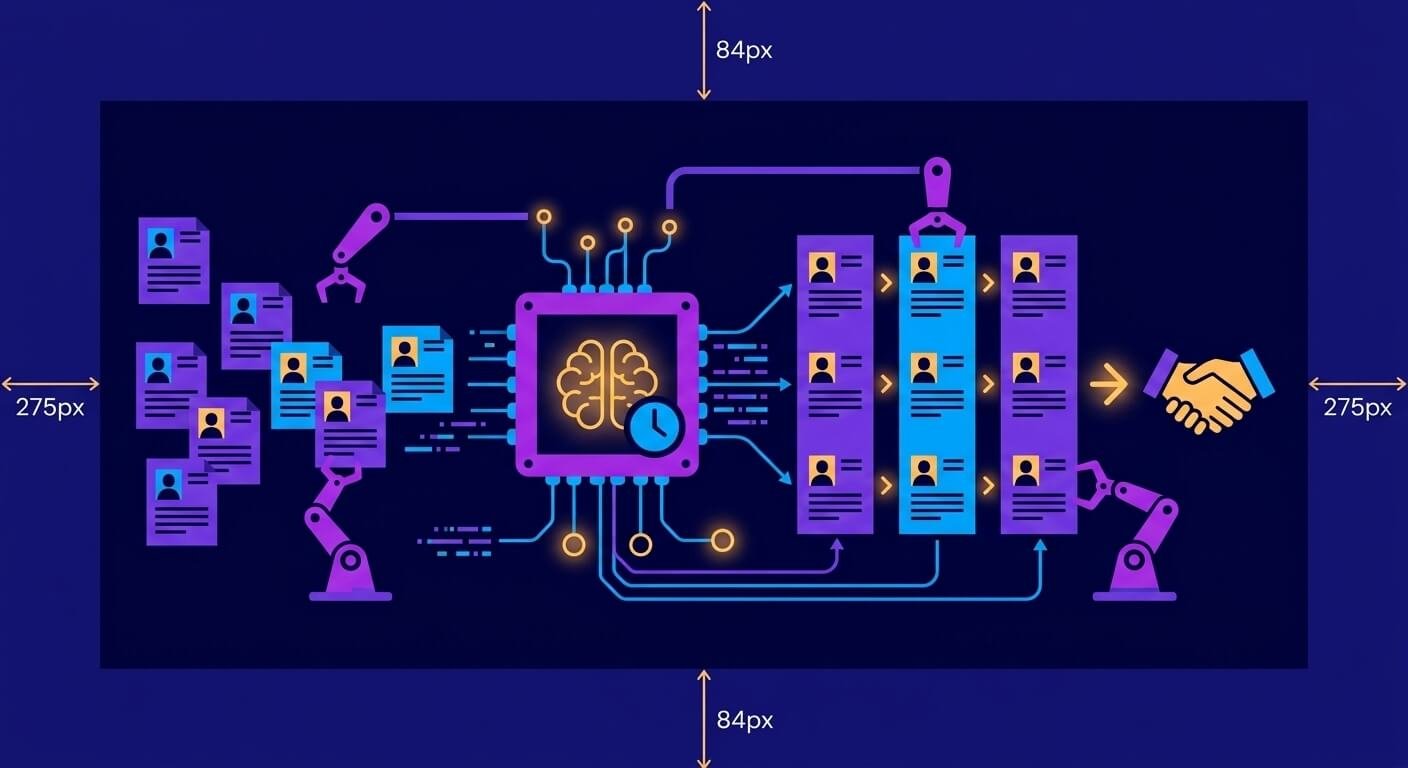

The signs you need a fractional CMO are rarely subtle once you know what to look for yet most UK founders misdiagnose them as a hiring problem rather than a leadership gap. If your marketing budget is haemorrhaging on disconnected tactics, your junior team has no strategic north star, and you are still personally approving ad copy, the answer is not another marketing manager. The real solution is board-level commercial leadership, and the smartest move you can make right now is to talk to a fractional CMO before burning another quarter of budget on tactics that serve no coherent strategy.
7 Signs at a Glance1. No documented commercial strategy. 2. Fragmented, siloed marketing channels. 3. Junior team operating without senior direction. 4. Founder still approving daily marketing decisions. 5. Your board cannot articulate your unique market positioning. 6. Customer acquisition costs are rising with no clear attribution model. 7. NPS or client retention is declining despite increased marketing spend.
This diagnostic guide has been built specifically for UK SME founders and CEOs generating between £2 million and £15 million in revenue who are approaching a genuine strategic inflexion point. Each section below maps a specific organisational symptom to a root cause, so you can determine with clarity whether your growth plateau demands tactical reinforcement or executive-level commercial leadership.
What a Fractional CMO Actually Does
A Fractional Chief Marketing Officer is a part-time, outsourced C-suite executive who provides board-level marketing strategy and commercial leadership without the full-time salary obligation. This is a critical distinction: a Fractional CMO is not a senior marketing manager with an inflated title, nor a consultant who delivers a report and disappears. They assume genuine executive accountability for your go-to-market motion, your revenue pipeline architecture, and your marketing return on investment. They align total marketing expenditure to overarching revenue targets, establish MQL and pipeline attribution frameworks, and mentor your internal team to raise collective commercial capability. According to the CIM’s 2025 Marketing Leadership Benchmark, organisations with dedicated senior marketing leadership generate 3.2 times more qualified pipeline than those relying on tactical management alone.
Fractional CMO Versus Marketing Manager
The distinction is not seniority it is scope and strategic authority. A marketing manager executes campaigns, manages day-to-day channel performance, and reports upward for approval. A Fractional CMO sets the strategy those campaigns serve, defines the commercial KPIs the channels must hit, and reports directly to the board. The table below makes this divide unmistakable.
| Dimension | Marketing Manager | Fractional CMO |
|---|---|---|
| Primary Focus | Tactical execution | Commercial revenue strategy |
| Reporting Line | Upward to CMO or MD | Direct to CEO or board |
| Budget Authority | Manages allocated budget | Sets and owns budget strategy |
| Strategic Input | None or minimal | Full go-to-market ownership |
| Team Leadership | Peer or small team | Full marketing function leadership |
| Typical UK Cost | £35,000–£55,000 per annum | £3,500–£6,000 per month retained |
| IR35 Exposure | Inside IR35 as employee | Outside IR35 as B2B consultancy |
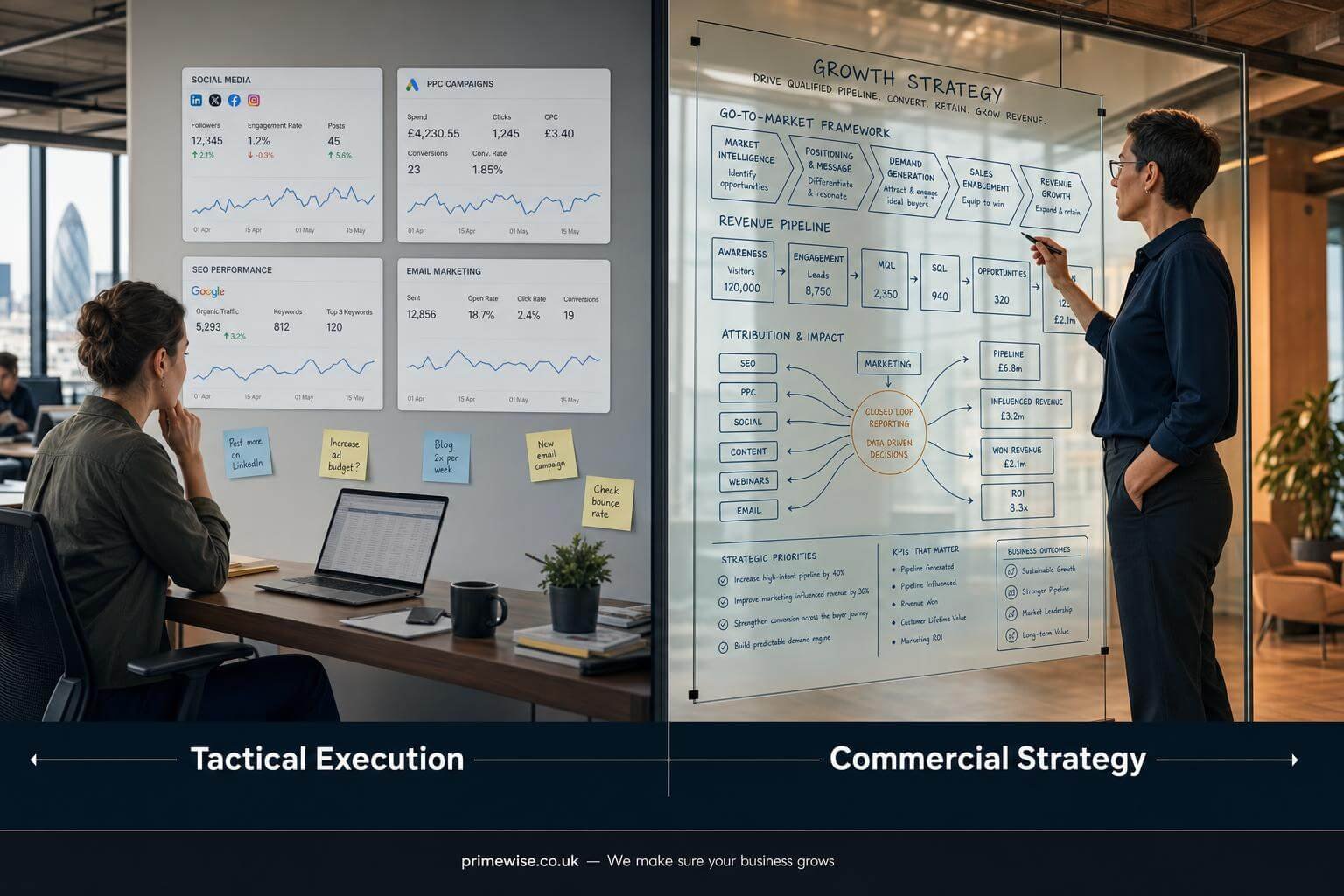
The 7 Signs Your Business Needs a Fractional CMO
Every symptom described below has a compounding cost. Left unaddressed, each one individually erodes margin and pipeline. Together, they create a growth ceiling that no additional mid-level hire will break through. Work through this diagnostic honestly against your current operation.
Sign One No Documented Commercial Strategy
If your marketing activity is driven by what feels urgent this week rather than a documented, board-approved plan tied to revenue milestones, you are operating in what practitioners call the random acts of marketing cycle. According to Beauhurst’s 2024 UK Scale-Up Report, 61 percent of UK SMEs that stalled between the £2 million and £5 million revenue mark cited an absence of a coherent go-to-market strategy as the primary cause. A Fractional CMO’s first deliverable is always a structured commercial strategy framework: target audience profiles, positioning architecture, channel hierarchy, and a 12-month pipeline roadmap mapped to specific revenue objectives. Without this foundation, every campaign your team runs is noise.
Sign Two Channel Chaos and Zero Attribution
Fragmented marketing channels operating in isolation are one of the clearest signs you need a fractional CMO rather than an additional pair of operational hands. When your SEO agency, PPC contractor, and social media executive operate without a unifying strategy or shared attribution model, customer acquisition costs climb while return on ad spend collapses. A Fractional CMO implements an omnichannel marketing framework, installs a marketing attribution model across your CRM and analytics stack, and ensures that every pound of digital spend is traceable to pipeline contribution. Demand generation and lead generation stop being interchangeable terms and start becoming measurable, sequenced motions within a broader revenue operations architecture.
Sign Three Your Junior Team Has No Strategic Leadership
A capable junior marketing team without senior leadership is not a marketing department it is a group of talented individuals executing in a strategic vacuum. Their output will remain permanently tactical: content calendars without narrative direction, email campaigns without lifecycle logic, social posts without positioning coherence. According to the Institute of Directors’ 2024 Leadership Gap Survey, 54 percent of UK SME marketing teams rated their ability to connect daily activity to commercial revenue outcomes as poor or very poor. A Fractional CMO does not replace your existing team. Instead, they act as a strategic mentor, elevating internal capability by installing commercial KPIs, running structured marketing operations cadences, and transforming execution-focused staff into revenue-accountable contributors.
Sign Four The Founder Is Still the De Facto CMO
Founder fatigue is a systemic growth blocker. When a CEO is reviewing campaign briefs, approving ad creative, and arbitrating between conflicting agency recommendations, two things happen simultaneously: strategic growth work goes undone, and the marketing team learns to wait for direction rather than lead. This bottleneck is quantifiable. McKinsey’s 2024 Founder Productivity Study found that founders in businesses between £1 million and £10 million revenue spend an average of 23 percent of their working week on marketing decisions that a competent CMO should own entirely. A Fractional CMO absorbs that executive bandwidth immediately, allowing founders to focus on enterprise scaling, investor relations, and Series A readiness while the commercial marketing function runs with genuine autonomy.
Executive InsightIf you are personally approving more than two marketing decisions per week, you are functioning as your company's CMO. The opportunity cost of that role is your company's next growth phase.
Sign Five Your Board Cannot Articulate Your Positioning
Ask three board members to describe your company’s unique market positioning in one sentence. If you receive three different answers or three versions of vague category descriptions your organisation lacks the strategic marketing clarity needed to compete in the UK’s intensely competitive B2B professional and financial services sectors. In London and the South East, where established competitors have decades of brand equity and senior commercial teams, a junior marketing manager rarely possesses the strategic depth or market gravitas to differentiate a mid-market challenger brand meaningfully. A Fractional CMO builds the positioning architecture that gives your entire commercial function a single, coherent narrative to execute against.
Sign Six Rising Acquisition Costs With No Causal Clarity
If your customer acquisition cost has increased over consecutive quarters but your team cannot explain why with data, you have a marketing leadership problem rather than a channel problem. Isolated tactical adjustments changing ad creative, switching agencies, boosting social spend are symptomatic responses to a structural misalignment between your marketing investment and your revenue architecture. A Fractional CMO conducts a full marketing audit, identifies the true cost-per-MQL and cost-per-acquisition across every channel, eliminates spend on non-attributable activity, and rebuilds the investment allocation around customer lifetime value and pipeline velocity. The result is not just lower acquisition costs, it is a predictable, scalable demand generation engine.
Sign Seven Retention Is Declining Despite Increased Spend
Increased marketing spend failing to arrest declining client retention or NPS scores is a definitive signal that your marketing function is disconnected from the full customer lifecycle. Marketing that stops at acquisition is an inherently incomplete commercial strategy. A Fractional CMO aligns your marketing operation across the entire revenue lifecycle from initial demand generation through to onboarding experience, retention communications, and advocacy programmes. This lifecycle alignment is particularly critical for UK B2B professional services firms where client lifetime value often exceeds initial contract value by a factor of four or five across multi-year relationships.
The Financial Architecture of the Fractional Model
The investment case for fractional executive leadership is compelling, not because it is cheap, but because it delivers disproportionate commercial return relative to the alternatives. Understanding the full cost comparison requires looking beyond base salary figures.
The True Cost of a Full-Time CMO in London
Securing senior marketing talent in London and the South East carries costs that extend well beyond the base salary figure. According to Glassdoor UK’s 2025 salary data, a Chief Marketing Officer in London commands a base salary of £150,000 to £220,000 per annum, supplemented by performance bonuses of 20 to 30 percent, equity or long-term incentive plans, employer National Insurance contributions, pension obligations, and executive search fees typically ranging from 20 to 30 percent of first-year salary. The total first-year cost of a senior CMO hire in London regularly exceeds £250,000 before a single strategy is implemented. The average CMO tenure is 28 months according to Spencer Stuart’s 2024 CMO Tenure Study meaning the search and onboarding cycle repeats with alarming frequency.
What a Fractional Retainer Delivers
Primewise.co.uk provides UK-based Fractional CMO engagements specifically for B2B professional services firms generating between £2 million and £15 million in annual revenue. Their retained model starts from £3,500 per month and includes a structured 90-day commercial impact framework, covering go-to-market strategy, team mentorship, channel rationalisation, and board-level reporting. For a business spending £180,000 annually on a fragmented mix of agencies and mid-level staff with no strategic cohesion, a Fractional CMO retainer often delivers measurable pipeline improvement within the first quarter at a fraction of the comparable full-time executive investment. If you recognise three or more of the signs described in this article, the most commercially rational next step is to speak with a Fractional CMO strategist at Primewise before your next budget cycle locks in another year of misaligned spend.
UK Compliance and IR35 Considerations
UK employment legislation introduces material complexity to any executive hiring decision. The off-payroll working rules under Chapter 10 of ITEPA 2003 commonly referred to as IR35 place the responsibility for determining employment status on the end-client in cases where a worker provides services through an intermediary. When a UK business engages a Fractional CMO through a structured B2B consultancy arrangement where the provider invoices through a limited company and operates with genuine commercial independence across multiple clients the engagement typically falls outside IR35 scope, eliminating the PAYE liability and employer National Insurance exposure that inside-IR35 determinations create. This structural distinction is a material financial advantage of the fractional model over traditional executive hiring. However, every IR35 determination is fact-specific: businesses should obtain confirmation from a qualified UK tax advisor or employment law solicitor before finalising any engagement structure.
Compliance NoticeIR35 status is determined by the specific facts of each engagement, not by job title or contract wording alone. Always obtain independent legal or tax advice before making IR35 determinations for executive arrangements.
When Is the Right Time to Appoint a Fractional CMO
Timing matters. Introducing fractional executive leadership too early before an internal team exists to lead delivers limited leverage. Introducing it too late after a growth plateau has compounded into structural decline means the turnaround requires significantly more resource and time. The optimal engagement window for most UK B2B SMEs is the transition phase between £2 million and £10 million annual recurring revenue, when tactical execution has begun to yield diminishing returns and the business requires a comprehensive commercial infrastructure overhaul to access the next growth tier.
Readiness Indicators for Executive Leadership
Beyond revenue milestones, specific operational conditions signal genuine readiness for a Fractional CMO engagement. The business should have at least one internal marketing resource capable of executing against a strategic brief, a CRM or pipeline visibility tool in place, and sufficient marketing budget typically £8,000 to £25,000 per month in total spend to make strategic reallocation meaningful. Without these foundations, the first phase of any Fractional CMO engagement becomes infrastructure-building rather than growth acceleration, extending the timeline to commercial return.
UK B2B Case Study From Stagnant to Scaling
Consider a London-based B2B legal technology firm that had plateaued at £3 million in annual recurring revenue for 14 months. The business had a £180,000 annual digital marketing budget distributed across three agencies with no shared attribution framework, a junior marketing coordinator with no senior direction, and a founder spending 25 percent of his working week making marketing decisions. The pipeline contained zero qualified enterprise leads. Upon engaging a Fractional CMO through Primewise, the first 90 days delivered a complete go-to-market strategy restructure: two underperforming agency relationships were terminated, spend was reallocated into a targeted account-based marketing programme focused on 120 enterprise accounts, and the junior coordinator was placed into a structured mentorship programme with weekly commercial reviews. By month seven, marketing qualified lead volume had increased by 280 percent, cost-per-acquisition had reduced by 44 percent, and the business closed its first £400,000 enterprise contract. Within 18 months, annual recurring revenue had reached £6.1 million driven entirely by the strategic infrastructure installed during the Fractional CMO engagement.
A Second Perspective Financial Services
A mid-market UK financial planning firm generating £4.5 million in recurring revenue faced a different but equally common challenge: a declining NPS score despite tripling its content marketing budget over 24 months. A Fractional CMO engagement identified that the firm’s marketing was entirely acquisition-focused, with no structured retention or client lifecycle communication programme. Within six months of implementing a full lifecycle marketing architecture including onboarding sequences, quarterly value-add communications, and a structured referral programme the firm’s NPS increased from 31 to 67, client churn reduced by 38 percent, and revenue from existing client upsell grew by £620,000 in the following financial year without any increase in acquisition spend.
Building the Business Case for Your Board
Securing internal alignment for a Fractional CMO engagement requires framing the investment in commercial outcomes rather than operational convenience. The most effective board-level argument is a direct cost comparison between the status quo fragmented agencies, churning mid-level hires, and founder time cost and the projected pipeline contribution of a structured fractional engagement. Use the seven diagnostic signs above as your evidence base, quantify the current cost of misaligned spend, and present the Fractional CMO retainer as a revenue investment with a measurable 90-day accountability framework rather than an overhead addition.
Your Next StepIf you recognised three or more signs in this article, Primewise.co.uk offers a no-obligation commercial diagnostic call for UK B2B founders. Speak with a Fractional CMO strategist and receive a structured assessment of your current marketing maturity within 48 hours.