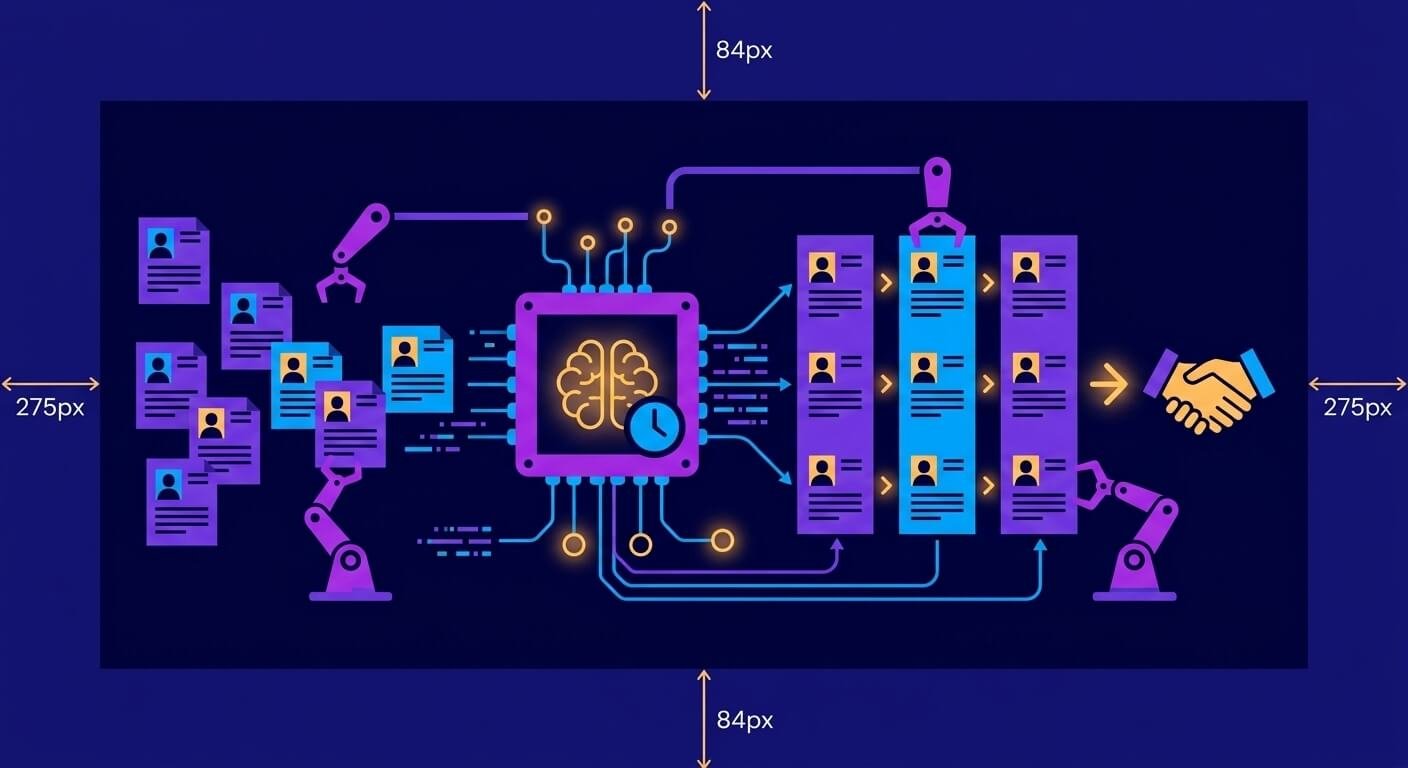

The benefits of a fractional CMO are best understood not as a marketing decision, but as a capital allocation decision and for UK scale-ups navigating growth plateaus, it is one of the most financially defensible moves a board can make. Accessing elite fractional CMO services means bypassing the prohibitive cost structure of a full-time executive hire while gaining immediate, board-ready marketing leadership precisely calibrated to your revenue stage. This article builds the complete financial and strategic case: cost avoidance, time-to-strategy acceleration, hiring risk elimination, and measurable pipeline ROI framed for founders, CEOs, and finance directors who need to defend the decision in a boardroom.
WHO THIS ARTICLE IS FORThis guide is written for UK founders, MDs, and CFOs at companies generating between £2M and £30M ARR who are evaluating whether fractional CMO leadership delivers a stronger return than a full-time executive hire. Every claim in this article is anchored to verifiable UK market data or a clearly stated methodology.
What Is a Fractional CMO
A Fractional CMO is a senior marketing executive engaged on a part-time, contract, or project basis to provide strategic leadership equivalent to a full-time Chief Marketing Officer, without the fixed employment costs or long-term contractual obligations. They operate at board level, own the go-to-market strategy, manage internal and agency teams, and are accountable to commercial outcomes not activity metrics. This definition is deliberately precise because it is the foundation of the financial argument that follows.
Marketing Leadership as Capital Allocation
Most growth-stage businesses frame their CMO hiring decision as a talent question. The correct frame is a capital efficiency question. The choice is not simply between a good marketer and a great marketer it is between a fixed, fully loaded payroll liability and a flexible, outcome-linked operational expenditure. For companies where EBITDA margins are under pressure and investor scrutiny is high, this distinction is not semantic. It is the difference between a hire that accelerates growth and one that quietly erodes it.
Fractional leadership converts the marketing function from a cost centre anchored to headcount into a precision instrument aligned to pipeline return on investment. Every pound committed to a fractional operator is deployed against a defined Statement of Work with measurable deliverables a governance discipline that permanent employment contracts rarely enforce with the same rigour.
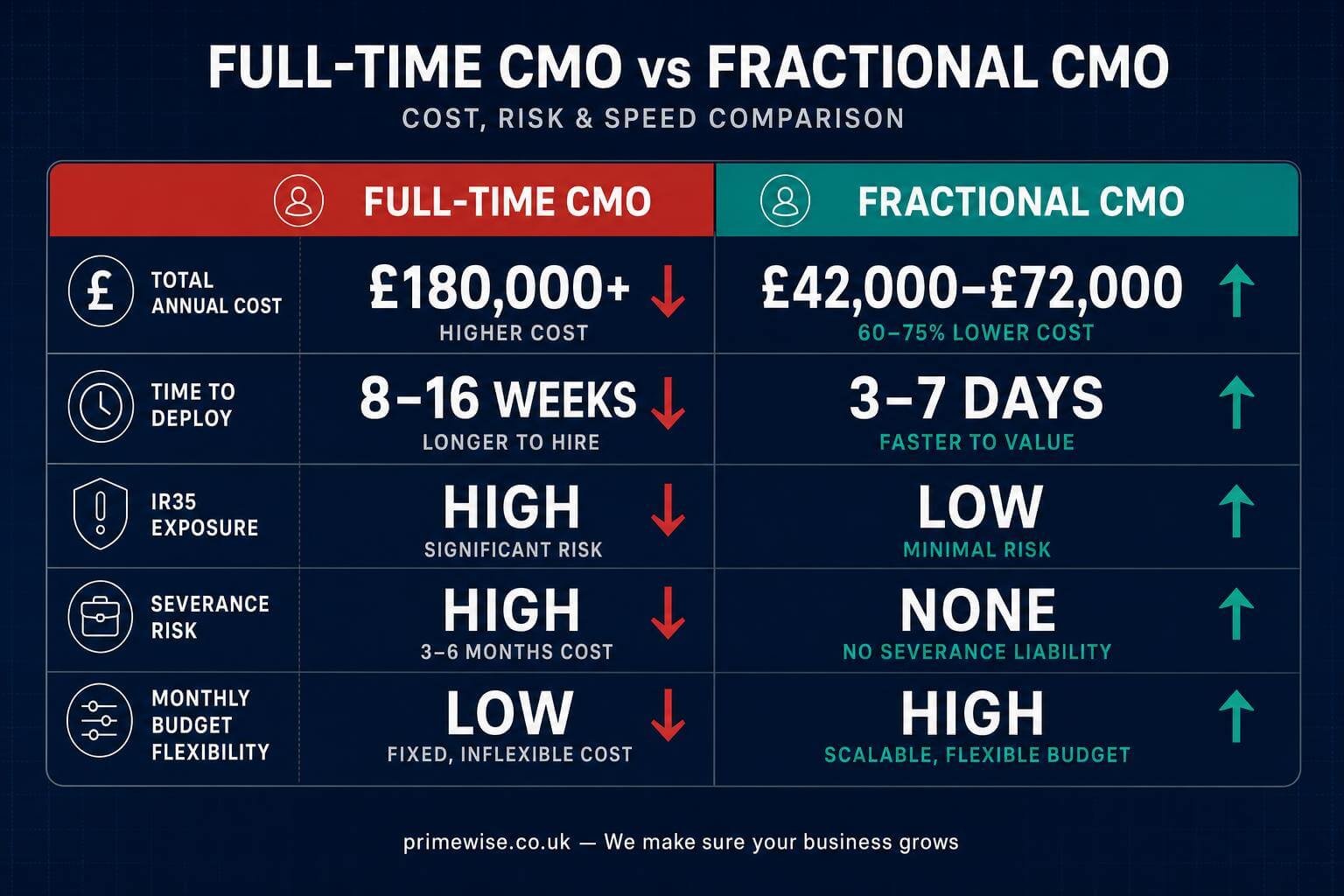
The Executive Capital Allocation Matrix
The true financial cost of a permanent Chief Marketing Officer is substantially higher than the headline salary figure that appears in a job advertisement. For finance directors building a business case, the fully loaded cost model is the only honest basis for comparison. Industry data consistently shows that a permanent executive costs approximately 1.4 times their base salary once recruitment fees, employer taxes, pension contributions, and benefits are factored in meaning a £120,000 base salary represents a real annual liability closer to £168,000 before bonuses or equity.
| Cost Dimension | Full-Time CMO | Fractional CMO |
|---|---|---|
| Base Salary (UK Midmarket) | £120,000 – £180,000 | Not applicable |
| Employer NICs (13.8%) | £16,560 – £24,840 | £0 |
| Executive Search Fee (20–30%) | £24,000 – £54,000 | £0 |
| Annual Bonus | £15,000 – £40,000 | £0 |
| Workplace Pension | £4,800 – £7,200 | £0 |
| Fractional Monthly Retainer | Not applicable | £4,000 – £12,000 |
| Time to Deployment | 3 – 6 months | 7 – 14 days |
| Severance Exposure | High | None |
| IR35 Risk | Not applicable | Mitigated via SoW |
When the full cost stack is modelled, a mid-market UK business can realistically save between £80,000 and £140,000 in year one by deploying fractional leadership rather than committing to a permanent executive. For a Series A or Series B company where every pound on the balance sheet represents runway, that saving is not a marginal efficiency gain it is a strategic reserve that can be redeployed into demand generation, product development, or market expansion.
PRIMEWISE CAPITAL EFFICIENCY AUDITPrimeWise deploys fractional CMO talent into UK scale-ups and regulated financial services firms within 10 business days. Request a no-obligation capital efficiency audit at primewise.co.uk to model your specific cost avoidance scenario before your next board meeting.
Bypassing the Fully Loaded Executive Premium
An executive base salary is the most visible line item in a hiring decision, but it is rarely the largest. Spencer Stuart’s CMO Practice data confirms that fully loaded executive costs encompassing search retainer fees (typically 25 to 30 percent of first-year compensation), signing bonuses, equity grants, and comprehensive benefits packages routinely push the real cost of a new CMO hire to between 1.4x and 1.6x the advertised base salary in the first twelve months alone. A fractional engagement eliminates every layer of this premium. The retainer pays exclusively for strategic output, not for administrative overhead, equity administration, or HR compliance management.
Evading UK Employer NICs and Statutory Costs
UK employers currently pay 13.8 percent National Insurance Contributions on all employee earnings above the secondary threshold a statutory cost that is entirely absent from a fractional B2B consultancy agreement. Beyond NICs, mandatory auto-enrolment pension contributions, private health cover, life assurance, and enhanced parental leave provisions add a further 8 to 12 percent to the true cost of a senior employee. These costs are not discretionary; they are statutory obligations. Fractional agreements, structured correctly through a business-to-business commercial framework, carry none of these liabilities for the hiring organisation. HMRC’s published guidance on employment status confirms that where a genuine B2B relationship exists with multiple clients, mutual obligation tests are not met and employer statutory contributions do not apply.
IR35 Compliance and Statement of Work Governance
For UK financial services firms, wealth management businesses, and regulated entities, IR35 compliance is not a peripheral consideration it is a board-level risk management priority. Since the 2021 off-payroll working reforms extended IR35 liability to medium and large private sector organisations, incorrectly classifying an executive as outside IR35 can expose the end-client to unpaid tax liability, interest charges, and HMRC penalties.
The correct risk mitigation structure is a rigorously drafted Statement of Work that specifies deliverables, project timelines, substitution rights, and the absence of mutuality of obligation. This structure combined with the fractional operator’s demonstrable work across multiple concurrent clients creates a defensible IR35 position. It is important to note that a well-structured fractional engagement does not eliminate IR35 as a consideration; it ensures that the liability sits appropriately with the contractor’s personal service company rather than with the hiring organisation. Businesses should always seek independent legal advice to confirm their specific IR35 assessment obligations before contracting.
LEGAL DISCLAIMERThe IR35 analysis presented in this article is for general informational purposes only and does not constitute legal or tax advice. Every organisation's circumstances differ. Consult a qualified UK employment law solicitor or tax adviser before making IR35 determinations.
Eradicating the Go-To-Market Delay
For Private Equity and Venture Capital-backed businesses, time is not merely money it is competitive positioning. A revenue plateau that persists for one additional quarter while a traditional CMO recruitment process runs its course represents an opportunity cost that compounds directly into valuation pressure at the next funding round. The structural delays embedded in UK executive hiring are not anecdotal; they are a documented feature of the labour market that fractional deployment categorically eliminates.
Circumventing UK Notice Periods
UK C-suite employment contracts routinely carry notice periods of three to six months. This means that even when a preferred candidate is identified and an offer is accepted, the organisation may wait two full quarters before the executive is seated. During this window, go-to-market campaigns stall, pipeline dries, and tactical marketing teams operate without strategic direction. A fractional CMO bypasses this entirely. Engagements can be structured and initiated within five to ten business days of commercial terms being agreed, ensuring operational continuity from week one.
Operational Cadence Versus Onboarding Lag
Even after a permanent hire physically joins, the productivity curve follows a well-documented trajectory. McKinsey research on executive onboarding indicates that newly appointed C-suite leaders typically require 90 days to audit internal systems, build political capital, and establish their operating model before executing meaningful strategic change. This lag is structural and inevitable it is not a reflection of individual capability but of the complexity of integrating a new permanent employee into a live organisation.
Fractional operators approach deployment with a fundamentally different posture. Operating across multiple client environments simultaneously, experienced fractional CMOs arrive with pre-built diagnostic frameworks, pre-validated demand generation playbooks, and an operator-first mindset that compresses the audit-to-execution timeline to approximately 14 days. By the end of the second week, a high-calibre fractional leader should have completed a commercial audit, identified the top three acquisition inefficiencies, and activated at least one immediate pipeline intervention.
Hiring Leverage and Severance Risk Elimination
The financial case for fractional leadership is not complete without quantifying the downside risk of the alternative. Permanent CMO hires carry a failure rate that boards routinely underestimate until the cost of a mis-hire lands on the P&L. Structuring executive marketing leadership through a fractional model fundamentally changes the risk profile of the decision.
The CMO Tenure Problem
Korn Ferry’s CMO tenure research consistently places the average tenure of a Chief Marketing Officer at between 18 and 36 months the shortest tenure of any C-suite role. This churn rate is not incidental. It reflects the structural misalignment between the long-term nature of brand and pipeline investment and the short-term performance cycles that boards impose on marketing leaders. The practical consequence for a hiring company is stark: a permanent CMO hire carries a probabilistic timeline to replacement within two to three years, at which point the full recruitment, onboarding, and severance cost cycle restarts. When modelled over a five-year horizon, the cumulative cost of two or three CMO replacement cycles can easily exceed £500,000 in direct costs alone, excluding the opportunity cost of pipeline disruption during each transition.
Scaling Expenditure Alongside Funding Milestones
One of the most commercially undervalued benefits of the fractional model is budget elasticity. VC and PE funding environments are characterised by distinct capital deployment phases seed, bridge, Series A, Series B each with different cash flow profiles and marketing priorities. A fractional CMO agreement can be structured with a variable retainer that scales in direct proportion to available capital and current growth objectives. During lean quarters or between funding tranches, the engagement can be scaled back without triggering statutory redundancy rights or severance obligations. Post-investment, it can be expanded immediately without a new recruitment cycle. This elasticity is simply not available within a permanent employment framework.
Translating Strategy into Pipeline ROI
Cost avoidance and structural efficiency are necessary arguments, but they are not sufficient ones. The most compelling dimension of the fractional CMO value proposition is the measurable revenue impact that a well-deployed operator delivers. Elite fractional leaders are not brand strategists in the traditional sense they are commercial operators who instrument marketing against pipeline metrics and hold themselves accountable to hard financial outcomes.
Customer Acquisition Cost Reduction
The primary financial lever that a fractional CMO activates in the first 90 days is Customer Acquisition Cost reduction. This is achieved through a forensic audit of the existing demand generation stack identifying channels with deteriorating efficiency, eliminating vanity spend on brand activity that cannot be attributed to pipeline, and reallocating budget toward the highest-performing acquisition vectors. For most mid-market businesses that have scaled tactical marketing without strategic oversight, this audit reveals between 20 and 35 percent of the marketing budget allocated to non-performing activity. Redirecting that capital toward optimised paid media governance, LinkedIn ABM programmes, SEO-driven demand capture, and email nurture infrastructure typically produces a measurable CAC reduction within 60 to 90 days.
Accelerating Marketing-Originated Pipeline Velocity
Generating leads without the conversion infrastructure to qualify and close them produces volume metrics that impress no one beyond a marketing coordinator. Fractional CMOs invest heavily in aligning marketing operations with the sales function standardising lead scoring models, building SLA frameworks between marketing and sales, and ensuring that attribution modelling accurately reflects the multi-touch reality of B2B buying cycles. This alignment reduces the average sales cycle length, increases the percentage of marketing-originated opportunities that progress to proposal stage, and creates a feedback loop that continuously improves targeting precision. The net result is a marketing-originated pipeline that finance directors can actually rely on in their forward revenue forecasts.
Who Is a Fractional CMO Suitable For
The fractional CMO model delivers maximum value within a defined firmographic window. Understanding whether your business sits within that window is a prerequisite for an honest ROI assessment.
- UK businesses generating between £2M and £30M in Annual Recurring Revenue that have outgrown founder-led marketing but cannot justify a full C-suite salary
- Series A and Series B companies with committed investor capital requiring a structured go-to-market function before the next milestone review
- Private Equity portfolio companies needing rapid EBITDA improvement through marketing efficiency gains within a defined hold period
- Financial services, insurtech, wealth management, and regulated sector firms requiring marketing leadership with compliance awareness and sector-specific acquisition experience
- Businesses with an existing in-house marketing team of two to eight people that needs senior strategic direction rather than additional tactical headcount
- Organisations preparing for a significant product launch, geographic expansion, or rebrand where a time-limited senior operator is more appropriate than a permanent hire
The fractional model is less suited to early-stage pre-revenue businesses that require an operational marketing generalist rather than a strategic leader, or to large enterprises with an established CMO and full marketing function already in place. Honesty about fit is a prerequisite for ROI.
Fractional CMO Versus Interim CMO Versus Virtual CMO
These three titles are used interchangeably in the UK market, but they describe meaningfully different engagement models that carry different commercial implications. An interim CMO is typically deployed to fill a specific vacancy gap they are transitional by definition, often operating on a full-time basis for a fixed period of three to twelve months, and their mandate is continuity rather than transformation. A virtual CMO typically refers to a remote-first operator, often engaged at a lower price point, whose scope is frequently limited to advisory input rather than active execution leadership.
A fractional CMO, in the truest sense, is a part-time strategic operator who divides their working week across a small number of high-growth clients simultaneously. This concurrent client model is commercially significant because it means the operator’s pattern recognition is continuously updated across multiple live growth environments. The competitive intelligence and cross-sector execution experience that a fractional CMO carries into your business is, arguably, more valuable than the reduced cost structure because it delivers insights that a single-company employee simply cannot accumulate.
A PrimeWise Financial Services Engagement
When PrimeWise was engaged by a Series B financial services firm generating £15M in Annual Recurring Revenue, the business faced a critical convergence of pressures: a new product suite requiring a structured launch, a stalled acquisition funnel, and a board that had already rejected a £120,000 permanent CMO hire on capital efficiency grounds. The engagement brief was precise audit the commercial marketing function, eliminate inefficient spend, and deliver the product launch within a defined capital envelope.
Within the first three weeks, the PrimeWise fractional operator completed a full acquisition funnel audit, identified and eliminated £20,000 per month in redundant paid media spend, restructured the content and SEO architecture to target regulated investment search intent, and built the launch communications framework for the new product suite. The product reached market four months ahead of the original board timeline. The return on the fractional engagement investment exceeded 300 percent within the first quarter a figure calculated against the fully loaded cost of the alternative hire and the revenue generated by the accelerated product launch.
KEY COMMERCIAL OUTCOMES£20,000 monthly ad spend eliminated in week three. Product launch accelerated by four months. 300%+ ROI on fractional engagement in Q1. Zero severance exposure. Zero IR35 liability for the hiring entity.
Key Takeaways
- The fully loaded cost of a UK CMO hire is approximately 1.4x the base salary when employer NICs, search fees, pension, and benefits are included fractional leadership eliminates this premium entirely
- UK notice periods of three to six months create a structural go-to-market delay that fractional deployment resolves within 7 to 14 business days
- The average CMO tenure of 18 to 36 months means most mid-market firms will face two or three replacement cycles in a five-year window each carrying full recruitment and severance costs
- Fractional agreements can be scaled up or down in direct alignment with funding milestones, preserving cash flow in lean quarters without triggering statutory employment obligations
- A correctly structured Statement of Work mitigates IR35 exposure for the hiring organisation; independent legal advice should always be obtained
- Experienced fractional operators compress the audit-to-execution timeline to approximately 14 days versus the 90-day onboarding lag standard for permanent hires
- CAC reduction of 20 to 35 percent is achievable within 60 to 90 days through forensic audit of non-performing demand generation spend
- The fractional model is optimally suited to UK businesses between £2M and £30M ARR with an existing small marketing team and a defined growth objective
- PrimeWise deploys fractional CMO talent into UK scale-ups and financial services firms within 10 business days visit primewise.co.uk to request a capital efficiency audit