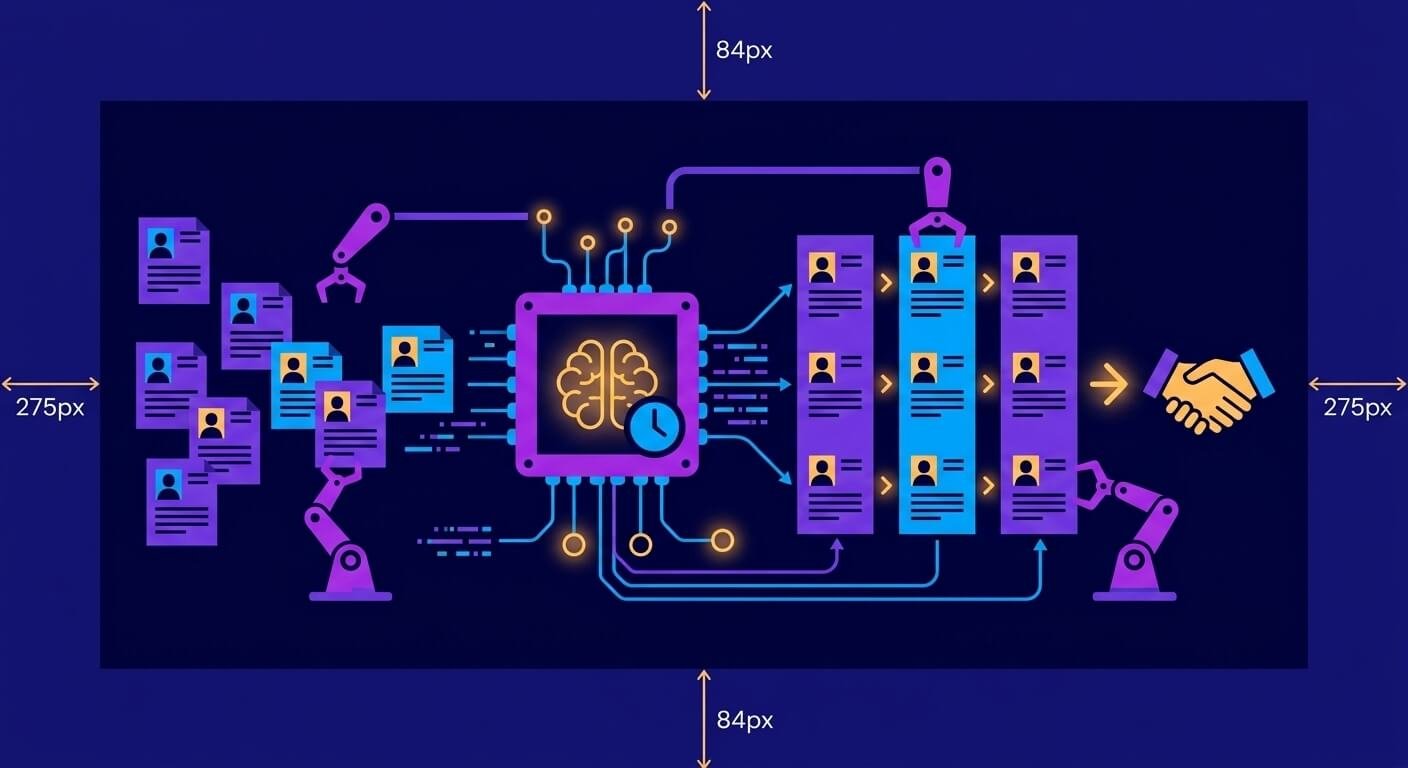

Knowing exactly when to hire a performance marketing consultant in London can be the difference between scaling efficiently and burning through investor capital on channels that stopped working six months ago. Most UK founders make this decision too late, after a second agency has been fired, after CAC has quietly doubled, or after a board meeting where nobody could explain why ROAS is declining despite a larger budget. This guide gives you the seven precise commercial triggers that signal your acquisition engine needs senior strategic intervention, not more tactical execution.
Executive SummaryUK scale-ups waste an average of 22–34% of paid media budget due to misaligned attribution and under-qualified oversight. A fractional performance marketing consultant closes that gap typically within 45 days without the £120k+ fixed overhead of a full-time hire. If any of the seven triggers below describe your business right now, you are past the point where another agency retainer will solve the problem.
What a Performance Marketing Consultant Actually Does
A performance marketing consultant is a senior growth strategist engaged on a fractional basis to audit acquisition channels, eliminate wasted ad spend, and build a scalable, attribution-rich revenue engine. This is not agency retainer work dressed up with a different job title. The distinction is strategic integration: a consultant operates at the executive layer, sits inside your commercial data, and is accountable to revenue outcomes, not click-through rates or impression share reports.
The model most high-growth UK scale-ups now adopt is what PrimeWise and a small number of senior fractional operators refer to as the Rent-to-Build framework. The consultant embeds with the leadership team, audits the existing infrastructure, builds a profitable and scalable acquisition system, and then manages the transition to a permanent internal hire once the engine is validated. You pay for expertise during the high-risk build phase, not a lifetime salary to test whether the model works.
- Full audit of historical paid media spend across all channels with attribution data review
- Implementation of advanced tracking infrastructure to map complex, multi-touch B2B buying journeys
- Development of bespoke revenue models aligned to board targets and investor milestones
- Recruitment and structured handover to an internal specialist once profitability is proven
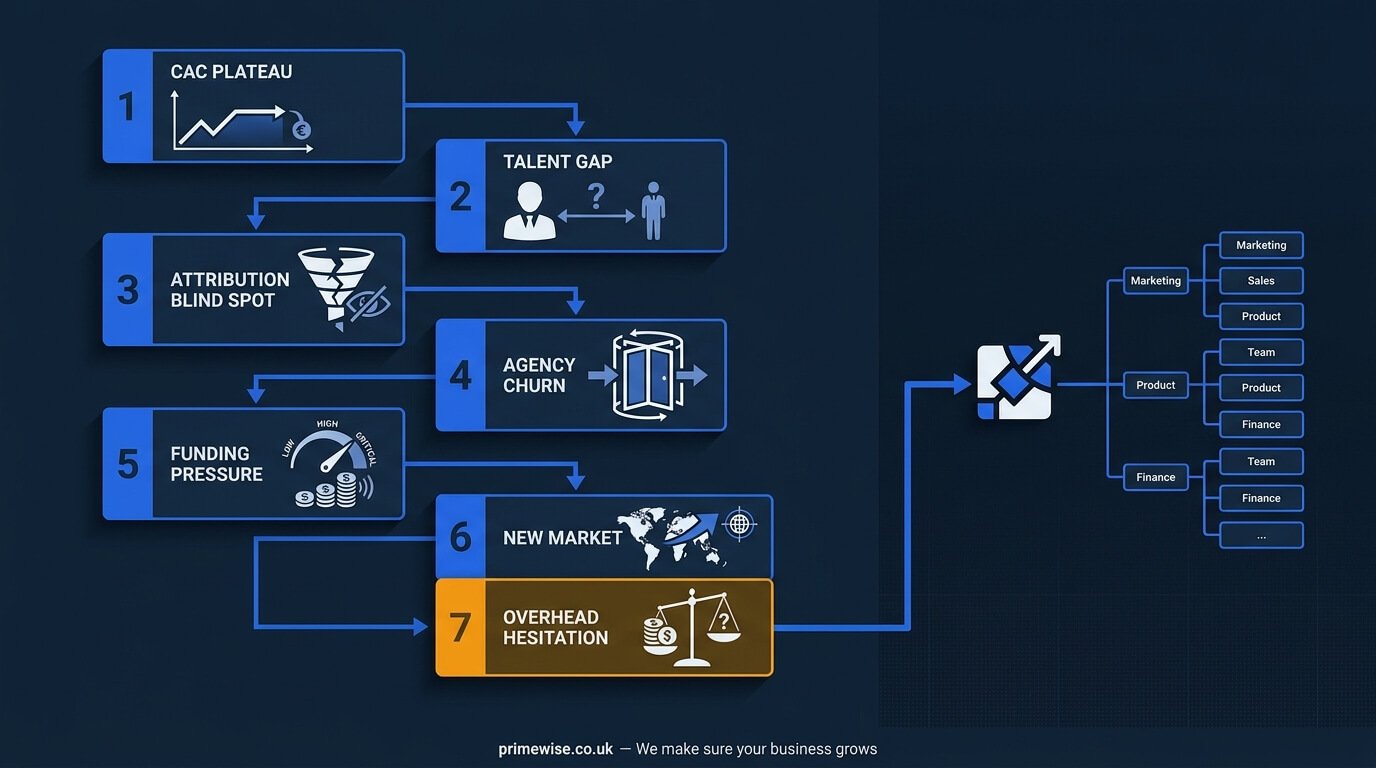
The Seven Commercial Triggers
These are not theoretical warning signs. Each trigger below represents a specific, measurable moment where staying with the current model, whether that is in-house execution, a junior growth hire, or a generalist agency will cost you more than the intervention. Identify which ones apply to your business today.
Trigger One: The CAC Plateau
The acquisition playbook that took your business from zero to £1M ARR will not take you to £5M. This is not a theory it is the most consistent failure pattern in UK scale-up growth. Channel saturation sets in, frequency rises, and the same audiences that converted efficiently at lower budgets begin to ignore or scroll past your ads. The data signal is specific: a 20% increase in monthly ad spend produces a 35–40% decline in ROAS. According to WARC’s 2025 UK Paid Media Efficiency Report, over 60% of scale-ups crossing the £3M ARR threshold experience a measurable CAC plateau within two quarters of increasing spend beyond their initial converting budget.
Solving a CAC plateau requires advanced unit economic modelling, identifying new audience architectures, testing adjacent acquisition channels, and rebuilding creative frameworks around higher-LTV segments. This is not a junior task. It requires someone who has rebuilt a paid acquisition engine at scale before, under budget pressure, with board visibility on the outcome.
Trigger Two: The Talent Gap
If a member of your team who was hired to execute campaigns is now making £50,000-per-month budget allocation decisions, you have a structural risk that is materialising quietly in your unit economics. Junior growth practitioners are skilled at platform-level execution, building ad sets, A/B testing creative, and managing campaign structures. What they are not equipped to do is align aggressive spend decisions with pipeline forecasting, board-level revenue targets, or cross-channel attribution strategy.
According to LinkedIn UK Talent Insights 2025, the average base salary for a Head of Growth in London now sits between £95,000 and £135,000, with top-quartile candidates demanding equity, bonus structures, and flexible working packages that push total compensation above £160,000. Until your acquisition model is consistently profitable and repeatable, hiring at that level is a premature commitment. The talent gap triggers when you need the thinking of a £130k executive but cannot yet justify the permanent overhead.
The London Cost RealityA full-time Head of Growth in London costs £95,000–£135,000 base salary, plus 15% Employer National Insurance (from April 2025), pension contributions, benefits, and equity dilution. A fractional performance consultant eliminates that fixed liability entirely, you access the same commercial intellect on a deliverables-driven engagement.
Trigger Three: The Attribution Blind Spot
High-LTV B2B clients do not convert after a single ad click. They research across LinkedIn, read three comparison articles, see a retargeting ad, attend a webinar, and then fill in a contact form six weeks later. If your current reporting attributes that conversion entirely to the last-click Google Ads campaign, you are systematically underfunding the channels that actually started the journey and overfunding the ones that just happened to be last in line.
The IAB UK’s 2025 B2B Measurement Report found that over 70% of UK B2B firms with monthly ad budgets above £20,000 are operating with last-click or single-channel attribution models, meaning they have near-zero visibility on which touchpoints drive qualified pipeline versus vanity engagement. Advanced attribution tools, including platforms such as HockeyStack, Northbeam, and Rockerbox, provide multi-touch, revenue-connected reporting that fundamentally changes channel investment decisions. A senior performance consultant implements and interprets these systems at speed. Without that capability in-house, spray-and-pray spend continues unchallenged.
Trigger Four: The Agency Churn Cycle
If you have engaged and exited two or more digital agencies within a twelve-month period, the problem is not bad luck in vendor selection. The problem is structural misalignment between what agencies are incentivised to report and what your business actually needs to measure. Agencies optimise for retained relationships. Their KPIs, click-through rates, impressions, cost-per-click, and quality scores are selected because they are easy to move and easy to present in a monthly report. None of those metrics appears on a P&L statement.
The agency churn cycle is one of the clearest signals that the business requires a partner whose financial incentives are tied to revenue performance, not retainer continuation. A performance consultant’s commercial model is built on demonstrable ROI which is why the engagement structure looks fundamentally different from a conventional agency contract.
Trigger Five: Board-Level Funding Pressure
Closing a Series A or Series B round creates a specific and intense pressure: deploy capital quickly enough to satisfy investor growth expectations, but not so aggressively that burn rate becomes a boardroom concern. Data from Beauhurst’s 2025 UK Scale-Up Investment Report shows that the median time between a Series A close and first board performance review is just 90 days. In that window, leadership teams are expected to demonstrate disciplined capital deployment across acquisition channels not ad hoc spend increases with unclear attribution.
A strategic performance consultant provides the senior oversight required to make that capital deployment defensible. They build the reporting infrastructure that allows the CFO to present channel-level ROI to investors with confidence, and they prevent the aggressive-but-undirected spend patterns that consume runway without producing proportional pipeline growth.
Trigger Six: Launching Into New Markets
Expanding from the UK to the US, or launching a premium financial product tier to an enterprise audience, is not a campaign duplication exercise. The acquisition landscape shifts entirely: CPMs rise, buying cycles lengthen, competitive density increases, and the creative and messaging frameworks that worked domestically often fail to land in new contexts. According to Google’s 2025 International Expansion Benchmark Study, businesses that attempt cross-market expansion without localised acquisition data see a 47% higher average CAC in the first two quarters compared to those with a market-specific strategy in place before launch.
A consultant who has built acquisition systems in the target market brings localised channel intelligence, audience architecture knowledge, and competitive benchmarks that no domestic team can replicate from scratch. This is not a gap that a generic agency brief fills it requires embedded, senior commercial judgement.
Trigger Seven: The Overhead Hesitation
You know you need executive-level performance strategy. You cannot yet justify £120,000–£150,000 in fixed base salary for a full-time hire. This is the overhead hesitation trigger, and it is the most common reason UK founders operating between £2M and £8M ARR find themselves in a strategic limbo too large for founder-led acquisition, too capital-conscious for a permanent C-level hire.
Post the October 2024 UK Budget, Employer National Insurance rose to 15% with the threshold lowered to £5,000 from April 2025 meaning the true employer cost of a £120,000 base salary now exceeds £138,000 before pension, benefits, or recruitment fees. Firms like PrimeWise operate precisely within this fractional model, embedding senior performance marketing expertise at the executive layer without triggering permanent headcount obligations. The engagement is classified as a supplier service flexible, outcomes-driven, and CFO-friendly from a procurement perspective.
IR35 Clarity for CFOsEngaging a performance marketing consultant on an outside-IR35 basis classifies the expenditure as a flexible supplier cost, not a payroll liability. This removes PAYE risk, Employer NI obligations, and pension auto-enrolment requirements, accelerating procurement approval and protecting cash flow.
The Consultant Bridge Framework
Whether to keep acquisition in-house, work with an agency, or bring in a fractional consultant depends entirely on your current revenue stage and monthly ad spend. The Consultant Bridge Framework below provides a structured decision reference based on commercial maturity. Note the critical mid-growth band, the Series A to Series B transition zone, which is precisely where most scaling decisions go wrong and where fractional expertise delivers the highest return on investment.
| Commercial Stage | Monthly Ad Spend | Recommended Resource | Key Risk at This Stage |
|---|---|---|---|
| Pre-Seed to Seed | Under £10,000 | Founder-led or Internal Specialist | Over-engineering early-stage acquisition before product-market fit is confirmed |
| Series A Scale-up | £10,000 – £50,000 | Fractional Performance Consultant | CAC plateau and attribution blind spots destroying margin as spend scales |
| Series A to Series B Transition | £50,000 – £100,000 | Fractional Consultant or Embedded Lead | Misaligned capital deployment creating board-level friction during high-scrutiny growth phase |
| Enterprise Maturity | Over £100,000 | Full-time Head of Growth | Organisational dependency on a single external operator without internal capability transfer |
This framework prevents two equally costly errors: over-investing in permanent senior headcount before the acquisition model is validated, and under-resourcing critical expansion phases with execution-only agency support that lacks strategic bandwidth. The goal is to match resource sophistication to operational maturity at every stage.
How to Evaluate a Performance Marketing Consultant
Knowing the triggers is only half the equation. Knowing what to look for and what to avoid during the evaluation process protects against the same misalignment that drove the agency churn cycle in the first place. The criteria below are drawn from the specific commercial requirements of UK scale-ups operating in high-competition B2B and financial services sectors.
- Demand attribution methodology transparency, they must be able to explain exactly how they will connect ad spend to closed revenue, not just pipeline creation
- Ask for a specific example of CAC reduction at a comparable revenue stage, including the before and after unit economics
- Confirm their IR35 status and operating structure before procurement to avoid unexpected tax classification risk
- Establish clear deliverables for the first 45 days. A credible consultant will specify an audit output, a revised tracking infrastructure, and initial channel recommendations by that milestone
- Assess commercial alignment, their day-rate or project fee should include performance-linked components tied to pipeline or revenue outcomes, not just time billed
Red Flags to Reject Immediately
Not every consultant operating under a fractional or independent label offers genuine C-level commercial value. The red flags below are specific enough to use as a filter in the first meeting, and each one has appeared repeatedly in the post-mortem accounts of founders who cycled through the wrong hire before finding the right one.
- They lead with platform certifications rather than revenue outcomes Google Partner badges do not signal strategic capability
- Their proposed KPIs are channel-level metrics rather than pipeline or revenue figures
- They cannot articulate a specific attribution model or name the tooling they would implement for your use case
- They have no documented experience at your revenue stage or in your sector B2B financial services acquisition is structurally different from D2C e-commerce
- They resist a defined scope or deliverables structure in favour of open-ended retainer arrangements with no performance accountability
45-Day ROI BenchmarkA top-tier performance marketing consultant should demonstrate measurable ROI within 45 days. In the first two weeks, this looks like plugging identified ad spend waste. By day 45, it looks like reallocated budget producing a qualified pipeline in channels that were previously invisible in your attribution model.
The UK Market Context in 2026
Persistent inflation and tightening credit conditions across the UK economy have materially extended B2B buying cycles since 2023. Procurement decisions that previously moved from first touch to closed-won in 60 days are now routinely taking 90 to 120 days in financial services, professional services, and enterprise SaaS. This has a direct impact on paid acquisition strategy: channels optimised for short buying cycles systematically underreport pipeline from high-LTV accounts, and attribution windows set at 30 days miss a significant proportion of converted revenue entirely.
A performance consultant operating in this environment must understand the macroeconomic context well enough to rebuild attribution windows, adjust channel weighting, and recalibrate CAC benchmarks to reflect actual buying behaviour not pre-inflation assumptions. The Marketing Efficiency Ratio (MER), which measures total revenue generated per pound of total marketing spend rather than isolating individual channel ROAS, has emerged as the preferred board-level metric for UK scale-ups navigating this environment. Transitioning from ROAS-only reporting to MER gives leadership teams a cleaner view of true acquisition efficiency across longer buying journeys.
What the First 90 Days Looks Like
One of the most common questions from leadership teams considering a fractional engagement is what they will actually receive and by when. The following timeline represents the standard delivery architecture for a senior performance consultant working with a UK scale-up operating between £10,000 and £60,000 per month in paid media.
- Days 1 to 14: Full audit of existing channel spend, attribution model, tracking infrastructure, and conversion data with a written findings report identifying the top three areas of spend waste and channel misallocation
- Days 15 to 30: Tracking infrastructure rebuild using appropriate tooling for business model and buying journey complexity, including GA4 configuration, CRM integration, and where relevant, multi-touch attribution platform implementation
- Days 31 to 60: Reallocation of audited budget to highest-performing channels, launch of net-new acquisition experiments against validated audience hypotheses, and first pipeline reporting against board-level revenue targets
- Days 61 to 90: Optimisation cycle based on live data, channel profitability ranking by true CAC and LTV, and presentation of validated acquisition model with performance benchmarks to inform permanent hiring decision
PrimeWise structures its fractional engagements precisely around this 90-day accountability cycle, with each milestone tied to specific commercial deliverables rather than hours billed. Founders and MDs considering whether this model fits their current stage are welcome to request a complimentary 30-minute paid media audit to identify the most critical spend inefficiency in their current acquisition setup before making any commitment.