Knowing how to hire an AI integration partner is one of the most consequential procurement decisions a UK mid-market firm will make in 2026. Whether you are evaluating your first AI vendor or rebuilding a failed integration strategy, this guide delivers a structured, regulation-aware vetting framework built specifically for UK enterprise and mid-market firms. The stakes are exceptionally high: the UK AI market was valued at over £16.9 billion in 2024, with DSIT projecting a contribution exceeding £800 billion to GDP by 2035. Yet Gartner’s 2025 research consistently shows that the majority of AI integration projects fail to deliver their promised ROI, primarily because procurement leaders lack a repeatable, technically rigorous methodology to separate genuine machine learning engineers from opportunistic rebranded IT agencies.
Executive SummaryThis guide covers the complete AI vendor vetting lifecycle for UK-regulated businesses: shortlisting criteria, reference checking protocols, IP ownership frameworks, FCA-aligned contract structures, and ironclad exit clauses. Use the proprietary AI VET Procurement Matrix to score every vendor objectively before committing a single pound of capital.
What Is an AI Integration Partner
An AI integration partner is a specialised technology vendor with verified machine learning engineering capabilities who designs, deploys, and scales bespoke artificial intelligence models within your existing enterprise infrastructure. Unlike a standard IT managed service provider or a general digital consultancy, a genuine AI integration partner owns proprietary model development methodologies, contributes to open-source algorithmic research, and operates within strict data privacy and algorithmic transparency frameworks required by regulated industries. The distinction matters enormously: engaging the wrong category of vendor results not in a technology upgrade, but in an expensive, compliance-exposed data migration project dressed up as AI.
Why the UK Market Makes This Decision Harder
London’s technology market is saturated with traditional managed service providers that have rapidly updated their marketing materials to feature artificial intelligence language without acquiring the underlying data science capabilities. Procurement leaders face a genuine mid-market dilemma because the surface signals polished decks, case study language, and AI-branded service lines are near-identical between authentic machine learning consultancies and rebranded IT agencies. The only reliable differentiator is deep technical interrogation conducted before any commercial conversation begins.
Compounding this challenge is the UK’s regulatory environment. The Financial Conduct Authority’s SYSC 8 rules govern the outsourcing of critical or important operational functions to third-party technology vendors and impose mandatory audit rights, risk assessment obligations, and documented exit strategies. Simultaneously, the ICO’s guidance under Article 22 of UK GDPR places strict obligations on firms using automated decision-making tools procured from external parties. Any AI integration partner operating in UK financial services must demonstrate documented compliance across both frameworks before a procurement conversation advances.
The AI VET Procurement Matrix
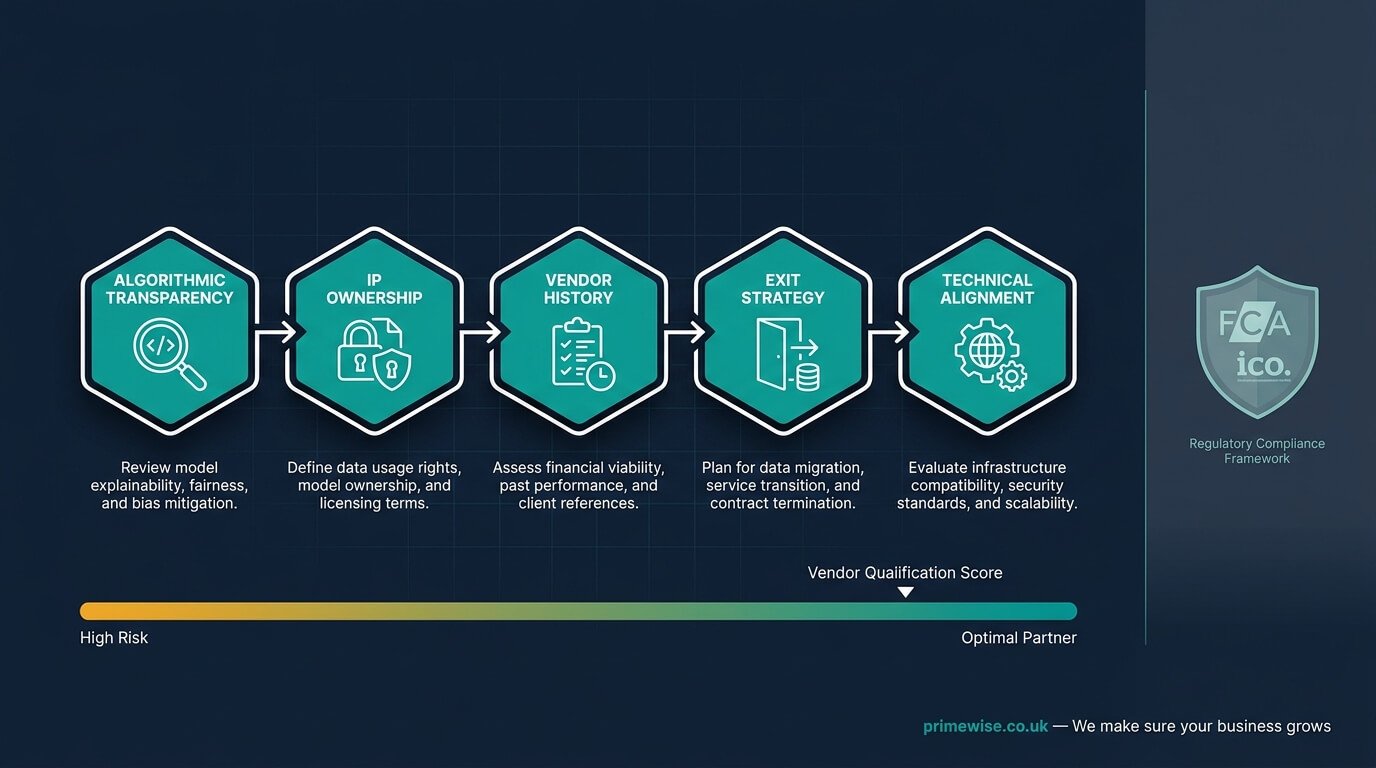
To remove subjectivity from the shortlisting process, procurement leaders should apply a structured evaluation framework across every vendor under consideration. The AI VET Procurement Matrix, developed for UK mid-market and enterprise procurement contexts, assesses five critical pillars that determine whether a vendor is genuinely equipped to deliver a compliant, commercially sound AI integration.
Algorithmic Transparency
A vendor scoring at the highest level on algorithmic transparency can produce detailed architectural diagrams of past deployments, articulate the mathematical foundations of their models in plain language, and explicitly explain their methodology for preventing data leakage during the training phase. A low-scoring vendor offers only high-level case studies with no technical substance, is unable to define how their models handle edge cases, and cannot describe their approach to monitoring for algorithmic bias. The ICO’s AI and Data Protection Toolkit and the FCA’s AI Discussion Paper DP5/22 both make clear that automated systems used in regulated financial decisions must be explainable. Vendors who cannot satisfy this requirement create immediate compliance exposure for the hiring firm.
IP Ownership
Intellectual property control is the single most commercially dangerous area of AI procurement. A vendor at the highest competency level will agree, without negotiation, that the hiring firm owns all fine-tuned model weights, proprietary training data, generated outputs, and bespoke algorithmic layers from the moment of project completion. A vendor who hesitates, qualifies, or counter-proposes retaining ownership of any part of the developed model is exhibiting a fundamental red flag. In a recent UK procurement case study, a prominent mid-market investment firm lost significant capital after failing to secure IP rights to their fine-tuned model weights. The vendor retained ownership of the customised algorithmic layer and used this leverage during contract renewal negotiations to extract materially higher fees. The firm had no legal recourse because the original contract contained ambiguous language rather than explicit assignment clauses.
Critical WarningNever allow a vendor contract to use the phrase 'licence to use' in relation to fine-tuned model weights or bespoke algorithmic outputs. The only acceptable legal standard is a full, unencumbered assignment of intellectual property to the client upon project completion. Instruct your legal counsel to review this clause before any code is written or data is transferred.
Vendor History
Authentic machine learning consultancies demonstrate their pedigree through a verifiable track record of bespoke model development, measurable post-launch outcomes, and documented performance against contractual machine learning KPIs. Procurement teams must request references from clients in comparable regulatory environments not generic technology testimonials and must conduct those reference calls without the vendor present. The focus of these conversations must be entirely on the post-launch operational lifecycle, not the sales or discovery experience.
Exit Strategy
A mature vendor will proactively present their exit and transition protocols as a standard element of their commercial proposal. Vendors who treat exit clause discussions as adversarial or premature are exhibiting a vendor lock-in mentality that will compound into commercial and operational risk throughout the engagement. Mandatory source code escrow, data portability in non-proprietary formats, and structured knowledge transfer sessions are non-negotiable requirements for any enterprise AI contract in 2026.
Technical Alignment
Technical alignment encompasses the vendor’s specific domain expertise, their MLOps lifecycle management capabilities, and their architectural fit with your existing infrastructure. Generalist AI agencies consistently underperform in financial services environments because they lack familiarity with the complex data taxonomies, audit trail requirements, and model risk management (MRM) frameworks specific to regulated industries. Vendors should be assessed on their experience with retrieval-augmented generation (RAG) architectures where relevant, their approach to foundation model fine-tuning risks, and their capability to manage model drift proactively within an agreed retraining schedule.
Red Flag Checklist for AI Vendors
Before advancing any vendor to the reference or commercial stage, procurement leaders should screen for the following warning signs. Each represents a documented pattern associated with failed AI integration projects in UK mid-market environments.
- Unable to produce detailed architectural diagrams of a comparable previous deployment without a non-disclosure agreement delay of more than five working days.
- Proposes retaining any ownership of fine-tuned model weights, bespoke algorithmic layers, or generated outputs after project completion.
- Cannot name the specific ICO guidance document governing automated decision-making that applies to your use case.
- Offers a standard SaaS uptime agreement rather than AI-specific SLAs with precision, recall, and hallucination thresholds.
- Is unable to define their approach to model accuracy drift and has no documented retraining protocol.
- Has no source code escrow provision in its standard contract template and resists introducing one.
- Cannot provide client references from regulated industry deployments, only from unregulated or consumer technology environments.
- Presents a fixed-price, fixed-scope contract for a bespoke machine learning engagement without a staged milestone structure.
- Has no documented shadow AI risk policy governing the use of third-party foundation models within your data environment.
- Avoids direct answers to questions about hidden post-launch compute costs or cloud infrastructure scaling expenses.
Procurement InsightOver 75% of AI integrations fail to meet ROI targets, according to consistent Gartner research on enterprise AI project outcomes. The root cause is almost never technical it is contractual. Ambiguous scope definitions, absent success KPIs, and missing IP clauses are the three most common failure points identified in post-mortem procurement reviews.
Conducting Rigorous Reference Checks
Reference checks for machine learning vendors require an entirely different protocol to those used for standard software procurement. The questions must focus exclusively on the post-launch operational lifecycle because this is where the true capability gap between authentic AI engineering firms and rebranded agencies becomes visible.
Questions That Reveal True Vendor Capability
The following questions should be asked directly of the vendor’s past clients, without the vendor present, during a structured thirty-minute call. The answers will reveal far more than any proposal document or demonstration.
- How did the vendor manage model accuracy drift in the six to twelve months following initial deployment?
- Were there hidden compute or cloud infrastructure costs that emerged after go-live that were not disclosed during scoping?
- Did the vendor deliver on their stated deployment timeline, and if not, what caused the delays?
- How responsive was the vendor’s engineering team to post-launch anomalies, API latency spikes, or model performance degradation?
- Did the vendor proactively flag regulatory compliance risks, or did your team have to identify them independently?
- How comprehensive was the technical documentation and knowledge transfer provided at the conclusion of the engagement?
- If you were renegotiating the contract today, which clause would you change first?
- Did the vendor’s post-launch support match the level of attention provided during the pre-sales and deployment phases?
Validating Deployment Timelines
Endless development cycles are among the most common and costly failure modes in bespoke AI engineering. References should confirm that the vendor has a proven track record of delivering against phased milestone schedules in enterprise environments. A vendor with a consistent history of timeline overruns in lower-complexity deployments will almost certainly underperform on a regulated financial services integration where data access controls, compliance sign-off, and audit trail requirements add significant friction to every development sprint. Ask references to quantify the variance between the contracted delivery timeline and the actual go-live date.
UK AI Integration Partner Cost Benchmarks
One of the most significant information gaps facing procurement leaders at this stage is the absence of reliable cost benchmarking data for UK AI integration engagements. The following ranges reflect the current market for regulated mid-market firms in 2026 and should be used as a qualification filter, not as a negotiating floor.
- Discovery and scoping engagements: £15,000 to £45,000 depending on data complexity, existing infrastructure maturity, and regulatory requirements.
- MVP model development and initial deployment: £80,000 to £250,000 for a bespoke, domain-specific machine learning model with full audit trail capability.
- Ongoing MLOps management and model maintenance: £8,000 to £25,000 per month depending on model complexity, retraining frequency, and SLA requirements.
- Regulatory compliance architecture overlay: £20,000 to £60,000 as a one-off engagement, typically required for FCA-regulated use cases involving automated decision-making.
- Full exit and knowledge transfer package: £10,000 to £30,000 vendors who refuse to price this separately or include it as a standard deliverable should be treated with significant caution.
Vendors pricing bespoke financial services AI integrations at materially below these ranges are almost certainly scoping the engagement inadequately, planning to recover margin through post-launch change requests, or lack the regulatory architecture experience required to deliver a compliant solution. PrimeWise.co.uk works with UK mid-market and regulated businesses to structure AI integration partnerships from the outset, including the legal and commercial frameworks that protect model IP and prevent vendor lock-in before the first line of code is written. If you are currently evaluating AI vendors, a structured scoping assessment can identify contractual and compliance risks before they become costly disputes.
Structuring the Commercial Agreement
Standard SaaS contracts are architecturally incompatible with generative AI and bespoke machine learning deployments. The commercial agreement must be structured from the ground up to reflect the dynamic, probabilistic nature of AI models where performance evolves over time, where compute costs scale with usage, and where the underlying technology requires continuous investment to maintain baseline accuracy.
Milestone-Based Remuneration
Financial risk is best mitigated through a rigorous milestone-based payment structure directly tied to verifiable, technically defined stages of model development. Acceptable milestone gates include successful completion of data ingestion and quality validation, initial training run completion with documented accuracy metrics, user acceptance testing sign-off against pre-agreed benchmarks, and production go-live with agreed monitoring dashboards active. Capital should never be released on the basis of time elapsed or effort expended only on the basis of measurable, contractually defined deliverables.
AI-Specific Service Level Agreements
Standard uptime guarantees are entirely inadequate for AI system performance management. AI-specific SLAs must define acceptable thresholds for model precision and recall, maximum permissible response latency for query processing, an agreed baseline hallucination rate with mandatory engineering intervention triggers, retraining obligations when model performance falls below agreed accuracy thresholds, and explicit cost-to-serve reduction targets tied to vendor compensation structures. By anchoring vendor remuneration to measurable ML KPIs rather than availability metrics, procurement leaders create genuine long-term alignment between vendor incentives and corporate ROI objectives.
Understanding MLOps Lifecycle Obligations
Before signing any AI integration contract, procurement leaders must understand the full MLOps lifecycle obligation they are entering into. Machine learning models are not static software deployments they are continuous data products that require ongoing monitoring, retraining, drift detection, and governance. The vendor contract must explicitly define who is responsible for model retraining when accuracy degrades, who owns the cloud infrastructure and bears the compute cost as usage scales, and who manages the model risk management (MRM) documentation required under FCA oversight frameworks. Vendors who treat post-launch MLOps as out of scope or as a separately billable add-on are not operating as genuine AI integration partners they are operating as project delivery firms with no long-term accountability for outcomes.
Intellectual Property Control Frameworks
Intellectual property is the most strategically critical element of any AI integration contract and the area most frequently exploited by vendors operating in bad faith. Legal counsel must review and sign off on IP clauses before any data is transferred or development work begins.
Ownership of Fine-Tuned Model Weights
The contract must explicitly state, with no qualifying language, that the hiring firm retains complete and unencumbered ownership of all proprietary training data, fine-tuned model weights, generated outputs, bespoke algorithmic layers, and system prompt architectures. This ownership must be legally assigned to the client upon project completion not licensed, not co-owned, not subject to ongoing royalty arrangements. The vendor may retain ownership of their underlying development frameworks and generic tooling, but everything built specifically for the client using the client’s data belongs exclusively to the client. Any vendor who frames this as an unreasonable request is indicating that their business model depends on retaining leverage over your organisation’s competitive AI capabilities.
AI System Cards and Governance Documentation
Aligned with responsible AI procurement principles and the broader direction of UK AI governance frameworks, procurement leaders should require vendors to produce AI system cards as a contractual deliverable. An AI system card documents the model’s intended use case, known limitations, training data characteristics, evaluation methodology, and identified risk factors. This documentation satisfies the ICO’s requirements for transparency in automated decision-making, supports the FCA’s expectations around model risk management, and provides the internal governance evidence required if the deployment is subject to audit. Vendors who have not produced AI system cards for previous deployments are unlikely to operate within the responsible AI procurement standards expected by UK regulators in 2026.
IP Protection ChecklistBefore signing: confirm full assignment of fine-tuned model weights to client, mandate AI system card delivery as a contractual milestone, define ownership of all generated outputs explicitly, and ensure your legal counsel reviews the IP clause against the AI Bill currently progressing through UK Parliament for forward compliance.
Exit Clauses and Transition Protocols
A mature procurement strategy anticipates the eventual end of every vendor relationship. Strong exit clauses are not adversarial they are evidence of a vendor’s confidence in the quality and durability of their work. Any vendor who resists detailed exit provisions is signalling that they intend to create dependency rather than deliver capability.
Mandatory Source Code Escrow
Source code escrow provisions must be included in every AI integration contract without exception. This legal mechanism ensures that if the vendor ceases operations, breaches the contract, or is acquired by a third party whose interests conflict with yours, the client can immediately access the complete architectural codebase, configuration files, API documentation, and infrastructure specifications required to maintain the deployed system. The escrow arrangement should be held by an independent third party, not by the vendor, and should be triggered automatically by a defined set of release conditions agreed in advance.
Data Portability and Offboarding Requirements
All data portability requirements must be defined comprehensively before the contract is signed. Transition protocols must mandate that all training data, vector embeddings, model parameters, and configuration files are exportable in universally accepted, non-proprietary formats. The contract should specify the exact file formats acceptable for each data category, the maximum time the vendor has to complete the export upon notice of termination, and any financial penalties for delayed or incomplete data return. Mandatory knowledge transfer sessions a minimum of four structured sessions with the vendor’s lead data engineers must be contractually obligated and must conclude before the final payment milestone is released. This sequencing ensures that the vendor’s financial incentive remains aligned with a complete and cooperative transition rather than a rushed or incomplete handover.
To receive a bespoke AI vendor vetting scorecard tailored to your sector and regulatory exposure, contact PrimeWise.co.uk today. Our structured assessment process is designed specifically for UK-regulated businesses navigating the AI integration procurement process for the first time or rebuilding following a failed vendor engagement.
Key Takeaways for Procurement Leaders
- Apply the AI VET Procurement Matrix across all five pillars Algorithmic Transparency, IP Ownership, Vendor History, Exit Strategy, and Technical Alignment, before advancing any vendor to the commercial stage.
- Require detailed architectural diagrams and documented model risk management frameworks from every shortlisted vendor, not high-level case studies or generic capability decks.
- Ensure all AI integration contracts include full IP assignment clauses, source code escrow provisions, and AI-specific SLAs with precision, recall, and hallucination thresholds.
- Validate vendor regulatory competence against FCA SYSC 8 obligations and ICO Article 22 UK GDPR guidance before sharing any proprietary data or commencing scoping work.
- Structure remuneration around technically defined milestones and tie vendor compensation to measurable ML KPIs including cost-to-serve reductions and latency thresholds.
- Mandate comprehensive offboarding protocols, including data portability in non-proprietary formats and minimum knowledge transfer sessions, with completion linked to final payment release.