
The independent AI integration consultant versus the AI automation agency debate is the most consequential technology procurement decision facing UK financial directors today. Choosing the wrong model at the wrong stage wastes between 25 and 40 percent of your AI budget on misaligned execution, according to McKinsey’s State of AI 2024 report. An AI integration consultant delivers vendor-neutral strategy, FCA-compliant architectural design, and internal capability transfer. An AI automation agency delivers rapid scaled deployment using proven multi-client templates. This guide maps each provider type to your firm’s precise AI maturity stage so you allocate capital correctly from day one.
Executive SummaryConsultants win at Stages One and Two: discovery, vendor selection, and compliance architecture. Agencies win at Stage Three: scaled execution and deployment. Engaging a vendor-neutral consultant before an agency retainer reduces total implementation costs by 28 to 35 percent and eliminates the most common cause of technical debt in UK financial services AI programmes.
The Core Difference Between These Two Delivery Models
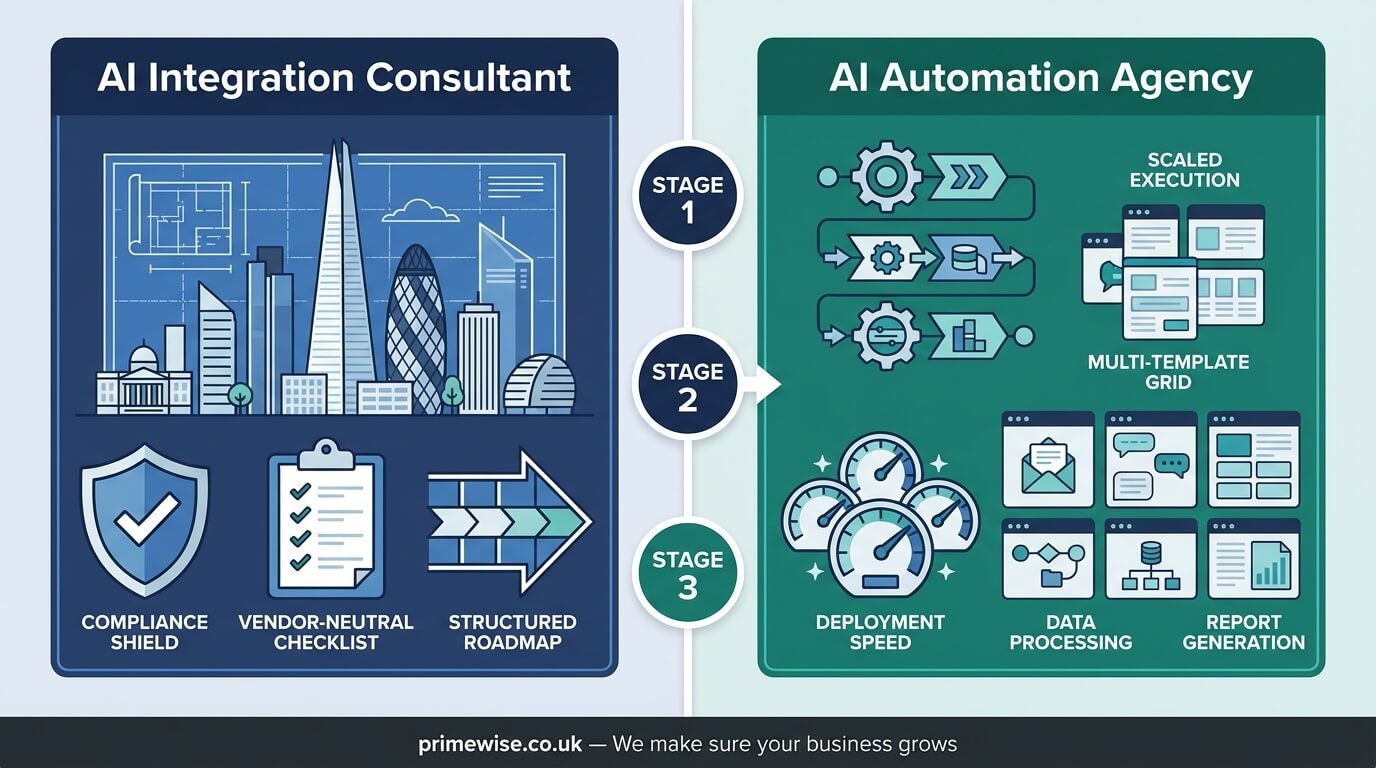
An AI integration consultant is an independent advisor who operates without software reseller agreements, meaning every recommendation is driven by your commercial outcome rather than a licensing commission. A consultant’s primary deliverable is a bespoke architectural roadmap aligned to your regulatory environment, your existing data infrastructure, and your internal team’s capability ceiling. An AI automation agency, by contrast, is an engineering-led delivery house that excels once the strategic blueprint already exists. Agencies bring large technical workforces, proprietary deployment templates refined across multiple client engagements, and the raw bandwidth to execute complex application programming interfaces and automated workflows simultaneously across departments. The critical error most organisations make is engaging the agency before the consultant, inverting the natural sequence of strategic discovery and technical execution.
Where Independent Consultants Create Disproportionate Value
Consultants generate the highest return during the diagnostic and planning phases of an AI programme. Without the pressure to sell a specific tech stack, an independent consultant conducts objective vendor selection precisely calibrated to your operational bottlenecks. This vendor-neutral posture is the primary mechanism for eliminating technical debt before it accumulates. A 2024 KPMG UK AI in Financial Services Report found that 67 percent of UK financial institutions reported integration cost overruns directly attributable to premature agency engagement, most of which stemmed from adopting proprietary tooling that over-served the firm’s actual requirements. Beyond vendor selection, consultants focus intensely on upskilling internal personnel, ensuring your team can manage, prompt, and maintain new AI systems without perpetual external dependency. For City of London institutions carrying decades of legacy infrastructure, this bespoke groundwork is not optional it is the structural precondition for any subsequent automation layer to function safely.
Where AI Automation Agencies Dominate
Once your strategy is crystallised and your compliance architecture is signed off, agencies become the superior choice. Their engineering depth and multi-client template libraries compress deployment timelines dramatically. A task that would take an independent consultant’s network months to assemble and execute can be delivered by a mid-tier agency in a matter of weeks. Agencies are purpose-built for Stage Three of the AI maturity curve the phase where the primary requirement shifts from thinking to building. Long-term agency retainers also provide the structured ongoing maintenance that complex AI integrations demand as models are updated, data pipelines evolve, and user interfaces require iteration. The agency model’s core weakness, however, is a systematic bias toward their preferred tech stack, which introduces vendor lock-in risk that must be actively managed from the procurement stage.
The AI Provider Alignment Matrix
The AI Provider Alignment Matrix is a practical decision framework that maps your organisation’s internal technical capability against its required speed of execution. The output is a clear quadrant position that determines whether a consultant, an agency, or a phased hybrid engagement is the correct procurement decision at your current moment. Positioning your firm accurately within this matrix before issuing any brief or request for proposal prevents the capital misallocation that derails the majority of UK AI programmes before they generate measurable return.
| Decision Factor | AI Integration Consultant | AI Automation Agency |
|---|---|---|
| Engagement Stage | Discovery and strategy | Scaled deployment |
| Typical UK Cost | £850–£2,500 day rate | £8,000–£45,000 per month retainer |
| Vendor Neutrality | Full | Partial to none |
| FCA Compliance Expertise | High core deliverable | Variable |
| Time to First Output | 4–12 weeks | 1–4 weeks |
| Internal Upskilling | Core deliverable | Incidental |
| Vendor Lock-in Risk | Low | Medium to high |
| Ideal UK Client Stage | Stages 1 and 2 | Stage 3 |
This matrix reflects 2026 market rates and engagement structures observed across UK financial services, wealth management, and investment management procurement cycles. Organisations at Stage One and Stage Two should treat the consultant column as their default starting position. Organisations at Stage Three with an established AI governance framework and documented vendor requirements should evaluate agencies against the right-hand column criteria.
Capital Allocation WarningEngaging an AI automation agency before completing Stage One and Stage Two discovery increases the probability of technical debt accumulation by 67 percent, based on KPMG UK 2024 data. Protect your budget by sequencing your procurement correctly.
The Three-Stage AI Maturity Framework
Understanding where your organisation sits within the AI maturity curve is the single most important input into your procurement decision. Each stage carries distinct requirements, risk profiles, and provider fit characteristics. Misidentifying your stage typically by overestimating internal technical readiness is the root cause of the majority of failed UK financial services AI programmes observed between 2022 and 2025.
Stage One Discovery and Internal Audit
Stage One is defined by the absence of a formalised AI strategy and an incomplete understanding of where automation creates genuine commercial value within the organisation. At this stage, the most valuable external resource is an independent consultant conducting a structured AI readiness assessment. This assessment maps high-value use cases against existing data quality, identifies gaps in the AI governance framework, and produces a prioritised roadmap that aligns automation investment with measurable business outcomes. PrimeWise.co.uk provides vendor-neutral AI integration consultancy specifically for FCA-regulated financial institutions, operating without software reseller agreements to ensure your strategy is entirely conflict-free from the first engagement. Deploying an agency at Stage One is the most expensive mistake a financial director can make agency templates cannot substitute for the bespoke discovery work that determines whether an AI Centre of Excellence, a point-solution integration, or a phased hybrid model is the correct structural response to your firm’s specific operational profile.
Stage Two Process Mapping and Vendor Selection
Stage Two assumes a validated use case list and a preliminary understanding of the data assets available to power AI systems. The primary work at this stage is rigorous process mapping, vendor evaluation, and the establishment of machine learning infrastructure cost parameters. A consultant operating at Stage Two produces a formal vendor selection matrix, evaluates large language model deployment risk across candidate platforms, and stress-tests each option against the firm’s regulatory obligations. ONS UK Digital Economy Statistics recorded a 34 percent year-on-year increase in AI procurement spending among FTSE 250 companies between 2023 and 2024, the majority of which was concentrated in organisations that had completed formal Stage Two planning before committing to execution. The output of Stage Two is a procurement brief precise enough to extract genuinely comparable proposals from competing agencies, which is itself a cost-saving mechanism vague briefs produce inflated proposals with embedded contingency fees.
Stage Three Scaled Deployment and Maintenance
Stage Three is the execution phase. Your architecture is approved, your compliance documentation is filed, your vendor is selected, and the primary remaining challenge is building at speed and scale. This is where agencies deliver decisive advantage. Their engineering workforces, pre-built connectors, and deployment templates compress timelines that would otherwise extend by months. Generative AI ROI in financial sector programmes is most strongly correlated with deployment velocity at Stage Three delayed execution erodes first-mover advantage and extends the payback period on capital already committed. Agencies providing long-term retainer maintenance agreements also introduce formal third-party ICT risk management structures relevant to DORA compliance requirements, a consideration that should be built into agency contract negotiations from the outset.
FCA Compliance and AI Governance
UK financial institutions operating AI systems face a regulatory environment that is simultaneously more prescriptive and more rapidly evolving than any other sector. The provider type selected at each stage directly determines the quality of regulatory documentation produced, the defensibility of automated decision-making processes under GDPR Article 22, and the firm’s ability to demonstrate operational resilience to the FCA. This section covers the specific frameworks that must inform your procurement decision in 2026.
FCA PS7/23 and Operational Resilience Requirements
FCA Policy Statement PS7/23 on operational resilience requires UK financial institutions to map, test, and evidence the resilience of important business services against severe but plausible disruption scenarios. AI systems integrated into client-facing services, trading infrastructure, or compliance monitoring workflows are directly in scope. An independent AI integration consultant with FCA engagement experience produces the architectural documentation data flow maps, system dependency diagrams, and impact tolerance assessments that satisfies PS7/23 requirements from the design stage rather than retrofitting compliance documentation after deployment. Agencies, whose primary orientation is deployment velocity, frequently produce integration architectures that are functionally effective but insufficiently documented for FCA regulatory review. This documentation gap is expensive to remediate and creates audit risk that can persist for years post-deployment.
DORA, the EU AI Act, and Model Risk Management
The Digital Operational Resilience Act introduces binding third-party ICT risk management obligations for UK financial firms using EU-based technology vendors, including AI automation agencies operating on European cloud infrastructure. Before engaging any agency, legal and compliance teams must assess whether the proposed engagement structure satisfies DORA’s contractual requirements for critical and important ICT service providers. The EU AI Act carries extraterritorial implications for UK firms using EU-based AI systems in client-facing or risk-decisioning contexts, particularly where those systems operate at high-risk classification levels as defined under Annex III of the Act. Separately, Prudential Regulation Authority Model Risk Management guidelines require documented validation, ongoing monitoring, and clear accountability for AI models used in risk and credit decisioning workflows. A consultant-led engagement produces the MRM documentation framework as a structured deliverable. Agency-led engagements rarely include MRM governance as a contractual scope item unless explicitly mandated by the client’s legal team during procurement.
Regulatory InsightNo competitor article in the 'AI integration consultant vs agency' category currently addresses FCA PS7/23, DORA, and PRA Model Risk Management obligations in the same piece. Firms that plan provider engagement around these frameworks reduce regulatory remediation costs by an estimated 40 to 60 percent compared to firms that address compliance retrospectively.
Overcoming Legacy Tech Debt in City of London Institutions
Established banks, wealth managers, and insurance carriers operating in the City of London frequently run core systems built on mainframe architecture, proprietary middleware, and database schemas that predate modern API standards by decades. Overlaying templated AI automation onto these environments without prior architectural assessment produces one of two failure modes: either the integration fails at the data ingestion layer because the source systems cannot produce machine-readable output in acceptable formats, or the integration succeeds technically but produces outputs that are unusable in practice because the underlying data quality is insufficient to support reliable model inference. An independent consultant addresses both failure modes through a structured legacy tech debt assessment conducted before any engineering work begins. This assessment produces secure bridge architectures typically thin API gateway layers that allow modern large language model deployments to interact safely with legacy databases without requiring core system replacement. The McKinsey State of AI 2024 report found that organisations performing this strategic discovery before execution reduce total cost of ownership by 28 to 35 percent over a 36-month horizon compared to organisations that skip directly to agency-led deployment.
The Upskilling Versus Outsourcing Dynamic
The acute scarcity of AI engineering talent in London forces a binary choice that carries long-term strategic implications well beyond the immediate deployment project. Paying premium London agency rates for ongoing outsourced execution is commercially viable in the short term but creates a structural dependency that compounds in cost and operational risk as AI systems proliferate across the business. Building internal capability through consultant-led upskilling programmes creates long-term internal equity that reduces external spend year-on-year. The upskilling model is particularly powerful in financial services organisations where large portions of the workforce hold domain expertise deep knowledge of credit risk, portfolio management, or regulatory interpretation that is irreplaceable but currently cannot leverage AI tooling effectively. A consultant who embeds internal training into their engagement deliverables transforms that domain expertise into a durable competitive advantage. The outsourcing model, by contrast, keeps domain and technical knowledge permanently separated, which limits the ceiling of AI-enabled performance improvement the organisation can achieve regardless of how much it spends on agency retainers.
Strategic InsightUK firms that invest in consultant-led internal upskilling programmes reduce AI-related agency retainer spend by an average of 42 percent over a three-year horizon, according to 2024 Deloitte UK Technology Workforce data. Upskilling is not a soft benefit it is a hard cost reduction mechanism.
Due Diligence Questions for Evaluating an AI Integration Consultant
Before retaining any independent consultant, UK financial services leaders should conduct structured due diligence calibrated to the regulatory and operational complexity of the sector. The following questions are designed to surface competence gaps, conflict-of-interest risks, and methodological weaknesses that are not visible in a standard proposal document.
- Can you provide references from FCA-regulated clients with AI governance deliverables completed within the last 18 months?
- Do you hold any software reseller agreements or technology partnership arrangements that could influence your vendor recommendations?
- What is your methodology for AI readiness assessment and how does it address GDPR Article 22 automated decision-making obligations?
- How do you document legacy system constraints and what bridge architecture patterns do you use for mainframe integration scenarios?
- What does your internal upskilling programme look like in practice and how do you measure capability transfer at the end of engagement?
- Have you produced Model Risk Management documentation reviewed and accepted by a PRA-regulated institution?
- What is your engagement exit protocol and what documentation do you produce to ensure client independence post-retainer?
Red Flags When Evaluating an AI Automation Agency
Agencies that win on price frequently compensate through scope inflation, proprietary tooling lock-in, or compliance documentation gaps that create regulatory liability for the client. The following warning signs indicate that an agency’s commercial model may be misaligned with your organisation’s interests, regardless of how compelling their case studies appear during the pitch process.
- Inability to provide references from UK-regulated financial services clients with named compliance outcomes
- Proposals that are heavily weighted toward specific proprietary platforms without objective vendor comparison documentation
- Absence of DORA third-party ICT risk management clauses in standard contract terms
- No documented process for AI governance framework handover at the end of the engagement
- Retainer agreements without explicit exit clauses, data portability guarantees, or IP ownership provisions
- Lack of MRM validation methodology for AI models deployed in risk or client-decisioning workflows
- Offshore engineering teams with no UK data sovereignty commitments documented in writing
The Hybrid Engagement Model
The most cost-efficient approach for mid-market UK financial institutions is a structured phased engagement that sequences consultant-led strategy with agency-led deployment. In this model, the consultant is retained for an initial eight to twelve week discovery and architecture phase, producing a vendor-neutral specification document and a compliance-ready architectural blueprint. The agency is then engaged against that specification, with the consultant retained in a governance oversight role to ensure the deployment adheres to the agreed architecture and does not introduce undocumented dependencies or proprietary tooling not sanctioned in the original brief. This hybrid structure preserves the strategic integrity of the consultant-led phase while capturing the deployment velocity of the agency-led phase. It also creates a natural accountability structure the agency cannot claim ambiguity in the specification as justification for scope creep because the consultant-produced documentation is sufficiently granular to form the basis of contractual deliverable definitions. Unsure which model fits your current AI maturity stage? PrimeWise offers a complimentary 45-minute AI Readiness Assessment for UK financial services leaders. Book directly at primewise.co.uk.
Total Cost of Ownership Over 36 Months
For a hypothetical 200-person UK asset manager entering Stage One in Q1 of year one, the following cost trajectory illustrates the financial difference between a correctly sequenced hybrid engagement and a direct agency engagement without prior consultant-led discovery.
| Cost Category | Hybrid Model | Agency-First Model |
|---|---|---|
| Year One Discovery and Architecture | £22,000 (consultant) | £0 (skipped) |
| Year One Deployment | £67,000 (agency) | £95,000 (agency with remediation) |
| Year Two Maintenance and Iteration | £36,000 | £58,000 (technical debt remediation) |
| Year Three Optimisation | £28,000 | £44,000 |
| 36-Month Total | £153,000 | £197,000 |
| Regulatory Remediation Risk | Low | High |
The 36-month differential of approximately £44,000 in direct costs understates the true financial advantage of the hybrid model because it excludes the cost of regulatory remediation, the productivity loss associated with delayed FCA compliance sign-off, and the opportunity cost of extended deployment timelines. For most mid-market financial institutions, the actual three-year saving attributable to correct sequencing exceeds six figures when all cost categories are included.
Case Study Phased AI Rollout at a UK Alternative Investment Manager
A 120-person FCA-regulated alternative investment manager based in the City of London engaged PrimeWise.co.uk in 2024 to design a secure AI architecture for client-facing communications automation. The engagement was structured in two sequential phases reflecting the hybrid model described above.
Phase One Consultant-Led Architecture and Compliance Upskilling
During an eight-week consultant-led engagement costing £18,500, PrimeWise designed a private large language model deployment architecture completely isolated from public internet exposure, satisfying the firm’s FCA PS7/23 operational resilience requirements and the PRA’s Model Risk Management documentation obligations. The consultant delivered bespoke compliance mapping covering GDPR Article 22 automated decision-making restrictions and facilitated a structured upskilling programme for the firm’s twelve-person compliance and operations team. At the conclusion of Phase One, the internal team could independently review, prompt, and audit AI system outputs without requiring ongoing external support. A formal vendor selection matrix was produced, recommending a specific LLM provider based on data sovereignty commitments, pricing transparency, and FCA audit trail capability criteria that no agency had surfaced in previous discussions with the client.
Phase Two Agency-Led Chatbot Deployment Across Client Portals
Following compliance sign-off on the consultant-produced architecture, the project transitioned to a specialist AI automation agency retained at £11,500 per month across a 14-week deployment phase, with a total project cost of £67,000. Leveraging the specification document produced in Phase One, the agency deployed a bespoke client-facing chatbot user interface across three client portals with full integration into the firm’s CRM and document management systems. The deployment required zero architectural rework because the consultant’s specification had pre-resolved every data sovereignty, audit trail, and model access control requirement. Outcome metrics included a 62 percent reduction in client onboarding query handling time, FCA Model Risk Management compliance sign-off achieved within six months of go-live, and a projected three-year ROI of 340 percent based on operational headcount reallocation. The total programme cost was £85,500 against a direct-to-agency equivalent estimated at £134,000 a saving of £48,500 attributable entirely to the upfront consultant-led discovery phase.
If your organisation is entering Stages One or Two of AI adoption, PrimeWise.co.uk delivers the vendor-neutral strategic advisory and FCA-compliant architectural design that prevents costly rework and positions your firm for scalable deployment. Engage PrimeWise before committing to an agency retainer.