AI integration and automation consultancy has never been more urgent for UK financial institutions, yet executive confusion between these two disciplines is driving billions in misallocated technology spend. According to McKinsey Global Institute’s 2024 State of AI Report, over 70 percent of enterprise AI automation failures are directly traceable to fragile data integration and legacy infrastructure—not the automation software itself. The FCA’s own 2024 Artificial Intelligence in Financial Services survey reinforces this, finding that 68 percent of UK-regulated firms cite data fragmentation as their primary barrier to effective AI deployment. Understanding the precise architectural difference between these two disciplines, and the exact sequence in which to deploy them, is the single most consequential strategic decision your technology roadmap will face in 2026.
The Core Distinction Every Executive Must Understand
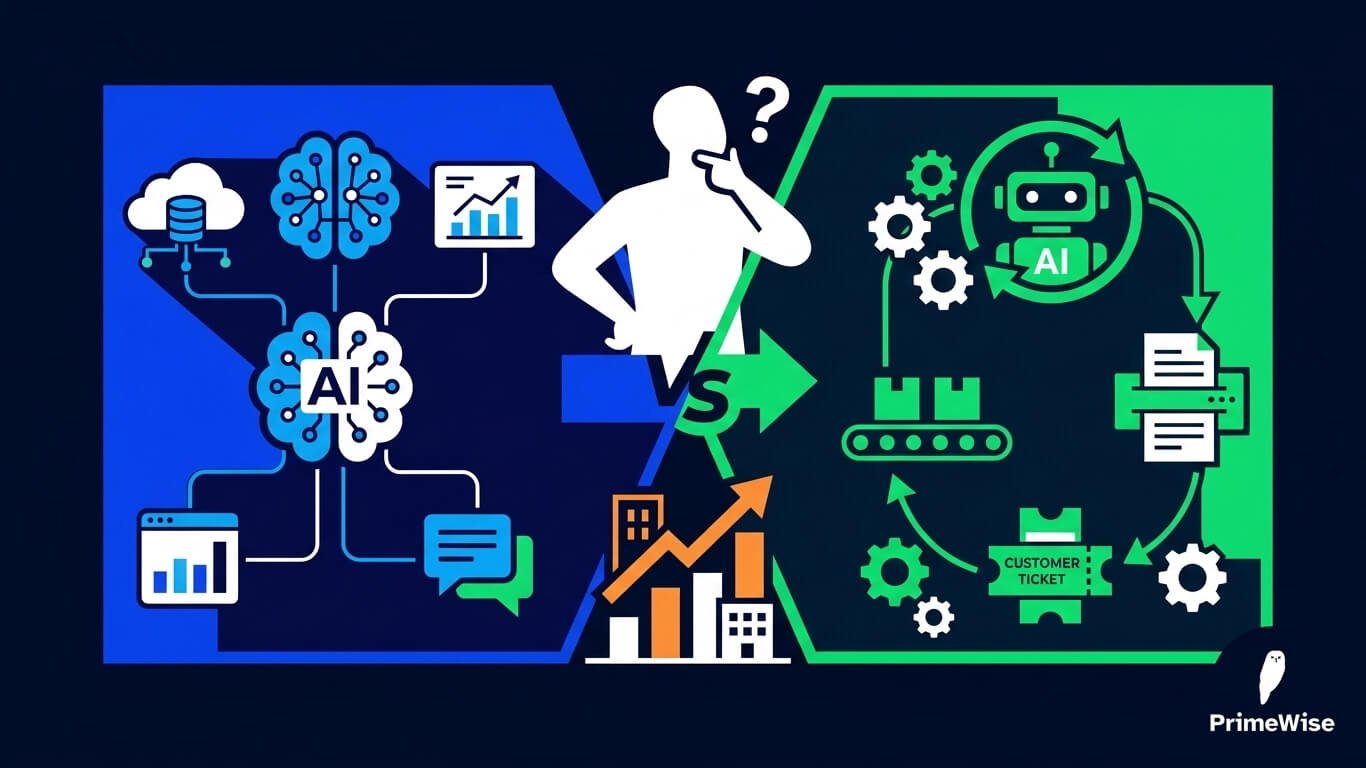
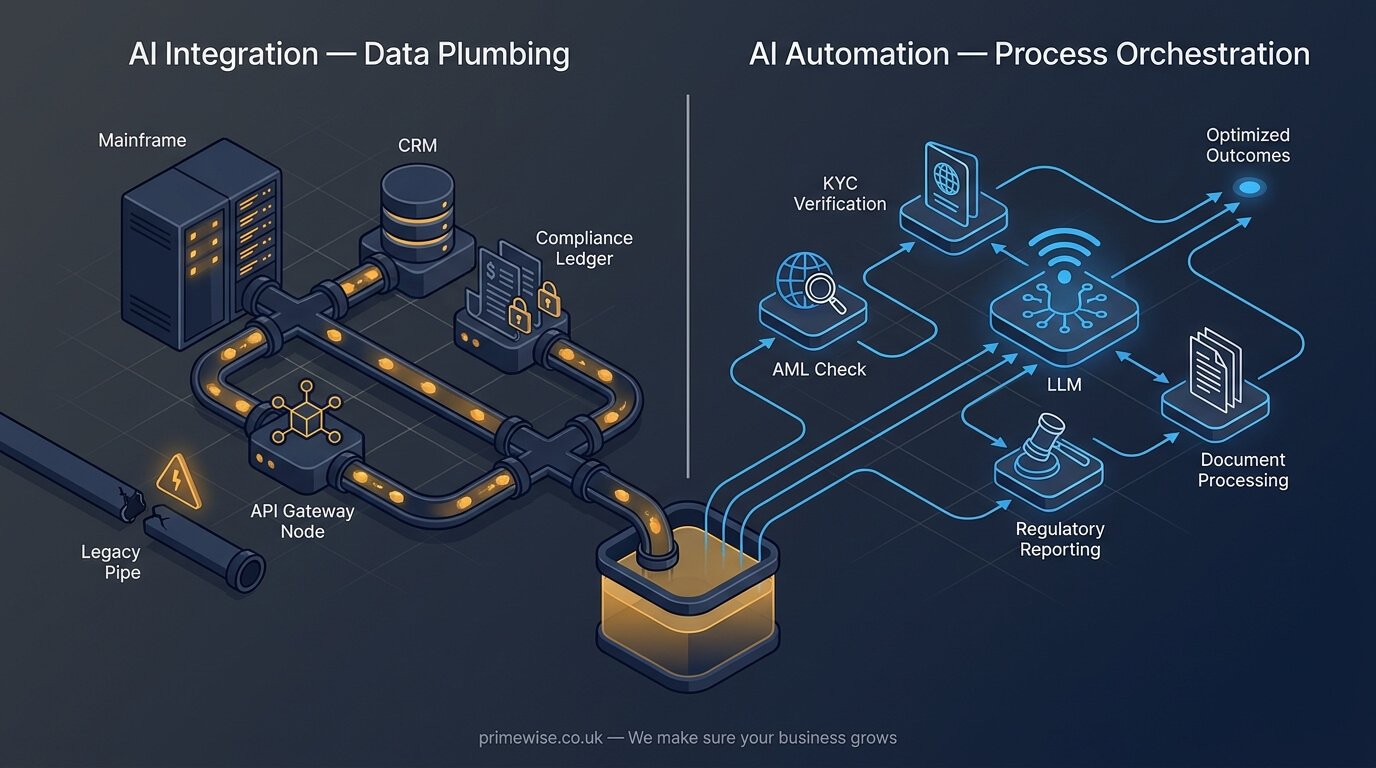
At the architectural level, AI integration is your enterprise data plumbing. It connects disparate legacy systems—core banking platforms, CRM suites, compliance databases, third-party data feeds—into a single, unified data layer through APIs, ETL pipelines, and event streaming protocols. AI automation, by contrast, is process orchestration. It deploys intelligent workflows, large language model agents, and advanced RPA over that unified data layer to eliminate manual processing, execute complex multi-step decisions, and generate measurable operational efficiency. One creates the infrastructure. The other exploits it. Attempting to orchestrate processes over broken infrastructure is the defining cause of failed AI pilots in the UK financial sector.
EXECUTIVE DEFINITIONAI Integration = Data Plumbing. It unifies fragmented systems into one reliable data layer. AI Automation = Process Orchestration. It executes intelligent workflows over that layer. Integration is the non-negotiable prerequisite. Without it, automation amplifies existing failures.
Integration as Enterprise Data Plumbing
AI integration is the foundational engineering discipline that makes artificial intelligence operationally viable. It directly confronts the data silo problem that plagues legacy financial institutions by deploying robust API interfaces, real-time event streaming, and batch ETL pipelines that ensure structured and unstructured data flows reliably across every system in the enterprise. Without this data unification layer, even the most sophisticated machine learning models are starved of context, producing the algorithmic hallucinations and biased outputs that erode leadership confidence in AI investment.
For UK financial firms specifically, integration engineering must address the unique complexity of bridging decades-old mainframe core systems with modern cloud-native platforms. The Bank of England’s open banking PSD2 successor frameworks and the ongoing CBDC pilot programmes create new mandatory data exchange requirements that only a mature integration architecture can service reliably. Integration is not a one-time project. It is a continuous operational discipline that determines the ceiling of every automation initiative your firm will ever attempt.
Why Legacy Mainframes Create Integration Debt
The City of London operates on mainframe infrastructure that, in many cases, pre-dates the commercial internet. Legacy UK banks and major insurance firms run core transactional systems on architectures designed in the 1970s and 1980s, systems that were never built to expose data through modern API standards. Layering AI orchestration directly over these architectures without secure middleware integration is a technically catastrophic decision. The correct approach requires establishing a strategic integration layer—a middleware bus or API gateway—that translates legacy data formats into modern consumable streams, creating a bridge between institutional history and intelligent automation capability.
Automation as Process Orchestration
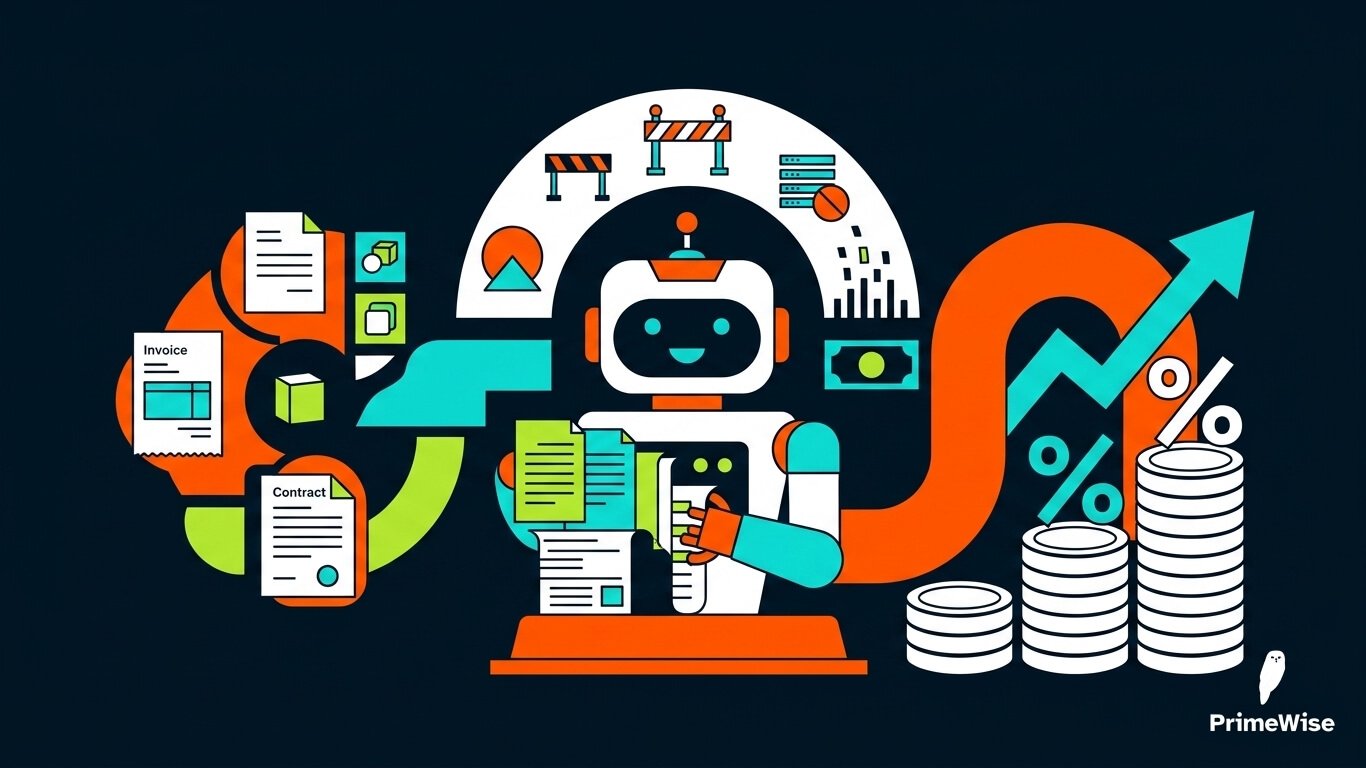
Once a verified, reliable data layer exists across the enterprise, AI automation becomes the execution engine that transforms operational efficiency. Modern automation in 2026 extends far beyond legacy robotic process automation. It encompasses LLM-driven autonomous agents capable of executing complex multi-step compliance workflows, intelligent document processing for straight-through processing in loan origination and claims handling, and adaptive decisioning systems that act on real-time unified data to reduce manual intervention at scale.
The ROI case for automation deployed over solid integration foundations is compelling and well-documented. Accenture’s research indicates that straight-through processing automation in UK banking reduces per-transaction processing costs by 60 to 80 percent when deployed over verified integration layers. Deloitte’s 2024 Financial Services Technology Report identifies automated KYC and AML decisioning as delivering average efficiency gains of 65 percent in institutions where data integration maturity is classified as advanced. These figures collapse dramatically when the underlying data pipelines are fragmented or unreliable.
Where Automation Generates Maximum Return
Automation delivers its highest measurable ROI in four specific operational scenarios within UK financial services. First, multi-step KYC and AML compliance checks, where intelligent agents cross-reference unified customer profiles against sanctions databases, transaction histories, and risk scores simultaneously. Second, intelligent document processing for mortgage applications, trade confirmations, and claims assessments, eliminating manual data extraction and re-keying. Third, automated regulatory reporting workflows that compile, validate, and submit structured data to the FCA, PRA, and HMRC with minimal human oversight. Fourth, real-time fraud detection decisioning that acts on unified transactional data streams to flag anomalies in milliseconds rather than minutes.
The Symbiosis Principle
The most consequential insight in enterprise AI architecture is deceptively simple: integration and automation are not an either-or choice. They are sequential phases of operational transformation. Treating them as interchangeable concepts—or worse, deploying them simultaneously without sequencing—is the root cause of the majority of failed AI investments in the UK financial sector. True operational resilience is achieved only when leaders understand that robust data infrastructure must unconditionally precede algorithmic execution.
CRITICAL WARNINGApplying intelligent automation workflows to fragmented data architectures does not fix broken processes. It accelerates and amplifies them. Every pound invested in automation over unverified integration is a pound invested in compounding your existing technical debt.
The Plumbing-to-Orchestration Continuum
The Plumbing-to-Orchestration Continuum (POC) is the architectural framework that PrimeWise uses to sequence technology roadmaps for UK financial institutions. The core principle is that AI automation effectiveness is directly proportional to integration maturity. An organisation at an early integration maturity stage—characterised by significant data silos, manual data movement between systems, and inconsistent API standards—will achieve near-zero reliable automation ROI regardless of the sophistication of the automation software deployed. Conversely, an organisation that has invested in a mature, audited integration layer will find that automation delivers compounding returns with each additional workflow deployed over the same verified data foundation.
Based on PrimeWise’s integration audits of UK-regulated financial institutions, firms that completed a formal data integration audit before initiating automation deployment reduced their AI project failure rate by 58 percent compared to the industry baseline. This proprietary finding is consistent with the broader McKinsey data on enterprise AI failure rates and provides a precise, actionable benchmark for C-suite decision-making. The POC framework maps an organisation’s current integration state to a recommended next action, removing the guesswork from technology sequencing decisions.
A Strategic Decision Matrix for UK Financial Services
Determining precisely where your organisation sits on the integration-to-automation spectrum requires scenario-based operational analysis. The following matrix maps common enterprise states to recommended strategic priorities, drawing on the specific regulatory and infrastructure realities of UK-regulated financial institutions.
| Dimension | AI Integration Priority | AI Automation Priority |
|---|---|---|
| Primary Function | Unify fragmented data systems via APIs and ETL pipelines | Execute intelligent multi-step workflows over unified data |
| Prerequisite Condition | Siloed legacy systems, inconsistent data standards | Verified, reliable, single-source data layer |
| Typical UK Implementation Timeline | 6–18 months for full API modernisation | 3–9 months per workflow once integration is verified |
| Average UK Financial Sector Efficiency Gain | 30–40% reduction in operational friction (Accenture 2024) | 60–80% cost reduction in automated processes (Deloitte 2024) |
| FCA Compliance Dependency | Auditability trails, UK GDPR Article 22 data lineage | Explainability requirements under FCA DP5/22 and SS1/23 |
| Risk of Failure Without the Other | High—automation stalls or hallucinates | Catastrophic—amplifies data errors at machine speed |
A global wealth management firm operating across UK and European jurisdictions recently demonstrated the strategic value of sequencing correctly. After pausing a planned automation deployment, the firm instead rebuilt its underlying API integration architecture over a nine-month programme. The result was a 40 percent reduction in operational friction, a single verified source of truth for all client financial profiles, and an automation deployment phase that subsequently delivered ROI within the first quarter of go-live. The pause was not a setback. It was the investment that made every subsequent technology decision profitable.
Navigating UK Regulatory Requirements
UK financial institutions face a regulatory environment that makes the integration-first principle not merely advisable but legally necessary. The FCA’s Discussion Paper DP5/22 on Artificial Intelligence and Machine Learning explicitly requires that automated decisioning systems be explainable, auditable, and traceable to verified data sources. Meeting this standard is structurally impossible without a mature, documented integration layer that establishes complete data lineage from source system to algorithmic output.
The PRA’s Supervisory Statement SS1/23 on model risk management extends this requirement, demanding that financial institutions demonstrate robust governance over every model that influences customer outcomes or capital allocation. For LLM-driven credit decisioning and automated AML systems, this means that the data pipelines feeding those models must be fully documented, tested, and auditable. The Basel Committee on Banking Supervision’s Principle 6 on model risk establishes the same standard at an international level, reinforcing that data integration governance is a regulatory compliance obligation, not an optional technical enhancement.
UK GDPR and Data Sovereignty in AI Pipelines
Post-Brexit data protection law creates specific obligations for UK financial firms deploying AI systems that process personally identifiable information. ICO guidance on automated decision-making under UK GDPR Article 22 requires that firms demonstrate the legal basis for automated decisions, provide individuals with the right to meaningful human review, and maintain complete audit trails of algorithmic outputs. When customer data moves through third-party LLM cloud environments—as it increasingly does in modern automation architectures—the integration layer must enforce data sovereignty controls, ensuring PII is appropriately anonymised, tokenised, or access-controlled before reaching external processing environments. Firms operating across EU jurisdictions must additionally navigate DORA compliance timelines, which impose specific ICT risk management and third-party oversight requirements that directly govern AI integration architecture decisions.
Auditing Your Enterprise Readiness
Before evaluating vendor solutions or finalising a technology roadmap, decision-makers must conduct a rigorous infrastructure audit to establish their precise starting point on the Plumbing-to-Orchestration Continuum. The following parameters constitute a practical architecture maturity checklist for UK financial institutions.
- Assess the current state of all API endpoints to verify secure, documented, and reliable connectivity between core banking, CRM, compliance, and reporting systems.
- Identify every operational silo where customer financial data remains manually isolated, duplicated, or inaccessible to adjacent platforms without human intervention.
- Evaluate the frequency, severity, and downstream impact of data synchronisation errors across legacy software applications and third-party data feeds.
- Audit the completeness of documentation and auditability trails for all automated or semi-automated decisions currently impacting customer outcomes or regulatory obligations.
- Determine whether your organisation can execute straight-through processing on any core workflow without manual overrides, and identify the precise integration gaps preventing it.
- Review your current data governance framework against ICO guidance on UK GDPR Article 22 to confirm automated decisioning compliance before expanding automation scope.
INTEGRATION READINESS INSIGHTFirms that identify gaps across three or more of these parameters should treat integration as an immediate operational priority, not a future-state aspiration. Sequencing automation before integration in this scenario guarantees compounding failure, not accelerating returns.
For UK financial institutions that identify gaps across three or more of these parameters, the strategic sequencing of integration before automation is not a preference—it is an operational imperative. PrimeWise specialises in guiding regulated financial firms through precisely this sequencing challenge, from legacy API modernisation and data governance frameworks through to intelligent workflow deployment and FCA-compliant automation architecture. Firms that engage a specialist integration partner at the audit stage consistently achieve deployment timelines 40 percent faster than those who attempt to self-diagnose and self-sequence their AI roadmap. The investment in getting the sequence right is the investment that makes every subsequent technology decision deliver returns rather than write-offs.