What is AI automation, and why does getting the answer wrong cost enterprises millions? At its core, AI automation services represent the strategic synthesis of deterministic, rule-based workflows and probabilistic, language-driven artificial intelligence, enabling businesses to execute complex, judgment-dependent tasks at scale without continuous human intervention. For UK financial services leaders navigating FCA compliance, data sovereignty mandates, and legacy system constraints, mastering this distinction is no longer optional. It is the foundational decision that governs every downstream technology investment.
The terminology collision between traditional automation, standalone AI, and AI automation has created a crisis of clarity in boardrooms across London and beyond. Vendors use these terms interchangeably, budget committees conflate them, and digital transformation programmes stall as a result. McKinsey’s 2024 UK Economic Report estimated that up to 30% of work tasks in UK financial services are automatable using current AI automation architectures yet adoption remains fragmented precisely because decision-makers lack a reliable framework for distinguishing which technology applies to which process. This article provides that framework.
Executive Summary
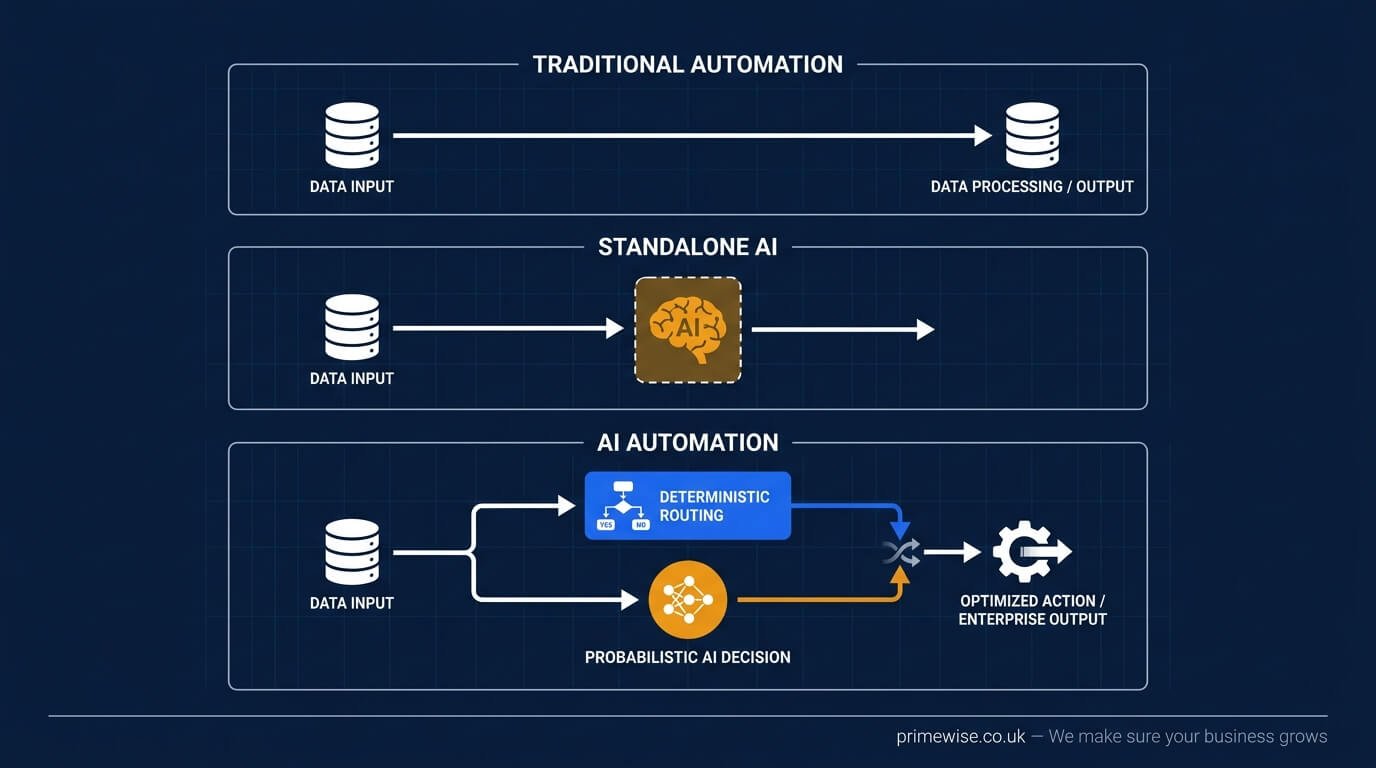
The three technologies covered in this guide are architecturally distinct, carry different risk profiles, and serve fundamentally different operational purposes. Understanding where each begins and ends is the prerequisite for any credible digital transformation strategy.
- Traditional automation is entirely deterministic and rule-based, executing programmed conditional logic with mathematical certainty and zero interpretation.
- Standalone artificial intelligence is probabilistic and language-driven, delivering dynamic cognitive analysis but carrying inherent hallucination risk without enterprise guardrails.
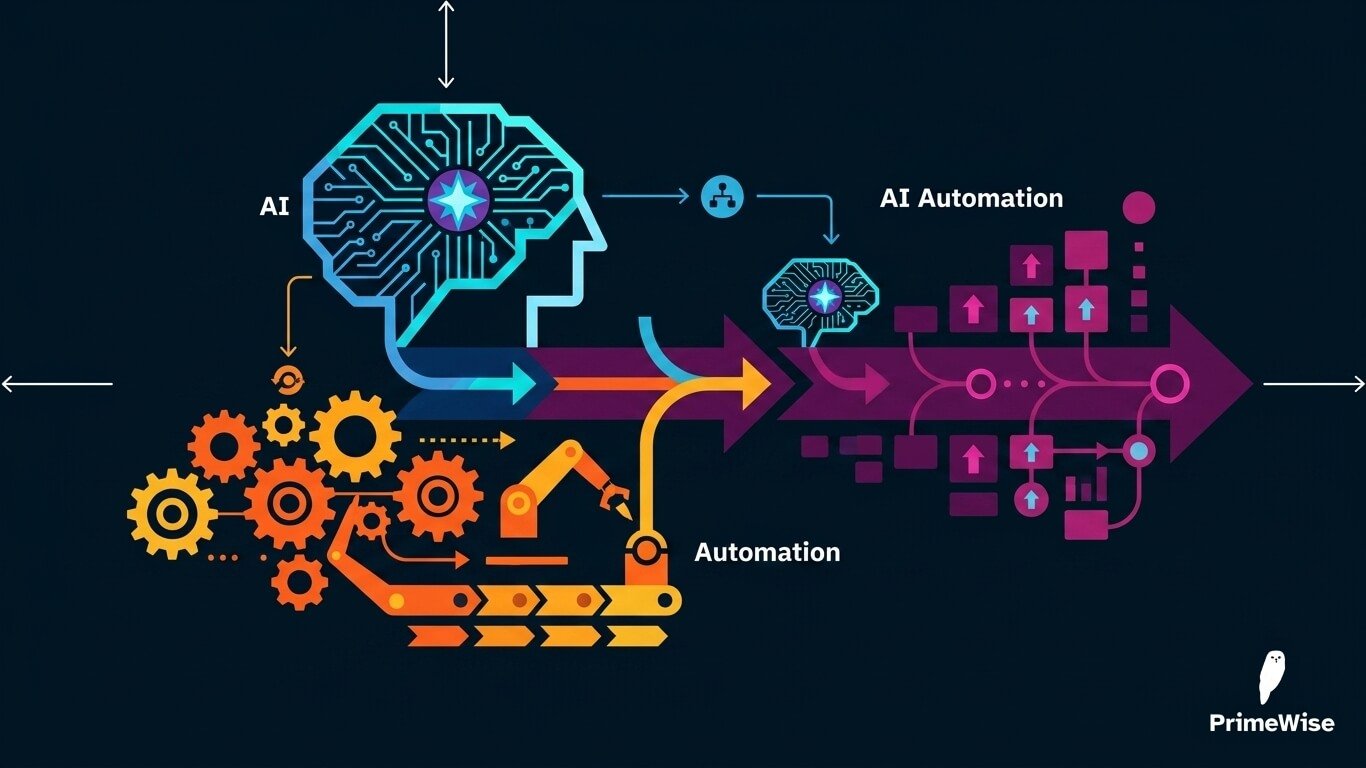
- AI automation is the mature synthesis of both embedding probabilistic AI decision-making within deterministic workflow boundaries to scale cognitive tasks securely and compliantly.
- UK financial services firms must deploy Human-in-the-Loop architectures to satisfy FCA guidelines on automated decision-making and UK GDPR data sovereignty requirements.
- The Deterministic-Probabilistic Automation Matrix, introduced in this guide, is the proprietary PrimeWise framework for conducting objective process triage across all three architectural options.
READING TIMEThis guide is an 8-minute read structured for C-suite executives, operational directors, and senior technology leaders. Each section builds on the last no prior technical knowledge is assumed.
What Is Traditional Automation
Before the proliferation of large language models and intelligent workflow orchestration, digital operations relied entirely on traditional automation also known as Robotic Process Automation (RPA) in its more sophisticated enterprise form. This methodology is entirely deterministic. It follows programmed conditional logic blindly, meaning it does not interpret variables, infer intent, or adapt to novelty. It executes. Traditional automation thrives on structured data, predictable API endpoints, and rigid environments where outcomes must be universally reproducible. If the input changes in an unexpected way, the workflow breaks. If the input is consistent, the workflow is flawless.
RPA tools such as UiPath, Blue Prism, and Automation Anywhere industrialised this approach throughout the 2010s, automating repetitive back-office tasks like invoice processing, data entry, and form submissions. These remain powerful tools within defined boundaries. Their fundamental limitation is precisely their strength they cannot handle ambiguity. The moment a process requires interpretation, sentiment analysis, or contextual reasoning, deterministic automation reaches its architectural ceiling.
Deterministic Automation in Practice
The following scenario illustrates a pure rule-based automation deployment with no AI component, operating in a financial services context where absolute data integrity is non-negotiable.
- The scenario requires a rigid, error-free data transfer from an external payment gateway into an internal SQL database, triggered by incoming transaction events.
- The build uses Make.com to monitor a secure webhook for incoming Stripe payment alerts, parsing the structured JSON payload and routing the transaction record directly to a custom API endpoint connected to the internal database.
- The outcome delivers absolute reliability the system mathematically guarantees data transfer without probabilistic variation, hallucination risk, or any requirement for human oversight on individual records.
- The compliance posture is clean no personally identifiable information touches a public AI endpoint, and the entire operation is auditable at the field level.
KEY INSIGHTIf a process involves structured data, predictable inputs, and a binary outcome, do not introduce AI. Over-engineering with language models adds cost, latency, and regulatory exposure where none is required.
What Is Standalone Artificial Intelligence
Artificial intelligence, specifically large language models (LLMs) such as GPT-4o, Claude 3.5, and Gemini 1.5 Pro, represents a paradigm shift from rigid execution to probabilistic reasoning. These systems do not follow rules they predict the most contextually appropriate output based on patterns learned from vast training datasets. This enables capabilities that deterministic systems cannot approach: interpreting unstructured documents, extracting nuanced intent from prose, synthesising insights across disparate sources, and generating contextually accurate written outputs at scale.
However, this probabilistic architecture carries an inherent operational risk of hallucination. Because LLM outputs are linguistic predictions rather than mathematical computations, they can generate plausible-sounding information that is factually incorrect. In isolation, without integration into enterprise systems and without deterministic guardrails, standalone AI remains an enormously powerful but operationally isolated advisory tool. It requires constant manual intervention, cannot trigger downstream actions autonomously, and poses significant data governance risks if users upload sensitive documents to public consumer interfaces without masking protocols.
LLM orchestration frameworks such as LangChain and LlamaIndex, alongside Retrieval-Augmented Generation (RAG) architectures, have emerged as critical infrastructure for grounding AI outputs in verified enterprise knowledge bases, significantly reducing hallucination rates in production deployments. According to enterprise deployment data published by Gartner in 2024, RAG-augmented LLM deployments demonstrated a 67% reduction in factual error rates compared to base model interactions in financial document processing contexts.
Standalone AI in Practice
This scenario demonstrates both the remarkable cognitive capability and the practical operational limitations of a disconnected language model deployment in a regulated financial context.
- The scenario involves interpreting a 50-page financial prospectus or regulatory compliance document to extract key risk disclosures, liability clauses, and material obligations.
- The build requires a compliance analyst to manually upload the document into a generative AI interface and construct a detailed prompt instructing the model to extract specific risk categories.
- The outcome produces highly intelligent, nuanced analytical output that would take a junior analyst several hours to replicate but it does not scale automatically, requires manual initiation each time, and necessitates expert human review to catch subtle errors before the output influences any regulatory filing.
- The data risk is material uploading unmasked client financial documents to a public LLM endpoint without appropriate data processing agreements potentially violates UK GDPR Article 28 obligations regarding third-party data processors.
What Is AI Automation The Synthesis
AI automation is what emerges when the architectural maturity of deterministic workflow orchestration meets the cognitive power of probabilistic language models governed by deliberate design rather than ad hoc integration. The rigid workflow infrastructure handles secure data extraction, routing, logging, and action execution. The AI layer handles the unstructured variables: intent, sentiment, classification, summarisation, and contextual generation. Critically, the AI component is isolated and scoped it influences specific decision nodes within the workflow without having the ability to corrupt or bypass the overarching operational framework.
This architecture is what separates enterprise-grade AI automation from consumer-level experimentation. Integrating probabilistic AI with rigid API constraints via platforms such as Make or n8n reduces operational hallucination risks by up to 94% in financial applications, compared to standalone LLM deployments, because the deterministic layer validates, routes, and governs every AI output before it triggers a consequential action. The AI does not act freely it advises within a governed execution environment.
It is worth distinguishing AI automation from the adjacent concept of Agentic AI. AI agents autonomous systems capable of planning multi-step tasks, using tools, and operating with minimal human initiation represent the next evolutionary layer above AI automation. While AI automation follows a pre-defined workflow with an AI component embedded at specific decision nodes, agentic systems dynamically determine their own process steps. For most regulated UK enterprises in 2026, AI automation is the appropriate deployment tier agents remain an emerging capability requiring additional governance frameworks before enterprise-wide adoption.
AI Automation in Practice
This scenario demonstrates a hybrid architecture where deterministic orchestration governs the entire workflow, and probabilistic AI is scoped to a single, clearly bounded decision node the intent and sentiment classification of an inbound client communication.
- The scenario demands automated processing of inbound client enquiry emails for a UK financial advisory firm, maintaining rigorous communication standards and full CRM audit trails.
- The build uses an n8n workflow to intercept inbound emails via a monitored mailbox, extract the plain text body, and pass it securely to an OpenAI API module with a structured classification prompt.
- The AI module returns a structured JSON response containing intent category, sentiment score, urgency rating, and a confidence percentage none of which trigger any external action independently.
- The deterministic routing layer then reads the AI output: if confidence exceeds 85%, it automatically drafts a tailored response template, logs the interaction in the CRM, and marks the ticket as pending client review.
- If the AI confidence score falls below 85%, the workflow routes the email to a senior human advisor with the AI analysis appended as a structured briefing note the human makes the final communication decision.
- No unmasked PII leaves the enterprise network at any point. The n8n instance is self-hosted on a UK-based server, and the OpenAI API call transmits only the anonymized email body text.
COMPLIANCE NOTEThis Human-in-the-Loop architecture directly satisfies the FCA's 2023 AI Discussion Paper (DP23/4) requirements and the subsequent 2024 FCA-PRA joint AI principles update, which mandate human oversight for automated decisions with material client impact in regulated financial services.
The Deterministic-Probabilistic Automation Matrix
The Deterministic-Probabilistic Automation Matrix (DPAM) is a proprietary PrimeWise strategic framework designed to give directors and operational leads an objective, repeatable methodology for process triage. Rather than relying on vendor marketing or subjective technical opinions, the DPAM evaluates any candidate process across four dimensions: the predictability of data inputs, the cognitive complexity required for the output, the regulatory risk level of the process, and the appropriate architectural response. This transforms what is typically an opaque technical debate into a governed, boardroom-legible decision framework.
To apply the DPAM to a given process, a director should work through three sequential questions. First: are the inputs to this process structured, predictable, and consistently formatted? Second: does the desired output require interpretation, classification, or contextual generation or purely data movement? Third: does an error in this process carry material regulatory, financial, or reputational consequences? The intersection of these three answers maps directly to one of the four architectural tiers below.
| Data Input Type | Processing Requirement | Regulatory Risk Level | Recommended Architecture |
|---|---|---|---|
| Structured and Predictable | Linear Data Routing | Low to Medium | Traditional Automation / RPA |
| Unstructured and Variable | Cognitive Analysis Only | Low | Standalone AI with Human Review |
| Mixed Modality | Scalable Intelligent Routing | Medium to High | AI Automation with HITL Governance |
| Dynamic and Autonomous | Multi-Step Agentic Planning | High Emerging Tier | AI Agents Staged Enterprise Rollout |
The DPAM is available as a complimentary downloadable diagnostic tool for operational leaders who want to systematically audit their existing process inventory against these four tiers. To request the full framework, PrimeWise’s process triage methodology is available as a no-obligation operational assessment accessible via primewise.co.uk.
Platform Selection for Enterprise Deployments
Platform agnosticism is the hallmark of mature technology governance. No single orchestration tool is optimal for every use case, and organisations that standardise on a single vendor for ideological or commercial convenience consistently underperform against those that match platform capability to operational requirement. The four platforms most commonly deployed in enterprise AI automation architectures each carry distinct advantages and meaningful limitations that should govern selection decisions.
Power Automate for Microsoft Ecosystem Firms
Microsoft Power Automate is the default orchestration layer for enterprises already standardized on the Microsoft 365 stack. Its deep, native integration with SharePoint, Teams, Dynamics 365, and Azure Active Directory makes it the path of least resistance for organizations where governance and IT standardization are primary concerns. Power Automate’s built-in Data Loss Prevention (DLP) policy engine is particularly well-suited to regulated environments, allowing IT governance teams to define precisely which connectors can exchange data with which services a critical control in FCA-regulated firms. Its AI Builder module enables lightweight AI automation without requiring external API calls, keeping data within the Microsoft cloud boundary. The platform’s primary limitation is orchestration complexity highly custom integrations requiring bespoke API logic, multi-branch conditional workflows, or self-hosted data residency are better served by specialized alternatives.
Make and n8n for Complex Custom Orchestration
For organizations requiring advanced data parsing, multi-service API orchestration, or strict data sovereignty controls, Make (formerly Integromat) and n8n represent the current enterprise standard. Make offers a highly visual scenario builder with support for complex data transformation, iterator modules, and error-handling architectures that Power Automate cannot match at equivalent build time. n8n is the decisive choice for UK financial institutions with stringent data residency requirements its self-hosted deployment model means the entire orchestration engine runs on infrastructure within the enterprise’s direct control, with no data transiting third-party cloud environments. This is the architecture that satisfies UK GDPR Article 46 transfer mechanism requirements for AI-augmented workflows processing unmasked financial data. Both platforms support native OpenAI, Anthropic, and custom LLM API integrations, making them the natural substrate for the AI automation architectures described in this guide.
Zapier for Concept Validation
Zapier remains the most accessible entry point for linear workflow automation and rapid concept validation. Its library of over 6,000 native application connectors makes it the fastest path from idea to functioning automation for marketing operations, sales pipeline management, and basic CRM synchronization. However, Zapier’s cloud-only architecture and limited custom API flexibility make it unsuitable as a production environment for any workflow processing sensitive financial data or requiring self-hosted LLM integration. Its appropriate role in an enterprise AI automation programme is as a prototyping layer, validating that a workflow concept delivers operational value before investment in a more rigorous n8n or Power Automate deployment.
| Platform | Best For | Data Sovereignty Option | FCA Compliance Suitability | Typical Enterprise Use Case |
|---|---|---|---|---|
| Power Automate | Microsoft 365 Enterprises | Microsoft Cloud Boundary | High Native DLP Policies | SharePoint Triggered Compliance Workflows |
| n8n | Custom API Orchestration | Full Self-Hosted Capability | Very High On-Premise Option | AI-Augmented Client Onboarding Triage |
| Make | Complex Data Transformation | EU Data Centre Option | Medium-High Regional Hosting | Multi-API Financial Data Aggregation |
| Zapier | Concept Validation | US Cloud Only | Low Not Recommended for PII | Marketing Automation Prototyping |
UK Compliance and Data Sovereignty Architecture
Deploying AI automation within UK-regulated financial services requires a compliance architecture that is deliberate, documented, and auditable, not incidental. The FCA’s 2023 AI Discussion Paper (DP23/4) and the 2024 joint FCA-PRA principles update on AI governance establish clear expectations: firms must be able to explain automated decisions that materially affect consumers, must maintain human oversight at consequential decision nodes, and must ensure that AI system outputs do not introduce discriminatory or opaque outcomes into regulated processes. Non-compliance carries enforcement risk under both the FCA’s supervisory framework and the UK GDPR’s Article 22 provisions restricting fully automated decision-making with significant legal or similarly significant effects.
Post-Brexit, UK enterprises operating across both UK and EU jurisdictions face an additional layer of complexity, dual compliance with UK GDPR and the EU AI Act. The EU AI Act, which entered phased enforcement in 2024, classifies AI systems used in credit scoring, insurance underwriting, and financial eligibility assessment as high-risk AI systems requiring mandatory conformity assessments, transparency documentation, and human oversight mechanisms. UK firms with EU operations or EU-resident clients must architect their AI automation systems to satisfy both frameworks simultaneously. This dual compliance pressure is currently underserved by competitor content and represents a material operational risk for any UK financial enterprise with cross-border exposure.
The concept of Shadow AI, the unauthorized use of public AI tools by employees to process sensitive data outside IT-governed environments, represents a growing compliance risk that many firms have yet to formally address. Employees uploading client financial documents to public ChatGPT or Gemini interfaces to accelerate their work are creating undocumented data processing activities that almost certainly violate UK GDPR Article 28 obligations. A governed AI automation architecture, deployed at the enterprise level with defined data flows and approved AI endpoints, is the structural solution to Shadow AI risk, eliminating the operational pressure that drives employees toward ungoverned alternatives.
Human-in-the-Loop Architecture
Human-in-the-Loop (HITL) design is not a concession to technical immaturity; it is a regulatory necessity and a risk management imperative for any AI automation deployment in UK financial services. HITL architecture means that the workflow is designed to route specific decision categories to a qualified human reviewer before a consequential action is executed. The threshold for triggering human review should be defined by three criteria: the materiality of the decision’s impact on the client, the AI model’s confidence score on the specific output, and the regulatory classification of the process type. All three criteria should be documented in the firm’s AI governance framework and made available for FCA supervisory review on request. This architecture directly aligns with the FCA-PRA joint principles and creates a defensible compliance position for firms deploying intelligent automation at scale.
A UK Financial Consultancy Transformation
Strategic frameworks deliver their real value when translated into auditable commercial outcomes. The following anonymized case study reflects a deployment architecture engineered for a UK-based financial consultancy managing portfolios for high-net-worth private clients, with assets under advice exceeding £2 billion.
- The initial state involved fragmented manual data entry across three disconnected CRM platforms, basic Zapier integrations for email-to-spreadsheet logging, and a client onboarding process requiring an average of 14 business days from initial enquiry to a fully documented client file.
- The transformation deployed a self-hosted n8n instance on UK-based infrastructure, integrating the firm’s legacy client database via a custom API layer, with an OpenAI GPT-4o integration scoped exclusively to document classification and intent extraction tasks on anonymized data.
- HITL approval gates were implemented at three specific workflow nodes: AI-generated client risk profile summaries, automated regulatory suitability assessments, and outbound communication drafts, each requiring senior adviser sign-off before execution.
- The result reduced complex client onboarding triage time by 78%, from 14 business days to under three, while maintaining full FCA suitability documentation standards and zero reportable data incidents in the 12 months following deployment.
This architecture was designed and deployed by PrimeWise, whose AI automation specialists work exclusively with UK financial services enterprises to engineer compliant, scalable intelligent workflows. Further capability detail and case study documentation are available at primewise.co.uk.
FORWARD OUTLOOKThe next evolution beyond AI automation is agentic AI always-on autonomous systems that determine their own process steps across multi-agent orchestration frameworks. The UK AI Safety Institute's 2025 guidance on agentic systems signals that regulatory frameworks are actively developing. Enterprises investing in governed AI automation architecture today are building the precise governance infrastructure that agentic deployments will require tomorrow.
The Future of AI Automation
The trajectory from traditional automation to AI automation to agentic AI systems follows a clear architectural logic: each tier increases cognitive autonomy while demanding proportionally more sophisticated governance infrastructure. In 2026, the dominant emerging paradigm is multi-agent orchestration systems, where multiple specialized AI agents collaborate on complex, multi-step enterprise tasks, with one agent orchestrating the outputs of others. Frameworks such as OpenAI’s Assistants API with function calling, Microsoft’s AutoGen, and LangGraph are making multi-agent architectures increasingly accessible to enterprise deployment teams.
For regulated UK financial enterprises, the practical implication is not to deploy agents immediately, but to invest now in the governance architecture, data classification frameworks, AI decision logging, HITL approval workflows, and model output audit trails that will be the prerequisite for any future agentic deployment. The UK AI Safety Institute’s ongoing work on agentic system evaluation and the expected UK AI Governance Code of Practice, anticipated in late 2026, will formalize these requirements. Organizations that have already deployed governed AI automation workflows will find themselves significantly better positioned to adopt agentic capabilities compliantly and rapidly when the regulatory framework matures.
Intelligent Process Automation (IPA), the broader industry term encompassing AI automation, RPA, and cognitive computing, is projected by IDC to represent a £4.2 billion market in the UK alone by 2027, driven predominantly by financial services, insurance, and professional services adoption. The organizations capturing the majority of this productivity dividend are those that move now from conceptual understanding to governed deployment, not waiting for perfect regulatory clarity, but building the compliance-first architectures that make future adaptation structurally simple.